As someone who runs a digital marketing agency in Melbourne, I've spent years in the trenches with small business owners, particularly in the e-commerce space. I've seen firsthand what works and what's just noise. Let me be straight with you: SEO isn't some mystical secret. It's the most reliable, long-term strategy for getting your products in front of people who are actively searching for them.
Forget paid ads for a moment. They're great for a quick boost, but the traffic stops the second you turn off the tap. A smart SEO strategy is different. It's about building a real, tangible asset for your business—an asset that generates sales 24/7, long after the initial work is done. It gives you stability and, ultimately, the freedom to grow on your own terms.
Table of Contents
- Why SEO is Your Most Powerful Growth Engine for E-Commerce
- Mastering the Foundations: Local SEO for Australian Retailers
- On-Page SEO for Shopify & WordPress: The Technical Nitty-Gritty
- Content Strategy: Attracting High-Intent Buyers
- Building Real Authority: Smart Link Building Strategies
- Tracking What Matters: SEO Analytics for E-Commerce Growth
- Beyond SEO: A Holistic Digital Marketing Approach
- Wrapping It All Up: Your Path Forward
Why SEO Is Your Most Powerful Growth Engine
I get it. As an e-commerce owner, you're juggling inventory, customer service, and a dozen other things. You hear 'SEO' and probably imagine a complex, costly battle against giants like The Iconic or JB Hi-Fi that you can't possibly win.
Let me tell you from real-world experience: that's the wrong way to look at it.
Working as a marketing agency in Melbourne, I've seen countless Shopify and WordPress stores transform their businesses by focusing on a smart, targeted organic search strategy. It consistently becomes their number one source of profitable growth.
The concept is simple. SEO is about building your own digital real estate, not just renting ad space. Every well-optimized product page, every helpful blog post, and every link you earn is another brick in your foundation. It strengthens your brand's presence for the long haul.
Building a Sustainable Future, Not Just a Temporary Spike
Paid channels like Google Ads and Facebook Ads are fantastic for a quick hit of traffic, especially for testing a new product. But they create a dependency. The moment your budget runs out, the traffic vanishes. SEO is the complete opposite.
- Long-Term Value: The work you put in today keeps paying you back for months, even years. A blog post ranking for a high-intent keyword can bring in qualified buyers 24/7 without you spending another cent on it.
- Increased Trust and Credibility: People instinctively trust organic search results more than paid ads. When you rank high on Google, it positions your brand as an authority, building confidence before a visitor even clicks through to your store. This is crucial for e-commerce conversions.
- Cost-Effective Customer Acquisition: Yes, SEO requires an upfront investment of time or money. But over the long run, the cost to acquire a customer through organic search is often drastically lower than with paid channels. You're not paying for every single click.
The Growing Importance of Organic Search in Australia
This isn't just my opinion; it's a measurable shift in how Australian businesses are investing. It's projected that SEO spending in Australia will hit around AUD 1.5 billion in 2025—a massive jump.
And with small businesses making up 97% of all Australian enterprises, it's clear that local entrepreneurs are putting their money into SEO to capture local demand and build more resilient businesses.
Once you grasp the immense power of SEO, the logical next step is exploring options for finding the right SEO company for small businesses that understands e-commerce. This isn't just about outsourcing; it's about finding a partner like a skilled /wordpress-developer-melbourne who can turn your vision into measurable growth. A top-tier /wordpress-development-company can make all the difference.
Your Foundation for Success: Mastering Local SEO and Google Business Profile
Before we dive into complex keyword strategies for your product pages, let's lock down the fundamentals that can bring in customers almost immediately, especially if you have a physical storefront or a local warehouse.
For any Australian e-commerce business with a brick-and-mortar presence—whether you're in Melbourne, Sydney, or a regional town—local SEO is your secret weapon. It’s absolutely non-negotiable.
This is about capturing people actively searching for products like yours, right in your neighbourhood. When someone searches "handmade leather goods near me" or "boutique clothing Richmond," you need to be the first name they see. That’s the power of local SEO, and its foundation is your Google Business Profile.
Your Digital Storefront: Google Business Profile
Your Google Business Profile (GBP) is often the very first interaction a potential customer has with your brand online. It's far more than a simple listing; it's a dynamic profile that can drive phone calls, website visits, and foot traffic directly from Google Search and Maps.
Getting this right is one of the highest-impact things you can do for your business, and it costs nothing but your time. The goal is simple: fill out every single field with as much accurate, compelling information as you can.
Here’s what I tell my clients to focus on first:
- Business Name, Address, Phone (NAP): This information must be 100% consistent everywhere it appears online. A tiny variation like "St" instead of "Street" can confuse search engines and hurt your rankings.
- Categories: Choose the most specific primary category for your core business (e.g., "Women's Clothing Store"). Then, add relevant secondary ones ("Shoe Store," "Jewellery Store").
- Service Area: If you offer local delivery, define your service area precisely. This helps you appear in searches within those specific suburbs.
- Hours of Operation: Keep these updated religiously, especially for public holidays. Nothing frustrates a potential customer more than showing up to a closed shop.
- Photos and Videos: Upload high-quality, real photos of your storefront, your team, and your products. Businesses with photos receive 42% more requests for driving directions on Google Maps. It's a huge trust signal.
This process shows how a simple investment in SEO creates a cycle of growth, turning that initial effort into tangible leads and revenue.
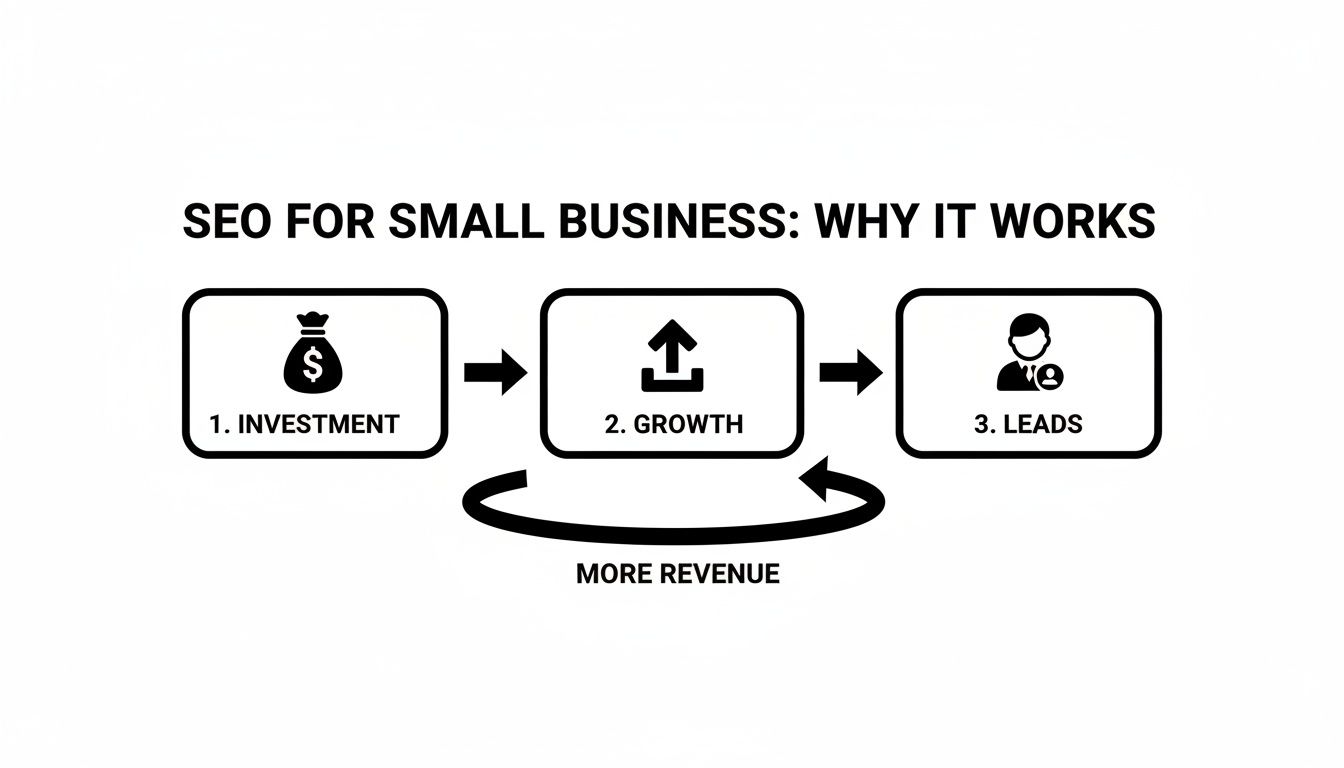
The key takeaway is that SEO isn't a one-off cost. It's a continuous engine for business development.
The Power of Local Search Intent
The way people find local businesses has fundamentally changed. Everyone is on their mobile, expecting instant, location-aware results.
The data backs this up completely. Recent reports show that 46% of all Google searches carry local intent, and a staggering 76% of those local mobile searches lead to an in-person visit within 24 hours.
Despite this massive demand, over half of local Australian businesses haven't even claimed their GBP, leaving a huge opportunity on the table for savvy e-commerce owners like you who also have a physical presence.
I treat my clients' Google Business Profiles like mini-social media platforms. It’s not a "set it and forget it" task. You have to be active to get the best results.
This means regularly using features like:
- Google Posts: Share updates, new product arrivals, special offers, or event announcements. These posts appear directly in your profile and show Google that your business is active and engaged.
- Q&A Section: Proactively ask and answer common questions yourself. "Do you offer click-and-collect?" "What are your return policies?" This lets you control the narrative and provide helpful information upfront.
- Reviews: Actively encourage your happy customers to leave reviews, and make sure you respond to every single one—good or bad. This engagement sends incredibly strong positive signals to Google.
Claiming your profile is just the first step. For a comprehensive walkthrough, check out this guide on how to get a Google Business listing. By mastering your GBP, you're not just doing "SEO"; you're building a powerful, free customer acquisition channel.
On-Page SEO for E-Commerce Platforms like Shopify and WordPress
Once your local SEO is dialled in, it’s time to focus on the digital real estate you actually own: your website. This is where you have full control over the signals you send to Google.
Whether you're running on Shopify or have a custom WooCommerce setup built by a /wordpress-website-developer, the core principles of on-page SEO are the same. The difference is in how you implement them. As a WordPress web developer by trade, I know that a good SEO plugin is non-negotiable. For a /shopify-developer, it's more about mastering the platform's built-in features for products and collections.
This part is all about making it crystal clear to search engines what each page is about and why it deserves to rank. Let's get into it.
Nail Your Title Tags and Meta Descriptions
Think of title tags and meta descriptions as your digital billboard in the search results. They’re often the first impression a potential customer has of your brand, and getting them right is crucial for earning that click.
-
Title Tags: This is the blue, clickable headline people see in Google. It should include your main keyword (ideally near the start) but also be compelling enough to make someone curious. It’s the title of a chapter in a book—it needs to be descriptive and relevant.
-
Meta Descriptions: This is the short snippet of text below the title. While it’s not a direct ranking factor, it has a massive impact on whether someone clicks your link or a competitor's. A great meta description works like ad copy, summarising the page's value and giving the searcher a reason to visit.
For example, an e-commerce product page title might be "Handmade Leather Wallets | Free Shipping Australia-Wide | Brand Name." The meta description could then be, "Discover our premium, handcrafted leather wallets. Made from full-grain leather and built to last. Shop now for free express shipping across Australia."
I always tell my clients to write for humans first, Google second. A well-written, engaging meta description that speaks to a user's problem will always outperform a keyword-stuffed one. Click-through rate is a powerful signal to Google that your page is relevant.
Use Header Tags to Structure Your Content
Header tags (H1, H2, H3, etc.) are essentially an outline for your page. They help both search engines and human readers understand the hierarchy of your content, making it way easier to scan and digest.
The H1 tag is your page's main headline, and you should only ever have one. It needs to contain your primary keyword and clearly state what the page is all about. For a Shopify collection page, this would typically be the collection name, like "Women's Summer Dresses."
Then you have H2 and H3 tags, which are used for subheadings to break up your content into logical sections. Sprinkling related keywords and long-tail variations into these is a fantastic way to improve your page's relevance for a wider range of searches without sounding like a robot.
To help you keep track, here's a quick checklist you can use for your product and collection pages.
Essential On-Page SEO Checklist for E-Commerce
This table breaks down the key elements to focus on when you're optimising your core pages.
| SEO Element | What to Do | Why It Matters |
|---|---|---|
| H1 Tag | Use one unique H1 per page. Include your primary keyword. | Tells search engines the single most important topic of the page. |
| Title Tag | Keep it under 60 characters. Place your keyword near the front. Make it clickable! | This is your main headline in search results. It directly impacts click-through rate. |
| Meta Description | Write compelling ad-like copy under 160 characters. Include a call-to-action. | Persuades users to click on your result over competitors. |
| URL Structure | Keep it short, descriptive, and include your primary keyword (e.g., /handmade-leather-wallets). |
A clean URL helps users and search engines understand the page's content at a glance. |
| Header Tags (H2, H3) | Use them to break up content into logical sections. Sprinkle in related keywords naturally. | Improves readability for users and provides contextual clues to search engines about sub-topics. |
| Image Alt Text | Write descriptive alt text for every image, including relevant keywords where appropriate. | Helps with accessibility and allows your images to rank in Google Images search. |
Following these steps for your main pages gives you a solid on-page foundation that many competitors overlook.
WordPress On-Page SEO: Let Plugins Do the Heavy Lifting
For anyone on WordPress/WooCommerce, a good SEO plugin like Yoast SEO or Rank Math is a game-changer. These tools demystify on-page optimisation, especially for business owners who aren't SEO experts. They give you a simple interface to edit title tags and meta descriptions, and they even provide real-time feedback. It’s like having an SEO specialist looking over your shoulder. Many skilled /wordpress-developers will set this up as a standard part of their /wordpress-development process.
Shopify On-Page SEO: Master the Basics
Shopify is an e-commerce powerhouse, but you need to know where to look to get the SEO right. The most important areas are your product and collection pages.
- Product Pages: Your product title automatically becomes your H1, so make it count. Go beyond the generic manufacturer's copy and write unique, descriptive product descriptions. Use this space to answer common questions and highlight benefits, weaving in your keywords naturally.
- Collection Pages: Treat these pages like important hubs. Many stores leave the collection description area blank, but it’s a massive SEO opportunity. Add a few paragraphs of keyword-rich content explaining what the collection is about and who it’s for.
- Image Alt Text: For every single product image, write descriptive alt text. This is crucial for accessibility and gives Google another clue about your page's content. Instead of "IMG_1234.jpg," your alt text should be something like "black-leather-bifold-wallet-for-men." This can also help you show up in Google Images search, driving extra traffic.
Whether you’re on WordPress or working with /shopify-development-partners, the goal is the same. By methodically optimising these on-page elements, you’re providing clear, structured information that helps both Google and your customers understand exactly what you offer.
Creating Content That Actually Attracts Customers
Let's be honest, the whole idea of "content marketing" can sound completely exhausting for an e-commerce owner. You're probably picturing a never-ending cycle of blog posts you simply don't have the time to write.
But I want you to reframe this: great content isn't about volume; it's about answering your customers' questions before they even think to ask them. This is how you build genuine trust and authority online, turning your website into a resource, not just a storefront.
Good content is the engine that drives your entire SEO strategy. It gives Google a reason to rank you and gives potential customers a reason to buy from you. It’s about creating helpful product guides, detailed buying guides, and comparison articles that solve real problems for your audience.
Finding Your Content Goldmine
Here's a secret I share with all my clients: the best content ideas won't come from a fancy keyword tool. They come directly from your customers. The questions you get asked every single day are an absolute goldmine for topics that have real buyer intent.
I always tell my clients to start right here:
- Your Sent Emails: Go look through the last 50 emails you've sent to prospects or customers. What questions are you repeatedly answering about your products? Every single one is a potential blog post.
- Product Reviews & Q&As: What questions pop up on your product pages? What are the common themes in your reviews (both good and bad)? Address these head-on.
- Customer Support Tickets: If you have a support system, what are the most frequent issues people run into? Creating a detailed guide can not only attract new customers but also seriously reduce your support load.
When you create content based on these real-world interactions, you naturally start targeting long-tail keywords. These are the longer, more specific search phrases your bigger competitors are probably ignoring. Someone searching for "best organic cotton baby swaddle for summer" is much closer to buying than someone just typing "baby clothes."
Focusing on Buyer Intent Keywords
As a small business, you can't afford to waste a single minute creating content that doesn't eventually lead to a sale. That’s why you have to be ruthless about focusing on keywords that signal someone is ready to make a decision.
These often fall into a few key categories for e-commerce:
- Comparison Keywords: "PMAX vs google shopping ads" or "Shopify vs BigCommerce for Australian stores"
- "Best Of" Keywords: "best running shoes for flat feet Australia" or "best local /wordpress-developer-sydney"
- Problem/Solution Keywords: "google shopping ads not spending budget" or "how to stop a dress from riding up"
- Review/Alternative Keywords: "[Product Name] review" or "[Competitor Brand] alternative"
These are the types of queries people use when they are actively looking for a solution. Ranking for these, even if the search volume seems low, will bring in far more qualified traffic than broad, generic terms.
Structuring Content for a Zero-Click World
The way people get information from Google is changing, and it's changing fast. With the rise of AI Overviews and featured snippets, users often get their answers without ever clicking through to a website. This is what we call a zero-click search.
Recent industry analyses for the Australian market highlighted this shift, showing zero-click searches are set to rise significantly through 2025. This means our content strategy has to adapt. To stay visible, we need to make our content incredibly easy for Google's AI to understand and pull from. You can find out more about how AI is shaping SEO for Aussie businesses in this breakdown.
The goal is no longer just to get a click; it's to become the source of the answer. This means structuring your content so Google can easily pull out key information for its answer boxes and AI summaries.
Here's exactly how I do it:
- Use Clear Headings: Structure your content with question-based H2s and H3s. Think like your customer (e.g., "What's the Best Material for Yoga Pants?").
- Provide Direct Answers: Answer the question directly and concisely in the first paragraph right after the heading. Get straight to the point.
- Use Lists: Use bullet points and numbered lists to break down information. Google absolutely loves pulling these into featured snippets.
- Keep Paragraphs Short: Write in short, scannable sentences. Make it easy for both humans and machines to digest your content quickly.
By focusing on real customer questions and structuring your content in this answer-first format, you're not just writing blog posts. You're creating strategic assets that work for you 24/7, consistently attracting and converting your ideal customers.
Earning Authority with Smart, Affordable Link Building
When e-commerce owners hear "link building," they often picture complicated spreadsheets and hefty invoices. I want you to forget all that. At its heart, link building is simply about earning votes of confidence from other websites. And you absolutely do not need a massive budget to do it well.
Over the years working with small businesses across Melbourne, I've seen that the most powerful links don’t come from expensive campaigns. They come from genuine relationships and creating things people actually find useful. Let's walk through some practical strategies that have worked wonders for our clients, from local tradies to growing e-commerce stores.
Nail Your Local Foundations First
Before you even think about outreach or content, let's grab the easiest wins. Getting your business listed in reputable online directories is one of the simplest and most effective ways to build a solid base of links.
We're not talking about spammy, low-quality sites. We're talking about platforms that Google already knows and trusts.
- The Big Players: Think Yelp, Yellow Pages, and TrueLocal. These are the modern-day phone books and carry a lot of weight.
- Niche-Specific Directories: Are you a member of a trade association? Is there a well-known directory for your industry (like a list of certified /shopify-developers)? A link from here tells Google exactly what you do.
- Local Chambers of Commerce: Joining your local chamber of commerce is great for networking, and it almost always comes with a listing on their website—an instant, high-authority local link.
Here’s the non-negotiable rule: NAP consistency. Your Name, Address, and Phone number must be identical everywhere. Any small variation can confuse Google and weaken the value of these listings.
Tap Into Your Community
One of the most overlooked link-building tactics for e-commerce businesses is right in front of them: collaborating with other local, non-competing businesses. You probably already have a network of people you know, like, and trust. It's time to use it.
For an e-commerce store, this might look like:
- A complementary brand partnership: If you sell handmade coffee mugs, team up with a local coffee roaster. You could co-author a blog post about pairing the perfect roast with the right mug, and you both link to each other’s sites. Simple, authentic, and effective.
- Sponsoring a local event: Getting behind a small community festival, a charity fun run, or a local sports team often gets you a thank-you link on their website. It’s brilliant for your brand image and even better for your local SEO.
This approach is about turning real-world relationships into digital authority. It’s genuine, powerful, and something your big, faceless national competitors just can't replicate.
Create Content That Earns Links on Autopilot
Okay, this is the long game, but it's easily the most powerful strategy of all. The goal here is to create content so genuinely valuable that other people want to link to it, without you even having to ask. It becomes a passive link-building engine that works for you 24/7.
But this means moving beyond generic blog posts. You need to create a true resource.
- The Definitive Guide: Instead of "Tips for Google Shopping," create "The Ultimate Beginner's Guide to Google Shopping Ads." Make it the most comprehensive, easy-to-follow guide out there, packed with screenshots, step-by-step instructions, and insider tips.
- An Original Case Study: Document your process for "How We Mastered Facebook Ads Creative Testing." Show your methodology, share the real results (warts and all), and give people actionable takeaways. Journalists and bloggers love linking to real data.
- A "Crash Course" Tutorial: Build a detailed tutorial that solves a common pain point. Think "A Shopify Development Crash Course for Non-Developers" or a guide on the /shopify-developer-api. Another great topic would be a guide on building custom blocks in Gutenberg for a WordPress site, a key skill for any advanced /wordpress-development-melbourne project.
When you become the source of genuinely helpful information, other bloggers, industry experts, and even businesses in your space will naturally start to reference your work. This isn't a quick trick; it's a strategy built on sharing your expertise generously. That's how you build true authority that lasts.
Measuring What Matters: How to Track Your SEO Success
Alright, we’ve laid the groundwork, tuned up your website, and started creating content. But how do you actually know if any of it is working? It's incredibly easy to get lost in a sea of data, so I want to cut through the noise and focus on the handful of metrics that genuinely matter for an e-commerce business.
This isn’t about chasing numbers that look good in a report but don’t move the needle. This is about connecting your SEO efforts to real business outcomes—the stuff that actually pays the bills.
Your Two Most Important Free Tools
Before you can measure anything, you need the right tools set up. Thankfully, Google gives us two incredibly powerful platforms for free: Google Analytics 4 (GA4) and Google Search Console. Getting these installed is non-negotiable. Seriously.
- Google Search Console (GSC): Think of this as your direct line to Google. It shows you how Google sees your site, which keywords are actually bringing people to you, and flags any technical gremlins holding you back.
- Google Analytics 4 (GA4): This is where you see what people do after they land on your site. It tracks user behaviour, page views, and, most importantly, e-commerce transactions.
Getting these set up correctly is fundamental. I always ensure my clients have proper GTM and Google Analytics setup from day one. GA4 needs a tracking code installed on your website, which is a pretty straightforward process on platforms like WordPress or Shopify, usually via a Google Tag Manager container.
Diving Into Google Search Console
For me, Google Search Console is the first place I look to check the health of an SEO strategy. It gives you pure, unfiltered data on your organic performance without any fluff.
The heart of GSC is the Performance report. It breaks down four key metrics:
- Total Clicks: How many times someone actually clicked on your website link from a Google search.
- Total Impressions: How many times your website link was shown in a search result.
- Average CTR (Click-Through Rate): The percentage of impressions that turned into a click. A strong CTR often means your title tags and meta descriptions are doing their job.
- Average Position: Your average ranking spot across all the keywords you show up for.
This screenshot from Google's own documentation shows exactly what you’ll see—a clear visual of how your clicks, impressions, CTR, and position are trending.
What’s so powerful here is drilling down into the specific queries (the actual keywords people typed) that are driving clicks. This gives you direct insight into what’s resonating with your audience and which products are gaining organic traction.
Connecting SEO to Business Goals With GA4
While GSC tells you how people find you, GA4 tells you if those visitors are actually valuable to your business. The single most critical step here is setting up e-commerce conversion tracking. This means telling Analytics to track every purchase, including the revenue generated from that purchase.
For an e-commerce store, a conversion is a completed purchase. For a service-based business, it could be a contact form submission.
Once you’ve defined your conversions, you can head straight to the Acquisition reports in GA4 and see exactly how much revenue is coming directly from organic search. This is the moment you can finally say, "Our SEO work generated $15,000 in sales last month." That’s a metric that actually matters.
Focus on Actionable Metrics, Not Vanity Metrics
It's so easy to get distracted by flashy numbers. The total number of keywords you rank for or your overall website traffic might look impressive, but they don't tell the whole story.
I’ve seen businesses with massive traffic that made very little money, and I’ve seen businesses with a small amount of highly targeted traffic that were incredibly profitable. The difference is focusing on metrics that lead to revenue.
To keep it simple, you need to separate the metrics that drive business growth from the ones that just stroke your ego.
Key SEO Metrics vs. Vanity Metrics
Focus on the metrics that directly impact your business goals and avoid those that look good but mean little.
| Metric to Track (Focus on This) | Vanity Metric (Ignore This) | Why It Matters for Your Business |
|---|---|---|
| Organic Revenue & Transactions | Total Keyword Rankings | This is the bottom line. It directly measures how much money SEO is bringing you. |
| Organic Traffic to Key Category/Product Pages | Total Website Traffic | Not all traffic is equal. Focusing on traffic to your money-making pages tells you if your SEO is attracting the right audience. |
| Click-Through Rate (CTR) for High-Intent Keywords | Average Ranking Position | A high CTR for important keywords shows your search result is compelling, even if you're not in the #1 spot. |
| Number of Backlinks from Relevant Sites | Total Number of Backlinks | One high-quality link from a relevant industry site is worth more than 100 low-quality ones. Quality over quantity. |
Tracking these core metrics moves you beyond guesswork and into making data-informed decisions. You’ll know which content is driving sales, which keywords are bringing in qualified leads, and where to double down on your efforts for the best possible return.
Beyond SEO: A Holistic Digital Marketing Approach for E-Commerce
While SEO is the bedrock of sustainable growth, the most successful e-commerce businesses I've worked with understand it's part of a larger ecosystem. True market dominance comes from a consistent, multi-channel approach where everything works together. Marketing your business is all about consistency.
PPC & Paid Social: Driving Immediate Sales
As a Facebook ads agency and Google Ads specialist, I know that paid channels are the perfect complement to a long-term SEO strategy.
- Google Ads: The debate of PMAX vs Google Shopping ads is a hot topic. PMax can be powerful, but standard Shopping campaigns often offer more control, especially for beginners. We've written extensively on topics like Google shopping ads for dropshipping and how to diagnose a Google shopping ads not spending budget issue. Understanding campaign priority in Google ads is also crucial for success. Many wonder, what budget to spend on google ads? The answer depends, but you can start small and scale. The initial question of how much does it cost to start Google ads is less about a fixed number and more about your testing budget.
- Meta Ads (Facebook & Instagram): Mastering Facebook ads is a skill. It involves a rigorous Meta ads creative testing process to find winning combinations. A key lesson I've learned is Facebook ads – don't quit too early. It takes time for the algorithm to learn. Setting up your Instagram shop and Facebook shop is also a fantastic way to create a seamless shopping experience.
Advanced Technical Setups: GTM, APIs, and Custom Development
This is where my team really gets our hands dirty. Proper tracking is non-negotiable. This means a flawless Conversions API installation for Meta to combat iOS tracking issues and properly setting up Google Tag Manager containers.
On the development side, we're constantly pushing the boundaries. Our expertise ranges from Shopify development to advanced WordPress design. This includes projects like building custom Shopify apps using Shopify CLI or creating unique user experiences by building custom blocks in Gutenberg. Leveraging the Shopify API allows for truly bespoke solutions that off-the-shelf apps can't match.
The Rise of AI Voice Agents for Small Business
One of the most exciting areas we're focusing on is the implementation of AI voice agents. For many service-based businesses like tradies, hairdressers, and dentists, a missed call is lost revenue. An ai receptionist is a game-changer. We've been developing solutions around keywords like ai-voice-agent, ai voice agent pricing, and ai receptionist australia.
Our system uses a custom number set up through Twilio and offers:
- 24-hour call answering: It never gets sick or tired.
- Appointment booking: It can book appointments directly into your Calendly or business calendar.
- Saves thousands in lost business: For businesses that rely on phone calls, this is a revolutionary way to capture every single lead.
We believe the ai appointment setter will become a standard tool for small businesses in the coming years, and we're at the forefront of this technology in Australia.
Conclusion
SEO for your e-commerce business isn't about chasing algorithms or finding secret loopholes. It's about a consistent, customer-focused approach built on a solid technical foundation, valuable content, and genuine authority. It's a long-term investment, but it's the most powerful one you can make for the sustainable growth of your brand.
At Alpha Omega Digital, we believe in tracking what matters to drive real growth for your business. We are a marketing agency based in Melbourne, Australia, but we also service clients from Sydney, Brisbane, Newcastle, Perth, Adelaide, Darwin, and Hobart.
Have a project in mind? Contact us to see how we can help.
[email protected]
Read more insights from our team on web design, paid ads, and growth strategy.