
Home / Blog / Details
Uncategorized
A Guide to Conversion Rate Optimisation Service in Melbourne
Uncategorized
Let's be honest, getting traffic to your website is only half the battle. As a digital marketing agency in Melbourne, I've seen countless Shopify and WordPress sites with healthy visitor numbers but seriously disappointing sales. This is where a conversion rate optimisation service comes in—it’s the methodical process of turning the visitors you already have into paying customers, making every single marketing dollar work harder for you.
What a CRO Service Actually Does for Your Business

Think of your website like a physical retail store. You might be brilliant at getting people through the door with your Google Ads or Facebook Ads campaigns, but if the layout is confusing, the checkout queue is a mile long, or nobody can find what they're looking for, they'll just walk out without buying a thing.
A conversion rate optimisation service acts like a meticulous store manager. We observe customer behaviour, identify the bottlenecks, and fix the things that are costing you sales. It’s not about guesswork or randomly changing button colours and hoping for a win. It’s a systematic, data-driven process designed to find and eliminate the friction points that cause potential customers to give up and leave.
The Detective Work Behind CRO
The first step is always a deep-dive analysis. We essentially become digital detectives, using a whole suite of tools to figure out precisely how users interact with your site. This goes way beyond just looking at basic traffic numbers. We use specialised tools to see the full picture:
- Google Analytics and GTM: We set up robust tracking with Google Tag Manager to map out the user journey—where people come from, which pages they visit, and exactly where they drop off. This tells us what is happening.
- Heatmaps and Session Recordings: These tools show us why it's happening. Heatmaps reveal where users click, move their mouse, and how far they scroll, highlighting what grabs their attention and what gets completely ignored. Session recordings are like watching over a user's shoulder as they browse your site in real-time.
- User Feedback and Surveys: Sometimes, the easiest way to find a problem is to just ask. We can implement simple on-site polls or surveys to gather direct feedback from your visitors about their experience.
From Data to Actionable Insights
Once we've gathered all this data, the real work begins. A CRO service translates these observations into testable hypotheses.
For instance, if we see from heatmaps that almost nobody is clicking your main call-to-action button, our hypothesis might be: "Changing the button text from a vague 'Learn More' to a direct 'Shop Now' will increase clicks by clarifying the next step."
A good conversion rate optimisation service doesn't rely on opinions. It uses data to form educated guesses (hypotheses) and then scientifically tests them to find proven winners that actually increase your revenue.
This whole thing is a continuous cycle: analyse, hypothesise, test, and implement. It’s all about making small, incremental improvements that compound over time into massive gains.
The ultimate goal? To transform your website from a simple digital brochure into a highly efficient sales engine. For an ecommerce business, this means more add-to-carts, fewer abandoned checkouts, and a much healthier bottom line, ensuring the traffic you pay for delivers a real return.
Understanding the Numbers That Matter in Australian eCommerce
Before you can improve anything, you first need to know what ‘good’ actually looks like. As a marketing agency in Melbourne, one of the first questions I get from eCommerce clients is, "What's a realistic conversion rate for my store?" It’s a fantastic question, because the answer is almost always, "It depends."
Context is everything. A 2% conversion rate might be exceptional for a high-ticket furniture store but a massive red flag for a business selling low-cost fashion accessories. Setting the right benchmarks is the critical first step in any successful conversion rate optimisation service. Without it, you're just flying blind.
This is exactly why we always start by digging into industry-specific data. It helps us set achievable goals and spot genuine growth opportunities for our clients, whether they're running on Shopify or have a custom WordPress site.
What the Data Tells Us About Australian Shoppers
To get a clearer picture, let's look at the broader trends. Australia's eCommerce landscape has seen some interesting shifts lately. As of September 2024, the average conversion rate settled at 1.78%, which sits just below the global average of 1.88%.
What's really telling, though, is how much this number changes from one industry to the next. For instance, the service industry is a standout performer, hitting an impressive 3.3% average conversion rate—that's nearly double the overall market average.
This variation proves why a one-size-fits-all approach to CRO just doesn't work. Your targets have to be tailored to your industry, your products, and your audience. Beyond just conversion rates, having access to comprehensive sales insights is vital for understanding the overall health of your business and spotting where the next big win might come from.
Australian eCommerce Conversion Rate Benchmarks by Industry
To give you a practical starting point, I’ve put together a table with some key Australian industry benchmarks. Use this to see how your Shopify or WordPress store stacks up and to get a feel for what’s realistically possible with a dedicated CRO strategy.
| Industry Sector | Average Conversion Rate (Australia) | What This Means for Your Business |
|---|---|---|
| Fashion & Apparel | 1.4% – 2.2% | Highly competitive with short decision cycles. Small improvements in product page design and checkout flow can have a big impact. |
| Health & Beauty | 2.5% – 3.5% | Trust is paramount. Strong social proof, detailed product info, and subscription options often drive higher conversion rates. |
| Electronics & Tech | 1.2% – 1.8% | Customers are research-heavy. Clear specs, comparisons, and customer reviews are essential to close the sale. |
| Home & Furniture | 0.8% – 1.5% | A higher-priced, considered purchase. High-quality imagery, financing options, and clear return policies are key conversion levers. |
| Food & Beverage | 3.0% – 4.5% | Often driven by repeat purchases. A seamless mobile experience and simple re-ordering process are critical for success. |
Seeing your number next to these benchmarks can be a real eye-opener. If you're below average, don't panic—it just means there's a significant opportunity for growth. This is great news. It highlights exactly where the leaks are in your sales funnel and gives us a clear starting point for our optimisation efforts. This data-backed approach is the foundation of any successful conversion rate optimisation service.
Our Proven 5-Step CRO Process for eCommerce Growth
So, how do we actually get these results? It’s not about guesswork, hunches, or jumping on the latest design trend. At our Melbourne agency, every conversion rate optimisation service we deliver is built on a repeatable, data-driven framework. This structure takes the guesswork out of the equation and makes sure every change we make is aimed squarely at delivering a measurable return.
I’m going to walk you through the exact five-step process we’ve refined over the years. This is the engine that drives success for our clients, whether they’re running on Shopify or a custom WordPress site.
First, to give you some context, this flowchart shows the conversion rate benchmarks we often use as a starting point for Australian eCommerce businesses.
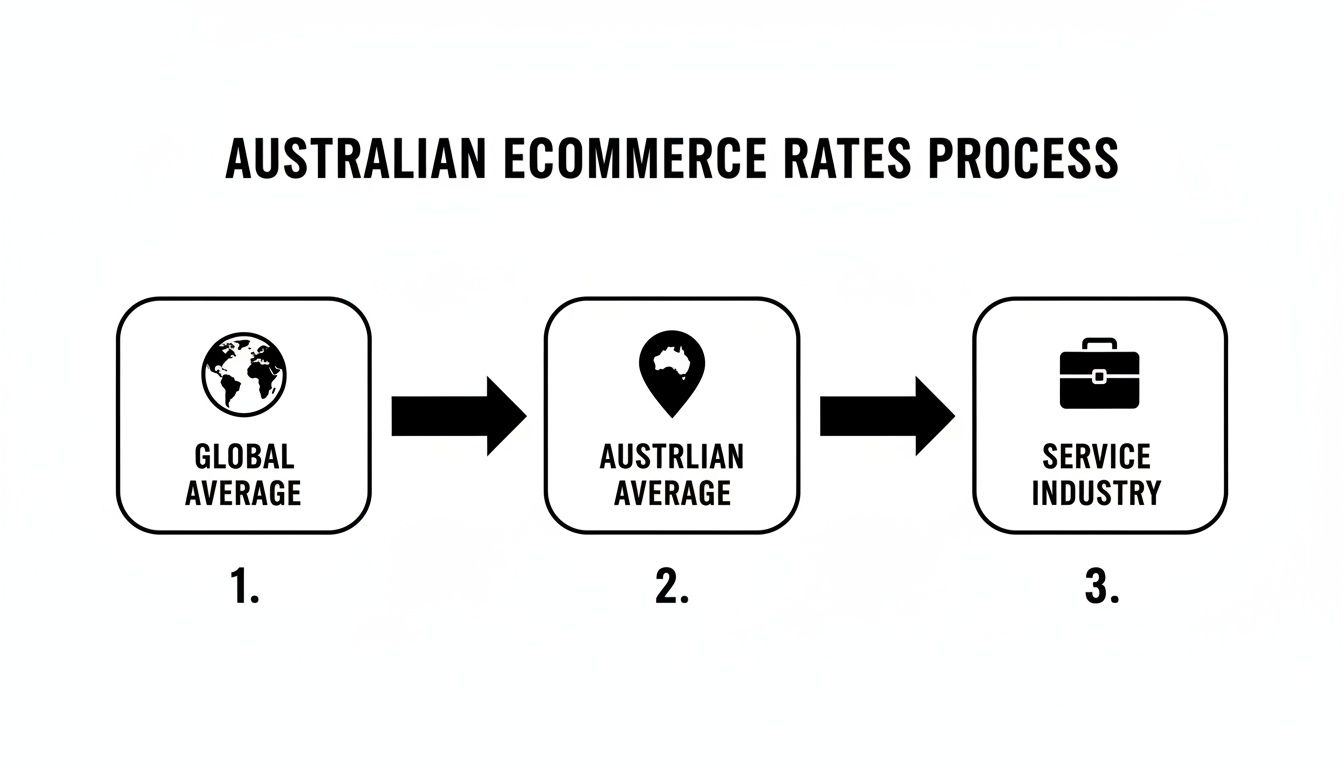
It highlights an interesting fact: while the average Aussie eCom site sits just under the global rate, certain sectors like the service industry perform much, much better. This shows what's possible when you really focus on optimisation.
Step 1: Discovery and Analytics
This is where we put on our digital detective hats. Before we can even think about suggesting a change, we need to get a crystal-clear picture of what’s actually happening on your website. We conduct a deep-dive audit using a whole suite of powerful tools.
- Google Analytics & GTM: First things first, we properly set up your Google Tag Manager containers. This is non-negotiable. It ensures we’re tracking every meaningful interaction—from button clicks to form submissions—giving us clean, reliable data to map out the user journey.
- Heatmaps & Session Recordings: Using tools like Hotjar, we watch where users are actually clicking, see how far they scroll, and pinpoint exactly where they get stuck or confused. Honestly, watching real user recordings is often the most eye-opening part of this entire phase.
- Technical Audit: We check for performance killers. Is the site sluggish? Are there broken links causing frustration? A slow-loading Shopify or WordPress site will sabotage conversions, no matter how good the design is.
Step 2: Hypothesis and Strategy
With a pile of data in hand, we shift from observation to strategy. Raw numbers are useless on their own; our job is to translate them into educated, testable ideas for improvement. We don’t just say, "The product page isn't working." We form specific, measurable hypotheses.
For instance, a solid hypothesis might sound like this: "By changing the generic 'Submit' button on the contact form to 'Get My Free Quote', we believe we can increase form submissions by 15% because it clarifies the immediate value for the user."
This is easily the most critical step in the whole process. A strong hypothesis, born from real data, is the foundation of any successful optimisation campaign. It turns a vague problem into a clear, testable solution.
Step 3: A/B Testing and Implementation
This is where the real science begins. Instead of just rolling out a change across your entire website based on a hunch, we run controlled experiments. A/B testing (or split testing) means showing two different versions of a page to different groups of your visitors at the same time to see which one performs better.
We let the data decide the winner, whether it’s testing a new checkout flow on a store built by a sharp Shopify developer or trying out a new headline on a WordPress landing page. For more complex tests, like adding custom functionality via the Shopify API, our expert developers make sure the implementation is flawless.
Step 4: Analysis and Learning
Once a test has run long enough to give us a statistically significant result, we dive into the analysis. Did our hypothesis win? Lose? Was it a draw? The outcome itself isn't as important as what we learn from it.
Believe it or not, a losing test can be just as valuable as a winner. It tells us what doesn’t work for your audience, which helps us avoid making the same mistake again. We document every single finding, slowly building a library of insights that are unique to your customers and your business.
Step 5: Ongoing Optimisation
Conversion rate optimisation is not a "set and forget" project. It’s a continuous loop of improvement. The winner of one A/B test simply becomes the new baseline—the control version for the next test. We take what we’ve learned, form new hypotheses, and keep hunting for the next growth opportunity.
This iterative process ensures your website is constantly evolving and getting better. The gains compound over time, steadily pushing your revenue and profitability upwards.
Tackling the Biggest Conversion Killer: The Abandoned Cart
There's nothing more frustrating for an e-commerce store owner than watching a customer get all the way to the finish line, only to vanish without a trace. This is cart abandonment, and from my experience as a digital marketing agency in Melbourne, it is without a doubt the single biggest and most costly leak in almost every online store.
This isn’t just a small drip; it’s a torrent of lost revenue. The numbers in Australia paint a very clear picture. The average add-to-cart rate is around 10.9%, but the cart abandonment rate skyrockets to a concerning 69.57%.
Think about what that means: for every 10 people who show clear buying intent by adding a product to their cart, nearly seven of them will leave before paying. For any business running on Shopify or WordPress, this gap represents the single most profitable opportunity for optimisation.
This is precisely why a huge part of any effective conversion rate optimisation service focuses squarely on plugging this leak.
Why Do Shoppers Abandon Their Carts?
Before you can fix the problem, you have to understand the "why" behind it. After years of digging into analytics for our clients, I've found the reasons are often surprisingly simple and completely fixable. They usually fall into a few key categories.
- Unexpected Costs: This is the number one culprit, time and time again. Surprise shipping fees, taxes, or other charges that only appear at the very end of the checkout process will send customers running.
- A Complicated Checkout: Forcing users to create an account, presenting too many form fields, or having a confusing multi-step process creates friction. People just give up.
- Lack of Trust: Customers are hesitant to enter credit card details on a site that doesn't feel secure. A lack of trust signals like security badges, clear return policies, or customer reviews can be a total deal-breaker.
- Technical Glitches: A slow-loading page or a bug in the checkout flow on a Shopify or WordPress site is an instant conversion killer. Nobody has the patience for that.
Our Strategy for Winning Back Lost Sales
Fixing cart abandonment isn't about one single trick; it's a multi-pronged approach that addresses these issues head-on while also trying to bring back shoppers who have already left. Here are a few of the core tactics we put in place.
1. Streamlining the Checkout Experience
First, we make the path to purchase as smooth as possible. This means offering a guest checkout option, simplifying forms to only ask for the absolute essentials, and ensuring total price transparency right from the start. For the stores we work with, a frictionless checkout is non-negotiable.
2. Building Unshakeable Trust
Next, we strategically place trust signals throughout the checkout process. This includes simple but powerful elements like:
- Displaying security logos (e.g., McAfee, Norton).
- Adding customer testimonials or star ratings.
- Making the return policy and satisfaction guarantees clearly visible.
3. Using Smart On-Site Tactics
We can often prevent abandonment before it even happens. Exit-intent popups are a great example of this. If a user’s mouse moves towards the back button, we can trigger a popup offering a small discount or free shipping to entice them to complete their purchase. It's a simple, effective way to keep them on the page.
4. Powerful Retargeting Campaigns
For those who do slip away, the game isn't over. By setting up the Meta Conversions API correctly, we can run highly effective retargeting campaigns on Facebook and Instagram. These ads remind shoppers of the exact products they left in their cart, often with a compelling offer to bring them back. To dive deeper into this, there are some excellent resources that outline strategies to reduce cart abandonment and win back lost sales.
Even a small reduction in your cart abandonment rate can lead to a significant and immediate boost in your monthly revenue. It's often the lowest-hanging fruit and the most profitable place to focus your CRO efforts.
How We Helped a Melbourne Business Get More Leads
Theory is great, but at the end of the day, results are what pay the bills. I want to walk you through a real (but anonymous) case study of a service-based business right here in Melbourne. They had a problem I see all the time: they were getting decent traffic from their Google Ads, but the number of people actually filling out their contact form was painfully low.
Their website looked professional enough, but it just wasn't pulling its weight. As a marketing agency in Melbourne that lives and breathes this stuff, we knew there were huge opportunities hiding in plain sight. Our job was to use a proper, structured CRO process to find the friction points that were quietly costing them business.
The Initial Diagnosis
The first thing we did was dive into their WordPress site with tools like heatmaps and session recordings. We wanted to see exactly how real people were behaving, not just guess. The data told a very clear story.
Visitors would land on the homepage, scroll a little bit, and then just… leave. The main contact form had a massive drop-off rate, which means people were starting to fill it out and then giving up halfway through.
Our initial audit flagged a few key issues:
- A Vague Value Proposition: It wasn't immediately obvious why someone should choose them over a competitor. Their main headline was generic and didn't connect with the customer's real problem.
- A High-Friction Contact Form: The form was way too long, asking for a bunch of details upfront. It felt like a chore, not a simple enquiry.
- A Lack of Trust Signals: There were no customer testimonials, reviews, or industry badges anywhere near the call-to-action. This hesitation was costing them leads.
Forming Our Testable Hypotheses
Armed with this data, we didn’t just start making random changes we thought would work. Instead, we developed a few clear, testable hypotheses to guide our A/B tests.
Our main hypothesis was this: "By clarifying the main headline to focus on a key customer benefit, simplifying the contact form to only three essential fields, and adding a row of client logos directly above the form, we can increase form submissions by at least 25%."
This is what separates professional CRO from guesswork. We didn't just redesign the page because it 'looked better'. Every single change was a calculated experiment designed to solve a specific, data-backed problem.
The Results: A Clear ROI
We ran the A/B test for three weeks, splitting the traffic 50/50 between the original page and our new, optimised version. The results were immediate and pretty dramatic.
The new version of the landing page delivered a 42% increase in contact form submissions from the exact same amount of traffic. This wasn't a fluke; it was a statistically significant lift that directly translated into more qualified leads and, ultimately, more revenue for their business.
This is the real power of a proper conversion rate optimisation service. It’s not just about tweaking a website. It’s about turning the traffic you already have into a reliable engine for growth, delivering a genuine and measurable return that actually impacts your bottom line.
How to Choose the Right CRO Partner in Australia
Picking an agency for conversion rate optimisation is a massive decision, and honestly, it can feel a bit overwhelming. As a digital marketing agency in Melbourne, I've seen firsthand what separates a great partner from one that just talks a good game. It’s not about flashy presentations; it’s about a transparent process, deep platform expertise, and a genuine investment in your success.
Choosing the right partner is about finding an extension of your team. You need someone who is as obsessed with your numbers as you are and has the skills to actually move the needle.
Look for Hands-On Platform Expertise
The first thing I always recommend is to check for specific, hands-on experience with your platform. A CRO strategy for a custom WordPress build is worlds away from one for a Shopify store. Vague talk about 'best practices' just won't cut it.
Ask them direct questions about their experience:
- For Shopify Stores: Have you worked with the Shopify API for custom solutions? Can you show me examples of theme customisations or Shopify app integrations you've handled? A proficient Shopify developer is a huge asset here.
- For WordPress Sites: Do you have a dedicated WordPress developer on your team? Ask about their experience with building custom blocks in Gutenberg, optimising for Core Web Vitals, and integrating with third-party tools.
An agency that understands the nuts and bolts of your platform can implement tests faster and more effectively, without breaking your site. It’s that simple.
Insist on a Data-Driven Process
A legitimate CRO partner will be obsessed with data. Their process should be transparent, methodical, and based entirely on what your numbers are telling them. If a potential agency starts suggesting big design changes based on their 'gut feeling', that’s a massive red flag.
A great CRO partner doesn't guess; they hypothesise. They use analytics, heatmaps, and user recordings to find problems, form an educated guess on how to fix it, and then run a controlled A/B test to prove it.
Ask to see their process. It should look something like the five-step framework we covered earlier: deep-dive analysis, data-backed hypothesis, controlled testing, thorough analysis, and ongoing optimisation. Anything less is just guesswork.
Ask About Communication and Reporting
Clear and honest communication is non-negotiable. You need to know exactly what’s being tested, why it’s being tested, and what the results are—whether they're good, bad, or inconclusive. A true partner shares the losses as openly as the wins because both provide valuable learnings.
Finally, discuss their pricing models. Some agencies work on a monthly retainer, others on a per-project basis, and some even offer performance-based models. Make sure you understand exactly what you're paying for and what the expected deliverables are. A detailed proposal should clearly outline the scope of work, the process, and the reporting structure, ensuring you're choosing a partner who is truly aligned with your business goals.
Your CRO Questions, Answered
To wrap things up, here are answers to the most common questions I get from business owners when they're thinking about investing in conversion rate optimisation. Let's clear up the things that come up time and again.
How Long Does It Take to See CRO Results?
This is always the first question, and the honest answer is: it depends.
Sometimes you can see a big impact from a "quick win," like fixing a broken checkout button on a Shopify store. That kind of thing can show results in just a couple of weeks.
But a proper A/B test needs to run long enough to gather real, statistically solid data — usually 2-4 weeks per test. The true, compounding results start to build over several months as we complete multiple cycles of testing, learning, and improving. CRO is definitely a marathon, not a sprint.
What Does a Conversion Rate Optimisation Service Cost?
Pricing can vary quite a bit depending on what you need. Most agencies, including our Melbourne-based team, work with a few different models:
- Monthly Retainer: This is the most common approach. It’s a fixed fee for ongoing optimisation work, so we're constantly testing and improving things for you.
- Per-Project Fee: A simple, one-off price for a specific job, like a full website audit or running a series of landing page tests.
- Performance-Based: In this model, the fee is tied directly to the results we get, like a percentage of the extra revenue we generate.
Your investment really comes down to the complexity of your site and how intensive you want the testing program to be.
Can CRO Hurt My SEO?
This is a great question, and a valid concern. When done correctly, the answer is a firm no.
Professional CRO agencies follow Google's guidelines for A/B testing to the letter. We use tools that let search engines know exactly what's happening, so there’s no confusion or penalty.
In fact, good CRO almost always improves your SEO. By creating a better experience for your users, we naturally increase things like time on site and reduce bounce rates — signals that Google absolutely loves.
Alpha Omega Digital is a marketing agency based in Melbourne, Australia but also services clients from Sydney, Brisbane, Newcastle, Perth, Adelaide, Darwin and Hobart. Have a project in mind? Contact us.
Your Comment
Your email address will not be published. Required fields are marked *