
Home / Blog / Details
Uncategorized
How a Melbourne Marketing Agency Chooses The Best Website Builder for Small Business
Uncategorized
As a marketing agency based in Melbourne, I've seen first-hand how the right website builder can make or break a small business. It's not just about getting online; it’s about choosing a foundation that actually drives growth. From my experience, platforms like WordPress or Shopify are usually the best bet because they offer the horsepower for long-term growth, deep customisation, and powerful search engine optimisation.
While simpler tools like Wix or Squarespace might seem tempting for a quick launch, I've learned that your website builder is a core business decision. It's a choice that will ripple through your sales, marketing, and overall efficiency for years to come. Picking the right one from the start saves a world of pain later on.
Table of Contents
- Why Your Website Builder Is a Critical Business Decision
- The Top 4 Website Builders: A Melbourne Agency's Perspective
- Which Platform Is Best for Your Business Type?
- Advanced Capabilities: SEO, Customisation, and Future-Proofing
- Unlocking Growth: Advanced Digital Marketing Strategies
- AI Voice Agents: The Next Frontier for Small Business Automation
- When to DIY vs. Hiring a Professional Agency
- Frequently Asked Questions About Website Builders
Why Your Website Builder Is a Critical Business Decision
As a marketing agency here in Melbourne, I’ve seen it all. Countless small businesses get stuck on the wrong platform, unable to grow, or they avoid building a website entirely because the whole thing feels too overwhelming. This is a massive missed opportunity, especially in the competitive local market.
Choosing the right platform isn’t just a tech task; it's a fundamental part of creating a comprehensive strategic plan for your small business. The decision you make on day one directly impacts your ability to attract customers, process sales, and pivot when new opportunities arise. It truly sets the stage for everything that follows.
The Australian Small Business 'Website Gap'
There’s a huge gap between what Australian customers expect online and what many local businesses actually provide. Recent data paints a surprising picture: only 41% of small businesses in Australia even have a website.
And yet, 75% of consumers say they prefer to buy from businesses that have an online presence. So what’s causing this disconnect? From my experience, it usually boils down to a few common roadblocks:
- Cost: 34% of small business owners point to cost as the main barrier.
- Perceived Need: 28% simply believe they don’t need a website.
- Technical Knowledge: 22% feel they lack the skills to build and manage one.
This is exactly where modern website builders and specialist agencies come in, bridging that gap between needing a professional presence and having the in-house resources to create one.
More Than Just an Online Brochure
Your website isn’t a digital business card. It’s the central hub for your entire marketing ecosystem and the foundation that supports every growth activity we help businesses implement, day in and day out.
Think of your website builder as the engine of your business. A weak engine might get you moving, but it will stall the moment you try to accelerate. A powerful, flexible engine lets you scale, add new features, and outperform your competitors when it really matters.
This choice dictates your ability to execute effective marketing strategies down the track. Can the platform handle the technical SEO needed to attract local Melbourne customers? Will it integrate properly with Google Ads to track your leads? Can you implement the Meta Conversion API for accurate data from your Facebook ads?
These are the questions that separate a simple online page from a genuine, hard-working business asset. Making the right choice upfront means you’re building on solid ground from the very start.
Alright, let's move from the high-level theory to a real-world, head-to-head comparison. When business owners here in Melbourne ask me which platform to use, the conversation almost always boils down to four main players: WordPress, Shopify, Wix, and Squarespace. I work with these platforms every single day, so I’ve seen their strengths and weaknesses up close.
This isn’t just a list of features. I’m going to break them down based on what actually matters for a growing Australian business: how easy they are to get started with, their real power for eCommerce, their potential to rank on Google, and what happens when your business really starts to take off. We'll also touch on the hidden costs and maintenance headaches that often get glossed over.
Most of the time, when a business struggles with their website, it’s because of a mismatch in one of these key areas.
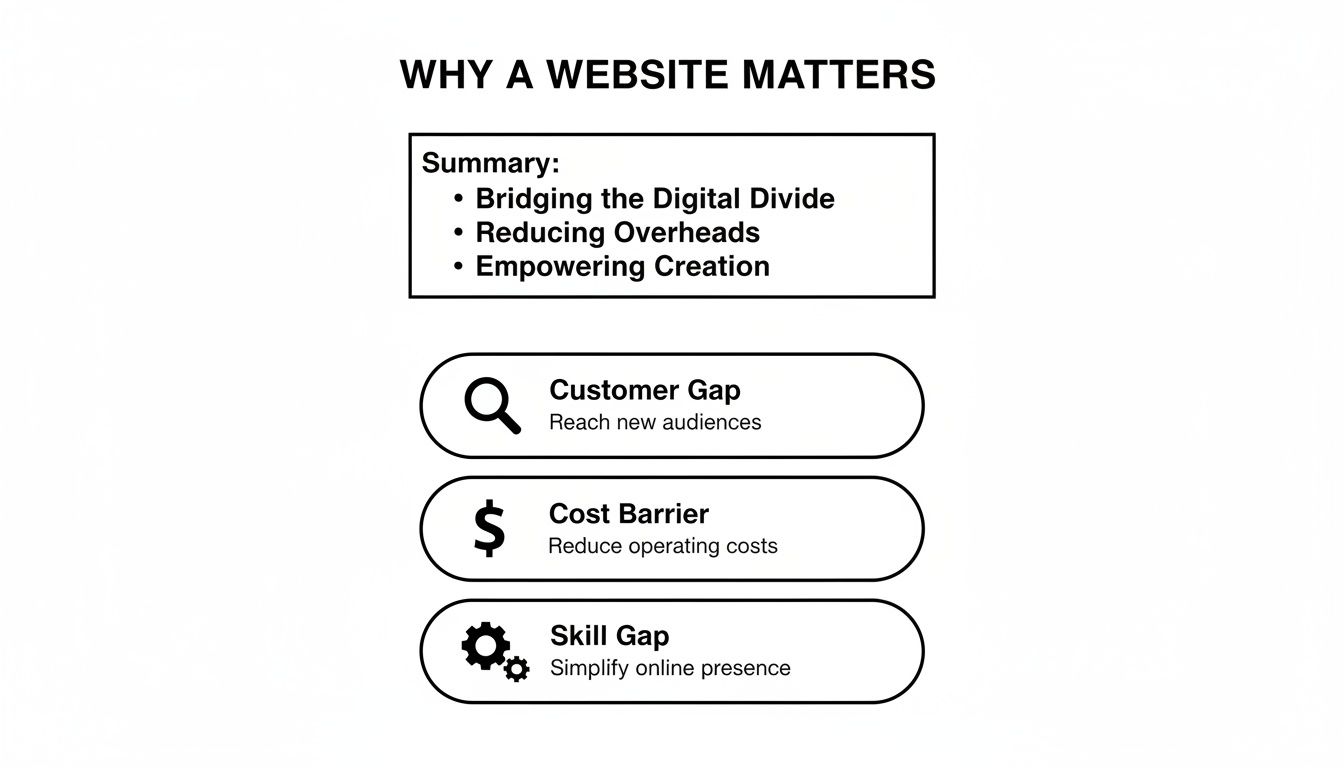
As you can see, the main hurdles are bridging the customer gap, overcoming cost barriers, and closing skill gaps. The right website builder is crucial for helping small businesses clear these obstacles and start growing.
The Top 4 Website Builders: A Melbourne Agency's Perspective
WordPress: The Powerhouse of Customisation
First up is WordPress. It’s not really a website builder; it's a full-blown Content Management System (CMS) that powers over 43% of all websites on the internet. Its biggest strength is its open-source nature, which gives you absolute freedom.
From a digital marketing agency Melbourne perspective, this freedom is everything. We can dig right into the code, build completely custom features, and fine-tune SEO in ways that are simply impossible on closed platforms. For an e-commerce store in a competitive market like Sydney or Melbourne, this level of control is often the key to ranking for high-value keywords. For example, our team of /wordpress-developers can implement custom schema that helps your products stand out in search results.
But all that freedom comes with responsibility. You're in charge of hosting, security, updates, and backups. While a good /wordpress-developer-melbourne can manage all this for you, it’s definitely not the "set and forget" experience some business owners are looking for.
Shopify: The Undisputed eCommerce King
If your business is built around selling products online, Shopify is almost always the answer. It wasn’t designed as a general website builder with an eCommerce add-on; it’s a dedicated selling machine, engineered for conversions from the ground up.
I’ve worked on countless Shopify development projects, and its simplicity for managing products, inventory, payments, and shipping is just unmatched. The backend is incredibly intuitive for store owners, and its app store lets you add powerful integrations without ever needing to write code.
Shopify is built to do one thing exceptionally well: sell. It removes the technical headaches of running an online store so you can focus on your products and marketing. The trade-off is less control over the underlying code compared to WordPress.
From an advertising standpoint, setting up things like the Meta Conversion API or tracking for Google Shopping ads is very straightforward. For most eCommerce businesses, especially those in dropshipping or with large inventories, Shopify is the path of least resistance to making money. And when you need more advanced functionality, a skilled /shopify-developer can use the /shopify-developer-api to build custom apps and integrations.
Wix and Squarespace: The All-in-One Simplicity Kings
Wix and Squarespace often get lumped together because they serve a similar purpose: providing an easy, all-in-one solution for businesses that need to get online quickly with minimal technical fuss. Their drag-and-drop editors are intuitive, and they handle all the hosting and security for you.
Squarespace, in particular, has carved out a strong niche in Australia. While global statistics show Wix with a larger market share, locally, Squarespace captures a significant 19% of the website builder market. This suggests many Aussie small businesses prioritise beautiful design and a fast launch over deep customisation. You can see more on these market share findings to understand how the local landscape differs.
These platforms are excellent for portfolios, artists, or e-commerce businesses just starting out. They are perfect for establishing an online presence and running basic lead generation campaigns, like Google ads for contact form submissions.
The main drawback? Scalability and SEO limitations. While they’ve definitely improved their SEO tools, they can't compete with the granular control offered by WordPress. If your business model relies heavily on ranking for competitive search terms or you might need unique functionality down the road, you could hit a ceiling. They’re a fantastic starting point, but they can be difficult to migrate away from once you outgrow them.
Website Builder Feature Comparison for Australian Small Businesses
To help you visualise the differences, here’s a direct comparison of the key features that matter most to small e-commerce businesses—from ease of use and eCommerce power to SEO flexibility and long-term scalability.
| Feature | WordPress (with WooCommerce) | Shopify | Wix | Squarespace |
|---|---|---|---|---|
| Best For | Content-heavy sites, custom functionality, maximum SEO control. | Serious eCommerce businesses of all sizes, from startups to large retailers. | Portfolios, artists, and small e-commerce businesses needing a simple, fast setup. | Creatives, and e-commerce businesses focused on strong visual branding and aesthetics. |
| Ease of Use | Steeper learning curve. Requires management of hosting, plugins, and security. | Very intuitive. Built for non-technical store owners to manage products, orders, and sales easily. | Easiest to use. A true drag-and-drop editor that's very beginner-friendly. | Easy to use, though slightly less flexible than Wix. Focuses on structured, template-based design. |
| eCommerce Power | Highly powerful with WooCommerce, but requires more setup and maintenance. Limitless customisation. | The gold standard. A dedicated selling platform with a massive app ecosystem and robust features. | Good for basic stores. Lacks the advanced inventory, shipping, and tax features of Shopify. | Best for selling a small number of products or digital goods. Not ideal for complex inventories. |
| SEO Flexibility | Excellent. Total control over every aspect of SEO with plugins like Yoast or Rank Math. | Very good. Handles most technical SEO automatically, but less control over site structure than WordPress. | Good, but limited. Has improved significantly but can't match the deep control of WordPress. | Good for basic SEO. Has all the core features, but advanced customisation is restricted. |
| Scalability | Infinite. Can be scaled to handle any amount of traffic or functionality if built correctly. | Excellent. Built to handle massive traffic spikes and large product catalogues without any issues. | Limited. Can become slow and difficult to manage as the site grows in complexity. | Limited. Best for smaller sites; performance can suffer with too many pages or products. |
| Monthly Cost (Approx. AUD) | $15 – $100+ (Hosting, domain, premium plugins/themes). Costs can vary widely. | $44 – $449+ (Subscription plan, transaction fees, premium apps). Clear, predictable pricing. | $22 – $60+ (All-in-one plans). Watch for add-on costs for specific features. | $25 – $65+ (All-in-one plans). Pricing is straightforward. |
Ultimately, there's no single "best" platform—only the one that’s best for your business right now. A startup artist needs something different than a dropshipping store, and a national eCommerce brand has entirely different needs from both. Use this table to align a platform's strengths with your immediate goals and long-term vision.
Which Platform Is Best for Your Business Type?
The question I get more than any other is, "So, which one should I actually use?" The honest answer? There’s no single winner. The right website builder is the one that fits your business model, your budget, and where you want to be in a few years.
Choosing a platform is really about matching its core DNA to what you do every day. A boutique fashion label in Perth has completely different needs than a national dropshipping brand. Let's break this down for e-commerce businesses to make the choice a lot clearer.
For E-commerce Brands Selling Physical Products
If your main game is selling products online, the conversation usually starts and ends with Shopify. It was built from the ground up for one reason: to make selling simple, efficient, and scalable.
From my experience as a Shopify developer, its biggest strength is how it removes friction. Things like inventory management, payment gateways, shipping integrations, and abandoned cart recovery are all baked right in. For any product business, you need robust e-commerce capabilities, and Shopify nails this, letting you focus on your products and marketing, not on keeping the tech running. Our team of /shopify-developers has helped countless businesses get the most out of the platform.
That said, WordPress with WooCommerce is a beast of an alternative for businesses that need total control and customisation. If you have a unique product configurator, a complex subscription model, or need to hook into a specific inventory system, a custom /wordpress-development project might be the smarter long-term move. It demands more hands-on management, but its potential is limitless.
For Service-Based Businesses Focused on Leads
Are you a tradie, a consultant, a therapist, or another service professional in Melbourne or Sydney? Your website has one primary job: get you leads. It needs to rank well in local search and make it incredibly easy for potential clients to get in touch.
This is where WordPress truly shines.
Its flexibility for SEO is a game-changer for local businesses. A skilled seo agency melbourne can tune a WordPress site to completely dominate local search results. We can build dedicated landing pages for different services, optimise for "near me" searches, and integrate it perfectly with your Google Business Profile.
This level of control becomes critical when you're running Google ads for service based businesses. We can create high-converting landing pages and track every single form submission or phone call, giving us the hard data needed to optimise your ad spend for the best possible return. While platforms like Squarespace are fine for a basic online brochure, WordPress is the engine you need for serious lead generation.
For a service business, your website isn't just a digital flyer; it's a lead generation machine. WordPress gives you the tools and control to build the most powerful machine possible, directly impacting your bottom line.
For Creatives and Portfolio-Based Businesses
If you're a photographer, designer, or artist, your website's main job is to showcase your work in the most visually stunning way possible. Speed and simplicity are everything.
This is Squarespace's sweet spot.
Squarespace is famous for its beautiful, professionally designed templates that look great on mobile right out of the box. You can get a visually impressive portfolio site online in a single weekend without writing a single line of code. It handles all the technical stuff, so you can focus on curating and presenting your best work.
Wix is another strong contender here, giving you more of a free-form, drag-and-drop design canvas. In my experience, however, Squarespace's more structured approach often results in a more polished and professional-looking site for creatives who put aesthetics above all else. You trade some technical control, but for many, it’s a worthwhile compromise. The goal is to let your work speak for itself, and these platforms provide an elegant frame to do just that.
Advanced Capabilities: SEO, Customisation, and Future-Proofing
Right, let's talk about what happens after your website is built. A pretty design is one thing, but a site that actually grows your business needs to pull in the right traffic and turn visitors into customers. This is where we need to look past the shiny templates and get into the technical stuff that separates the serious platforms from the hobbyist ones.
Thinking about this from the start is absolutely critical. I’ve seen it happen too many times: a choice that seems quick and easy today becomes a massive headache in a year or two when you need to roll out advanced marketing to keep up with competitors.
Unlocking Search Engine Dominance
Every platform on the planet will claim they're "good for SEO," but what that actually means varies wildly. Sure, they all let you change basic things like page titles and meta descriptions. But for a business trying to rank in a competitive market like Melbourne or Sydney, that’s just table stakes.
Real SEO power comes from granular, nuts-and-bolts control. This means things like:
- Advanced Schema Markup: The ability to add structured data that helps Google deeply understand your services, products, and location, which can lead to those eye-catching, rich results in search.
- Site Speed Optimisation: Direct control over image compression, code minification, and server response times. Site speed isn’t just a nice-to-have; it's a confirmed ranking factor.
- Crawlability and Indexing: The power to tell search engines exactly how to crawl your site using tools like
robots.txtand manage complex URL structures without creating a mess.
This is where WordPress just plays in a different league. With the right plugins and a skilled /wordpress-web-developer, you have total control over every single element. It’s the reason why, for tough, competitive keywords, WordPress is often the weapon of choice for a dedicated seo agency melbourne.
While Shopify has fantastic built-in SEO for e-commerce, and Wix and Squarespace are perfectly fine for basic local visibility, WordPress offers an unlimited ceiling. When you need to outrank established competitors, that unlimited potential becomes a critical advantage.
Beyond Changing Fonts to True Customisation
Customisation isn't just about tweaking colours and fonts. It's about bending the website to the will of your business processes. For an e-commerce store, this could mean a custom product visualiser, a unique "build your own bundle" feature, or a complex subscription system.
Here again, the platforms couldn't be more different.
- Wix and Squarespace give you customisation inside a sandbox. You can rearrange elements and change styles, which is great for simple sites, but you're fundamentally limited by the tools they give you.
- Shopify offers a brilliant middle ground. Its App Store is massive, providing thousands of integrations. For anything more specific, our team of /shopify-development-partners can use the Shopify API for building custom Shopify apps using Shopify CLI to add entirely new functionality. This is incredibly powerful for scaling e-commerce brands.
- WordPress is pure freedom. If you can dream it, it can be built. This is where our deep expertise in WordPress development comes in. We can do things like building custom blocks in Gutenberg to make content management dead simple for your team, or we can develop completely unique plugins from scratch to solve a specific business problem.
This is the code-level customisation we often handle for clients, allowing for truly unique features that your competitors simply can't replicate on a closed platform.
The screenshot above gives you a glimpse into our structured approach to WordPress web development, showing the strategic planning and deep customisation that goes into building a high-performance site.
Future-Proofing Your Marketing Tech Stack
Your website is the hub of your marketing world. As your business grows, you'll inevitably need to plug in more advanced tools. This could mean setting up Google Tag Manager containers for sophisticated tracking, implementing the Meta Conversion API for rock-solid ad attribution, or building a custom bridge to your inventory management system.
A closed platform can become a major bottleneck here. If the platform doesn't have a native integration for the tool you need, you’re often just out of luck.
With an open-source platform like WordPress, however, a skilled /wordpress-development-company can integrate almost any third-party service imaginable. This ensures your website builder won't stop you from adopting the marketing tech you need to scale tomorrow.
Unlocking Growth: Advanced Digital Marketing Strategies
Choosing the right website builder is just the first step. The real magic happens when you leverage that platform to run powerful marketing campaigns. At our digital marketing agency in Melbourne, we live and breathe this stuff. Here’s a look at the key strategies we use to turn our clients' websites into growth engines.
Mastering Paid Advertising: From Google to Meta
Paid ads are often the fastest way to get your products in front of motivated buyers. Whether it's through a Facebook ads agency or managing your own campaigns, understanding the nuances is critical for e-commerce success.
- Google Ads for E-commerce: This is where a beginner's guide to Google Shopping ads is invaluable. We often focus on Google Shopping ads for dropshipping, as it’s a high-intent channel. A common issue we troubleshoot is Google Shopping ads not spending budget, which usually points to feed or bidding issues. Understanding the difference between PMAX vs Google Shopping ads is also crucial; PMAX offers more automation, but standard Shopping can provide more granular control. We also manage Google ads for service based businesses aiming for lead generation, specifically optimising for Google ads for contact form submissions.
- Meta Ads (Facebook & Instagram): Mastering Facebook ads is about more than just boosting posts. It involves a rigorous Meta ads creative testing process to find winning ad combinations. A common mistake is when advertisers don't quit too early on a campaign that needs time to optimise. Success relies on setting up your Instagram Shop and Facebook Shop correctly and knowing how to measure success on Facebook ads using the right metrics.
A key question we always get is what budget to spend on Google ads or how much does it cost to start Google ads? The answer depends on your industry and goals, but consistency is key. Marketing your business = consistency. We also help PPC for tradies by using the best call tracking softwares for PPC call campaigns (eg Callrail, Go High Level) to measure real-world results.
The Technical Backbone: Tracking and Analytics
You can't optimise what you can't measure. Setting up the technical infrastructure is non-negotiable for serious marketing.
- GTM and Google Analytics: Proper setup is the foundation of data-driven marketing. We handle everything from setting up Google Tag Manager containers to configuring complex event tracking in GA4.
- Meta Conversion API: With the decline of third-party cookies, a server-side Conversions API installation for Meta is essential for accurate ad attribution. We handle the complete setup of Meta Conversion API to ensure our clients' ad data is as reliable as possible.
Harnessing the Power of Local SEO
For businesses with a physical presence or a defined service area in cities like Melbourne, Local SEO is a goldmine. It's about making your business visible to nearby customers actively searching for your products or services.
- Google My Business (Google Business Profile): Your GBP is your digital storefront on Google. We optimise it with accurate information, regular posts, and a strategy to encourage customer reviews.
- On-Page Local Signals: This involves optimising your website content with location-specific keywords, embedding Google Maps, and creating pages for each service area. As an seo agency in Melbourne, we have a deep understanding of what it takes to rank in this competitive market.
AI Voice Agents: The Next Frontier for Small Business Automation
Beyond traditional digital marketing, we're now helping clients revolutionise their customer service with cutting-edge technology like ai-voice-agents. For many small businesses, especially in the e-commerce and service sectors, missed calls equal lost revenue. An AI receptionist solves this problem permanently.
What is an AI Voice Agent?
An ai-voice-agent is an automated system that uses artificial intelligence to answer phone calls, interact with customers in a natural-sounding voice, and perform specific tasks. Think of it as a super-powered receptionist that never sleeps. The ai voice agent pricing is a fraction of a human receptionist's salary, making it an incredibly cost-effective solution.
How AI Receptionists Transform Customer Service
For businesses like hairdressers, beauty therapists, dentists, restaurants, and doctors, an ai receptionist Australia based solution can be a game-changer. Here’s how we set it up:
- Custom Twilio Number: We provide a custom phone number through Twilio, a leading communications platform.
- 24/7 Answering: The AI answers every call, day or night. It never gets sick or tired, ensuring you never miss a lead.
- Intelligent Responses: It can answer frequently asked questions, provide business hours, and even route calls to the right person if needed.
- Save Thousands in Lost Business: For tradies and other service pros, a single missed call can mean losing a high-value job. The AI captures every opportunity.
Implementing an AI Appointment Setter
The real power comes from turning these AI agents into proactive ai appointment setters. We program the system to:
- Book Appointments Directly: The AI can access your calendar (like Google Calendar or Calendly) and book appointments for customers in real-time during the call.
- Qualify Leads: It can ask pre-qualifying questions to ensure you only spend time on high-quality leads.
- Send Confirmations: Once an appointment is booked, the system can automatically send SMS or email confirmations to the customer.
This technology is no longer science fiction. It's a practical, affordable tool that we are implementing for Australian businesses to help them become more efficient and profitable.
When to DIY vs. Hiring a Professional Agency
This is a crossroads every small business owner hits. Let’s be clear: DIY builders are brilliant tools for getting an idea off the ground. I often recommend them to startups with tight budgets because they let you launch fast, test the waters, and get a digital footprint without a huge upfront cost.
But there comes a point where the very website that helped you start becomes the thing holding you back. That simple template that felt so liberating at first now feels like a ceiling on your growth. Recognising that moment is crucial.

Signs It’s Time to Partner with an Agency
Making the jump from DIY to a professionally built site isn’t about vanity. It's a strategic business decision. If any of these sound familiar, it’s probably time to bring in the experts.
Here are the most common signals I see with clients:
- You've Hit a Revenue Ceiling: Your sales have gone flat, and you have a nagging feeling your site’s clunky checkout or generic design is to blame. A professional agency can rebuild the user journey to turn more of those visitors into customers.
- You Need Advanced Marketing Integrations: You’re ready for serious marketing, but your platform just can’t keep up. You need sophisticated tracking with Google Tag Manager or the Meta Conversion API for accurate ad data, and that’s often way beyond what simple builders can handle.
- Your Brand Needs to Stand Out: Your business has grown up, but your website still looks like it's fresh out of the box. A unique brand experience demands custom design and functionality that a /wordpress-development-company can build from scratch.
- You're Wasting Too Much Time on Maintenance: You spend more time fixing plugin conflicts and troubleshooting random issues than actually running your business. An agency takes all those technical headaches off your plate.
A high-converting, professionally built site isn’t an expense; it’s a growth asset. You have to frame the investment as an ROI-driven decision. It’s about building a machine that generates leads and sales 24/7.
Making the Leap to Professional Development
Partnering with an agency like Alpha Omega Digital isn't just about getting a prettier website. It's about building a strategic tool optimised for speed, security, and conversions. As a Melbourne-based marketing agency, we don’t just build sites; we build them with a deep understanding of what drives results, from local SEO to paid advertising campaigns.
A professionally designed site removes friction. It makes it easy for your customers to do what you want them to do. If you're ready to stop tinkering and start growing, it might be time for a chat.
Have a project in mind? Contact us today.
Frequently Asked Questions About Website Builders
After walking countless business owners through this decision, I've noticed the same questions tend to pop up. Choosing the right website builder isn't just about features; it's about cost, future-proofing, and the nitty-gritty technical details.
Here are some of the most common questions I get, with straightforward answers to help you feel confident in your choice.
What Is the Cheapest Way to Build a Website for a Small Business?
This is a tricky one because 'cheapest' can mean a few different things. Builders like Wix or Squarespace look tempting with their low monthly fees, but the real cost isn't what you pay today—it's what you pay over the long haul.
A simple WordPress site with a basic theme and affordable hosting can have a very low starting cost. The catch is that you need to budget for things down the line, like premium plugins, security, or calling in a WordPress developer in Melbourne when you hit a wall.
For e-commerce, Shopify's basic plan often works out to be more cost-effective. It wraps up hosting, security, and powerful sales tools into one predictable monthly fee, which can be much cheaper than piecing together a similar setup on WooCommerce from scratch.
Can I Switch My Website Builder Later?
Technically, yes, but it's almost never as simple as flicking a switch. Moving from one platform to another—like from Wix to WordPress or Squarespace to Shopify—is a complete do-over. It's a full rebuild of your website.
You can usually get your core data out, like:
- Product information (names, prices, descriptions)
- Blog posts and articles
- Customer lists and order history
But your site's design, layout, theme, and specific features are all locked into the original platform. This is the single biggest reason why choosing the right platform from day one is so critical. A migration is a costly, time-consuming project that can seriously disrupt your business, so it's a headache you want to avoid if at all possible.
Which Website Builder Is Best for SEO in Australia?
If you're after maximum control and ranking potential, WordPress is the undisputed winner. It gives an experienced WordPress website developer total access to the site's code, structure, and every on-page element you can think of.
This opens the door for advanced strategies like custom schema markup, serious site speed tuning, and technical SEO fixes that closed platforms just can’t handle.
That said, Shopify has excellent built-in SEO features, especially for e-commerce. Both Wix and Squarespace have improved massively, too. They're perfectly fine for businesses targeting less competitive local keywords. But for a national campaign or a tough market, WordPress gives you the best fighting chance.
Do I Need a Developer to Use WordPress?
Not at all. You can absolutely get a basic WordPress site up and running on your own. Modern page builders like Elementor or Divi have made it possible for non-technical users to create professional-looking pages with simple drag-and-drop tools.
However, to unlock what WordPress is really capable of, bringing in a professional is a game-changer. For the tasks that directly fuel your growth—like performance optimisation, advanced security, or creating unique features with custom Gutenberg blocks—the expertise of a skilled WordPress development team is invaluable. They take care of the technical headaches so you can focus on running your business.
Alpha Omega Digital is a marketing agency based in Melbourne, Australia but also services clients from Sydney, Brisbane, Newcastle, Perth, Adelaide, Darwin and Hobart. Have a project in mind? Contact us.
Your Comment
Your email address will not be published. Required fields are marked *