Home / Blog / Details
Uncategorized
The Ultimate Guide to Ecommerce SEO Marketing for Australian Businesses
Uncategorized
As a marketing agency in Melbourne, I've spent years in the trenches with ecommerce businesses, and I've learned one crucial lesson: a beautiful online store is useless if nobody can find it. At its core, ecommerce SEO marketing is the art and science of making sure your store shows up right when people are searching for the products you sell. It’s not about quick hacks; it’s a long-term strategy that blends technical perfection, killer content, and genuine authority to drive organic traffic and, most importantly, sales.
This guide is a deep dive into the strategies I've personally used to help Australian ecommerce businesses grow. I'll cover everything from the foundational technical SEO for platforms like Shopify and WordPress, to advanced paid advertising tactics that complement your organic growth.
Table of Contents
- Why Your SEO Foundation is Non-Negotiable
- Keyword Research: Finding Long-Tail Keywords with High Buyer Intent
- Building Authority: Content Marketing and Backlinks
- Supercharging Growth with Paid Ads
- Advanced Technical SEO and Development
- Introducing AI Voice Agents for Business Growth
- Measuring Success and Proving ROI
- Your Ecommerce SEO Questions Answered
Why Your SEO Foundation is Non-Negotiable
I’ve watched the Australian ecommerce market absolutely explode, and one thing has become painfully clear: a beautiful website isn't enough to get a slice of the pie. To have any chance of succeeding, you need a rock-solid SEO foundation right from the get-go. Without it, you're basically building a stunning shop in the middle of the desert with no roads leading to it.
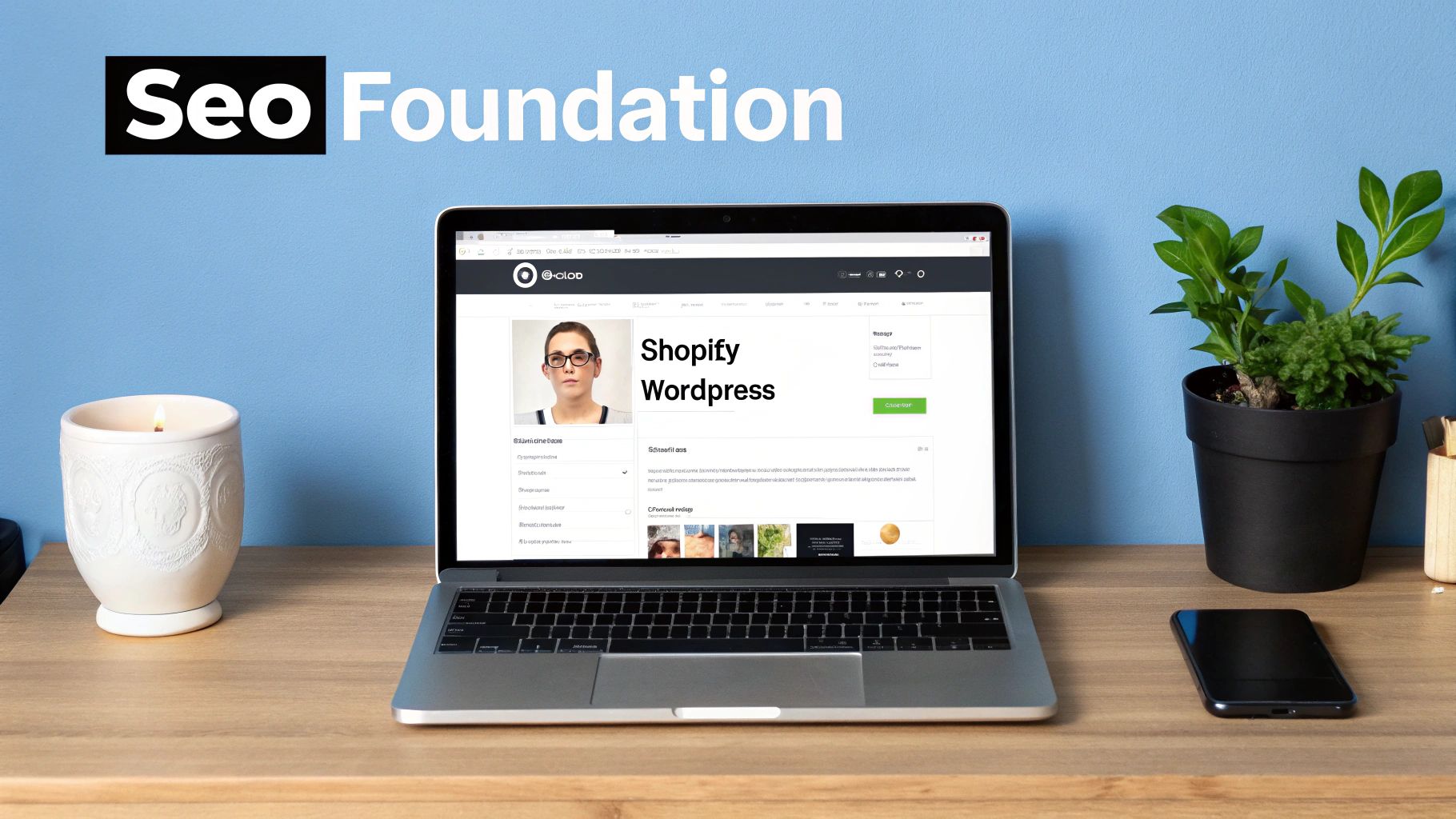
This initial groundwork is what separates the stores that thrive from those that slowly fade into obscurity. It’s all about making sure Google can find, crawl, and properly understand every single product you sell. Let’s walk through the essential technical SEO checklist we use at our agency for every new Shopify and WordPress store.
Mastering Mobile-First and Blazing-Fast Site Speed
The vast majority of Aussies now shop on their phones. This isn't a trend; it's the new standard. Google knows this and prioritises sites that offer a flawless mobile experience through its mobile-first indexing. This simply means Google predominantly uses the mobile version of your site for indexing and ranking. If your store is clunky, slow, or a pain to navigate on a phone, your rankings will suffer. Period.
Site speed is just as critical. A tiny one-second delay in page load time can cause a significant drop in conversions. We use tools like Google PageSpeed Insights and GTmetrix to benchmark performance and hunt down bottlenecks, like oversized images or bloated code, that are slowing things down.
From my experience, the biggest wins often come from simple fixes: compressing product images before uploading them and choosing a lightweight, well-coded theme. These two actions alone can dramatically improve your Core Web Vitals scores.
Choosing Your Platform: Shopify vs. WordPress Development
The platform you build on directly impacts your SEO capabilities. Both Shopify and WordPress are fantastic choices, but they’re built for different needs. This choice is fundamental, and it's where having a strong development partner makes all the difference.
- Shopify Development: This platform is brilliant for getting started fast. Its whole ecosystem is designed for ecommerce, with a user-friendly interface and solid built-in features. As experienced Shopify development partners, we know it's a closed system, which means less technical tinkering but also less flexibility for deep customisation unless you bring in a skilled Shopify developer.
- WordPress Development: When paired with WooCommerce, WordPress offers total control. A skilled WordPress developer in Melbourne can build a completely custom experience, from unique product filters to bespoke checkout flows. This freedom allows for highly specific SEO optimisations that aren't always possible on Shopify. A great wordpress development company can unlock its full potential.
Ultimately, the choice comes down to your technical comfort and long-term goals. Shopify gets you to market quicker, while a well-built WordPress site offers a much higher ceiling for customisation and performance.
The Critical Role of Analytics: GTM and GA4 Setup
You can't optimise what you don't measure. Setting up Google Analytics and Google Tag Manager (GTM) isn't just a box-ticking exercise; it’s the central nervous system of your entire marketing strategy. GTM acts as a container, letting you manage all your tracking scripts—like Google Analytics, the Meta Pixel, and others—from one place without constantly needing a developer to edit your site's code.
When it's set up properly, you can track the metrics that drive real business decisions:
- Which channels bring in the most valuable customers?
- Where are users dropping off in the checkout process?
- What's the true conversion rate of your Google Ads campaigns?
The data here tells a story. Ignoring it is like trying to navigate a ship without a compass. Setting up GTM containers properly is one of the first things we do for any new client.
Keyword Research: Finding Long-Tail Keywords with High Buyer Intent
Once your technical foundation is solid, it's time to get into the stuff that actually makes you money: your product and category pages. From my experience running a marketing agency here in Melbourne, I can tell you this is where the real ecommerce SEO battle is won or lost. It's all about turning a casual searcher into a happy, paying customer.
This all kicks off with keyword research, but probably not the way you're used to. Forget chasing broad, super-competitive terms. We're hunting for high-intent, long-tail keywords. These are the specific, multi-word phrases customers type into Google when they know exactly what they want and have their wallets ready. The beauty of these keywords is that they are often less competitive, meaning you can easily rank number 1 for them with the right strategy.
Think about the difference between someone searching for "running shoes" versus "lightweight women's trail running shoes for wide feet". That second searcher is miles closer to buying, and that’s precisely the traffic you want to capture.
How I Uncover High-Intent Keywords That Convert
So, how do you find these golden nuggets? I have a few go-to methods that work time and time again:
- Analyse Competitor Pages: Use your favourite SEO tool to see what long-tail keywords your most successful competitors are ranking for on their product pages. This is the fastest way to find proven, money-making terms.
- Check Google's "People Also Ask": Type your main product keyword into Google and scroll down to the "People Also Ask" box. These are the literal questions your potential customers are asking. Answer them.
- Mine Customer Reviews: Your own product reviews—and those of your competitors—are a goldmine of natural language. Look for the exact phrases and descriptions customers use when they talk about the products.
Once you have a solid list of these long-tail keywords, the real work begins. You need to weave them into your product pages in a way that feels completely natural and genuinely helpful.
Crafting Product Pages That Turn Searchers into Buyers
A product description is your 24/7 digital salesperson. It has to do more than just list features. To really get results, you have to master the art of writing product descriptions that convert. The goal is to paint a picture of how the product solves a problem or makes the customer's life better.
Your product page has two audiences: the search engine crawler and the human shopper. Your job is to satisfy both. You need the right keywords for Google to understand your page, but you need persuasive, benefit-driven copy to convince a person to click "Add to Cart".
The Australian market is getting incredibly crowded. By 2025, the country is projected to have 106,636 online shopping businesses, a huge 10.2% increase from 2024. This intense competition means generic, boring product pages just won’t cut it anymore. You have to create a better user experience to stand out and get your slice of the pie.
My On-Page SEO Checklist for Perfect Product Pages
To keep things practical, here's a checklist I use to ensure every product page is optimised from the ground up. Ticking these boxes gives you a massive advantage over competitors who overlook the details.
| SEO Element | What to Do | Why It Matters |
|---|---|---|
| Page Title | Include the primary keyword, product name, and brand. Keep it under 60 characters. | This is the first thing users see in search results. A clear title improves click-through rates. |
| Meta Description | Write a compelling summary (~155 characters) with the main keyword and a call-to-action. | It doesn't directly impact rankings, but a good description convinces users to click on your link over a competitor's. |
| URL Slug | Keep it short, clean, and keyword-rich. Example: /womens-trail-running-shoes |
A simple, readable URL helps both users and search engines understand the page content at a glance. |
| H1 Tag | Use one H1 tag per page, usually the product name itself. | This is the most important heading on the page and tells Google what the page is primarily about. |
| Product Description | Weave in primary and secondary keywords naturally. Focus on benefits, not just features. | Good copy sells the product to humans while signalling relevance to search engines. |
| Image Alt Text | Describe each image accurately using relevant keywords. | This helps your images rank in Google Images and makes your site accessible to visually impaired users. |
| Internal Links | Link to related products or relevant blog posts. | It keeps users on your site longer and helps spread link equity (ranking power) across your pages. |
| Schema Markup | Implement Product schema to show rich snippets (price, reviews, availability) in search results. | This makes your listing stand out on the SERP, which can dramatically increase click-through rates. |
Following this checklist for every product page creates a powerful, consistent signal to Google that your site is a high-quality, relevant resource for shoppers.
Building Authority: Content Marketing and Backlinks
A technically perfect store gets you to the starting line, but it won't win the race. I’ve seen it time and again: true market domination, especially in crowded e-commerce niches, comes from building genuine authority. This isn't just about tweaking settings. It's about proving to Google—and more importantly, to your customers—that you're the absolute go-to expert in your field.
You get there with two things: creating genuinely helpful content and earning high-quality backlinks that act as votes of confidence from others.

This is the part of e-commerce SEO where you stop just optimising and start creating. It’s how you build a brand that not only ranks but earns trust, which leads directly to more organic sales.
Creating Content That Naturally Attracts Links
The best content strategy for an online store isn't about churning out generic blog posts. It’s about solving your customers' problems at every stage of their journey. The real goal is to create resources so valuable that other websites want to link to them. A quality wordpress website developer can create the perfect blog structure for this.
Here are a few content types that have consistently delivered massive results for our clients:
- Practical Buying Guides: Go way beyond your product descriptions. Think bigger. Create an in-depth guide like "The Ultimate Guide to Choosing Hiking Boots for Australian Trails." Cover everything from materials to fit, and subtly feature your own products as the perfect solution.
- Detailed Comparison Articles: Your customers are already comparing options, so beat them to it. Write articles like "Merino Wool vs. Synthetic Base Layers: What's Actually Best for Winter?" This positions you as an unbiased expert and captures searchers who are deep in the consideration phase.
- Helpful How-To Tutorials: Show people how to get the most out of your products. If you sell high-end coffee beans, a detailed tutorial on "How to Dial in the Perfect Espresso Shot," complete with videos and step-by-step instructions, can become a go-to resource for coffee lovers.
This kind of content does two jobs at once. It helps you rank for valuable, long-tail keywords and establishes your brand as a helpful authority, making the eventual sale feel natural, not forced.
The most effective e-commerce content answers the questions your customers are asking before they even land on a product page. By being the one to provide the answer, you build trust and become the default choice when they're ready to buy.
Local SEO and Google My Business for Ecommerce
Even if you ship Australia-wide, don't sleep on local SEO. It's a non-negotiable, especially if you have a physical presence like a warehouse in Melbourne or a showroom in Sydney. Your Google Business Profile (GBP) is your digital storefront for local searches, and it's a goldmine. As an SEO agency in Melbourne, this is one of the first things we optimise for local clients.
Optimising your GBP is crucial. This means:
- Ensuring all your information is accurate and up-to-date—from your address to your business hours.
- Actively encouraging and responding to customer reviews. Good reviews are a massive trust signal for both customers and Google.
- Using Google Posts to announce new products, share articles, or promote sales.
When someone in your city searches for a product you sell, a well-optimised GBP can put you right at the top of the page, often above the standard organic listings. It’s a powerful way to capture high-intent local traffic that many online-only stores completely ignore. A strong local presence just reinforces your overall authority in Google’s eyes.
Supercharging Growth with Paid Ads
I'm a massive believer in SEO, but I'm also a realist. Building strong organic rankings is a long game, and as a business owner, you need sales coming in now.
This is where paid advertising becomes SEO's best friend. It’s how you get immediate traffic and, more importantly, immediate data while your organic authority slowly compounds in the background.
Think of SEO and paid ads as two sides of the same coin. They should never operate in silos. At our agency, we constantly use insights from Google Ads campaigns to inform our SEO strategy, and vice versa. It’s a powerful feedback loop that fast-tracks growth.
A Beginner's Guide to Google Shopping Ads
For any ecommerce store, Google Shopping is non-negotiable. It's the most direct way to get your products in front of people with high buyer intent. When I work with dropshipping clients, a common issue is Google Shopping ads not spending budget. This usually comes down to issues with the product feed, bidding strategy, or audience targeting. We systematically troubleshoot these to get the ads firing. I’ve found that even for service-based businesses, a well-structured Google Ads campaign focused on contact form submissions can be incredibly effective.
PMAX vs. Standard Google Shopping: My Experience
For any ecommerce store, Google Shopping is non-negotiable. But the big question I always get is whether to use Performance Max (PMAX) or stick with standard Shopping campaigns. Honestly, there's a place for both, and my experience shows that the answer isn't always straightforward.
PMAX vs. Google Shopping Ads is a hot topic. PMAX is Google’s AI-driven, "do-it-all" campaign type. It’s incredibly powerful because it can show your products across YouTube, Display, Search, Discover, and more. It’s fantastic for reaching a broad audience and letting Google’s machine learning find pockets of customers you might not have even thought of.
Standard Shopping campaigns, on the other hand, give you granular control. You can add negative keywords, adjust bids for specific products, and get a much clearer picture of where your ads are actually showing up. Understanding campaign priority in Google Ads is crucial here. This control is vital for protecting your budget and optimising performance, especially for niches like Google Shopping ads for dropshipping.
My take? Start with a standard Shopping campaign to gather baseline data and establish control. Once you have a handle on what works, introduce a PMAX campaign to scale your reach and uncover new opportunities. Running them in tandem often delivers the best of both worlds.
Mastering Facebook & Instagram Ads for Ecommerce
While Google Ads are brilliant for capturing existing demand (people searching for what you sell), Meta ads on Facebook and Instagram are perfect for creating it. This is where you get your products in front of people who don't even know they need them yet. We operate as a full-service Facebook ads agency and have a refined process for this.
It starts with a rigorous Meta ads creative testing process. We test multiple images, videos, and copy variations to find what resonates. Setting up an Instagram Shop and Facebook Shop is also a key step to create a seamless shopping experience. Accurate tracking is everything. It's why setting up the Meta Conversions API (CAPI) is absolutely critical. After the iOS privacy changes, the standard Meta Pixel can miss a huge chunk of conversion data. CAPI sends data directly from your server (your Shopify or WordPress site) to Meta's servers, giving you a much more accurate picture of campaign performance and your true return on ad spend (ROAS).
How Much Should You Budget for Google Ads?
This is the million-dollar question. "How much does it cost to start Google Ads?" The answer is, it depends—but you don't need a fortune to get started. I usually advise clients to begin with a budget they're comfortable testing for at least a month, say $500 to $1,500. For tradies looking for leads, effective PPC for tradies can start in a similar range.
The goal of this initial budget isn't necessarily to be profitable. The goal is to buy data.
That data will tell you which keywords convert, what ad creative works, and who your most valuable audience segments are. Once you have that information, you can confidently scale your budget on the campaigns that are actually driving sales. This synergy between paid discovery and organic strategy is what truly fuels sustainable growth.
Advanced Technical SEO and Development
To truly dominate in ecommerce, you sometimes need to go deeper than off-the-shelf solutions. This is where custom development comes into play, giving you a competitive edge that others can't easily replicate.
Shopify Development Deep Dive: From Design to Custom Apps
While Shopify is user-friendly, its true power is unlocked through custom Shopify design and development. We've worked with many clients who needed functionality beyond the standard app store. This is where the Shopify API and Shopify CLI become our best friends. I’ve personally gone through a Shopify development crash course or two to stay on top of the latest changes.
We often find ourselves building custom Shopify apps using Shopify CLI to solve unique business problems, like complex inventory management or unique product customisation options. Having a team of skilled Shopify developers who can leverage the API allows us to create truly bespoke ecommerce experiences that are fast, reliable, and perfectly tailored to our clients' needs.
WordPress Development: Custom Blocks and Full Control
For those who need ultimate flexibility, WordPress is my platform of choice. As a WordPress developer, I love the open-source nature that allows for complete customisation. The introduction of the Gutenberg editor has been a game-changer. We're now building custom blocks in Gutenberg for clients, which allows them to easily manage complex page layouts without needing to touch a line of code.
This level of control, from a wordpress development melbourne perspective, is crucial for implementing advanced SEO strategies and creating pixel-perfect designs. A great wordpress web developer can build a site that is not only beautiful but also a high-performance marketing machine. If you're looking for a top-tier team, check out our WordPress developer in Melbourne.
The Meta Conversions API: A Must-Have Setup
I mentioned it before, but it's worth repeating: if you run Meta ads, proper Conversions API installation for Meta is not optional. It’s essential. It bridges the data gap caused by ad blockers and iOS privacy updates, ensuring your ad reporting is as accurate as possible. This allows us to make smarter decisions about ad spend and creative, ultimately leading to a better return on investment for our clients.
Introducing AI Voice Agents for Business Growth
In our quest to help businesses thrive, we're always looking for the next technological leap. Right now, that leap is the ai-voice-agent. For many businesses, especially those that rely on phone calls and appointments, missed calls equal lost revenue. This is where an AI receptionist changes the game.
What is an AI Voice Agent or AI Receptionist?
Imagine a receptionist that works 24/7, never gets sick, never takes a holiday, and can handle dozens of calls simultaneously without getting tired or flustered. That's an ai voice agent. These systems use advanced artificial intelligence to understand human speech, answer questions, and perform tasks just like a human receptionist would. They are also known as ai appointment setters, as one of their primary functions is to book clients directly into your calendar.
How We Set Up a Custom AI Receptionist with Twilio
From our experience as a digital marketing agency in Melbourne, we've seen the direct impact of missed calls on service businesses. To solve this, we've developed a system where we setup a custom number through Twilio, a leading cloud communications platform. This number becomes your business's new front line. When a customer calls, the ai receptionist answers instantly. It can provide information, answer frequently asked questions, and, most importantly, book appointments directly into your calendar system like Calendly or Google Calendar.
Key Features: 24/7 Answering, Appointment Booking, and More
The benefits are massive. You get 24 hour call answering, meaning you never miss a lead, even if they call at 10 PM on a Sunday. The AI never gets sick or tired, providing consistently professional and helpful service every single time. It seamlessly books appointments into your calendar or Calendly, eliminating the administrative headache and ensuring your schedule is always full.
Who Benefits? Tradies, Salons, Dentists, and Beyond
This technology can save thousands in lost business for a huge range of industries.
- For tradies, it means no more missed job inquiries while you're on-site or driving.
- For hairdressers and beauty therapists, it means a fully booked schedule without having to constantly stop work to answer the phone.
- For dentists, restaurants, and doctors, it streamlines the entire appointment-setting process, freeing up human staff to focus on in-person customer service.
An AI receptionist in Australia is no longer a futuristic concept; it's a practical tool that delivers a tangible return on investment by capturing revenue that would otherwise be lost.
Exploring AI Voice Agent Pricing
When people hear about this technology, their first question is often about ai voice agent pricing. The cost is significantly lower than hiring a full-time human receptionist. You're not paying a salary, superannuation, or holiday pay. Instead, it's typically a monthly subscription model based on usage. The value proposition is clear: for a fraction of the cost of a human employee, you get a more reliable, 24/7 solution that directly increases your revenue by capturing every single lead. The ROI is almost immediate.
Measuring Success and Proving ROI
There’s a classic saying: if you can’t measure it, you can’t improve it. In ecommerce, this isn’t just a nice quote—it’s the absolute truth. All the traffic in the world means nothing if it doesn't actually translate into sales. Let’s move past the vanity metrics. What really tells you if your business is growing are revenue, conversion rate, and customer lifetime value (CLV).
The Best Call Tracking Software for PPC Campaigns
For many businesses, especially service-based ones and high-ticket ecommerce, a phone call is the most valuable conversion. To accurately measure the success of our PPC campaigns, we rely on call tracking. The best call tracking softwares for PPC call campaigns like CallRail or GoHighLevel are essential. They allow us to assign unique phone numbers to different campaigns, so we know exactly which ad, keyword, or channel drove that valuable phone lead. This is critical for optimising Google ads for service based businesses.
Consistency is Key: Why You Shouldn't Quit Your Ads Too Early
One of the biggest mistakes I see businesses make is giving up on their Meta ads way too soon. They run an ad, it doesn't perform brilliantly in three days, and they kill it. The problem is, you haven't given the algorithm nearly enough time or data to actually find your audience. Facebook ads – don't quit too early!
My Meta ads creative testing process is built on patience and data. We let campaigns run long enough to exit the "learning phase." How to measure success on Facebook ads isn't about day-one results; it's about looking at trends over a week or two. Marketing your business = consistency. This applies to SEO, content, and especially paid ads.
The goal isn't to find a single "perfect" ad. It's to build a system of continuous improvement. Test, learn, iterate, and then test again. This data-driven approach consistently beats gut feelings every single time.
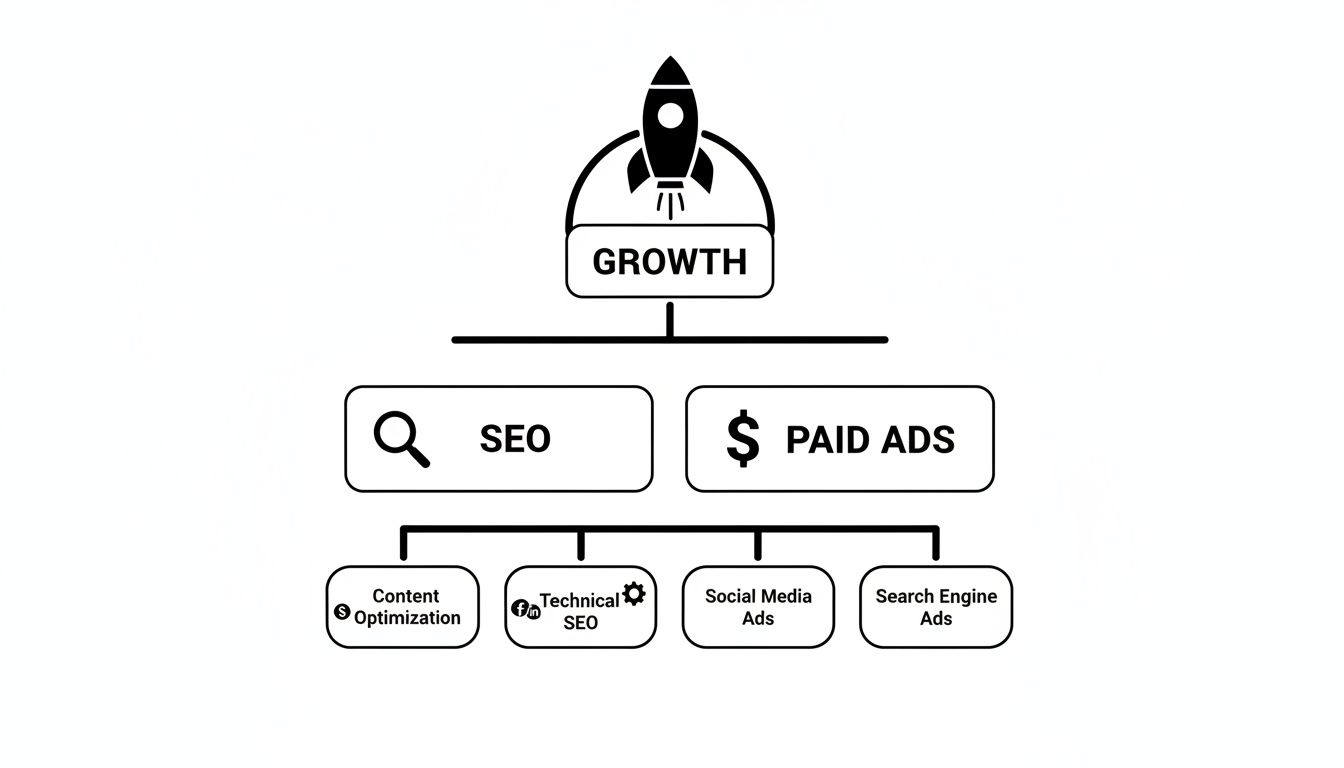
This diagram shows how our integrated strategies for SEO and Paid Ads work together to fuel real business growth. You can see that while SEO and paid ads are distinct channels, they both feed into the central goal of sustainable growth, creating a powerful feedback loop that builds on itself.
Your Ecommerce SEO Questions Answered
Over the years, I've had countless chats with ecommerce store owners in Melbourne and right across Australia. While every business is unique, the same core questions about ecommerce SEO tend to pop up again and again.
Here are my honest, straightforward answers to a few of the most common ones I hear.
How Long Does Ecommerce SEO Really Take to Work?
Honestly, it depends. It's the answer no one wants to hear, but it's the truth.
For a brand new store in a competitive niche, you might see some early movement in 3-4 months. But significant, revenue-driving results? That typically takes 6-12 months to really kick in. It’s a marathon, not a sprint.
Factors like your starting point, your industry's competitiveness, and how consistently you apply these strategies all play a huge role. SEO is about building a long-term asset, which is why we often pair it with targeted Google Ads campaigns. This gets you immediate traffic and sales while your organic authority builds in the background.
Should I Focus on Technical SEO or Content?
You absolutely need both. They work hand-in-hand, and you simply can't succeed with just one.
Think of your technical SEO as the foundation of a house. If it's unstable—a slow site, broken links, not mobile-friendly—it doesn’t matter how amazing your content is. A solid technical base, often handled by professional WordPress developers or Shopify developers, is what allows Google to efficiently find, index, and ultimately rank your fantastic product pages and blog posts.
Trying to build a content strategy on a poor technical foundation is like trying to put a beautiful roof on a house with crumbling walls. Eventually, the whole thing will fall down. Fix the foundation first.
Can I Do My Own Ecommerce SEO or Hire an Agency?
You can definitely handle the basics yourself, especially when you're just starting out. Writing unique product descriptions, optimising page titles, and starting a blog are excellent first steps that can make a real difference. Go for it.
However, as you grow, the complexity ramps up significantly. Advanced technical SEO, strategic link building, and managing integrated ad campaigns require specialist expertise and a lot of time.
A dedicated digital marketing agency in Melbourne can accelerate your growth and help you avoid costly mistakes, freeing you up to focus on what you do best: running your business.
Alpha Omega Digital is a marketing agency based in Melbourne, Australia but also services clients from Sydney, Brisbane, Newcastle, Perth, Adelaide, Darwin and Hobart. Have a project in mind? Contact us.
Your Comment
Your email address will not be published. Required fields are marked *