As someone who has been in the trenches building online stores for years, I can tell you that the answer to "which is the best ecommerce platform for Australian businesses?" isn't a simple one. If you ask me, Shopify is often the go-to for a reason—it’s user-friendly, packed with Aussie integrations like Afterpay and Australia Post, and gets you selling fast. But I've also worked with plenty of businesses who crave total control, and for them, building on WooCommerce with a custom WordPress setup gives them a level of creative freedom that's just unmatched.
From my real-world experience, the right choice really comes down to your specific business needs, how comfortable you and your team are with technology, and where you genuinely see your brand in the next few years. It’s a big decision, so let’s break it down.
Choosing Your Platform: An Australian Agency's Perspective

Picking an ecommerce platform feels like a massive commitment, and honestly, it is. As a marketing agency in Melbourne, we at Alpha Omega Digital have seen firsthand how the right foundation can propel a business forward, while the wrong one can become a constant source of frustration and a money pit. My goal with this guide is to cut through the marketing fluff.
I’m not just going to list off features you can find anywhere online. I want to share my real-world experience from building and growing stores for Australian businesses just like yours. My aim here is to give you a clear, practical way to choose a platform that not only works for you today but also fuels your growth tomorrow—without all the confusing tech jargon.
Quick Australian Ecommerce Platform Comparison
To give you a bird's-eye view, here’s a quick breakdown of the most popular platforms I see being used successfully in Australia and who they're generally best for.
| Platform | Best For | Ease of Use | Typical Monthly Cost (AUD) |
|---|---|---|---|
| Shopify | Startups, SMBs, dropshippers, and most retailers needing a fast, reliable launch. | Very High | $44 – $449+ |
| WooCommerce | Businesses wanting full control, content-heavy sites, and custom functionality. | Medium | $30 – $200+ (Varies with hosting/plugins) |
| BigCommerce | Larger businesses, B2B sellers, and stores with very large product catalogues. | High | |
| Squarespace | Creatives, artists, and brands where visual presentation is the top priority. | Very High | $38 – $72+ |
Think of this decision as finding a home for your business online—one that aligns with how you actually operate.
For many Australian businesses, Shopify is the clear frontrunner, capturing a dominant 28% market share among the top local sites. That puts it comfortably ahead of competitors like Squarespace at 24% and WooCommerce at 17%. This market leadership is especially crucial for small businesses in cities like Melbourne, where agencies like ours specialise in building high-converting Shopify stores that perfectly blend slick design with performance marketing. If you're interested, you can explore more data on the ecommerce platform market share to see the trends for yourself.
The Four Pillars of a Successful Ecommerce Platform

Before my team and I even think about a platform's design capabilities or write a single line of code, we put it through a rigorous test. From my experience with Australian clients, every potential platform must stand up to four non-negotiable pillars. Getting these right from the start saves countless headaches and lost revenue down the track.
These aren't just technical checkboxes; they are the fundamental building blocks of a high-performing online store that can actually grow and make money in the Australian market. I've seen businesses ignore one of these and end up with costly problems, from budget blowouts to missed sales opportunities.
Pillar 1: Total Cost of Ownership
The advertised monthly fee is just the tip of the iceberg. I always analyze the total cost of ownership, which gives a much clearer picture of the real investment required. This includes looking at transaction fees, the costs of essential third-party apps, and potential ongoing support you might need from a WordPress developer or Shopify expert.
A platform might seem cheap initially, but if it requires five expensive apps to replicate the native functionality of another, it’s not a cost-effective choice. My team and I map out these hidden costs to ensure there are no surprises for our clients.
Pillar 2: Local Integrations
This pillar is absolutely critical for any business operating in Australia. I personally scrutinise how well a platform supports local payment gateways like Afterpay, Zip, and Stripe right out of the box. Can it seamlessly integrate with Australia Post, Sendle, or other domestic shipping carriers?
A platform that forces you to rely on clunky, third-party workarounds for core local services creates friction for both you and your customers. Smooth, native integrations are a sign that the platform is genuinely invested in the Australian market.
A platform's success in Australia is often determined by its local ecosystem. If it doesn't play well with Australian payment and shipping providers, it creates an unnecessary barrier to conversion and operational efficiency.
Pillar 3: Marketing and SEO Capabilities
Your ecommerce store needs to be a powerful marketing engine, not just a product catalogue. I assess its SEO potential from the ground up. Can you easily edit meta titles, descriptions, and URL structures for local search optimisation?
More importantly, how smoothly does it integrate with essential marketing tools? I look at its compatibility with GTM and Google Analytics, which is vital for setting up sophisticated tracking for Google Shopping Ads and understanding customer behaviour. A platform that makes it difficult to implement the Meta Conversion API for Facebook Ads is an immediate red flag for me. These tools are the backbone of any serious digital marketing strategy, so this isn't negotiable.
Pillar 4: Scalability and Future-Proofing
Finally, I evaluate its ability to grow with you. Will the platform support your business from its first sale to its ten-thousandth without slowing down or requiring a complex and expensive migration? Scalability isn't just about handling more traffic; it's also about having the flexibility to add new features, expand product lines, and integrate with more advanced systems as your business matures. This is where a robust Shopify API or the open nature of WordPress can be a game-changer.
Beyond the choice of platform, understanding the foundational design principles is another key part of building a successful e-commerce presence. A well-structured site improves user experience and conversions, so it's worth reviewing some essential e-commerce website design best practices as you plan your build.
Shopify vs WooCommerce: A Head-to-Head Australian Comparison
This is the classic matchup, the one I talk through with clients at our digital marketing agency in Melbourne almost every week. On one side, you have Shopify, the all-in-one powerhouse that takes the headache out of the technical side of ecommerce, letting you get to market incredibly fast.
On the other is WooCommerce, the endlessly flexible plugin for WordPress that gives you complete ownership and control. As a hands-on WordPress developer, I really appreciate the creative freedom it offers to build genuinely bespoke customer experiences, especially when it comes to WordPress design and building custom blocks in Gutenberg, without being tied down by platform transaction fees.
At the end of the day, Shopify’s convenience comes at the cost of some control, while WooCommerce's freedom means you're on the hook for your own hosting, security, and updates. The choice really boils down to what you value more: streamlined simplicity or total creative and technical freedom.
Core Philosophy and Ease of Use
Shopify is built from the ground up for simplicity. It's a Software-as-a-Service (SaaS) platform, which means they manage all the technical heavy lifting—hosting, security updates, and performance tweaks. For a new business owner who just wants to start selling products, this is a massive plus.
WooCommerce, being a plugin for WordPress, is built on a philosophy of open-source freedom. You have the power to change anything and everything, from the checkout flow to the underlying code. But this demands a more hands-on approach. You’re responsible for picking a hosting provider, installing SSL certificates, and keeping everything up to date.
For many of our clients, the choice comes down to this: Do you want to be a 'renter' with a great landlord who handles all the maintenance (Shopify), or an 'owner' who has total freedom but is also responsible for fixing the plumbing (WooCommerce)?
Marketing and Technical Integrations
From my digital marketing perspective, both platforms can be incredibly powerful, but they handle technical setups differently. Getting tracking tools like Google Tag Manager containers and the Meta Conversion API configured is critical for running effective Facebook Ads and Google Ads campaigns.
With Shopify, these integrations are often handled through apps from their marketplace, which can be as simple as a one-click install. WooCommerce, however, typically gives you more direct control. This often involves using plugins or adding code snippets directly to your theme files—a task that might need a WordPress web developer. The ability to do a manual conversions API installation for Meta gives you a level of data control that some marketers, myself included, really value.
WooCommerce is all about empowering you to build a powerful commerce engine right on top of the world’s most popular content management system, giving you one unified platform for content and sales.
Customisation and Control
This is where the two platforms really part ways. Shopify's customisation happens within the guardrails of its theme architecture and App Store. While you can achieve a lot with a premium theme and the right apps, you're still playing in Shopify's sandbox. For truly unique features, you’d need a specialised Shopify developer for Shopify development, or even for building custom Shopify apps using Shopify CLI.
WooCommerce, on the other hand, offers almost limitless customisation. Because it’s open-source, a skilled WordPress development company can build virtually any feature you can dream up, from complex product configurators to very specific shipping rules. For businesses that need fine-grained control over shipping, especially for regulated goods, checking out the best shipping restriction plugins for WooCommerce shows just how deep the customisation can go.
Shopify vs WooCommerce Australian Feature Breakdown
To make things clearer, here’s a direct comparison of how the two platforms stack up on the key features that matter for Australian businesses from my experience.
| Feature | Shopify | WooCommerce (WordPress) |
|---|---|---|
| Setup Speed | Very fast; you can launch a basic store in a weekend. | Slower; requires setting up hosting, WordPress, and the plugin. |
| Technical Skill | Low; designed for beginners with no coding knowledge. | Medium to High; some familiarity with WordPress is a must. |
| Local SEO | Good, but the URL structure can be a bit rigid. | Excellent; you have full control over every single SEO element. |
| Transaction Fees | 0.5% – 2% (unless you use Shopify Payments). | None from the platform itself (you only pay your payment gateway fees). |
| Ongoing Costs | Fixed monthly subscription + any app fees. | Hosting fees + any premium plugin costs. Can be cheaper to start. |
| Support | 24/7 direct support via chat, email, and phone. | Community forums and paid support from your hosting or plugin developers. |
Ultimately, Shopify excels for businesses that want a fast, simple, and reliable path to selling online, while WooCommerce is the go-to for those who need deep customisation and full control over their digital destiny.
While Shopify and WooCommerce get all the limelight, there are a few other platforms that serve specific Australian businesses exceptionally well. As a digital agency here in Melbourne, I often look beyond the two giants to find the perfect match for a client's unique situation.
BigCommerce, Neto, and Squarespace each have their own distinct strengths, making them the right call in certain scenarios. It’s less about which one is universally “best” and more about which one fits your business model—whether you're a large-scale retailer needing serious horsepower, an omnichannel business with Aussie roots, or a creative brand where looks are everything.
BigCommerce: The Built-in Powerhouse
BigCommerce goes head-to-head with Shopify but plays the game a little differently. Its core strength, in my opinion, is the sheer amount of advanced functionality that comes standard, right out of the box.
For bigger businesses or those with really complex product catalogues, this is a massive advantage. Instead of relying on a dozen paid apps for things like advanced product filtering, customer groups, or faceted search, BigCommerce includes most of it natively. This seriously cuts down on "app fatigue" and can lower your total cost of ownership as you scale.
From my experience, BigCommerce is a fantastic option for B2B businesses or stores with massive, complex inventories. The platform is built to handle thousands of SKUs and intricate product variations without needing a patchwork of third-party solutions.
The platform is designed for serious ecommerce, offering a robust foundation for businesses that have well and truly outgrown simpler solutions. A quick look at their Australian homepage shows you exactly where their focus lies: enterprise-level features.
This all-in-one, comprehensive approach is what makes BigCommerce such a compelling choice for established retailers looking for a powerful, integrated solution.
Neto (Cin7): The Australian Omnichannel Specialist
Neto, now part of the inventory management giant Cin7, is as Australian as it gets. It was designed from the ground up for the local market, and you can feel that heritage in its DNA.
Its main strength lies in its deep integration with the Australian retail ecosystem. If you run a brick-and-mortar store alongside your online shop, Neto becomes particularly compelling. It connects seamlessly with:
- Australian POS systems: Unify your in-store and online sales data without any fuss.
- Local accounting software: Sync your financials with platforms like Xero or MYOB.
- Australian shipping carriers: Get real-time quotes and streamlined fulfilment with Australia Post, StarTrack, and others.
This makes it a prime choice for omnichannel retailers who need a single source of truth for their entire operation. While other platforms can pull this off with apps, Neto’s native connections are just more reliable and deeply embedded.
Squarespace: The Visual Storyteller
Squarespace has come a long way from just being a portfolio builder. It now offers solid ecommerce functionality wrapped in its award-winning, visually stunning templates. For brands where aesthetics are everything—think artists, designers, photographers, or high-end bespoke products—Squarespace is an excellent choice.
Its drag-and-drop editor is incredibly intuitive, letting you create beautiful, magazine-worthy storefronts without touching a line of code. But this focus on design and simplicity does come with trade-offs.
The platform's ecommerce engine can feel a bit limiting for stores with large or complex inventories. If your business needs deep technical customisation, like building custom apps using the Shopify API or implementing intricate GTM and Google Analytics tracking setups, you'll find Squarespace restrictive pretty quickly. It absolutely nails the presentation but lacks the raw ecommerce power and extensibility of platforms like BigCommerce or WooCommerce.
Matching the Right Platform to Your Business Model
The question I get asked most isn't "what's the best platform?" but "what's the best platform for me?". And that's the right question to ask. The truth is, the ‘best’ platform is simply the one that slots perfectly into your specific business model, your budget, and where you want to be in a few years. There’s no single right answer, but there are definitely right answers for specific situations.
From my experience working with Aussie businesses, I’ve seen what works and what doesn't. It really just comes down to matching a platform's core strengths to your day-to-day reality.
The Startup and Direct-to-Consumer Brand
For startups, dropshippers, and direct-to-consumer (D2C) brands, the goal is speed. You need to launch fast, prove your product has legs, and get sales in the door. For this, my recommendation is almost always Shopify. Its all-in-one nature gets rid of the technical headaches, letting you pour your energy into what matters: marketing, creative, and running effective Google Shopping ads. The whole ecosystem is built for simplicity, which is exactly what a new venture needs, and it integrates perfectly with Instagram Shop and Facebook Shop for social selling.
The Established Brand with Unique Needs
When you're a more established business with unique processes or a heavy focus on content marketing, a custom WordPress development project with WooCommerce often delivers the best long-term value. This path gives you complete freedom. You own everything, and you can build any feature or integration you can dream up without being boxed in by a platform's rules. It’s the perfect choice for brands that view their website as a core, evolving asset—not just another sales channel.
This decision tree infographic helps visualise the choice between other strong contenders based on your business focus.
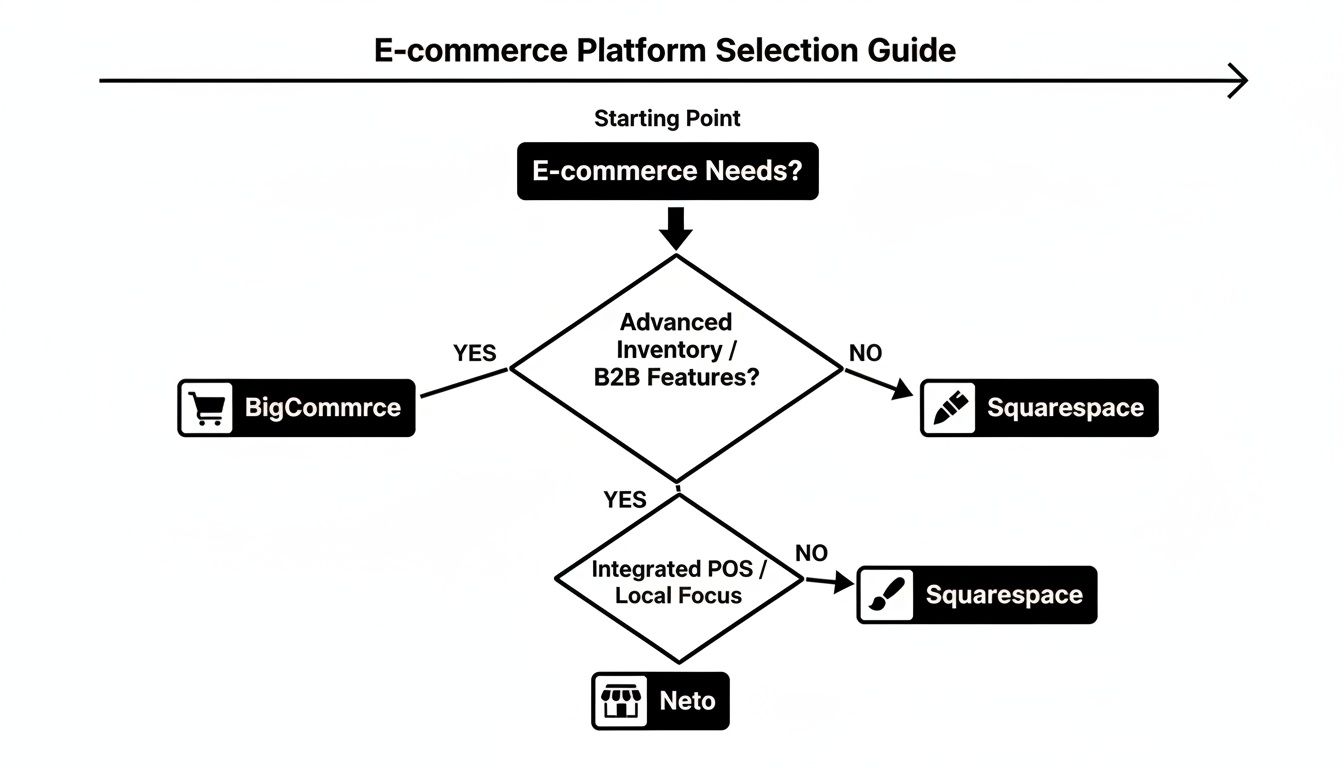
The key takeaway here is how specific needs, like B2B functionality or strong local POS integration, can point you directly to platforms like BigCommerce or Neto.
The B2B and Large Catalogue Retailer
BigCommerce is an absolute powerhouse for B2B companies or stores juggling massive, complex catalogues. It comes with a huge number of advanced features right out of the box, which cuts down your reliance on third-party apps and often lowers the total cost of ownership as you grow. If your business model involves tiered pricing, customer groups, and managing thousands of SKUs, BigCommerce is built to handle that kind of complexity from day one.
The Omnichannel Australian Retailer
For retailers with a serious brick-and-mortar footprint here in Australia, Neto (now Cin7) offers a compelling advantage. Its deep, native integrations with Australian point-of-sale systems, local couriers like Australia Post, and accounting software make it a standout choice for unifying online and offline operations. That sharp focus on the local retail ecosystem can solve a lot of logistical headaches for omnichannel businesses.
Choosing the right platform is about honestly assessing your current needs and future goals. A platform that feels perfect for a fast launch might become restrictive in three years, while a more complex platform might be overkill for a simple startup.
Ultimately, selecting the best ecommerce platform in Australia requires looking beyond feature lists. You have to understand how each system will support your day-to-day operations and your long-term vision.
When to Partner with an Ecommerce Agency
Getting an online store live is one thing. Building a high-performance sales engine that actually drives consistent revenue? That’s an entirely different game. While DIY platforms like Shopify and Squarespace are incredibly accessible, I've found that partnering with a professional team is how you unlock your true growth potential and sidestep those expensive rookie mistakes.
Think of it like this: the platform is the vehicle, but an expert agency is the skilled driver who knows the racetrack inside out. As a marketing agency in Melbourne, I often see business owners get stuck on technical hurdles that stall their growth. That's the perfect moment to bring in an expert.
When Your Platform Feels Limiting
One of the most common triggers is feeling boxed in by your platform’s built-in features. You might have a brilliant idea for a unique customer experience or a custom feature that would set you apart, but no way to actually build it. This is where a team with deep development skills becomes essential.
My team's expertise includes:
- Custom Shopify Development: We do more than just Shopify design; we build private apps and work with the Shopify developer API to create features you simply can't find on the App Store.
- Advanced WordPress Development: For businesses on WooCommerce, we offer comprehensive WordPress development, building custom Gutenberg blocks and crafting truly bespoke brand experiences.
If your platform is holding your vision back, it’s a clear sign you need a development partner.
When Your Marketing Spend Isn't Delivering Results
Pouring money into ads without seeing a real return is a frustrating and expensive cycle. I've seen it many times, and more often than not, the problem isn't the ad creative itself, but the technical foundation it's built on. Inaccurate data leads to poor targeting, which means your ad spend gets wasted. That's where a specialist Facebook ads agency comes in.
We specialise in the complex technical setups needed for high-performing campaigns. This includes the precise implementation of Google Tag Manager containers and the meticulous setup of the Meta Conversion API. Getting this right ensures your tracking is accurate, your audiences are well-defined, and every dollar in your ad budget works as hard as it possibly can. My team and I live and breathe this stuff, from Meta ads creative testing processes to understanding the nuances of PMAX vs Google Shopping ads.
Partnering with an agency isn't an admission of failure; it's a strategic decision to accelerate growth. It's about recognising that your time is better spent on your products and customers, while experts handle the technical complexities of digital marketing and development.
When You Need a Cohesive Growth Strategy
Finally, it’s time to call in an agency when you need a single, unified strategy that connects your website, your marketing, and your customer data into one powerful system. If your local SEO is lagging, your Google Ads campaigns are underperforming, and you aren't sure which levers to pull, an expert can provide clarity and a clear path forward.
As you can see from a screenshot of our contact page, getting started is straightforward.
This form is the first step towards creating a cohesive strategy that integrates everything from local SEO to sophisticated ad campaigns. Alpha Omega Digital is a marketing agency based in Melbourne, Australia, but we also service clients from Sydney, Brisbane, Newcastle, Perth, Adelaide, Darwin and Hobart. Have a project in mind? Contact us today.
Your Top Ecommerce Platform Questions, Answered
Over the years, I've had countless conversations with Australian business owners trying to navigate this exact decision. They all tend to circle back to the same few critical questions. Getting these right from the start can save you a world of pain down the track.
How Much Does an Ecommerce Website Actually Cost in Australia?
This is the classic "how long is a piece of string?" question. The truth is, the cost can swing dramatically.
On one end of the spectrum, you can get a DIY site up and running on Shopify or Squarespace for around $50 a month plus some transaction fees. This is a brilliant, low-risk way to validate an idea or get a simple store online without a massive upfront commitment.
On the other end, a custom-built store from a team like ours can range from a few thousand dollars into the tens of thousands. It all comes down to the complexity of the design, the specific features you need, and the integrations required to make it all work seamlessly. I’ve always encouraged clients to see this not as a cost, but as a core investment in their single most important business asset.
Which Platform is Best for SEO in Australia?
Honestly, both Shopify and WooCommerce are absolute powerhouses for SEO when they’re in the right hands. Because it's built on WordPress, WooCommerce gives you slightly more granular control over the nitty-gritty technical SEO elements, especially local SEO for things like your Google My Business profile. This can be a huge plus if you have the in-house know-how or an SEO agency in Melbourne dialing it in for you.
That said, Shopify's entire infrastructure is engineered for speed and mobile-friendliness right out of the box—two of Google’s biggest ranking factors. At the end of the day, your SEO success will hinge far more on your strategy and execution (your content, site health, and backlinks) than the platform itself.
Your choice of platform sets the stage, but great SEO is about the performance you put on it. A well-optimised Shopify store will always outperform a poorly managed WooCommerce site, and vice versa.
Can I Just Switch Platforms Later On?
Yes, you can, but—and this is a big but—it's a highly technical and delicate operation that I would never recommend taking lightly. Migrating a store involves meticulously transferring all your product data, customer accounts, and order history from one system to another. It's not a simple copy-paste job.
The most critical part? You absolutely have to preserve your hard-earned SEO rankings by implementing proper 301 URL redirects. Mess this up, and your search traffic can fall off a cliff overnight. This is one of those jobs where bringing in an experienced WordPress developer or Shopify expert isn't just a good idea; it's essential to avoid catastrophic data loss and protect your visibility.
At Alpha Omega Digital, we don't just build websites; we build the foundations for business growth. We've navigated these challenges with clients across Australia every single day, from our home base in Melbourne to businesses in Sydney, Brisbane, Newcastle, Perth, Adelaide, Darwin and Hobart. Got a project on your mind? Get in touch and let's talk about building something that lasts.