Getting more traffic to your eCommerce website isn't about finding some secret hack. From my experience running a marketing agency here in Melbourne, I've learned it's about building a solid foundation first, then consistently applying the right strategies. It all starts with a technically sound website that search engines can actually understand, followed by creating genuinely valuable content that speaks directly to your ideal customer.
Your Foundation for Driving More Clicks
Whenever I sit down with a new eCommerce client here at my marketing agency in Melbourne, the conversation always starts in the same place. Before we even think about running a single Facebook ad or writing a blog post, we have to talk about the foundation. It’s the least glamorous part of marketing, but honestly, without it, everything else is just a waste of time and money.
Sustainable website traffic is built on a reliable platform that works for you 24/7. This means getting the non-negotiable pillars right from the very beginning. For us, that always starts with the technical stuff.
Mastering Your Technical and Local SEO
The first thing we do is a deep dive into technical SEO. Think of it like this: if Google's crawlers can't properly find, read, and understand your Shopify or WordPress site, you're pretty much invisible. We check for things like site speed, mobile-friendliness, and clean URL structures – the signals that tell Google your site is a quality destination.
Next, especially for businesses with a physical shop or a defined service area, we get laser-focused on local SEO. This is incredibly powerful. Optimising your Google Business Profile (formerly Google My Business) is an absolute must. It’s how you capture that high-intent "near me" traffic from potential customers in cities like Melbourne, Sydney, or Brisbane who are ready to buy now.
We had a Melbourne-based client selling specialty coffee beans. Their online store was beautiful, but their local traffic was non-existent. By simply optimising their Google Business Profile with the right categories, photos, and encouraging reviews, we saw a 40% increase in local search traffic within two months.
Why a Mobile-First Design Is Non-Negotiable
Here in Australia, the vast majority of online shopping happens on a mobile phone. A "mobile-first" design isn't just a trendy term; it's a critical business requirement. This means your website shouldn't just work on mobile; it should be designed for mobile from the ground up.
If a customer has to pinch and zoom to read your product descriptions or fumbles through a clunky checkout on their phone, they're gone. We've seen conversion rates plummet on sites with poor mobile experiences. A seamless journey from discovery to purchase on a small screen is key to turning traffic into revenue.
- Fast Loading Times: Every second counts. A slow site on mobile will lose customers before they even see your products.
- Simple Navigation: Menus should be clear, and finding products should be effortless with just a thumb.
- Easy Checkout Process: Forms should be simple, with options like Apple Pay or Google Pay to reduce friction.
Ultimately, building this strong foundation is about making it easy for both search engines and humans to love your site. This focus on organic growth is essential because it drives the most qualified and consistent traffic. In Australia, organic search accounts for a massive 68% of all website visits. Furthermore, sites that maintain regular content updates see, on average, 55% more traffic than those that don't, which shows the power of combining a solid technical base with consistent effort. You can find more Australian SEO insights and see how these numbers stack up.
As a digital marketing agency in Melbourne, we see this play out every day. Get the foundation right, and you're setting yourself up for long-term, profitable growth.
Alpha Omega Digital is a marketing agency based in Melbourne, Australia but also services clients from Sydney, Brisbane, Newcastle, Perth, Adelaide, Darwin and Hobart. Have a project in mind? Contact us.
Driving Organic Traffic with SEO and Content
Alright, let's get into the real engine room of sustainable traffic growth: organic search. This is where the magic of consistency happens. As a digital marketing agency in Melbourne, I’ve seen firsthand how a smart content strategy can completely transform a business. It’s not about churning out endless blog posts; it’s about creating a powerful content ecosystem that pulls in your ideal customer.
The entire process kicks off with a simple but crucial step: understanding what people are actually searching for. I’m not talking about guessing or focusing on broad, obvious keywords. The real gold is in uncovering the specific questions and problems your customers have.
Uncovering What Your Audience Really Wants
We always start with deep-dive keyword research. Our goal is to find what we call "profitable long-tail keywords"—those longer, more specific phrases that tell you a user is much closer to making a purchase.
For example, instead of targeting a vague term like "women's shoes," we'd dig deeper for something like "comfortable black leather ankle boots Melbourne." The person searching for the latter knows exactly what they want, and if you can provide it, you're far more likely to land the sale.
This research underpins every single piece of content we create, from high-value blog posts and buying guides to the descriptions on your product pages. It’s about answering questions before they're even asked, building trust and authority with every click. For those using video, applying effective video SEO strategies is absolutely paramount for boosting discoverability and pulling in more organic traffic.
Turning Keywords into High-Ranking Content
Once we have our list of target keywords, the next job is to create content that Google loves to rank. This involves way more than just stuffing keywords into a page. It's about structuring your content logically and making it incredibly valuable for the reader.
We don't just write text; we build engaging experiences. Here's a look at how we approach this for different platforms:
- For WordPress Development: We often build custom blocks in Gutenberg. This lets us create unique, reusable content modules—like styled testimonials, product feature boxes, or interactive FAQs—that make blog posts far more dynamic and engaging than a simple wall of text.
- For Shopify Development: A huge focus is structuring Shopify collections and product pages for maximum search visibility. This means optimising titles, writing compelling descriptions that use target keywords naturally, and ensuring the user experience is completely seamless from search to checkout.
In my experience, marketing your business is all about consistency. Sporadic blog posts get sporadic results. A steady drumbeat of valuable content is what builds momentum and tells Google that your site is a reliable authority in its niche.
Building Your Content Ecosystem
Every piece of content should work together. A blog post about "How to Style a Linen Shirt" should link directly to your linen shirt products. A guide to "Choosing the Right Skincare for Dry Skin" should feature your relevant moisturisers and serums. This internal linking is crucial for SEO and for guiding users on a journey through your site.
The Australian online marketplace paints a clear picture of why this matters. As of early 2025, temu.com saw its annual website traffic grow by over 56% in Australia, showing just how effective modern acquisition strategies can be. In contrast, ebay.com.au's traffic declined by almost 12%, a sign that even established giants must constantly adapt. This shows how vital it is for your eCommerce brand to have an evolving and competitive strategy.
By consistently creating content that solves problems and guides users, you position your brand as the go-to expert. This is how you win at organic search and drive website traffic that lasts.
Alpha Omega Digital is a marketing agency based in Melbourne, Australia but also services clients from Sydney, Brisbane, Newcastle, Perth, Adelaide, Darwin and Hobart. Have a project in mind? Contact us.
Using Paid Ads to Accelerate Your Growth
While SEO and content are building your long-term organic foundation, sometimes you just need to turn on the tap and get customers to your site right now. That’s exactly where paid advertising shines. As a digital marketing agency in Melbourne that lives and breathes this stuff, I've seen firsthand how a sharp ad campaign can deliver immediate, measurable results for eCommerce stores.
Paid ads on platforms like Google and Meta (that’s Facebook and Instagram) let you skip the slow burn of organic growth. You can place your products directly in front of people who are actively looking to buy, making it a powerful way to accelerate sales, test out new products, and gather invaluable data about your customers.
A Beginner's Guide to Google Shopping Ads
For any eCommerce business—especially if you're just starting out or even dropshipping—Google Shopping ads are a non-negotiable. These aren't your standard text ads. They're the product listings with images and prices you see right at the very top of a Google search, and they're incredibly effective because they capture people with high commercial intent.
Getting started can feel a bit intimidating, but the core process is actually pretty straightforward:
- Set Up Google Merchant Center: This is where your product feed lives. You'll link it to your Shopify or WordPress site so Google always has the latest info on your products, prices, and stock levels.
- Link to Google Ads: Next, you connect your Merchant Center account to your Google Ads account. This is what allows you to build campaigns using the products from your feed.
- Create Your First Shopping Campaign: Inside Google Ads, you’ll pick your budget, target locations (like Australia), and bidding strategy. For beginners, I always recommend starting with a simple Standard Shopping campaign. It gives you far more control.
One of the most common issues I see is when Google Shopping ads are not spending their budget. This usually points to a few classic culprits: your bids might be too low, your product feed could have errors, or your audience targeting is way too narrow. Start by checking your Merchant Center for any disapproved products and then slowly increase your bids to see if that kickstarts delivery.
PMAX vs Standard Shopping: Which to Choose?
Google will heavily push you towards Performance Max (PMAX) campaigns. These are their newer, heavily automated campaign types that use machine learning to run ads across all of Google's channels (Search, Display, YouTube, etc.) from a single campaign.
- Standard Shopping: Gives you more manual control. You can set negative keywords and have a direct say over bidding. It's fantastic for understanding what works and for businesses with very specific product goals.
- Performance Max (PMAX): Uses automation for a much broader reach. It's powerful, for sure, but it can feel like a "black box," giving you very little insight into where your ads are actually showing up.
My advice? If you're new to this, start with a Standard Shopping campaign. Learn the ropes, figure out which products are actually selling, and gather some solid data. Once you have a handle on what works, you can test PMAX to see if it can scale your results further.
Mastering Meta Ads with a Solid Testing Process
Over on Facebook and Instagram, success is all about the creative. Far too many businesses run a single ad, see poor results, and give up way too early. You have to remember that marketing your business is about consistency, and that includes consistently testing and learning.
At our agency, we follow a strict Meta ads creative testing process. We don't guess what will work; we let the data tell us.
We start by testing multiple variations of ad copy, headlines, and visuals (images vs. videos) against each other in a controlled environment. By isolating one variable at a time, we can definitively see which element resonates most with the audience, leading to a lower cost-per-purchase and a higher return.
We're also obsessive about tracking. Setting up the Meta Conversions API (CAPI) is crucial for accurate measurement these days. It allows you to send conversion data directly from your server to Meta, bypassing browser-based tracking limitations like those from Apple's iOS updates. This, combined with a proper Google Tag Manager and Google Analytics setup, gives you a true picture of your return on ad spend.
What Budget Should You Spend on Google Ads?
This is the million-dollar question: How much does it cost to start Google Ads? There's no single magic number, but I always tell my Melbourne clients to be prepared to invest at least $30-$50 per day as a starting point. This provides enough data for the algorithm to learn and for you to start seeing which campaigns have potential.
Think of that first few hundred dollars not as an expense, but as an investment in data.
Alpha Omega Digital is a marketing agency based in Melbourne, Australia but also services clients from Sydney, Brisbane, Newcastle, Perth, Adelaide, Darwin and Hobart. Have a project in mind? Contact us.
The Technical Toolkit for Accurate Tracking
If you're serious about scaling your website traffic—and more importantly, your revenue—you have to get obsessed with data. But I’m not talking about just any data. I’m talking about clean, reliable data. This is the behind-the-scenes work that turns your marketing from a guessing game into a predictable growth engine.
This is where we get our hands a little dirty on the technical side. As a digital marketing agency in Melbourne, I've seen countless businesses spend a fortune on ads, only to have no real idea what’s actually working because their tracking is a complete mess. Let's fix that.
Setting Up Your Tracking Foundation With GTM
The first tool in our kit is Google Tag Manager (GTM). The best way to think of GTM is as a toolbox that holds all your other tools (like your tracking scripts). Instead of bugging a developer to add bits of code to your website for Facebook, Google Analytics, or other platforms, you can manage them all from one central dashboard.
Setting up GTM containers is one of the first things we do for any new client. It gives us the agility to add, edit, or remove tracking tags in minutes, without ever touching the website’s code directly. This is crucial for maintaining site speed and security, especially on custom WordPress or Shopify projects.
Without clean data, you're flying blind. You can't optimise what you can't accurately measure. A proper GTM and Google Analytics setup is the absolute baseline for any business that wants to grow its website traffic effectively.
The Essential Role of The Meta Conversions API
Ever since Apple's iOS 14 update rolled out, tracking ad performance on Facebook and Instagram has become much, much harder. The Meta Conversions API (CAPI) is the solution to this headache. It lets your website's server send conversion data—like purchases or lead form submissions—directly to Meta, bypassing the browser-based tracking limitations that cause so many issues.
A proper CAPI installation is no longer a "nice-to-have"; it's non-negotiable for accurate attribution. Without it, your ad platform will miss a huge number of conversions, making your campaigns look less effective than they truly are. We always prioritise a server-side CAPI setup for our clients to make sure we're making decisions based on the most complete data possible.
Leveraging The Shopify API and Custom Apps
For businesses on Shopify, the possibilities extend even further. The Shopify API is an incredibly powerful tool that allows for deep customisation. While it's definitely more advanced, it opens up a world of potential for increasing website traffic and sales that you just can't get with off-the-shelf apps.
- Building Custom Shopify Apps: Using tools like the Shopify CLI, we can build custom apps that solve unique business problems—from complex inventory management to specialised marketing automations that generic apps simply can't handle.
- Unique Customer Experiences: The API allows us to create truly personalised shopping experiences or build custom blocks and sections in Shopify themes that go way beyond the standard drag-and-drop editor.
Understanding the technical layer of your marketing is a complete game-changer. It ensures every dollar you spend is accounted for and every decision you make is backed by solid data. For more insight into your traffic sources and campaign effectiveness, it's worth reading up on mastering UTM variables for accurate tracking. It's a foundational skill for seeing exactly where your traffic and sales are coming from. This level of detail makes all the difference when you're trying to scale.
Alpha Omega Digital is a marketing agency based in Melbourne, Australia but also services clients from Sydney, Brisbane, Newcastle, Perth, Adelaide, Darwin and Hobart. Have a project in mind? Contact us.
Optimising Your Website for People and Profit
So, you've done the hard work. You've built out your content, started running some Google Shopping ads, and the traffic is finally starting to roll in. But here’s a hard truth I’ve learned from my years running a digital marketing agency in Melbourne: getting people to your website is only half the battle.
If your site is slow, confusing, or feels untrustworthy, that precious traffic you paid for will evaporate in seconds. This next step is all about the human element—turning clicks into customers.
First Impressions Are Everything: Site Speed and Design
Before a visitor ever reads your product description or sees your amazing photos, they experience your site’s speed. If your Shopify or WordPress site takes more than a couple of seconds to load, a huge portion of your visitors will simply hit the "back" button. This is especially true on mobile.
We once worked with an eCommerce client whose beautiful, high-resolution images were crippling their load times. By optimising those images and streamlining their code, we cut their load time in half. The result? A 15% drop in bounce rate and a noticeable lift in conversions, almost overnight.
It’s not just about speed, though. A clean, professional, and intuitive design builds immediate trust.
You wouldn’t trust a physical store with a messy, disorganised layout, and the same logic applies online. A well-structured Shopify or WordPress design tells visitors you’re a legitimate, professional business they can feel safe buying from.
Making It Easy for People to Buy
This is where Conversion Rate Optimisation (CRO) comes into play. It’s the art and science of making it as easy as possible for a visitor to take the action you want them to take—in this case, making a purchase. It's all about removing friction.
Think about your own online shopping experiences. What frustrates you?
- Confusing Navigation: Can users easily find categories and products? A clear, simple menu is non-negotiable.
- Cluttered Product Pages: Is your "Add to Cart" button impossible to miss? Is key information like price and shipping easy to find?
- Complicated Checkout: Do you force users to create an account? Offering a guest checkout and simple payment options like Apple Pay can drastically reduce cart abandonment.
As you tweak things, remember just how critical mobile is. Recent 2025 data shows that with 26.1 million internet users in Australia, nearly half of all online time (48.9%) happens on mobile devices. This isn’t a small segment of your audience; it’s a massive portion that demands a seamless mobile experience. For a deeper dive, you can explore the full Australian digital report to see just how dominant mobile has become.
A fast, mobile-responsive, and easy-to-navigate website isn't just a technical requirement; it's a fundamental part of customer service. It respects your visitors' time and guides them smoothly from interest to purchase, ensuring the traffic you worked so hard to acquire actually turns into profit.
Alpha Omega Digital is a marketing agency based in Melbourne, Australia but also services clients from Sydney, Brisbane, Newcastle, Perth, Adelaide, Darwin and Hobart. Have a project in mind? Contact us.
Wrapping It Up: The Real Secret to Consistent Growth
Getting more website traffic isn't about finding one magic bullet. It’s a marathon, not a sprint, built on consistent, strategic effort day in and day out. The real aim is to build several reliable streams of visitors, so you're never left high and dry if one channel suddenly dips. It all boils down to knowing your customer, creating genuine value, and showing up where they are, again and again.
As a marketing agency in Melbourne, I've seen firsthand that consistency is the engine of growth. Sporadic efforts get you sporadic results. It’s the steady, planned approach across SEO, content, and paid ads that builds unstoppable momentum over time.
This simple flow chart really nails the core principles of turning the traffic you earn into actual sales.
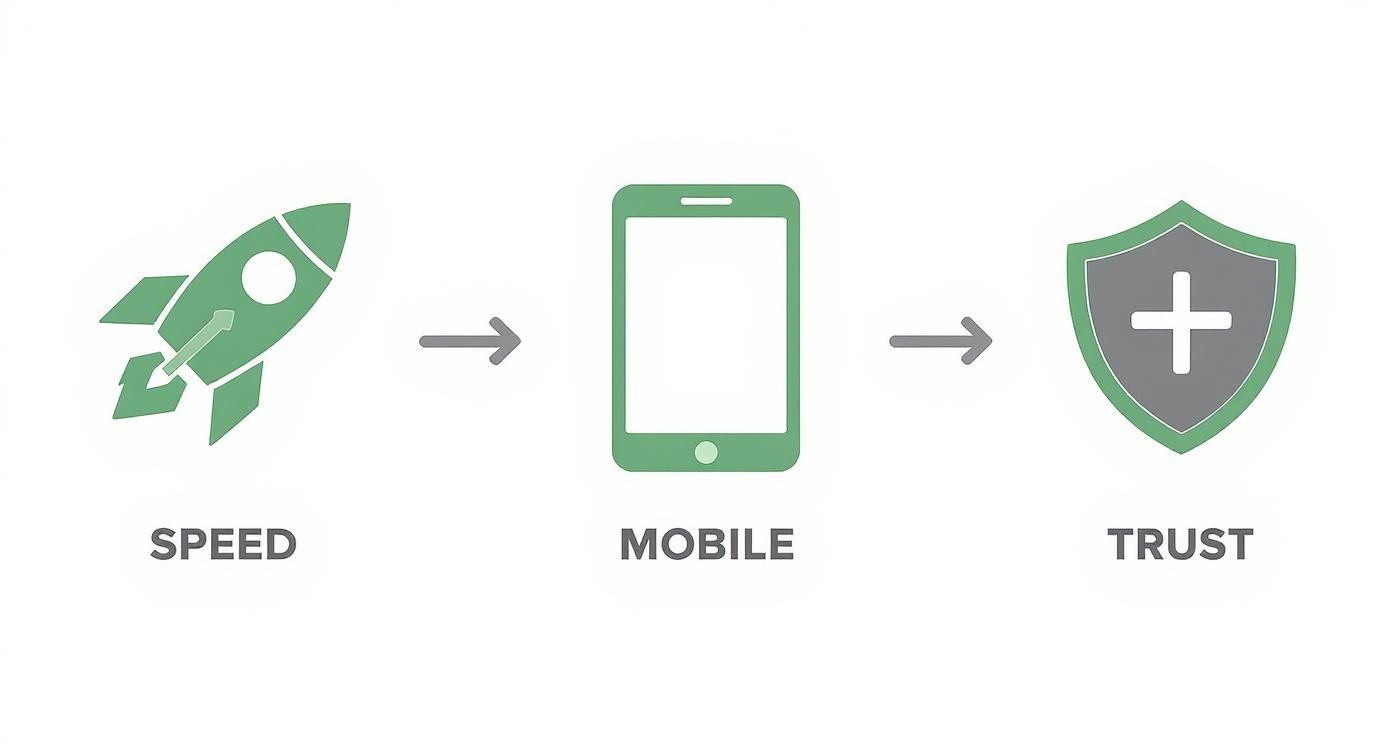
The graphic breaks it down perfectly: a great user experience starts with speed, is built for mobile, and is founded on trust. Nail these three things, and you've got the foundation for turning visitors into loyal customers.
The most successful businesses I’ve worked with, especially in eCommerce, are the ones that commit to the process. They don’t pull their Facebook ads after a week or give up on SEO after a month. They get that sustainable, long-term growth is the real prize.
Whether your business is in Melbourne or anywhere else in Australia, these principles hold true. By combining a technically solid website with content that actually helps people and smart, targeted advertising, you create a powerful engine that attracts your ideal customers, day in and day out.
Alpha Omega Digital is a marketing agency based in Melbourne, Australia, but we work with clients in Sydney, Brisbane, Perth, and right across the country. Got a project you're ready to get serious about? Get in touch with us.
A Few Common Questions We Get Asked
These are the kinds of conversations I have every single week with business owners right here in Australia. If you've been wondering about any of these, you're not alone.
How Long Does SEO Actually Take to Work?
This is easily the most common question I get asked, especially from businesses here in Melbourne. The honest, no-fluff answer is that SEO is a long game. It's an asset you build over time.
While you might see some positive signs within the first three months, it really takes a solid 6 to 12 months of consistent effort to see significant, game-changing organic traffic.
Think of it this way: the work you put in today pays dividends for years to come, long after you've stopped paying for an ad click. The exact timeline always depends on how competitive your industry is, your website's current authority, and how consistently you stick with the strategy.
What's a Realistic Starting Budget for Google Ads?
For a new eCommerce store dipping its toes in the water, I generally recommend starting with a daily budget of at least $30 to $50. That’s usually enough to get the ball rolling, gather some real data, and let the algorithm start learning what works.
But the key isn't just the raw budget; it's how you use it. I’ve found that kicking things off with a super-targeted Google Shopping campaign focused on your most profitable products is the smartest move. It puts your money exactly where the highest purchase intent is.
Should I Focus on SEO or Paid Ads First?
Ah, the classic chicken-or-the-egg question. Ideally? You do both at the same time. They complement each other beautifully.
Paid ads get you immediate traffic and sales, which is great for cash flow. But more importantly, they give you priceless data on which keywords and products actually convert. You can then feed those proven winners directly into your long-term SEO strategy.
If you absolutely have to choose one to start, paid ads will give you faster results and data. SEO, on the other hand, builds a sustainable, long-term asset that reduces your reliance on ad spend over time.
Why Am I Getting Traffic but No Sales?
This is a frustrating one, but it’s more common than you think. Nine times out of ten, it points to a major disconnect between your traffic and what people experience when they land on your website.
Either the traffic you're attracting is low-quality (think window shoppers, not buyers), or your site has some serious conversion roadblocks.
The usual culprits I see are:
- Painfully slow loading speeds, especially on mobile devices.
- A confusing or clunky checkout process that makes people give up.
- A lack of trust signals, like customer reviews, clear return policies, or secure payment badges.
This is exactly where Conversion Rate Optimisation (CRO) becomes your best friend. You need to get into the data, analyse the user journey, and start plugging the leaks in your sales funnel.
Alpha Omega Digital is a marketing agency based in Melbourne, Australia but also services clients from Sydney, Brisbane, Newcastle, Perth, Adelaide, Darwin and Hobart. Have a project in mind? Let's have a chat.