From my experience, I've seen countless Melbourne ecommerce founders try to juggle everything, and paid ads are often the first thing to become a time-sink. That's why so many are turning to specialist pay per click agencies. It's not just about offloading tasks; it's a strategic move to gain a competitive edge.
Why Smart Ecommerce Brands Partner With PPC Agencies

When you're running a Shopify or WordPress store, every minute of your day is precious. You’re focused on product development, inventory management, and customer service. Attempting to master the complex, ever-shifting rules of Google Ads or Meta Ads on top of that is a recipe for burnout and wasted money.
I've seen it firsthand. A brilliant business owner pours thousands of dollars into campaigns with little to show for it. The issue isn't their product or their work ethic; it's a lack of specialised knowledge. This is precisely where a partnership with a dedicated marketing agency in Melbourne makes a huge difference.
Beyond Clicks to Strategic Growth
A common misconception is that a PPC agency simply "runs your ads." In reality, a true partnership is about building a scalable growth engine for your business. It’s about having a team of experts who live and breathe this stuff, obsessing over your Return on Ad Spend (ROAS) so you don't have to.
This move from DIY to a professional agency is becoming increasingly common. The adoption of PPC advertising among Australian SMBs has surged, with 65% of SMBs actively running PPC campaigns as of 2025. This is a massive jump from just 26% in 2016, and with 95% of businesses reporting a positive ROI, it’s clear why so many are increasing their ad budgets. You can discover more insights about this trend on RockingWeb.com.au.
A great agency brings several key advantages to the table, and it’s these benefits that really move the needle for your store.
Core Benefits of a Specialised PPC Agency Partnership
| Benefit | What This Means for Your Ecommerce Store |
|---|---|
| Deep Platform Expertise | You get a team that masters platforms like Google Ads and Meta Ads, understanding nuances that take years to learn. This covers everything from campaign structure and bidding to creative testing. |
| Technical Proficiency | They handle the complex setups like Google Tag Manager, the Meta Conversions API, and Google Analytics 4, ensuring your data is accurate and reliable from day one. |
| Time Savings | Outsourcing frees you to focus on what you do best—running your business. The hours you save from not building, monitoring, and optimising campaigns are invaluable. |
| Strategic Insight | Beyond just managing bids, an agency provides a strategic perspective. They analyse market trends, competitor activity, and customer behaviour to find new opportunities for growth. |
Ultimately, it’s about having a dedicated growth partner in your corner, not just another vendor.
A Focus on Ecommerce Success
For ecommerce brands specifically, working with an agency that understands the entire customer journey is critical. It's not just about driving traffic; it's about converting that traffic into sales.
A specialist agency knows how to craft compelling Google Shopping ads, run effective retargeting campaigns on Instagram, and optimise landing pages on Shopify or WordPress to maximise conversions.
They can help you navigate common ecommerce challenges, like figuring out what budget to spend on Google Ads or troubleshooting why your Google Shopping ads are not spending budget. Ultimately, partnering with one of the right pay per click agencies is an investment in expertise, efficiency, and profitable growth.
What a Results-Driven PPC Agency Actually Does
So, what are you actually paying for when you hire a pay per click agency? When I talk to business owners, there's often a bit of a mystery around what a good agency really does behind the scenes. It’s so much more than just picking a few keywords and throwing some money at Google Ads.
Think of it less like hiring a freelancer for one task and more like bringing on a dedicated growth department for your brand. A high-impact agency delivers a whole suite of specialised services designed to work together, turning your ad spend into predictable revenue.
The Strategic Foundation of PPC
Before a single dollar of your budget gets spent, the real work begins. This is the part that separates the pros from the amateurs, and it's where campaigns are won or lost before they even launch. A great agency will start with a deep dive into your business, your market, and your customers.
This initial phase always includes:
- Deep-Dive Keyword Research: This isn’t just about finding the obvious, high-traffic terms. We hunt for the long-tail keywords—those longer, more specific phrases—that show serious buyer intent, the ones your competitors are probably ignoring. For an online store, that means finding gold like "vegan leather crossbody bag melbourne" instead of just "handbags."
- Competitor Analysis: We get into the trenches and see exactly what your competitors are doing. What are they spending, where are their ads showing up, and what messaging are they using? This lets us spot gaps in the market and find opportunities to get ahead.
- Audience Persona Development: We get crystal clear on who your ideal customer is—what they care about, what problems they have, and where they hang out online. This understanding shapes everything from the ad copy we write to the platforms we target.
Campaign Build and Technical Execution
With a solid strategy in place, the technical work kicks off. This is where expertise in platforms like Shopify and WordPress becomes non-negotiable, especially for a digital marketing agency in Melbourne focused on e-commerce. It’s one thing to have a plan; it’s another to have the technical chops to execute it flawlessly.
In Australia, the best PPC agencies have become a core part of the marketing ecosystem for this very reason, delivering specialised setups that genuinely boost conversions. Client reviews often point to huge wins in cost-efficiency and traffic, all thanks to this hands-on, personalised campaign management.
A truly results-driven PPC agency won’t just manage your ad spend. They’ll help you understand the critical difference between ROI and ROAS to make sure every campaign is driving real, measurable profit for your business.
This execution phase is where the magic happens. A top-tier agency will handle the entire technical stack for you.
Essential Technical Setups
- Google Tag Manager (GTM) & Analytics: We set up GTM to manage all your tracking scripts in one clean, organised place. This ensures your Google Analytics 4 is collecting rock-solid data on user behaviour, conversions, and revenue. No guesswork allowed.
- Meta Conversions API: With all the privacy changes making browser-based tracking less reliable, setting up the Conversions API is a must. It creates a direct, server-to-server connection so your Meta Ads (Facebook & Instagram) get more accurate conversion data, even if a user has tracking blockers.
- Google Shopping & Merchant Center: For any product-based business, this is your lifeline. We make sure your product feed is perfectly optimised, your Merchant Center account is free of errors, and your Shopping campaigns are structured for maximum profitability. This also means knowing when to use PMAX vs Google Shopping ads to get the best results.
From here, we move into building and launching the campaigns themselves—crafting compelling ad copy, designing visuals that stop the scroll, and structuring campaigns to drive specific actions, like contact form submissions or direct sales. This full-service approach ensures every part of the machine is working together to get you real results.
How Pay Per Click Agencies Structure Their Fees
So, let's talk about the big question: "How much is this actually going to cost me?" It's the first thing most business owners ask, and for good reason. The answer isn't always straightforward because not every pay per click agency uses the same pricing structure. I'm going to pull back the curtain on the most common models you'll run into.
After years of running a marketing agency in Melbourne, I've seen it all, but most pricing plans fall into one of three buckets. Each has its own rhythm, especially for an e-commerce store where ad spend can jump around from month to month.
Percentage of Ad Spend
This is probably the most common model out there. The agency takes a cut of your monthly ad spend as their management fee, usually somewhere between 15% and 30%. So, if you're spending $5,000 a month on Google Ads and the agency's fee is 20%, you'd pay them $1,000 to manage everything.
It's a popular approach because it scales naturally. As your business grows and you decide to invest more into ads, the agency’s fee grows too. This gives them a built-in reason to help you scale your campaigns effectively. The only thing to watch for is an agency focused on just pushing up your spend instead of homing in on what’s profitable (your ROAS).
A good agency will only ever suggest spending more because something is working brilliantly and it’s time to pour fuel on the fire. It’s a conversation about scaling results, not just scaling budgets.
Flat Monthly Retainer
This one is as simple as it sounds. You pay a fixed amount every single month, no matter what your ad spend is. For business owners who need predictable costs, this is a huge win. You know exactly what’s coming out of the bank each month.
An agency might charge a flat $2,000 a month to handle all your campaigns, for example. Some agencies also use a tiered system. A store spending $5,000 a month might pay a $1,500 retainer, but once they hit $20,000 in spend, that retainer might jump to $3,500.
The beauty is in the simplicity, but you need to make sure the agency stays hungry. Because their fee isn't directly tied to performance, it’s crucial to have clear goals (KPIs) in place so you know they’re actively working to get you the best results.
Performance-Based Fees
On the surface, this model sounds like a dream come true. The agency’s fee is tied directly to the results they get for you—like the number of leads, sales, or hitting a specific Return On Ad Spend (ROAS). You’re paying for pure, tangible outcomes.
While it sounds like a no-brainer, risk-free option, the devil is in the details. It can get complicated. Not all leads are created equal, and defining what counts as a "sale" can get tricky. This model works best when the goals are crystal clear and easy to track, like a simple contact form on a service website. For a complex Shopify store with different product margins and customer journeys, it can be much harder to set up in a way that’s fair for everyone.
At the end of the day, any of these models can work. The trick is finding a digital marketing agency in Melbourne that offers a structure that feels right for your budget, your goals, and how you want to grow.
How to Choose the Right PPC Agency for Your Ecommerce Store
Picking the wrong PPC agency is a costly mistake I've seen brands make way too often. You end up with torched ad spend, months of lost momentum, and a whole lot of frustration. To stop that from happening, I’ve put together a practical guide to help you cut through the sales pitch and find the signals of genuine expertise.
Finding the right partner is about more than just their client list or a slick presentation. It’s about finding a team that truly gets the ecommerce battleground, especially for platforms like Shopify and WordPress. You need someone who will act like a genuine extension of your team and drive real, profitable growth.
Look Beyond the Highlight Reel
Every single agency will show you their best case studies, but you have to dig deeper. When you're looking at their past work, don't just get mesmerised by the impressive ROAS numbers they flash on the screen. The real story is always in the details and the strategy behind those results.
Start by asking questions that peel back the layers of their process:
- "What was the single biggest challenge with this account, and how did you overcome it?" A good answer will be specific and honest, showing you their real-world problem-solving skills.
- "Can you walk me through the first 90 days on this project?" This reveals their onboarding and strategy development process. A great agency will talk about auditing, technical setup, and initial testing phases, not just "launching campaigns."
- "What was the communication and reporting rhythm like with this client?" This gives you a feel for their transparency and how they operate as a partner.
An agency that can clearly talk you through its strategic thinking is far more valuable than one that just points to a graph going up and to the right. True experts have deep platform knowledge, which is why we also specialise as a WordPress development company. This ensures the technical foundations of your site can actually support the ad campaigns we build.
Assess Their Ecommerce and Platform Acumen
Running ads for an ecommerce store is a completely different ball game to generating leads for a service business. Your potential agency needs to live and breathe the world of online retail. They should be talking your language from the very first conversation.
Listen for their experience with specific ecommerce headaches:
- Optimising Google Shopping feeds and navigating Merchant Center disapprovals.
- Building effective Performance Max campaigns versus standard Shopping.
- Setting up the Meta Conversions API for accurate tracking on Shopify.
- Running a sophisticated Meta ads creative testing process.
An agency that truly gets it will also understand how different marketing channels feed each other. For instance, businesses that combine PPC with SEO in their marketing strategy see, on average, 25% more clicks and enjoy 27% higher profits than those relying on just one. This shows how a holistic view pays off. You can learn more about these digital marketing statistics and see how an integrated approach amplifies results.
Finding the right agency isn't about ticking boxes. It's about finding a team whose expertise aligns with your specific needs, whether that's advanced Shopify development or mastering Google Ads for contact form submissions on a service-based WordPress site.
Before you sign on the dotted line, it pays to have a structured way to evaluate your options. I've put together a simple checklist to guide you through the vetting process. Use these questions during your calls to separate the talkers from the doers.
PPC Agency Vetting Checklist
| Evaluation Area | Key Questions to Ask | What a Good Answer Looks Like |
|---|---|---|
| Strategic Approach | "Can you walk me through your process for auditing a new account?" | They should talk about a deep dive into historical data, audience analysis, competitor research, and technical setup—not just a quick glance. |
| Ecommerce Expertise | "What's your experience with Google Merchant Center and product feed optimisation?" | They'll mention specific tools (e.g., Feedonomics, GoDataFeed), common issues (GTIN errors, disapprovals), and strategies for improving feed quality. |
| Platform Knowledge | "How do you approach tracking in a post-iOS14 world?" | A strong answer involves the Meta Conversions API (CAPI), server-side tagging, and first-party data strategies, not just relying on the pixel. |
| Communication & Reporting | "What does your reporting look like, and how often will we communicate?" | Look for mentions of customised dashboards (not just default reports), scheduled calls, and a clear point of contact. They should report on metrics that matter to you (like profit and new customers), not just clicks. |
| Team & Account Structure | "Who will be working on my account day-to-day?" | You want to hear about experienced account managers and strategists, not a junior person running the show after the senior salesperson closes the deal. |
This checklist isn't exhaustive, but it covers the core areas that separate a top-tier agency from an average one. A great potential partner will welcome these questions and have thoughtful, detailed answers ready.
Prioritise Communication and Transparency
Finally, never underestimate the power of clear, proactive communication. I've seen this single factor make or break an agency-client relationship more times than I can count. A great agency doesn't just email you a report once a month; they keep you in the loop.
During your initial calls, pay close attention to how they communicate. Are they clear and direct? Do they take the time to explain complex concepts without jargon? Are they asking thoughtful questions about your business, or are they just trying to push a pre-made package on you?
The best pay per click agencies are transparent from day one. They’ll be honest about what’s working, what isn’t, and—most importantly—what they're doing to fix it. This partnership approach is what turns a simple vendor relationship into a powerful growth engine for your store.
Your First 90 Days With a New PPC Agency
So, you’ve signed on the dotted line with a new agency. What happens now? A great agency doesn’t just flick a switch and cross its fingers; they walk you through a structured, transparent onboarding process. I want to give you an inside look at what you should really expect in the first 30, 60, and 90 days of a proper partnership.
This initial period is all about building a rock-solid foundation. Think of it as a journey that moves from deep strategy and meticulous technical setup to thoughtful campaign construction and, finally, a carefully managed launch. Forget about getting a simple data dump in a spreadsheet—good reporting tells a clear story about performance, what we’ve learned, and the strategic roadmap for the next month.
The First 30 Days: Foundation and Setup
The first month is hands down the most critical. It’s less about seeing a flood of sales and more about getting all the technical and strategic pieces perfectly aligned. Don't mistake a lack of immediate, massive returns for a lack of progress. The groundwork laid here genuinely determines the success of everything that follows.
During this phase, your agency should be laser-focused on:
- Deep Discovery and Strategy: This kicks off with a call where they dive deep into your business goals, target audience, profit margins, and any past advertising performance. They need to understand your business almost as well as you do.
- Technical Implementation: This part is non-negotiable. They should be setting up or auditing your Google Tag Manager containers, making sure Google Analytics is tracking correctly, and implementing tools like the Meta Conversions API for accurate data.
- Account and Campaign Builds: Armed with a strategy, they’ll start structuring your Google Ads account, building out campaigns, digging into keyword research, and writing that crucial first round of ad copy.
This infographic gives you a visual overview of the key milestones you should hit in your first 90 days.
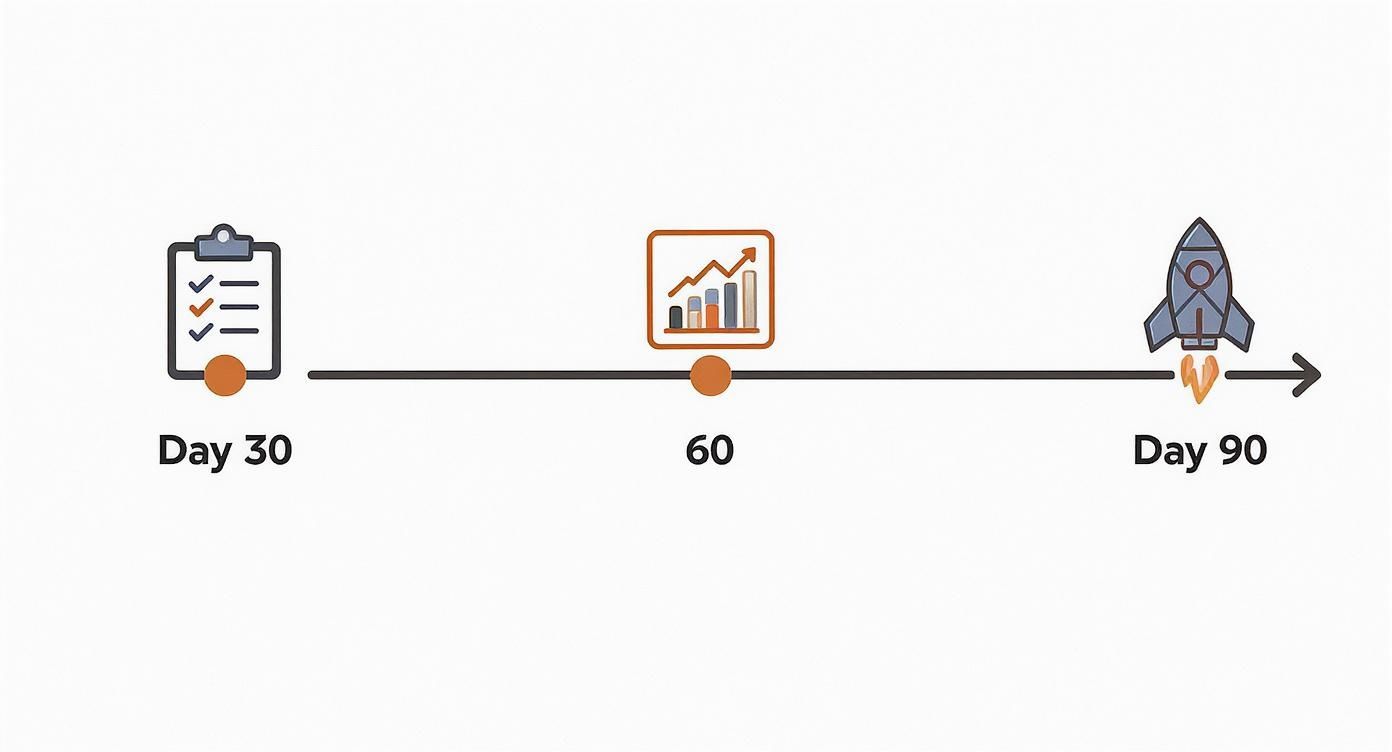
It shows the natural progression from initial planning and setup to data analysis and strategic scaling, which is the core of any successful agency partnership.
The Next 60 Days: Launch and Learn
With the foundation firmly in place, month two is all about launching campaigns and gathering data. This is where the initial hypotheses get tested in the real world. Your agency will be watching performance like a hawk, looking for early signs of what's clicking with your audience and what isn't.
Expect this period to be very hands-on from the agency's side. They should be making frequent, small tweaks to bids, budgets, and targeting based on the data flowing in. Communication is key here; you should receive your first proper report detailing initial results, key learnings, and the plan for the month ahead.
The goal of the second month isn't necessarily massive profit. It’s about achieving statistical significance—gathering enough data to make smart, evidence-based decisions instead of just guessing.
The Final 90 Days: Optimise and Scale
By the time you hit the end of the third month, the fog really starts to clear. Your agency now has enough performance data to pinpoint the winning campaigns, ad creatives, and keywords. The focus shifts from broad testing to aggressive optimisation and scaling what works.
This is when you should start to see a tangible, consistent return on your investment. Your agency will be reallocating budget away from underperforming areas and funnelling it into the campaigns that are driving real results. They’ll be doubling down on the winners, refining your targeting, and exploring new growth opportunities uncovered by the data. This is what sets the stage for a long-term, profitable partnership.
Final Thoughts on Partnering with a PPC Agency
Let's pull this all together. Choosing from the endless list of pay per click agencies out there is a serious investment in your brand's future. After walking through how agencies work, what they charge, and how to spot the good ones, you should feel ready to confidently pick a partner who will actually deliver a powerful return.
From my experience, the key is finding a team that truly lives and breathes e-commerce. You want people who prioritise transparent communication and are genuinely obsessed with your results—not just their own management fees. This is the difference between a simple vendor and a true growth partner.
Finding Your Ideal Growth Partner
The right agency becomes an extension of your own team. They get the technical details that actually matter, from being an expert Shopify developer to building custom solutions as a skilled WordPress developer in Melbourne. This kind of technical skill is the foundation of successful ad campaigns, making sure your landing pages are built to convert and your tracking is flawless.
They also need to be masters of the ad platforms themselves, with deep, hands-on experience in:
- Running a rigorous Meta ads creative testing process to find the visuals that really connect.
- Mastering Google Ads for service-based businesses and e-commerce stores alike.
- Setting up critical infrastructure like the Meta Conversions API for tracking you can actually trust.
At the end of the day, a great agency partnership is about consistency. It's about having a team that shows up every single day, digging into the data, testing new ideas, and pushing your brand forward—one profitable click at a time.
This dedication is what separates the average agencies from the great ones.
Ready to Scale Your Business?
Alpha Omega Digital is a marketing agency based in Melbourne, Australia but also services clients from Sydney, Brisbane, Newcastle, Perth, Adelaide, Darwin and Hobart. Have a project in mind? Contact us
Frequently Asked Questions
Here are my straight-up answers to the questions I get asked most often.
How Much Should an Ecommerce Store Budget for Google Ads?
I've had hundreds of conversations about this, and while there's no single magic number, here's my honest take: if you're a serious ecommerce business in Australia, you need to be prepared to spend $2,000 to $5,000 per month on ads. And just to be clear, that’s purely for the ad spend, not including agency fees.
Why that much? Because anything less makes it incredibly difficult to gather enough data to see what’s working. With a smaller budget, you're essentially flying blind. This amount gives us enough runway to test properly, learn quickly, and start optimising your campaigns for actual results. Of course, we always fine-tune this based on your product margins and how fast you want to grow.
How Long Until We See a Return on Investment From PPC?
You’ll see traffic and clicks almost immediately. That’s the easy part. But getting a stable, profitable return on your investment doesn't happen overnight.
I’m always upfront with my clients about the timeline:
- Month 1: This is all about setup and data gathering. We're testing everything—audiences, ad copy, keywords—to figure out what resonates with your customers.
- Month 2: By now, a clearer picture is forming. We can see which campaigns are winners, and we start shifting your budget to back what's working.
- By the end of Month 3: This is when you should expect to see a consistent, positive ROI.
PPC is a marathon, not a sprint. Be very wary of any agency promising you the world in the first week. It’s just not how it works.
The best agency partnerships are built on the understanding that the first 90 days are an investment in long-term, scalable growth. Patience and a data-driven approach always win out.
What Is the Difference Between SEO and PPC for Ecommerce?
I love this question because it gets to the core of a smart digital strategy. The analogy I always use with my clients seems to make it click.
- PPC is like renting a storefront in the best spot in the mall. The moment you start paying rent, you get a flood of high-quality, targeted foot traffic.
- SEO is like buying the land and building your own flagship store. It takes longer and costs more upfront, but once it’s built, it’s a powerful asset that generates free, organic traffic for years.
The smartest strategy? Do both. A solid SEO campaign, especially from an expert SEO agency in Melbourne, builds your brand’s long-term authority. At the same time, PPC drives immediate sales and gives you invaluable keyword data you can feed back into your SEO efforts. They work together beautifully.
Will I Own My Ad Accounts if I Hire an Agency?
Yes. 100%. This is non-negotiable. You must always have full ownership and admin access to your Google Ads and Meta Business Manager accounts.
Any reputable agency, like us, will work as a partner inside your existing accounts. You should be able to log in and see exactly what we're doing at any time. It ensures total transparency and protects you. If an agency ever insists on creating accounts in their own name that you can’t access, it’s a massive red flag. Walk away.
Alpha Omega Digital is a marketing agency based in Melbourne, Australia but also services clients from Sydney, Brisbane, Newcastle, Perth, Adelaide, Darwin and Hobart.
Have a project in mind? Contact us