When I talk to small business owners about SEO, it's rarely about chasing the same massive keywords as the big corporations. From my experience running a digital marketing agency in Melbourne, it's about being smarter. It's about focusing on high-impact, local strategies that actually make the phone ring and drive real sales, especially for eCommerce businesses.
For a small company, winning at SEO means owning your local market. It means prioritising local SEO and creating content that answers the specific, high-intent questions your real customers are asking right before they're ready to buy. It's about targeting those long-tail keywords with high buyer intent that can easily rank you at number one.
Why Typical SEO Advice Fails Small Businesses
Let's be honest. As a small business owner, you're constantly bombarded with SEO advice that sounds like it was written for a multinational with an unlimited marketing budget. I’ve seen it time and time again from my office here in Melbourne: promising businesses, especially in the eCommerce space, pour money into strategies that are completely disconnected from their reality.
The internet is full of generic tips about complex link-building campaigns and exhaustive technical audits. This is the kind of advice that fails small companies because it’s not built for you. It ignores your most powerful advantage: your direct connection to your customer and your local expertise.
The Corporate Playbook vs Small Business Reality
Most SEO guides push a one-size-fits-all approach. They tell you to target broad, highly competitive keywords, which is like a local online boutique trying to outrank ASOS for "dresses." It's a losing battle from the start.
This disconnect is a huge problem in Australia. While most businesses know they need to be found online, a 2023 study showed that only 36% of small businesses actively use SEO. A big part of that is the fact a staggering 61% haven't even claimed their Google Business Profiles, which can lead to getting up to 7x fewer clicks than competitors who have.
My experience running a digital marketing agency in Melbourne has shown me that the real wins for small companies come from a focused, local-first strategy. It's not about being #1 for everything; it's about being #1 for the customers who are in your city and ready to buy.
Setting The Stage For What Actually Works
Instead of getting lost in complicated theories, my focus here will be on tangible results—more qualified leads, more contact form submissions, and more sales for your eCommerce store. This guide cuts through the noise to give you a practical plan built on high-impact tactics you can implement right away.
We'll concentrate on what truly moves the needle.
Here’s what we'll be digging into:
- Dominating Your Local Area: Turning your Google Business Profile into a lead-generation machine.
- Building a Solid Foundation: Ensuring your website is structured for both Google and your customers.
- Smart Content Creation: Answering the real, high-intent questions your ideal clients are asking.
While typical SEO advice might feel overwhelming, focusing on cost-effective SEO strategies for maximum ROI is how small businesses can thrive without a huge budget. It’s time to forget the corporate playbook and build a strategy that actually works for you.
Mastering Your Local SEO Foundation
If there's one battleground where you, as a small business, can consistently outmanoeuvre the big national players, it's in your own backyard. Local SEO isn't just a part of your strategy; for most small companies, it is the strategy. This is where your real customers are, and it’s where you can get the phone ringing and the online orders coming in.
From my experience as a marketing agency in Melbourne, I've seen countless eCommerce and service businesses transform their fortunes by simply nailing their local presence. It all starts with your single most important local asset: your Google Business Profile (GBP).
Your Google Business Profile Is More Than a Listing
Think of your GBP not as a static listing, but as a dynamic, customer-generating machine. It’s often the very first interaction a potential customer has with your brand. Just claiming it isn't enough; you need to turn it into a powerhouse.
The data paints a clear picture: by 2025, it's expected that 46% of all Google searches in Australia will have local intent. That’s huge, especially when you consider that 78% of mobile searches for local services lead to a visit or call within 24 hours. The numbers don't lie—actively managed profiles get more clicks and higher conversion rates. This is why a top-tier SEO agency in Melbourne will always start here.
To get the most out of it, focus on these key areas:
- Choose Hyper-Specific Categories: Don't just list "Clothing Store." Use secondary categories like "Women's Fashion Boutique," "Sustainable Clothing," or "Vintage Apparel." The more specific you are, the better Google can match you to relevant searches.
- Write Compelling Updates: Use the "Updates" feature to post about new product arrivals, special offers, or recent projects. Treat it like a mini-blog right on the search results page.
- Encourage Authentic Reviews: Actively ask happy customers for reviews. And critically, respond to every single one—good or bad. This shows Google (and customers) that you're engaged and trustworthy.
The Power of NAP Consistency
Beyond your GBP, Google looks for consistent signals about your business across the web. The most critical signal is your NAP—Name, Address, and Phone number.
Every time your business is mentioned online, whether on Yelp, TrueLocal, or an industry-specific directory, your NAP information must be identical. I mean exactly identical. "St." is not the same as "Street," and "(03)" is different from "+61 3". Any inconsistency creates confusion for search engines and can hurt your local rankings.
Take the time to audit your top 20 local citations. Create a spreadsheet and manually check that your NAP is perfect everywhere. It's a tedious but incredibly high-impact task that many competitors overlook.
This consistency builds a web of trust around your business, reinforcing to Google that you are a legitimate, established local entity.
Building Trust with Local Citations
Citations are simply mentions of your business online. They don't even need a link back to your website to be valuable for local SEO. The goal is to get your business listed in reputable online directories relevant to your industry and location.
Think about directories like:
- Yellow Pages
- Yelp Australia
- TrueLocal
- Industry-specific sites (e.g., for eCommerce, directories related to your product niche)
- Local chamber of commerce sites
To help you prioritise, I've put together a quick checklist of the most impactful local SEO tasks. Tackling these first will give you the biggest bang for your buck.
Local SEO High-Impact Checklist
| Task | Impact Level | Why It Matters |
|---|---|---|
| Optimise Google Business Profile | High | Your GBP is often the first impression. A complete profile with reviews and updates drives calls and visits directly from search results. |
| Ensure NAP Consistency | High | Inconsistent Name, Address, and Phone numbers confuse Google and damage trust. Consistency across all listings is crucial for rankings. |
| Build High-Quality Citations | Medium | Listings on relevant directories (like Yelp, TrueLocal) confirm your location and services, sending strong trust signals to search engines. |
| Get More Customer Reviews | High | Reviews are a massive ranking factor and build social proof. More positive reviews lead to more clicks and more trust. |
| Create Local Landing Pages | Medium | Dedicated pages for each service area (e.g., "Plumber Fitzroy") capture highly-specific searches and convert better than a generic homepage. |
Getting these fundamentals right sets a strong foundation for everything else. It tells Google you’re a serious local player worth showing to its users.
Getting listed on these platforms sends strong trust signals to Google. It confirms your location and the services you offer, solidifying your position as a key player in your local market. To really master your local SEO, you can also consider specialised strategies like building high-converting local SEO landing pages designed to capture geo-targeted searches effectively. This approach helps convert that local traffic into tangible leads and sales, making your local SEO efforts even more powerful.
Building a Website That Google and Customers Love
Your website is your digital storefront, your 24/7 salesperson. Getting traffic is only half the battle; if your site is slow, confusing, or just plain broken, that hard-won traffic will leave without a second thought. As someone who spends their days as a WordPress developer and Shopify developer, I've seen firsthand how a well-structured site can completely transform a small company's online performance.
Think of your website's structure as the aisles in a physical store. If everything is messy and disorganised, customers will get frustrated and walk out. Google’s crawlers feel the same way. A logical structure helps them understand what your business is about and which pages are most important. This is fundamental to expert WordPress development.
Creating a Logical and Scalable Site Structure
A common mistake I see is cramming every single service or product category onto one page. It’s a massive missed opportunity for ranking. Instead, you need to create a clear hierarchy that guides both users and search engines, whether you're using WordPress or need a custom solution from Shopify development partners.
For an eCommerce business, that structure might look something like this:
- Homepage: A broad overview of your brand and featured products.
- Category Pages: Main "Shop" page linking out to individual collection pages (e.g.,
yoursite.com.au/collections/womens-dresses,yoursite.com.au/collections/mens-jackets). - Product Pages: Detailed pages for each individual product.
- Location Pages: If you have a physical presence or serve specific areas, pages like
/wordpress-developer-melbourneor a page for a/wordpress-developer-sydneyare crucial for capturing local searches. This shows Google you are the relevant authority in that specific location. - About Page: Tell your story and build trust.
- Contact Page: Make it dead simple for people to get in touch.
This organised approach allows you to target specific keywords on each page, dramatically increasing your chances of ranking for those terms. It’s a non-negotiable part of any successful SEO for small companies campaign, whether you hire a /wordpress-website-developer or a team of /shopify-developers.
On-Page SEO: The Details That Matter
With your structure in place, it’s time to get into the details on each page. On-page SEO is all about sending clear signals to Google about what each page's content covers.
Start with your title tags. This is the blue clickable link that appears in the search results, and it's your first chance to grab someone's attention. Make it compelling and be sure to include your primary keyword for that page.
Next, use headings (H1, H2, H3) to break up your content. Your H1 is your main page title, and you should only have one per page. Use H2s and H3s to create a logical flow for the reader, making the content scannable and easy to digest. I often find small businesses forget this simple step, resulting in a wall of text that nobody wants to read. A skilled /wordpress-web-developer will build this into your theme.
From my experience, a simple audit of title tags and headings can produce some seriously quick wins. I've seen pages jump in rankings just by rewriting a vague title tag to one that clearly states the page's purpose and includes the target keyword.
Site Speed and Mobile-Friendliness Are Non-Negotiable
You could have the best-looking website in the world, but if it takes more than three seconds to load, a huge chunk of your visitors will simply leave. Page speed is a critical ranking factor for Google and an even more critical factor for user experience.
One of the biggest culprits of slow sites? Unoptimised images. Before you upload any photo, make sure you compress it using a tool like TinyPNG. This can drastically reduce the file size without sacrificing much quality.
Equally important is mobile-friendliness. The majority of web traffic now comes from mobile devices, so your website must provide a seamless experience on a smartphone. Most modern WordPress and Shopify themes are responsive by default, but always test it yourself. Navigate your site on your phone—is it easy to read? Are the buttons easy to tap? If not, you're losing customers.
As a wordpress development company, we ensure these technical fundamentals are sorted from day one. Building a site that Google and customers love isn't about secret tricks; it's about getting these core principles right and creating an experience that is clear, fast, and genuinely helpful. Our teams in /wordpress-development-melbourne and for /wordpress-development-sydney specialise in this.
Creating Content That Attracts Your Ideal Client
When I talk to small business owners, the idea of "content creation" sounds like a full-time job they just don't have time for. They picture endless blogging and shooting videos, trying to be a mini media company on top of everything else.
But here’s the secret: for a small business, content isn't about volume. It's about answering the specific, pressing questions your ideal clients are asking right before they decide to pull the trigger.
Your goal isn't to attract everyone on the internet. It's to build a library of genuinely useful resources that pull in the right kind of customers—the ones who see your expertise and are ready to take the next step. This is one of the most powerful, and often overlooked, parts of a smart SEO for small companies strategy.
Finding Your "Buyer Intent" Keywords
The real magic happens when you start targeting what we in the industry call "buyer intent" keywords. These aren't the short, vague terms people use when they're just browsing. These are the longer, more specific phrases someone types into Google when they're actively looking for a solution and are close to making a decision.
Think about the difference. Someone searching for "what is PPC" is just kicking tyres. But someone searching for "Google ads for service based businesses" or "Google ads for contact form submissions"? That person has a problem they need to solve, and they're looking for an expert to help them.
Honestly, my best source for these keywords isn't some fancy tool. It's real conversations. Every question a potential customer asks you on the phone or drops in an email is pure gold. These are the long-tail keywords you can easily rank number one for.
These questions almost always reveal high-intent, long-tail keywords, like:
- "what budget to spend on google ads"
- "PMAX VS google shopping ads"
- "google shopping ads for dropshipping"
- "how much does it cost to start google ads"
Each one of these is a perfect topic for a helpful article. You're not guessing what people want to know; you're directly answering the questions they’re already asking.
Brainstorming Content from Customer Pain Points
Let's make this practical. For the next week, grab a notepad and write down every single question you get from a lead or a customer. No matter how small. I guarantee you'll start to see patterns.
If you run an eCommerce business, those questions might sound something like this:
- "How do I set up Instagram shop and Facebook shop?"
- "Is a custom Shopify app the right choice for my store? How do I use the Shopify API?"
- "What's the best way to handle the Meta conversion API setup?"
These aren't just questions; they're cries for help. Your content should be the immediate, helpful answer. Imagine creating a "Beginners guide to Google Shopping ads" or a detailed walkthrough on setting up GTM and Google Analytics containers. You'd be directly addressing these pain points before they even have to ask you.
I once worked with a client who was constantly being asked about their creative process for paid ads. We turned that one recurring conversation into a detailed blog post titled "Our Meta Ads Creative Testing Process." It quickly became one of their highest-performing pages, attracting exactly the kind of educated, high-quality client they wanted to work with.
This approach just works. First, you're targeting keywords your competitors are probably ignoring. Second, you immediately establish yourself as an expert who genuinely understands your customer's problems. Marketing your business is all about consistency.
More Than Just Blog Posts
Don't get trapped thinking that "content" has to mean a 2,000-word article every single week. For a busy small business, it’s about choosing the right format for the job. Your mission is to build a resource hub that works for you 24/7, answering questions while you sleep.
Here are a few different formats that work incredibly well:
- Simple How-To Guides: Walk people through a process step-by-step. A guide on "Conversions API installation for Meta" could be an absolute lifesaver for a DIY store owner who's feeling overwhelmed. A WordPress design or Shopify design tutorial can attract businesses looking for development help.
- Case Studies & Project Galleries: Show, don't just tell. If you’re a Shopify development expert, showcase a recent project. Detail the problem, the solution you built (maybe you built a custom block in Gutenberg or a custom app using Shopify CLI), and the results. This builds immense trust and credibility.
- Checklists and Cheat Sheets: Create simple, downloadable PDFs. A checklist for "Mastering Facebook Ads" or a comparison of "The best call tracking softwares for PPC call campaigns" (like CallRail or Go High Level) provides immediate value and helps you capture email addresses for your newsletter.
Ultimately, your content strategy should be built on a foundation of consistency and helpfulness. It's about showing up regularly with information that answers real questions. It proves you understand your clients' world, whether they're struggling with Google Shopping ads not spending their budget or trying to figure out campaign priority in Google ads. Our Facebook ads agency can help you not quit too early and show you how to measure success. This is how you stop chasing clients and start attracting the ones who are looking for a true partner, not just another service provider.
The Rise of AI Voice Agents for Small Business
A game-changing piece of content you can create is a comprehensive guide on new technology that solves a major pain point. For many service businesses like tradies, hairdressers, and dentists, that pain point is missed phone calls. We've been exploring how an ai-voice-agent can solve this. Imagine a 10,000-word guide on the benefits of an ai receptionist in Australia. We can set up a custom number through Twilio that provides a 24-hour call answering service. This AI never gets sick, never gets tired, and can book appointments directly into your calendar or Calendly. For a tradie, this saves thousands in lost business. We could explore ai voice agent pricing and show how it's a fraction of the cost of a human receptionist. This type of high-value content, targeting keywords like ai-voice-agents and ai appointment setter, becomes a linkable asset that establishes you as an industry leader.
Adapting to AI Search and Zero-Click Results
Google's search results page isn't what it used to be. As someone running a digital marketing agency in Melbourne, I've had a front-row seat to the chaos. Ranking number one is no longer the endgame. Now, we’re up against AI Overviews and the explosion of "zero-click" searches, where people find what they need on Google itself and never actually visit a website.
For a small business, that can sound terrifying. If nobody clicks, how are you supposed to get customers? The reality is the game has changed, but it’s definitely not over. It just means our approach to SEO for small companies needs to be a lot smarter.
The New Reality of the Search Results Page
The days of a simple list of ten blue links are long gone. Search for something now and you might see an AI-generated summary, a map pack, a "People Also Ask" box, and a dozen other features—all before you even see the first traditional organic result.
The data backs this up, and it's pretty confronting. In 2025, the click-through rate for the top organic spot has tanked to just 19%. This is no surprise when you realise zero-click searches now account for a whopping 70% of all searches in Australia. With AI Overviews popping up in 39% of results, the fight for a simple click is tougher than ever.
But there's a silver lining. Businesses that double down on local SEO are seeing up to 76% more local phone enquiries. This tells us exactly where the opportunity is hiding. If you want to dive deeper into these numbers, you can check out this detailed analysis of AI and SEO statistics for Aussie businesses.
This flowchart maps out the strategic pivot every small company needs to make.
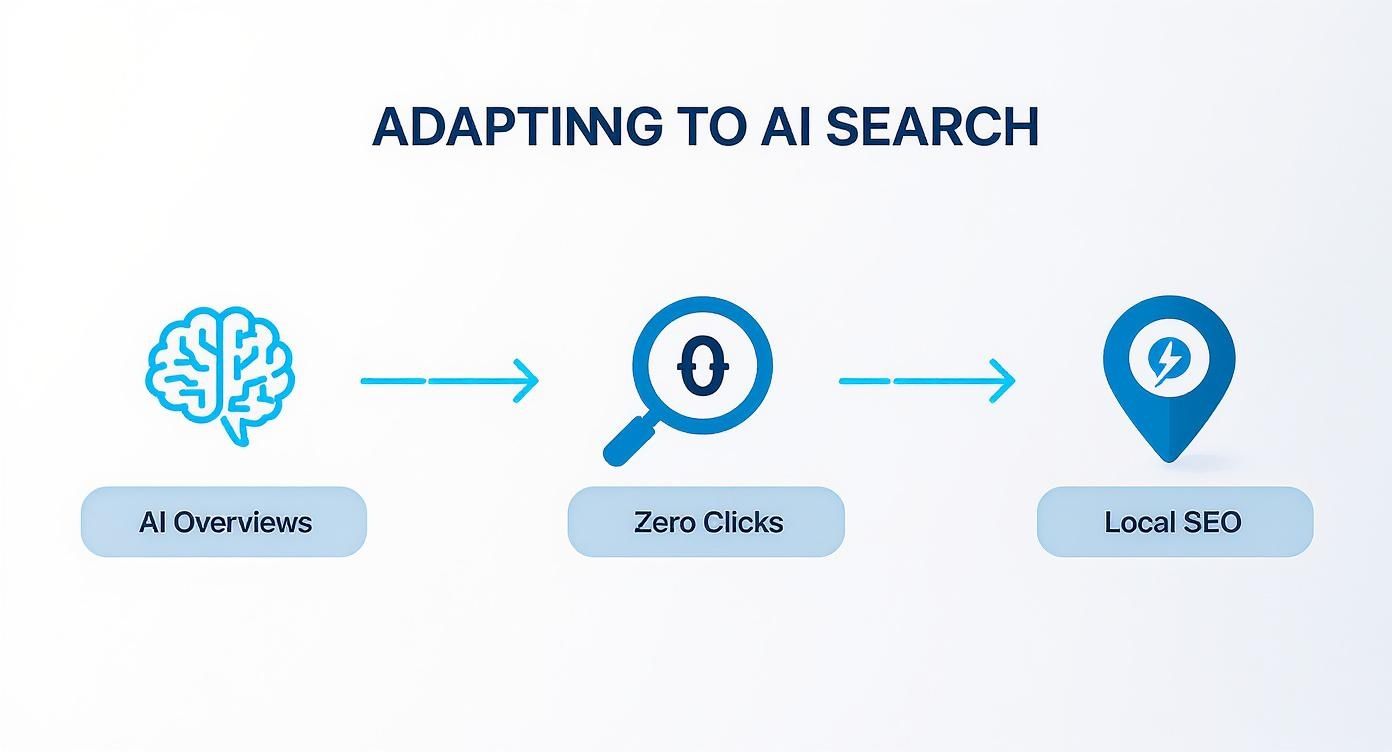
The message here is clear: while traditional website clicks are becoming a rare prize, direct engagement through things like your Google Business Profile is where the real value is now.
How to Win in a Zero-Click World
Instead of battling for a click that might never come, your new goal is to own the real estate you can control on the search results page. This isn’t about abandoning your website; it's about expanding your strategy to win customers before they even have a chance to click.
Your most powerful tool here is your Google Business Profile. I’ll say it again because it’s that important: your GBP is your new homepage. It’s where you can land new business without a single click to your site.
Here’s how you adapt:
- Optimise for Featured Snippets: Write content that gives direct, clear answers to common questions. Think concise paragraphs and bullet points. This is your ticket to getting featured in AI Overviews and those "People Also Ask" boxes.
- Make Your GBP Irresistible: Pack it with high-quality photos, post regular updates, and hound your happy customers for reviews. The aim is to give a potential customer so much confidence in your profile that they call you straight from the search results page.
- Create "Must-Click" Content: When you do want people to visit your site, make it worth their while. Don't just answer a simple question. Offer a downloadable guide, an in-depth case study, or a unique tool that an AI summary could never replicate. Give them a powerful reason to click. A great example is a detailed Shopify development crash course.
I often tell my clients that ranking #1 is great, but getting a phone call is better. In this new era, your focus should be on generating direct actions—calls, direction requests, and messages—not just website visits.
For an eCommerce shop, this could mean optimising product listings for Google Shopping so they show up with rich details right in the search results. For a tradie, it means having a GBP overflowing with five-star reviews and photos of recent jobs, and maybe even integrating an ai appointment setter to capture leads 24/7.
This shift isn't a reason to panic; it's a strategic pivot. Once you understand the new rules of the game, you can position your small business to not just survive, but to win customers right where they're looking.
Time to Get Your Hands Dirty: A Simple SEO Plan for Real Results
We've covered a lot of ground, from the nuts and bolts of your website to the wild new world of AI search. Now, let's pull it all together into a straightforward plan you can actually start today. The secret to SEO for small businesses isn't about doing everything at once. It’s about being smart and focusing on what moves the needle the most.
If you do nothing else, start with your local presence. Seriously. Getting your Google Business Profile dialled in is the single most powerful thing you can do right now. Nail that, and you’re already ahead of half your competitors. Once that's ticking along nicely, turn your focus to your own turf: your website's on-page SEO. A logical site structure, clear page titles, and a fast-loading experience are non-negotiable.
Where to Start First
Your journey should feel like building blocks, stacking one win on top of another. Follow this progression, and you'll build momentum without feeling overwhelmed.
- Own Your Backyard: Get your Google Business Profile 100% complete and keep it fresh. Go after reviews like your business depends on it (because it does) and always, always respond to them. This is your fast track to getting the phone ringing.
- Shore Up the Foundations: Tackle the on-page SEO basics. Make sure you have dedicated pages for each of your key services, and for goodness sake, make sure your site is fast and works beautifully on a mobile phone. This is where expert /wordpress-developers can be invaluable.
- Become the Answer: Start creating simple content that answers the real questions your customers are asking. This isn't about writing epic blog posts; it's about being genuinely helpful. This is what builds trust and attracts people who are ready to buy.
Keeping Score: How to Know if It’s Working
You don't need a super-complex, expensive dashboard to see if your efforts are paying off. Just get the two free essentials set up: Google Analytics and Google Search Console.
Google Analytics shows you how many people are visiting your site and how they got there. But Search Console is the real goldmine for SEO; it tells you exactly what search terms people typed into Google to find you and flags any technical gremlins holding your site back. A quick check-in on these each month will give you a crystal-clear picture of what's working and what isn't.
Ultimately, the choice between doing it yourself or hiring a pro comes down to your time versus your budget. If you're ready to roll up your sleeves and invest the hours, the steps in this guide will absolutely get you moving in the right direction. If you'd rather an expert partner like a top /shopify-developer step in and accelerate your growth, well, that's what we're here for.
At Alpha Omega Digital, we’re a marketing agency based in Melbourne, Australia, but we work with clients right across Sydney, Brisbane, Newcastle, Perth, Adelaide, Darwin and Hobart. Have a project you want to get off the ground? Let's have a chat.
Your Top SEO Questions, Answered
Every small business owner I talk to has questions about SEO. That's a good thing. It means you're thinking strategically about your growth. Here are the honest answers to the questions that come up the most.
How Long Does SEO Actually Take to Work?
This is the big one, and the honest answer is: it's not an overnight fix. You can generally expect to see the first positive signs within 3 to 6 months. This isn’t usually a flood of new customers, but more like green shoots—climbing up a few spots in Google, more traffic to your site, or a few extra calls coming from your Google Business Profile.
The real, business-changing results? That usually takes 6 to 12 months of consistent effort. Think of it like building a house; the foundation comes first, and the momentum builds from there. Local SEO can sometimes move the needle faster, especially if you’re in a less crowded market.
What’s a Realistic SEO Budget for a Small Company?
SEO budgets for small companies can be all over the place, but let's talk real numbers. For a typical small eCommerce business in Australia working with an agency like a digital marketing agency in Melbourne, a realistic starting point is somewhere between $1,000 to $2,500 per month.
This kind of investment allows for the essentials: getting your local SEO sorted, fixing the technical stuff on your site, and creating some decent content. Anything less than that, and you're probably not going to have enough firepower to make a dent against your competitors. It's an investment, not just a cost, and it should absolutely deliver a return over time.
Can I Just Do SEO Myself, or Do I Really Need to Hire Someone?
You can absolutely get started with DIY SEO. In fact, you should! By tackling the foundational steps in this guide—like getting your Google Business Profile looking sharp, cleaning up your website’s on-page basics, and writing genuinely helpful content—you can make some serious headway on your own.
But let's be real, SEO can get complicated and incredibly time-consuming, especially with advanced topics like using the /shopify-developer-api or complex Google ads setups.
If you find yourself running out of hours to stay on top of it, or you're trying to rank in a really competitive industry, that’s when bringing in an agency makes sense. They can speed things up and bring a level of expertise that's tough to build when you’re also trying to run a business.
Alpha Omega Digital is a marketing agency based in Melbourne, Australia but also services clients from Sydney, Brisbane, Newcastle, Perth, Adelaide, Darwin and Hobart. Have a project in mind? Contact us.
[email protected]
Read more insights from our team on web design, paid ads, and growth strategy.