I’ve seen it a hundred times working with Aussie brands: a company pours a small fortune into ads, gets a flood of traffic, and then scratches their head when sales barely budge. This is where Conversion Rate Optimisation (CRO) completely changes the game. As a marketing agency in Melbourne, I can tell you it’s not about getting more traffic; it’s about turning the visitors you already have into paying customers.
In the cut-throat Australian market, a small lift in your conversion rate delivers a far bigger punch than just another ad campaign.
Why CRO Is Non-Negotiable For Australian Ecommerce
As a digital marketing agency in Melbourne, we see the same pattern play out again and again. A business will go all-in on Google Ads or Facebook ads to get people to their store, but they completely ignore the experience once people land there. It’s like spending a fortune on flyers for a grand opening, only to have a messy shop with a broken EFTPOS machine.
CRO is the methodical process of fine-tuning your online store to make it easier, more intuitive, and more compelling for visitors to buy from you. It’s all about removing friction, building trust, and creating a seamless path from that first click to the final checkout confirmation.
The Australian Ecommerce Challenge
In Australia, simply buying more traffic is an expensive race to the bottom. The competition is fierce, and ad costs are constantly creeping up. This is where focusing on your conversion rate gives you a powerful, almost unfair, advantage.
Before we dive deeper, let's look at the numbers. Here’s a quick snapshot of where Australian ecommerce businesses typically stand, giving you a baseline to compare against.
Australian Ecommerce Conversion Rate Benchmarks
A quick look at key conversion rate statistics for Australian businesses to understand the current landscape and where your business fits in.
| Metric | Statistic |
|---|---|
| Average Ecommerce Conversion Rate (Australia) | 1.78% |
| Average Ecommerce Conversion Rate (Global) | 1.88% |
| Average Add to Cart Rate | 10.9% |
| Average Cart Abandonment Rate | 69.57% |
These figures tell a clear story: the average Aussie online store converts less than two out of every hundred visitors. That’s a lot of potential revenue left on the table. Improving that on-site experience is crucial to stand out and capture more sales from the traffic you’re already paying for. You can find more Australian marketing statistics to see how the local market is performing.
Think about it this way: Doubling your ad spend might double your traffic, but it also doubles your costs. Doubling your conversion rate, however, doubles your revenue from the same amount of traffic and the same ad spend.
This is why CRO is so critical for sustained growth. It makes every single dollar you spend on marketing work harder.
Moving Beyond Guesswork
Good CRO isn’t about randomly changing button colours or rewriting headlines based on a hunch. That's just throwing spaghetti at the wall. It’s a data-driven science. It involves:
- Deep Analysis: Using tools like Google Analytics and GTM to pinpoint exactly where users are dropping off in the buying journey.
- User Behaviour Insights: Watching session recordings and heatmaps to see how people actually interact with your Shopify or WordPress site. You see where they get confused, what they ignore, and what they click on.
- Forming Hypotheses: Creating educated guesses based on that data. For example, "We believe cart abandonment will decrease by 15% if we simplify the mobile checkout by removing two unnecessary fields."
- Controlled Testing: Running A/B tests to prove whether your changes have a positive, negative, or neutral impact. The data, not your opinion, decides the winner.
By adopting this mindset, you stop wasting time and money on changes that don’t work. You start making strategic, evidence-backed improvements that directly boost your bottom line. Even a small, consistent lift in your conversion rate can have a massive impact on your store's profitability over time.
Our Data-Driven CRO Process For Australian Businesses
Sustainable growth never comes from guesswork. I’ve learned that from years of working as a marketing agency in Melbourne. Randomly changing button colours or rewriting headlines without data is like trying to navigate the Outback without a map—you’ll get lost, fast.
Real, measurable improvement in your conversion rate comes from a methodical process, one that’s rooted in understanding how real people actually behave on your website.
Our approach to conversion rate optimisation in Australia is always data-first. We don’t make assumptions about what your customers want; we find out for sure. This ensures every change we make is a strategic move designed to improve your bottom line, not just a shot in the dark.
Step 1: Deep Dive Into Analytics And Research
The journey always begins with a deep dive into your analytics. This is where we uncover the "what" and the "where." Using tools like Google Analytics 4 and properly configured Google Tag Manager containers, we find the biggest leaks in your sales funnel.
We start by asking critical questions:
- Which product pages get heaps of traffic but have terrible 'add to cart' rates?
- At what specific step in the checkout process are most of your mobile users dropping off?
- Are visitors from our Google Ads campaigns bouncing the second they hit the landing page?
This hard data gives us a clear roadmap of the problem areas. But numbers only tell half the story. To understand the "why," we overlay this with insights from heatmaps and session recordings. Watching how real users interact with your Shopify or WordPress site is incredibly revealing. We can literally see their frustration, hesitation, and confusion firsthand.
This flowchart shows our basic flow from getting traffic to optimising it for maximum revenue.
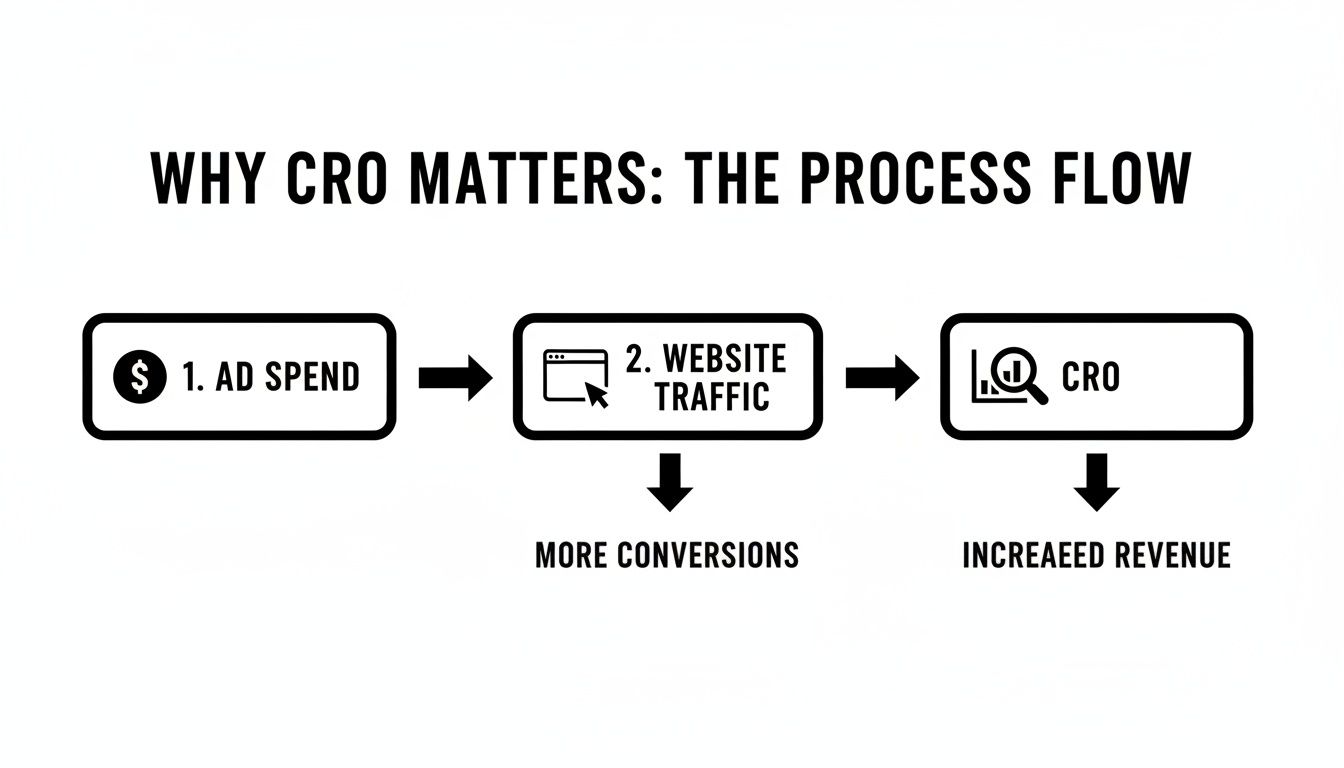
The visualisation makes it clear: simply paying for traffic isn't enough. The CRO phase is what turns that investment into actual, tangible revenue.
Step 2: Formulating A Strong Hypothesis
With solid data in hand, we move from just observing to taking action. This means forming a strong, testable hypothesis. A good hypothesis is never a vague idea; it's a specific, evidence-backed statement that predicts an outcome.
For instance, instead of saying "let's make the product page better," our hypothesis would sound more like this:
"We believe that by replacing the standard product image gallery on mobile with a sticky, thumb-friendly video carousel, we will increase the 'add to cart' rate by 10%. This is because session recordings show users struggling to swipe through images and missing key product features."
This format—We believe that [the change] will result in [the outcome] because [the reason]—forces us to be crystal clear. It connects every single proposed change directly back to the user data we've gathered. It's a structured approach that’s absolutely fundamental to effective conversion rate optimisation in Australia.
Step 3: Controlled Testing And Validation
Once we have a solid hypothesis, it's time to put it to the test. This is where we launch controlled A/B tests to see if our assumption was right. We'll show the original version of the page (the 'control') to 50% of your visitors and the new version (the 'variant') to the other 50%.
The test runs until we have a statistically significant result—which is just a fancy way of saying the outcome isn't due to random chance. The data, not our personal opinion, declares the winner.
If the variant wins, we roll it out permanently. If it loses or makes no real difference, we ditch it and move on to the next hypothesis, armed with fresh learnings.
Step 4: Learning And Iterating
This cycle of research, hypothesis, testing, and learning never really stops. CRO isn't a one-off project; it’s an ongoing process of small, incremental improvements that compound over time. Every test, whether it’s a win or a loss, gives us valuable insights into your customers' behaviour.
This iterative process ensures your website is constantly evolving to better meet the needs of your Australian audience, turning more browsers into buyers and making every single one of your marketing dollars work harder.
High-Impact CRO Tactics for Shopify and WordPress
A solid, data-driven process is your foundation. But now for the fun part: the specific tactics that actually move the needle on conversions. Over the years, we’ve worked with countless Aussie e-commerce businesses, and we’ve found that certain platforms have unique levers you can pull for maximum impact.
We live and breathe Shopify and WordPress every single day. While the core principles of good CRO are universal, how you execute them on each platform can be wildly different.
Optimising the Shopify Customer Experience
As dedicated Shopify development partners, we’ve seen what works—and what definitely doesn't—on this powerhouse platform. The goal is always the same: create a completely frictionless journey from the moment someone lands on a product page to the second they see that "Thank You" message.
Here’s where we focus our efforts for Shopify stores:
- Product Page Persuasion: Your product page does all the heavy lifting. We obsess over optimising it with high-quality, professional media (images and videos), persuasive copy that sells benefits instead of just features, and clear trust signals like customer reviews and security badges.
- Checkout Streamlining: Cart abandonment is the silent killer of conversions. We often streamline the Shopify checkout process, stripping out unnecessary steps and offering guest checkout to reduce friction, especially for first-time buyers.
- Custom API Solutions: Sometimes, an off-the-shelf app just won't cut it. As an experienced Shopify developer, we use the Shopify API to build custom solutions—think unique product bundlers or advanced shipping calculators—that create a smoother path to purchase.
Driving Conversions on WordPress and WooCommerce
When we're working with our WordPress clients, particularly those on WooCommerce, the focus shifts slightly. User experience is still king, but technical performance plays a much bigger role in keeping potential customers locked in.
Our philosophy for WordPress CRO is simple: speed and clarity. A slow, confusing site is a conversion killer. We prioritise creating an experience that is lightning-fast, flawlessly responsive on mobile, and guides the user with compelling calls-to-action (CTAs).
This often requires a more hands-on development approach. For example, we frequently work with our WordPress developers in Melbourne to build custom Gutenberg blocks. This lets us create unique, high-converting landing pages that stand out from generic templates and perfectly match the intent of our paid ad campaigns. A custom-built page can be optimised for speed in ways a bloated page-builder theme simply can't.
Practical Tactics You Can Implement
Beyond platform-specific strategies, some tactics work wonders right across the board. These are the quick wins and foundational elements that every Australian e-commerce store should have on its radar. For a broader perspective, you can also check out these actionable conversion rate optimization tips.
Here are a few practical examples we often put into play:
- Implement Exit-Intent Popups: Just as a user is about to leave your site without buying, an exit-intent popup can grab their attention one last time. Offering a small discount or free shipping for their email is a powerful way to capture a lead you would have otherwise lost.
- Leverage User-Generated Content (UGC): Social proof is incredibly persuasive. We encourage clients to showcase customer photos and reviews directly on their product pages. Seeing real people enjoying a product builds immense trust and helps new visitors overcome that initial hesitation.
- A/B Test Your CTAs: The words on your "Add to Cart" button can have a surprising impact on your bottom line. We regularly test variations like "Buy Now," "Add to Bag," or "Get Yours Today" to see which one resonates most with the audience and drives more clicks.
- Add Trust Badges and Guarantees: Displaying secure payment logos (like Afterpay, Zip, and PayPal) and highlighting your returns policy or satisfaction guarantee near the checkout button can massively reduce purchase anxiety and lift conversion rates.
By combining these platform-specific optimisations with proven CRO tactics, you can start turning more of your hard-earned traffic into loyal, paying customers. Each small improvement contributes to a much larger, more profitable whole.
Connecting Paid Ads To On-Site Conversions
Conversion rate optimisation doesn't exist in a vacuum. As a marketing agency in Melbourne that manages a serious amount of ad spend, I can tell you the biggest waste of money isn't a bad ad—it's sending perfectly good traffic from a great ad to a landing page that just doesn't convert.
You can have the best ad creative in the world, but if the user journey breaks the second they land on your site, you’ve just paid to disappoint a potential customer.
True optimisation is about creating a seamless, persuasive path from the moment someone clicks your ad to the second they hit 'complete purchase'. The ad makes a promise, and your landing page absolutely has to deliver on it.
The Google Ads And Landing Page Connection
When it comes to Google Ads, the golden rule is message match. It’s that simple.
The keywords someone types into Google, the ad copy they click on, and the headline on your landing page must all sing from the same hymn sheet. If a user clicks an ad for "waterproof hiking boots," they had better land squarely on a page full of waterproof hiking boots—not your general footwear category.
This is where your campaign strategy really matters.
- PMAX vs. Google Shopping: For eCommerce stores, deciding between Performance Max and standard Shopping campaigns is a huge deal. Standard Shopping gives you that old-school granular control over specific products and search terms, which is perfect for pushing high-margin items. PMAX, on the other hand, unleashes machine learning to find customers across all of Google's channels. It can be incredibly powerful for scaling up, but you do trade some of that fine-tuned control for reach.
- Google Ads for Service Businesses: For businesses chasing leads—like booking appointments or getting quote requests—the game is completely different. We almost always build dedicated landing pages for campaigns targeting specific services. This ensures the page speaks directly to the user's problem and offers a crystal-clear, frictionless way to get in touch. Every single element, from the headline down to the form fields, is obsessed over to maximise Google Ads for contact form submissions.
Mastering Meta Ads Creative And Technical Setup
Over on Meta Ads (Facebook and Instagram), the rules change slightly. While message match is still important, the real key to success is relentless, unapologetic creative testing.
We are constantly cycling through different images, videos, headlines, and ad copy to find the magic combinations that connect with a specific audience. What works for a 25-year-old in Sydney will almost certainly bomb with a 45-year-old in Perth.
But here’s the catch: brilliant creative is useless if your data is a mess. This is where the technical setup becomes the unsung hero of your campaigns.
Accurate tracking is the bedrock of any successful paid ads strategy. Without it, you're flying blind, unable to tell which ads are driving real sales and which are just burning a hole in your budget.
This is exactly why we put such a heavy emphasis on a rock-solid technical foundation. We start by properly setting up Google Tag Manager containers, which act as the central nervous system for all our tracking tags.
From there, one of the most crucial steps for any eCommerce store is the Conversions API installation for Meta. This creates a direct, server-to-server link between your Shopify or WordPress site and Facebook. It’s a game-changer because it ensures data is tracked reliably even when browser-based pixels are blocked by iOS updates or ad blockers.
This clean stream of data allows Meta's algorithm to do its job properly—finding more customers who look just like your best ones, which can dramatically improve your return on ad spend.
This holistic approach—aligning the ad strategy with the on-site experience—is the core of effective conversion rate optimisation in Australia. In fact, local eCommerce businesses are projected to lift their conversion rates towards the 2% to 4% mark, a significant jump from where they’ve been. This growth isn't happening by accident; it's driven by these precise optimisations that create a smoother, more connected customer journey. You can explore more about these trends and what they mean for Australian online retailers.
How To Measure Your CRO Efforts For Real Insights
"If you can't measure it, you can't improve it." It's an old business saying, but it’s the absolute foundation of successful conversion rate optimisation. I see so many Aussie businesses make the same mistake, though: they obsess over one single number—the final conversion rate. While that’s obviously important, it doesn't tell you the whole story.
Focusing only on your final sales conversion rate is like just looking at the final score of a footy match without watching the game. You know who won, but you have no clue how or why. To get real insights, you need to look at the entire field of play and understand all the crucial moments that led to that score.
Building Your CRO Dashboard in GA4
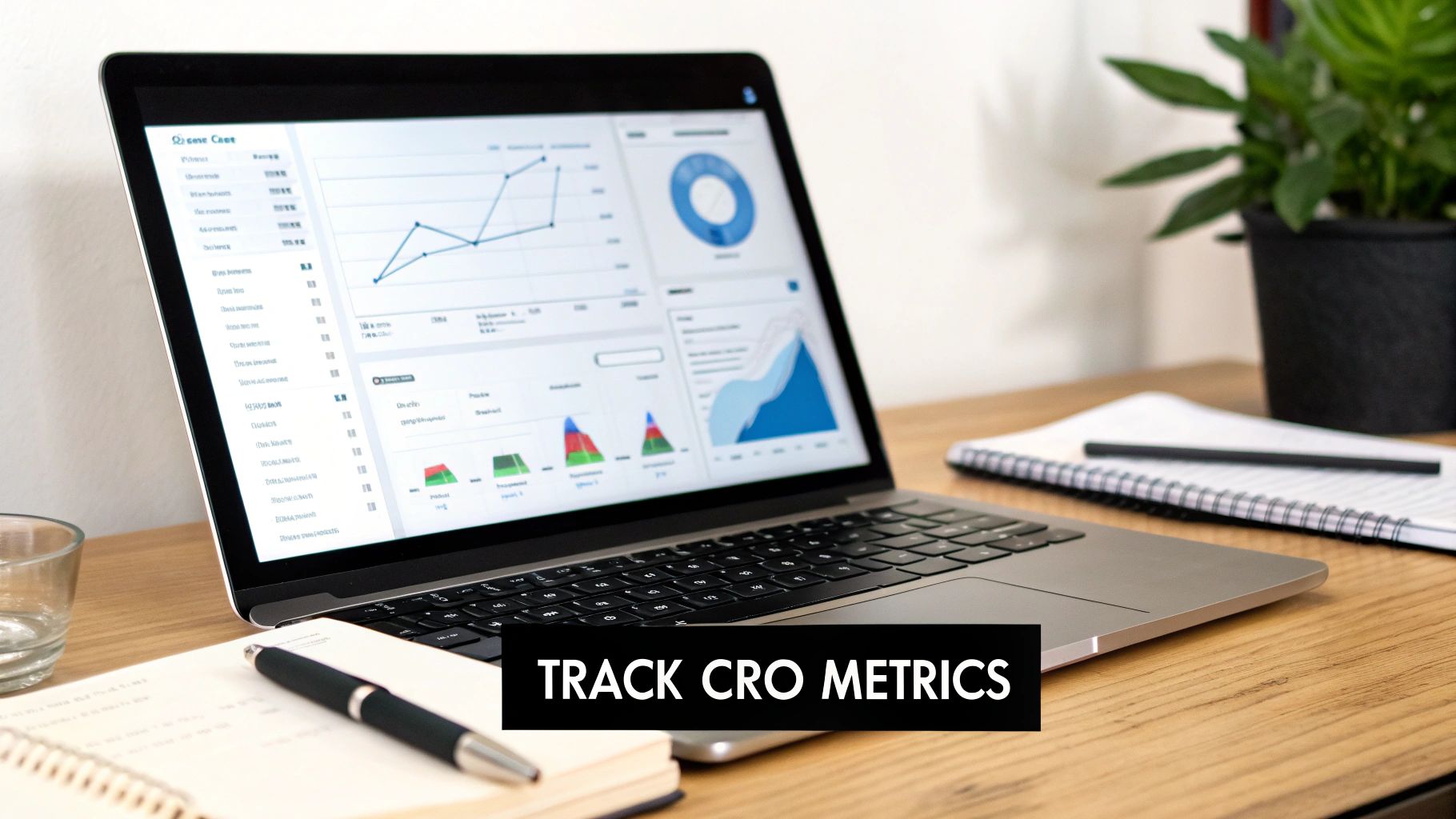
To really get a feel for whether your efforts are paying off, you need a complete picture of user behaviour. We always teach our clients to build and monitor a dashboard of key metrics within Google Analytics 4 (GA4). Think of it as your store’s health check at a glance.
Your dashboard should track metrics like:
- Cart Abandonment Rate: What percentage of people add items to their cart but bail before paying? This is a massive red flag for friction in your checkout.
- Average Order Value (AOV): Are your CRO changes actually leading to bigger purchases? Sometimes an optimisation can lift conversions but lower the average spend, so you have to track both.
- Bounce Rate on Key Pages: Are users landing on your product pages or campaign landing pages and leaving straight away? A high bounce rate often points to a disconnect between your ad and your page.
- Time on Site: Are visitors actually engaging with your content, or are they just scanning and leaving? More time spent usually signals higher interest.
To gauge the effectiveness of your CRO strategies on Shopify, it's essential to accurately track performance; learn about 5 Easy Ways To Track A Shopify Store's Sales Volume.
The Power of Tracking Micro-Conversions
Look, not every visitor is ready to whip out their credit card on the first visit. That’s why tracking micro-conversions is so important. These are the smaller, valuable actions a user takes that show they're moving in the right direction.
Think of micro-conversions as leading indicators. They prove your changes are having a positive impact on user engagement, even before the final sale is made. They tell you your strategy is on the right track.
Examples of crucial micro-conversions include:
- Signing up for your email newsletter
- Adding an item to a wishlist
- Watching a product video
- Downloading a size guide or lookbook
Tracking these smaller steps gives you a much richer, more detailed picture of what your users are thinking. It helps you measure the impact of changes that build trust and engagement over time.
Setting Up Conversion Funnels in GA4
One of the most powerful features in GA4 for CRO is the ability to build custom conversion funnels. This lets you map out the exact steps a user should take—from landing on a product page to completing a purchase—and see precisely where they're dropping off.
For example, you can create a funnel that tracks:
- Users who viewed a product page.
- Users who clicked 'Add to Cart'.
- Users who started the checkout process.
- Users who completed the purchase.
This visualisation will instantly highlight the biggest leaks in your sales pipeline. If you see a massive drop-off between starting checkout and finishing the purchase, you know you’ve got a problem on your payment or shipping page that needs fixing right now. This level of insight lets you confidently measure the impact of every single optimisation you make.
Choosing The Right CRO Agency In Australia
Partnering with the right team for your conversion rate optimisation in Australia is a massive decision. I’ve seen it firsthand here as a marketing agency in Melbourne — the wrong partnership doesn't just stall progress, it burns through your budget and leaves huge opportunities on the table.
You have to look past the slick sales pitch and dig into how an agency actually works.
A genuine CRO expert is obsessed with data and research. Their first questions shouldn't be about your budget; they should be about your analytics. They should be itching to get into your GA4 data, to understand your user flows, and to pinpoint where your customers are dropping off before they even think about proposing solutions.
Questions To Ask A Potential CRO Partner
Ask them to walk you through a case study, and don’t let them get away with just showing you the impressive final numbers. You need to understand the why behind every change they made.
- What was the initial hypothesis and what data was it based on? A great agency can articulate a clear, data-backed reason for every single test they run. No "we thought this would look better" answers.
- Can you show me a losing test? This is my favourite question. An agency that claims they’ve never had a losing test isn't testing hard enough or isn't being honest. Failure is where the real learning happens.
- What is your experience with our platform? Whether you're on Shopify or WordPress, you need a partner who knows the tech inside out. Ask for specific examples of how their WordPress developer or Shopify developer has solved a tough conversion problem.
Look for a partner who offers transparent reporting and can clearly articulate the strategy behind every single test. If they can't explain their process in simple terms, they probably don't understand it well enough themselves.
Ultimately, you're looking for a true partner, someone genuinely invested in your growth. This means finding an agency that combines deep technical know-how with a strategic, data-driven CRO methodology.
This combination is critical right now. Australian eCommerce businesses are trying to climb from the current average conversion rate of 1.78% to a top-tier target of 3-5%. This isn't just a vanity metric; it’s a response to customers demanding better, more seamless online experiences, especially on mobile. You can read more about Australian conversion rate targets to see exactly where the market is heading.
Alpha Omega Digital is a marketing agency based in Melbourne, Australia but also services clients from Sydney, Brisbane, Newcastle, Perth, Adelaide, Darwin and Hobart. Have a project in mind? Contact us.
Common Questions About Conversion Rate Optimisation
Over the years, I've had hundreds of conversations with Aussie business owners about CRO. It's one of those things that sounds great in theory, but the practical side of it brings up a lot of the same questions.
I've gathered the most common ones here to give you clear, straightforward answers. This is the kind of practical advice I wish I had when I first started as a marketing agency in Melbourne, and I hope it helps clear things up for you.
How Long Does It Take to See Results From CRO?
This is a big one. Everyone wants to know when the magic happens. The honest answer? CRO is a long game, not a quick fix. While you might run a simple A/B test on a button colour and see a winner in a couple of weeks, the real, lasting value comes from building momentum over time.
The timeline really depends on your website traffic. A high-traffic Shopify store can get statistically significant data much faster than a niche B2B site. As a general rule, you should plan for an initial 3-6 month program. That’s enough time to get foundational changes in place, run a few key tests, and start seeing meaningful, sustainable improvements.
The goal isn't just one big win; it's about building a system of ongoing improvement that compounds over time. Small, consistent gains add up to massive results.
What Is a Good Conversion Rate for an Australian Ecommerce Store?
If I had a dollar for every time I've been asked this! While the Australian average hovers around 1.78%, that number is almost useless on its own. A "good" conversion rate is completely specific to your industry, your price point, and even where your traffic is coming from.
Think about it: a luxury furniture store selling $5,000 sofas could have a 0.5% conversion rate and be wildly profitable. On the other hand, a fast-fashion brand selling $30 t-shirts might need to aim for 3-4% just to hit its targets.
Instead of getting fixated on a generic number, your focus should be on consistently improving your own baseline. A 20% lift from a 1% conversion rate to 1.2% can have a huge impact on your bottom line and is a much more realistic goal to start with.
Can I Do CRO Myself or Do I Need an Agency?
It's absolutely possible to get started with some basic CRO yourself. You can fire up free tools like Google Analytics and try out an entry-level heatmap tool to find the most obvious roadblocks on your site. Honestly, it’s a great way to get your feet wet and understand your users better.
But at a certain point, you'll hit a wall. Truly effective CRO is a specific blend of skills: deep data analysis, user experience (UX) design, strict A/B testing methodology, and often, the technical chops to actually build the changes. This is especially true when you need a WordPress developer or Shopify developer to implement something more complex than a text change.
An experienced agency can massively speed up your results. They help you avoid the common testing pitfalls that waste time and traffic, and they bring a fresh, objective perspective. They’ve seen what works across dozens of stores and can apply those learnings to yours from day one.
Alpha Omega Digital is a marketing agency based in Melbourne, Australia but also services clients from Sydney, Brisbane, Newcastle, Perth, Adelaide, Darwin and Hobart. Have a project in mind? Contact us.
[email protected]
Read more insights from our team on web design, paid ads, and growth strategy.