As a marketing agency in Melbourne, I've seen firsthand how search engine optimisation can transform a local business. It's not about some vague, global ranking. It's the art and science of making your website impossible to miss for local customers searching on Google. Forget ranking for "best coffee" nationally; for my clients, it's about showing up when someone in Fitzroy, St Kilda, or South Yarra is actively looking for the exact product or service you offer. It’s how you capture that high-intent, ready-to-buy local traffic for your e-commerce store.
Why Melbourne SEO Is Your Biggest Local Advantage
I've spent years in the trenches of Melbourne's digital marketing scene, and I've seen countless e-commerce businesses chase broad, national keywords. They get frustrated when their website traffic doesn't translate into actual sales or local customers choosing click-and-collect.
The truth? In a market as competitive as ours, the real battle is won at the suburb level. As a digital marketing agency in Melbourne, I've found that local SEO is less about being found by everyone and more about being found by the right people—those in your immediate service area who trust local brands.
Think about how Melburnians actually search. When they want a specific product fast, they don't just search for it; they add a local modifier. They search for "Shopify stores Melbourne" or "same-day delivery Richmond." These are red-hot queries from people ready to take action, and a sharp, localised SEO strategy puts your business directly in their path.
The Power of Local Intent
I've worked with Melbourne e-commerce businesses that completely turned their sales around simply by shifting their focus inward. We stopped chasing vanity keywords and started targeting the specific, location-based searches their ideal customers were using every day. For a local fashion boutique, that meant focusing on Shopify development to build a slick online store, then using local SEO to attract nearby shoppers. The results were almost immediate because we were finally speaking the same language as a motivated local audience.
Local SEO isn't just a tactic; it's a fundamental shift in how you view customer acquisition. It's about acknowledging that your most valuable customers are often just around the corner, and you need to make it incredibly easy for them to find you online.
The data absolutely backs this up. For Melbourne e-commerce businesses, local search isn't just a channel; it's often the channel for customers ready to spend money.
Industry reports show that roughly 46% of all Google searches carry local intent. That means nearly half of all searchers are explicitly looking for a business nearby. Even better, grabbing that top spot in the local search results can capture about 24.4% of all clicks. That's a massive advantage when you're targeting specific, suburb-level keywords. You can explore more about these local search statistics to see just how big the opportunity is.
Understanding what your customers are really looking for is the first step. Different search queries signal different needs, and knowing how to respond is key.
Local Search Intent Breakdown For Melbourne Businesses
This table breaks down the different types of local search queries and what they mean for your e-commerce business.
| Query Type | Example Search | Customer Intent | Business Opportunity |
|---|---|---|---|
| Navigational | "Your Brand Name Fitzroy" | Looking for your specific business location or online store. | Ensure your Google Business Profile is accurate with correct address, hours, and website link. |
| Informational | "best women's boutiques Hawthorn" | Researching or planning, not yet ready to buy. | Create helpful blog content. Think "The Ultimate Guide to Melbourne Fashion Boutiques." |
| Transactional | "buy handmade earrings Melbourne" | Ready to buy right now. | This is where you need to be visible. Your GBP, local landing pages, and Google Shopping ads must be optimised. |
| Implicit Local | "coffee beans near me" | No location mentioned, but Google knows the user wants a local result based on their device's location. | A strong GBP and mobile-friendly site are critical to capture these "near me" searches. |
Recognising these different intents allows you to tailor your content and SEO strategy to meet the customer exactly where they are in their journey.
This diagram shows how the core parts of a winning Melbourne SEO strategy fit together, connecting local intent, your Google Business Profile, and mobile search.
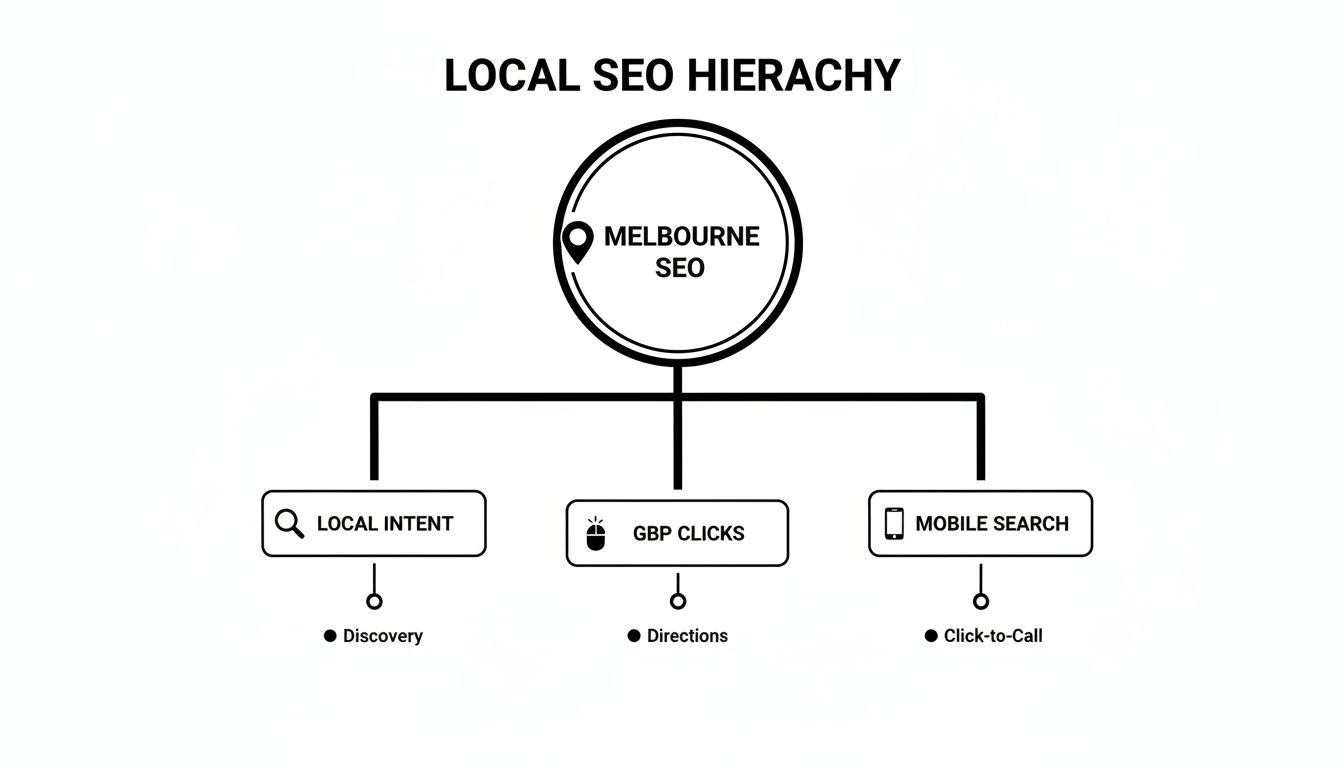
The key thing to notice here is how interconnected these elements are. A strong mobile presence fuels "near me" searches, which in turn drives clicks and calls directly from your Google Business Profile.
Before we dive into the nitty-gritty, it's vital to grasp this core idea. Effective SEO for a Melbourne business is all about demonstrating local relevance. It’s about proving to both Google and your customers that you are the go-to choice in their specific area.
Building Your Digital Shopfront With Google Business Profile
If you take just one thing away from this guide, let it be this: your Google Business Profile (GBP) is the single most powerful tool you have for local SEO. I always tell my e-commerce clients to think of it as their digital shopfront.
Long before a potential customer ever visits your website, they'll likely see your GBP listing in Google Maps or the "map pack" that pops up in search results. It’s often their very first interaction with your brand.
For any business serious about search engine optimisation in Melbourne, getting this profile right isn’t just a recommendation—it's the absolute foundation of your local strategy. A well-oiled GBP can bring in phone calls, website clicks, and foot traffic without you spending a cent on ads. It's that powerful.
Nailing The Non-Negotiables
The very first thing we do with any new client is a full audit and optimisation of their GBP. We start with the basics, which are surprisingly easy to get wrong but critical to get right. It all comes down to consistency.
- NAP Consistency: This stands for Name, Address, and Phone number. These three details must be exactly the same on your GBP, your website, and any other online directory. No "St" on one and "Street" on another. This consistency is a massive trust signal for Google.
- Primary Category: Choosing the right primary category is crucial. Be as specific as you can. If you sell women's clothing, "Women's clothing store" is better than the generic "Clothing store."
- Service Area: Define your service area clearly. If you are a marketing agency in Melbourne that serves specific suburbs or the entire metro area, list them. This helps you appear in searches like "Shopify developer near me."
From my experience, businesses that spend time getting these foundational elements perfect see a noticeable lift in local visibility within weeks. Google rewards businesses that provide clear, accurate, and consistent information because it helps them provide better results to searchers.
Bringing Your Profile To Life
Once the basics are locked in, it's time to make your profile actually stand out. A sparse, empty profile looks untrustworthy. A rich, active one tells both Google and customers that you're an active, engaged business.
Here’s where you’ll manage all these crucial details—your digital control centre for telling Google everything it needs to know about your Melbourne business.
We focus on a few key areas to make our clients’ profiles pop:
- High-Quality Photos: Upload professional photos of your products, your packaging, and your team. Showcasing your brand visually builds instant trust.
- Encourage Reviews: Actively ask your happy customers for reviews. Positive reviews are a massive ranking factor. Just as importantly, respond to every review, both positive and negative. It shows you care.
- Use Google Posts: This is like a mini-blog inside your GBP. Announce new products, share promotions, or highlight a best-seller. It keeps your profile fresh and signals to Google that you're active.
- Answer Questions: The Q&A section is a goldmine. Proactively add and answer common questions like "Do you offer click-and-collect?" or "What are your shipping times to Sydney?" As a Facebook ads agency, we often add questions like, "How to measure success on Facebook ads?" for our clients.
To really solidify your digital shopfront, you can explore more dedicated resources on the topic. For instance, there are some great Google Business Profile tips for local growth that dive even deeper into these strategies.
Mastering your GBP is the most direct path to dominating local search in Melbourne.
Finding Keywords The Melbourne Market Actually Uses
Let's get straight to the point: your entire SEO strategy lives or dies on the words you choose. Generic keyword research pulls in generic traffic, and generic traffic doesn't pay the bills. The real wins happen when you start thinking like a local and chase the specific, high-intent phrases people are actually typing into Google right here in Melbourne.
It's not just about what you sell; it’s about where you sell it. A broad term like "Shopify developer" is a battlefield, attracting clicks from all over the world. But a long-tail keyword like "Shopify developer for Melbourne fashion brands" is pure gold. It grabs someone with a specific need, in a specific place, whose intention to hire a local is screamingly obvious.
Thinking Like A Melburnian
Anytime I work with a Melbourne e-commerce client, this is where we start. We have to go beyond the obvious product keywords and get granular. We dig into the suburbs, the landmarks, and even the local slang that real Melburnians use. This is how we find brilliant keywords your competitors have completely missed.
For an e-commerce agency, this could mean targeting phrases like "Shopify design for Richmond boutiques" or "custom WordPress development for Melbourne artists." These aren't just search terms; they are direct lines to customers looking for a specialist who gets their world. Nailing your keyword strategy is everything for local success. You can learn exactly how to choose keywords for SEO with a clear, modern approach that fits this local-first mindset.
The whole game is shifting from broad, high-volume keywords to specific, high-intent ones. Honestly, I'd rather get 10 visits from people searching "Shopify API expert in Collingwood" than 1,000 from "Shopify help." Why? Because those 10 visitors are infinitely more likely to become paying clients.
Spying On Your Local Competitors
Another crucial piece of the puzzle is figuring out what’s already working for others in Melbourne. I use tools to see exactly which local keywords your direct competitors are ranking for. This isn't about copying their homework; it's about finding the gaps they've left wide open.
Maybe a competitor ranks well for "Google Ads for e-commerce" but has zero content targeting specific niches like "Google Shopping ads for dropshipping" in Australia. That’s your opening. Or perhaps they rank for "Facebook ads agency Fitzroy" but not for "Instagram Shop setup Fitzroy." By spotting these gaps, you can create sharp, targeted content that swoops in and captures that highly qualified traffic.
Comparing Broad vs. Local Long-Tail Keywords
This table really drives home the difference between casting a wide, generic net and using a targeted, local spear.
| Keyword Type | Example | Search Volume | Competition | Buyer Intent |
|---|---|---|---|---|
| Broad Match | Shopify developer | High | Very High | Low |
| Local Long-Tail | Shopify developer Brighton | Low | Low | Very High |
| Broad Match | WordPress design | High | Very High | Low |
| Local Long-Tail | WordPress developers Southbank | Low | Low | Very High |
See the pattern? The real value isn't in the raw search volume. It's in the sky-high buyer intent that comes baked into a specific, location-based search.
When you build your keyword list around these hyper-local terms, you stop attracting browsers and start attracting buyers. These are people who are ready to make a decision and are actively looking for a local expert to help them. This is the bedrock of any successful Melbourne SEO campaign.
Crafting On-Page SEO and Content That Speaks to Melburnians
Once we’ve locked in the exact keywords your Melbourne customers are tapping into Google, the real work begins. Now, it’s time to build out website pages and blog content that not only targets these phrases but genuinely connects with a local audience. This is where a generic, one-size-fits-all approach completely falls over; your content needs to feel like it was written for a Melburnian, by a Melburnian.
This isn't about just sprinkling keywords around and hoping for the best. It’s about building a digital presence that screams local expertise. For instance, instead of creating a single, broad "WordPress Development" service page, I build highly specific, locally-targeted pages. It’s a strategy I’ve used with great success, creating dedicated pages like my guide for a WordPress developer in Melbourne to capture that precise, high-intent traffic.
The Nuts and Bolts of On-Page SEO
On-page SEO covers all the optimisations you make directly on your website pages. Think of it as labelling everything correctly so Google understands exactly what each page is about and who it’s for. It’s the foundational workhorse of any successful search engine optimisation in Melbourne campaign.
When I build a new page for a client, I meticulously check off these key elements:
- Title Tags: This is the big blue headline that shows up in Google’s search results. It has to include your main local keyword, like "Shopify Developer Fitzroy | Your Brand Name."
- Meta Descriptions: This is the short summary underneath the title tag. It needs to be a punchy, click-worthy snippet that includes your keyword and a reason for someone to click.
- Header Tags (H1, H2, H3): Your H1 is your main page title. Subheadings (the H2s and H3s) break up the content and should naturally weave in variations of your local keywords.
- Image Alt Text: This is a simple text description for your images. It helps search engines "see" your visuals and is a perfect spot to add a local keyword, like "building custom blocks in Gutenberg for a Melbourne cafe."
Getting these technical details right is non-negotiable, but it's only half the story.
Writing Content That Screams Local Authority
To truly stand out in the local search results, you have to prove to Google—and more importantly, to your customers—that you're a genuine part of the Melbourne business community. This means creating content that does more than just sell your services.
I work with clients to build a content strategy that proves they know their stuff, locally. This could look like:
- Client Case Studies: Showcasing successful projects with other Melbourne-based e-commerce stores.
- Local Guides: Writing a blog post like "A Beginner's Guide to Google Shopping Ads for Melbourne Retailers."
- Neighbourhood Pages: Creating specific content for the suburbs you serve, proving you understand the local market.
This approach transforms your website from a simple online brochure into a genuinely useful local resource.
What I've learned is that Google rewards authenticity. When you create content that is genuinely helpful and relevant to a specific geographic area, you're sending powerful signals that you are the go-to authority in that location. It’s about building trust, not just rankings.
The way Melburnians search has fundamentally changed, thanks to our phones. With mobile searches making up 56–60% of total local queries, optimising for people on the go is everything. The explosion of "near me" and voice-assisted searches, where 58% of consumers now find local businesses, means your content has to answer direct questions clearly and quickly. You can discover more insights about Melbourne's local search trends to get a better handle on this shift. This is exactly why my focus is always on creating content that’s not just locally relevant but also mobile-friendly and easy to digest.
Building Local Authority With Citations And Backlinks
Getting your on-page SEO right is a massive step, but to really start climbing the ranks in Melbourne, Google needs to see that other people trust you.
Think of it like a real-world reputation. If a bunch of well-respected locals vouch for you, you’re seen as credible. In the digital world, this authority is built through two key things: local citations and high-quality backlinks.
From my experience working with Melbourne e-commerce businesses, this is the piece of the puzzle that often gets missed. It’s not just about what you say on your own website; it’s about what the rest of the web says about you.
Unpacking Local Citations
A local citation is simply any online mention of your business’s Name, Address, and Phone number (what we call NAP). You’ll usually find them on online business directories. Think of them as digital signposts scattered across the internet, all pointing back to your business and confirming to Google that you are a legitimate local operation at a specific address.
The number one rule with citations is consistency. Your NAP details must be identical everywhere. The slightest variation—like using "St" on one site and "Street" on another—creates confusion for search engines and waters down your authority.
I always tell my clients that consistent citations are the foundational layer of off-page local SEO. They're the easiest wins to secure, and they build a baseline of trust that Google absolutely needs to see before it will rank you prominently.
For any e-commerce business in Melbourne, here are a few essential directories to get listed on:
- General Directories: Yellow Pages, TrueLocal, Yelp Australia.
- Industry-Specific: For e-commerce specialists, directories for marketing or web design are key.
- Hyper-Local: Melbourne-specific business directories or community portals.
The Power of Local Link Building
While citations are the foundation, backlinks are the real power players. A backlink is just a clickable link from another website to yours. Google sees these as votes of confidence. Getting a link from a highly respected local source is like a glowing recommendation that carries some serious weight. We're a top WordPress development company, so we focus on earning links from tech and design blogs.
This isn’t about collecting hundreds of spammy, low-quality links. It’s about earning a handful of high-quality, relevant ones. As a marketing agency in Melbourne, we focus on building real relationships that lead to these kinds of natural links.
Here are a few actionable strategies we use all the time:
- Sponsor a Local Event: Getting behind a local Melbourne community festival, a charity run, or an industry meetup often gets you a link from their website. It's a win-win.
- Partner with Nearby Businesses: Team up with a non-competing business in your area. For example, a Shopify development partners could partner with a local photographer, and they could link to each other’s services pages.
- Get Featured in Local News: If your e-commerce brand has a great story, pitch it to local Melbourne blogs or news outlets like Broadsheet or Time Out Melbourne. A single feature story can result in a powerful backlink.
- Join Local Business Associations: Organisations like the Victorian Chamber of Commerce and Industry often have member directories that link back to your website.
Building this local authority takes time and effort. It’s about embedding your business into the fabric of the Melbourne community, both online and offline. But the payoff—in trust, visibility, and rankings—is absolutely worth it.
How to Choose a Melbourne SEO Agency That Delivers Results
Investing in search engine optimisation is a big decision for any business, so picking the right partner is absolutely critical. After years of running a marketing agency in Melbourne, I've seen firsthand what separates the teams that deliver real value from those that just talk a good game. It’s not about flashy sales pitches; it's about finding a team that becomes a genuine extension of your own.
The first thing I always look for is transparency. A good agency won't hide behind jargon or confusing metrics. They should be able to give you clear, easy-to-understand reports that show exactly what they're doing, how it's performing, and—most importantly—how their work is impacting your bottom line with leads, calls, and sales. For us, this includes a deep dive into GTM and Google Analytics, and if we're running campaigns, explaining our Meta ads creative testing process.
What to Look For in a Partner
When you're vetting potential agencies, you need to dig deeper than their homepage. A great digital marketing agency in Melbourne will be able to prove their worth with solid evidence and a clear, logical strategy built for your business, not a one-size-fits-all template.
Here are the green flags to watch for:
- Real Local Case Studies: Ask to see examples of their work with other Melbourne e-commerce businesses. This proves they actually understand the local market.
- A Focus on ROI: They should be more interested in how SEO is driving revenue for your business than just chasing vanity rankings for broad, meaningless keywords.
- Clear Communication: You should know exactly who your point of contact is and expect regular, meaningful updates. A good partner keeps you in the loop, not in the dark.
From my experience, the best client-agency relationships are built on a shared understanding of your goals. An agency should take the time to learn your business inside and out before they even start talking about keywords or backlinks.
Red Flags to Avoid
Just as important is knowing what to steer clear of. I've seen far too many e-commerce owners get locked into contracts that deliver nothing but frustration and wasted money.
Be wary of any agency that:
- Guarantees #1 Rankings: This is the oldest trick in the book. No one can guarantee a specific ranking on Google. It's an immediate red flag that suggests they might use risky, short-term tactics that can get you penalised.
- Offers Vague Deliverables: If they can't clearly explain what you're paying for each month in simple terms, walk away. You should know exactly what work is being done.
- Locks You into Long Contracts: A confident agency will be happy to work on a shorter-term or rolling basis to prove their value first. They won't need to trap you to keep you.
The investment in SEO is becoming more strategic for Australian businesses for a reason. Market trends show that spending on SEO services is projected to hit AU$1.5 billion by 2025. This isn't just random spending; it's because organic search delivers a massive 50–53% of all website traffic and boasts a high conversion rate, justifying the cost when you partner with the right team. You can read more about these Australian SEO statistics to see the full ROI potential for yourself.
Ultimately, choosing an agency is about finding a team that gets the Melbourne landscape and is genuinely committed to getting you measurable results. It’s a partnership, not just a transaction.
Frequently Asked Questions About Melbourne SEO
SEO is a field with a lot of moving parts, and it’s completely natural to have questions before you jump in. These are some of the most common ones I hear from Melbourne e-commerce owners who are trying to get their heads around what it all means for them.
How Long Does It Take To See SEO Results in Melbourne?
This is the big one, and the honest answer is: it depends, but there's a general timeline I see over and over.
You can usually expect to see some initial, positive movement within 3 to 6 months. This is when the foundational work—like optimising your Google Business Profile and sorting out the key on-page elements—starts to pay off. You'll begin to notice little wins in rankings and maybe a small uptick in traffic.
However, locking in those significant, stable rankings for the really competitive keywords? That typically takes somewhere in the ballpark of 6 to 12 months. SEO in a competitive city like Melbourne is a long game. The first few months are all about building a solid foundation, while the lasting results come from consistent, ongoing effort. Marketing your business is all about consistency.
How Much Should I Budget For SEO Services?
The cost of SEO can vary dramatically based on how competitive your industry is and what you're trying to achieve.
For a small local e-commerce store just getting started, a monthly retainer with a reputable marketing agency in Melbourne might kick off anywhere from $1,500 to $2,500.
If you're in a more cut-throat niche—like high-end fashion or competitive electronics—you’re probably looking at costs ranging from $2,500 to $5,000+ per month. I always tell clients to stop thinking of it as an expense and start seeing it as an investment. Good SEO should generate a real, positive return by bringing in more qualified leads and sales.
Can I Do Local SEO Myself For My Melbourne Business?
Absolutely. You can definitely get the ball rolling on your own, and there are some basics every business owner should handle.
For starters, claiming and properly filling out your Google Business Profile is a fantastic first step. It's something you can (and should) do yourself, and it makes a real difference.
But SEO gets complicated, fast. As a specialist seo agency melbourne, we bring deep expertise in the nitty-gritty stuff like technical SEO, building a smart content strategy, and effective link building. This includes complex tasks like a full WordPress developer audit, or for Shopify stores, using the Shopify developer API to create custom solutions. These are the tasks that are incredibly time-consuming and require specialised knowledge to actually compete and win in a market as bustling as Melbourne's.
Alpha Omega Digital is a marketing agency based in Melbourne, Australia but also services clients from Sydney, Brisbane, Newcastle, Perth, Adelaide, Darwin and Hobart. Have a project in mind? Contact us
Alpha Omega Digital
Read more insights from our team on web design, paid ads, and growth strategy.