If you’re a small business owner, the term ‘marketing automation’ might sound a bit corporate, maybe even a little intimidating. But let me break it down without any of the jargon.
Think of it as your most dedicated employee—the one who works around the clock, never takes a holiday, and handles all those repetitive but absolutely crucial marketing tasks. From my own experience working with countless small businesses here in Melbourne and across Australia, I’ve seen firsthand how this technology frees you up from the daily grind so you can focus on what actually matters: growing your business.
Imagine no longer having to manually send a welcome email to every new subscriber. Or chase down every abandoned shopping cart. Or follow up with every lead that fills out a form on your website. That’s the real power of marketing automation. It takes care of the monotonous work, freeing you up to think about big-picture strategy, build genuine customer relationships, and actually grow your brand.
Levelling the Playing Field
At its core, marketing automation is about levelling the playing field. It gives your small business the power to deliver the kind of personalised, timely experiences that build loyalty and drive sales—all without needing a huge team or a massive budget. This isn't just about being more efficient; it's about being able to compete effectively with the bigger players in your industry.
The shift towards these tools has been massive, especially here in Australia. Adoption accelerated sharply as small businesses looked for smart ways to cut costs while scaling their outreach. By mid-2025, surveys indicate that roughly three-quarters (around 75%) of Australian small and medium business leaders reported investing in or implementing AI and automation tools.
Considering that about 97.2% of Australia's 2.6 million businesses are small, this has created a huge opportunity for affordable and accessible automation platforms. It's no longer a tool just for the big end of town.
The Key Benefits You Can Expect
So, what tangible results can you actually expect? It really boils down to a few key areas that I see deliver wins time and time again for my clients.
Here’s a quick look at the core advantages.
| Core Benefits of Marketing Automation for Small Businesses |
| :— | :— |
| Benefit | Impact on Your Business |
| Significant Time Savings | Frees up your team from repetitive tasks like sending emails, posting on social media, and following up leads. This means more time for strategy, customer service, and growth. |
| Increased Revenue | Automated workflows for abandoned carts, upsells, and targeted promotions can recover lost sales and boost customer lifetime value—often on autopilot. |
| Improved Customer Relationships | Delivers personalised, relevant messages based on customer behaviour. This makes people feel understood and valued, which is the secret sauce for building long-term loyalty. |
| Better Lead Nurturing | Automatically guides potential customers through the sales funnel with targeted content, keeping your brand top-of-mind until they are ready to buy. No more leads slipping through the cracks. |
These aren't just buzzwords; they represent a fundamental shift in how you can operate. You're building systems that work for you, not the other way around.
At its heart, marketing automation for a small business is about creating scalable systems. It allows a one-person marketing team or a small group to communicate with hundreds or thousands of customers in a way that feels personal and attentive.
Ultimately, this is about working smarter, not harder. You can set up workflows that nurture leads over weeks or even months, ensuring your brand stays top-of-mind without you having to manually track every single interaction.
To really dig into the potential here, the world of AI marketing automation is taking this a step further, making these systems even more intelligent and effective. It's a fantastic resource for diving deeper into what's possible.
Alright, let's move from theory to the practical stuff. The ideas are great, but seeing marketing automation actually work is where you'll have your lightbulb moment. For my e-commerce clients, I always zero in on a core set of automations that deliver the biggest and fastest returns.
These are the absolute workhorses. They'll transform your business by saving you time and boosting your revenue almost straight away.
Let's dive into what I call the 'essential three'—the automations I set up for pretty much every online store I work with, from tiny Melbourne startups to established national brands.
The Welcome Series: An Instant Connection
Your welcome series is your first, and honestly, your best chance to make a brilliant impression. When someone trusts you with their email address, they are at their most engaged. A single, boring confirmation email just doesn’t cut it anymore. You need a sequence that introduces your brand, builds a bit of rapport, and gently guides them toward that first purchase.
Think of it like a friendly shop assistant greeting a new customer walking into a boutique on Chapel Street. A simple three-part series can work wonders here:
- Email 1 (Sent Immediately): Delivers the promised discount or resource. Keep this one simple. Confirm their subscription and give them that instant value you promised.
- Email 2 (Sent 1 Day Later): Tell your brand story. Who are you? What do you stand for? This builds a human connection that goes beyond just the products you sell.
- Email 3 (Sent 2-3 Days Later): Showcase your best-selling products or most popular categories. This helps new subscribers navigate your store and discover items they might actually love.
This simple workflow does more than just sell; it starts a conversation and sets the tone for your entire customer relationship.
The Abandoned Cart Sequence: The Revenue Rescuer
This is, without a doubt, the most profitable automation you can set up. Studies consistently show that around 70% of online shopping carts are abandoned. That's a staggering amount of potential revenue just sitting there, waiting to be recovered. An automated abandoned cart sequence is your safety net.
I’ve seen clients recover 10-15% of lost sales with just a basic three-email flow. The key is to be helpful, not pushy.
Your goal with an abandoned cart email isn't just to shout "You forgot something!" It's to gently remind them, overcome potential objections like shipping costs, and make it incredibly easy to complete their purchase.
A typical sequence might look something like this:
- Email 1 (1-2 hours after abandonment): A simple, friendly nudge. "Did you forget something?" with a direct link straight back to their cart.
- Email 2 (24 hours later): Address common worries. You could highlight your easy return policy, showcase some customer reviews, or offer to answer any questions they might have.
- Email 3 (48-72 hours later): Create a little bit of urgency. This is often where a small discount (think 10% off or free shipping) can be the final nudge they need to get over the line.
For online stores looking to minimise lost sales, exploring effective abandoned cart email templates can give you a fantastic head start on writing your own copy.
The Post-Purchase Follow-Up: Creating Repeat Customers
Getting a new customer is great. But turning them into a repeat buyer is where real, sustainable growth happens. That period right after they buy is a golden opportunity to strengthen the relationship and build loyalty. This is where you can truly stand out from the crowd.
Instead of just sending a transactional order confirmation, build an automated workflow that actually enhances their experience:
- Order Confirmation: This is standard, of course, but you can elevate it by including a genuine thank you message and setting clear expectations for shipping times.
- Shipping Confirmation: A quick, clean email to let them know their order is on the way.
- "Check-In" Email (7-14 days after delivery): Ask how they're enjoying their purchase. This shows you care about their experience and opens the door for valuable feedback.
- Review Request: A week or two after that, ask for a product review. This helps you gather the social proof that encourages other customers to buy.
These three automations—welcome, abandoned cart, and post-purchase—are the foundation of a powerful marketing automation for small business strategy. They work tirelessly in the background to nurture leads, recover sales, and build the kind of customer loyalty that actually grows your brand.
Choosing the Right Automation Tools for Your Budget
Feeling a bit overwhelmed by the sheer number of automation tools out there? You’re not alone. It can feel like a new platform pops up every week, each one promising to solve all your problems. Let’s cut through the noise and get practical about what you, as a small business owner, actually need.
The truth is, you don’t need the most expensive, feature-packed tool on the market. From my experience, the best tool is the one that fits what you need right now, connects smoothly with your existing tech, and doesn't make you nervous every time the subscription fee hits your account.
Start with Your Core Needs, Not Shiny Features
Before you even glance at a single pricing page, you need to be brutally honest about what you're trying to achieve. It's so easy to get distracted by flashy features you'll never end up using. For most small businesses, especially in e-commerce, the must-haves are pretty straightforward.
You need a platform that can handle the "essential three" automations we talked about earlier:
- A solid Welcome Series: To greet new subscribers and make a strong first impression.
- Abandoned Cart Recovery: To automatically chase down those lost sales (this one pays for itself).
- Post-Purchase Follow-ups: To turn one-time buyers into loyal, repeat customers.
Anything beyond this is a bonus, at least when you're starting out. Complex lead scoring or advanced CRM capabilities are great, but they often come with a higher price tag and a much steeper learning curve. Nail the basics first—that's where you'll get the biggest and fastest return.
Key Factors for Small Business Owners
When I'm advising a client from our Melbourne agency on a tool, we focus on a few key things. Price is obviously a big one, but it’s definitely not the only thing that matters. A cheap tool that’s impossible to use will just end up costing you more in time and frustration.
Here's what to really look for:
- Ease of Use: Can you actually build a simple workflow without needing a degree in computer science? Look for platforms with intuitive drag-and-drop builders. You should feel empowered, not confused.
- Integrations: Does it connect seamlessly with your e-commerce platform (like Shopify or WooCommerce) and other tools you rely on? Bad integrations lead to messy data, and messy data is the enemy of effective automation.
- Scalability: Choose a tool that can grow with you. I always recommend platforms with pricing plans based on your number of contacts. This means you won’t be overpaying when you’re small, but you’ll have room to expand without having to switch everything over later on.
The goal isn't to find a platform that does everything. It's to find one that does exactly what you need it to do, really well, at a price that makes sense for your business right now.
Comparing Popular Automation Tools for Small Businesses
To give you a starting point, I’ve put together a quick comparison of some platforms that are genuinely well-suited for Australian small businesses. I’ve personally used all of these with clients and can vouch for their strengths in different situations.
| Tool | Best For | Key Features | Starting Price (AUD approx.) |
|---|---|---|---|
| Klaviyo | Shopify & Ecommerce | Deep Shopify integration, pre-built e-commerce workflows, advanced segmentation, and SMS marketing. | Free for up to 250 contacts, then scales. |
| ActiveCampaign | Service & B2B Businesses | Powerful automation builder, integrated CRM, lead scoring, and great for complex sales funnels. | Starts around $49/month for 1,000 contacts. |
| Mailchimp | Beginners & Simple Needs | Very user-friendly interface, great for basic email campaigns and simple automations. | Free plan available, paid plans from ~$20/month. |
| Brevo (Sendinblue) | Budget-Conscious Businesses | All-in-one platform with email, SMS, chat, and CRM. Generous free plan for getting started. | Free for up to 300 emails/day, paid plans start low. |
Making a smart, informed decision now will save you countless headaches down the road. Just remember to start with your core needs, focus on ease of use and solid integrations, and you’ll find a tool that empowers your business without breaking the bank.
Setting Up Your First Automation Workflow
Alright, it’s time to roll up our sleeves and actually build something. Theory is great, but putting it into practice is where you'll see just how powerful marketing automation for small business can be. We're going to walk through creating your very first automated campaign using the classic welcome email series as our example.
My goal here is to pull back the curtain and show you that setting up these workflows isn't nearly as complex as it sounds. You don’t need to be a coding genius; you just need a clear plan.
Step 1: Define a Clear Goal
Before you write a single word or click a single button in your software, ask yourself: what am I actually trying to achieve here? A vague goal like "engage customers" won't cut it. You need something specific, something you can measure.
For our welcome series, a strong goal would be: "To drive first-time purchases from new subscribers by offering a 10% discount and showcasing our best-selling products."
This goal is perfect because it's:
- Specific: It targets new subscribers and aims for that crucial first purchase.
- Measurable: We can easily track how many people use the discount code.
- Actionable: It gives us a crystal-clear direction for the content of our emails.
Having this objective from the start keeps your entire workflow focused and makes it much easier to know if it's working later on.
Step 2: Map the Customer Journey
Next, let's put ourselves in the customer's shoes. What are they expecting to happen after they sign up? For a welcome series, the journey is pretty straightforward.
- The Trigger: It all begins when a user subscribes to your newsletter. This is the starting pistol that kicks off the entire automation.
- Immediate Action: They expect that promised discount code right away. Your first email needs to deliver on that promise, instantly. No delays.
- Building a Connection: Over the next few days, you want to introduce your brand and build a bit of trust. This is where you tell your story and show them you're more than just a shop.
- Guiding the Purchase: Finally, you make it easy for them to use their discount by showing them exactly what they could buy.
This simple map becomes the blueprint for your automation. Each step corresponds to a specific action or email in your sequence.
Step 3: Set Up Triggers and Craft Compelling Content
Now we get into the nuts and bolts inside your automation software. The first thing you'll set up is the trigger. In most platforms, this is as simple as selecting an option like, "When a user subscribes to list [Your Newsletter List]".
Once the trigger is set, you build out the sequence. Here's a simple but highly effective three-part welcome series:
- Email 1 (Sent Immediately):
- Subject: Welcome! Here’s your 10% discount.
- Content: A warm, genuine welcome, a clear presentation of the discount code, and a big, obvious call-to-action button that takes them straight to your store.
- Email 2 (Wait 1 Day):
- Subject: So, what’s our story?
- Content: This is your chance to connect on a human level. Share your brand's mission, what makes you different, or a bit about the people behind the products. It builds trust beyond the transaction.
- Email 3 (Wait 2 Days):
- Subject: P.S. Don't let your discount expire!
- Content: Showcase a few of your best-selling products with great images and direct links. Remind them their discount code is waiting and create a gentle sense of urgency.
This structured flow guides the new subscriber from interest to conversion without ever feeling pushy.
Remember, the tone of your emails should match your brand. Whether you're quirky and fun or professional and polished, consistency is key to building a recognisable brand voice.
Step 4: Test, Test, and Test Again
This is the final, critical step that so many people skip. Before you flick the switch and let this run for your real customers, you have to test it thoroughly.
Go through the entire process yourself. Sign up for your own newsletter using a test email address and check for the following:
- Did the first email arrive immediately?
- Did the next emails arrive after the correct time delay?
- Do all the links actually work?
- Are there any embarrassing typos or formatting errors?
Fix any issues you find. Once everything is working perfectly, you can confidently set your workflow live. You’ve just built a 24/7 sales assistant that will work tirelessly to turn your new leads into paying customers.
This visual guide breaks down the core things to think about when choosing the right automation tools, from your budget to essential features and integrations.
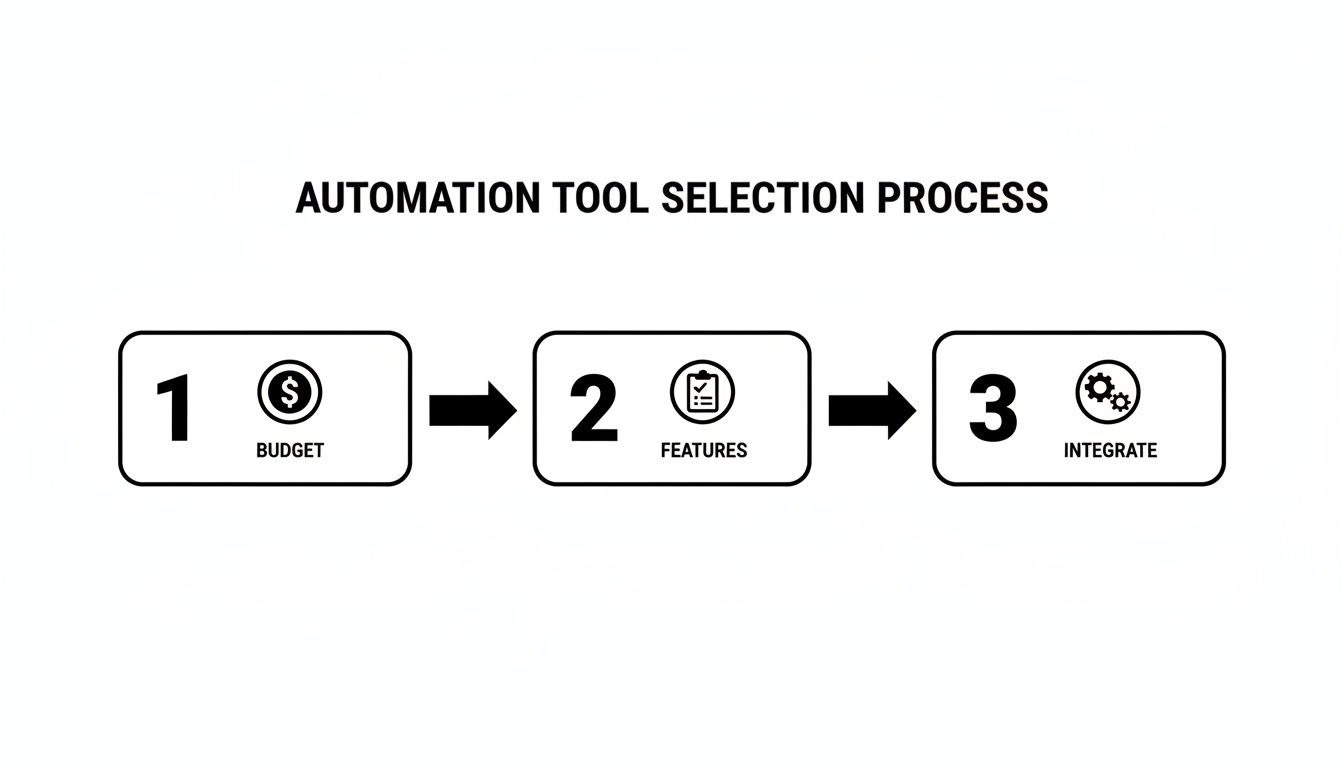
The key takeaway here is that picking a tool is a strategic process, not just a price comparison. You need to make sure the software actually fits your business's financial and technical reality.
Using Automation to Create Personalised Experiences
This is where marketing automation goes from being a handy time-saver to an absolute game-changer. I'm going to show you how to use the customer data you're already collecting to deliver experiences that feel genuinely personal, making your audience feel seen and valued—not just marketed to. It’s all about creating moments that feel one-to-one, even when you're communicating with thousands.
We’re moving way beyond just slotting a [First Name] tag into an email subject line. The real power is in using dynamic content.
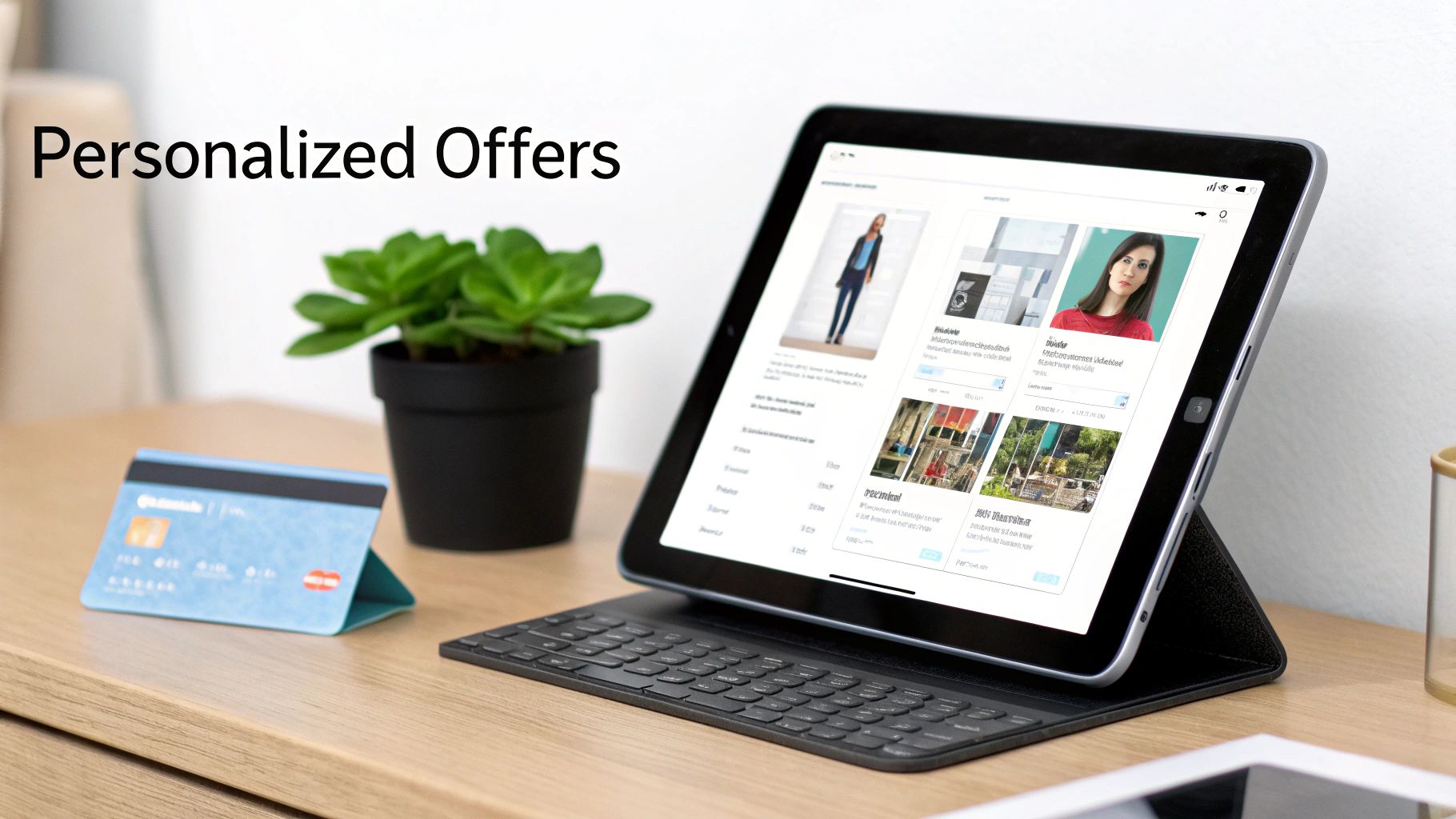
Imagine sending a single email campaign where every person sees different product recommendations based on what they've previously browsed or bought. A customer who recently bought hiking boots sees an email automatically showcasing waterproof jackets. Someone else who browsed women's running shoes sees the latest arrivals in that category. This is what modern automation platforms can do, and it's incredibly powerful.
Leveraging Behavioural Data for Relevance
The secret sauce here is behavioural data. Your automation software can track what people do on your site, letting you build hyper-relevant segments and triggers. You’re no longer guessing what your customers might like; you’re using their own actions to guide your marketing.
Here are a few practical ways I’ve put this to work with my e-commerce clients:
- Post-Purchase Upsells: If a customer buys a coffee machine, you can automatically send them an email a week later showcasing your premium coffee beans. It’s relevant, helpful, and a highly effective way to encourage that second purchase.
- Replenishment Reminders: Selling something that runs out, like skincare or supplements? Set up an automation to send a reminder email just before they're due to run low—say, 50 days after a 60-day supply was purchased.
- VIP Segmentation: Automatically tag customers as VIPs once they've spent over a certain amount (like $500) or made a certain number of purchases (e.g., 5+). You can then send this group exclusive offers, early access to sales, or just a special thank-you note.
Personalisation isn’t a nice-to-have anymore; it’s an expectation. When you deliver content that feels curated and thoughtful, you're not just selling a product. You're building a relationship that fosters loyalty and dramatically increases customer lifetime value.
The Role of AI in Modern Personalisation
New artificial intelligence features are making all of this even more accessible for small businesses. Many automation tools now come with AI assistants that can help you write better subject lines, A/B test email copy, and even predict the best time to send a campaign to each individual subscriber.
This AI-driven approach is quickly becoming central to marketing. In fact, studies show that 76% of ANZ small business owners planned to use generative AI or AI tools for their marketing in 2025. This push is driven by the need to manage campaigns at scale, especially as Australian social ad spend is projected to hit around US$4.73 billion in 2025.
You can read more about these small business trends and see just how significant this shift is. For an e-commerce brand, this means creating a shopping experience that feels uniquely tailored, which translates directly into higher engagement and more sales.
Avoiding Common Marketing Automation Mistakes
Embarking on your marketing automation journey is exciting, but I've seen where things can go wrong. I want to help you sidestep some of the most common pitfalls I've witnessed firsthand. The single biggest mistake is falling into the 'set it and forget it' mindset.
Automation is not a crockpot; it's more like a garden. It needs ongoing attention to thrive. You have to monitor your results, tweak your workflows, and continually optimise your campaigns for better performance. A sequence that worked brilliantly six months ago might need a refresh today.
Keeping Your Data Clean and Connected
Another major trap I see businesses fall into is messy data. When your tools aren't properly integrated, you end up with siloed, inconsistent information. This is a campaign killer. If your Shopify store, your email platform, and your CRM aren't speaking the same language, your automation efforts will be built on a shaky foundation.
This is a widespread challenge. While adoption of automation is high, over half of small businesses feel overwhelmed by the number of apps they use. Around 50% report data inconsistencies between their tools that directly harm the effectiveness of their automations. Businesses with a solid data foundation are far more likely to see significant success with these tools. You can explore more about how AI is shaping the Australian small business sector to understand the importance of this.
Balancing Automation with a Human Touch
Finally, it’s crucial to avoid the danger of over-automating and losing the human touch. The goal is to enhance, not replace, genuine customer relationships. Use automation to handle the repetitive tasks so you have more time for meaningful, personal interactions.
The secret to successful marketing automation for a small business is finding the right balance. Use these powerful tools to scale your communication and efficiency, but never at the expense of authentic connection.
Here are a few tips to maintain that balance:
- Personalise, don't just automate: Use customer data to make your automated messages feel relevant and personal.
- Monitor replies: Always have a real person ready to respond when a customer replies to an automated email.
- Pick up the phone: For high-value customers or complex issues, nothing beats a real conversation.
By avoiding these common mistakes, you can ensure your automation efforts save you time, make you money, and strengthen your customer relationships all at once.
Frequently Asked Questions About Marketing Automation
As a Melbourne-based marketing agency, I field a lot of questions from small business owners who are curious but a little wary of marketing automation. It’s a big step, and it’s completely normal to have some concerns. Here are my honest, straight-up answers to the questions I hear the most.
How Much Should a Small Business Budget for Automation?
There's no single magic number here, but from what I’ve seen, a good starting point is usually between $50 to $200 per month. Heaps of the best platforms out there have free or really affordable starter plans, which are perfect for dipping your toes in without a huge financial commitment.
Ultimately, your cost will come down to two things: the number of contacts you have and the specific features you actually need. My advice is always to start small. Pick a tool that fits your current budget, get really good at its core features like email automation, and prove the concept first. Once you start seeing a clear return, you can confidently upgrade to a more advanced plan.
Can Marketing Automation Feel Too Robotic?
It absolutely can if it’s done poorly, but the real goal of good automation is the exact opposite. I’ve seen some terrible automation in the wild, and it’s always based on generic, one-size-fits-all messages that feel cold and impersonal. Great marketing automation, on the other hand, uses customer data to create more personal and relevant experiences, not less.
To avoid that robotic feeling, you have to lean into segmentation. This just means sending targeted messages based on what your customers have actually done—like products they’ve viewed or things they’ve bought. Use dynamic content to personalise emails with things they’re genuinely interested in. The key is to use automation to deliver the right message to the right person at exactly the right time. It should feel helpful, not creepy.
How Do I Measure the Success of My Automation Efforts?
Measuring success is crucial; otherwise, you’re just flying blind. You need to focus on a few key performance indicators (KPIs). For your email workflows, keep a close eye on your open rates, click-through rates, and conversion rates. Are people actually opening and engaging with what you’re sending?
For lead nurturing, the main metric is your lead-to-customer conversion rate. But at the end of the day, the most important number is your Return on Investment (ROI). Is the revenue you’re generating from your automated campaigns greater than what you’re spending on the software? Most platforms have built-in dashboards that make tracking all of this pretty straightforward.
What Is the Difference Between Email Marketing and Marketing Automation?
This is a great question, and it’s one that often trips people up. Think of it this way: email marketing is a specific action, like sending out your weekly newsletter to everyone. Marketing automation is the broader technology that makes those actions smarter and more strategic.
A basic email marketing tool lets you send a single email blast to your whole list. An automation platform, on the other hand, lets you build clever 'if this, then that' workflows. For example, IF a customer abandons their cart, THEN you can automatically send them a reminder email two hours later. It’s all about creating a sequence of communications that responds to user triggers, not just sending one-off messages.
Alpha Omega Digital is a marketing agency based in Melbourne, Australia but also services clients from Sydney, Brisbane, Newcastle, Perth, Adelaide, Darwin and Hobart. Have a project in mind? Contact us
[email protected]
Read more insights from our team on web design, paid ads, and growth strategy.