Let's cut through the jargon. I'm going to explain this based on my real experience running a marketing agency. A landing page is a standalone webpage built for a single, focused purpose: to get a visitor to take one specific action. That's it. Nothing else matters.
Your Website's Secret Salesperson
From my experience running a marketing agency in Melbourne, the best way to get your head around a landing page is to think of your e-commerce website like a physical shop.
Your homepage is the friendly receptionist at the front desk. They greet everyone, offer a bit of general information, and can point people in all sorts of directions—to your ‘About’ page, your blog, your different product categories. It’s helpful, sure, but it’s juggling a dozen different jobs at once.
A landing page, on the other hand, is your top salesperson.
Imagine a customer clicks a specific ad for a new line of sneakers. They aren't sent to the general receptionist. Instead, they're escorted directly into a private room where your best salesperson is waiting, ready to talk exclusively about those sneakers.
There are no distractions. No other products on the shelves, no links to your company’s history, and definitely no blog posts about your latest team outing. It's a one-on-one conversation with a single goal: get the customer to buy those sneakers.
That’s the raw power of a landing page for an e-commerce business.
Landing Page vs Homepage At a Glance
To make the distinction crystal clear, it helps to see the core differences side-by-side. I've found this is the quickest way for our e-commerce clients to grasp why both are essential but serve entirely different functions.
| Characteristic | Landing Page | Homepage |
|---|---|---|
| Primary Purpose | To convert visitors for one specific offer or campaign. | To introduce the brand and guide visitors to different areas of the site. |
| Navigation | Minimal or completely absent to eliminate distractions. | Full navigation menu (About, Services, Blog, Contact, etc.). |
| Content Focus | Laser-focused on a single message and call-to-action (CTA). | Broad overview of the entire business and its value proposition. |
| Traffic Source | Typically from paid ads (Google, Facebook) or specific email links. | From various sources, including direct traffic, organic search, and referrals. |
| Number of Links | Very few, usually just the CTA and maybe a privacy policy link. | Dozens of internal and external links. |
Understanding this fundamental difference is the first step. Next, I'll dive into why this focused approach is an absolute game-changer for e-commerce businesses, particularly when running paid advertising campaigns where every click costs you money.
Why Landing Pages Are a Game Changer for Marketing
So, we've established that a landing page is a specialist, not a generalist. But why should you actually care? From my experience as a digital marketing agency in Melbourne, I've seen dedicated landing pages completely flip the script on marketing results for e-commerce businesses. This isn't just theory; it’s about getting a bigger bang for your buck on every single ad dollar you spend.
The magic of a landing page is its brutal simplicity. By stripping away all the usual distractions—like navigation bars, sidebars, and links to other parts of your site—you create a direct, uncluttered path for your customer. They click an ad for a specific product, and they arrive on a page that is 100% focused on that exact product. There's nowhere else to go but forward, towards the action you want them to take.
This focused approach is especially critical when you're paying for traffic from platforms like Google Ads or running a campaign with a Facebook ads agency. You're paying good money for each click, so sending that expensive traffic to a busy homepage is like inviting a motivated buyer into your store and then immediately showing them the fire exit. A good landing page keeps them in the room, engaged with the one thing they came for.
Skyrocketing Your Conversion Rates
The most obvious benefit is a dramatic lift in conversion rates. Because the message on the landing page perfectly matches the ad the user clicked on, the whole experience feels seamless and persuasive. It builds instant trust and clarity, guiding them straight to the 'Buy Now' or 'Sign Up' button.
The data backs this up in a big way. Across all industries, the median landing page conversion rate sits at 6.6%, which is often two or three times higher than a typical website's overall conversion rate. The top 10% of landing pages? They’re hitting conversion rates of 11% or higher, which shows just how powerful they can be when you get them right. These aren't small numbers; they can make or break a campaign, especially if you're a dropshipper trying to optimize your Google Shopping ads for dropshipping. You can even explore more Australian conversion rate statistics to see how your industry stacks up.
This isn't just about making more sales from the same traffic; it’s about making your entire marketing funnel more efficient.
Gaining Deeper Audience Insights
Beyond the immediate conversions, landing pages are incredible tools for gathering data. By creating different pages for different audience segments or offers, you can quickly learn what actually resonates with your customers.
We use tools like Google Tag Manager and Google Analytics to track absolutely everything. Setting up Google Tag Manager containers properly is the first step. Which headline gets more clicks? Which product image drives more sales? Every test provides invaluable insights that you can then apply across your entire marketing strategy, from your next email campaign to your core website copy. We also ensure a proper Conversions API installation for Meta to get the full picture of our client's ad performance.
This constant process of testing, learning, and iterating is exactly how we build winning campaigns for our e-commerce clients.
The Anatomy of a High-Converting Landing Page
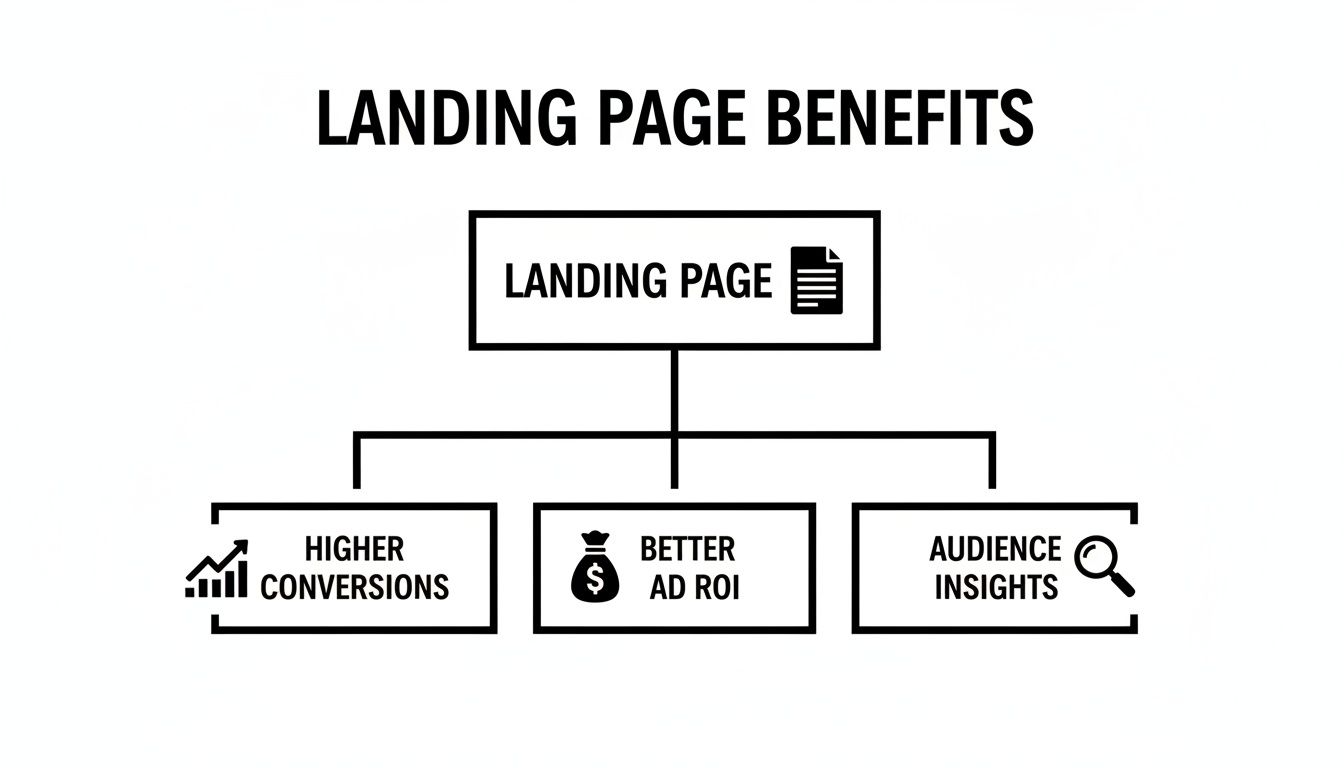
This diagram gets straight to the point. A dedicated landing page isn't just a nice-to-have; it's a strategic tool that directly boosts conversions, improves your ad spend, and gives you incredibly valuable insights into what your audience actually wants. Think of it as your best salesperson, working 24/7.
The Essential Building Blocks
Over the years, I've built and tested more landing pages than I can count for e-commerce stores. While every business is different, the pages that consistently win share the same core DNA. These are the non-negotiables that work together to turn a casual click into a genuine customer.
-
The Unmissable Headline: This is your first—and maybe only—chance to grab someone. It has to be punchy, clear, and perfectly match the promise you made in your ad. If a user clicks an ad for "50% Off Winter Coats," the headline on the page better say something almost identical. Anything else feels like a bait-and-switch.
-
Persuasive, Scannable Copy: Let's be honest, nobody reads walls of text online anymore. Your copy needs to be sharp, use bullet points, and get straight to the point. It should speak directly to the customer's problem and frame your product as the only logical solution.
-
High-Quality Visuals: We're visual creatures. You need to show your product in its best light with crisp, high-resolution images or a short, compelling video. For an e-commerce brand, this could be showing the product from multiple angles or in a real-world setting that helps the customer imagine it in their own life. Our Meta ads creative testing process has shown time and again how crucial the right image or video is.
The Conversion Catalysts
Nailing the basics is crucial, but a few extra elements can pour fuel on the fire and seriously boost your page's performance. These are the components that build trust, create a bit of urgency, and gently nudge a hesitant visitor over the finish line.
A great landing page has one job: to remove friction. Every single element should make it easier for the user to say 'yes'. If it doesn't serve that purpose, it's just a distraction that's costing you money.
To really dial things in, mastering landing page conversion rate optimization is a complete game-changer. It’s all about refining each of these components to squeeze every last drop of performance out of your page.
-
Social Proof and Trust Signals: This is your credibility engine. Things like customer testimonials, star ratings, or logos of well-known brands you’ve worked with build instant confidence. When a new visitor sees that other people have already had a great experience, their guard comes down.
-
A Clear and Compelling Call-to-Action (CTA): This is it—the final step. Your CTA button needs to stand out visually and use action-packed text. Something like "Get My Discount Now" is worlds better than a boring "Submit." There should be absolutely no doubt about what you want the user to do next.
Optimising Your Landing Page for Mobile Users
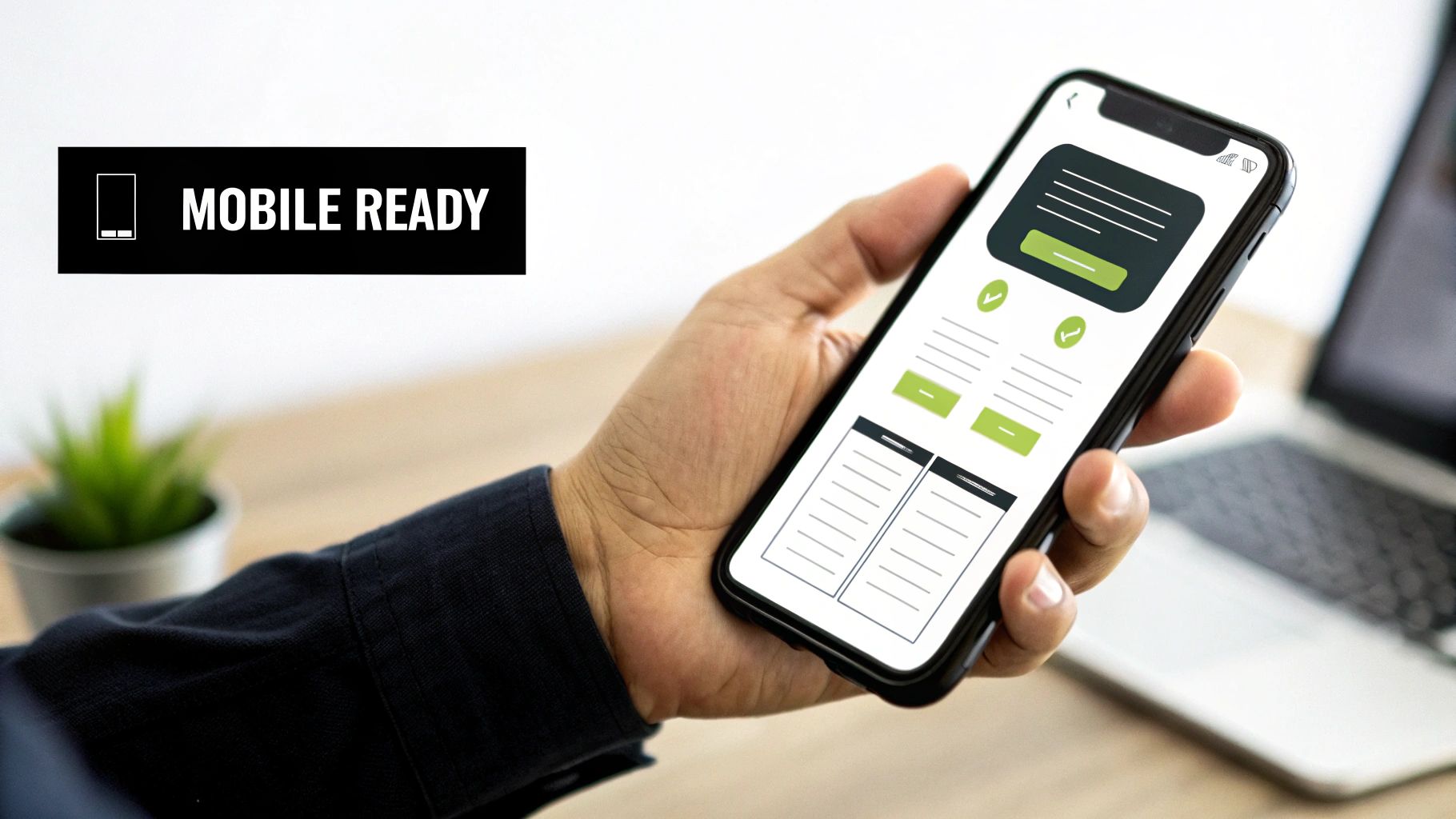
Let me be blunt for a moment. As a marketing agency in Melbourne, one of the biggest leaks I see in an e-commerce client's budget comes from ignoring mobile users. It’s pretty simple: if your landing page looks terrible or is a nightmare to use on a phone, you're just lighting money on fire. A huge chunk of your customers are scrolling on their phones, probably while waiting for a coffee or sitting on the train.
You absolutely cannot afford to treat them as an afterthought.
The numbers don't lie. Desktop users convert at an average rate of 3.2%, while mobile users trail behind at just 1.8%. That gap is massive, especially when you realise that 68% of searches in Australia happen on mobile. Aussies love to browse on their phones, but this data screams that most landing pages aren't built to give them a good experience, and it's costing e-commerce businesses dearly. For a deeper dive, you can explore Australian marketing statistics.
Common Mobile Mistakes I See Every Single Day
From my years doing WordPress development and Shopify development, a few classic mistakes pop up over and over again. They seem small, but they absolutely kill conversions for e-commerce stores.
- Painfully Slow Load Times: Mobile users have zero patience. If your page takes more than a couple of seconds to load, they’re gone. Oversized images are usually the biggest culprit here.
- Tiny, Unreadable Text: Nobody wants to pinch and zoom just to read your headline. Your font size needs to be comfortable for reading on a small screen, period.
- Forms That Are Impossible to Fill Out: Asking for ten fields of information on a mobile form is a conversion killer. Keep it dead simple. Make the fields and buttons large enough for thumbs to easily tap.
How to Create a Seamless Mobile Experience
Closing that mobile conversion gap isn't rocket science; it's about being thoughtful and putting the user first. When we build a landing page for a client, whether it's on WordPress or Shopify, our mobile-first checklist is non-negotiable.
First off, your design must be responsive. This means the layout automatically adjusts to fit any screen size perfectly, from a small phone to a huge desktop monitor. As a WordPress developer in Melbourne, I've seen how crucial this is. Sometimes this involves building custom blocks in Gutenberg to ensure perfect mobile rendering. For Shopify, the principles are the same, whether we're talking Shopify design or using the Shopify API for custom features.
Second, think about "thumb-friendly" design. All your important buttons, especially the Call-to-Action, need to be easy to tap without accidentally hitting something else. We strategically place them where a user’s thumb naturally rests.
Finally, simplify everything. Cut down your copy, stick to a single-column layout, and make sure your core message is visible without any scrolling. The goal is to make taking action completely effortless.
Right, so you've built a brilliant landing page. It's got a killer headline, persuasive copy, and a call-to-action that’s impossible to ignore. But then… crickets.
I’ve seen this happen time and time again. An e-commerce business invests in a fantastic page, but it just sits there, collecting digital dust. Building an amazing page is only half the battle; you have to get the right people to actually see it.
This is where your traffic strategy comes in, and honestly, it’s just as important as the page design itself. Simply blasting a link out everywhere and hoping for the best is a surefire way to burn through your marketing budget with nothing to show for it. You need to be intentional about where your visitors are coming from.
As a marketing agency in Melbourne, the channels we rely on most for e-commerce are Google Ads, Facebook Ads, and good old-fashioned organic SEO. Each one attracts a different type of visitor with a completely different mindset, and your landing page needs to speak their language.
Matching Your Message to Your Medium
Think of it like this: someone who clicks on a super-specific Google Ad for "buy black leather boots size 10" is in full-on purchase mode. They’re ready to buy, right now. The landing page they hit needs to be ruthlessly efficient, showing them exactly that product and nothing else. There’s no time for a lengthy brand story; they just want a clear, fast path to the checkout. This is a core part of any beginner's guide to Google Shopping ads.
On the other hand, someone scrolling through their Facebook feed who clicks on an ad is in a much more passive, discovery-focused state of mind. Something just caught their eye. For this person, your landing page can be a bit more engaging. You might use a video or some storytelling to build that desire before you ask for the sale. This is where mastering Facebook ads becomes so important, and knowing how to measure success on Facebook ads will tell you if your approach is working.
This alignment between the ad and the page is critical. Sending all your paid traffic to your generic homepage is one of the costliest mistakes you can possibly make, as it forces the user to start their search all over again from scratch.
The channel a visitor comes from tells you a lot about their intent. A great landing page speaks the right language for that specific channel, making the visitor feel understood from the very first click.
The data backs this up, showing that not all traffic sources are created equal when it comes to conversions. Interestingly, email-driven landing pages often come out on top, hitting an average conversion rate of 12.8%. Paid search follows at 7.2%, with paid social not far behind at 6.4%.
For Australian e-commerce businesses, these benchmarks highlight just how important it is to not only drive traffic but to fine-tune the page for the specific channel it's coming from. You can discover more insights into landing page statistics on Shopify.com.au.
Our Process for Building and Testing Landing Pages
Building a landing page that actually works isn't about slapping some text on a pretty template and hoping for the best. At Alpha Omega Digital, my team and I treat it like a science. I want to pull back the curtain and show you exactly how we turn a simple page into a genuine conversion machine for our e-commerce clients. It’s a methodical process that leaves absolutely nothing to chance.
It all kicks off with a deep dive into audience research. We need to get inside the heads of the people we’re trying to reach. What are their biggest frustrations? What words do they use to describe their problem? What’s the one thing that makes them hesitate before hitting ‘buy’? Once we have that foundation, we build the first version of the page, whether that’s through custom Shopify development or flexible WordPress development. Our Shopify development partners are experts at this.
Data-Driven Design and Development
The moment a page goes live, our real work begins. We lean heavily on tools like Google Tag Manager and other advanced analytics platforms to track every single user interaction. We set up meticulous tracking to see precisely where people click, how far they scroll down the page, and at what point they leave. This data isn't just for colourful reports; it’s the fuel for our optimisation engine.
Using this information, we start forming educated guesses, or hypotheses. For example, we might hypothesise, "Changing the button colour from blue to orange will likely increase clicks by 15% because it creates a stronger visual contrast against the background." Then, we put it to the test.
A landing page is never truly 'finished.' It's a living asset that should be constantly evolving based on real user data. The moment you 'set it and forget it' is the moment you start leaving money on the table.
Relentless A/B Testing and Optimisation
This brings us to the core of our whole process: rigorous A/B testing. We'll run different versions of the page at the same time to see which one performs better in the real world, with real traffic.
We test everything, including:
- Headlines: Pitting a benefit-driven headline against one that asks a provocative question.
- Calls-to-Action (CTAs): Trying out "Get Your Free Quote" versus "Start Your Project Today."
- Images and Videos: Seeing if a product video converts better than a static, aspirational lifestyle image.
- Form Length: Testing if removing just one non-essential field can significantly boost lead submissions.
As a marketing agency in Melbourne, we know from experience that even the smallest, incremental wins from these tests can add up to a massive impact on a campaign’s ROI over time. This cycle of building, measuring, and learning is how we make sure our landing pages don't just look good—they deliver tangible, measurable results for e-commerce brands.
A Few Common Landing Page Questions I Get Asked
Even after explaining what landing pages are all about, a few questions tend to pop up again and again from my e-commerce clients. Let's run through them, because clearing these up will give you the confidence to start using them properly in your own marketing.
Can I Just Use My Homepage as a Landing Page?
Technically, yes, you can send ad traffic anywhere you like. But should you? Absolutely not. From my experience, sending paid traffic to a homepage is one of the fastest ways to burn through your ad budget with nothing to show for it.
Think about it: your homepage is designed to do a dozen different things. It has navigation bars, links to your blog, your ‘About Us’ page, different product categories… it's full of distractions. A dedicated landing page is built with a single, laser-focused goal, which dramatically boosts your chances of converting that visitor you just paid for.
How Many Landing Pages Should I Have?
The honest answer? It depends entirely on your marketing campaigns.
Ideally, you should have a unique landing page for each distinct campaign, ad group, or even audience segment. For example, if you're a Shopify developer running ads for three different services—say, theme customisation, building custom Shopify apps using Shopify CLI, and site migrations—you should have three separate landing pages. This ensures your message is perfectly aligned with the specific ad that brought the visitor there, making the whole experience seamless.
What Is a Good Conversion Rate for a Landing Page?
This is the million-dollar question, and the answer is always "it varies." A "good" conversion rate can change wildly depending on your industry, your offer, and where your traffic is coming from.
The median rate in Australia hovers around 6.6%, but I’ve seen campaigns hit well over 10%, which is generally considered excellent.
But here’s the most important thing: forget the averages for a minute. The real goal is to establish your own baseline and then constantly test and tweak to improve it. Focus on beating your own numbers, not getting hung up on what everyone else is doing.
Do Landing Pages Help with SEO?
They absolutely can. While it’s true that many landing pages—especially for short-term ad campaigns—are set to "noindex" so they don't clutter up search results, that’s not the only way to use them.
You can create evergreen, SEO-optimised landing pages designed to rank for specific long-tail keywords. These act as powerful, super-targeted entry points from organic search, capturing highly qualified traffic for your business long after a paid campaign has ended. Our SEO agency in Melbourne uses this strategy all the time to complement our Local SEO and Google My Business optimisation efforts.
Alpha Omega Digital is a marketing agency based in Melbourne, Australia but also services clients from Sydney, Brisbane, Newcastle, Perth, Adelaide, Darwin and Hobart. Have a project in mind? Contact us.
Alpha Omega Digital
Read more insights from our team on web design, paid ads, and growth strategy.