Ever feel like your website is a busy store full of window shoppers, but very few people are actually making it to the checkout? That's a classic conversion problem. From my experience working with eCommerce businesses, I’ve learned that a conversion rate optimisation agency is basically a performance detective for your website, figuring out how to turn more of that hard-earned traffic into actual revenue. We don’t just guess what might work; we use real data to find out why visitors aren't converting and build a solid strategy to fix the leaks.
What a CRO Agency Actually Does for Your Business
Getting traffic to your website is only half the battle. If those visitors don’t take action—like making a purchase, filling out a form, or signing up—then your marketing spend isn't delivering its full potential. This is the exact problem we solve as a digital marketing agency in Melbourne.
Our job is to dive deep into your website's performance, using tools like Google Analytics and heatmaps to really understand how people behave on your site. I've spent countless hours sifting through this data for clients, pinpointing the exact moments customers hesitate, get confused, or just give up and leave. From there, we build a data-backed strategy to smooth out those friction points.
Turning Clicks Into Customers
This isn't about random tweaks or changing button colours based on a gut feeling. It’s a methodical, scientific process that involves a few key steps I follow with every client:
-
Data Analysis: I start by getting a clear picture of your current performance. This means digging into bounce rates, exit pages, and conversion funnels to identify exactly where you're losing potential customers.
-
User Behaviour Research: Next, we use specialised tools to see how real people interact with your site. Are they ignoring your main call-to-action? Are they getting stuck on the checkout page? This qualitative data gives us the "why" behind the numbers.
-
Hypothesis and Testing: Based on what we find, we form educated hypotheses. For example, "We believe that simplifying the checkout form will increase completed purchases by 15%." We then run controlled A/B tests to prove (or disprove) this without risking your existing sales.
For many Australian businesses, there's a huge opportunity for improvement. The average eCommerce conversion rate here is a modest 1.78%, lagging behind the global average. Considering the AU$56.07 billion local market, bridging this gap can unlock some serious revenue.
A CRO agency helps businesses better understand their customers and make data-driven decisions that directly impact the bottom line. It's about moving from guesswork to a predictable system for growth.
To give you a clearer picture, here’s a quick breakdown of what we focus on.
Key Focus Areas of a CRO Agency
| Service Area | What It Means for Your Business | Key Platforms |
|---|---|---|
| Data & Analytics Audit | We find out where you're losing money by analysing user journeys and identifying drop-off points. | Google Analytics, Adobe Analytics |
| User Experience (UX) Research | We use heatmaps, session recordings, and surveys to see what's frustrating your visitors. | Hotjar, Crazy Egg, Microsoft Clarity |
| A/B & Multivariate Testing | We test new page designs, copy, and layouts against your current version to see what performs best. | Google Optimize, Optimizely, VWO |
| Landing Page Optimisation | We create high-converting landing pages specifically for your paid ad campaigns to maximise ROI. | Unbounce, Instapage, Leadpages |
| Funnel & Checkout Optimisation | We streamline the path to purchase, removing friction to reduce cart abandonment and increase sales. | Shopify, WooCommerce, Magento |
Ultimately, our goal is to make your website work harder for you, ensuring every visitor has the best possible chance of becoming a customer.
To truly understand the multifaceted approach a CRO agency employs, it's beneficial to look at practical guides covering strategies to improve ecommerce conversion rates. This science of optimisation applies directly to Melbourne-based eCommerce stores on platforms like Shopify and WordPress, helping you understand the real value beyond just traffic numbers.
Our Six-Step CRO Process That Delivers Real Results
Getting real results from Conversion Rate Optimisation isn't about guesswork or changing a button colour on a whim. It’s about following a proven system. Over the years, I've refined a process that consistently works for our eCommerce clients, moving them from uncertainty to clear, profitable actions.
It's a journey we take with every client, and it’s built on a simple premise: every decision must be backed by solid evidence. This is how we deliver predictable growth, not just hopeful changes.
Here’s a look at how we approach analysis, strategy, and implementation for our clients.
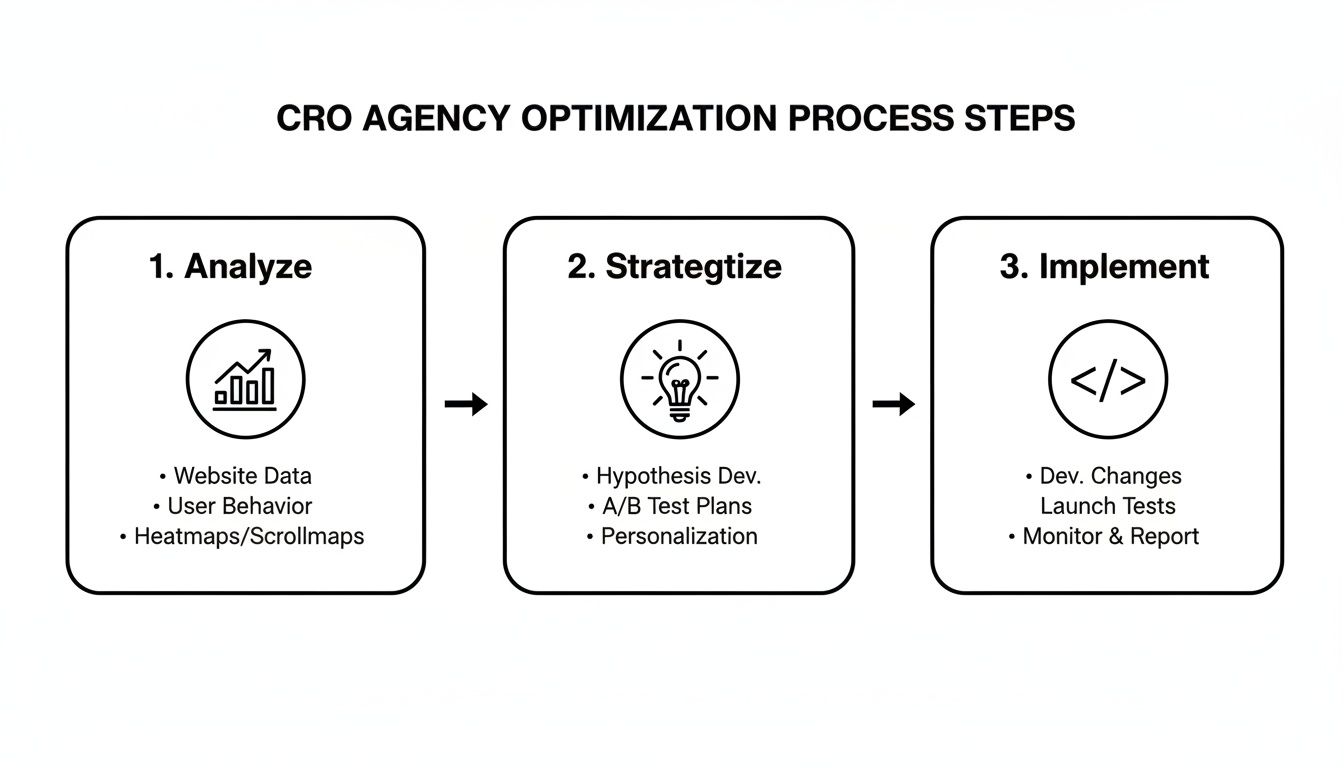
Effective CRO is never a one-and-done task. It's a continuous cycle of data-driven analysis, smart planning, and hands-on implementation that leads to ongoing improvement.
Stage 1: Discovery and Research
First things first: we have to do a deep dive. I can’t fix what I don’t truly understand. This is where we immerse ourselves in your business, digging into everything from your Google Analytics data and Google Tag Manager setup to user behaviour recordings and heatmaps.
We’re on the hunt for patterns, friction points, and the exact moments people abandon their carts or leave your site. I ask the tough questions: Where are users dropping off? What part of the journey is confusing them? This foundational research informs every single thing we do next.
Stage 2: Hypothesis Formulation
With solid data in hand, we shift from observation to action. This is where we form clear, testable hypotheses. A hypothesis isn't just a random guess; it's an educated statement grounded in the evidence we’ve just gathered.
For example, I might say: "Based on heatmap data showing users are completely ignoring the main navigation, I believe that simplifying the menu options will increase product discovery and lead to a 5% lift in add-to-cart actions." It’s specific, measurable, and based on real user behaviour.
Stage 3: Controlled A/B Testing
This is where the real science comes into play. We run controlled A/B tests to validate our hypotheses without risking your existing revenue. It’s simple, really: we split your website traffic, showing one group the original version (the 'control') and the other group our new version (the 'variation').
We then meticulously measure which one performs better against our goal, whether that’s more clicks, form fills, or actual sales. This process ensures our decisions are driven by what your customers actually do, not what we think they’ll do.
Stage 4: Implementation
Once a test produces a statistically significant winner, it’s time to make that change permanent. This is where our skills as a WordPress developer or Shopify developer become crucial. We don’t just hand you a report and walk away.
We have the in-house technical expertise to flawlessly implement the winning design, whether that involves building custom Gutenberg blocks for a WordPress site or modifying a Shopify theme file.
This seamless integration of strategy and execution is what sets a true digital marketing agency in Melbourne apart. An idea is only as good as its implementation, and we ensure the technical work is done to the highest standard.
Stage 5: Optimisation and Iteration
The work is never truly done. After implementing a win, we analyse the new data and immediately start looking for the next opportunity. Each test provides fresh insights that fuel our next hypothesis.
This creates a powerful cycle of continuous improvement. Your website gets progressively better, smarter, and more profitable over time. It’s not about finding one magic bullet; it's about making dozens of intelligent, data-backed improvements that compound over time.
Connecting Your Paid Ads to a CRO Strategy
Running Google Ads or Meta Ads without a solid CRO plan is like pouring water into a leaky bucket. I've seen it time and again with businesses in Melbourne; you're spending good money on every single click, but your website isn't set up to convert that expensive traffic into actual sales.
It's one of the fastest ways to burn through a marketing budget with very little to show for it.
This is where a conversion rate optimisation agency connects the dots between your ad spend and your actual return on investment. The goal is to create a seamless, persuasive journey from the moment someone sees your ad to the moment they complete a purchase.
Maximising Your Ad Spend With Landing Page Optimisation
From personal experience, one of the biggest levers for improving ad performance is optimising your landing pages. It’s where the magic really happens.
When your ad message perfectly matches what a user sees on your landing page—what we call ‘message match’—it creates a smooth, trustworthy experience. This simple alignment can dramatically boost your Google Ads Quality Score, which in turn lowers your cost-per-click (CPC) and stretches your budget further.
We achieve this through a few key tactics that just work:
- Dedicated PPC Landing Pages: Instead of sending expensive ad traffic to a generic homepage, we build focused landing pages designed for one single goal: conversion.
- Message and Offer Congruency: The headline, copy, and offer in your ad must be immediately visible and consistent on the landing page. No surprises.
- Frictionless User Experience: Pages are designed to be fast, mobile-friendly, and incredibly easy to navigate, guiding the user straight to the call-to-action.
A core part of this is continuous testing. For any eCommerce business serious about results, learning how to properly A/B test landing page variations is non-negotiable for squeezing every last drop of performance out of your campaigns.
The Critical Role of Tracking and Analytics
You can't optimise what you don't measure. It’s a cliché because it’s true.
This is why a proper tracking setup is the absolute foundation of connecting paid ads to CRO. Without it, you’re just flying blind and hoping for the best. We make sure every campaign is meticulously tracked using tools like Google Tag Manager and the Meta Conversions API. Setting up the Conversions API for Meta can be tricky, but it's essential for accurate tracking in a post-iOS14 world.
This detailed setup allows us to see exactly which ads, keywords, and audiences are driving conversions and which are just wasting money. It gives us the hard data we need to make smart decisions, kill underperforming campaigns early, and double down on what’s working. This data-driven approach is essential in a competitive market like Melbourne.
How We Marry Web Development with CRO
A brilliant CRO idea is useless if you can’t actually build it. That’s a hard truth I’ve seen play out too many times. You can have the sharpest data and a game-changing hypothesis, but if your development team can’t bring it to life quickly and accurately, the whole strategy falls apart.
This is where our approach as a digital marketing agency in Melbourne really sets us apart. We aren't just strategists who hand you a list of recommendations and wish you luck. We're builders.
As both a WordPress development company and a Shopify partner, we have the in-house technical chops to actually execute on the strategies we create. That seamless connection between insight and implementation is our secret sauce.
From Hypothesis to High-Converting Code
When we spot a conversion opportunity, our development team is in the loop from day one. This makes sure every idea is not just effective in theory, but also technically sound and scalable in reality.
For our eCommerce clients, this synergy looks like this:
- Building Custom Gutenberg Blocks: Instead of being stuck with your theme's default options on a WordPress site, we can build custom, flexible blocks that perfectly match our test design. This creates a more unique and persuasive user experience that your competitors can't easily replicate.
- Developing Custom Shopify Sections: For Shopify stores, we create bespoke sections that can be easily tested and rolled out. This lets us implement unique layouts or features that standard themes just don’t support, giving our clients a real competitive edge.
- Mastering the Shopify API: Our ability to work directly with the Shopify API means we can build custom solutions from the ground up—from unique product bundles to slicker, faster checkout flows that go way beyond out-of-the-box functionality. This can even involve building custom Shopify apps using Shopify CLI.
- Flawless Tracking Implementation: We make sure tools like Google Tag Manager and the Meta Conversions API are perfectly configured. Clean data is the absolute foundation of good CRO, and we treat your tracking setup like gold.
An A/B test is only as reliable as its technical execution. Glitches, slow load times, or cross-browser issues can completely invalidate your results. Our integrated approach eliminates these risks by ensuring a flawless build from day one.
Technical Fundamentals Are CRO Fundamentals
Beyond the fancy custom builds, we know that the technical bedrock of your website is a massive part of its conversion potential. A slow, clunky, or broken site will kill your conversion rate, no matter how good your offer is.
Our whole development process is built around CRO principles. We obsess over things like:
- Site Speed: A one-second delay in page load time can slash conversions by up to 7%. We're constantly optimising images, code, and server response times to make your site feel lightning-fast.
- Mobile Responsiveness: With most of your traffic likely coming from mobile, a perfect mobile experience is completely non-negotiable. We design and test for a mobile-first world, ensuring your site is a breeze to use on any device.
- Clean UI/UX: Our designs are clean, intuitive, and laser-focused on guiding the user toward the conversion goal. We strip out the distractions and make the path to purchase as simple and frictionless as possible.
This deep integration of web development and conversion strategy means we don't just find conversion opportunities—we build them. By bridging that critical gap between marketing insights and flawless technical work, we deliver results that are both measurable and sustainable.
How to Choose the Right CRO Agency in Melbourne
Finding the right agency is probably the most critical decision you'll make in this entire process. Not all are created equal, especially in a specialised field like CRO. As a digital marketing agency in Melbourne, I’ve seen firsthand how a poor partnership can waste time and money, while the right one can completely change a business's trajectory.
This isn't about finding a supplier; it's about finding a true partner. You need a team that is genuinely invested in your growth, not just in sending you a monthly invoice. I want to give you a practical checklist to help you vet potential agencies and make an informed choice for your Melbourne-based business.
Look for a Hybrid Skillset
The best CRO results come from a team that gets both marketing psychology and the technical side of web development. A great idea is useless if it can't be built properly, and a technically perfect test won't convert if it ignores how customers think and behave.
When you're talking to a potential conversion rate optimisation agency, ask them about their experience with:
- Platform-Specific Development: Do they have genuine experience as a WordPress developer or Shopify partner? Can they show you examples of custom solutions they've built?
- Paid Advertising Acumen: How deep is their knowledge of Google Ads and Meta Ads? A team that lives and breathes paid traffic knows exactly how to build landing pages that align with ad campaigns and drive conversions.
- Analytics and Tracking: Ask them how they would set up your tracking. They should talk confidently about Google Tag Manager, the Meta Conversions API, and making sure your data is rock-solid from day one.
Ask for Proof and Transparency
Talk is cheap. Any agency can claim to get results, but a great one will be eager to prove it. Don't be shy about asking the tough questions.
The single most important question you can ask is: "Can you walk me through a case study for a business like mine?" Look for real numbers, specific challenges they overcame, and a clear explanation of their process. An agency proud of its work will have this ready.
An agency that is transparent about its process, reporting, and even its failures is one you can trust. A major red flag is any agency that makes grand promises without showing the data-driven methodology to back it up.
Agency Evaluation Checklist
Here’s a quick checklist I've put together to help you compare potential partners. Use it to cut through the sales pitches and find a team that truly fits your business.
| Criteria | What to Look For | Red Flags to Avoid |
|---|---|---|
| Proven Track Record | Detailed case studies with real eCommerce businesses, clear metrics (revenue lift, AOV), and client testimonials. | Vague promises, no specific examples, or only showing vanity metrics like traffic increases. |
| Technical Expertise | In-house developers for Shopify and WordPress. They should discuss site speed, custom code, and API integrations. | Outsourced development, inability to answer technical questions, or a focus only on design without implementation. |
| Transparent Process | A clear, documented methodology for research, testing, and reporting. They should explain how they get results. | A "secret sauce" they can't explain. A lack of a structured process or unclear reporting schedules. |
| Cultural Fit | They act like a partner, ask smart questions about your business, and seem invested in your long-term success. | A sales-heavy approach, pressure to sign quickly, or a one-size-fits-all solution for every client. |
Choosing the right CRO partner is a big decision, but with the right questions and a clear set of criteria, you can find a team that will become an invaluable extension of your own.
Common Questions About Conversion Rate Optimisation
Over the years, I've answered hundreds of questions from business owners dipping their toes into CRO. It’s natural to be curious and even a bit sceptical about how it all works. I get it.
So, in this final section, I’ll tackle the most common questions head-on to clear up any lingering doubts you might have. Think of this as the straight-talk part of the conversation.
How Much Does a Conversion Rate Optimisation Agency Cost?
This is always the first question, and the honest answer is: it varies. A lot. The cost really depends on the scope of work we agree on. Some agencies will lock you into a monthly retainer that can range from $2,000 to over $10,000, while others might use a project-based or even a performance-based model.
At our marketing agency in Melbourne, we tailor the pricing to your specific business goals. The way I see it, this work should pay for itself by making the traffic you already have more valuable. It's an investment in profitability, not just another line item on your expenses sheet. For eCommerce businesses, the ROI from a small increase in conversion rate can be massive, easily justifying the cost.
How Long Until We See Results from CRO?
While it’s sometimes possible to find small, quick wins in a matter of weeks, a proper CRO strategy is a long game. It’s not about magic tricks; it’s about gathering enough data to make smart, statistically sound decisions that actually move the needle.
You can typically expect to see meaningful insights and measurable improvements within the first 90 days. The whole process is iterative, with each A/B test building on the last to create continuous, compounding growth over time. Patience is key here, but it definitely pays off.
The goal isn't a one-time lift. It's about building a repeatable system for sustainable growth. Every test—whether it wins or loses—gives us valuable data that makes your website smarter and more effective.
What Is the Difference Between SEO and CRO?
Great question. This one comes up all the time.
Think of it like this: SEO (Search Engine Optimisation) is all about getting more of the right people to walk through your front door. CRO (Conversion Rate Optimisation) is about making sure they buy something once they're inside.
They are two sides of the same coin and work best when they're in sync. World-class work from an SEO agency in Melbourne is wasted if your site can't convert that traffic, and a high-converting site is useless if nobody can find it in the first place. A healthy digital strategy needs both firing on all cylinders.
What Tools Do You Use for Conversion Rate Optimisation?
Our process is driven by hard data, not guesswork. To get the job done right, we rely on a suite of best-in-class tools that tell us not just what is happening, but why.
Here’s a peek at our core toolkit:
- Data & Analytics: Google Analytics and Google Tag Manager are the foundation. This is where we get all our quantitative data.
- User Behaviour Analysis: To understand the "why" behind the numbers, we use heatmapping and session recording tools like Hotjar or Microsoft Clarity to see exactly how people are interacting with your site.
- A/B Testing Platforms: For running controlled experiments, we use powerful platforms like VWO, Optimizely, or the now-retired Google Optimize.
This combination of quantitative and qualitative tools lets us make decisions based on solid evidence, not just opinions. It’s this methodical approach that drives real, measurable results for our clients.
Alpha Omega Digital is a marketing agency based in Melbourne, Australia but also services clients from Sydney, Brisbane, Newcastle, Perth, Adelaide, Darwin and Hobart. Have a project in mind? Contact us
[email protected]
Read more insights from our team on web design, paid ads, and growth strategy.