Let's cut through the jargon. I've seen it countless times with businesses I work with: you have a website, which is like your flagship store. You've paid for ads and marketing to get people in the door, but if the layout is confusing or the checkout line is a mile long, they're going to walk straight back out, empty-handed.
That’s where Conversion Rate Optimisation (CRO) comes in. From my experience, it’s the art and science of turning those window shoppers into actual, paying customers. Think of it as methodically improving your site to increase the percentage of visitors who take the exact action you want them to.
What Is Conversion Rate Optimisation Really?

At its heart, CRO is about making the most of the traffic you already have. Instead of just pouring more money into ads to attract more visitors, you focus on making your website more effective for the visitors who are already there. I’ve found this is the most sustainable way to grow an eCommerce business.
The 'conversion' isn't always a sale, either. It’s any valuable action a visitor can take on your site. For the eCommerce businesses we work with here in Melbourne, that could be anything from:
- Completing a purchase on a Shopify store.
- Filling out a contact form on a WordPress site.
- Signing up for an email newsletter.
- Downloading a product catalogue.
- Even just adding an item to their cart.
To get a handle on the key ideas, it helps to know the language. This little table breaks down the fundamental terms you'll run into.
Core CRO Concepts at a Glance
| Concept | Simple Explanation | Example for an eCommerce Store |
|---|---|---|
| Conversion | The specific action you want a visitor to take. | A customer completing the checkout process and making a purchase. |
| Conversion Rate | The percentage of visitors who complete that action. | If 2 out of 100 visitors buy something, your conversion rate is 2%. |
| Call to Action (CTA) | A button or link prompting the visitor to act. | A button that says "Add to Cart" or "Buy Now". |
| A/B Testing | Comparing two versions of a webpage to see which performs better. | Testing a green "Buy Now" button against a red one to see which gets more clicks. |
| Landing Page | The first page a visitor sees after clicking an ad or link. | A dedicated product page that a user lands on from a Google Shopping ad. |
| Funnel | The series of steps a visitor takes to become a customer. | Homepage > Category Page > Product Page > Cart > Checkout. |
Knowing these terms makes it much easier to understand how all the pieces of a CRO strategy fit together to drive real growth.
Why It's More Than Just Changing Button Colours
I’ve seen so many businesses fall into the trap of thinking CRO is just about random tweaks. They’ll change a button from blue to green, cross their fingers, and hope for the best.
That’s not CRO; that’s just guessing.
True CRO is a disciplined, data-driven process. It involves digging into the data to understand why your visitors aren't converting, then using that insight to form a hypothesis that you can test scientifically. It's about getting inside your customer's head to remove friction and answer their questions before they even have to ask. For a deeper dive, check out these top conversion rate optimization best practices.
The Sobering Reality of Australian eCommerce
The need for a proper CRO strategy becomes crystal clear when you look at the numbers from my experience in the Australian market.
Right now, in Australia, the average eCommerce conversion rate is a pretty modest 1.78%. That means for every 100 people who visit a typical online store, fewer than two will actually buy something. The main culprits are usually friction in the user experience, slow-loading pages, or a clumsy mobile interface.
This single statistic highlights a massive opportunity. Doubling that rate from 1.78% to 3.56% means you’ve doubled your revenue without spending a single extra dollar on acquiring new traffic. That’s the power of optimisation.
Right, so we've covered what Conversion Rate Optimisation is. But the real question is, why should you care?
I've seen it time and time again with eCommerce businesses here in Melbourne: ignoring CRO is like having a bucket with a hole in it. You can keep pouring more water (traffic from your Facebook ads or Google ads) in, but you'll always be leaking potential sales. Getting a handle on CRO is about plugging that hole, and it delivers tangible results that ripple through your entire business.
The most immediate win? A huge boost to your Return on Ad Spend (ROAS).
Think about it. Every dollar you put into Google Ads or Meta Ads is spent to bring potential customers to your digital doorstep. But if your website fumbles the ball at the last second, a huge chunk of that ad spend is just… gone. By improving your conversion rate, every single click you've already paid for becomes dramatically more valuable.
Squeezing More Value from Your Existing Traffic
Let’s play this out with a real-world example from my experience. Imagine you run a Shopify store and spend $5,000 a month on ads to get 10,000 visitors. If your conversion rate is a pretty standard 1.5%, that nets you 150 sales.
Not bad. But what happens if, through some smart CRO work, you lift that rate to 3%?
Suddenly, you’re making 300 sales from the exact same ad spend and traffic. You've just doubled your revenue without tipping a single extra cent into your marketing budget. That’s the raw power of CRO. This isn't just for e-commerce, either—it's just as critical for service businesses running Google Ads for contact form submissions, where every single lead is gold.
Uncovering a Goldmine of Customer Insights
This is where things get really interesting. Maybe the most powerful, long-term benefit of CRO is the deep understanding it gives you of your actual customers. The process forces you to stop guessing and start analysing real user behaviour—what they love, what frustrates them, and exactly where they hesitate before pulling the trigger.
This isn't just about abstract website data; it's a direct window into your customers' minds. You learn what messaging truly resonates, which product features they actually care about, and what their biggest pain points are.
This goldmine of information lets you sharpen everything in your business, not just your website. You can use these insights to:
- Improve Product Development: Uncover features customers are crying out for or are constantly confused by. If you’re a Shopify developer building custom apps, this kind of feedback is priceless.
- Sharpen Your Marketing Messages: Start aligning your ad copy and email campaigns with the language and motivations your customers are already using.
- Enhance Your Overall Strategy: Make smarter, data-backed decisions on everything from pricing and promotions to customer service flows.
When you invest in CRO, you're not just patching a leaky funnel. You’re building a smarter, more customer-obsessed business from the ground up. You’re turning your website from a static online brochure into your most effective salesperson—one that works 24/7 to turn visitors into loyal customers. For any digital marketing agency in Melbourne serious about delivering real growth, this isn't a "nice-to-have"; it's fundamental.
Our Proven Framework for CRO Success
Effective CRO isn't about guesswork. It’s not about randomly changing button colours and hoping for the best. I've seen that approach fail more times than I can count. Real, sustainable results come from a disciplined, scientific process that puts data, not assumptions, in the driver's seat.
Here at our marketing agency, we’ve spent years refining a framework that consistently delivers. It’s a structured cycle that moves from broad observation to specific, measurable improvements. I'll walk you through the exact four stages we use to build real growth for our eCommerce clients.
Think of it like this: CRO acts as a multiplier for your ad spend. It makes every dollar you're already spending work harder, which directly boosts your return.
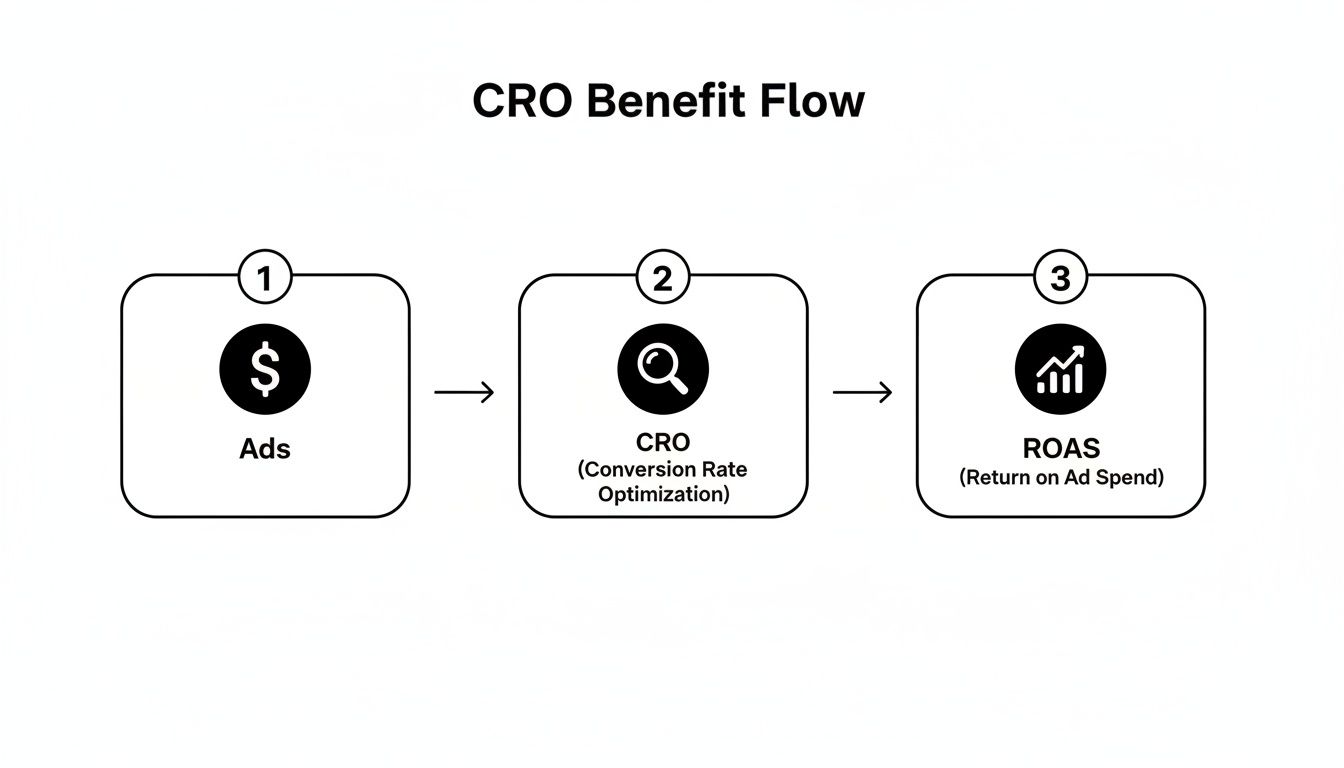
This simple flow shows how CRO improves the money you're already spending on ads, leading to a much better Return on Ad Spend (ROAS).
Stage 1: Research and Analysis
This is where we put on our detective hats. The goal is to deeply understand what your users are actually doing on your site—and more importantly, why. We don't guess; we gather cold, hard evidence.
This involves a mix of quantitative and qualitative data:
- Quantitative Data: We dive deep into your Google Analytics and Google Tag Manager containers. We’re looking for patterns in your conversion funnels, identifying pages with high drop-off rates, and segmenting user behaviour by device, traffic source, and location. Correctly setting up GTM and Google Analytics is crucial, along with the Meta Conversion API, to ensure data accuracy.
- Qualitative Data: This is where the real magic happens. We use tools like heatmaps to see where users are clicking (and where they aren't). We also watch anonymised session recordings to see their actual journeys—the hesitations, the frustrations, and the moments of confusion. This is often where we find the biggest "aha!" moments.
Stage 2: Hypothesis and Prioritisation
With our research complete, we move from observation to action. We translate our insights into educated, testable statements called hypotheses. A strong hypothesis is specific, measurable, and based on the evidence we’ve gathered.
It follows a simple but powerful structure: "Because we observed [data/insight], we believe that [making this change] will result in [this outcome]."
For example:
"Because we observed in session recordings that 40% of mobile users abandon the checkout on the shipping details page, we believe that simplifying the form from six fields to three will reduce cart abandonment by 20% for mobile visitors."
Of course, not all ideas are created equal. We prioritise these hypotheses using a scoring system based on potential impact (how much of a lift could this create?), confidence (how sure are we based on the data?), and ease of implementation (how much development work is needed?). This ensures we focus on the changes that will move the needle the most, first.
Stage 3: A/B Testing and Implementation
This is the scientific part of the process where we prove or disprove our hypothesis. Using A/B testing software, we create a variation of the page (Version B) that includes our proposed change and test it against the original (Version A).
Traffic is split randomly between the two versions, and we let the test run until we have a statistically significant result. This means we can be confident that the outcome isn't just due to random chance. If Version B wins, we have a data-backed reason to implement the change across the entire site. The creative testing process for Meta ads follows a similar logic.
There are many ways to approach these tests. To implement effective strategies, you can explore various proven conversion optimization techniques to find what might work best for your audience.
Stage 4: Learning and Iterating
This final stage is perhaps the most important. A test doesn't just produce a winner or a loser; it produces a learning. We analyse the results to understand why the change worked—or why it didn't.
If the test was a success, we roll out the winning version to 100% of the traffic. If it failed, we use the insights to form a new, smarter hypothesis for the next test. The key is that we've learned something valuable about our customers either way.
This creates a continuous loop of improvement. The learnings from one test become the foundation for the next round of research, leading to a smarter, more effective website over time. This iterative cycle is the engine of long-term conversion growth.
Practical CRO Tactics for Shopify and WordPress
Alright, theory is one thing, but this is where the rubber meets the road. A solid framework is your map, but you need actual tactics to get you to your destination. After years in the trenches with eCommerce clients at our marketing agency, our team has seen what really works (and what definitely doesn't), especially on Shopify and WordPress.
Let me pull back the curtain on some of the battle-tested tactics we use day in, day out. These aren’t just random ideas pulled from a blog post; they’re targeted fixes for the common conversion blockers we see holding eCommerce businesses back.
Optimising Your Shopify Store for Sales
When you're running a Shopify store, the game is all about creating a smooth, trustworthy path from the moment someone lands on a product page to the final thank you screen. Friction is the enemy. Every tiny improvement you make chips away at that friction and adds directly to your bottom line.
Here’s where we usually start:
- Product Page Perfection: Think of your product page as your best digital salesperson—it needs to do all the heavy lifting. We start with the basics: high-resolution images from every angle and a video if it makes sense. Then we move to the copy, making sure it speaks to the customer's needs and desires (benefits!), not just a dry list of specs (features!). Great Shopify design is key here.
- Building Unshakable Trust: Online shoppers are naturally a bit sceptical. We counteract that by plastering trust signals everywhere they matter. This means genuine customer reviews (especially those with photos), crystal-clear shipping and return policies, and familiar security badges. You’d be amazed how much a simple “30-Day Money-Back Guarantee” icon near the ‘Add to Cart’ button can boost confidence.
- A Flawless Mobile Checkout: This is completely non-negotiable. The majority of your traffic is on a phone, so the checkout experience has to be silky smooth. We obsess over this, testing for big, easy-to-tap buttons, streamlined forms with auto-fill, and offering express payment options like Apple Pay and Google Pay to skip the tedious manual entry. This can be achieved through good Shopify development or even custom Shopify apps built with the Shopify CLI.
As experts in Shopify development, we know our way around the platform's code. Sometimes a small tweak in the theme or a custom-built app is all it takes to make a massive dent in cart abandonment.
Driving Conversions on WordPress Sites
For WordPress sites, the game shifts a little. For an eCommerce store running on WooCommerce, the focus is on absolute clarity, lightning speed, and guiding the user towards one clear, obvious action.
Our go-to playbook includes:
- Simplifying Navigation: We constantly see websites with menus that look like a shopping list. A confused user is a user who clicks away. We strip back the main navigation to focus only on the most critical paths, making it dead simple for people to find exactly what they’re looking for.
- Obsessing Over Site Speed: Slow websites kill conversions. It’s that simple. We run deep technical audits to squash oversized images, implement proper browser caching, and trim down bloated code. Not only does a faster site make users happier, but it also earns you a nice little nod from Google, which helps with your local SEO.
- Crafting Powerful Calls-to-Action (CTAs): A weak, generic CTA like "Submit" on a contact form is a huge missed opportunity. We test specific, benefit-driven copy like "Get Your Free Quote Now" or "Download My Guide." We then test everything about it—the colour, the size, the placement—to make sure it grabs attention and gets the click. Building custom blocks in Gutenberg can make this process highly efficient.
Our background as a specialised WordPress developer in Melbourne gives us the technical skills to get these changes done right, from building custom landing page components to optimising database queries for that extra bit of speed.
It's easy to look at these tactics and think they're minor tweaks, but their combined impact can be massive. We once worked with an eCommerce client whose checkout form had eight different fields to fill out. We tested a simplified version with just three essential fields and increased their sales by over 35%. For another business, just making the shipping costs obvious on the product page—instead of hiding them until checkout—slashed their cart abandonment rate almost overnight.
This is what CRO is all about. It’s a series of small, informed changes that add up to big wins. We often find that the most common issues on Shopify and WordPress sites have straightforward CRO solutions.
Common Conversion Blockers and CRO Solutions
Here’s a quick look at some frequent problems we see and the specific CRO tactics we use to fix them.
| Platform | Common Problem | Effective CRO Tactic |
|---|---|---|
| Shopify | High cart abandonment rate | Add trust badges (e.g., "Secure Checkout") and express payment options like Apple Pay/Google Pay in the cart. |
| Shopify | Low add-to-cart rate | Improve product photography with lifestyle images and videos. Add a clear "Money-Back Guarantee" near the CTA. |
| Shopify | Customer confusion about shipping | Display estimated shipping times and costs directly on the product page before the user adds to cart. |
| WordPress | High bounce rate on service pages | Simplify the page headline to focus on a single benefit. Add social proof like client logos or testimonials above the fold. |
| WordPress | Low lead form submissions | Reduce the number of form fields to the absolute minimum (e.g., Name, Email, Message). Change the button text from "Submit" to a benefit-driven CTA. |
| WordPress | Poor navigation and user flow | Streamline the main menu to 3-5 key items. Use heatmaps to identify where users are getting lost and simplify those pages. |
These practical tactics are the building blocks of a successful CRO program, turning your website from a simple online brochure into a powerful conversion machine. Looking ahead, the standards are only getting higher. To stay competitive, Australian websites should be aiming for conversion rates between 3-5% by the end of 2026. This reflects a major shift in consumer expectations, especially since over half of all website traffic in Australia now comes from mobile, making a perfect mobile experience absolutely critical. You can discover more insights about these future Australian conversion benchmarks and see why getting this right is so important.
Setting Up Your Toolkit for Measurement and Testing
You simply can't improve what you don't measure. In my experience, the biggest breakthroughs in conversion rate optimisation come from solid data, not lucky guesses. To get that data, you need the right set of tools.
The great news is you don't need a massive budget to get started. A powerful, practical toolkit is more accessible than ever.
The absolute foundation of any CRO program is solid analytics. This starts and ends with making sure your Google Analytics and Google Tag Manager (GTM) setups are bulletproof. This isn't just about tracking page views; it's about meticulously setting up goals and events for every single valuable action a user can take on your site, from a form submission to an 'add to cart' click.

Seeing What Your Users See
Once your quantitative data is flowing, it's time to add the "why" to your "what." This is where qualitative tools come into play, and they are genuine game-changers.
Platforms like Hotjar or Microsoft Clarity provide a visual story of user behaviour that numbers alone can never tell you. They offer two key features:
- Heatmaps: These show you an aggregated view of where users are clicking, moving their mouse, and how far they scroll down a page. It's a quick way to see if your most important buttons are being ignored or if users are trying to click on things that aren't actually links.
- Session Recordings: This is like looking over your user's shoulder. You can watch anonymised recordings of real user sessions to see their exact journey—where they hesitate, where they get frustrated, and where they ultimately drop off.
Digging into your analytics reports is the first step. Here, you can find pages with high exit rates or funnels where users are abandoning the process, giving you the first clues for your CRO investigation.
Proving Your Ideas with A/B Testing
After you've gathered data and watched user sessions to form a solid hypothesis, you need a way to test it scientifically. This is where A/B testing platforms become essential.
These tools allow you to show different versions of a page to different segments of your audience and measure which one performs better against your goals.
The core idea is to let your users' actions—not your personal opinion—decide what works best. A/B testing removes the guesswork and gives you a data-backed reason to make a change.
Many platforms are out there, from free options like Google Optimize (now part of GA4) to more advanced tools like VWO or Optimizely. For businesses on platforms like Shopify, many apps integrate directly into your store, making it easier than ever to start running experiments.
As a digital marketing agency in Melbourne, we rely on these tools daily to validate our strategies and drive real growth for our clients. By combining analytics, user behaviour tools, and a solid testing platform, you have everything you need to start making smarter, data-driven decisions.
Should You DIY or Hire a Marketing Agency?
Alright, so you’re seeing the potential in conversion rate optimisation. This usually leads to the big question I get from clients all the time: should you try to run with this yourself, or is it time to bring in a team? I’ll give you the honest breakdown based on what I’ve seen work.
Going the DIY route can be a fantastic way to learn the ropes, especially if you're just starting out or working with a tight budget. You can get your hands dirty with tools like Google Analytics and even run some basic tests to see what happens.
But the DIY path often hits a ceiling, and it usually happens fast.
The biggest hurdles are almost always a lack of time, the high cost of specialised testing software, and most importantly, the experience needed to interpret data correctly. It's one thing to see a high bounce rate on a product page; it's another thing entirely to understand the subtle user behaviours causing it.
When to Call in the Experts
Partnering with a specialised digital marketing agency in Melbourne like ours is about bringing in a team that has already seen what works—and what doesn't—across dozens, if not hundreds, of websites. We’ve already made the mistakes, learned the hard lessons, and refined our process on someone else's dime, so you don't have to.
When you hire an agency, you’re not just getting an extra pair of hands. You're getting:
- A Structured Process: We bring a data-driven framework from day one, which means we skip the guesswork and move straight to evidence-based strategies.
- Specialised Expertise: Our team lives and breathes this stuff. From a dedicated WordPress developer to a Shopify API expert, we have the technical skills to implement changes correctly and efficiently without breaking your site.
- An Outside Perspective: It's incredibly difficult to be objective about your own website. We bring fresh eyes to spot the conversion roadblocks you’re probably too close to see.
This isn't just about avoiding common pitfalls; it's about getting results faster. Recent Australian marketing statistics and benchmarks highlight just how much conversion rates can vary by industry, so having a team that understands your specific niche is crucial. For a Melbourne business looking to scale, turning raw data into actionable insights is the key to transforming average performance into a high-converting engine.
Ultimately, the decision comes down to your goals and resources. If you have the time and passion to learn, DIY is a great starting point.
But if you want to maximise your return on investment and hit your growth targets sooner, bringing in an expert team is one of the smartest investments you can make.
Alpha Omega Digital is a marketing agency based in Melbourne, Australia but also services clients from Sydney, Brisbane, Newcastle, Perth, Adelaide, Darwin and Hobart. Have a project in mind? Contact us for a no-obligation chat.
Frequently Asked Questions About CRO
To wrap things up, let's run through some of the most common questions I hear from clients here in Melbourne about Conversion Rate Optimisation. My goal is to give you quick, clear answers to help everything click into place.
How Long Does It Take to See Results From CRO?
Honestly, there's no single timeline. It all comes down to your website's traffic volume and how big the changes we're testing are. For a site with decent traffic, you could see statistically significant results from an A/B test in just a few weeks.
But here's the thing: CRO isn't a one-off fix. It's an ongoing process of continuous improvement. The real win is building a culture of testing and learning that delivers small gains over months and years, turning tiny improvements into major growth. Marketing your business requires consistency.
What Is a Good Conversion Rate to Aim For?
This is the classic 'it depends' question. As we've seen, the Australian eCommerce average hangs around 1.78%, but this number swings wildly depending on the industry. A high-ticket eCommerce store might have a lower rate than a low-cost fashion retailer, but higher profit margins.
Instead of chasing a magic number, focus on your own baseline. A 'good' conversion rate is one that's consistently getting better. The real goal should be to beat your own historical performance, month after month.
Can CRO Hurt My SEO?
When done correctly, CRO actually helps your SEO. By improving the user experience, you often boost the exact metrics Google loves—things like time on site and pages per session—while cutting down your bounce rate. These are all positive signals that tell Google users are finding what they need.
The key is to follow best practices for testing, like using the correct canonical tags on test pages and ensuring your testing tools don't slow your site down. As an experienced SEO agency in Melbourne, we handle the technical side to make sure your optimisation efforts work together, not against each other.
How Much Traffic Do I Need to Start With CRO?
While more traffic definitely lets you run tests faster and reach statistical significance quicker, you don't need millions of visitors to get started. Even with lower traffic, you can kick things off with qualitative research (like heatmaps and user surveys) to spot obvious friction points.
Making changes based on this direct user feedback can lead to significant wins long before you have enough data for a formal A/B test. As a rule of thumb, we typically suggest having at least 1,000 conversions per month to run effective, statistically valid A/B tests.
Alpha Omega Digital is a marketing agency based in Melbourne, Australia but also services clients from Sydney, Brisbane, Newcastle, Perth, Adelaide, Darwin and Hobart. Have a project in mind? Contact us
[email protected]
Read more insights from our team on web design, paid ads, and growth strategy.