Home / Blog / Details
Uncategorized
How to Advertise on Google Ads: An Ecommerce Guide from Our Melbourne Agency
Uncategorized
Before you even think about writing an ad or picking a keyword, let's talk about what actually makes a Google Ads campaign work. From my experience as a digital marketing agency in Melbourne, I’ve seen countless eCommerce businesses dive in headfirst, burn through their budget in a week, and walk away convinced "Google Ads doesn't work for my store."
The truth is, the magic isn't in the ad itself—it's in the prep work. Getting the foundation right is the only way to avoid wasting your marketing budget, especially when you're trying to sell products online.
Laying the Groundwork for Google Ads Success
Skipping the foundational steps is like building a house on sand. It might look okay for a minute, but it's destined to fall apart. Let's get the concrete poured first.
Define Your Objectives and Audience
First things first: what does a win actually look like for your eCommerce store? This single question dictates your entire strategy. Are you trying to get more direct sales, or are you focused on building a list of potential customers?
For an online store, whether you're using Shopify or a custom site built by a WordPress developer, the main goal is almost always Return On Ad Spend (ROAS). For every dollar you put into ads, how many dollars in sales are you getting back? It's a straightforward, ruthless metric. This is where many businesses fail; they focus on clicks instead of profit. For example, a campaign generating a 2x ROAS might seem okay, but if your product margins are only 40%, you're actually losing money on every sale. We aim for a profitable ROAS from day one.
Once that goal is crystal clear, you need to get inside your ideal customer's head. What problem are they trying to solve right now? What specific words are they typing into that Google search bar when they're looking to buy a product like yours? Building a detailed picture of your customer helps you write ad copy that actually connects and choose keywords that attract people ready to buy, not just browse. For instance, a search for "buy black leather jacket melbourne" has far higher buyer intent than just "jackets."
Optimise Your Technical Foundation
This part is non-negotiable, yet it's where most DIY campaigns fail. You absolutely must have a flawless installation of Google Analytics 4 and Google Tag Manager. Without proper tracking, including Enhanced eCommerce tracking, you're flying blind. You have no idea which ads are making you money and which are just burning a hole in your pocket. We make sure our eCommerce clients have rock-solid tracking from day one, so we can connect every dollar of ad spend directly to real sales. Setting up the Meta Conversion API and a robust Google Tag Manager container is the first thing we do for any client.
By far the most overlooked piece of the puzzle is the product page and checkout experience. You can have the best, most persuasive ad in the world, but if it sends people to a slow, confusing, or broken page, you've just paid for a click that went nowhere. Your product page has to instantly deliver on the promise you made in your ad, with clear images, pricing, and a simple "Add to Cart" button.
Think about it. You launch a campaign targeting Melbourne, tapping into a huge audience glued to their phones. With over 90% of Australians using smartphones daily, a mobile-first experience isn't a bonus; it's essential. The opportunity is massive, especially when you consider YouTube's ad reach hits 77.9% of Australia's entire population. But you can only capture that opportunity if you're prepared to meet customers on their terms, with a seamless experience. You can dig deeper into these trends and what's coming in 2025 by exploring the evolution of Google Ads in Australia.
This simple flow shows how these core pillars fit together.
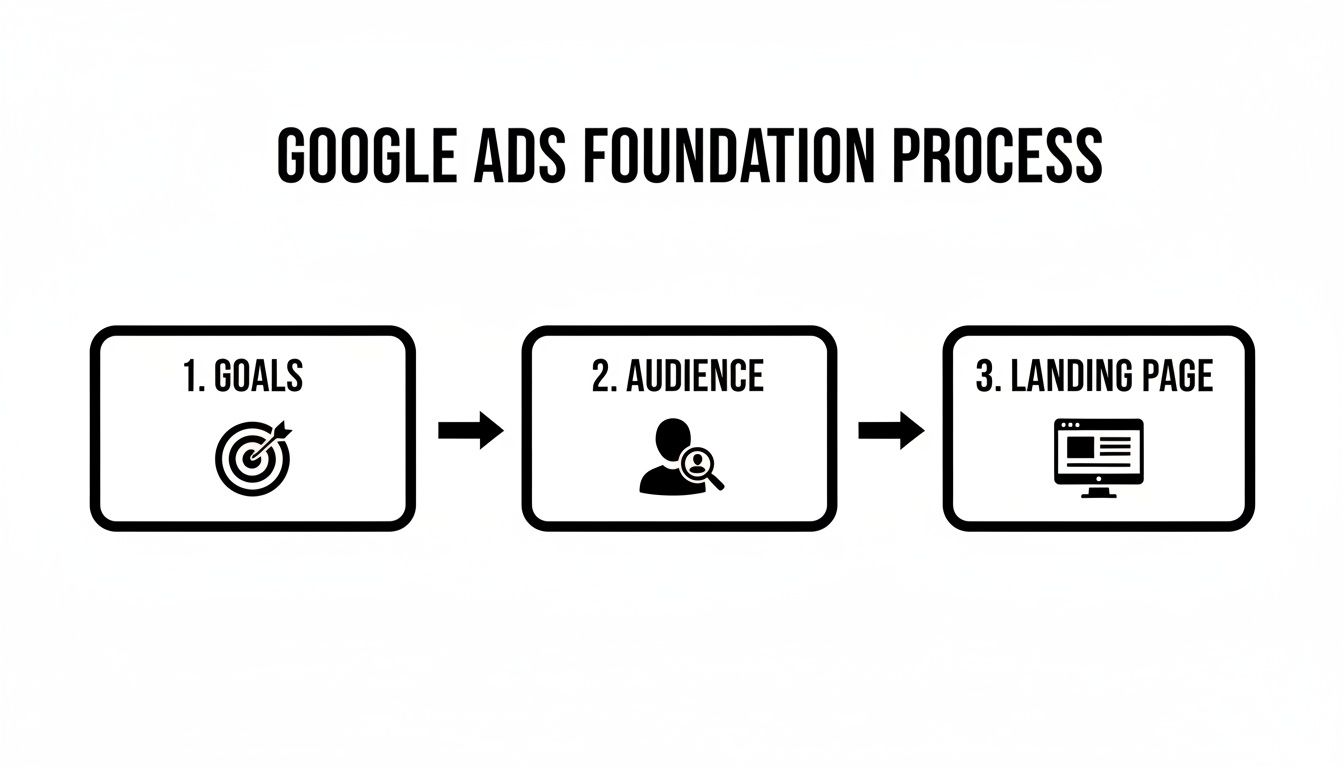
As you can see, clear goals, a deep understanding of your audience, and a high-performing landing page aren't just separate tasks. they're sequential, interconnected steps you have to nail before you even think about launching a campaign.
Alright, with the groundwork sorted, it’s time for the fun part: actually building the campaign that’s going to bring in customers. This is where your strategy meets action, and getting it right from the start will save you a heap of wasted time and money down the track.
The first big decision you’ll make is the campaign type. This isn't just a technical setting; it links directly back to those business goals we talked about earlier.
Think of your goals as the starting point for every decision you make from here on out.
Choosing the Right Campaign Type
When I'm setting up campaigns for my eCommerce clients, the choice usually boils down to one of three core types. Knowing when to use each is absolutely critical.
Choosing the right campaign type is the first major fork in the road. Get it right, and you're on the path to high-intent sales; get it wrong, and you'll burn through your budget with little to show for it. To make it easier, here's a quick comparison of the heavy hitters we use most often for our eCommerce clients.
Choosing the Right Google Ads Campaign Type
| Campaign Type | Best For | Key Advantage | When We Use It |
|---|---|---|---|
| Search Campaigns | Capturing active, high-intent customers who are searching for your specific products. | Puts your brand directly in front of someone at the exact moment they're looking to buy. It's the lowest-hanging fruit. | For eCommerce stores with known product searches ("buy women's running shoes australia"). We always start here for immediate, high-intent traffic. |
| Google Shopping | eCommerce stores with physical products. It's a non-negotiable if you're selling anything online. | Highly visual ads that show the product, price, and your brand right in the search results. They attract buyers who are ready to purchase. | Essential for all our Shopify and WooCommerce clients. It's the bread and butter for driving product sales and getting an edge over text-only ads. A well-structured shopping campaign is a goldmine. |
| Performance Max (PMax) | Scaling your reach and finding new customers across all of Google's channels using AI. | Leverages machine learning to find converting customers you wouldn't have found otherwise. It's an all-in-one campaign type that covers YouTube, Display, and more. | Once an eCommerce store has solid conversion data flowing from Shopping and Search. PMax needs good data to learn from, so we typically introduce it to scale an already profitable account. |
Each of these campaign types has its place. The key is to start with the one that most closely matches your immediate business goals before branching out. For most eCommerce stores, that means starting with a combination of Search and Standard Shopping.
Finding Keywords That Convert
Next up: keyword research. Let's be clear, the goal here isn’t to find the most popular keywords; it’s to find the ones with the highest buyer intent.
I always tell my clients to focus on long-tail keywords—that is, specific phrases of three or more words.
Think about the difference between someone searching "shoes" versus "buy Nike Air Zoom Pegasus 40 women's size 8." The first person is just browsing. The second person has their credit card practically out. Targeting these super-specific, high-intent phrases means less competition and a much, much higher chance of conversion. We use tools like Ahrefs and SEMrush to find these gems that competitors often overlook.
I organise these keywords into tightly-themed ad groups. For example, all keywords related to "WordPress development" go in one ad group, while everything for "Shopify API development" goes in another. For an eCommerce store, this means one ad group for "women's hiking boots" and another for "men's waterproof hiking boots." This structure is vital. It lets you write incredibly relevant ad copy for each specific search, which dramatically improves your Quality Score and ultimately lowers your costs. We work with both Shopify developers and WordPress developers to ensure the site structure supports these granular campaigns.
Of course, great keywords are only half the battle. You need compelling ads. Understanding how to write ad copy that converts is essential because your ad needs to speak directly to the searcher's problem and offer a clear, convincing solution.
Setting a Realistic Budget and Bidding Strategy
One of the first questions I always get from new eCommerce clients in Melbourne is, "How much should I actually spend on Google Ads?" And the honest answer is… there’s no magic number. But I'm not going to leave you guessing. Setting a smart starting budget isn't about pulling a figure out of thin air; it’s about making an educated guess based on real-world data and your own business goals.
The key is understanding your industry's typical Cost-Per-Click (CPC) and what you're trying to achieve. For a niche online clothing store, a click might only cost a couple of dollars. For a store selling high-ticket electronics, it could be much, much higher.
Here in Australia, the advertising space is getting more competitive by the day. Recent analysis shows the average CPC has climbed to over $5.26, which really highlights why precise, careful management is no longer optional if you want a positive return. To get a better feel for these benchmarks, it's worth exploring the detailed 2025 Google Ads data for Australia.
Your starting budget needs to be big enough to actually gather meaningful data. I usually recommend a minimum of $1,500-$3,000 per month for competitive eCommerce stores. Think of this initial investment as funding the crucial "learning phase" where Google's algorithm figures out who your best customers are. Trying to start with $20 a day for an online store is a recipe for frustration and slow results.
Demystifying Bidding Strategies
Once you have a budget, you need to tell Google how to spend it. This is where your bidding strategy comes into play, and picking the right one is vital.
Here are the main options you’ll come across for eCommerce:
- Manual CPC: This gives you total control. You set the absolute maximum you're willing to pay for a single click. It's great for control freaks like me, especially when launching a brand-new campaign where I want to keep a very tight rein on spending and test the waters.
- Maximise Clicks: This strategy tells Google to get you as many clicks as it can within your daily budget. I almost never recommend this for eCommerce. It drives a high volume of traffic, but it doesn't care about the quality of those clicks or whether they convert.
- Smart Bidding (Automated): This is where you let Google's AI take the wheel. These strategies use machine learning to automatically optimise for specific goals, like sales or revenue.
The choice between different Smart Bidding strategies really comes down to the business model and data maturity. For a brand new eCommerce store, we might start with Maximize Conversions to gather initial sales data. For our established Shopify clients with plenty of conversion history, it's all about Target ROAS (Return On Ad Spend) to make sure every dollar we spend is generating profitable sales. We even work with clients who need a custom WordPress development company to build out advanced tracking before we can confidently use Target ROAS.
Sidestepping Common Budget Mistakes
A common nightmare for new advertisers is watching their entire daily budget disappear by 10 AM on low-quality traffic. This usually happens when your bids are way too high, your targeting is far too broad, or your Google Shopping ads are not spending their budget on the right products.
One of the simplest yet most effective fixes is campaign priority in Google Ads. For Google Shopping, you can set up multiple campaigns with different priorities (low, medium, high) and use negative keywords to funnel specific searches to the right campaign. For example, a high-priority campaign for your best-selling products can ensure they get the most visibility, while a low-priority campaign can act as a catch-all for general terms. This is a key strategy we use for Google Shopping ads for dropshipping, where margins are tight and every click counts.
It's these small, strategic adjustments that make every single dollar in your budget count.
Launching your campaign is just the beginning. The real growth happens in the trenches, with consistent, data-driven optimisation. This is what separates campaigns that thrive from those that fizzle out after a month. It’s a constant cycle of testing, learning, and refining.
The first week is all about patience. Seriously. Google's algorithm is in its learning phase, so making drastic changes is the worst thing you can do. My main job here is just to watch for obvious red flags—an ad getting disapproved, the budget not spending, that sort of thing. I'll glance at high-level metrics like clicks and impressions, but I’m not making any big decisions yet.
The First 30 Days: Your Data-Driven Playbook
After a couple of weeks, you'll have enough data to start making meaningful adjustments. This is where I dive into the metrics that actually matter for your bottom line, not just the vanity ones.
Here’s what I focus on for eCommerce stores:
- Conversion Rate: What percentage of people who click your ad actually buy something? This tells you if your product pages are effective.
- Cost Per Conversion (or CPA): How much are you paying for each sale? This is a core profitability metric.
- Return On Ad Spend (ROAS): For every dollar you put in, how many dollars are you getting back in revenue? This is the holy grail for eCommerce stores and the number one metric we live and die by.
These numbers tell the true story of your campaign's performance. You can’t optimise what you don’t measure, which is why accurate tracking is non-negotiable. A critical piece of this puzzle is properly setting up Google Ads conversion tracking to connect your ad spend to real-world results.
Uncovering Gems in the Search Terms Report
One of the most powerful tools in your optimisation arsenal is the Search Terms Report. This little gem shows you the exact queries people typed into Google right before they clicked your ad. It’s an absolute goldmine of insights.
I review this report weekly to do two crucial things:
- Find New Keyword Opportunities: You'll often discover highly relevant, long-tail product keywords you hadn't even thought of. I'll grab these promising terms and add them to my ad groups to capture more high-intent traffic.
- Add Negative Keywords: Just as importantly, you'll spot irrelevant searches that are wasting your money. If you sell "premium leather boots" but see clicks from someone searching for "cheap rubber boots," you immediately add "cheap" and "rubber" as negative keywords. This single action can dramatically improve your ROAS by eliminating wasted spend.
Continuously refining your negative keyword list is one of the most underrated optimisation tactics. It's like trimming the fat, making sure your budget is only spent on the people most likely to become customers. We do this for both our Google Ads and Facebook Ads agency clients. Marketing your business is all about consistency in these small, daily actions.
The 90-Day Optimisation Cycle
Beyond the first month, the focus shifts to ongoing testing and improvement. This is where we start A/B testing different ad headlines and descriptions. Does a headline focused on "Free Shipping Australia-Wide" outperform one highlighting "5,000+ 5-Star Reviews"? We test, measure the conversion data, and double down on what works. Our Meta ads creative testing process is rigorous, and we apply the same discipline to Google.
This iterative process extends to your landing pages, too. We might test a different call-to-action button colour or swap out the main hero image. It sounds small, but these changes can lead to significant improvements in conversion rates over time, whether it's for a Shopify design or a custom WordPress design. This is something our team of WordPress developers and Shopify developers collaborates on closely.
This cycle of analysing data, refining keywords, and testing creatives is how you turn an average campaign into a predictable engine for business growth.
Advanced Tactics to Scale Your Ad Spend Profitably
Alright, so you’ve got a profitable campaign humming along. The sales are coming in, ROAS is looking good, and you're ready to grow. The big question now is: how do we pour more fuel on this fire without wrecking the engine? This is where we shift from the basics to turning that initial success into a genuine growth machine for your business.
First up, and probably the most powerful tool in the shed for scaling, is remarketing. Think about it for a second. Someone has already visited your site, browsed your products, maybe even popped something in their cart… but then they vanished. These aren't cold leads; they’re warm prospects who already know your brand and showed real interest. Getting a targeted ad back in front of them with a dynamic product feed is easily one of the highest-returning things you can do in Google Ads.
Finding New Customers with Lookalike Audiences
Once we're re-engaging people who already know us, we can use that data to find a whole new audience of people who should know us. This is where Similar Audiences (what Meta calls Lookalike Audiences) come into play.
Google’s magic here is that it can analyse the behaviours and characteristics of your best customers—the ones who've already bought from you—and then go find other people across the web who act just like them.
It's an incredibly smart way to broaden your reach without just guessing who to target next. You're literally using your own customer data as a blueprint to find your next best customers. This works exceptionally well for building audiences for your Instagram Shop and Facebook Shop as well.
Integrating AI-Powered Campaigns
To really take things to the next level, we have to embrace Google’s AI-powered campaign types, especially Performance Max (PMax). A common debate is PMax vs Google Shopping ads, but we see them as partners. Your Standard Shopping campaigns are brilliant for capturing people who are actively looking for what you sell right now and give you great control. But PMax is designed to create demand, finding new pockets of customers across all of Google’s channels—YouTube, Display, Discover, Gmail, the lot.
In a competitive market like Melbourne, you can't just stick to one channel and hope for the best. We find that layering a PMax campaign on top of core Search and Shopping campaigns creates a proper full-funnel strategy. It lets you capture people at every single stage of their journey, from casual browsing on YouTube to being ready-to-buy on Google Search. It’s how we transform a good campaign into a market-leading one. This is a core part of our philosophy as a marketing agency in Melbourne.
Australia's digital advertising space is absolutely booming, and businesses are investing heavily in platforms like Google Ads to stay competitive. The sheer scale is mind-boggling; YouTube alone reached 77.9% of the population in early 2025. This kind of reach gives us an unprecedented opportunity to scale businesses profitably, something every marketing agency in Melbourne should be laser-focused on. You can explore more on Australia's digital growth to see the numbers for yourself.
By using these advanced tactics, we’re not just spending more money; we're investing it more intelligently to build long-term market leadership.
Common Google Ads Questions from Melbourne Businesses
After running campaigns for countless Melbourne eCommerce businesses, you start to hear the same questions pop up. It makes sense—Google Ads can feel like a bit of a black box when you’re just starting out.
So, let's clear the air. I’m going to tackle the most common questions I get, with straight-up, practical answers based on what I’ve seen work (and not work) for online stores right here in Australia.
How Much Does It Cost to Start Google Ads in Australia?
There’s no magic number here. You can technically start with just a few dollars a day, but for an eCommerce store, that won't give you enough data to know what's actually working. You need to give the algorithm something to chew on.
For a local Melbourne service business—think tradies or consultants—I usually recommend a starting budget of at least $500-$1000 per month. This is enough to gather meaningful data and start making smart decisions.
If you’re in a competitive e-commerce space, you’ll need to be more aggressive. A starting point of $1500-$3000 is far more realistic. Your actual cost really comes down to your industry’s average Cost-Per-Click (CPC). Some keywords might cost a couple of dollars, while others in fierce markets like fashion or electronics can easily top $5-10 a click. The key question isn't what budget to spend on Google Ads, but what budget is needed to get enough data to achieve a profitable ROAS.
How Long Until Google Ads Starts Working?
Traffic? You can get that almost instantly. Once your ads are approved, you could see clicks rolling in within a few hours.
But "working"—as in, delivering a consistent, profitable return—takes a little more patience.
Google's algorithm needs about one to two weeks for its initial 'learning phase'. I always tell my clients to expect the first 30 days to be about gathering data, and to commit to a 90-day period to properly test, learn, and optimise.
One of the biggest mistakes I see is businesses pulling the plug too early. They get nervous after a week or two and shut it all down, often right before the campaign was about to find its groove. Mastering Facebook ads or Google ads requires patience; don't quit too early.
Can I Run Google Ads Myself or Should I Hire an Agency?
You can absolutely run Google Ads yourself. Learning the platform is a valuable skill, and with enough time and patience, it’s definitely doable.
The reality, though, is that the platform is incredibly complex. It's dangerously easy to burn through your budget on the wrong keywords, incorrect match types, or poor bidding strategies without even realising you're doing it.
Working with a specialised digital marketing agency in Melbourne gives you a shortcut. You get to tap into years of experience and sidestep all the costly mistakes we've already made and learned from. We know how to structure campaigns efficiently from day one, manage your budget to minimise waste, and scale your results much faster. We have deep experience across Google Ads, Local SEO through Google My Business, and are a top-tier SEO agency in Melbourne for eCommerce brands.
Often, the investment in an agency pays for itself simply by preventing wasted ad spend and accelerating your path to getting real, profitable conversions that actually grow your business.
At Alpha Omega Digital, we are a marketing agency based in Melbourne, Australia, but also service clients from Sydney, Brisbane, Newcastle, Perth, Adelaide, Darwin, and Hobart. Have a project in mind? Contact us.
Your Comment
Your email address will not be published. Required fields are marked *