Think of an SEO audit as a full diagnostic check-up for your website’s ability to show up on Google. It's a deep dive that goes way beyond those free online tools, digging into the technical errors, content gaps, and structural problems that are quietly holding you back and costing you customers.
Why An Audit Is The Foundation Of Your Marketing
I've seen this happen so many times, especially with eCommerce clients right here in Melbourne. A business will pour money into a stunning Shopify design, clever Facebook ads, and a polished Google Ads campaign, then wonder why the sales just aren't coming. They're sending all this valuable traffic to a website that, from a technical perspective, is broken.
You wouldn't build a house on dodgy foundations, right? So why would you spend your marketing budget driving people to a site that isn't built to convert them?
A professional SEO auditing service is the essential first step before you spend another cent. It’s your strategic roadmap, pinpointing exactly what's holding your site back from its true potential.
It's like this: running paid ads without an SEO audit is like trying to fill a bucket with water when it's full of holes. You can keep pouring more water (money) in, but you'll never fill it up because you haven't plugged the leaks first.
An audit is the process of finding and plugging those leaks. It’s not just about listing problems; it’s about understanding why they’re problems and, more importantly, prioritising them based on how much they're hurting your bottom line.
Uncovering Hidden Revenue Blockers
So many of the most damaging issues are completely invisible to the average business owner. Your site might look great on the surface, but under the hood, serious problems could be sabotaging all your hard work. A proper audit uncovers these hidden blockers, which often include things like:
- Slow Page Speed: Studies have shown that even a one-second delay in page load time can slash conversions by 7%. For a Shopify store, that’s a direct hit to your daily revenue.
- Mobile Usability Issues: Well over half of all website traffic now comes from mobile devices. If your site is a pain to use on a phone, you're turning away a massive chunk of your potential customers before they even get started.
- Indexing Problems: These are technical glitches that stop Google from properly "reading" and ranking your pages. It’s basically like having a shop with the doors locked—customers can’t get in because they can’t find the entrance.
- Poor Site Structure: A confusing website layout makes it hard for both users and search engines to find important pages, like your main product categories or service pages. This is a super common issue for growing sites, particularly on platforms like WordPress where content gets added over time without a clear plan. For clients who need a total site architecture rethink, a professional WordPress developer can be a game-changer.
From Problems To A Strategic Plan
At the end of the day, a quality SEO audit doesn't just dump a long list of problems on your desk. It gives you a prioritised action plan. It tells you what to fix first to get the fastest and biggest wins.
This kind of strategic clarity makes sure that every dollar and every hour you invest in your website—from writing content to running paid ads—works as hard as it possibly can. It turns your website from a simple online brochure into a powerful, efficient engine for growing your business.
The Five Pillars of a Comprehensive SEO Audit
An SEO audit is so much more than running a website through an automated tool and spitting out a score. A real, professional audit is like a full diagnostic check on a high-performance car; it’s about getting under the hood to inspect every single system and make sure they’re all firing together for maximum power. When I run an SEO auditing service, I break the entire process down into five core pillars.
Think of these as the essential systems of your website. A weakness in just one can cause the entire machine to sputter and underperform, no matter how much you pour into paid ads or social media.
This diagram shows how a solid technical foundation underpins all your marketing efforts, just like a building’s foundation supports the whole structure. If that base is cracked, everything built on top is at risk.
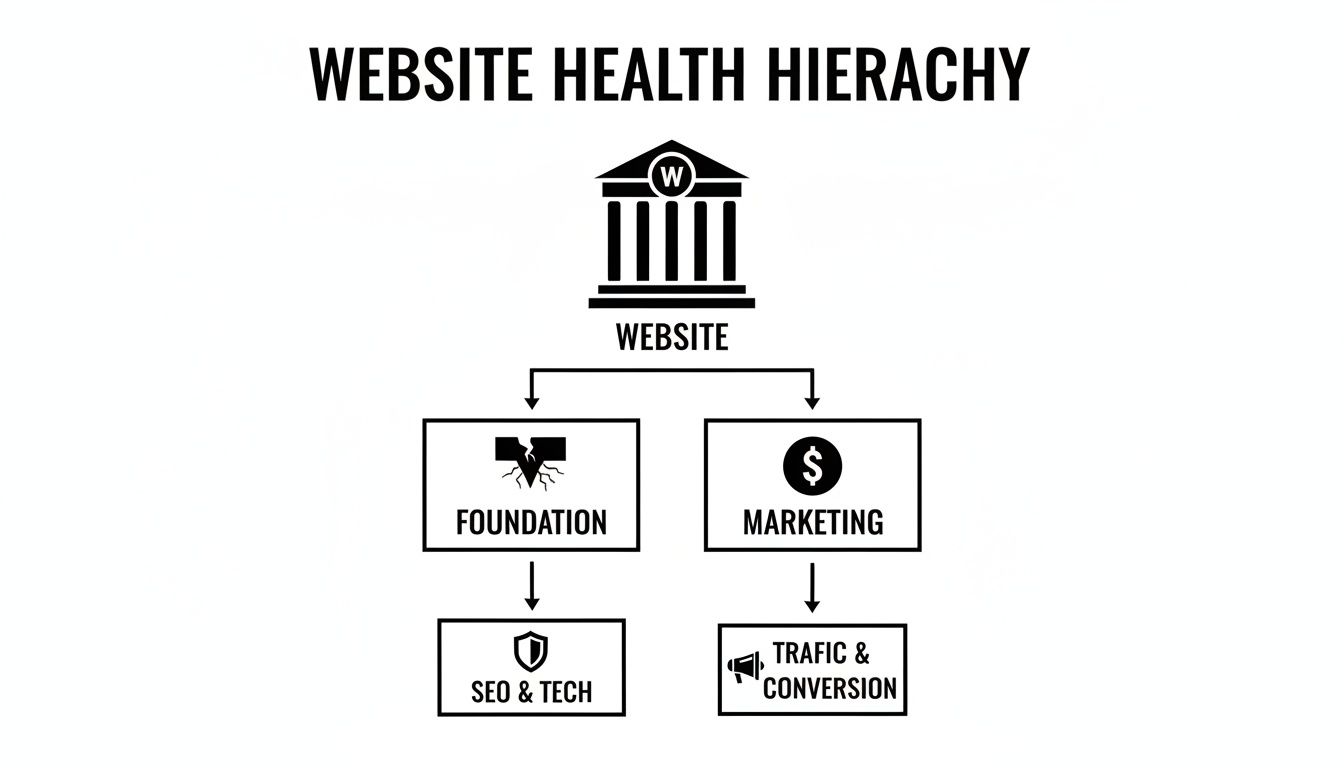
As you can see, without a healthy foundation (your technical SEO), any money you spend on marketing could be wasted on a site that simply can't convert the traffic it gets.
So, let's break down exactly what a thorough audit looks at. I've organised these five pillars into a table to make it clear what each one covers and, more importantly, why it’s so critical for a Melbourne business like yours.
The Five Pillars of a Comprehensive SEO Audit
| Audit Pillar | What It Covers | Why It's Critical for Your Melbourne Business |
|---|---|---|
| 1. Technical SEO | The "engine room"—site speed, mobile-friendliness, crawlability, indexability, and site architecture. All the behind-the-scenes stuff Google sees first. | If your site is slow, broken on mobile, or confusing for Google to crawl, nothing else matters. You won't rank, and any visitor who does arrive will leave. |
| 2. On-Page SEO | The structure and relevance of your actual page content. This includes title tags, meta descriptions, heading structure (H1s, H2s), and internal linking. | This is how you signal to Google what each page is about. Getting this right helps you rank for the right keywords and entices users to click on your result. |
| 3. Off-Page SEO & Backlinks | Your website's authority and reputation across the web, primarily driven by your backlink profile—links from other websites pointing to yours. | High-quality backlinks are like votes of confidence from respected sources. They tell Google you're a trustworthy authority in your field, which is a massive ranking factor. |
| 4. Content & Keyword Gaps | A deep-dive analysis of what your competitors are ranking for that you aren't. It's about finding untapped opportunities to capture high-intent traffic. | This is the fastest way to find profitable keywords you've missed. For a Melbourne business, it could uncover niche local service terms your competitors dominate. |
| 5. Local SEO | All the signals that prove your relevance to a local audience. This includes your Google Business Profile, local citations (NAP consistency), and customer reviews. | For any business targeting Melbourne customers, this is non-negotiable. It's what gets you into the map pack and ensures you appear in "near me" searches. |
Each of these pillars is connected. A technically sound website makes it easier for Google to see your great on-page SEO. Strong content earns you valuable backlinks, and a solid local presence ensures the right people find you. It's a complete ecosystem, and a proper audit assesses how well all parts are working together.
Pillar 1: Technical SEO
This is the engine room of your website. It covers all the nuts and bolts that Google’s crawlers analyse to figure out if your site is healthy, fast, and easy to access. Honestly, if your technical SEO is a mess, nothing else you do will get you very far.
A technical audit is where we check for things like:
- Site Speed: How quickly your pages load is a massive ranking factor. For a Shopify store, even a one-second delay can kill conversions.
- Mobile-Friendliness: Your site has to be flawless on mobile. No excuses. Period.
- Crawlability & Indexability: Can Google actually find, crawl, and understand all your important pages? We hunt for crawl errors, broken redirects, and misconfigured
robots.txtfiles that might be accidentally blocking search engines. - Site Architecture: Is your website laid out logically? A clean, well-organised site is far easier for both users and search engines to navigate. This is especially vital for a complex WordPress development project with hundreds of pages.
Pillar 2: On-Page SEO
Once we’ve confirmed the engine is running smoothly, we look at the content on your actual pages. On-page SEO is all about structuring your content to clearly signal to Google what each page is about. This isn't about stuffing keywords everywhere; it's about clarity, relevance, and providing a great user experience.
This involves optimising your:
- Title Tags & Meta Descriptions: These are your digital storefront in the search results. They have a huge impact on whether someone clicks on your link or a competitor's.
- Heading Structure (H1, H2s): Proper headings create a logical hierarchy for your content, which helps search engines (and readers) understand what's most important on the page.
- Internal Linking: Strategically linking relevant pages together helps spread authority across your site and guides users towards your most important content or conversion points.
Pillar 3: Off-Page SEO & Backlinks
Off-page SEO is all about your website's authority and reputation on the wider internet. The biggest piece of this puzzle is your backlink profile—the collection of all the links pointing to your site from other websites. You can think of these as votes of confidence or referrals.
A high-quality link from a respected, relevant website is a powerful signal to Google that your site is trustworthy and authoritative. A proper audit digs into the quality and quantity of these links, sniffing out any toxic or spammy links that could be dragging you down and identifying opportunities to build new, powerful ones.
Pillar 4: Content & Keyword Gap Analysis
This is where we put on our detective hats. A content and keyword gap analysis involves a deep dive into what your top competitors are ranking for that you aren’t. It’s one of the most effective ways to find high-intent, money-making keywords you might be completely overlooking.
For an eCommerce client, for example, we might discover their main competitor is ranking #1 for "best running shoes for flat feet Melbourne." By creating a superior, more in-depth guide on that exact topic, we can start to intercept that highly qualified traffic.
Pillar 5: Local SEO
For any business that serves customers in a specific geographic area, this pillar is non-negotiable. As a digital marketing agency Melbourne, this is a massive focus for the majority of our clients. A local SEO audit zeroes in on the specific factors that help you show up in the Google Map Pack and for crucial "near me" searches.
A strong local presence is absolutely vital. We meticulously review your Google Business Profile optimisation, the consistency of your business name, address, and phone number (NAP) across hundreds of online directories, and your strategy for generating local customer reviews. It’s all about proving to Google that you are the most relevant and trusted local choice for a potential customer.
Winning Locally With A Melbourne SEO Audit
For any business trying to win over customers in Melbourne, a Local SEO audit isn’t just a nice-to-have—it’s absolutely essential. Think of it this way: a general audit looks at your whole website, but a local audit grabs a magnifying glass. It zooms right in on the specific signals that tell Google you're the best choice for customers in a particular area.
It’s all about making sure that when someone searches for a "Shopify developer in Melbourne" or "WordPress development company near me," your business is the one they find first. I’ve seen firsthand how a focused local SEO audit can completely change a business's trajectory. It’s the difference between being invisible to potential customers just down the street and completely dominating the Google Map Pack. The result? Real foot traffic and phone calls that translate directly into revenue.
This specialised part of an SEO auditing service is non-negotiable. It doesn’t matter if you’re a local service business (like a tradie or a beauty therapist) or an eCommerce store with a physical shopfront—if you want to target a specific city, you need this.
The Power of NAP Consistency
One of the biggest culprits we almost always uncover in a local audit is inconsistent NAP data. NAP stands for your business Name, Address, and Phone number. It sounds simple, but you’d be shocked at how many businesses have tiny variations of their details scattered all over the internet—on old directories, social media profiles, and forgotten websites.
Google uses this info like a digital breadcrumb trail to verify who you are and where you’re located. If that trail is messy—using "St" instead of "Street," a missing suite number, or an old phone number—it erodes Google's trust in your business. That directly hurts your ability to show up in local search results.
A local SEO audit meticulously scours the web, hunting down every single mention of your business. The goal is to make sure your NAP is 100% identical everywhere. This creates a strong, consistent signal that tells search engines exactly who you are and where you operate.
Optimising Your Google Business Profile
Your Google Business Profile (GBP) is your most valuable piece of real estate in local search. It's that information box that pops up on the side of the search results and in Google Maps, showing off your reviews, photos, hours, and services. A local audit goes deep, optimising every single part of your profile.
This isn’t just a box-ticking exercise. It includes:
- Making sure your primary and secondary business categories perfectly match your services.
- Writing a keyword-rich business description that speaks directly to your ideal Melbourne customer.
- Uploading high-quality, geotagged photos of your work, your team, and your premises.
- Using features like Google Posts and the Q&A section to actively engage with customers.
These aren't just cosmetic tweaks; they are powerful signals that directly influence how visible you are in the highly competitive "map pack."
Building Critical Local Signals
Beyond NAP and GBP, a proper local audit focuses on building location-specific authority. We look for opportunities to get your business mentioned on other Melbourne-based websites, blogs, or local business directories. This could mean anything from sponsoring a local community event to getting featured in a neighbourhood business guide.
The data on this is incredibly compelling. Local SEO audits in Australia have been shown to drive explosive growth. Some businesses have seen 692% increases in Google profile views and a massive 404% jump in phone calls after just 12 months of getting their local presence right.
For a deeper dive into what makes local search tick, check out our ultimate guide to local search optimization. Here in Melbourne's small business scene, where we excel in WordPress builds and paid ads, these audits are the key to fixing the inconsistent data that costs businesses customers every single day. The impact is real—even a single extra review can boost your visibility in hundreds of searches.
What To Expect From Your SEO Audit Report
After all the analysis is done, we get to the most important part of any SEO auditing service: the report. This is where the rubber hits the road.
A great audit report is not just a 50-page data dump spat out by a fancy tool; that’s useless to a busy business owner. It should be a strategic, actionable document that translates complex technical findings into a clear, prioritised plan.

When I deliver an audit to one of my Melbourne-based clients, my primary goal is clarity. I want them to understand not just what’s broken but why it matters and exactly what they need to do next. The report should empower you, not overwhelm you.
From Data To A Clear Action Plan
A truly valuable audit deliverable cuts through the noise. It organises all the findings based on two simple factors: impact and effort. What are the quick wins that will make the biggest difference right now? What are the complex, long-term projects that need to be planned for?
This prioritisation is what separates a professional analysis from an automated scan.
The purpose of an audit report isn't to show you how many problems your website has. It's to give you a step-by-step roadmap to solve the most important ones first, turning those problems into opportunities for growth.
To get a better feel for this, you can explore various actionable SEO audit report sample templates online to see how data is typically presented. While formats vary, any high-quality report should contain a few key sections.
Key Sections Of A Quality Audit Report
A comprehensive report should be structured to guide you from a high-level overview down to the nitty-gritty details. Here’s what you should expect to see:
- Executive Summary: This is a one-page, plain-English overview of the most critical findings. It’s written for the business owner who needs the big picture and main strategic takeaways without getting lost in technical jargon.
- Prioritised List of Technical Fixes: This is the core of the technical audit. It will detail issues like crawl errors, slow page speed, mobile usability problems, and indexing issues. Crucially, each item should be ranked by severity so your developers know exactly where to start.
- On-Page Optimisation Recommendations: This section provides specific, page-by-page advice for improving your title tags, meta descriptions, headings, and internal linking. For an eCommerce store, this could include a plan to optimise your top 10 product category pages for better visibility.
- Content Strategy Suggestions: Based on the competitor and keyword gap analysis, this section identifies new content opportunities. It might recommend creating a series of blog posts, building out a resource hub, or expanding service pages to capture more high-intent traffic.
- Backlink Improvement Plan: Here, we analyse your current backlink profile, flag any potentially harmful links that need addressing, and outline a strategy for acquiring new, high-authority links to boost your site’s credibility.
Each point should be a clear directive. For instance, instead of just saying "improve page speed," a good report will say, "Compress these specific 15 images and defer the loading of this particular script to improve load time by an estimated 1.2 seconds."
That level of detail transforms a list of problems into a genuine, step-by-step action plan.
How Much Do SEO Auditing Services Cost In Melbourne?
Alright, let’s talk numbers. When business owners ask me about an SEO auditing service, the first question is almost always about price. It’s a fair question, but I always encourage people to frame it a little differently: an audit is an investment in your business’s future, not just another line item on the expenses sheet.
The price for a professional audit in a competitive city like Melbourne isn't a simple, one-size-fits-all figure. It really boils down to the complexity of your digital storefront. A deep-dive audit for a massive eCommerce store built on Shopify with thousands of products will naturally be a bigger investment than one for a simple WordPress site for a local service business.
Factors That Influence The Price
A few key things determine the final price of a proper SEO audit. Understanding these helps clarify why a cheap, automated report just isn't in the same league as a professional, strategic analysis.
- Website Size and Complexity: The number of pages is a huge factor. A 20-page website is much quicker to crawl and analyse than a 2,000-page one with complex filters and product variations.
- Platform: The tech stack matters. Auditing a custom-built website or a large, intricate Shopify development project with multiple apps often requires more specialised skills than a standard WordPress site.
- Depth of the Audit: A basic technical health check is one thing. A full-stack audit that includes competitor analysis, content gap identification, and a complete backlink profile review is a completely different beast.
An Investment Versus A Cost
Here’s how I encourage my clients to think about it. You could easily spend $5,000 a month on Google Ads, sending perfectly good traffic to a website that’s slow, confusing, or technically broken. That’s a massive ongoing expense that’s essentially trying to fill a leaky bucket.
Or, you can make a one-time investment to find and plug those leaks for good.
Fixing the core issues makes every single marketing dollar you spend work harder. In a market like Melbourne, a comprehensive SEO audit typically costs between $2,000 and $5,000 AUD for small to medium businesses, depending on the site's size and complexity. This investment uncovers the silent killers of your organic traffic—things like broken links, slow page speeds, and poor mobile optimisation.
Without a proper audit, for example, you might be completely invisible for high-intent local searches like 'Shopify development Melbourne' or 'Google Ads agency near me,' which are exactly the kinds of terms we target for our own clients. You can get more insights on SEO pricing in Melbourne on studiohawk.com.au.
The real cost isn’t the price of the audit; it's the hidden expense of lost sales and wasted ad spend from running a poorly optimised website month after month.
When you weigh up the one-off investment in an audit against the immense cost of hiring a full-time, in-house SEO team (which can easily top $100,000 per year with salary, tools, and overheads), the value becomes crystal clear. An audit delivers a powerful ROI by unlocking sustainable, organic growth and turning your website into an engine for conversions, not just an online brochure.
Choosing The Right Melbourne SEO Agency For Your Audit
Let’s be honest, not all SEO agencies are the same. Picking the right partner for your audit is one of the most critical decisions you'll make. The goal isn’t to get a generic list of problems; it’s to find a team that delivers a transparent, expert-led SEO auditing service and hands you a strategic roadmap for growth.
As a marketing agency Melbourne, I know just how competitive the local market is. You need a partner who gets your specific industry, whether that's scaling an eCommerce store on Shopify or drumming up leads for a service business on WordPress. The right agency should feel like an extension of your own team, not just another vendor.
Your Practical Vetting Checklist
When you're chatting with potential agencies, you need to see past the sales pitch. It’s all about asking the right questions to understand their actual expertise and how they work. Here’s a checklist to help guide those conversations.
- Ask About Their Process and Tools: A solid agency will have no problem walking you through their methodology. Ask what specific tools they use—like Ahrefs, Screaming Frog, or Semrush—and, more importantly, how they combine that data with actual human analysis.
- Request Relevant Case Studies: Don't just ask for any case study; ask for examples from businesses like yours. If you run a Shopify store, you want to see their track record with other eCommerce clients. This is the proof that they have real, hands-on experience in your world.
- Discuss Their Reporting Style: Find out what the final audit report actually looks like. Will it be a clear, prioritised action plan, or a confusing data dump? A high-quality report should translate all the technical jargon into a simple, step-by-step guide you can actually use.
Red Flags To Watch Out For
Knowing what to look for is only half the battle. You also need to know what to avoid. Certain claims are immediate red flags that should make you think twice.
Be extremely wary of any agency that guarantees "#1 rankings" on Google. No one can ethically promise specific rankings. Google's algorithm is a complex, ever-changing beast. A reputable agency will focus on a strategy for sustainable growth, not empty promises.
Another massive red flag is a lack of transparency. If an agency is cagey about their methods or can’t explain their strategy in plain English, it’s often a sign they’re relying on outdated or dodgy tactics. You’re looking for a partner, not a black box.
The Value of Agency Expertise
Here’s something many business owners don’t realise: hiring a professional agency for your SEO audit actually saves you money and delivers far deeper strategic insights than trying to build an in-house team from scratch.
Research shows that for Sydney SMEs, an in-house SEO setup can run you around $222,000 annually once you factor in salary, super, taxes, and all the essential tool subscriptions. In contrast, agency retainers are a fraction of that cost and give you access to an entire team of specialists. As you can see in this in-depth cost comparison of in-house vs agency SEO, agencies absorb these huge overheads. This allows businesses to tap into high-level expertise for specific projects, like a $2,000-$5,000 audit that can unlock some serious organic growth.
Ultimately, the right partner is one who shows a genuine interest in your business goals and has the proven experience to help you get there.
At Alpha Omega Digital, we’re a marketing agency based in Melbourne, Australia, but we also service clients from Sydney, Brisbane, Newcastle, Perth, Adelaide, Darwin and Hobart. Have a project in mind? Contact us.
Your SEO Audit Questions, Answered
To wrap things up, I wanted to tackle some of the most common questions we get from business owners here in Melbourne and across Australia. These are the practical queries that pop up time and again, and getting clear answers can help you decide if an SEO auditing service is the right next step for you.
How Long Does a Proper SEO Audit Take?
This is a great question, and the answer really depends on the size and complexity of your website. For most small to medium businesses—think a typical Shopify eCommerce store or a WordPress site for a local service—a comprehensive audit usually takes between 2 to 4 weeks.
Why so long? Because a good audit goes deep. It allows us enough time for thorough technical crawling, digging into what your competitors are doing right, reviewing your entire backlink profile, and then putting it all together into a detailed, actionable report. Be wary of anyone promising a one-day audit; that’s usually just a surface-level scan with an automated tool, not a real strategic analysis.
Will an SEO Audit Guarantee I’ll Rank Number One on Google?
Honestly? No, and you should run from any agency that makes that kind of promise. An SEO audit is like a diagnostic check-up for your website. It’s the essential first step that identifies everything holding you back and gives you a clear roadmap for improvement. Acting on those recommendations is what will dramatically improve your chances of ranking higher.
Think of it like this: a personal trainer can give you a brilliant fitness assessment and a perfect workout plan. That plan is crucial for getting results, but you still have to show up to the gym and do the work. The same goes for SEO.
Real ranking success comes from consistent implementation, ongoing effort, and keeping an eye on your competitors. The audit provides the strategy and foundation you need to compete effectively and build sustainable growth online.
Can I Just Do an SEO Audit Myself With Online Tools?
While there are some fantastic tools out there like Screaming Frog or Ahrefs that can spot certain technical issues, a DIY audit often misses the bigger picture. The real value of a professional SEO auditing service isn't just in the data—it's in the interpretation.
An experienced expert combines data from multiple sources with years of hands-on knowledge. They can see the patterns, understand the nuances of your specific industry (eCommerce is a totally different beast to lead generation), and prioritise fixes based on what will actually move the needle. You're not just paying for a report; you're paying for an expert analysis and a coherent growth strategy that comes from it.
Alpha Omega Digital is a marketing agency based in Melbourne, Australia but also services clients from Sydney, Brisbane, Newcastle, Perth, Adelaide, Darwin and Hobart. Have a project in mind? Contact us.