A Shopify Partner, in simple terms, is an officially recognised agency or freelancer who has proven they know the Shopify platform inside and out. From my experience running a digital marketing agency in Melbourne, I can tell you they're specialists—not generalists—vetted by Shopify itself, ensuring they have the real-world skills to build, design, and market high-performing eCommerce stores.
What Is a Shopify Partner and Do You Need One?

As the head of a digital marketing agency in Melbourne, I've seen countless eCommerce business owners hit a wall. They know their online store could be doing so much better, but they’re just not sure who to trust with their investment. A common question I hear is whether they should just hire a general web developer or look for someone with that specific "Shopify Partner" badge.
Here’s an analogy I like to use from my own experience: if you owned a high-performance European car, you wouldn't take it to any old mechanic for a complex engine repair. You’d find a certified specialist who knows that vehicle inside and out. A Shopify Partner is that certified specialist for your eCommerce business.
The Official Badge of Trust
That "Partner" title isn't just a fancy label for their website. It means the agency or individual has been formally accepted into Shopify's official program. This gives them access to exclusive resources, advanced training materials, and a direct line to Shopify's support teams when things get tricky. I’ve had to use that direct line before, and it can save a project from going off the rails.
More importantly, it signifies a deep commitment to the platform's best practices. This official recognition is your assurance that you're working with someone who lives and breathes Shopify. They understand its unique architecture, from the nuances of Liquid theme code to the complexities of the Shopify developer API.
Different Partners for Different Needs
The Shopify ecosystem is massive, and partners tend to specialise in specific areas. Before you decide if you need one, it's a good idea to explore different types of Shopify Partners to understand what they offer.
Generally, I see them fall into a few key categories:
- Shopify Developers: These are the technical wizards. I rely on them for everything from custom theme development and building custom Shopify apps using Shopify CLI to complex integrations with third-party systems. If you need a unique feature that a pre-built app just can't provide, a developer is who you call. We work with talented Shopify developers who can handle anything you throw at them.
- Shopify Designers: Focused purely on aesthetics and user experience (UX), these are the folks who make sure your store not only looks amazing but is also dead simple for customers to navigate. Their goal is to create a visually appealing and intuitive shopping journey that naturally boosts conversions.
- Marketing Agencies: This is where my team and I fit in. A partner agency like ours focuses on the most important thing: driving traffic and sales. We manage everything from the technical marketing setup like setting up Google Tag Manager containers and the Meta Conversion API to running targeted Google Ads and Facebook Ads campaigns that bring in customers.
Many store owners I've worked with find the best results come from a full-service agency that combines all of these skills. When the team that builds your website also manages your marketing, you get a powerful, cohesive strategy for growth. It ensures your store isn't just a pretty storefront; it's a well-oiled sales machine.
Shopify Partner vs General Freelancer At A Glance
This quick comparison highlights the key differences I've personally seen between hiring an official Shopify Partner and a general web freelancer for your eCommerce store.
| Attribute | Official Shopify Partner | General Freelancer |
|---|---|---|
| Expertise | Deep specialisation in Shopify's platform | Broad web development skills (WordPress, Squarespace, etc.) |
| Vetting | Officially vetted and recognised by Shopify | Self-proclaimed expertise; no official vetting |
| Resources | Direct access to Shopify's partner support & resources | Relies on public forums and documentation |
| Best Practices | Trained in Shopify's specific best practices for performance & conversions | May apply general web practices that aren't optimal for Shopify |
| Focus | eCommerce growth, sales funnels, and conversion optimisation | Often focused on design and basic functionality |
| Cost | Typically higher due to specialised skills and proven value | Can be lower, but may come with higher risk or hidden costs |
Ultimately, choosing a Partner is an investment in specialised knowledge that I believe can save you time, prevent costly mistakes, and accelerate your store's growth.
The Real-World Benefits Of Hiring A Shopify Agency
So, beyond the official title, what’s the actual, tangible return you get when you hire a Shopify Partner? It’s a question I get a lot from eCommerce business owners here in Melbourne. They see the badge, but they want to know what it really means for their bottom line.
A dedicated partner does so much more than just build a nice-looking website; we build a high-performance sales engine.
From my experience, the biggest benefit is having a team that deeply understands the entire eCommerce ecosystem, not just one piece of it. It’s about creating a seamless flow from the moment a potential customer clicks a Facebook ad to the final checkout confirmation. This integrated approach prevents the costly mistakes and technical headaches that plague so many online stores.
It's about having a team that can troubleshoot why your conversion tracking is off because they understand both GTM and Google Analytics and the Shopify backend. Or a team that can build custom functionality using the Shopify developer API because your business has unique needs that off-the-shelf apps just can't meet.
Access to Exclusive Tools and Knowledge
One of the less-obvious advantages I've found from working with a certified partner is getting early access to beta features. Shopify is constantly rolling out new tools and updates, and partners are often the first to know. This can give you a massive competitive edge. Imagine being able to implement a new, conversion-boosting checkout feature months before your competitors even know it exists.
This insider knowledge also extends to the vast app ecosystem. With over 8,000 apps on the Shopify App Store, it's dangerously easy to install something that slows down your site or conflicts with other tools. A good partner has tested hundreds of apps. I know my team has. We know which ones are reliable, fast, and genuinely effective, saving our clients from performance nightmares and wasted subscription fees.
The Australian eCommerce scene is incredibly competitive. Having a partner who can provide even a small technical or strategic advantage can be the difference between stagnating and scaling. It’s not just about what they build; it's about the specialised knowledge they bring to the table.
This is especially true for local businesses. Australia has become one of Shopify's most significant markets, with somewhere between 151,000 and 170,000 live Shopify stores operating in the country. This makes it the third-largest market for Shopify globally. As a digital marketing agency Melbourne relies on, it means we have a deep pool of experience helping local brands stand out in a seriously crowded space. You can explore more about Australia's thriving Shopify scene and why it's a prime market for growth.
An Integrated Technical and Marketing Strategy
The real magic happens when development and marketing are handled under one roof. When our team works on a Shopify development project, we’re not just thinking about code; we’re thinking about how that code will impact your SEO and your paid ad campaigns.
Here’s a practical example I see all the time: an eCommerce business hires a freelancer to build their site, then hires us to run Google Ads. We immediately find that critical tracking elements, like the Meta Conversion API or Google Analytics 4 eCommerce events, were never set up correctly. This means their ad data is inaccurate, and they've been burning money on campaigns that can't be properly optimised.
When we handle the whole process, we ensure a flawless setup from day one.
- Google Tag Manager (GTM): We install and configure GTM containers to manage all your tracking scripts efficiently, without bloating your site's code. This is a must for any serious eCommerce store.
- Conversions API installation for Meta: We set this up to ensure you get accurate ad performance data, even with iOS privacy changes. This is non-negotiable for running profitable Facebook and Instagram ads.
- Custom Shopify Development: Whether you need a unique feature built with the Shopify API or custom Gutenberg blocks for a headless WordPress blog, our Shopify developers ensure it works seamlessly with your marketing stack.
This isn't about aesthetics; it's about building a solid foundation for growth. It’s about turning your website from a simple online brochure into a strategic asset designed to attract traffic, nurture leads, and consistently generate sales.
How To Choose The Right Shopify Partner For Your Business
So, you’re sold on bringing in a Shopify Partner. Good. Now for the tricky part: figuring out which one is actually the right fit for your eCommerce business. This is a big decision. Get it right, and you could launch your store into its next growth phase. Get it wrong, and you’re looking at months of frustration and a wasted budget.
The key, in my opinion, is to look past the flashy websites and impressive client logos. You need to dig a bit deeper to find an agency that not only has the technical skills but genuinely gets your business goals and believes in being transparent.
Look Beyond The Portfolio
Every single agency will show you their prettiest work. A slick portfolio is a decent starting point, but it's just that—a start. What you really need to find are case studies, especially ones that are relevant to your industry. If you sell high-end fashion, a case study about a dropshipping gadget store isn’t going to tell you a thing about what they can do for you.
Look for real, measurable results. A proper case study should answer questions like:
- How much did they actually increase conversion rates?
- What was the return on ad spend (ROAS) for their marketing campaigns?
- Did they improve site speed, and by how much?
Testimonials are nice for a bit of social proof, but I've found they rarely have the specific details you need to make a smart decision. A case study with hard data is infinitely more valuable.
This decision tree can help you narrow down what kind of partner you need based on what you’re trying to achieve—whether that’s growth, more sales, or sorting out technical headaches.
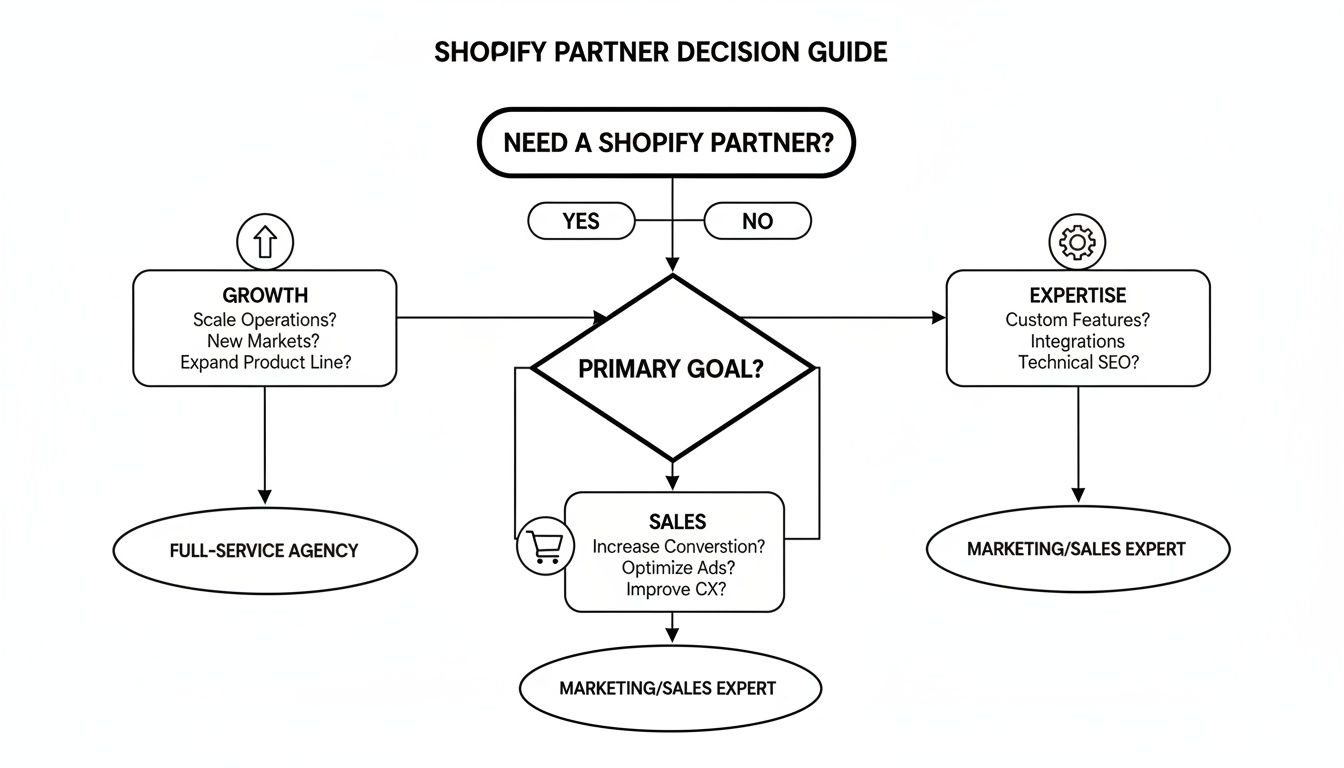
This visual guide simplifies the whole process, connecting your core needs to the specific skills you should be looking for in a partner.
Your Shopify Partner Vetting Checklist
To help you stay focused during your search, I've put together a checklist based on my own process. Use this to systematically evaluate potential partners and make sure they have the skills your eCommerce business needs to grow.
| Checklist Item | Why It Matters | What to Look For |
|---|---|---|
| Relevant Case Studies | Proves they can deliver results for businesses like yours, not just in general. | Look for case studies in your niche with specific KPIs like conversion rate lift, ROAS, or AOV increase. |
| Technical Expertise | Ensures they can handle complex development, app integrations, and performance optimisation. | Ask technical questions about their development workflow, Shopify APIs, or how they handle site speed. |
| Clear Communication | A good partner explains complex ideas simply and keeps you in the loop. | They should be able to break down their strategy without jargon. Look for prompt and clear email responses. |
| Transparent Reporting | You need to see exactly what you're paying for and the impact it's having. | Ask for a sample report. It should clearly link their activities to your business goals (e.g., revenue, leads). |
| Cultural Fit | You'll be working closely with them, so their team's values and work style should align with yours. | During calls, gauge if they listen, understand your brand, and feel like a true partner, not just a vendor. |
| Proactive Strategy | The best partners don't just take orders; they bring fresh ideas to the table. | Do they suggest improvements or new opportunities? A proactive partner is invested in your growth. |
This isn't about ticking every single box, but it gives you a solid framework to compare agencies and move beyond just a gut feeling.
Ask The Right Questions
Once you’ve got a shortlist, the interview process begins. This is your chance to really vet their expertise and see if they can walk the walk. Don't be afraid to get into the weeds with detailed, technical questions. A genuine expert will welcome the chance to show you what they know.
Here are a few questions I always recommend asking:
- "Can you detail your Meta ads creative testing process?" A vague answer here is a major red flag. A good agency will describe a structured process involving testing different ad formats, copy, and audience segments. How to measure success on Facebook ads is key, and they shouldn't quit too early on tests.
- "How do you approach setting up Google Tag Manager for a new eCommerce client?" Their answer should involve things like separate containers, creating data layers for eCommerce events, and ensuring clean tracking for platforms like Google Analytics 4.
- "What's your approach to campaign priority in Google Shopping Ads?" This is a great one to test their advanced knowledge of Google Ads. It shows they understand how to segment campaigns for better performance, especially for dropshipping or when comparing PMAX vs Google Shopping Ads.
- "Have you ever built a custom Shopify app using the Shopify CLI?" Even if you don't need a custom app right now, this question helps you gauge the depth of their development capabilities. A good Shopify development crash course would cover this.
Their answers will quickly tell you whether they are true practitioners or just good at sales talk.
Major Red Flags To Watch Out For
Just as important as knowing what to look for is knowing what to avoid. I’ve seen too many eCommerce businesses get locked into contracts with agencies that under-deliver, and it’s usually because they missed some early warning signs.
A partner who can't clearly explain their process in simple terms either doesn't understand it well enough themselves or is intentionally being obscure. Transparency is non-negotiable.
Here are the biggest red flags I tell people to keep an eye out for:
- Guaranteed #1 Rankings: This is an impossible promise in the world of SEO. Anyone worth their salt knows that rankings are influenced by hundreds of factors, many of which are completely outside their direct control.
- Vague Reporting: If they can't show you exactly what metrics they’ll be tracking and how they'll report on them, just walk away. You should get clear, regular reports that tie their work directly to your actual business goals.
- Lack of a Clear Process: A good agency has a structured, repeatable process for everything from onboarding to campaign optimisation. If they can’t explain their methodology, it’s usually a sign of disorganisation.
To choose the right Shopify partner, it really helps to understand the qualities of top Shopify SEO experts who can properly boost your sales. Vetting for these specific qualities will help ensure you find a partner who values transparency and delivers results you can actually measure.
Understanding Shopify Partner Pricing Models
Let's talk about the money. It's one of the first, and most important, questions I get from eCommerce business owners: "So, how much does it cost to start Google Ads and hire a partner?"
The truth is, there's no single number. Shopify Partners price their work in different ways, depending on what you actually need done. Getting your head around these models is the first step to matching your budget with your goals and walking into a partnership with your eyes wide open.
When you start looking for help, you'll generally find three main ways partners charge for their services. Each one is built for a different kind of relationship, from a one-off build to a long-term growth plan.
Project-Based Fees for Builds and Redesigns
This is the most common model for big, definite tasks, like Shopify design or WordPress development. A project-based fee gives you a single, fixed price for a clearly defined job.
Personally, I prefer this for development projects because it creates total clarity for everyone. You know exactly what you’re paying, and we know exactly what we need to deliver. It’s perfect for an eCommerce business that needs a new Shopify store built or is migrating from another platform.
For a project-based fee, you should expect:
- A detailed proposal that breaks down every single deliverable, from theme customisation to app installations.
- Clear timelines with milestones for design, development, testing, and launch.
- A fixed cost that won’t budge unless the scope of the project changes in a big way.
A simple theme setup might start in the low thousands, but a full custom build with complex features or a Shopify developer API integration could easily be $15,000 to $30,000+. It all comes down to the complexity and the hours required.
Hourly Rates for Consulting and Small Tasks
Sometimes you don't need a whole project. You might just need an expert for a few hours to squash a bug, install a tricky app, or give you some straight-up advice on how to improve your conversion rate. That's where hourly rates come in.
You're essentially buying a block of an expert's time. This model is perfect for:
- Small, specific code tweaks.
- Technical consulting sessions.
- Troubleshooting when your Google Shopping ads are not spending budget.
- Training your team on a new feature.
As a digital marketing agency in Melbourne, we often use this for one-off consultations or minor technical fixes. It’s a flexible way to get an expert on your team without committing to a massive project. Rates vary, but for a skilled Shopify developer, you can expect to pay anywhere from $100 to $250+ per hour.
Monthly Retainers for Ongoing Growth
This model is the standard for any service that needs continuous work and optimisation, like marketing and SEO. When you hire an agency to manage your Google Ads or run an ongoing SEO campaign, you'll almost always pay a monthly retainer.
This fee covers the agency's time, expertise, and the consistent effort needed to manage and improve your campaigns month after month.
A monthly retainer isn't just about paying for tasks; it's an investment in a long-term partnership. You're bringing specialists into your business who are constantly focused on driving your growth.
At our agency, retainers are how we handle services like paid advertising and our comprehensive SEO agency Melbourne packages. It lets us plan, execute, analyse, and tweak our strategies over time to deliver the best possible return on your investment. Marketing your business requires consistency, and retainers build that in.
Monthly retainers for something like PPC management often start around $1,500-$2,000 per month, plus your actual ad spend. The total investment really depends on the scale of your campaigns and how ambitious your goals are. The most important thing is that the deliverables are crystal clear, and you get transparent reports showing you exactly how that investment is performing.
Why A Full-Service Shopify Agency Is A Growth Multiplier

One of the most common mistakes I see eCommerce businesses make is trying to piece their growth strategy together. They’ll hire a great designer for the look, a sharp developer for the code, and a different marketing person to run the ads.
On paper, it makes sense. But in reality? It’s often a recipe for confusion, missed opportunities, and a whole lot of finger-pointing when things don't go to plan. I've been the one called in to clean up these messes, and it's never pretty.
This fragmented approach creates silos. The designer doesn’t know how their choices impact site speed, which ends up hurting the marketing team's Google Ads quality score. The developer isn't looped into the marketing team's tracking needs, leading to broken analytics. It’s a disconnected system where nobody has the complete picture.
This is where a full-service Shopify agency completely changes the game. By bringing all these functions under one roof, you create a powerful synergy that acts as a true growth multiplier for your business.
A Unified Strategy from Code to Conversion
When the same team that handles your Shopify development also runs your Google Shopping campaigns, something powerful happens. The developers and marketers are in constant communication, not just sending emails back and forth. The insights from your ad campaigns directly inform the A/B tests we run on your product pages.
This integrated model leads to some pretty immediate wins:
- Cleaner Data: Tracking is implemented correctly from the start. We set up Google Tag Manager containers and the Meta Conversion API as part of the initial build, ensuring your marketing data is accurate from day one.
- Faster Problem-Solving: If a Facebook ads agency campaign's performance suddenly drops, our team can immediately check for technical issues on the site. There's no back-and-forth between different freelancers; we just solve it.
- Cohesive Growth: Our developers, designers, and marketers all work from the same strategic playbook. We’re all pulling in the same direction, with the shared goal of increasing your revenue.
It’s about having a team that can build a custom feature with the Shopify API and instantly know how to track its usage and impact on your marketing funnels.
Technical Marketing That Just Works
Let's be honest, modern digital marketing is deeply technical. Running successful paid ads on platforms like Google and Meta requires more than just good creative; it requires a flawless technical setup to make sure your budget is actually spent effectively.
This is where a full-service Shopify agency really shines. We bridge that critical gap between complex development and high-performance marketing.
For instance, we can manage everything from a complete Shopify development project to fine-tuning your local SEO. Because we understand the nuts and bolts of both, we can make changes that benefit both your organic rankings and your paid campaigns at the same time.
This deep integration is especially critical for local businesses in competitive markets. As a digital marketing agency in Melbourne, we know how to optimise your store not just for online sales, but for local visibility via your Google My Business profile, too. We can manage your local listings and run localised Google Ads campaigns that complement your broader eCommerce strategy.
When your developer understands your marketing goals and your marketer understands your site's technical limitations, you eliminate friction. This alignment is where real, sustainable growth comes from.
The Shopify partner ecosystem in Australia is powered by a global network of over 44,000 developers, designers, and affiliates. Here in Australia, this translates to a strong community of certified partners ready to deliver specialised services. With the average Shopify merchant using six apps from the App Store, there are multiple touchpoints where an integrated partner can add immense value.
An Extension of Your Own Team
Ultimately, a full-service agency becomes more than just a vendor; we become an extension of your team. We are your outsourced eCommerce department, fully invested in your success because our success is directly tied to yours.
You get one point of contact, one strategy, and one team that understands your brand, your customers, and your goals. This completely eliminates the headache of managing multiple freelancers and lets you focus on what you do best: running your business.
From building custom WordPress blocks for your blog to optimising your PMAX campaigns, having one partner handle it all ensures consistency and quality across every part of your online presence. It's a more efficient, effective, and ultimately more profitable way to grow.
If you're a business with a paid ads budget of at least 3k a month, I'd love to offer you a low risk deal- get a month of paid ads management FREE. Apply now through the contact page.
Ready To Build Your High-Growth Shopify Store
We’ve covered a lot of ground here. By now, I hope you have a solid grasp on what a Shopify Partner actually is, the real-world benefits of bringing on a full-service agency, and a clear checklist for telling the good ones from the bad. You even know what to expect when it comes to pricing.
Now it's time to put all that theory into practice.
The right partner doesn’t just build you another website. They build you a strategic asset, something engineered from day one for growth. They're the specialists who truly get the deep connection between a clean, technical build and a marketing campaign that actually turns a profit.
Your Next Step Towards eCommerce Growth
As a Melbourne-based agency, my team at Alpha Omega Digital lives and breathes at this exact intersection of development and marketing. We see it every single day: a unified strategy, where your Shopify developers and marketing experts are in the same room, creates a powerful momentum that fragmented, siloed teams just can't replicate.
We don't just build Shopify stores; we build businesses. Our entire process is grounded in transparency and a relentless focus on results you can actually measure. We aim to become a true extension of your team, because we know our success is directly tied to yours.
Choosing a partner is one of the most significant decisions you'll make for your eCommerce business. It's an investment in expertise, efficiency, and a clear path to scaling your brand.
For businesses ready to get serious about growth, we want to make that decision a whole lot easier. We're confident in our ability to deliver, and we're more than willing to prove it.
If you're a business with a paid ads budget of at least $3k a month, I'd love to offer you a low-risk way to get started. You can get an entire month of our paid ads management completely FREE. It’s our way of showing you the value we bring to the table, right from the get-go.
This is your chance to work with a dedicated Shopify partner that understands the entire eCommerce picture.
Have a project in mind? Contact us to apply for your free month of ads management and let's start building your high-growth store today.
Got Questions About Shopify Partners?
Good. You should. It's a big decision. Here are some of the most common questions I get from eCommerce business owners trying to navigate this space, answered in plain English.
What's The Difference Between A Shopify Partner And A Shopify Expert?
This one trips a lot of people up, but it's pretty simple when you think about it.
The term 'Shopify Partner' is the broad umbrella for anyone officially in Shopify's program. This includes developers, designers, marketers, and affiliates who build things for the Shopify ecosystem.
'Shopify Experts', on the other hand, is a much smaller, curated group. These are the agencies Shopify has hand-picked and verified for their top-tier work and proven results. Think of it like this: all Experts are Partners, but only a fraction of Partners become Experts. An agency's Partner status is the baseline—it's the first thing you should always look for.
How Much Does It Cost To Hire A Shopify Partner In Melbourne?
This is the big "how long is a piece of string?" question, but I can give you a realistic ballpark from my experience. As a marketing agency Melbourne eCommerce businesses work with, we see costs fall into a few common brackets.
A fairly straightforward theme setup with some customisation might land in the low thousands. But if you're looking for a full-blown custom store build, complete with unique features or complex integrations using the Shopify developer API, you're more likely looking at a range of $15,000 to $30,000+.
For ongoing work like paid ads or SEO, Melbourne agencies usually work on a monthly retainer. These often start around $1,500-$2,500 per month, which is separate from your actual ad spend. The best approach is always to have a conversation and get a quote tailored to exactly what you need.
Can A Shopify Partner Help With My Marketing And SEO?
Absolutely. In fact, in my opinion, they should. The best Shopify Partners aren't just coders who build a site and then disappear; they're growth partners.
A true partner can handle everything from getting your Local SEO sorted to managing sophisticated Google and Facebook Ads campaigns. This holistic approach is a game-changer. When the team running your ads also understands the technical nuts and bolts of your website, everything just works better. You get a cohesive strategy that actually drives results, instead of different specialists pulling in opposite directions.
If you're a business with a paid ads budget of at least 3k a month, I'd love to offer you a low risk deal- get a month of paid ads management FREE. Apply now through the contact page.
Alpha Omega Digital is a marketing agency based in Melbourne, Australia but also services clients from Sydney, Brisbane, Newcastle, Perth, Adelaide, Darwin and Hobart. Have a project in mind? Contact us.
[email protected]
Read more insights from our team on web design, paid ads, and growth strategy.