As a marketing agency in Melbourne, I’ve had countless conversations with business owners who are frustrated with their websites. They’ve often spent a small fortune on a design that looks pretty but does absolutely nothing to bring in actual customers. Let’s be real: a great website isn’t just an online brochure; it needs to be your hardest-working salesperson, generating leads and sales 24/7. This is the difference between having a simple online presence and a revenue-generating machine.
This guide is built from my real-world experience. I want to cut through the fluff and talk about what actually moves the needle for your business.
Your Website: The Core of Your Digital Marketing Engine
From my experience working as a digital marketing agency in Melbourne, I've seen countless businesses pour money into a stunning site, only to watch it sit there gathering digital dust. The missing piece is almost always strategy. A high-performing website is the central hub where all your marketing efforts—like your Google Ads or Facebook Ads—finally converge and pay off.
Think of it like this: your ad campaigns and your local SEO efforts are all roads leading into a city. Your website is the city itself. If that city is confusing to navigate or unwelcoming, visitors will turn around and leave immediately. All the money you spent building those roads? Wasted.
The Three Pillars of a Successful Website
A website that genuinely delivers results for an eCommerce business is built on three core pillars. If you neglect any one of them, the whole thing will wobble.
Smart Design (UX/UI): This goes so much deeper than just colours and fonts. It’s about getting inside the head of your Melbourne customer and understanding their journey. We map out how they think, what they’re looking for, and make it incredibly easy for them to buy your products.
Powerful Technology: The platform your site is built on matters—a lot. For most of my eCommerce clients, this means choosing between the insane versatility of a custom build from a WordPress developer in Melbourne or the streamlined power of Shopify. The right tech stack makes sure your site is fast, secure, and ready to grow with you.
A Clear Growth Strategy: How will people actually find you? This involves integrating everything from local SEO, so you show up in Melbourne-based searches, to properly setting up Google Tag Manager containers and the Meta Conversion API for laser-focused ad campaign tracking.
A website's job isn't to win design awards; its job is to win customers. It must be a seamless blend of aesthetic appeal, intuitive functionality, and a rock-solid strategy designed to turn visitors into loyal patrons.
Throughout this guide, I'll break down these concepts from the perspective of a Melbourne marketing agency that has been in the trenches with eCommerce businesses. We’ll focus on what actually drives growth, from picking the right platform to integrating powerful paid ad campaigns that turn your website into a reliable source of sales.
Finding the Right Digital Marketing Agency in Melbourne
Choosing the right digital marketing agency in Melbourne can feel overwhelming. I’ve seen countless eCommerce owners get burned by slick sales pitches, only to end up with a website that looks okay but does absolutely nothing to bring in actual business. The secret is to look past the glossy portfolios and start asking the hard questions that reveal what an agency is truly made of.
A pretty design is just the price of entry. What you really need is a partner who can show you the money—case studies with real, tangible results. I’m talking about measurable bumps in sales and return on ad spend (ROAS). If an agency can’t show you exactly how their work impacted another eCommerce business's bottom line, that's a massive red flag.
Beyond the Portfolio: What to Look For
When you’re vetting a potential Melbourne web design agency, you need to dig into their process and their team's actual skills. A one-person show might build a decent-looking site, but do they have the deep, in-house expertise needed to build a genuinely high-performance asset?
Here’s a practical checklist to guide your conversations:
- In-House Technical Skills: Ask them straight up if their development is done in-house. You need a team with proven experience in WordPress development, especially for building custom blocks in Gutenberg. Or, you need expert Shopify developers who can handle everything from custom theme design to tricky integrations using the Shopify API. You might even need a team capable of building custom Shopify apps using Shopify CLI.
- A Documented Process: Can they walk you through a clear, step-by-step process? This should cover everything from discovery and strategy to design, development, testing, and launch. A chaotic process is a one-way ticket to missed deadlines and blown budgets.
- Marketing Integration: A great website is useless if no one ever sees it. Does the agency have a team that actually understands how to drive traffic? This means having specialists in local SEO and experts who can manage complex Google Shopping ads for dropshipping or scale Performance Max campaigns. They should also be masters of the Meta ads creative testing process.
- Tracking and Analytics Expertise: Ask about their experience with GTM and Google Analytics. They should be able to explain how they’ll set up conversion tracking—including more advanced setups like a Conversions API installation for Meta—to make sure every single dollar you spend on ads is accountable.
Questions to Ask on Your First Call
That initial discovery call is your best chance to see if an agency is the right fit. Don’t be afraid to take control of the conversation and get the answers you need.
When I'm talking to a potential client, I want them to challenge me. A good partner isn't afraid of tough questions; they welcome them because it shows the client is serious about results, just like we are.
Here are a few questions I recommend asking any potential marketing agency in Melbourne:
- Can you show me a case study for an eCommerce business similar to mine and walk me through the ROAS you achieved?
- Who will be working on my project? Are your developers, designers, and marketers full-time employees?
- How do you approach conversion rate optimisation after the site goes live?
- What is your process for integrating paid ad campaigns, like Google Shopping and Meta ads, with a new website build?
Finding the right partner comes down to finding a team that’s as invested in your business goals as you are. It’s about more than just a transaction; it's a partnership built on sustainable growth.
WordPress vs Shopify: Which Platform Is Best for Your eCommerce Business?
"Should I go with WordPress or Shopify?" This is easily one of the most common questions I hear from Melbourne business owners, and for good reason. Choosing your platform is like deciding on the foundation for your house; it determines what you can build, how much it will cost, and how easily you can expand later on.
As a marketing agency in Melbourne, I've built countless sites on both platforms, and I can tell you there's no single "best" answer. It all comes down to your specific business model, your goals, and how comfortable you are with the tech side of things.
Let's break down the core differences, based on my firsthand experience.
When to Choose WordPress: The Ultimate Customisation Engine
I think of WordPress as the ultimate creative toolkit. If you can dream it, a skilled WordPress developer can almost certainly build it. This is its greatest strength and, for some, its biggest challenge. You can hire a WordPress web developer from Sydney, Melbourne or anywhere else in Australia.
WordPress is perfect for businesses that need more than just a simple online store. This includes unique branded experiences or complex functionality that a template just can't deliver.
Here are a few scenarios where WordPress really shines for eCommerce:
- Content-Heavy Websites: If blogging and detailed product guides are central to your SEO strategy, WordPress is unmatched. Its content management system is far more powerful.
- Custom Features: Need a unique subscription model, a product customizer, or a B2B ordering portal? A WordPress development company can build these features right into your site.
- Total Design Freedom: You have complete control over every single pixel. We can build completely custom blocks in Gutenberg, ensuring your site looks and feels exactly like your brand, not a generic theme.
- Scalable SEO: With plugins like Yoast SEO and full control over the code, a good seo agency in melbourne can implement advanced SEO tactics that are much harder to achieve on other platforms.
But all this freedom comes with responsibility. WordPress needs regular maintenance—updates, security checks, and backups—to keep it running smoothly and securely. It’s definitely not a "set and forget" platform.
When Shopify Is the Smart Choice: The Ecommerce Powerhouse
Shopify, on the other hand, is a purpose-built machine for selling products online. It’s a closed ecosystem, which means less flexibility but also far greater ease of use, security, and reliability right out of the box. For most Melbourne eCommerce businesses, it’s the go-to platform.
Its biggest selling point is simplicity. You don't have to worry about hosting, security patches, or server maintenance—Shopify handles all of that for you. This frees you up to focus on what you do best: marketing and selling your products.
Shopify removes technical barriers, making it incredibly powerful for eCommerce brands that want to get to market quickly and scale without worrying about the underlying infrastructure. It's built for one thing: conversions.
A skilled team of Shopify developers and Shopify development partners can still offer significant customisation. Using the Shopify developer API and custom app development, we can extend its core functionality to meet unique business needs, like creating custom integrations or specialised subscription models. It’s the ideal platform for businesses that want to launch an Instagram Shop or Facebook Shop seamlessly.
To help you get a clearer picture, here's a quick side-by-side look at how the two stack up for a typical Melbourne business owner.
WordPress vs Shopify: A Quick Comparison for Melbourne Businesses
| Feature | WordPress (with WooCommerce) | Shopify |
|---|---|---|
| Best For | Content-heavy sites, unique custom functionality, and B2B stores. | Pure-play eCommerce stores, from startups to enterprise level. |
| Ease of Use | Steeper learning curve. Requires more hands-on management. | Extremely user-friendly. Built for non-technical store owners. |
| Customisation | Virtually limitless. If you can imagine it, you can build it. | Good customisation within its ecosystem, but you don't control the core code. |
| Maintenance | You are responsible for hosting, security, and all updates. | Fully hosted and managed. Shopify handles all technical maintenance. |
| Cost Structure | Lower upfront software costs, but development and maintenance can be expensive. | Monthly subscription fee plus transaction fees. Apps can add up. |
| SEO | Excellent. Offers deep control over all technical and on-page SEO elements. | Very good out of the box, but less control over advanced technical SEO. |
This table should give you a gut feeling for which direction to lean. If you’re still weighing your options, digging into a detailed breakdown of Shopify vs WordPress vs Solo AI Website Creator can offer more valuable insights into which website builder is right for you.
This decision tree helps visualise the key questions to ask when you're looking for a web partner, focusing on their portfolio, proven results through case studies, and the strength of their in-house team.
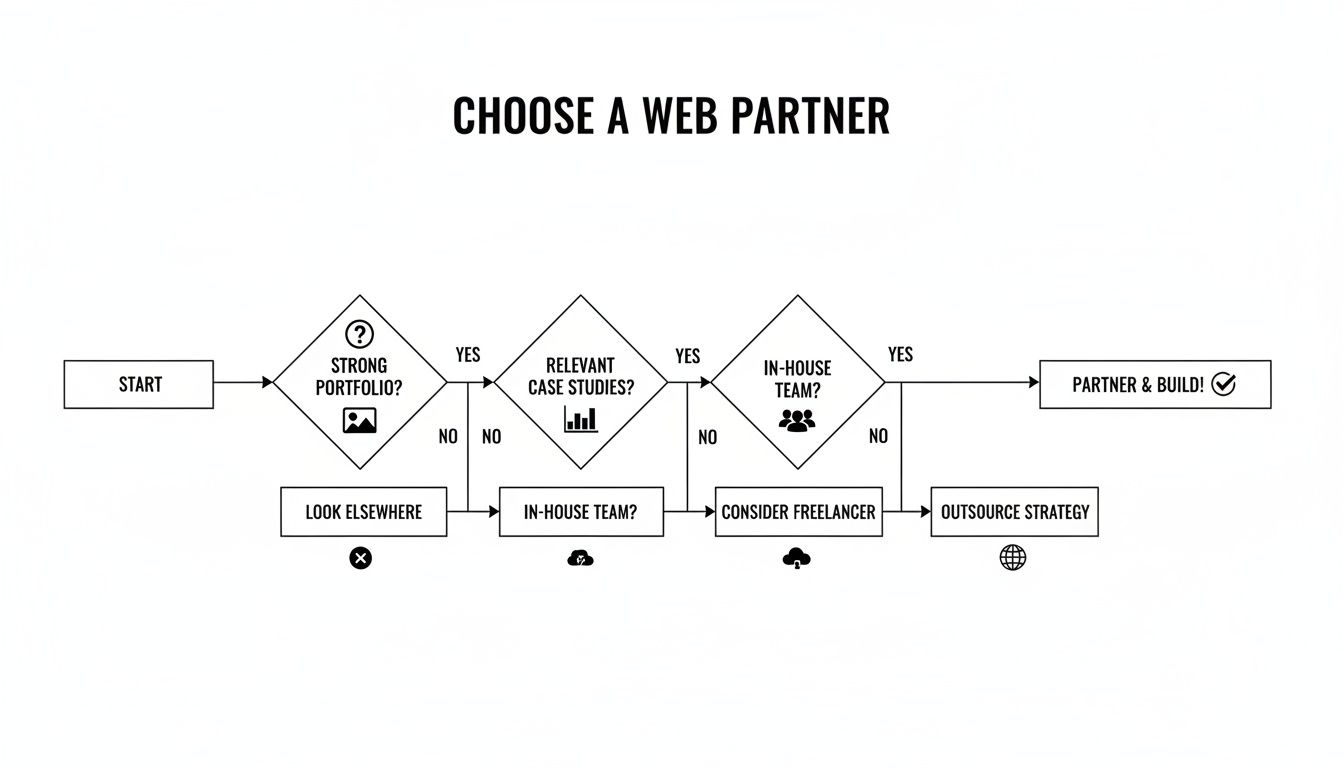
Ultimately, this process guides you toward someone who can provide not just a design, but a comprehensive growth strategy. Choosing the right platform is the first step, and choosing the right partner to build on it is what ensures your investment pays off.
The Critical Role of Performance in Melbourne Web Design

I’ve seen it happen more times than I can count: a Melbourne business sinks a small fortune into a beautiful website, only to discover it’s slower than a tram during peak hour on Swanston Street. In a market as competitive as this, a slow website isn’t just a minor hiccup—it’s a conversion killer.
Every extra second a potential customer is forced to wait is another opportunity for them to hit the back button and head straight to your competitor.
Performance is simply non-negotiable. It’s not a "nice-to-have" feature; it directly impacts user experience, bounce rates, SEO rankings, and, most importantly, your bottom line. Just think about your own behaviour online. If a page takes forever to load, you're gone. Your customers are exactly the same.
A snappy, responsive site signals professionalism and builds trust. This is where a skilled team of WordPress developers or Shopify experts can make a tangible difference, crafting an experience that respects your customer's time and attention.
Understanding Google's Core Web Vitals
Google is obsessed with user experience, which is why they rolled out Core Web Vitals. These are just a few specific metrics that measure a website's loading performance, how quickly it responds to clicks, and whether it’s visually stable. You don’t need to be a developer to get the gist.
Let’s break them down:
- Largest Contentful Paint (LCP): How long does it take for the main event—like a big banner image or the first block of text—to appear on the screen? This is all about perceived loading speed.
- First Input Delay (FID): When a user first tries to interact with your site (like clicking a button), how long does it take to respond? This measures how interactive and snappy your site feels.
- Cumulative Layout Shift (CLS): Have you ever tried to click on something, only for the page to jump around at the last second, causing you to click on an ad by mistake? CLS measures that annoying visual instability.
A great score in these areas signals to Google that your site offers a quality experience, which can give your SEO a serious leg-up. As a digital marketing agency in Melbourne, optimising for these vitals isn't an afterthought; it's a core part of our process.
Practical Steps to a High-Performing Website
Achieving a lightning-fast website isn't magic. It's the result of deliberate, smart technical choices made from day one. We focus on building sites that are lean, efficient, and clean, whether it's a custom WordPress development project or a finely tuned Shopify store.
Here’s a peek at how we make it happen:
- Optimised Images: Let's be honest, huge, uncompressed images are the number one culprit behind slow websites. We use modern image formats and smart compression to make sure your photos look incredible without dragging down your load times.
- Clean, Efficient Code: Bloated themes and a spaghetti mess of plugins are a recipe for a sluggish site. Our WordPress development company writes clean code from the ground up and carefully vets every plugin to maintain peak performance.
- Quality Hosting: Your web host is the engine that powers your website. We guide our clients toward high-quality Australian hosting solutions that provide the speed and reliability needed to serve a Melbourne audience without a hitch.
A high-performance website isn’t an accident. It’s the direct result of a strategic focus on clean code, optimised assets, and a user-first mindset from the very start of the design process.
The impact of this focus is massive. One Australian case study saw a redesigned website achieve a 42% increase in conversion rate in just 90 days, with 92% of users experiencing good Core Web Vitals. This shows a crystal-clear link between site speed and real business results, which you can read more about in these web design insights.
Of course, performance is about more than just speed. It's about building a website that effectively turns visitors into customers. You can learn more about how to improve your ecommerce conversion rate with other targeted strategies.
Integrating Paid Ads for Explosive Growth
Building a stunning, high-performance website is a huge win, but let's be honest—it’s only half the battle. A brilliant website with no traffic is like opening a gorgeous retail store in a laneway nobody knows exists. This is where we connect the dots between world-class Melbourne web design and targeted, results-driven paid advertising. It’s the one-two punch that turns your website from a static online brochure into a machine that actively generates sales.
From my experience as a digital marketing agency in Melbourne, I've seen that the most successful businesses don’t treat their website and their advertising as separate things. They get that a well-built site is the perfect launchpad for incredibly profitable Google Ads and Facebook Ads campaigns. The two have to work in perfect harmony. Marketing your business is all about consistency.
The Technical Foundation for Paid Ads Success
Before we even dream of writing ad copy or deciding what budget to spend on Google ads, we have to get the technical plumbing right. This is a non-negotiable step that a lot of agencies skip over, leading to wasted ad spend and messy, unreliable data. We make sure every click is tracked and every dollar is accounted for.
Here’s how we get it done:
- Setting up Google Tag Manager (GTM): Think of GTM as a central dashboard for all your marketing tags and tracking codes. We use it to cleanly install things like your Google Ads conversion tag without having to bother a WordPress developer to mess with the website’s code for every little change.
- Implementing the Meta Conversions API: With all the privacy changes happening, just relying on the Facebook Pixel isn't cutting it anymore. We set up the Meta Conversion API for a more reliable, server-to-server connection that captures customer actions accurately. This gives us much better data to work with when optimising your campaigns.
- Comprehensive Conversion Tracking: Whether you’re a service-based business or an eCommerce store, we meticulously track every important action. This means setting up tracking for contact form submissions, phone calls, and, of course, online sales. This data tells us exactly what’s working and what isn’t.
Tailoring Ad Strategies to Your eCommerce Business
A one-size-fits-all approach to paid ads is a recipe for disaster. A campaign designed for PPC for tradies is fundamentally different from one built to sell products for a Shopify store.
For my service-based clients, the main goal is usually to drive high-quality enquiries. We focus heavily on Google ads for contact form submissions, targeting specific local keywords that show someone is ready to buy. We also bring in the best call tracking softwares for PPC call campaigns (like CallRail or Go High Level) to measure which ads are driving phone calls, giving us a complete picture of what's working.
For eCommerce businesses, the game is all about Return On Ad Spend (ROAS). This is where our expertise as a Facebook ads agency and Google Shopping specialist really comes into play. You need a team that knows how to measure success in Facebook ads and understands that you should never quit on Facebook ads too early.
For an online store, a successful paid ads strategy isn't just about driving traffic; it's about driving profitable traffic. We obsess over ROAS, using data-driven creative testing on Meta and optimising product feeds for Google Shopping and PMAX campaigns to ensure every dollar you spend comes back with friends.
This often involves walking our clients through a detailed beginners guide to google shopping ads, explaining concepts like campaign priority in Google ads and the key differences between PMAX vs Google shopping ads. If you find your Google Shopping ads not spending budget, we know how to fix it. We make sure your product data is flawless, your ad creative is compelling, and your budget is being spent on the campaigns delivering the highest return.
Ultimately, integrating paid ads is about creating a predictable system for growth. It’s how we take the incredible foundation of your new website and actively put it in front of the right people, at the exact moment they’re ready to buy.
The Future of AI-Powered Web Design & Lead Capture

Let's talk about what’s next. As a marketing agency in Melbourne, I'm always looking over the horizon, and right now, that conversation is all about Artificial Intelligence. AI is completely changing how we approach web design, steering us away from static, brochure-like websites and towards living, personalised experiences that actively work to win you customers.
This isn't just about slapping a chatbot in the corner of your screen and calling it a day. I’m talking about weaving AI-first principles into our Melbourne web design projects from the very beginning. It's a genuine shift in how we think about what a website is supposed to do.
Beyond Chatbots: Smarter AI Integration
When I talk about AI, I mean intelligent systems that make your website work harder and smarter. It's about building a site that actually adapts to each visitor, delivering an experience that feels like it was made just for them.
Here are a few ways we're already putting these ideas into practice:
- Smart Content Recommendations: For an eCommerce shop, this means showing a user products they’re genuinely likely to want based on their browsing history—not just generic best-sellers.
- Dynamic Calls-to-Action (CTAs): The website can intelligently change the CTA based on where a user is in their journey. A first-time visitor might see a "Learn More" button, while someone who has been back a few times sees an offer for "10% Off Your Next Order."
- Automated A/B Testing: AI can constantly test different headlines, images, and layouts to see what converts best, automatically improving your site over time without you needing to lift a finger.
This strategic approach turns websites into living systems. Melbourne businesses that are getting on board with AI are seeing incredible results; one Australian company's redesign led to a 42% jump in its site-wide conversion rate and a 65% increase in how long people stayed on the site. It's proof that smarter, AI-driven designs keep users hooked for longer. You can read more about these trends and how Melbourne businesses are rethinking UX.
Practical AI Solutions That Capture Lost Leads
One of the most powerful and practical tools we’ve developed is our AI Voice Agent service. This is a perfect example of how AI can solve a real-world business problem and plug straight into your website. Our AI receptionist Australia service is designed for local businesses.
Think about it: for tradies, hairdressers, beauty therapists, dentists, restaurants, or doctors, a missed phone call is a missed opportunity. Our AI receptionist or AI appointment setter answers your calls 24/7. It never gets sick or tired, and never misses a lead.
We set up a custom number through Twilio, and the AI agent answers calls, books appointments directly into your calendar or Calendly, and answers common questions. This service alone can save thousands in lost business for service-based professionals. To learn more, check out our guides on AI voice agents and AI voice agent pricing.
This shows how forward-thinking agencies are using AI not just as a gimmick, but as a real tool to build more intelligent, efficient websites that deliver a clear return on investment. The future of web design isn’t just about looking good; it's about being smart.
Your Melbourne Web Design Questions Answered
I’ve had a lot of chats with Melbourne business owners trying to get their heads around the whole web design and marketing process. It can feel like a massive, confusing project, so I wanted to lay out some clear, straight answers to the questions that come up time and time again.
How Much Does a New Website Cost in Melbourne?
This is always the first question, and the honest answer is: it really depends. You could get a simple, template-based site up and running for a few thousand dollars. At the other end of the scale, a large, custom-built eCommerce store on Shopify or a corporate site with unique features built by a WordPress developer could easily run into the tens of thousands.
The final price tag really comes down to a few key things:
- Complexity: How many pages do you need? What about special features like booking systems or member logins?
- Platform: A custom WordPress build usually involves more hands-on development time than a Shopify setup. Our WordPress development in Sydney and Melbourne teams can handle any level of complexity.
- Strategy & Design: Are we starting from scratch with user experience mapping, custom design, and marketing integrations?
But instead of getting stuck on price, I always try to frame it around value. A better question is, how much does it cost to start Google ads? The investment in your website and ads should be viewed through the lens of the return it will generate.
How Long Does It Take to Build a Website?
For a professional eCommerce website, you should realistically plan for a timeline of 6 to 12 weeks. That gives us enough breathing room to get all the critical stages right—from strategy and design through to development, loading up content, and doing thorough testing before launch.
A simpler project might be a bit quicker, sure. But a complex build that needs a Shopify development crash course for the team or tricky work with the Shopify API could definitely take longer. We stick to a transparent, structured process so every project stays on track and you know exactly what’s happening every step of the way.
Do I Need Ongoing Maintenance and SEO After Launch?
Yes, absolutely. I can't stress this enough. A website isn't a "set and forget" thing. It's more like a car—it needs regular servicing and fuel to keep it running and get you where you want to go. This includes local SEO and managing your Google My Business profile.
Ongoing maintenance is vital, especially for WordPress sites. It typically involves:
- Regularly updating plugins and themes.
- Running security scans to keep hackers out.
- Taking frequent backups of your entire site.
- Keeping an eye on site speed and performance.
This is all about protecting your investment and making sure it keeps delivering results for your business long after we’ve hit the launch button.
If you're a business with a paid ads budget of at least 3k a month, I'd love to offer you a low-risk deal—get a month of paid ads management FREE.
At Alpha Omega Digital, we are a marketing agency based in Melbourne, Australia but also service clients from Sydney, Brisbane, Newcastle, Perth, Adelaide, Darwin and Hobart. Have a project in mind? Apply now through the contact page.
[email protected]
Read more insights from our team on web design, paid ads, and growth strategy.