If you're running an eCommerce brand in Melbourne, there's a fair chance you've already had this experience. You launch Facebook and Instagram ads, the clicks start coming in, your budget gets spent, and Ads Manager looks busy enough to feel productive. Then you check sales, and the gap between what the platform says happened and what reached your store starts to get uncomfortable.
That's usually when store owners start asking the right questions. Not "how do I get more clicks?" but "what's broken in the system?" In my experience, profitable Meta campaigns don't come from one clever audience setting or one nice-looking video. They come from getting the whole conversion ecosystem right. Tracking. Offer. Creative. Landing page. Checkout. Post-click behaviour. The ad is only one part of it.
For Melbourne brands, that matters even more because you're competing in a crowded market. A good Facebook Ads agency in Melbourne shouldn't just turn ads on. It should help you see whether the platform is driving profitable growth, and whether your Shopify or WordPress site is strong enough to convert the traffic you're paying for.
Tired of Wasting Money on Facebook Ads in Melbourne
A Melbourne store owner launches a new campaign on Monday, sees traffic by Tuesday, and by Friday starts wondering where the money went. Ads Manager shows clicks and add-to-carts. Shopify or WooCommerce shows a weaker result. The bank account feels the difference immediately.
We see this pattern all the time with eCommerce brands that come to us after trying Meta in-house or through a freelancer. The problem usually is not that Facebook and Instagram stopped working. The problem is that the account, the tracking, and the website are not working together well enough to turn paid traffic into profitable sales.
That matters more now because paid social is no longer just an ad-buying job.
If the offer is weak, creative gets ignored. If tracking is messy, good campaigns look average. If the landing page is slow or unclear, Meta keeps sending traffic into a leaky funnel. Money disappears in small amounts across the whole system, which is why fixing ads alone rarely solves the problem.
What wasted spend usually looks like
For Melbourne eCommerce brands, the warning signs are usually easy to spot once you know where to look:
- Budget gets spent before the economics are proven, so the account scales faster than your confidence in the numbers.
- Platform reporting clashes with store data, leaving you stuck between Ads Manager, Shopify or WooCommerce, and analytics tools that tell different versions of the same story.
- Creative fatigues early, especially when one offer or one format gets pushed too hard into a limited audience.
- Retargeting carries the account, while cold prospecting is too weak to support real growth.
A practical way to judge this is to stop asking whether Meta got the last click and start looking at how it contributed across the buying journey. If you need a clear framework for mastering multi-touch attribution, start there before making budget decisions based on one reporting view.
Wasted ad spend usually comes from several smaller issues at once. Weak measurement, weak offer, weak creative, and weak site conversion all stack up.
Why this hits Melbourne brands hard
Melbourne is a competitive market. Audiences are saturated faster, creative wears out sooner, and small mistakes in setup get expensive quickly. We have seen brands increase spend with decent click-through rates, then realise the actual bottleneck was a product page that did not build enough trust or a checkout flow that dropped too many buyers.
That is why we treat Facebook Ads as part of a conversion ecosystem, not a standalone media channel. We set up server-side tracking and CAPI so reporting is more reliable. We compare platform data with what the store and attribution tools show. We check whether the Shopify or WordPress site can convert the traffic being purchased. Without that work, ad performance is easy to misread and even easier to waste.
If your campaigns feel busy but profit is inconsistent, the issue is usually broader than targeting.
Why Most Facebook Ad Campaigns Underperform
Most underperforming campaigns aren't failing because Facebook ads stopped working. They fail because the account was built on assumptions that no longer hold up.
The biggest one is this. Too many businesses still trust platform reporting as if it's the whole story. It isn't. Privacy changes have made attribution less clean, less complete, and less forgiving of sloppy setup. If you're judging profitability purely from what Meta reports inside the platform, you can make very expensive decisions with a lot of confidence.
The attribution problem most agencies skip
A major gap in Melbourne-focused Facebook Ads agency content is measurement after privacy changes. Many local agency pages still talk about targeting, leads, and ROAS, but rarely explain how attribution works when Meta's tracking is constrained. Independent Australian guidance now emphasises server-side tracking, Conversion API, and first-party data as more reliable ways to measure paid social performance in this overview of Facebook advertising in Australia.
That point matters more than most businesses realise. If Meta misses part of the user journey, it can under-report conversions. If your site setup is messy, other tools can also misread the journey. The result is confusion, and confused businesses usually do one of two things:
- They quit too early and turn off campaigns that were helping more than they realised.
- They scale too early because platform numbers looked stronger than the actual margin story.
The usual weak points in a struggling account
When I audit accounts, I tend to find a cluster of issues rather than one smoking gun.
| Problem area | What it looks like in practice | Why it hurts |
|---|---|---|
| Tracking | Pixel only, poor event mapping, duplicate events | You can't trust the feedback loop |
| Creative | One or two ad variations running too long | Fatigue sets in and costs creep up |
| Offer | Generic discount or weak product angle | People scroll past because nothing feels compelling |
| Landing page | Slow mobile product pages or cluttered layout | Clicks don't turn into purchases |
| Reporting | Decisions based on CTR or vanity metrics | The account gets optimised for activity, not profit |
What doesn't work anymore
There are a few habits I'd stop immediately if a store is struggling.
- Boosting posts and hoping. That's not a serious acquisition strategy.
- Obsessing over CTR alone. A high click-through rate can still produce weak revenue if the landing page or offer misses.
- Targeting tricks without creative depth. Interest stacks and audience hacks won't save a stale ad.
- Ignoring post-click behaviour. If visitors bounce, hesitate, or abandon cart, the problem isn't solved inside Ads Manager.
Practical rule: Treat Meta's in-platform numbers as diagnostic, not final. Use them to spot patterns. Use deeper measurement to judge business value.
A strong Facebook Ads agency in Melbourne should be able to explain exactly how it decides whether Meta is profitable now, not just whether the dashboard looks active.
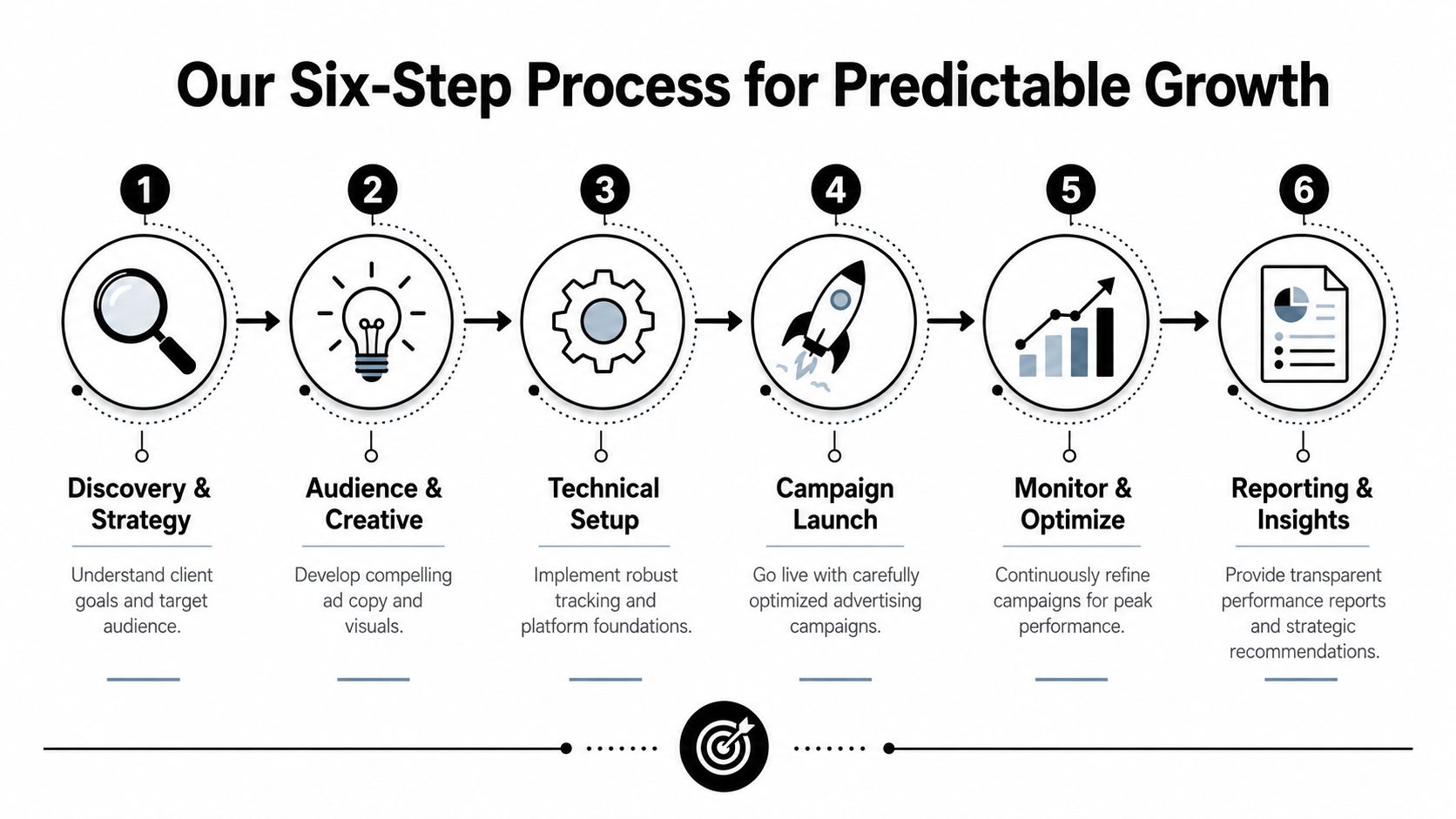
Our Six-Step Process for Predictable Growth
The accounts that scale cleanly tend to follow a disciplined rhythm. Not glamorous. Just organised. Every useful campaign I've seen comes back to the same pattern: understand the business, build the data layer properly, launch with a testing plan, then optimise without chasing noise.
Step one and two
1. Discovery and strategy
We start by looking at the business before touching the ad account. Product economics, repeat purchase behaviour, best sellers, margins, shipping friction, seasonality, and what customers care about. If the offer is weak or the store has obvious conversion blockers, no amount of media buying will rescue it.
2. Audience and creative planning
Strategic messaging and creative selection determine whether campaigns are sharpened or diluted. We map cold, warm, and existing customer messaging separately. Then we decide what creative angles deserve testing first. Product benefit, problem-solution, social proof style, founder-led, UGC style, bundle push, and direct response offer angles all behave differently.
Step three and four
3. Technical setup
Before launch, we make sure the account can learn from the right signals. That includes event integrity, platform connections, Google Analytics visibility, and proper handoff between the website and ad platforms. If the measurement layer is unreliable, every later decision gets weaker.
4. Campaign launch
We launch with structure, not chaos. That usually means controlled testing rather than dumping many variables into one campaign and pretending the result means something. Early learning matters. Bad launch setups often poison an account because they create false winners.
Step five and six
5. Monitor and optimise
Once campaigns are live, the job is pattern recognition. We review creative response, audience quality, landing page engagement, and conversion behaviour. We don't make random changes every few hours. We make specific changes for specific reasons.
6. Reporting and insights
The reporting shouldn't just tell you what happened. It should tell you what to do next. Good reporting connects ad behaviour with site behaviour and commercial outcomes, so budget decisions stay grounded.
Here's the core logic in a short list:
- Start with business reality because ad performance can't be separated from margin, offer, and fulfilment.
- Build campaigns around testable variables so you know whether the winner was the creative, the audience, or the landing page.
- Protect data quality early because fixing bad measurement after scale is slower and more expensive.
- Optimise in layers by separating creative, targeting, and on-site conversion issues.
- Report for decisions rather than producing dashboards that look polished but change nothing.
A digital marketing agency in Melbourne that works with eCommerce properly should be able to walk you through a process like this in plain English. Not just what gets done, but why each stage exists.
Building an Unbreakable Technical Foundation
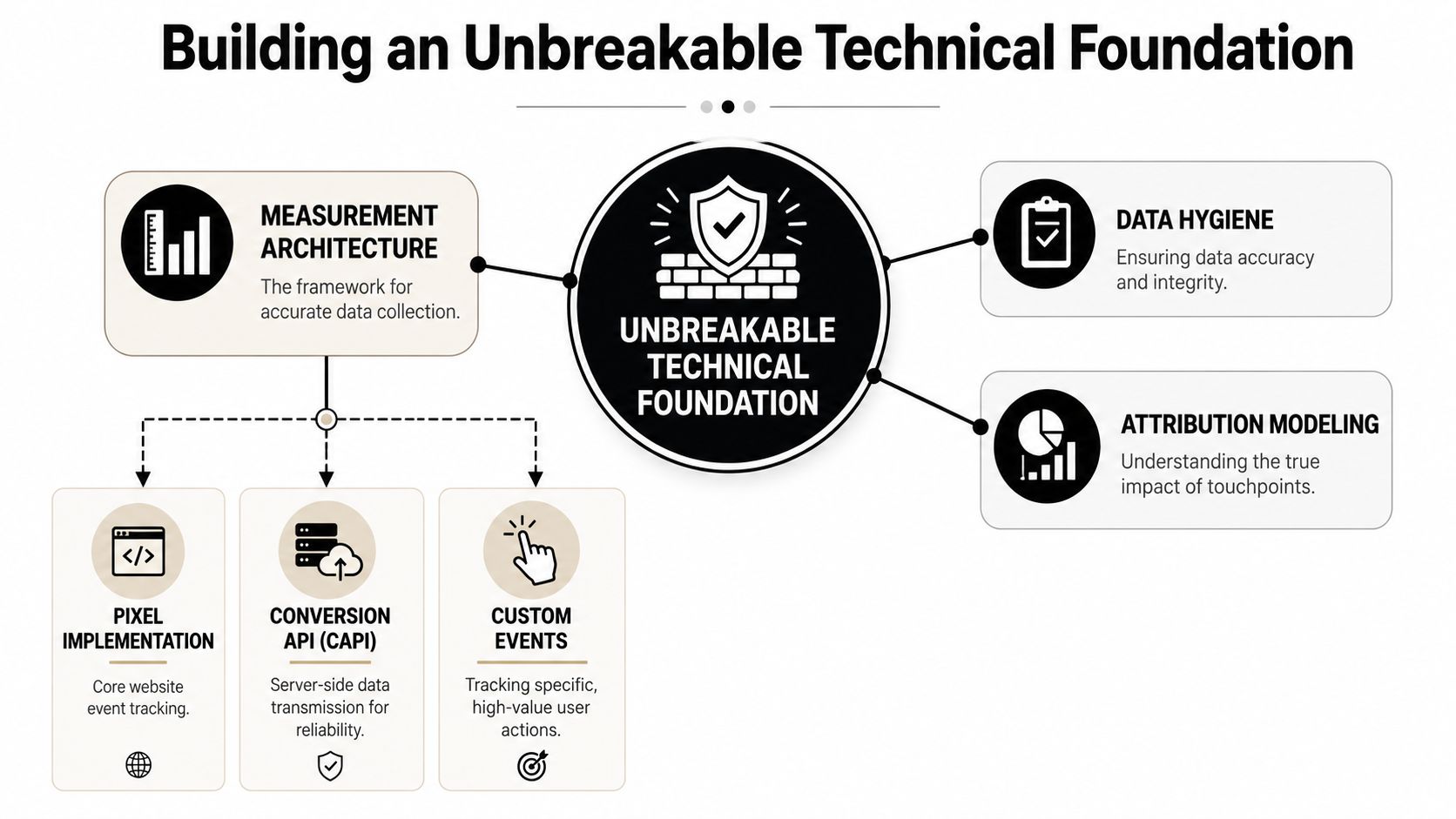
Technical setup is where many paid social campaigns fail unnoticed. The ads may look good, the targeting may be decent, and the budget may be fine, but if the data coming back is patchy, the account starts learning from an incomplete picture.
That's why I treat measurement architecture as the foundation, not an admin task.
What a strong setup actually includes
A high-performing Melbourne Meta Ads stack typically requires Pixel plus Conversions API (CAPI) before launch. When browser-side tracking is incomplete, reported conversions can undercount actual sales or leads, which distorts CPA and ROAS. Adding server-side CAPI reduces that attribution loss and gives agencies cleaner signals for budget allocation, as explained in this breakdown of Meta ads setup and CAPI.
That sounds technical, but the practical version is simple.
- Meta Pixel tracks actions from the browser side.
- Conversions API sends data from the server side.
- Google Tag Manager helps implement and manage tags more cleanly.
- Google Analytics helps validate what users do after the click.
If you only rely on the browser, you'll miss part of the story. If you add server-side tracking thoughtfully, you usually get a more reliable picture of what happened.
How we use data without trusting one platform blindly
For Melbourne businesses running Meta ads, campaign decisions should be judged on impressions, clicks, and conversions in Ads Manager, with website-side validation in Google Analytics to capture post-click behaviour and avoid vanity metrics. In practice, CTR and platform conversion counts are diagnostic signals, while landing-page engagement and downstream conversions help identify whether targeting, creative, or page experience is causing the performance gap, as outlined in this guide to essential Facebook ads performance metrics.
That's a much more useful way to work. It stops you from blaming the wrong part of the funnel.
| Tool | Main job | What it helps answer |
|---|---|---|
| Meta Pixel | Browser event tracking | Did the visitor trigger key actions on site? |
| Conversions API | Server-side event sharing | Are we recovering tracking that the browser missed? |
| Google Tag Manager | Tag deployment and management | Is the setup controlled and consistent? |
| Google Analytics | Post-click behaviour analysis | Did traffic actually engage and move toward purchase? |
What this looks like on Shopify and WordPress
The platform changes the implementation details, but not the principle.
On Shopify, we pay close attention to checkout flow, event mapping, and app conflicts that can muddy conversion data. On WordPress, the risk is often plugin bloat, inconsistent event firing, or custom themes that need more careful tag implementation.
This is also where a broader technical skill set matters. If you're working with a team that handles both paid media and site implementation, services like Shopify development in Melbourne can support cleaner event setup and better conversion paths, instead of leaving the ads team and dev team to blame each other.
If tracking is wrong, optimisation becomes theatre. You make changes, the dashboard moves, and nobody really knows whether the business improved.
A real Facebook Ads agency in Melbourne should be comfortable talking about Pixel, CAPI, GTM, event quality, and attribution without drowning you in jargon.
Creative and Copy That Actually Converts
Once the tracking is stable, the next lever is creative. For most small and mid-sized brands, creative often yields the biggest gains. Not because targeting doesn't matter, but because weak creative gets ignored no matter how clever the audience setup is.
For Melbourne SMBs, the biggest Facebook Ads lever may now be the website and offer, not the ad account. Australian market guidance points to rising competition and the need for creative-led optimisation, not just audience targeting, with performance increasingly dependent on short-form video, rapid creative testing, and stronger landing-page conversion in this Australian perspective on Facebook ads for SMBs.

What we test first
When a brand says "our ads aren't working", I usually want to see the creative library before I look at the campaign settings. Most underperforming accounts have one of these issues:
- The hook is too soft and doesn't earn attention in the first moment.
- The angle is generic and sounds like every other store in the feed.
- The offer isn't clear so the user has no reason to act now.
- The ad and landing page are mismatched which creates friction after the click.
A better testing process gives each of those its own lane.
Our creative testing process
We don't just swap colours and hope. We build batches around clear hypotheses.
Hook testing first
Different openings change performance fast. A founder talking to camera behaves differently from a product demo, customer reaction, or problem-led opening.Angle testing next
One ad may focus on convenience. Another on quality. Another on a specific use case. Another on a bundle or offer. The point is to learn what buyers care about most.Format variation
Some products respond to static images. Others need short-form video or UGC-style editing to feel native in the feed.Copy depth
We test direct response copy against lighter copy, feature-led messaging against objection handling, and short punchy headlines against more explanatory variants.
Creative rule: Don't ask one ad to prove everything at once. Test one meaningful variable at a time, then build from the winner.
What actually tends to convert
This varies by product, but a few patterns show up regularly for eCommerce:
- Short-form video often works well when the product needs demonstration.
- UGC-style creatives can feel more believable than polished brand ads when trust is the main barrier.
- Offer-led ads can lift response when the product is already understood but the customer needs a reason to buy now.
- Problem-solution copy works when the pain point is obvious and emotionally familiar.
The mistake is assuming one winning format will keep working indefinitely. Creative fatigue is real. A healthy account needs rotation, fresh angles, and a process for replacing tired ads before performance slips too far.
That's why I'd choose a team with a testing discipline over one with a fancy pitch deck every time. A Facebook Ads agency in Melbourne earns results through iteration, not slogans.
Your Website Is Your Most Important Salesperson
A Melbourne store can have strong creative, a sensible offer, and enough budget to learn. Then the clicks hit the site and sales stall. The usual pattern is familiar. Product pages take too long to load, the first screen looks generic, shipping information is buried, and mobile checkout asks for too much work.
That handoff matters more than many brands expect.
Facebook and Instagram traffic is interruption traffic. People did not wake up planning to visit your store. The ad earns a few seconds of attention, and the website has to turn that attention into intent fast. If the page feels confusing, slow, or thin on trust, the session ends before the product gets a fair shot.
The site has a clear job:
- Match the ad message so visitors immediately see the product, offer, or problem they clicked for
- Answer the first objections with delivery details, returns information, reviews, FAQs, and clear product benefits
- Keep mobile buying simple with readable layouts, obvious buttons, and fewer distractions
- Protect purchase intent at checkout by avoiding surprise costs, awkward form fields, and unnecessary steps
I do not judge landing pages on visual polish alone. I look at whether they help a cold visitor make a decision.
| Website element | What good looks like | What usually goes wrong |
|---|---|---|
| Above-the-fold content | Product, value proposition, and CTA are obvious | Brand-first design hides the actual offer |
| Product page copy | Specific benefits, sizing, materials, delivery, returns | Thin descriptions that create doubt |
| Social proof | Reviews, UGC, and trust signals near decision points | Proof is weak, hard to find, or missing |
| Mobile UX | Fast pages, clean spacing, sticky add-to-cart where needed | Crowded sections and too much scrolling before action |
| Checkout | Clear total cost and a short path to payment | Friction from forced account creation or surprise shipping |
The practical test is simple. If a new visitor lands on the page and cannot answer "What is this, why should I trust it, and what happens if I buy?" within seconds, conversion rate suffers.
This is also where post-iOS14 measurement and site performance connect. If tracking is patchy, brands misread what the website is doing. We use server-side tracking, CAPI, and clean event setup to get a more reliable view of where buyers drop off, which pages assist conversion, and whether the account is bringing in the right traffic. That does not fix a weak page on its own, but it stops teams from guessing.
Three questions usually expose the underlying issue fast:
- Does the landing page continue the conversation started in the ad?
- Can someone buy comfortably on a phone without hunting for information?
- Does the store earn trust before asking for the sale?
If the answer is no, media buying alone will not solve it.
I have seen small changes make a meaningful difference. Moving shipping and returns higher on the page. Tightening the first headline so it reflects the ad angle. Reworking product imagery to show use, scale, and detail. Cutting unnecessary checkout steps. None of that is glamorous, but it is often where profitability is won.
Your ad gets the click. Your website has to finish the sale.
Real Results in a Competitive Melbourne Market
A Melbourne brand can have a good product, solid reviews, and a healthy ad budget and still struggle to make Meta work. I see it often. The account looks active, the spend is going out, sales are coming through, but nobody can say with confidence which campaigns are driving profitable growth and which ones are just claiming credit.
That problem gets exposed faster in Melbourne because competition is high and buyers have options. Costs rise quickly when creative is average, tracking is patchy, or the site does not carry enough buying intent once the click lands.

A representative example
One Melbourne fashion boutique came to us with that exact mix of symptoms. The products were strong. Customers liked the brand. Spend was high enough to generate data. But growth had stalled because the account was relying on a small retargeting pool, the creative had been running too long, and attribution was giving the owners more comfort than truth.
We fixed it in layers.
First, we cleaned up measurement so Meta was not optimising from incomplete signals. That meant checking event quality, tightening attribution, and making sure server-side tracking and CAPI were feeding back cleaner purchase data.
Next, we rebuilt the testing plan around new angles. Different hooks, clearer offers, stronger product context, and creative designed for cold traffic rather than just people who already knew the brand.
Then we worked on the pages receiving the traffic. Good-looking product pages are not always high-converting product pages. In this case, the site needed clearer value communication, better mobile flow, and fewer points where intent could fade before checkout.
Why good accounts work as systems
The accounts that scale in Melbourne usually have one thing in common. The ad account, tracking setup, and website support each other.
That changes the quality of decisions. Media buying gets easier when reporting is more trustworthy. Creative testing gets sharper when the site is strong enough to convert the traffic you earn. Budget increases feel less risky when you can separate real acquisition from inflated platform reporting.
I do not look for one magic ad. I look for friction between parts of the system and remove it.
What eCommerce brands should look for
If you are comparing agencies, ask better questions than who can launch campaigns in Ads Manager. Ask who can diagnose the full path from impression to purchase and explain the trade-offs clearly.
That usually includes:
- Meta creative testing with a clear testing cadence
- Conversions API setup and event validation
- GTM and analytics checks to reduce reporting noise
- Shopify or WordPress conversion issues that suppress revenue
- Offer positioning that matches buyer intent
- Landing and product page feedback tied to paid traffic behaviour
That is the work that produces stable growth. In a competitive Melbourne market, ad buying on its own is rarely enough. The brands that win usually have a cleaner measurement setup, sharper creative, and a store that can convert the demand their ads create.
Ready to Grow? Let's Talk
If you're tired of guessing, the next step isn't more random testing inside Ads Manager. It's getting clear on whether your business has the ingredients for paid social to work properly. That means a serious offer, enough budget to generate useful data, a site that can convert, and tracking you can trust.
I'm most useful to businesses that are already committed to growth and have a paid ads budget of at least $3,000 per month. At that level, there's usually enough room to test properly, learn faster, and avoid making every decision from tiny samples and mixed signals.
The kind of help that usually moves the needle
For eCommerce businesses, the biggest improvements often come from connecting these pieces:
- Meta ad management with proper creative testing and budget control
- Website development on Shopify or WordPress so the traffic converts
- GTM and Google Analytics setup so reporting is grounded in reality
- Meta Conversions API setup so the account has better feedback loops
- Offer and landing page refinement so clicks turn into revenue
For some service or high-touch businesses, call handling matters too. In those cases, a custom number through Twilio can be useful when paired with automation that answers calls, handles basic lead qualification, and books appointments into a calendar or Calendly flow. The value there is operational. Fewer missed calls. Faster response. More captured opportunity when the business owner is busy.
A simple low-risk offer
If you're a business with a paid ads budget of at least 3k a month, I'd love to offer you a low risk deal. Get a month of paid ads management FREE. Apply now through the contact page.
That works best for businesses that want a proper start, not a watered-down test. The point is to give the account enough attention to assess the offer, the data, the creative, and the website together.
Alpha Omega Digital is a marketing agency based in Melbourne, Australia, and also services clients in Sydney, Brisbane, Newcastle, Perth, Adelaide, Darwin, and Hobart. If you've got a project in mind, use the contact page to start the conversation.
If you're looking for a practical Alpha Omega Digital partner that can handle paid ads, tracking, and the website work that supports conversion, reach out. If your business has at least a 3k monthly paid ads budget, you can apply for a free first month of paid ads management through the contact page.
Alpha Omega Digital
Read more insights from our team on web design, paid ads, and growth strategy.