You're probably in one of two camps right now.
Either you run an eCommerce brand and hear “cold calling agency” and immediately think of spam, interruption, and a fast way to annoy people. Or you've already hit the ceiling with email, Meta ads, Google Ads, and SEO, and you're looking for another acquisition lever that doesn't rely on waiting for someone to convert on-site.
I've sat on both sides of that fence. As a Melbourne agency owner working with growth-focused businesses, I've seen cold calling flop when it's treated like a volume game. I've also seen it become a sharp tool when it's plugged into the rest of the stack properly. For eCommerce, that usually means wholesale outreach, distributor conversations, retail partnership pipelines, reactivation of old trade leads, and follow-up on high-intent actions that happen on your site or inside your CRM.
That's the part many businesses miss. A modern cold calling agency isn't there to replace your digital channels. It works best when it sits beside your Shopify store, your WordPress site, your Google Ads account, your Meta campaigns, your CRM, and your reporting setup. When the agency knows who to call, why they're calling, and what signal triggered the outreach, the calls stop feeling cold in the old sense of the word.
Rethinking Cold Calling for eCommerce in 2026
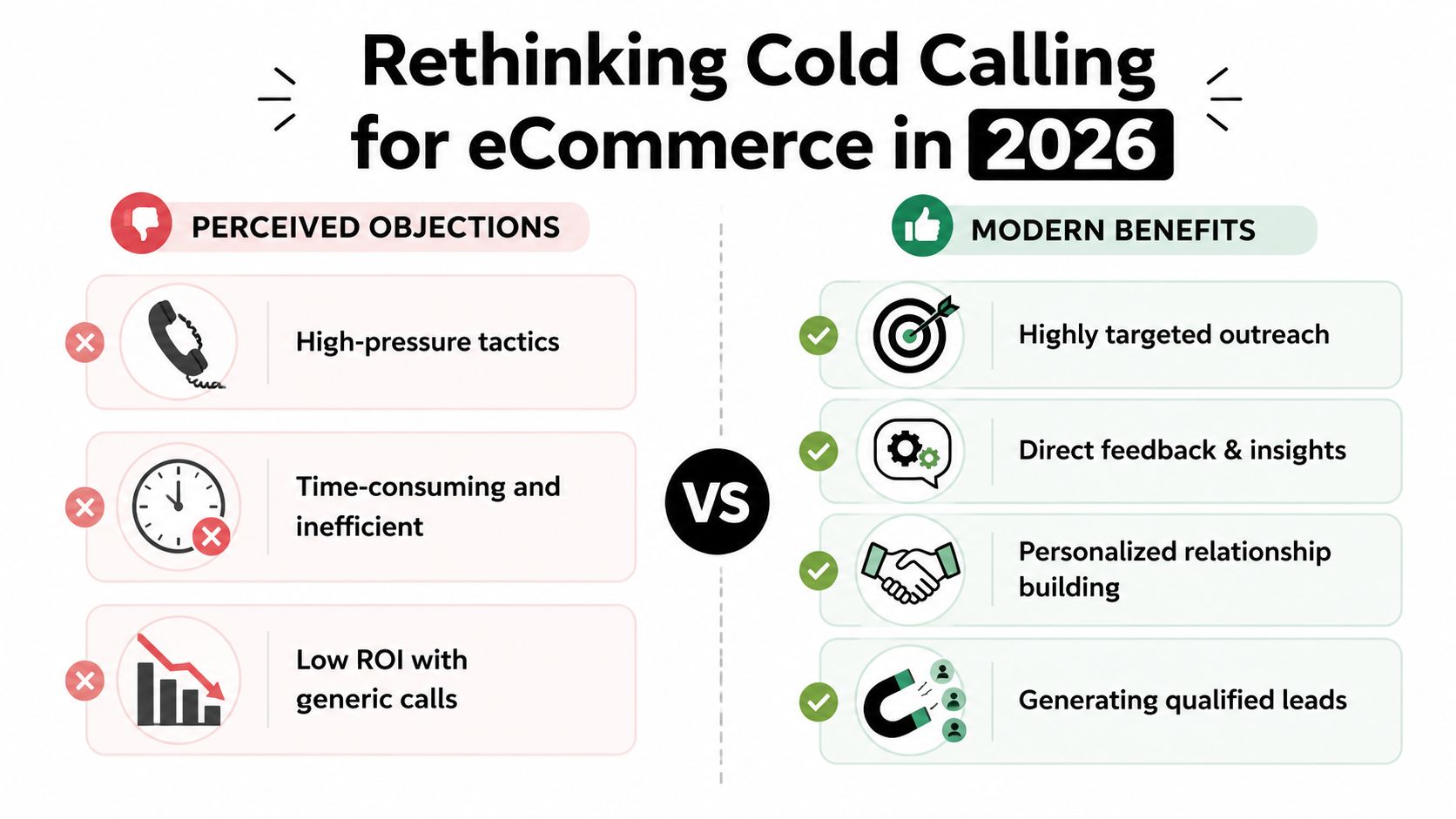
Most eCommerce owners still picture cold calling as a blunt instrument. Random list. Generic script. Pushy rep. Bad timing. Poor fit.
That model deserves to die.
What still works is selective, signal-led outreach. A lot of B2B guidance now leans toward calling after a prospect has opened an email, visited a pricing page, or shown some other buying signal, rather than treating the phone as a disconnected first move. That shift matters because it makes the conversation more relevant and gives the rep a real reason to call, as noted in this piece on signal-based calling and call relevance.
Why eCommerce businesses still benefit
For B2C, cold calling usually isn't the first growth lever I'd reach for.
For B2B eCommerce, wholesale, trade accounts, partnerships, stockist recruitment, larger repeat buyers, and channel sales are a different story. If you sell into retailers, resellers, clinics, studios, specialty shops, or larger procurement teams, phone outreach can still open doors that ads alone won't.
I've found it works best when the offer has one of these traits:
- Clear commercial upside. The buyer can quickly understand margin, resale potential, operational gain, or customer demand.
- A defined ideal customer profile. You know exactly which verticals, store types, or account sizes fit.
- Useful proof assets. Your site, product sheets, case examples, FAQ pages, and landing pages support the call once the buyer looks you up.
- A real next step. The rep isn't trying to close everything on the spot. They're trying to book a proper conversation, secure a review, or start an account application.
What changed from the old model
The biggest shift is precision.
The strongest campaigns now start with segmentation and timing, not bravado. A caller who knows the prospect runs a Shopify store, carries adjacent products, recently viewed a wholesale page, or engaged with an email is in a very different position from someone reading from a generic list.
Practical rule: If the caller can't explain why this account was selected, the campaign usually isn't ready.
That also lines up with how digital teams already think. We segment ad audiences. We split product feeds. We build custom landing pages. A modern cold calling agency should work the same way. It should treat the phone as one channel in a coordinated acquisition system.
What doesn't work anymore
Some things still fail almost every time:
- Reading rigid scripts instead of using conversation frameworks
- Calling weak-fit lists just to hit dial targets
- Ignoring website and CRM signals
- Sending prospects to thin, outdated websites
- Treating all leads as equal
A lot of eCommerce businesses already have the ingredients for good outbound. They just haven't connected them. If your digital marketing agency Melbourne team is already running Meta, Google, email, and analytics, the missing piece may not be more traffic. It may be better follow-up on the right accounts.
The Core Services and Process of a Modern Agency
A modern cold calling agency should run like an extension of your marketing and sales operation, not a room full of reps chasing activity.
I learned that the hard way with an Australian eCommerce client selling into retail stockists. Traffic was fine. Meta was generating interest. Google Ads was catching high-intent searches. But outbound underperformed because the calling team had no clear rules on who to call, what counted as a good prospect, or what to feed back into the CRM. Once we fixed the process, the calls started supporting the rest of the stack instead of working against it.
Discovery and list building
The first step is defining the accounts worth calling. For eCommerce, that usually means more than industry and postcode.
A good agency will pressure-test the brief with questions around commercial fit, buying process, store setup, and channel mix. For Australian brands, I want them asking things like whether the target account already sells online, whether they run Shopify or WordPress, whether they have a wholesale workflow, and whether the owner is still the buyer or the decision sits with a category manager.
The working list should reflect that detail:
- Commercial fit. Order value, margin, repeat purchase potential
- Operational fit. Can the account onboard and reorder without creating support headaches?
- Channel fit. Retail, wholesale, marketplace, DTC, or a mix
- Geography. Melbourne first, then state, then national, if that matches fulfilment capacity
- Exclusions. Existing customers, low-fit micro accounts, problem categories
If the campaign targets merchants, tools that help you connect with qualified merchants for sales can help narrow the field before anyone starts dialling.
Messaging and call frameworks
The better agencies do not hand reps a rigid script and hope for the best. They build a repeatable framework.
That framework should include a clear opener, a reason for the call, two or three discovery questions, objection handling, and one specific next step. The rep still needs room to sound natural. That matters even more in eCommerce, where the conversation often jumps between product fit, margin, shipping, site experience, and stock availability within a few minutes.
I usually want the agency to prepare different versions for different segments. A retailer already selling online needs a different conversation from a traditional wholesaler just starting digital expansion. The same applies if the prospect came in warm from an ad click, opened a nurture email, or visited a trade page on your site before the call.
Outreach and qualification
Weak agencies usually get exposed during these scenarios. They report “good conversations” but can't explain what that means in pipeline terms.
A capable team sets qualification rules before launch. For B2B eCommerce, that often includes buyer role, current product range, likely order profile, timing, platform setup, and whether there is a genuine commercial reason to keep talking. If your stack includes Shopify or WordPress, the agency should also know what signals matter in the CRM and what should trigger follow-up from email or paid media.
A booked call with someone who cannot buy, will not buy, or does not fit your margins is not progress. It is admin.
The agency also needs sales support assets that match the call. If a prospect checks your site while the rep is still on the phone, the experience needs to hold up. I have seen good calls die because the wholesale page was thin, the category structure was confusing, or the lead form went nowhere.
Reporting and feedback loops
The reporting should help you improve the whole system, not just count call outcomes.
The best agencies send back practical feedback your digital team can use straight away. That includes which segments answer, which offer angles get interest, which objections repeat, and which pages prospects ask for after the call. In a well-run setup, those insights feed back into ad messaging, landing pages, email flows, sales collateral, and CRM stages.
Here's the reporting view I want:
| Area | What the agency should surface |
|---|---|
| Targeting | Which account types respond and which ones waste time |
| Messaging | Which opening lines and value propositions start real conversations |
| Qualification | Which meetings match your ICP and which ones should have been filtered out |
| Objections | Pricing, timing, platform limitations, fulfilment concerns, incumbent suppliers |
| Follow-up | What content prospects ask for, and what should be automated in the CRM |
That feedback loop is the core value. Calls give you direct buyer language that ad dashboards never will, and for Australian eCommerce brands trying to connect outbound with Shopify, WordPress, paid media, and CRM follow-up, that is where a modern agency earns its keep.
Measuring Success The KPIs That Actually Matter
A Melbourne brand can burn through a month of agency fees and still learn nothing useful if the reporting only shows call volume.
I've seen that happen with eCommerce campaigns aimed at wholesale buyers, stockists, and retail partners. The agency reports 1,200 dials, everyone nods, and the founder still cannot answer the only question that matters. Did those calls create qualified pipeline inside the same sales process already fed by Shopify forms, WordPress enquiries, Google Ads, and Meta retargeting?
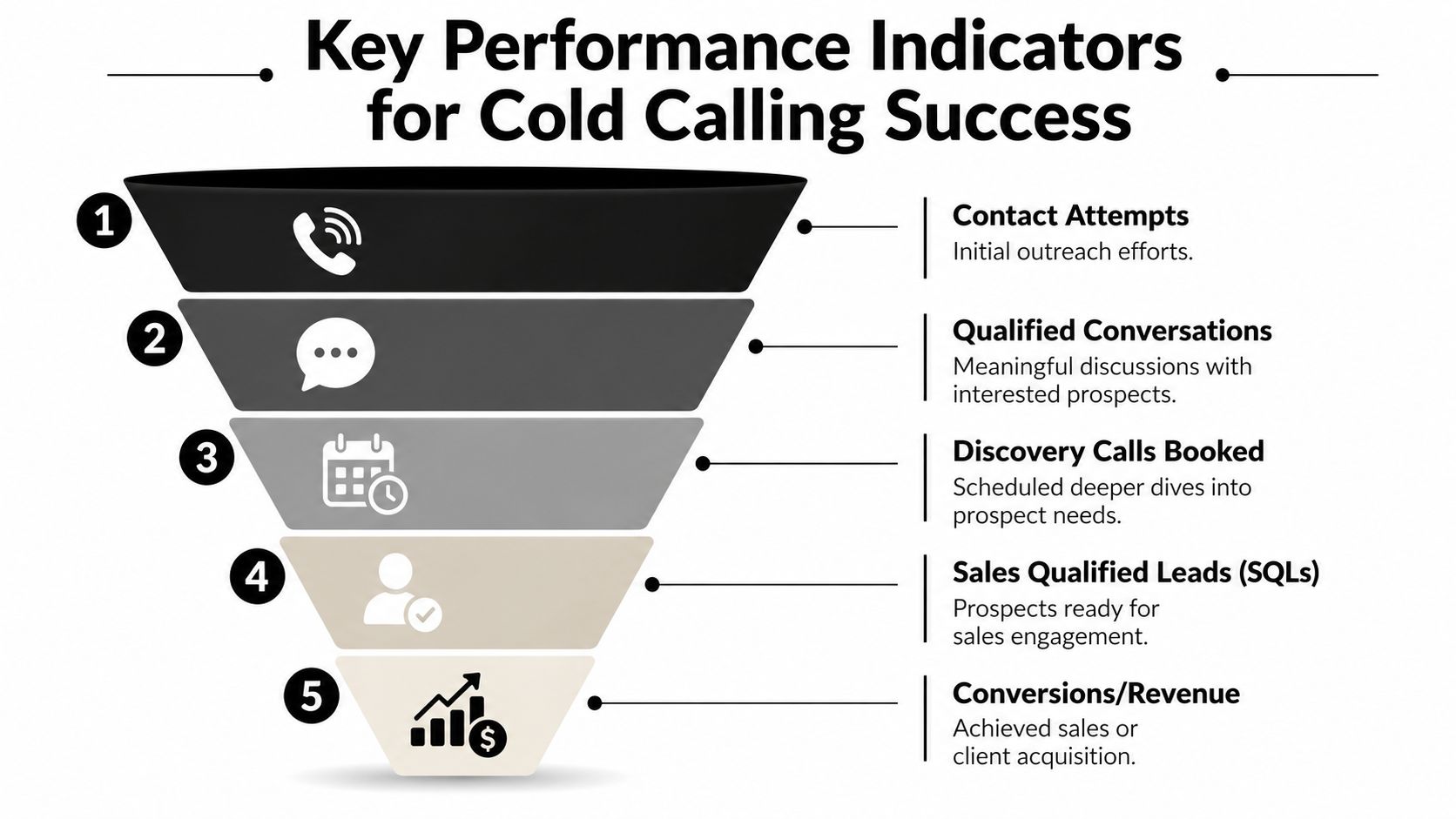
That is why I judge performance through a funnel ratio stack, not an activity report. I want to see contact rate, meeting rate, show rate, SQL quality, and revenue outcome together. Analysts at ZoomInfo's cold calling statistics note that pure cold outreach often produces low single-digit meeting rates from dials, while stronger teams outperform that baseline. The practical takeaway is simple. Small gains in one segment can produce a meaningful lift in qualified meetings without increasing call volume.
The KPI chain that tells the truth
Here's the scorecard I use when I review a cold calling agency for an eCommerce client.
| KPI | What it tells you | What usually affects it |
|---|---|---|
| Contact rate | Whether reps are reaching the right people | Data quality, direct dials, timing, list fit |
| Meeting rate | Whether live conversations convert into appointments | Messaging, rep skill, offer relevance |
| Show rate | Whether booked meetings are genuine sales opportunities | Qualification quality, calendar handling, reminders |
| SQL quality | Whether meetings deserve your sales team's time | ICP discipline, discovery process |
| Revenue outcome | Whether the channel makes commercial sense | Sales handoff, product fit, offer strength |
Looking at one number on its own leads to bad decisions. A campaign can post a healthy contact rate and still fail because the offer does not fit the account type. It can also book plenty of meetings that never happen because the rep is too loose in qualification or the handoff is sloppy.
To make the funnel easier to visualise, this short explainer is useful:
What I check first
I usually start in the middle of the funnel.
If meetings are booked but no one shows, I check qualification notes, calendar invites, and reminder workflows first. For Australian eCommerce businesses, that often exposes a process gap rather than a calling problem. The agency may be booking into the calendar correctly, but the lead lands in the CRM without the right context, the follow-up email comes from the wrong person, or the meeting page does not match the promise made on the call.
If reps are having conversations but not booking meetings, I listen to call recordings and review the segment. In my experience, weak positioning quickly becomes apparent during this process. A wholesale offer, a retailer pitch, and a Shopify service demo should not be judged against one blended benchmark because buyer intent, urgency, and objections are different.
Segmented reporting fixes that. I want results split four ways:
- By ICP. Retailers, distributors, agencies, and SaaS buyers respond differently.
- By source. Purchased data, CRM reactivation, inbound follow-up, and ad-engaged leads need separate benchmarks.
- By offer. Wholesale account acquisition and platform or service sales are different motions.
- By rep or team. Coaching gets easier once patterns are visible.
If a report cannot tell you which account type booked the meeting, where that lead came from, and whether it progressed in CRM, it is not useful enough.
The trade-off most brands miss
High meeting volume can hide poor commercial quality.
I would rather see fewer meetings that match the ICP, show up, and convert into real opportunities than a busy calendar full of weak fits. That trade-off matters even more in eCommerce because sales teams are often juggling inbound leads, partner enquiries, and account management at the same time. Every low-quality appointment steals time from channels already producing demand.
So I treat cold calling metrics the same way I treat paid media metrics. Clicks without conversion quality are a vanity number. Dials without appointment quality are the same. A good agency should be comfortable being measured against pipeline movement and revenue, not just activity.
Integrating Cold Calling With Your Digital Marketing Stack
Cold calling works better when it stops behaving like an island.
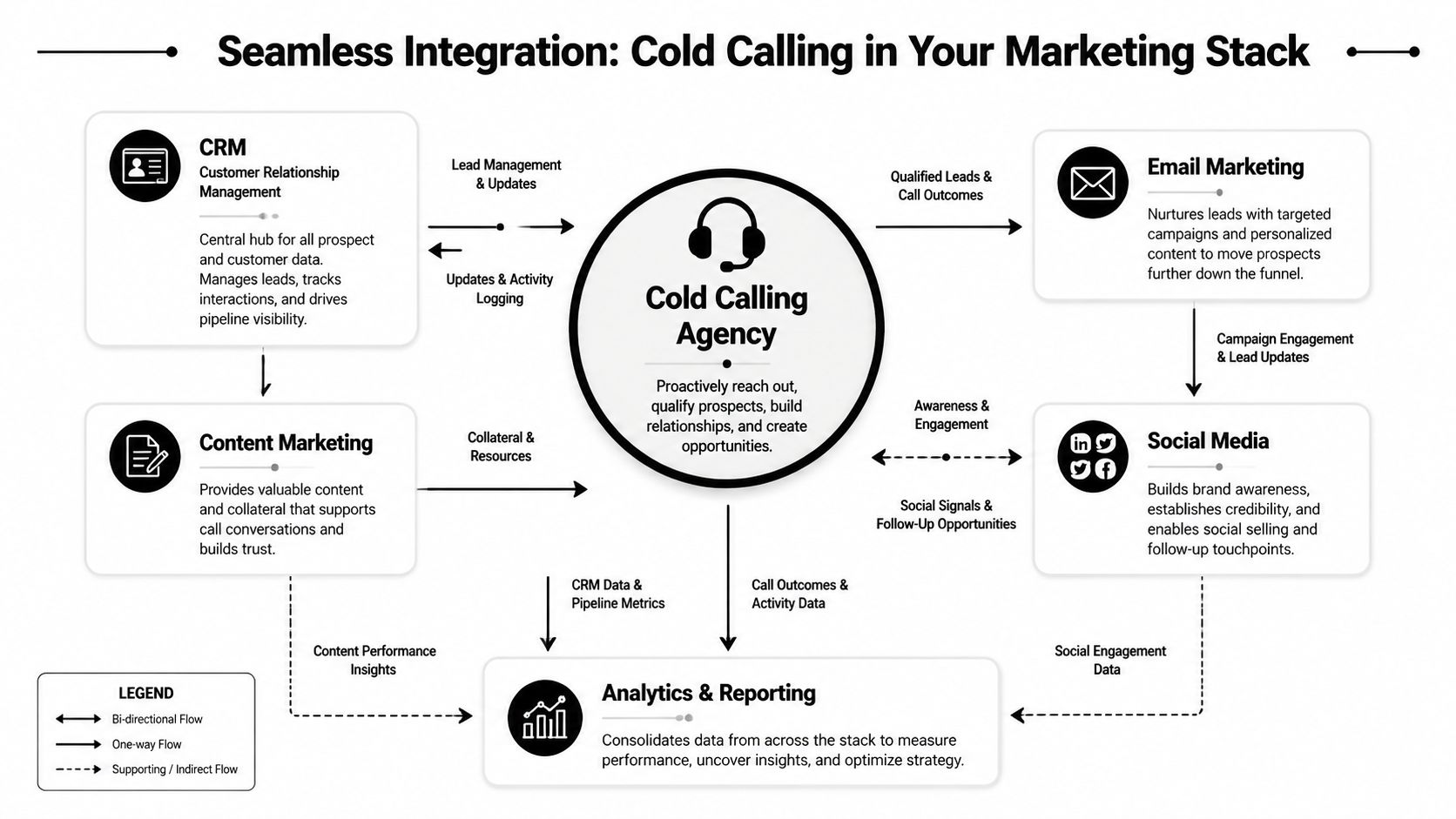
I observe the biggest difference between average campaigns and smart ones. The average setup has a rep, a dialler, and a spreadsheet. The smart setup ties the cold calling agency into the same ecosystem that already runs your eCommerce growth. That means CRM, email flows, landing pages, call tracking, analytics, paid media, and your website platform.
CRM first, always
If I had to choose one integration only, it would be the CRM.
Every call outcome should land somewhere structured. Not buried in notes. Not left in someone's inbox. A proper CRM setup lets you track who was called, what happened, what objection came up, what follow-up is due, and whether the meeting moved into pipeline.
For eCommerce businesses, this matters because lead sources are messy. You might have:
- Trade enquiries from a wholesale page
- Retail partnership leads from a form
- Past stockists that need reactivation
- High-intent website visitors logged through your forms or tracking stack
- App or service leads for a Shopify or WordPress offer
When all of that sits in one place, the rep doesn't call blind. They call with context.
Paid traffic and phone follow-up
Here, cold calling gets interesting for online stores.
A prospect clicks your Google Ads campaign, lands on a trade page, browses your range, and leaves. Most brands stop there and hope remarketing does the rest. A better setup creates a follow-up task if that prospect has already identified themselves through a form, previous touchpoint, or known account record.
I've used this thinking across paid media projects for years. If you're running a Google Ads agency campaign for high-intent acquisition, the value isn't only in the click. It's in what you do after the click. The same goes for paid social. A strong Facebook Meta ads agency setup can create awareness and first engagement, then a rep can turn that interest into a booked conversation when the account fits your wholesale or B2B offer.
Website platforms and sales enablement
Your store and site architecture play a bigger role than most owners realise.
If the rep sends someone to a cluttered site, the call gets harder. If the prospect lands on a polished wholesale page, a clear product explainer, or a structured service page, the call gets easier. That applies whether you're on Shopify or WordPress.
I've seen eCommerce teams get stronger results when they support outreach with pages adapted to the pitch:
- Wholesale landing pages with trade terms, product range, and enquiry steps
- Partner pages for stockists or distributors
- Demo pages for apps or technical services
- Resource pages that answer the common objections reps hear
That's where development matters. A fast build from a capable WordPress developer or a clean commerce build from a team that handles web design in Melbourne gives the rep somewhere credible to send people.
Call handling, Twilio, and missed-opportunity control
For service businesses, I've set up custom Twilio numbers that catch after-hours calls, route leads, answer enquiries around the clock, and book appointments into a calendar or Calendly. That model works because it removes missed-call leakage.
The same logic carries over to eCommerce when there's a high-value lead path. If a buyer wants to discuss a wholesale account, a bulk order, a custom run, or a platform integration, you don't want that lead falling through because no one followed up quickly or the enquiry got lost between inboxes.
A practical integrated stack usually includes:
- A tracked number for campaign-specific outreach or return calls
- CRM logging for every disposition
- Calendar booking logic for qualified meetings
- Email follow-up triggered after calls
- Analytics tagging so sales activity can be compared against marketing source data
That's when a cold calling agency becomes useful. Not as an isolated vendor, but as a working part of your acquisition system.
How to Vet and Choose the Right Agency Partner
A bad agency choice usually shows up fast. Reps chase the wrong accounts, meetings get booked with poor-fit prospects, your CRM fills with messy notes, and your team starts doubting the whole channel.
I've learned to treat vetting like hiring a salesperson who will represent the brand before a prospect ever clicks an ad, lands on a Shopify wholesale page, or fills out a WordPress form. If the agency cannot explain how it will work with your existing stack and sales process, I keep looking.
The questions I'd ask before signing
Price matters later. Fit matters first.
I want to hear specific answers, not polished generalities. For an Australian eCommerce business, that means asking how the agency handles wholesale outreach, retail stockist prospecting, distributor conversations, or high-value B2B offers tied back to your ad traffic and CRM records.
These are the questions I use:
- Who have you called for that looks like our model, especially B2B eCommerce, wholesale, or trade accounts?
- How do you source, clean, and verify target lists before the first dial?
- What counts as a qualified meeting, and who agrees that definition?
- How do call outcomes flow into our CRM?
- Can you work with our Shopify or WordPress forms, landing pages, and follow-up emails?
- What do you change if the first segment or script misses the mark?
- What reporting do we get each week, and will it show more than raw call volume?
- How do you feed call insights back into Google Ads, Meta Ads, or sales messaging?
That last point matters more than agencies like to admit. I don't want outbound sitting in its own silo. I want objections from calls shaping landing page copy, offer positioning, and retargeting creative.
If you want a rough sense of how providers position themselves before building a shortlist, review roundups of top cold call companies can help. I still make the final call based on process, reporting discipline, and integration capability.
Australian compliance and operating discipline
Australian outreach has rules, and a decent agency should be able to explain them without hand-waving. Ask how they handle the Do Not Call Register, consent, local calling windows, opt-outs, caller identification, and record keeping.
I also ask about operating setup in plain terms. What dialler do they use? How do they prevent abandoned calls? How are call outcomes logged? Can they show an audit trail if something goes wrong? The ACMA telemarketing and research rules are a better place to check the standard than relying on vague sales talk.
Good agencies tend to answer carefully here. That's a good sign.
Ask the agency how it manages caller ID, opt-outs, local hours, and Do Not Call hygiene. If the answer is loose or evasive, move on.
What a real partner sounds like
The agencies I trust usually sound more like operators than closers. They talk about test batches, list quality, script iteration, qualification standards, CRM fields, and what happens after the meeting is booked.
They also push back when the brief is weak. If your targeting is too broad, if your wholesale offer is unclear, or if your site gives reps nowhere credible to send buyers, a good partner will say so. I'd rather hear that early than pay for a month of poor calls.
Here's the quick filter I use:
| Agency behaviour | What it usually means |
|---|---|
| Heavy focus on call volume | Weak targeting may be hiding underneath |
| Clear qualification definitions | They respect your sales team's time |
| Detailed compliance answers | Lower brand and operational risk |
| Confidence working with CRM and site assets | Better fit for a modern eCommerce stack |
| Willingness to challenge your ICP | Better strategic input |
| Vague reporting promises | Problems later |
A strong agency should feel like part of your revenue operation. For Australian eCommerce brands, that means they can call well, report cleanly, and fit into the systems you already use.
Your Onboarding Checklist for Campaign Success
The first week after signing a cold calling agency usually decides whether the campaign settles into a useful rhythm or burns time fixing preventable mistakes.
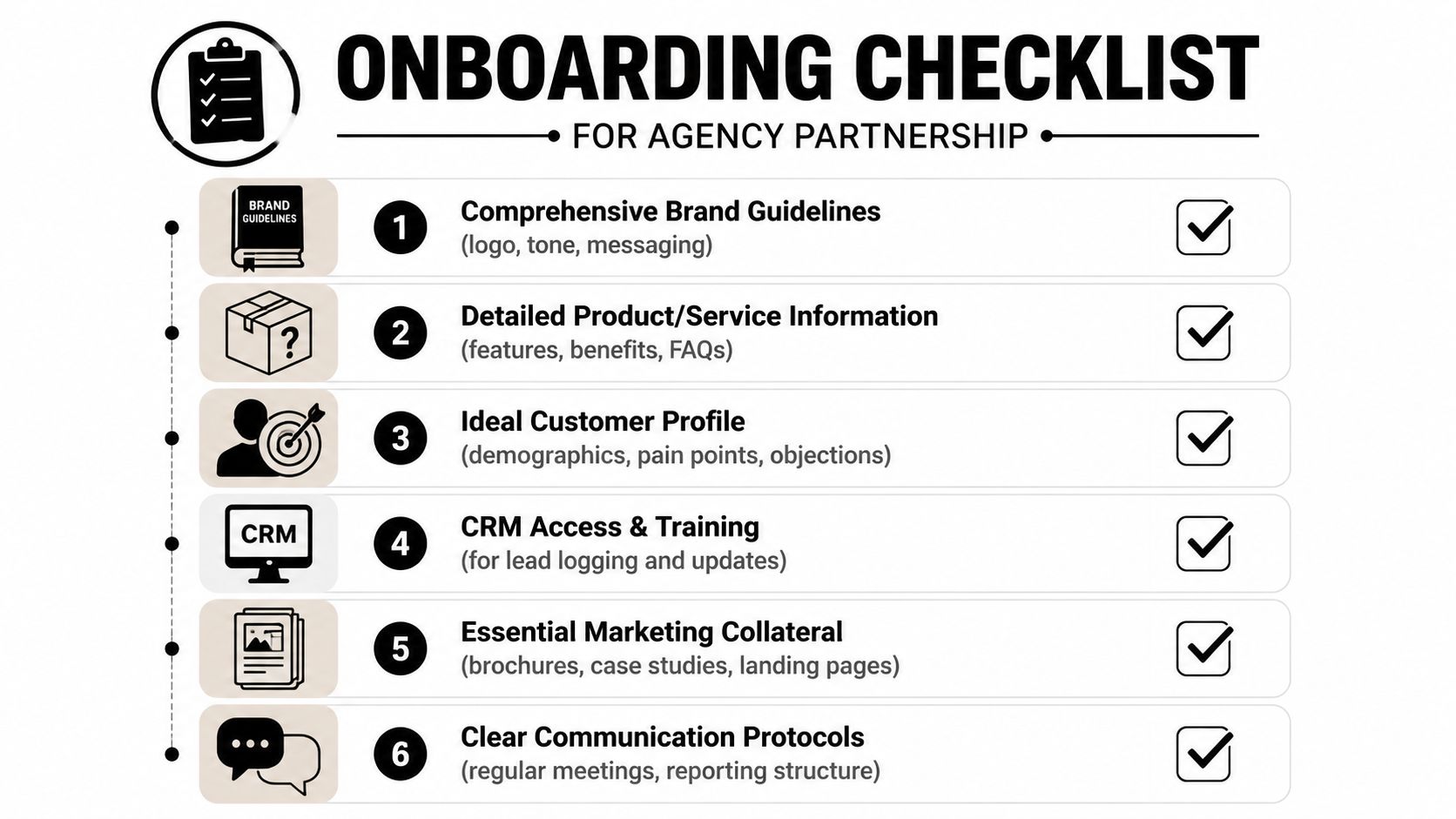
I've seen this play out with Australian eCommerce brands running Shopify or WordPress sites, paid traffic through Google and Meta, and a CRM that already holds years of customer and lead data. The agency starts calling before the inputs are tight. Reps improvise the pitch. Leads land in the wrong pipeline stage. Marketing says the agency is underperforming. Sales says the leads are weak. In reality, the setup was weak.
What I prepare before a single call goes live
I treat onboarding like a revenue ops job, not an admin task. If the agency is going to represent the brand well, it needs the same clarity I'd give my own internal team.
Here's what I want ready.
- A tight ideal customer profile. Include industry, account type, geography, business model, average order shape, and who should be excluded.
- A plain-English value proposition. The rep needs to explain what you sell, who it helps, and why the buyer should care now.
- Offer assets that match the call. Product sheets, wholesale terms, pricing logic, landing pages, FAQs, demo links, sample pack info, and any page the rep might send during follow-up.
- Real objection notes. Write down what buyers frequently question. Margin, minimum orders, shipping times, integration effort, setup friction, stock availability, contract terms.
- CRM rules. Show the agency where outcomes are logged, which fields are required, what each stage means, and who owns cleanup.
- A definition of a qualified meeting. If one team says a meeting is “interested” and the other says it must include budget, authority, and timing, friction starts fast.
That last point matters more than clients expect.
The gaps that usually cause trouble
Website readiness gets missed often. A rep can win interest on the phone, but if the follow-up page is thin, outdated, or built for a different audience, conversion drops after a good call. I've had to pause outreach before because the wholesale page did not answer basic buyer questions, even though the ad funnel looked polished. Cold calling exposes that mismatch quickly.
Internal handoff is the other weak spot. If the agency books a solid conversation and your team replies two days later, the lead has already cooled. Decide who confirms meetings, how quickly follow-up goes out, whether quotes come from sales or account management, and how outcomes feed back into the CRM.
A cold calling agency can create momentum. Your team still has to turn that momentum into revenue.
The onboarding session I actually run
I prefer one working session with the founder, sales lead, and whoever owns CRM or marketing ops. Long email threads usually hide disagreements that show up later in the campaign.
By the end of that session, I want six things locked:
- One primary ICP and one secondary ICP
- A meeting qualification checklist
- Approved pages, product docs, and follow-up collateral
- CRM fields, tags, and outcome labels
- Rules for edge cases, including bad-fit leads and compliance questions
- A review cadence for the first few weeks
For eCommerce brands, I'd add one more practical layer. Map the agency into the stack you already use. Decide whether booked meetings sit in HubSpot, Pipedrive, Klaviyo, or another system. Confirm how UTM tracking or source tagging works if prospects later convert through branded search, email, or retargeting. If you run Shopify for wholesale or WordPress for lead capture, make sure the pages the rep sends are current and match the offer being pitched.
That sounds basic. It saves a lot of cleanup.
Brands that already run disciplined ad accounts usually get this faster. The principle is the same. Better inputs produce better output, and a cold calling agency performs best when it plugs into the same operating system as the rest of your marketing.
Sample Scripts for B2B eCommerce Scenarios
A buyer picks up between supplier meetings, you get 20 seconds, and the call either earns a real conversation or dies on the spot.
That is why I do not write scripts that try to control every line. For B2B eCommerce, especially in Australia, the better approach is a talk track built around context, diagnosis, and one clear next step. The rep needs enough structure to stay on brief, but enough room to sound like a person who understands how retail, wholesale, and online operations work.
I also want these calls to match the rest of the marketing stack. If someone clicks a follow-up email after the call, lands on a Shopify wholesale page, fills out a WordPress form, or comes back later through branded search, the message should still line up. That consistency is what turns a decent cold call into a sales process you can track and improve.
Scenario one wholesale outreach to retail stockists
I have used a version of this for product brands trying to get range reviews with independent retailers and small chains.
Opening
“Hi, is this the buyer for [category]?”
If yes:
“Thanks, I'll keep it short. I'm calling from [brand]. We supply stores in [category], and I noticed you already carry products around that range. I wanted to ask whether you're open to reviewing new suppliers this quarter.”
That works because it gets to relevance quickly. It also gives the buyer an easy way to provide a direct answer.
Discovery
Once they engage, the rep should keep the questions practical:
- What is moving well for you in that category right now?
- Do you usually review new ranges seasonally or only when something is missing?
- Is the bigger consideration margin, sell-through, or finding something different from what every other store carries?
- Are you buying for one location or across multiple stores?
That last question matters more than teams expect. It changes the size of the opportunity and the follow-up material you send.
Value framing
Then tighten the message:
“The reason I called is simple. Stores tend to look at us when they want a range that sits neatly beside what already sells, without creating extra work for staff on the floor.”
I prefer language like that over big claims. Buyers hear polished supplier pitches all week. Plain language usually holds up better.
Call to action
“If it sounds relevant, I can send the range and wholesale terms today, then lock in a short follow-up once you've had a chance to review it. Would Tuesday or Wednesday be better?”
Specific options work better than vague requests for “a time sometime next week”.
Scenario two app, platform, or service outreach to eCommerce teams
This suits agencies, SaaS products, and technical service providers selling into established online stores. I have found it works best when the rep calls with one problem in mind, not a shopping list of capabilities.
Opening
“Hi [name], I'll keep this brief. I'm calling because your store looks active in [category or channel], and we help eCommerce teams improve [specific function] when they start hitting issues with [known problem]. Have you got a minute?”
For example, that problem might be messy feed management, poor conversion on key product pages, tracking gaps between Meta and the CRM, or a slow handoff between ad leads and the sales team. The rep should pick one. If they open with five, the buyer tunes out.
I learned this the hard way with service outreach into larger merchants. Technical buyers do not need a mini capability statement on the first call. They need proof that the caller understands where friction shows up inside a real stack.
What the middle of the call should sound like
This is the part that separates a useful outbound program from a calendar-filling exercise.
I want the rep to diagnose the current setup before they pitch anything:
- Current process. “How are you handling that now?”
- Operational friction. “Where does it break down for the team?”
- Priority. “Is that something you're trying to fix this quarter, or is it lower on the list?”
- Systems. “Are you managing that inside Shopify, a custom setup, or through another platform?”
- Decision-making. “Who else is usually involved when you review something like this?”
Those questions give you a much better read on fit. They also make the conversation more useful for the buyer, because you are talking about their workflow instead of forcing your own agenda onto the call.
If the account looks promising, the handover should stay simple:
“It sounds like there's something worth looking at properly. Rather than force it over the phone, the better next step is a short demo with the person who owns this internally. Would that make sense?”
That line works because it respects the complexity of the sale. A Shopify merchant, a WordPress-based lead gen business, and a wholesale eCommerce brand all buy differently. The call should only get enough agreement to move the opportunity into the right sales stage.
What I do not let reps do
A few habits ruin these calls fast:
- Feature dumping before any discovery
- Pushing past weak fit just to book a meeting
- Arguing with objections instead of clarifying them
- Using platform jargon the buyer never uses
- Promising outcomes the site, offer, or sales team cannot support
I care a lot about that last point. If the rep says one thing and the landing page, follow-up deck, or demo says another, conversion drops later and everyone blames the channel. Usually the problem is not the phone. It is the mismatch between outreach and the rest of the funnel.
The best script is the one a good rep can use without sounding scripted. Clear opening. Real diagnosis. A next step that fits the buyer's buying process. That is enough.
Ready to Grow Your eCommerce Business?
Cold calling still works. It just doesn't work the way many people think it does.
For eCommerce brands, especially those selling wholesale, building partnerships, chasing larger accounts, or turning digital intent into sales conversations, a cold calling agency can add a layer your ad account can't provide on its own. The phone gives you direct feedback, real objections, and a chance to move a good-fit account forward faster than passive remarketing often can.
The catch is that it needs to be set up properly. You need clear targeting, proper qualification, a compliant operating model, strong collateral, a CRM that captures outcomes, and a site that backs up what the rep says. That's why I see the best results when phone outreach sits inside a broader digital system rather than being treated as a separate experiment.
From my side, the businesses that tend to win are the ones that stay consistent. They don't expect one channel to do everything. They use Shopify or WordPress well. They tighten up Google Ads and Meta ads. They sort out call tracking, GTM, analytics, conversion tracking, and lead handling. Then they add human outreach where it makes commercial sense.
If you're searching for a marketing agency Melbourne businesses can rely on for that joined-up thinking, or a digital marketing agency Melbourne eCommerce brands can trust with both build and growth, the big advantage isn't one tactic. It's the integration between them.
That applies whether you need help with:
- Shopify development and custom commerce workflows
- WordPress design and bespoke builds
- Google Ads for service-based businesses or eCommerce stores
- Meta ads creative testing and measurement
- GTM and Google Analytics setup
- Meta Conversion API installation
- Google Shopping ads strategy
- Local SEO and Google Business Profile
- Call tracking systems using tools like Twilio, CallRail, or Go High Level
When those pieces talk to each other, growth gets more predictable.
If you've already got traffic but you're not converting enough of the right opportunities into conversations, cold calling may not be outdated at all. It may just be the missing follow-up layer.
If you're an eCommerce or service business with a paid ads budget of at least 3k a month, Alpha Omega Digital is offering a low risk deal. Get a month of paid ads management FREE. Apply through the contact page. They're a Melbourne-based agency working with businesses across Sydney, Brisbane, Newcastle, Perth, Adelaide, Darwin and Hobart, with support across WordPress, Shopify, Google Ads, Meta ads, and conversion-focused web design.
Alpha Omega Digital
Read more insights from our team on web design, paid ads, and growth strategy.