A Melbourne Shopify brand once replied to one of my emails with, “You're the first agency that mentioned the actual problem instead of asking for a meeting.” That message summed up what changed our results.
Good B2B outreach isn't about sending more. It's about noticing what matters, saying it clearly, and reaching out like a person who's done the work.
Stop Shouting and Start a Conversation
Most bad outreach looks the same. A generic subject line, a lazy compliment about the website, then a hard pivot into “we help businesses like yours grow”. Ecommerce owners see that and delete it in seconds.
I learnt that the hard way. Early on, we wrote outreach the way most agencies write it. Too broad, too polished, too focused on us. It sounded professional, but it didn't sound observant.

What changed for us
The shift was simple. We stopped treating outreach like a pitch and started treating it like the first useful interaction.
That matters even more in Australia because a lot of small and medium businesses don't have the luxury of wasting spend. IBISWorld's 2025 update shows that over 60% of Australian SMBs allocate less than $2,000 per month to digital marketing, which is why every outbound touch needs to count and why warm-network outreach plus micro-content works better than broad blasts for many local businesses (Crono on cold outreach strategies).
If I'm reaching out to a Shopify store in Melbourne, I'm not opening with “we're a digital marketing agency Melbourne businesses trust”. I'm opening with something specific like this:
- Shopping issue: Their product feed is healthy, but their Google Shopping campaign looks limited by structure.
- Tracking issue: Their Meta ads are active, but the site doesn't appear to be sending clean purchase signals.
- Site issue: Their category pages are visually decent, but speed, mobile UX, or merchandising flow is hurting conversion.
- Lead handling issue: They spend on ads, but no clear follow-up system exists for enquiries, callback requests, or abandoned forms.
That's a conversation starter. It shows relevance before authority.
The right fit matters more than the big list
I'd rather have a short list of stores I can help than a spreadsheet full of weak-fit leads. A lot of outreach fails before the first email because the targeting is wrong.
For ecommerce, I usually filter on practical signs:
| Fit signal | Why it matters |
|---|---|
| Active ads | They already believe in paid growth |
| Clear product catalogue | Easier to spot campaign and UX gaps |
| Decent brand presentation | Usually means they care about improving, not just price |
| Technical gaps | Creates a concrete reason to reach out |
| Service coverage in Australia | Makes local context easier to reference |
A tradie business is different again. For PPC for tradies, I'm looking for missed calls, weak landing pages, poor suburb targeting, or no call tracking. For a beauty clinic, it might be lead handling, offer clarity, or patchy retargeting. For a dentist, it could be booked-out times not aligning with enquiry capture. Same principle. Different trigger.
Practical rule: If you can't explain in one sentence why this business is a fit, you shouldn't contact them yet.
Real problems are often unstated
Most prospects won't say, “our GTM setup is broken” or “our Shopify design is costing us revenue”. They'll say things like:
- “Ads aren't working”
- “Lead quality is average”
- “We've tried an agency before”
- “Traffic is okay but sales are inconsistent”
Your job in B2B outreach is to interpret the surface complaint and connect it to the actual issue. Sometimes that issue is campaign structure. Sometimes it's WordPress development. Sometimes it's poor reporting. Sometimes it's that nobody is following up fast enough.
That's why I don't separate outreach from delivery knowledge. If you don't understand Google Ads for service based businesses, local SEO, Google My Business, Shopify API limitations, WordPress design, or how a Meta ads creative testing process works, your outreach sounds vague. The best outreach comes from real operational experience.
What doesn't work
Some things fail almost every time:
- Bought lists with no filtering: You end up emailing businesses you can't help.
- Fake familiarity: “Love what you're doing” means nothing if you don't mention anything real.
- Instant meeting asks: Most cold prospects aren't ready for that on touch one.
- One-size-fits-all service menus: Nobody wants a long list of everything you do.
The first message should earn the second message.
That's the frame I use now. Not “how do I close this lead?” but “have I said something useful enough that they'll keep talking?”
Choosing Your Playground Email LinkedIn and Calling
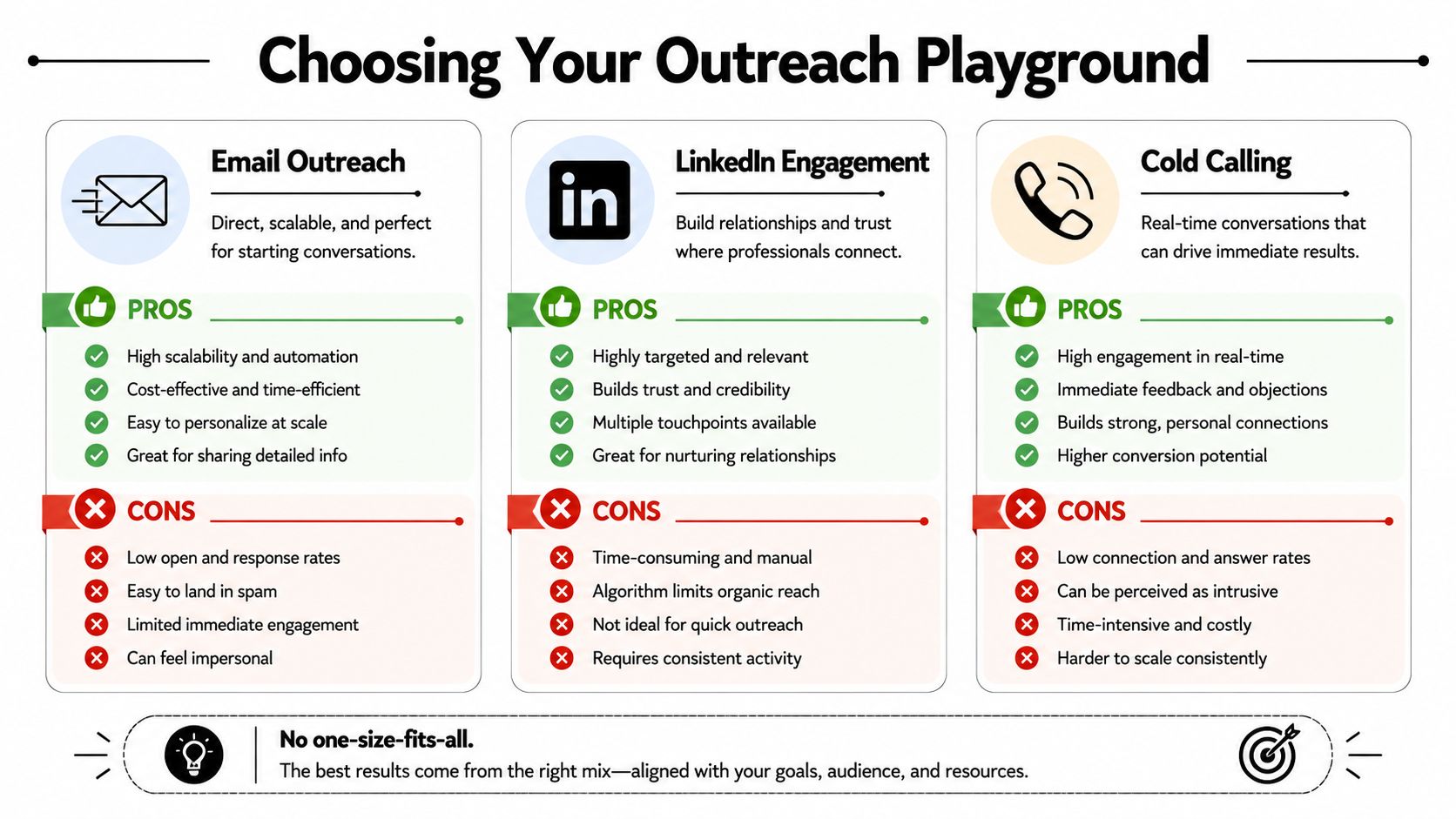
Every channel has a job. The mistake is expecting one channel to do everything.
For Australian B2B outreach, email is still the backbone. But it works best when LinkedIn and calling support it instead of competing with it. In Australia, 68% of B2B marketers rate personalised outbound email as their primary channel, while teams using a multi-channel sequence of email, LinkedIn, and calls achieve win rates of 18–24%, compared with 9–13% for single-channel approaches (Australian B2B outreach data referenced here).
Email is where I start
Email gives me room to be precise. I can reference a Shopify collection issue, a PMAX vs Google Shopping ads decision, a weak WordPress development choice, or a tracking gap without sounding rushed.
Email is best when I want to do one of these things:
- Show diagnosis: Point out a likely issue with Google Ads, feeds, UX, or analytics.
- Share a useful resource: A beginner's guide to Google Shopping ads or a note on campaign priority in Google Ads.
- Introduce a narrow service: Not “full service marketing”, but something specific like GTM and Google Analytics cleanup.
The downside is obvious. Deliverability can ruin a good campaign before a prospect even sees it. If your domains, sending habits, and warm-up process are sloppy, the copy doesn't matter. That's why any serious outbound operator should understand inbox health, and this guide to prevent email campaign failure is worth reading before you scale.
LinkedIn is the credibility layer
I don't use LinkedIn like a spam machine. I use it to make the email more believable.
If I email a founder on Tuesday, I might view their profile, engage with a post, or send a short connection request around the same time. Nothing aggressive. Just enough for my name to become familiar.
This works well for:
- Ecommerce founders: Especially when they're active around launches, sales, or product updates.
- Marketing managers: They often respond better when they can quickly inspect who's contacting them.
- Service business owners: They may ignore a long email but recognise your name after seeing you on LinkedIn.
What doesn't work is the classic “Thanks for connecting, here's what we do.” That kills momentum straight away. LinkedIn should warm the interaction, not rush it.
If email carries the detail, LinkedIn carries the context.
Calling still matters, especially for high-intent leads
Cold calling gets dismissed by people who've only seen it done badly. For ecommerce, I'm selective with it. For tradies, home services, clinics, and other service businesses, it still works because the business is often built around immediate enquiries.
A phone call is strongest when:
| Channel use case | Best use |
|---|---|
| After email engagement | Follow up while the issue is fresh |
| After multiple ignored touches | Check if the contact is even the right person |
| For service businesses | Speak directly about missed leads or ad waste |
| For urgent pain points | Move quickly when enquiry handling is weak |
We also use a custom number setup through Twilio for clients who need stronger lead handling. The practical appeal is obvious. It gives businesses a system that can answer calls around the clock, doesn't get sick or tired, can book appointments into a calendar or Calendly, and can save thousands in lost business when nobody answers the phone. That's useful for tradies, hairdressers, beauty therapists, dentists, restaurants, and doctors where one missed call can mean a missed customer.
The point of mentioning that in outreach isn't to sound clever. It's to speak directly to the commercial leak. If a plumber is paying for PPC and nobody's picking up after hours, the ad account isn't the only issue.
My honest channel split
If I had to sum it up:
- Email is where I diagnose.
- LinkedIn is where I build familiarity.
- Phone is where I confirm intent and move things forward.
A marketing agency Melbourne businesses hire to run serious outreach shouldn't be choosing between channels as if it's a loyalty test. The better question is which channel does which part of the job best.
My 8 Touch B2B Outreach Sequence Examples
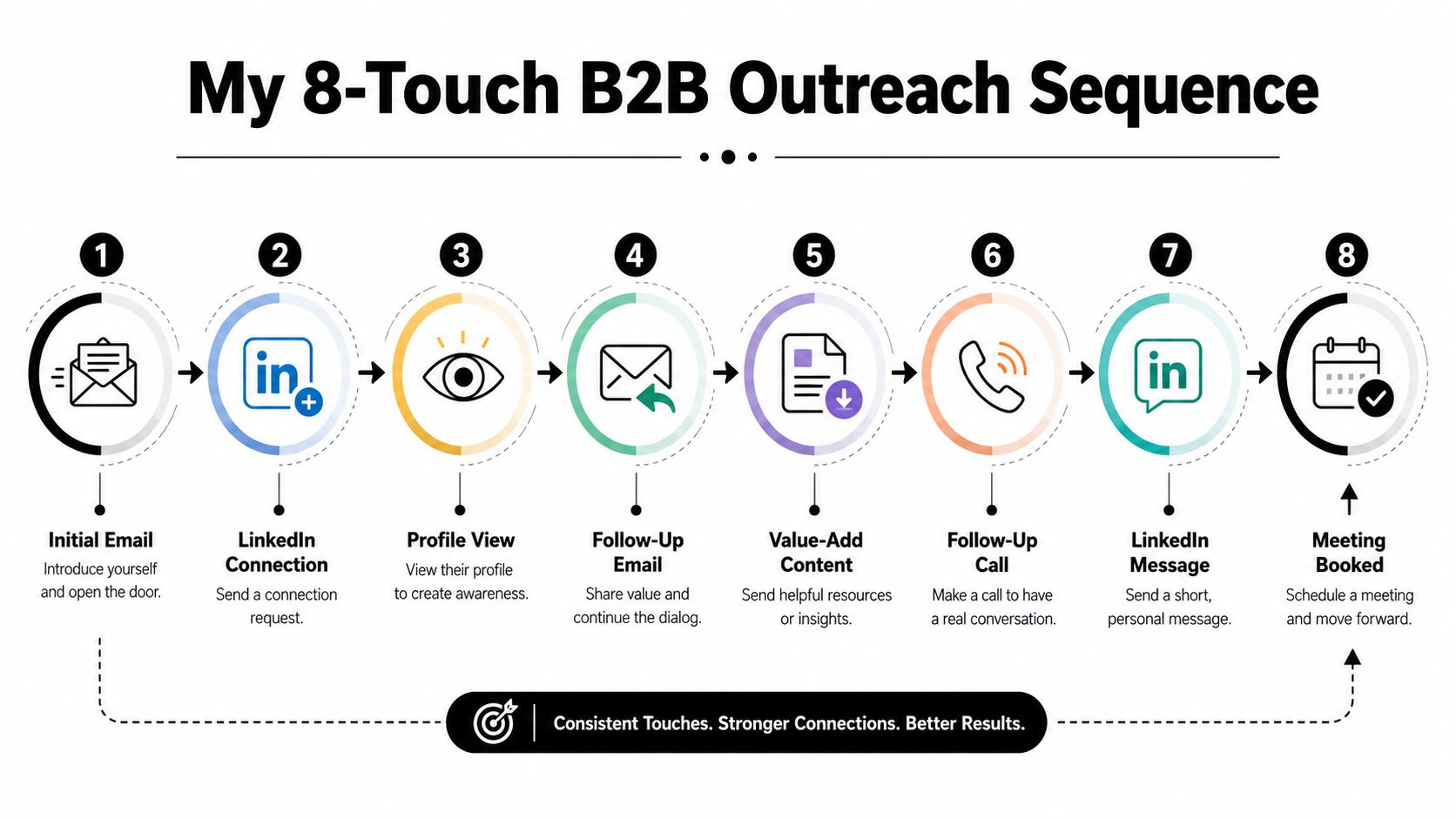
This is the sequence shape I come back to most often. It changes by niche, but the structure stays tight because broad, unplanned follow-up usually turns into noise.
McKinsey reports that companies using omnichannel sales tactics and hyperpersonalization are twice as likely to achieve more than 10% market-share growth, which is one reason I build outreach around a staged motion instead of one-off sends (McKinsey on next-gen B2B sales).
The sequence I use
Touch one. Personalised email
I lead with an observation, not a service list. Example: “Noticed you're running Shopping ads but your product grouping looks broad for a catalogue this size.”Touch two. LinkedIn profile view
No message yet. This is just a soft signal.Touch three. Follow-up email with value
I add one practical angle. Maybe PMAX vs Google Shopping ads. Maybe a note on Google Ads for contact form submissions. Maybe local SEO for a service brand.Touch four. LinkedIn connection request
Short and relevant. No pitch dump.Touch five. Second follow-up email
I make the commercial problem clearer. Poor tracking. Weak offer path. Feed structure. Slow category pages. Missed calls. Something grounded.Touch six. Call or voice note for high-fit leads
I only do this where there's clear fit.Touch seven. Final value-add message
A concise note with one useful suggestion and an easy out.Touch eight. Nurture or close the loop
If they're not responsive, they move into a softer follow-up pool.
Here's a useful video if you want another perspective on sequence thinking and message structure before adapting your own cadence.
Example for a Shopify brand
If I'm contacting an ecommerce store, the sequence might sound like this.
Email one
Subject: Quick note on your Shopping setup
Hi Sarah,
I had a look through your store and noticed the catalogue is strong, but the campaign structure may be making Google work harder than it needs to. I see this a lot with growing brands choosing between PMAX and standard Shopping without a clear campaign priority setup.
If you want, I can send a short breakdown of where I'd simplify it.
Cheers
Email two
I might cite our experience with Shopify development partners work and implementation decisions that affect ads, tracking, and merchandising. Not as a flex. As context.
Email three
By this point I'll often point to platform-specific work such as Shopify design decisions that influence conversion flow, or mention that we've seen stores improve decision-making when development and media buying aren't handled in separate silos.
Example for a WordPress lead
For a business on WordPress, the trigger is usually different. It might be load speed, awkward enquiry flow, weak mobile layout, or clunky content blocks.
A message there can reference practical experience as a WordPress developer or broader implementation work across WordPress development, WordPress design, and building custom blocks in Gutenberg. If the issue is form quality, I'll tie that back to lead capture. If the issue is structure, I'll tie it to conversion or SEO.
This is also where long-tail buyer intent topics matter. A business searching for terms like wordpress web developer, wordpress website developer, wordpress development company, wordpress development melbourne, shopify developer, shopify developers, or shopify developer api isn't browsing casually. They're close to action. Outreach works better when it aligns with those intent-heavy needs rather than generic branding talk.
What the sequence is really doing
The sequence isn't just trying to “get a response”. It's testing fit.
- Do they care about the problem?
- Do they recognise the issue?
- Do they engage more with technical, strategic, or commercial language?
- Are they the decision-maker or do we need to redirect?
A sequence should narrow uncertainty, not just increase touch count.
That's why I don't mind if some prospects never reply. A clean no, or silence from a weak-fit lead, is useful. The actual waste is chasing contacts who were never relevant in the first place.
Personalisation That Gets Replies
Personalisation is often misinterpreted as merely adding a first name and maybe the company name. That's not personalisation. That's mail merge.
The kind that gets replies comes from technical observation plus commercial relevance. When those two line up, the message feels informed instead of intrusive.
Use the stack as your opening
If I land on a store and can tell it's on Shopify, I'm already looking for clues. Is the collection filtering clumsy. Are there obvious UX gaps. Does the cart experience feel stock-standard when the brand needs something custom. Is there a reason they may need building custom Shopify apps using Shopify CLI instead of another app stack bandaid.
If the site runs on WordPress, I'm looking at speed, structure, templates, and whether the build feels like it's helping or hurting lead generation. That's where a note about working with WordPress developers Melbourne businesses rely on can sound relevant, not random.
A lot of ecommerce outreach also gets stronger when you tie web decisions to revenue channels. A generic design critique is easy to ignore. A note that connects site structure, checkout flow, and campaign performance is harder to dismiss.
Ad behaviour creates excellent triggers
One of the best openings is visible ad friction. If a brand is clearly running Meta ads and likely struggling to stabilise delivery, that's not a vague talking point. It's a specific operational pain.
Meta's own guidance is widely used by agencies as the benchmark that ad sets often need 50 to 100 conversions over a 7-day window to move beyond the learning phase, so when I see campaigns sitting in learning too often, I know there's probably a useful conversation to be had about account structure, creative volume, or signal quality (Meta Business Help on the learning phase benchmark).
That gives you a strong outreach angle for any business dealing with:
- Meta ads creative testing process issues
- Weak event quality from poor tracking
- Conversions API installation for Meta problems
- Creative fatigue without enough structured testing
- Mismatch between offer, landing page, and campaign objective
If I'm writing to a founder, I won't say all of that. I'll choose one precise observation.
Good personalisation sounds like this
Here are the kinds of lines that work better than fluff:
- For Shopify stores: “You've got solid product photography, but the store still relies on a fairly standard theme flow. If you're planning to scale paid traffic, that's usually when custom blocks or app-level development starts to matter.”
- For WordPress businesses: “The site looks established, but the mobile enquiry path takes too many steps. That tends to hurt Google Ads for contact form submissions.”
- For service brands: “Your Google My Business presence is active, but the landing page experience doesn't match the local intent you're paying for.”
- For brands running paid social: “Your ads are live, but if event tracking isn't clean, Meta will keep optimising against noisy signals.”
That's useful because it blends technical knowledge with the business outcome.
Where I get the details
I'm usually pulling from a mix of:
| Signal source | What it tells me |
|---|---|
| Website build | Platform, speed, UX, tracking clues |
| Ad library activity | Offer style, creative cadence, channel intent |
| LinkedIn posts | Hiring, growth stage, internal priorities |
| Job ads | Tech stack and capability gaps |
| Blog or resource content | What they care about publicly |
If you want a smart companion read on scaling this without sounding robotic, this comprehensive guide to B2B outbound is helpful because it focuses on making relevance repeatable rather than fake.
The best outreach line usually comes from something a prospect didn't explicitly say, but would immediately recognise as true.
That's where replies come from. Not from clever copy. From accurate observation.
My Tech Stack for Automation and Measurement
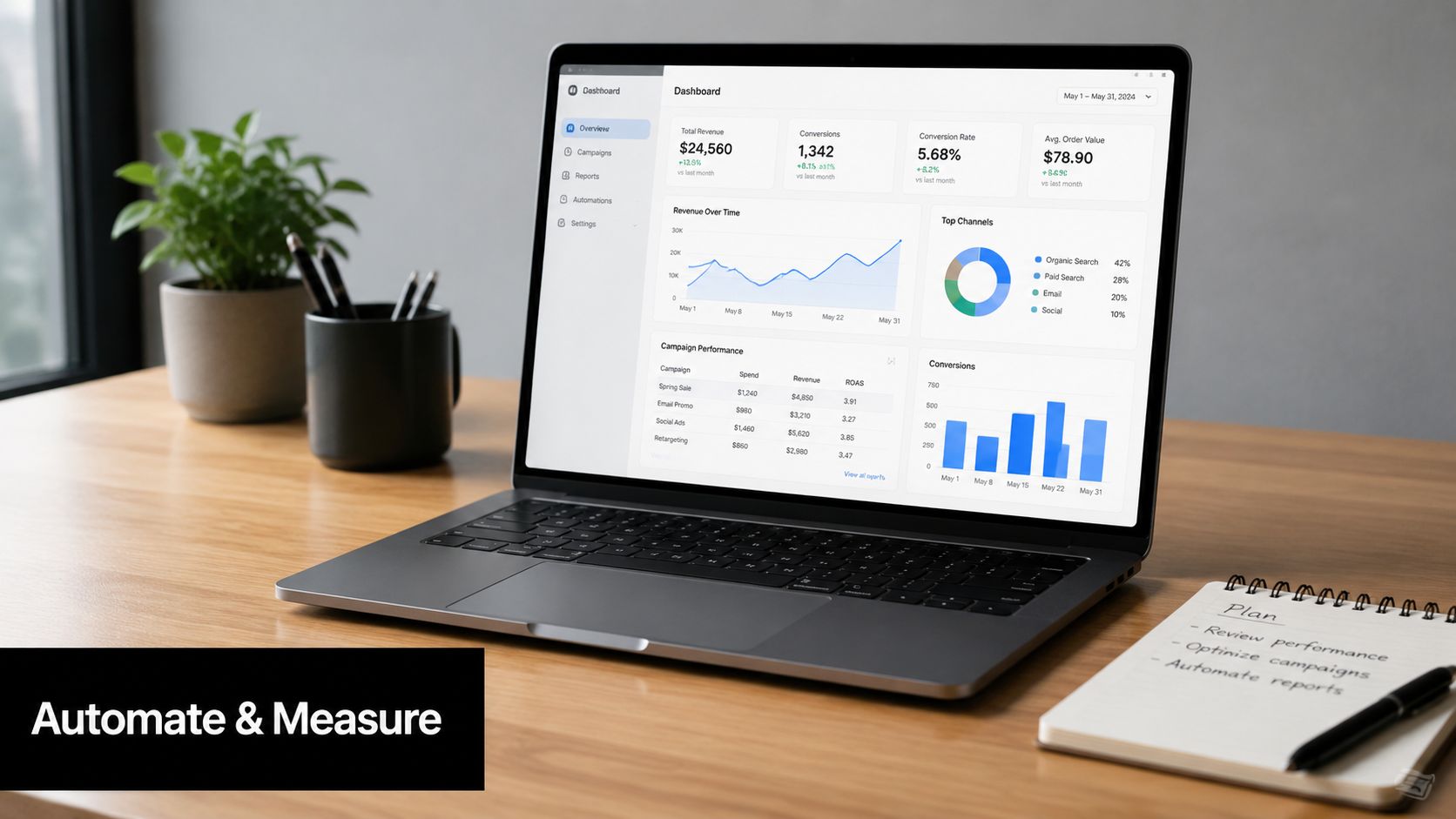
Manual outreach breaks down fast. Once you've got multiple touches across email, LinkedIn, calls, and nurture, memory isn't enough. You need a system that tells you what happened, what matters, and what to do next.
The stack doesn't need to be fancy. It needs to be disciplined.
The core setup
At a minimum, I want four things working together:
- CRM: Every contact, touchpoint, note, and status lives here.
- Sequencing tool: Handles the first part of the cadence cleanly.
- Call layer: Useful for service businesses and high-intent follow-up.
- Measurement setup: Tracks what leads to meetings, qualified leads, and sales.
The reason I keep this simple is that complexity hides weak decisions. A messy stack can make a bad outreach process look intricate.
What I automate and what I don't
Sopro's cold outreach data puts average cold-email response rates at 5.1% and notes that the first follow-up matters, while 93% of call conversations happen by the third dial, which is exactly why I automate the early sequence steps but flag engaged accounts for a human call quickly rather than stretching call volume forever (Sopro cold outreach statistics).
That means:
- Automated: Initial email, follow-up timing, task reminders, reply routing.
- Manual: Final message adjustments, high-fit call follow-up, account notes.
- Condition-based: If someone clicks, replies, or visits key pages, they get treated differently from a silent lead.
Not all replies are equal. A “send me more info” from a Shopify founder running Google Ads is more valuable than a polite brush-off from a poor-fit lead.
Field note: Automation should remove admin, not remove judgement.
What I actually measure
Open rates are weak as a primary KPI. I care more about progression.
For our own outreach and for clients, I look at:
Reply rate
Are the messages earning conversation?Positive reply quality
Are we hearing from actual decision-makers with a real problem?Meetings booked
Here, weak-fit lists get exposed fast.Sales-qualified opportunities
A booked call is nice. A relevant opportunity is better.Revenue attribution where possible
Especially when outreach supports paid ads, SEO, or lifecycle work.
For a digital marketing agency Melbourne businesses hire for performance work, attribution has to be more than “the client said they found us somewhere”. That's why clean GTM and Google Analytics implementation matters, along with clear conversion tracking for forms, calls, add-to-carts, and purchases.
For service businesses running Google Ads for service based businesses, I also like call tracking tools such as CallRail or GoHighLevel because phone leads still matter. If the campaign generates calls but nobody can tell which keywords, landing pages, or locations drove them, optimisation gets fuzzy fast.
The practical stack logic
The stack should answer three questions at any time:
| Question | What the stack should show |
|---|---|
| Who should we contact next | Tasks, statuses, and last touch |
| What message worked | Replies by angle, niche, and trigger |
| Where revenue came from | Channel, conversion point, and lead path |
That's enough to keep outreach organised without disappearing into reporting for reporting's sake.
Putting It All Together Your Free Month
What's worked best for us hasn't been flashy. It's been consistent. Good B2B outreach comes from narrowing the audience, spotting a real issue, using the right channel mix, and following up like someone who actually wants to help.
That applies whether you're speaking to a Shopify founder, a WordPress-based service business, a retailer trying to sort out PMAX vs Google Shopping ads, or a tradie who needs better PPC for tradies and tighter call handling. The tools change. The principle doesn't.
What this looks like in practice
A strong outreach system usually has these traits:
- Clear fit criteria: Not every business should be contacted.
- One sharp problem statement: Not a giant menu of services.
- A channel sequence: Email, LinkedIn, and calls used with purpose.
- Technical credibility: Enough knowledge to make the message believable.
- Consistent measurement: Reply rate, meetings, and sales progression.
The businesses that stick with this approach tend to get better over time because each campaign teaches them something. Which message landed. Which niche responded. Which service angle opened doors. Which lists were a waste.
Consistency beats intensity
A lot of owners quit too early. They send a handful of messages, get little back, and decide outbound doesn't work. Usually the issue isn't outreach itself. It's weak targeting, weak personalisation, or no real sequence.
The same thing happens in paid media. Facebook ads, Google ads, local SEO, Google My Business, Shopify development, WordPress development, SEO agency Melbourne work, and email outreach all punish inconsistency. If the process resets every week, the learning resets too.
The businesses that win at outreach usually aren't louder. They're more relevant for longer.
That's also why I like low-budget campaigns with discipline. For ecommerce brands especially, a tighter list and a sharper message often beat volume. If your whole monthly spend has to stretch, there's no room for vanity tactics.
Where this suits Australian businesses best
I've seen this approach work especially well for:
- Ecommerce brands needing Shopify development, Shopify design, stronger product tracking, or cleaner paid media support.
- Service businesses running Google ads for contact form submissions, call campaigns, or suburb-based lead generation.
- Tradies who need PPC plus proper phone handling, including custom Twilio setups for after-hours enquiries.
- Growth-stage operators who need WordPress website developer support, GTM clean-up, Meta Conversion API setup, or custom web work tied directly to lead generation.
If your business has a paid ads budget of at least $3k a month, I'd love to offer you a low-risk deal. Get a month of paid ads management free and judge the work based on what gets done. No inflated promises. No padded strategy deck. Just real hands-on management.
If you're looking for a team that understands ecommerce, development, tracking, and paid media together, Alpha Omega Digital is worth a look. We're a marketing agency based in Melbourne, Australia, and we also work with businesses in Sydney, Brisbane, Newcastle, Perth, Adelaide, Darwin, and Hobart. If your paid ads budget is at least 3k a month, I'd love to offer you a low risk deal. Get a month of paid ads management FREE. Apply now through the contact page.
Alpha Omega Digital
Read more insights from our team on web design, paid ads, and growth strategy.