If you're reading this, you're probably in one of two spots. Your Facebook ads are running, but the results feel inconsistent and hard to trust. Or you've had enough of boosting posts, patchy reporting, and agencies that talk a big game but leave you with no real understanding of what's happening under the hood.
I see this a lot with Melbourne ecommerce brands on Shopify and WordPress. They don't just need a Facebook advertising agency. They need a growth partner that can connect ads, landing pages, tracking, product feeds, creative, and the wider digital system that turns traffic into revenue. That's the difference between renting attention for a few weeks and building something that compounds.
A good marketing agency Melbourne businesses can rely on shouldn't create dependency. It should create clarity. You should know where your money is going, how results are measured, what needs fixing on the site, and what the next test is. If that sounds obvious, you'd be surprised how often it's missing.
What a Facebook Ads Agency Really Does For Your Business
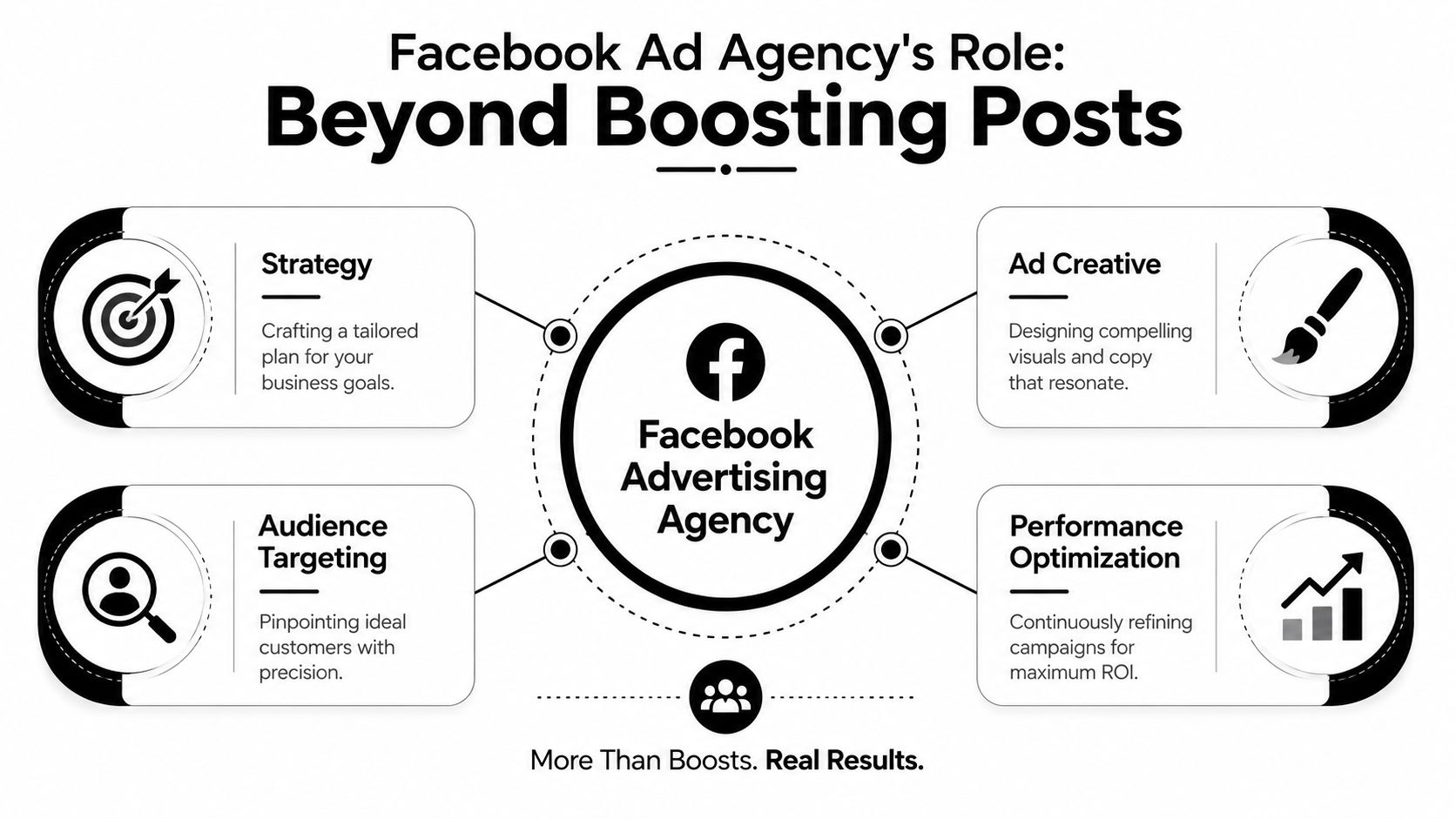
Most business owners think a Facebook advertising agency sits inside Ads Manager, picks an audience, launches a few creatives, and waits. That's not the job. The actual work is broader and a lot more technical than that.
In practice, a solid agency acts more like an architect for digital growth. It designs the strategy, checks the foundations, builds the tracking, and keeps refining the campaign as data comes in. That matters in Australia because Facebook and Instagram still offer enormous reach. Facebook reaches approximately 18.6 million people monthly and Instagram reaches 13.4 million, and advertisers compete in a live auction environment where Australian CPMs range from $8 to $18 according to Thinkify's guide to Facebook ads in Australia.
Strategy comes before targeting
A campaign usually fails long before launch. It fails when nobody answers the basic questions properly.
- Who are we trying to reach: New customers, repeat buyers, abandoned cart users, or previous purchasers.
- What are we asking them to do: Buy now, enquire, book, download, or watch.
- Why should they care: Price, convenience, identity, urgency, transformation, trust.
- Where are we sending them: Product page, collection page, lead form, landing page, Messenger, or call flow.
If those answers are vague, the media buying won't save you. That's true whether you're running ecommerce retargeting, Google Ads for service based businesses, or local campaigns tied to Google My Business and Local SEO.
Creative is not decoration
Weak agencies get exposed when they treat ad creative like a design task. Good agencies treat it like sales psychology.
Our Meta ads creative testing process usually starts with angle testing. Not just format testing. A square image versus a Reel won't fix a weak message. Ultimately, the questions are whether the ad hits the right pain point, whether the offer is clear, and whether the visual earns attention in-feed.
For ecommerce brands, that often means testing:
- Product-first hooks
- Problem-solution hooks
- Review-led or UGC-style concepts
- Founder-led or behind-the-scenes narratives
Practical rule: If the click is cheap but the page doesn't convert, the problem often sits in the offer, landing page, or audience-message match. If nobody clicks, the creative usually isn't doing its job.
If you're trying to tighten that creative workflow, it's also worth taking time to explore generative AI marketing. Not as a shortcut for replacing strategy, but as a way to speed up ideation, scripting, variation testing, and production support.
Tracking is where serious agencies separate themselves
A proper Facebook advertising agency should understand tracking beyond the Meta Pixel. That includes Meta Conversion API, Google Tag Manager, GA4 event validation, and server-side signals where needed.
For ecommerce, I also care about how the site is built. Shopify API work, Shopify development partners, custom checkout logic, and feed quality all affect what happens after the click. On WordPress, custom forms, cached pages, plugin conflicts, and event duplication can wreck attribution if nobody checks them carefully.
Here are the technical pieces I expect to see handled well:
| Area | What matters |
|---|---|
| Meta tracking | Pixel setup, Conversion API installation for Meta, event prioritisation |
| Analytics | GA4, attribution checks, conversion definitions |
| Tagging | Setting up Google Tag Manager containers cleanly |
| Platform integration | Shopify API, product catalogue, Instagram Shop and Facebook Shop |
| Site readiness | Mobile speed, landing page UX, checkout flow |
Optimisation is daily, not occasional
Once a campaign is live, the job becomes operational. Comments need moderating. Weak ads need pausing. Spend needs reallocating. Retargeting windows need adjusting. New creative needs entering the rotation before fatigue sets in.
That's why hiring an agency isn't really about outsourcing button clicks. It's about buying judgement, systems, and consistency.
Agency vs In-House The Unspoken Pros and Cons
This decision gets oversimplified all the time. People frame it like one side is smarter than the other. It isn't. Both models can work. Both can also go badly wrong.
An in-house hire gives you proximity. They sit with your team, know your products, hear customer feedback directly, and can move fast across departments. For a fast-moving ecommerce brand, that's a real advantage. They can coordinate with your Shopify developer, your email team, your product team, and whoever handles content without the lag that often comes with external partners.
An agency gives you range. You get access to specialists in creative, paid media, tracking, CRO thinking, Google Ads, GTM and Google Analytics, and often web support as well. That's useful when you're juggling Meta, Google Shopping ads for dropshipping, PMAX vs Google Shopping ads decisions, and platform issues all at once.
Where agencies help most
Agency support makes sense when:
- You need specialist depth: Conversions API installation, catalogue troubleshooting, campaign priority in Google Ads, and audience structure aren't entry-level tasks.
- You don't want to build a full team yet: Hiring a media buyer, designer, developer, and analyst separately is a bigger lift.
- You need external perspective: Internal teams sometimes become too close to the product and miss obvious messaging issues.
- You need execution across channels: A digital marketing agency Melbourne retailers work with often spans Facebook ads agency support, Google Ads, SEO, WordPress design, and Shopify design.
Where in-house usually wins
In-house usually wins when the business already has:
- Strong internal documentation
- Reliable creative production capacity
- Clean reporting and access to all accounts
- Enough spend and complexity to justify a dedicated team
Without those pieces, the in-house route can turn into one overworked marketer trying to manage media buying, email, content, analytics, and dev tickets at the same time.
The wrong setup isn't "agency" or "in-house". It's any setup where nobody owns the strategy clearly and nobody documents what they've learned.
The hidden cost nobody talks about
The biggest risk with agencies isn't fees. It's dependency.
I've seen ecommerce brands hand over everything for convenience. The agency owns the logic, the history, the tests, the ad account structure, the tracking notes, the audience learnings, and sometimes even the creative process. Then a team member leaves, the relationship ends, or the business wants to bring media buying inside, and suddenly nobody knows how to steer the account.
That risk isn't theoretical. A 2026 AU SME survey found that 61% of Melbourne eCommerce brands on Shopify or WordPress that use full-service agencies struggle to pivot campaigns post-24 months due to a lack of internal documentation and strategic control, as noted by The Ardor's review of Facebook advertising agencies in Australia.
What a growth partnership looks like
I draw a hard line between a service provider and a growth partner.
A service provider often keeps the machine running but doesn't transfer knowledge. A growth partner does the opposite. It gives you visibility into what is being tested, why budgets move, how conversion tracking is configured, what creative themes are winning, and what your internal team needs to know.
A healthier setup usually includes:
- Shared ownership: You own ad accounts, data, pixels, catalogues, and analytics access.
- Clear documentation: Naming conventions, testing history, tracking setup, and learnings are recorded.
- Regular education: The business understands what metrics matter and what decisions are being made.
- Cross-functional alignment: Ads, site changes, SEO, Google My Business, and feed management don't happen in silos.
That partnership model is slower to sell, but stronger over time.
Our Holistic Growth Services A Foundation for Ad Success
A lot of Facebook campaigns don't fail because the ads are bad. They fail because the system around the ads is weak.
I've watched brands obsess over audiences while sending paid traffic to slow collection pages, clunky product templates, broken mobile menus, or WordPress sites with forms that fire the wrong events. That's expensive. A click only has value if the page, the tracking, and the follow-up process are all working.

Web development affects ad performance more than people realise
For ecommerce, your website is part of the ad account whether you treat it that way or not. That's why I care just as much about Shopify development and WordPress development as I do about campaign setup.
If you're on Shopify, the conversation often includes custom theme work, speed, landing page structure, product page UX, app conflicts, product feed quality, and custom development through the Shopify API. Some brands also need work that goes deeper, like building custom Shopify apps using Shopify CLI or fixing how bundles, subscriptions, or metafields display across templates.
Melbourne businesses also need to budget for this realistically. A professionally built Shopify ecommerce store in Melbourne typically costs AUD 10,000 to AUD 50,000, while Shopify Plus builds range from AUD 40,000 to over AUD 100,000, according to WP Creative's breakdown of Shopify development cost in Australia. If you're hiring hands-on technical help, Shopify developers in Melbourne charge AUD 90 to AUD 140 per hour on average based on Abbacus Technologies' guide to hiring Shopify developers in Australia.
On WordPress, the issues are different. I often end up reviewing:
- Custom Gutenberg builds: Building custom blocks in Gutenberg so marketing teams can update pages without breaking layouts.
- Form tracking: Google Ads for contact form submissions only works when the thank-you flow and event setup are sound.
- Theme and plugin bloat: Especially common on older brochure sites that later try to add ecommerce or lead gen layers.
- WordPress design and WordPress development handoff: Design that looks polished in Figma but becomes slow or fragile in production.
If you need a technical resource for that side of the stack, a WordPress developer in Melbourne can help align site performance with campaign goals rather than treating development as a separate job.
Ads, SEO, and search intent should work together
A business shouldn't think in channels only. A user might discover you through Instagram, search your brand later, click a Google Shopping result, then come back through retargeting.
That's why integrated work matters. For ecommerce, I like pairing paid social with:
- Google Ads: Including shopping campaigns, PMAX testing, campaign priority in Google Ads, and branded search defence.
- Local SEO: Still relevant if you have a showroom, clinic, or local service footprint.
- Google My Business: Important for trust and local discovery.
- Technical tracking: GTM and Google Analytics to understand where revenue is coming from.
For businesses comparing support models, ecommerce marketing agency services and Google Ads agency support usually make more sense when they're connected to the site and reporting stack, not bolted on after the fact.
Missed calls are missed revenue
This matters more for service brands than many agencies admit. Tradies, beauty therapists, dentists, restaurants, and clinics can lose genuine demand because no one answers the phone quickly enough.
We've set up custom numbers through Twilio so calls can be handled with always-on automation. That setup can answer after hours, never gets sick or tired, books appointments into your calendar or Calendly, and gives businesses a cleaner way to route enquiries. For call-heavy campaigns, I also like using call tracking software such as CallRail or Go High Level so PPC call campaigns don't become a black box.
A Facebook ad can generate demand. It can't answer the phone for you unless you've built the system behind it.
That's the core reason I push a broader growth model. Ads don't live alone.
How We Build Winning Campaigns The Alpha Omega Digital Process
Most campaigns that look chaotic from the outside are chaotic on the inside. There's no clear hypothesis, no documented testing logic, and no discipline around what gets changed and when.
The process I trust is simple enough to explain and strict enough to repeat. It covers discovery, creative, targeting, launch, optimisation, and reporting without pretending the platform is predictable every day.
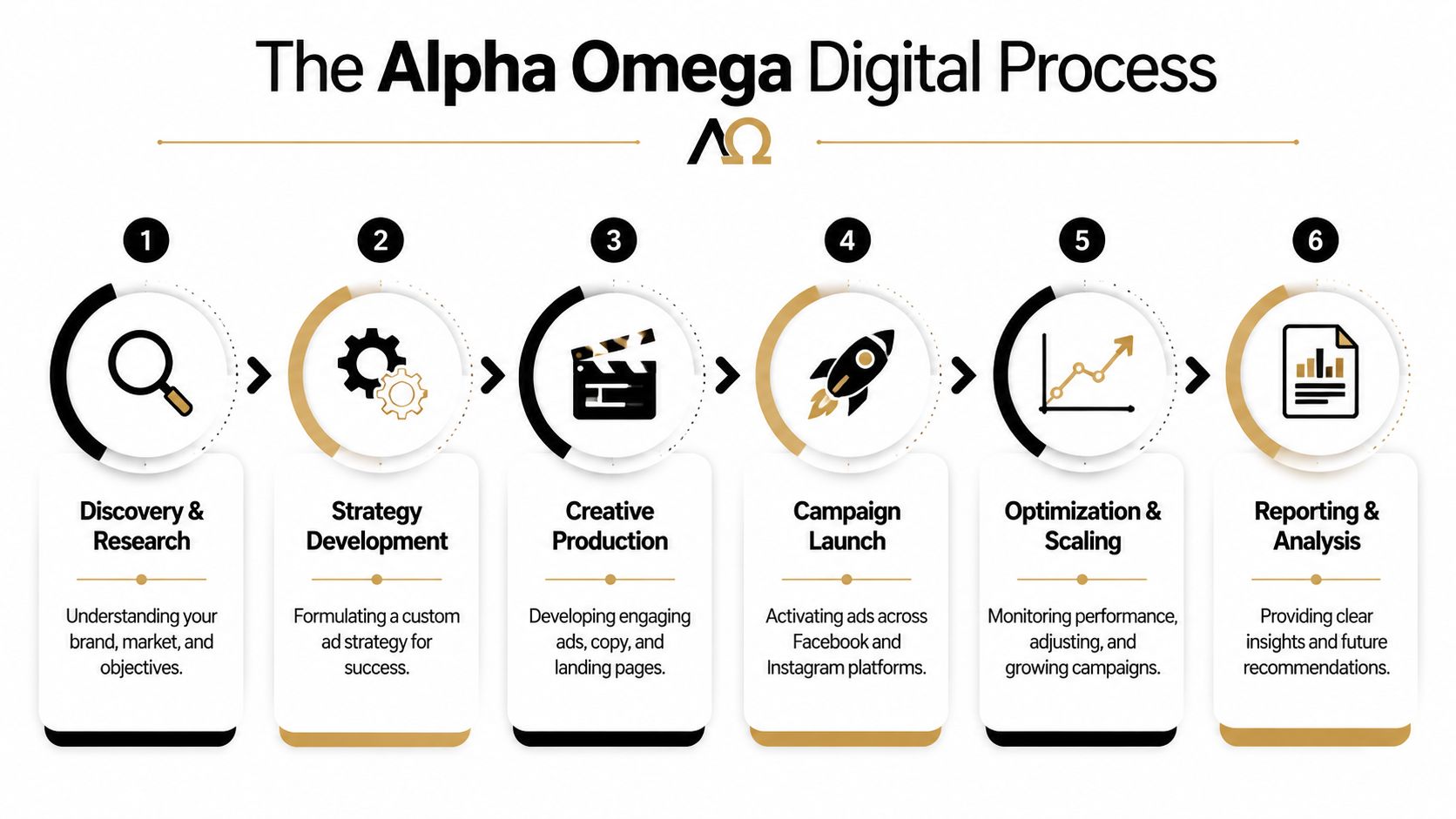
Step 1 to 3 define the setup
The first phase is discovery. We look at your offer, margins, customer behaviour, repeat purchase patterns, current tracking, landing pages, and existing account history. If the store runs on Shopify, that also means checking product feed quality, apps, template issues, and whether Instagram Shop and Facebook Shop are configured sensibly. If it's WordPress, we look at form handling, page speed, event firing, and whether the site is stable enough to support paid traffic.
Then comes strategy development. I don't like vague audience ideas like "women interested in fashion" or "business owners in Melbourne". The goal is tighter. We map campaign types to buying stages, split cold versus warm traffic, define primary conversion events, and work out where creative needs to do the heavy lifting.
Creative production comes next, a point at which too many campaigns become generic. Data from Meta's 2025 AU report reveals that ads using Emotional, Identity, or Critical angles achieve 3.2x higher ROAS than feature-only ads, but 74% of Melbourne SMBs rely on generic templates, according to the source referenced in this creative strategy discussion. That gap is exactly why creative deserves process, not guesswork.
To improve this stage, I often look outside the ad account. Community language, review mining, customer support transcripts, and product Q&A all reveal better hooks than a brainstorm in isolation. If you want a lightweight prompt-based workflow for ideation, this guide on how to generate Facebook ad ideas is a useful starting point.
Step 4 launch with control
Once the structure and creative are approved, the campaign launches. That sounds routine, but at that stage, discipline matters most.
I want naming conventions locked down. I want UTMs consistent. I want attribution checked across Meta and GA4. I want the catalogue, pixel events, and Conversions API setup reviewed before spend increases. Sloppy launches create messy data, and messy data leads to bad optimisation decisions later.
A quick overview of the working rhythm looks like this:
| Stage | What happens |
|---|---|
| Discovery | Business model, economics, tracking, site review |
| Strategy | Funnel design, audience structure, offer alignment |
| Creative | Hooks, scripts, visuals, landing page fit |
| Launch | QA, attribution checks, live deployment |
| Optimisation | Budget shifts, creative refreshes, audience refinement |
| Reporting | Commercial performance review and next actions |
A short walkthrough helps if you want to see the process visually:
Step 5 and 6 decide whether the account scales
Patience matters. Good accounts rarely reveal the answer in a few days. The early period is for learning what message, format, and audience combination deserves more budget.
I judge performance differently depending on the objective. For ecommerce, I care about purchase value, margin, and repeat purchase potential, not just top-line return. For lead generation, I care about lead quality and what happens after the form fill. A campaign can look good inside Ads Manager and still disappoint if sales follow-up is slow or the landing page attracts the wrong intent.
Don't quit too early. Quit the wrong creative, the wrong page, or the wrong offer. Keep the learning process intact long enough to make a fair decision.
That discipline is what turns random wins into a repeatable system.
Your Checklist for Choosing the Right Melbourne Agency
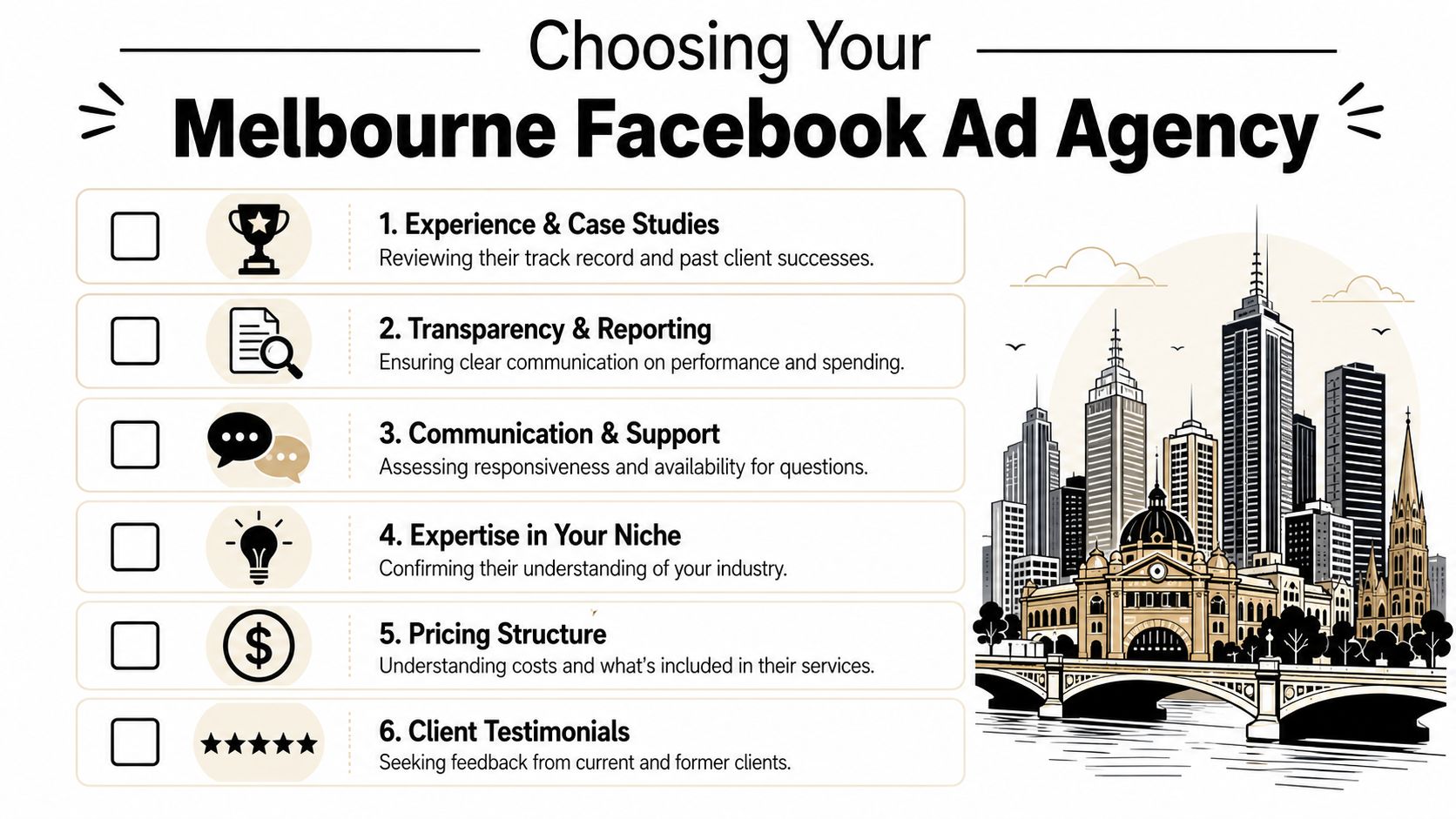
A slick proposal doesn't tell you much. Nearly every agency can build a polished deck, say the word ROAS a few times, and show screenshots from an account you can't properly verify.
What matters is how they think, how they communicate, and whether they make your business smarter over time.
Questions worth asking before you sign
I'd ask these in the first meeting, not after the contract lands.
- How do you make optimisation decisions: Ask whether they optimise primarily to ROAS or cost per conversion, and under what business conditions they switch the priority.
- Who owns the accounts and data: If access is restricted or the answer feels vague, that's a warning sign.
- What does your testing process look like: Serious operators should be able to explain creative testing, audience testing, and how they decide a test has enough signal.
- How often do you refresh creative: If they rely on one hero ad for too long, fatigue becomes your problem.
- What happens outside the ad account: Ask whether they review landing pages, feed quality, GTM, GA4, and site conversion issues.
The strongest conversations usually move beyond ads fast. They touch WordPress development, Shopify design, local SEO, Google Shopping ads not spending budget, beginners guide to Google Shopping ads decisions, and how the business handles sales once leads arrive.
The green flags I look for
Some answers immediately increase confidence.
| Green flag | Why it matters |
|---|---|
| They explain trade-offs clearly | Good agencies don't pretend every campaign objective suits every business |
| They talk about documentation | This reduces dependency and helps future handover |
| They discuss tracking early | Weak tracking makes every performance claim less reliable |
| They ask about margins and fulfilment | Revenue without commercial context is misleading |
| They challenge the landing page | Paid traffic magnifies site weaknesses |
One example of a transparent service page structure is a provider that clearly outlines its offers across Facebook Meta ads agency support and web design in Melbourne, because those two disciplines often affect the same conversion path.
The red flags I wouldn't ignore
These are the patterns that usually create pain later.
Guaranteed results
Nobody serious guarantees outcomes in an auction-based platform.No mention of creative testing
Best practices recommend testing at least 3 to 4 ad creatives and 2 to 3 audience segments before scaling, and frequency management matters too. For retargeting, frequency can exceed 2, but for cold traffic it should stay below 2 to reduce fatigue, based on the 2025 optimisation guidance referenced here.They only talk about clicks
Clicks matter, but they don't tell you enough about customer quality or revenue.No interest in your website
If they don't ask how the site converts, they're acting like media buyers, not growth partners.
The best agency interview feels a bit uncomfortable. They ask hard questions about your offer, margins, stock, sales process, and internal bottlenecks because those things affect campaign performance.
Pricing should be understandable
Most Melbourne businesses don't mind paying fair fees. They mind vague fees.
A common model is a flat monthly retainer or a percentage of ad spend. The key is understanding what's included. Is creative included. Is landing page work included. Does reporting cover actual business outcomes. Is Shopify or WordPress support available when conversion issues come from the site.
If you're also comparing a seo agency Melbourne businesses use alongside paid media, ask the same transparency questions there too. The principles don't change.
Budget Timelines and Measuring True ROI
This is usually the point where business owners want straight answers. How much should you spend, how long should you wait, and what should success look like.
The honest answer is that budget needs to match the goal. A business trying to validate one product line can start differently from a mature store with multiple collections, retargeting pools, and a full email stack. Still, some Australian benchmarks are useful for setting expectations.
What budget is realistic
For lead generation campaigns on Facebook in Australia, the average CPA ranges between AUD 20 and AUD 50, according to AdVisible's guide to Facebook ad costs in Australia. The same source notes that if a business wants 100 new leads at a target $40 CPA, it would need an AUD 4,000 monthly budget.
That doesn't mean every campaign should start there. It means tiny budgets often don't buy enough data to make good decisions. If you're trying to hire a Facebook advertising agency and spend very little, you'll usually end up under-testing creative, under-feeding the algorithm, and drawing conclusions too early.
Agency pricing also needs context. In Australia, agencies commonly charge 10 to 15% of monthly ad spend, or a flat fee between $1,000 and $2,500 per month, according to Engine Scout's overview of Facebook advertising agency pricing in Australia. If you want a broader explanation of how retainers, ad-spend percentages, and hybrids work, RedactAI's agency pricing guide is a practical reference.
What the first 90 days usually look like
I don't expect a brand-new campaign to reveal its final shape in week one. The first stretch is more about finding signal than forcing scale.
- Early phase: Tracking checks, audience qualification, landing page issues, and creative response start to show.
- Middle phase: Weak creatives get removed, stronger hooks get more spend, and the account starts to settle.
- Later phase: Once the offer-message-audience fit is clearer, scaling decisions become less random.
That timeline applies whether you're running Google ads for plumbers, PPC for tradies, Google shopping ads for dropshipping, or Meta campaigns for an ecommerce store. The learning process still needs enough budget, enough time, and clean enough tracking.
What ROI should actually mean
For ecommerce, I care about commercial return, not vanity metrics. High click-through rate with poor checkout completion isn't a win. Cheap traffic with high refund rates isn't a win either.
Here's the lens I use:
| Business type | Metric that matters most |
|---|---|
| Ecommerce | ROAS, margin, repeat purchase quality |
| Lead generation | Cost per lead, appointment quality, close rate |
| Call-driven services | Qualified calls, booked jobs, missed-call recovery |
The mistake I see most often is judging performance inside one platform only. You need Meta data, GA4, store data, and sales feedback working together. That's why GTM and Google Analytics, call tracking, and proper lead handling matter so much.
Frequently Asked Questions About Facebook Ads
Is Facebook better for ecommerce than for service businesses
A Melbourne ecommerce brand can get sales from a cold prospect who was not planning to buy that day. A local service business usually needs more trust before someone books, calls, or fills in a form. That difference shapes the whole account.
For ecommerce, Facebook and Instagram are strong at product discovery, remarketing, and repeat purchase campaigns. For service businesses, results depend just as much on the landing page, response speed, sales process, and call handling as the ad itself. I often pair Meta with Google Ads for tradies, clinics, and other local operators because search traffic catches people with clearer intent. Product brands can ask Meta to do more of the demand generation work.
Can a smaller brand compete against bigger advertisers
Yes, if it stops trying to look like a bigger brand.
Smaller businesses usually win through sharper positioning, better offers, more specific creative, and faster testing cycles. Larger advertisers can outspend you, but they often move slower and sound more generic. We've seen local brands outperform larger competitors because the message was clearer and the product page did a better job of answering buyer hesitation.
How do I measure success on Facebook ads properly
Start with business outcomes, not platform wins.
For ecommerce, check purchase value, margin, product mix, and whether new customers are worth acquiring. For lead generation, a form submission is only the start. You need to know whether that lead answered the phone, booked in, and turned into revenue. I have seen perfectly decent campaigns blamed for poor performance when the actual issue was slow follow-up or weak sales handling.
Should I use Facebook ads and Google ads together
In many accounts, yes.
Google captures existing demand. Facebook helps create interest before the search happens. Used together, they usually give a business better coverage across the buying journey. That only works well if the site is fast, the offer is clear, the tracking is accurate, and both platforms are feeding into the same commercial goal.
What if my ads stop working after a good run
It usually comes back to a short list. Creative fatigue, offer fatigue, seasonal demand shifts, tracking problems, stronger competition, or a drop in landing page conversion rate.
Good accounts are managed with the expectation that performance will move. They keep testing angles, refreshing creative, checking tracking, and reviewing the offer. A campaign that worked last month still needs active management this month.
What kind of agency relationship works best long term
The strongest setup is a growth partnership, where the business keeps ownership and gets stronger over time.
That means you keep access to the ad account, the data, the creative learnings, and the strategy behind key decisions. Your team builds internal understanding instead of handing everything off and losing the knowledge six months later. Agency dependency is a real risk, especially when ads, landing pages, tracking, and website changes sit with different providers who do not talk to each other.
That integrated model is how we work at Alpha Omega Digital. We manage ads, support WordPress and Shopify builds, improve tracking with GTM, GA4 and Meta Conversion API, and keep account ownership transparent so the business is never locked out of its own growth engine. If you want to discuss whether that approach fits your business, you can reach us through the contact page.
Alpha Omega Digital
Read more insights from our team on web design, paid ads, and growth strategy.