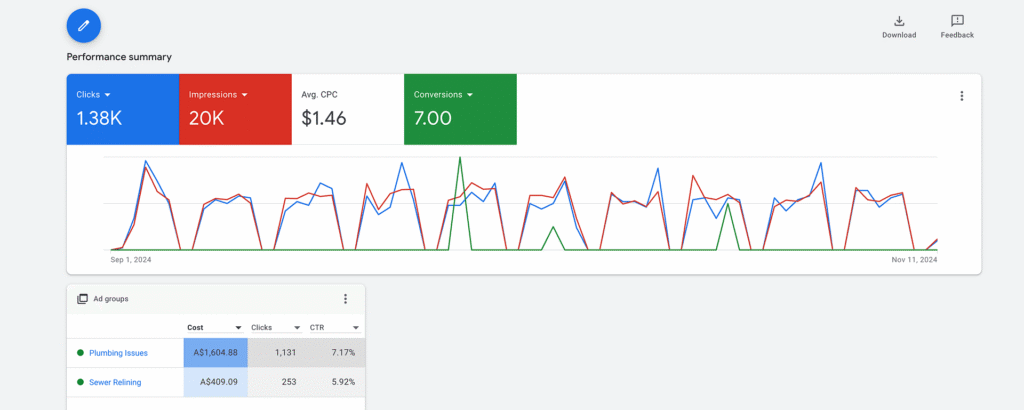
You’ve probably had the same experience I see across Melbourne. A store owner in Cremorne launches Google Ads, watches the daily budget disappear, then checks the sales and realises the campaign generated plenty of activity but very little profit. A service business in Brunswick gets enquiries, but the calls are poorly qualified, the contact form tracking is unreliable, and nobody can say which search terms produced the jobs.
That doesn’t mean Google Ads is broken. It means paid search exposes weak offers, incomplete tracking, poor landing pages and loose account structures very quickly. Australia’s internet advertising market reached A$19.8 billion in FY26, up 14% year on year, which shows how mature and competitive paid digital acquisition has become (Australian internet advertising market context). For a Melbourne ecommerce brand, Google Ads can be an excellent sales channel. For a local operator, it can fill the calendar with high-intent enquiries. But only when the account is managed around commercial outcomes rather than clicks.
I’ve worked with both ecommerce and service businesses, and my view is straightforward. A small business doesn’t automatically need a Google Ads agency. It needs the right operating model for its budget, margins, conversion volume and internal capacity. Sometimes that’s DIY. Sometimes it’s a freelancer. Sometimes a specialist agency pays for itself by preventing waste and fixing the parts of the funnel the owner can’t reasonably manage alone.
Why Most Small Business Owners End Up Hiring a Google Ads Agency
A Brunswick plumber once described his account to me as “a tap I couldn’t turn off”. He’d created a Search campaign, added broad service keywords, set a modest daily budget and expected enquiries to arrive. Instead, the account attracted searches from outside his service area, people looking for jobs, product research and unrelated plumbing information. The spend kept moving, but the business couldn’t connect it to profitable work.
An ecommerce founder in Cremorne can end up in the same position for different reasons. Product feeds need attention, conversion values need to be accurate, brand and non-brand traffic need separate analysis, and a website change can break the purchase event. The dashboard still displays numbers, so the problem can remain hidden until the owner compares ad spend with actual orders.
The four problems that catch owners out
- Tracking breaks. A WordPress redesign, Shopify checkout change or consent setting can stop purchases, phone calls or contact form submissions from being recorded correctly.
- Broad targeting consumes budget. Google can match broad keywords to searches that look related but have weak buying intent.
- Small campaigns lack useful feedback. A token campaign budget may produce too little conversion data to support confident optimisation.
- The dashboard becomes a second job. Search-term reviews, negative keywords, ad testing, feed diagnostics, landing-page changes and reporting all compete with running the business.
The owner often calculates only the management fee they’re avoiding. That misses the opportunity cost of time, the cost of bad data and the revenue lost while a weak campaign remains live. A Google Ads agency for small business should earn its place by improving the whole acquisition system, not by making the account look busy.
My rule: If you can’t explain which campaign generated a profitable sale or a qualified enquiry, you’re not managing performance. You’re monitoring activity.
You’ll usually end up choosing between three models. Keep the account in-house, hire a freelancer for focused execution, or engage an agency that can connect Google Ads with the website, analytics, CRM, feed and sales process. The right choice depends less on the label and more on what the business can consistently support.
What a Google Ads Agency Actually Does for Small Business
A competent agency doesn’t just “run ads”. It builds a measurement and optimisation system around the commercial action that matters, whether that’s a completed Shopify order, an assisted sale, a booked call or a qualified contact form submission.
I brief new clients using four operating buckets.
Account setup and structure
The first job is to make the account intelligible. That means deciding which campaigns deserve separate budgets, separating brand and non-brand intent where useful, building keyword groups around actual products or services, and creating negative keyword lists that block irrelevant searches.
For a Melbourne ecommerce business, the structure may need to distinguish product categories, best sellers, shopping activity and remarketing audiences. For a local service business, location settings, suburb coverage, opening hours and call assets matter more. Geo-targeting should reflect where the business can serve customers, not where the owner hopes to operate eventually.
A structured build commonly includes:
- Campaign architecture: Search, Shopping or Performance Max campaigns organised around budget and intent.
- Keyword control: Search terms reviewed regularly, with negative keywords added where they don’t represent buying intent.
- Ad assets: Responsive Search Ads, sitelinks, callouts, structured snippets, price information or promotion assets where appropriate.
- Performance Max inputs: Product feeds, audience signals, creative assets and clean conversion actions.
- Landing-page alignment: Ad promise, page content, offer and call to action must match.
Businesses that want a broader explanation of campaign planning can also review these high-intent PPC campaigns as a useful comparison point.
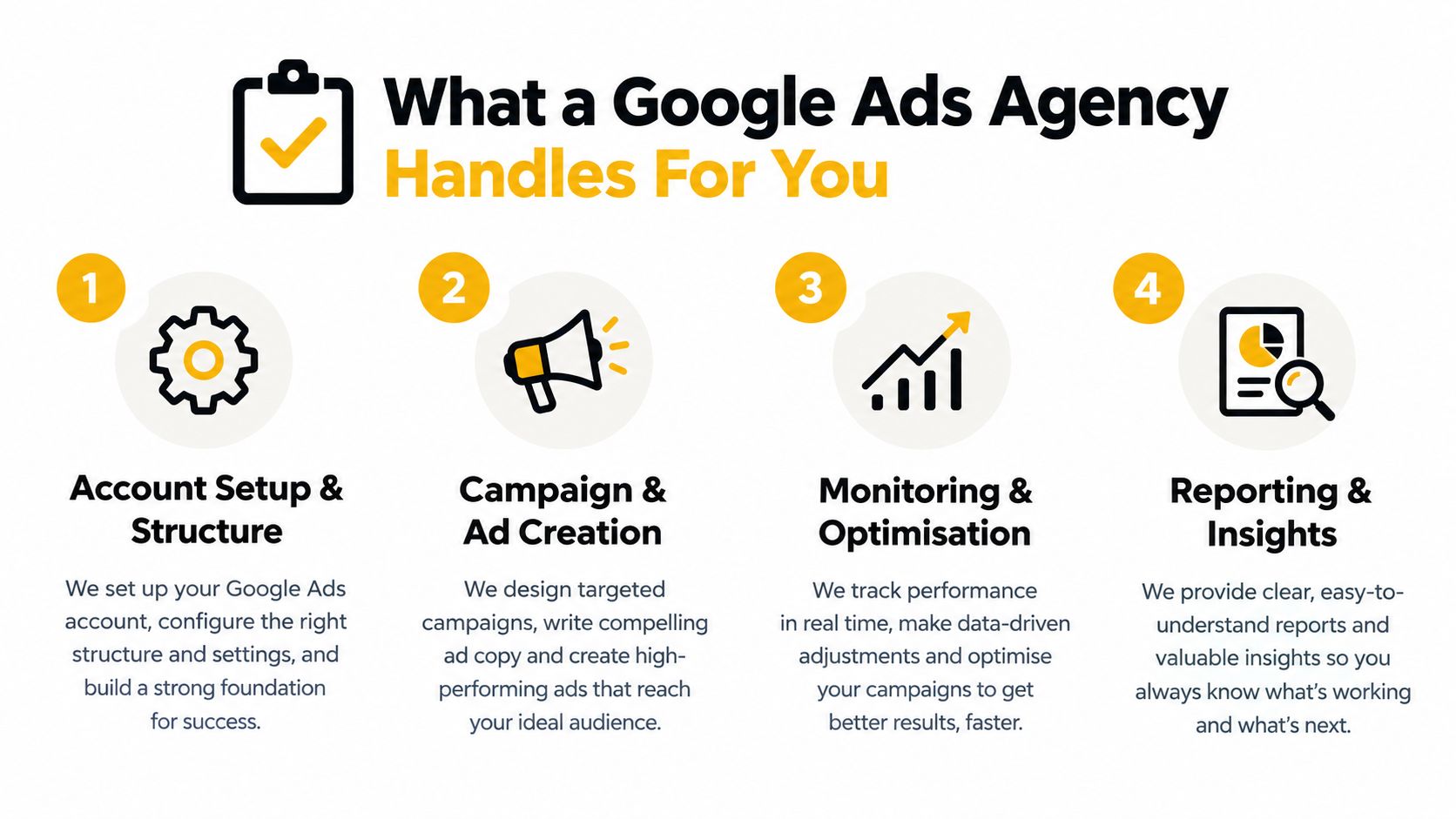
Ongoing optimisation
Once the campaign collects meaningful conversion information, the account manager can make better decisions about bidding and budget allocation. That work includes search-term pruning, ad testing, audience exclusions, landing-page feedback and Quality Score improvements.
Automation has a role, but I don’t hand every decision to automation from day one. For Melbourne SMEs, I generally favour manual control for high-intent Search, then selective automation when the account has reliable conversion tracking and enough commercial feedback. Performance Max can help an ecommerce brand scale across Google inventory, but it shouldn’t become an excuse to ignore the product feed, margins or search-query quality.
Tracking and measurement
A serious setup connects Google Ads with GA4, Google Tag Manager and the website’s actual business events. For ecommerce, that includes product views, add-to-cart activity, checkout progression, purchases and transaction values. For lead generation, it can include form submissions, calls, booked appointments and offline lead quality.
GTM naming conventions matter because messy containers make future troubleshooting slower. Enhanced conversions can strengthen measurement where the implementation supports them. Offline conversion imports can help service businesses distinguish a raw enquiry from a booked and profitable job.
Reporting that helps decisions
A monthly report should show more than impressions and clicks. I want to see spend, cost per acquisition or lead, conversion rate, impression share where relevant, revenue or qualified pipeline value, and the specific actions taken during the period.
Ecommerce reporting should connect transaction value, ROAS, CPA, conversion rate and margin. Lead-generation reporting should distinguish enquiries from qualified leads, booked jobs and pipeline value. A cheap lead that never answers the phone isn’t a success.
Pricing Models and Contract Structures You’ll Be Quoted
Australian SMEs commonly allocate around A$1,200 to A$7,000 per month to digital marketing, with roughly 40% to 60% often directed to PPC channels such as Google Ads, according to Australian benchmark material (Australian SME digital marketing and PPC benchmarks). That spend creates a practical question: how much should management cost before it starts reducing acquisition efficiency?
You’ll usually receive four commercial models.
| Pricing Model | Typical Melbourne Cost | Best For | Watch Out For |
|---|---|---|---|
| Percentage of spend | 12% to 20% of ad spend | Larger accounts scaling beyond A$10,000 monthly | Fees rise automatically as spend grows |
| Flat management fee | A$800 to A$2,500 per month | Predictable ongoing management | Scope may be vague |
| Performance or hybrid | Base retainer plus lead or revenue incentive | Businesses with reliable tracking and clear qualification rules | “Qualified lead” may be poorly defined |
| Project-based setup | A$1,500 to A$5,000 one-off | Owners who want account ownership and internal control | The handover may leave ongoing gaps |
Percentage pricing suits larger ecommerce accounts with active testing and frequent budget changes. It becomes expensive when spend rises faster than the work. For many Melbourne small businesses, I prefer a flat fee with a written scope covering campaign management, search-term reviews, tracking checks, reporting and agreed testing.
At around A$1,500 per month, a defined management fee is easier to assess than a percentage that changes with the budget. At around A$500 per month, an agency fee can consume too much of the acquisition budget. A tightly scoped freelancer or a one-off build with internal management may make more sense. Ecommerce stores usually need feed maintenance, product-level analysis and margin awareness. Service businesses need lead-quality rules, call tracking and follow-up checks. The contract should reflect that difference.
A performance or hybrid arrangement only works when conversion tracking is accurate and both sides define a qualified lead, booked job or attributable sale. Otherwise, the agency can optimise for cheap actions that do not produce revenue.
Google’s AU guidance confirms that advertisers can set an individual daily budget or a shared budget, and it provides a Google Ads budget planning and cost estimator resource. If you work from a monthly amount, Google’s interface explains that dividing it by 30.4 converts it into an average daily budget.
Read the contract before discussing creative ideas. Confirm that your business owns the Google Ads account, whether the agency uses an MCC, who owns landing pages and creative assets, how historical data remains accessible, and whether you can leave on a rolling monthly basis. A six or twelve-month term can work, provided it includes a clear exit clause and defined deliverables.
KPIs Timelines and What Realistic Results Look Like
Set different success criteria for ecommerce and service businesses. An online store should connect ad spend with revenue, margin and product-level profitability. A service business must trace an enquiry through the call or form, qualification, booking and completed job.
Melbourne CPCs vary sharply by industry. Legal services can cost far more per click than ecommerce or local trades, so apply benchmarks only as context, not as a target. CPC is an input. Profit comes from the commercial actions that follow.
| Stage | Ecommerce Metric, ROAS / CPA | Service Business Metric, CPL / Bookings |
|---|---|---|
| First 30 days | Validate purchase tracking, feed quality, product intent and baseline CPA | Validate calls, forms, location settings and lead quality |
| Around 60 days | Prune weak traffic, assess product groups and improve conversion rate | Compare qualified enquiries, call outcomes and booking quality |
| Around 90 days | Decide which products and campaigns deserve more budget | Assess pipeline value and whether lead volume supports scaling |
A fixed ROAS or CPL promise before reviewing the offer, margins, website and competition is a warning sign. A low-margin store needs a different break-even point from a premium brand. A service business that answers every call also has better economics than one that misses enquiries while staff are on jobs.
The first month is for measurement and corrections. Check that purchase events fire correctly, product values are reliable, search terms match the offer and landing pages reflect user intent. Sales may appear quickly, but one strong period does not prove a repeatable acquisition system.
By around 60 days, separate cheap activity from useful activity. Ecommerce accounts should cut wasted searches and compare product groups against margin. Service accounts should review qualified enquiries, call outcomes and booking rates, not just headline lead volume.
Around 90 days, decide where additional budget can produce more profitable growth. Keep a manual review process alongside Google’s automation. Automated bidding can respond to conversion data, while human checks catch poor search intent, weak leads, stock problems and margin issues that the platform cannot judge.
Call-heavy campaigns need source attribution and call recording configured properly. Review this 2026 phone tracking guide before selecting a tracking platform, especially if phone enquiries are a major part of revenue.
Use the same discipline for contact forms. Record the successful submission, then return lead-quality data to the account. Otherwise, optimisation can favour irrelevant forms over enquiries that become booked work and revenue.
Questions to Ask Before You Sign With Any Agency
A polished pitch deck tells you what an agency wants to sell. A good sales conversation reveals how the team works when a campaign underperforms.
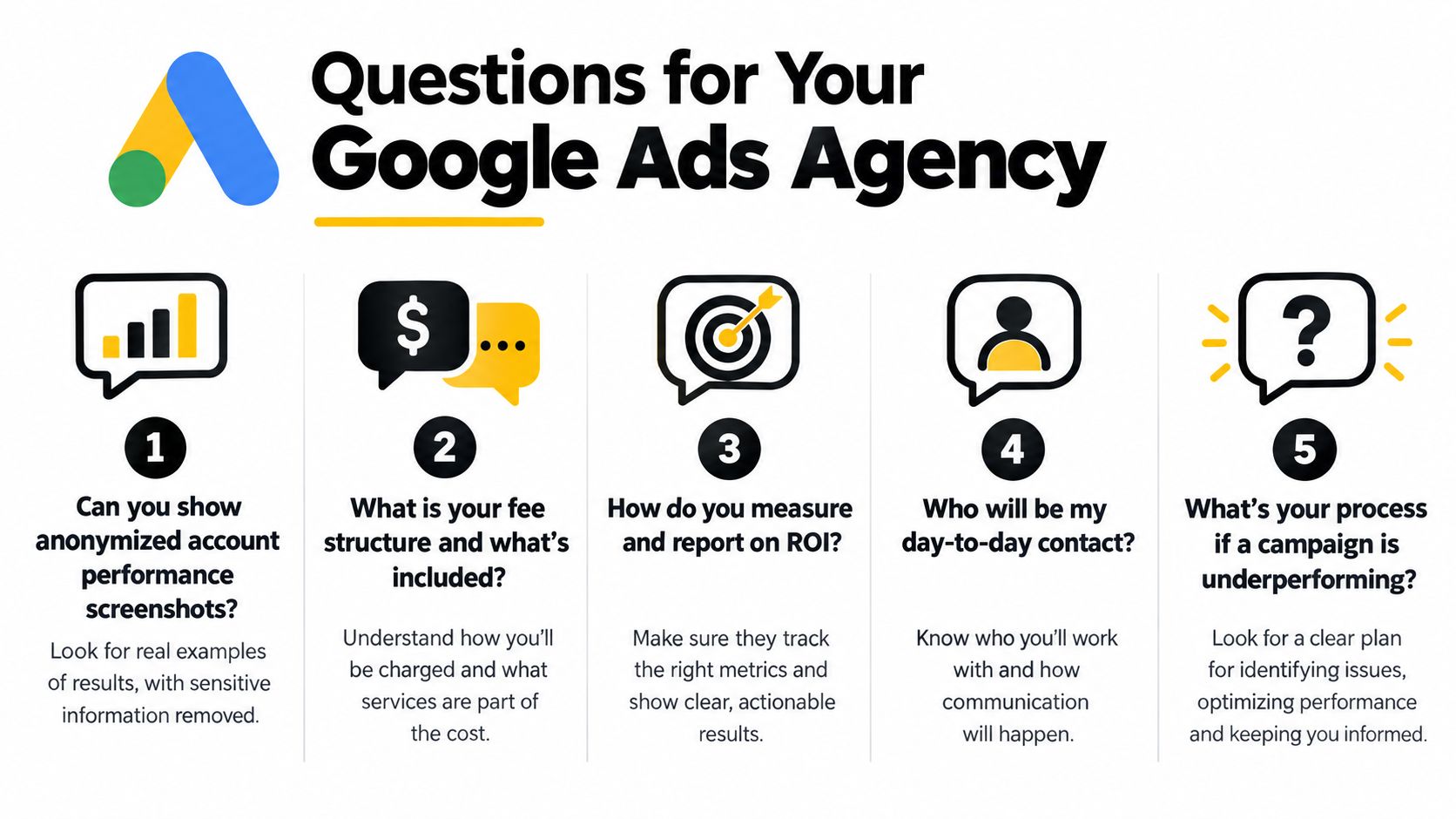
Ask these questions directly.
- Can you show anonymised account screenshots? You’re looking for evidence of real structure, search-term analysis, conversion actions and budget decisions, not a logo wall.
- Which recent accounts had a budget and business model similar to mine? An agency that manages large national accounts may not understand the constraints of a Melbourne store with a tightly controlled budget.
- Who owns the Google Ads account and the historical data? Your business should retain administrative access. If the agency refuses, leaving can mean losing context and control.
- Will I receive the raw reporting view? Looker Studio access, campaign-level data and a record of changes make performance easier to audit.
- Who works on the account each day? Ask for the person’s experience, not just the senior strategist’s credentials.
- What happens during holidays or staff changes? A documented cover process matters when campaigns spend every day.
- How do you define a qualified lead? For service businesses, a form fill is not necessarily a sales opportunity.
- What happens when results decline? The answer should describe diagnosis, testing and communication, not a guaranteed outcome.
You can use an independent resource to compare ads agencies with NotFair, then ask shortlisted providers to explain where their process differs.
A capable agency should be comfortable discussing account ownership, tracking limitations and failed tests. If the representative avoids those topics and keeps returning to vague promises, you’re learning something important.
Red Flags and Over Promises That Cost Small Businesses Money
I distrust certainty in a Google Ads sales pitch. No agency controls competitor bids, auction conditions, product demand, stock availability, landing-page quality or how quickly a business answers a lead.
The most common red flags are easy to recognise.
- Guaranteed first-page rankings: Google Ads placement depends on auction conditions and bid decisions. A guarantee usually hides the conditions attached to it.
- Guaranteed CPL or lead volume: A fixed cost per lead ignores the offer, suburb, competition, seasonality and qualification standard.
- Suspiciously low management fees: Low pricing can be legitimate for narrow scope, but vague deliverables usually mean important work is missing.
- Opaque reporting: Top-line clicks and impressions don’t tell you whether the account produces profitable orders or useful enquiries.
- No account ownership: If you can’t access your own account, you’re renting visibility rather than building an asset.
- Twelve-month lock-in without an exit clause: A long contract should come with a clear reason and a fair way to leave when the working relationship fails.
- Competitor price matching: This often signals that the agency is competing on margin rather than explaining what it will do.
- Artificial traffic tactics: Click fraud schemes, incentivised traffic and other shortcuts pollute the data and can damage the account.
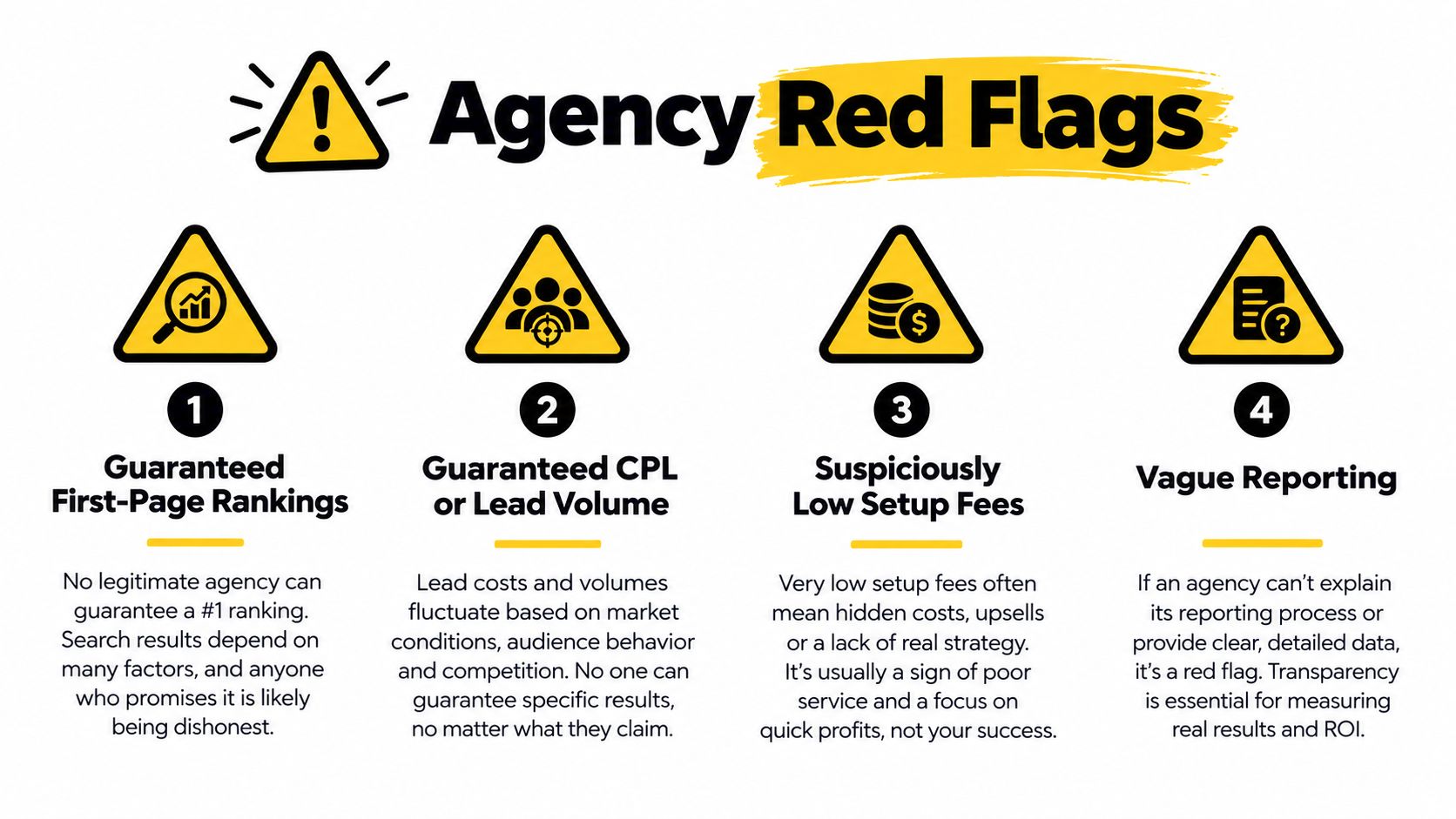
The test is simple. Ask the agency to explain its process for diagnosing weak performance, validating conversion tracking and reallocating budget. If the pitch relies on certainty instead of process, walk away.
DIY Freelancer or Agency A Decision Checklist for Melbourne SMBs
There’s no prestige in hiring an agency when you’re better suited to a focused freelancer. There’s also no virtue in keeping a technically demanding account in-house when the owner is already stretched.
| Factor | DIY | Freelancer | Agency |
|---|---|---|---|
| Monthly ad budget | Small and controlled | Moderate and stable | Large enough to support wider testing |
| Time available per week | High owner involvement | Limited owner involvement | Minimal owner involvement |
| Technical skill | Strong Google Ads and analytics knowledge required | Specialist knowledge available | Broader tracking, web and media capability |
| Landing pages and tracking | Built internally | Added by agreement | Often coordinated across disciplines |
| Growth ambition | Gradual | Steady | More structured scaling |
| Tolerance for slower testing | Higher | Moderate | Lower, with a wider testing process |
A Brighton apparel store spending about A$2,500 per month may not need a large agency for ongoing optimisation if Shopify purchase tracking, product values and feed data are already reliable. A freelancer can manage search terms, product groups, promotions and budget decisions while the owner supplies stock and margin information. For the initial build, a hybrid arrangement can make sense, with a specialist handling the tracking and account architecture before a freelancer takes over routine management.
Verdict for the Brighton store: Use a hybrid build, then a capable freelancer if the account remains focused and the owner can review commercial performance.
A Bayside plumbing business spending around A$1,800 per month faces a different problem. Emergency jobs arrive by phone, customers may call outside office hours, and the owner needs suburb-level targeting, call tracking and a reliable way to separate genuine jobs from poor enquiries. A freelancer may handle the ads well, but an agency with local campaign, landing-page and call-measurement experience is usually safer when the business depends on fast response.
Verdict for the Bayside plumber: Hire an agency if missed calls and tracking gaps are already costing jobs.
For ecommerce brands, the website is part of the advertising system. A slow or confusing Shopify design can waste paid traffic even when the campaign structure is sound. The same applies to WordPress development, custom Gutenberg blocks, product-page design and checkout usability. Paid media can’t rescue an offer that the site fails to present clearly.
When an Agency Becomes the Smarter Choice and How to Move Forward
The agency decision becomes more rational when monthly spend reaches roughly A$1,500 to A$2,000 in the Melbourne market, because faster testing, cleaner tracking and tighter waste control can justify the management overhead. That threshold isn’t a guarantee. It’s a practical point at which the account has enough commercial importance to deserve specialist attention, provided the margins and conversion process support it.
Australian guidance suggests many SMBs need only around A$1,000 to A$2,500 per month to run a meaningful Google Ads test, while management fees are often quoted around A$800 to A$2,000 per month (Australian Google Ads cost guidance). At lower budgets, those fees can consume too much of the acquisition plan. The right response may be a one-off setup, a freelancer or internal management with a proper audit.
Automation changes the decision, but it doesn’t remove the need for judgement. Performance Max, automated bidding, audience expansion and verification can reduce manual work, yet they also increase the importance of trustworthy conversion signals. I prefer a hybrid approach: controlled Search campaigns for high-intent queries, selective automation for scale, strict location targeting and regular checks of the underlying data. Google’s documentation also explains that Shopping campaign priority matters when products overlap, with Low, Medium and High priority levels and Low as the default (Google Shopping campaign priority documentation). That setting can affect which campaign uses its budget when the same products overlap.
Three sensible next steps
- Shortlist two or three Melbourne agencies. Choose teams that can show relevant ecommerce or service-business work, not just generic digital marketing examples.
- Book a strategy call with access questions ready. Ask who owns the account, how tracking will be tested and what the first review period will measure.
- Set a review checkpoint. Agree on spend, conversion definitions, reporting access and the actions that will be assessed before scaling.
A marketing agency Melbourne business owners can trust should be willing to audit the account before making grand promises. Alpha Omega Digital is a Melbourne-based provider of WordPress and Shopify development, web design, Google Ads and paid social services for Australian businesses. Its work can include conversion tracking, landing-page improvements and campaign management, which matters when the advertising account and website need to be assessed together.
For ecommerce projects, that may include Shopify development, Shopify design, Shopify API work, custom apps built with Shopify CLI, Instagram Shop and Facebook Shop setup, Meta Conversions API installation, GTM containers and a structured Meta creative testing process. For service businesses, the same broader system can include local SEO, Google Business Profile management, Google Ads for plumbers, PPC for tradies, contact form tracking and call campaigns using tools such as CallRail or GoHighLevel.
A custom number through Twilio can also support a more complete response system. Depending on the implementation, an automated phone assistant can answer calls around the clock, doesn’t get sick or tired, and can book appointments into a business calendar or Calendly. That can reduce lost opportunities for tradies, hairdressers, beauty therapists, dentists, restaurants and doctors, but the value still depends on accurate routing, clear scripts and responsible handling of customer information.
Practical decision: Hire the provider that can connect spend to sales conversations, not the one that offers the longest list of platform badges.
If your business has a paid ads budget of at least A$3,000 a month, I’d love to offer you a low-risk deal, one month of paid ads management free. Apply through the Alpha Omega Digital contact page, or visit Alpha Omega Digital to discuss Google Ads, Shopify or WordPress conversion improvements with a Melbourne team that also services Sydney, Brisbane, Newcastle, Perth, Adelaide, Darwin and Hobart.
[email protected]
Read more insights from our team on web design, paid ads, and growth strategy.