It’s a tough pill to swallow, but I can almost guarantee your e-commerce website is leaking revenue right now, and you probably don't even know it. As someone who runs a marketing agency Melbourne businesses trust, I've seen it firsthand. A conversion rate optimisation company exists for one reason: to find and plug those leaks. The goal is to turn more of your existing website visitors into paying customers, often without spending a single extra dollar on ads.
Why Your E-commerce Website Might Be Losing You Money
I talk to a lot of e-commerce owners who are hyper-focused on driving more traffic through Google Ads or Facebook Ads. Getting more eyeballs on your site is great, but it's only half the battle. If your website isn’t built to actually convert those visitors, you're just pouring water into a leaky bucket.
I once worked with a Melbourne-based Shopify store that was doing well with their marketing but felt stuck. Their conversion rate was hovering around 1%. While that might sound small, lifting it just a little can have a massive impact on the bottom line.
The Power of Small Improvements
By focusing purely on their website's user experience—improving product page clarity, streamlining the checkout, and fixing nagging mobile usability issues—we managed to lift their conversion rate to 2%.
That single percentage point increase literally doubled their revenue from the exact same amount of ad spend.
This is the core of what a true conversion rate optimisation company does. It's not about running a few A/B tests on button colours. It’s a deep, analytical process that gets into the weeds of how your customers actually behave.
It involves things like:
- User Experience (UX) Audits: Watching how real people interact with your site to find points of friction.
- Customer Journey Mapping: Understanding the path visitors take from the moment they land on your site to making a purchase.
- Technical Performance Checks: Making sure slow page speeds or bugs aren't costing you sales. A good agency often has a skilled WordPress developer or Shopify expert on hand for this.
- Data-Backed Hypothesis Testing: Using analytics from tools like Google Tag Manager and Google Analytics to form educated guesses about what changes will work, then testing them scientifically.
Benchmarking Your Performance
To know where you're going, you need to know where you stand. It helps to look at industry benchmarks to see how your site stacks up.
Here’s a quick look at some average conversion rates for different e-commerce sectors in Australia. This can give you a rough idea of what’s considered "normal" and where the opportunities might lie for your own business.
Australian E-commerce Conversion Rate Benchmarks by Industry
| Industry Sector | Average Conversion Rate (%) |
|---|---|
| Fashion & Apparel | 1.41% |
| Health & Beauty | 2.73% |
| Home & Garden | 1.62% |
| Food & Drink | 1.89% |
| Electronics | 1.35% |
| B2B Services | 2.50% |
Source: Data compiled from various Australian e-commerce and digital marketing reports.
As you can see, even the higher-performing industries are only converting a small fraction of their visitors. This just goes to show there's almost always room for improvement.
The real magic of CRO is that it compounds over time. Every improvement you make becomes a new baseline, lifting your revenue potential permanently. It’s one of the most powerful levers you can pull for sustainable growth.
For those looking to get a deeper understanding of the principles behind improving website performance, delving deeper into revenue optimization can be a real eye-opener.
Ultimately, partnering with a specialist is often the key to unlocking hidden growth you never knew you had.
What a Great CRO Partner Actually Does
When you bring on a conversion rate optimisation company, you’re not just paying for someone to run a few A/B tests. From my experience, the best agencies offer a whole suite of services that work together to figure out why your visitors aren't converting and then systematically fix those problems. It's a process driven by deep analysis, not just guesswork.
A truly great partner will go way beyond surface-level suggestions like "change your button colour". Their process should be completely transparent, kicking off with a thorough investigation into your website's performance and, more importantly, your customers' actual behaviour.
It All Starts with Research and Data Analysis
Everything in CRO begins with data. Before a single test is even thought about, a skilled CRO team will immerse themselves in your analytics. This isn't just a quick glance at your conversion rate in Google Analytics; it's more like a forensic investigation.
I've always found that the most powerful insights come from blending two types of data: the 'what' and the 'why'.
- Quantitative Analysis: This is where we dig into tools like Google Analytics 4 to map out user flows, pinpoint high-exit pages, and segment different audiences. It tells us what is happening on the site.
- Qualitative Analysis: This is where we discover why it's happening. We use tools like heatmaps to see where people are clicking (and not clicking), session recordings to watch their real journeys unfold, and customer surveys to get feedback straight from the source.
I remember working with a Shopify client who was losing heaps of customers right at the final checkout step. Analytics showed us the drop-off, but it couldn't tell us the reason. After watching just a handful of session recordings, we spotted the problem: dozens of users were repeatedly clicking a broken shipping calculator, getting frustrated, and bailing. That single insight led to a simple fix that immediately boosted their checkout completion rate by over 15%.
Developing Hypotheses and Testing Strategically
Once the research is done, the next step is to form hypotheses that are actually backed by data. A weak hypothesis sounds like, "Changing the button colour might work." A strong one, based on heatmap data, sounds like this: "The primary call-to-action button isn't getting clicked because its low-contrast design makes it blend into the background. By changing it to a high-contrast colour that aligns with our brand, we expect to increase clicks by at least 10%."
A proper CRO process is scientific. It involves creating a prioritised roadmap of tests based on potential impact and how easy they are to implement. The goal isn't just to run tests; it's to learn something valuable from every single one, whether it wins or loses.
Moving into Personalisation and More Advanced Strategies
Beyond standard A/B testing, a top-tier agency will look for ways to personalise the user experience. This might mean showing different messaging to new visitors compared to returning customers, or tailoring product recommendations based on what someone has looked at before.
Newer technologies like AI-powered shopping assistants are also changing the game for online retail, directly impacting conversions by offering personalised guidance and smoothing out the buying process. A forward-thinking CRO company will be all over these tools and know exactly when to recommend them.
Ultimately, their core services should give you a clear, repeatable system for continuous improvement, not just a list of one-off tests.
How to Spot the Right CRO Agency for Your Business
Choosing the right CRO partner is probably the most critical decision you'll make in this entire process. I’ve seen businesses get incredible results with the right team, and unfortunately, I've also seen them burn through a lot of cash with the wrong one.
Over the years, I’ve put together a practical checklist to vet potential agencies. I want to share the key points with you.
First, look at their track record, especially with businesses like yours. If you run an e-commerce store, ask to see case studies from other Shopify or WordPress clients. A great agency will be proud to show you real, verifiable results they've achieved for businesses in your industry.
Look for a Diverse Team of Specialists
Next, ask about who is actually on their team. A one-person show just can't have all the skills needed for effective CRO. A solid conversion rate optimisation company should have dedicated specialists.
You'll want to see evidence of:
- UX/UI Designers: People who live and breathe user-friendly experiences.
- Data Analysts: Experts who can get into the weeds of Google Analytics and find insights that others miss.
- Specialist Developers: A skilled WordPress developer or Shopify expert who can implement tests without breaking your site.
The tech stack they use is another massive clue. Look for agencies comfortable with industry-standard tools for A/B testing (like VWO or Optimizely), analytics (Google Analytics 4, Google Tag Manager), and user behaviour analysis (like Hotjar or Crazy Egg). Their fluency with these tools shows they're serious about making data-driven decisions.
Green Flags vs Red Flags
There are a few tell-tale signs that help separate the experts from the amateurs.
A huge green flag for me is when an agency insists on a thorough discovery phase or a site audit before they even start talking about potential results. This shows they’re committed to understanding your specific problems instead of just rolling out a generic playbook.
The flowchart below shows the typical process a good CRO agency follows. Notice how it all starts with deep research before any testing begins.
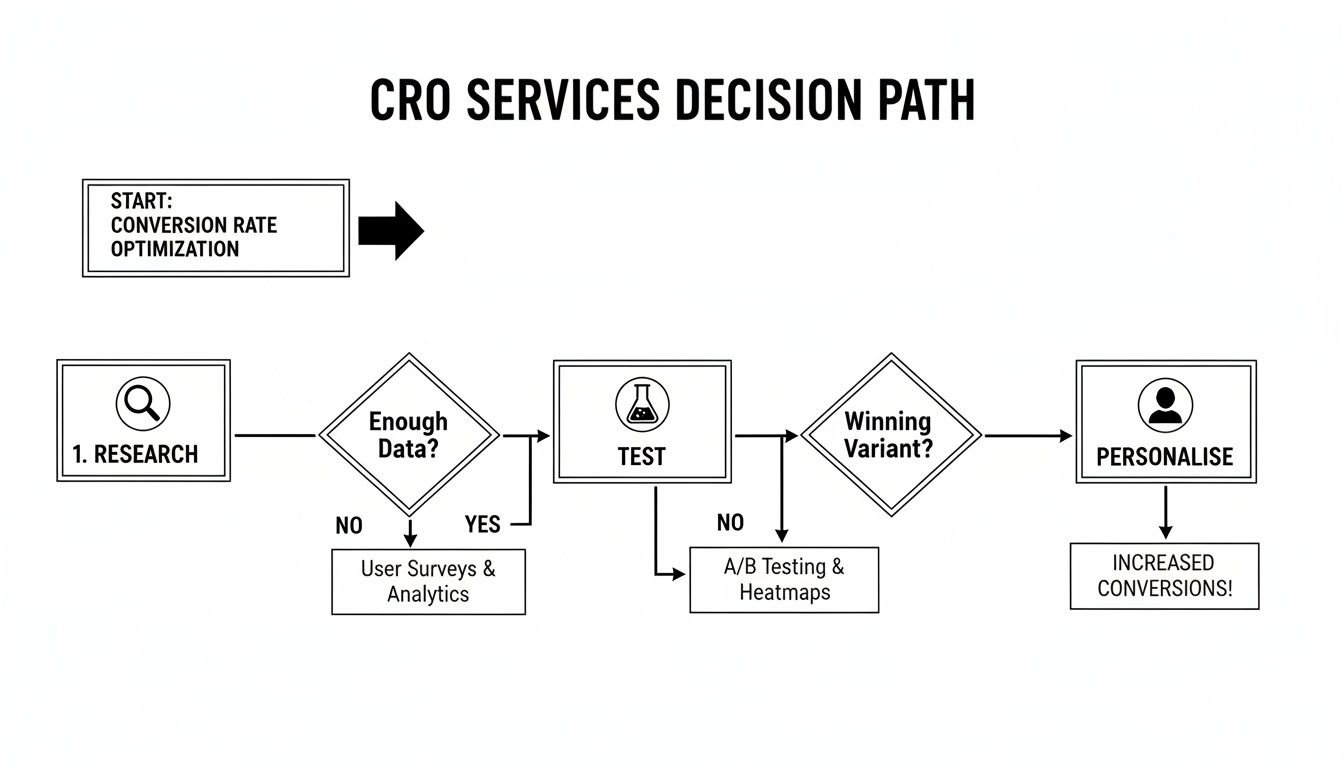
This structured approach ensures every action is backed by evidence, not just a hunch.
On the flip side, one of the biggest red flags is an agency that guarantees a specific conversion lift—like "we'll increase your conversions by 30%!"—without ever having seen your data.
Real CRO experts know that making promises like that is impossible. They understand that success comes from a methodical process of testing and learning, not from making wild guarantees. If it sounds too good to be true, it almost always is.
Why Your Mobile Site Is Probably Losing You Money

If your e-commerce strategy isn't built around mobile first, you're willingly leaving a huge amount of money on the table. I see this all the time. Business owners look at their analytics, see most of their traffic comes from mobile, but then don’t connect the dots to why their mobile conversion rate is so abysmal.
It’s no longer enough to have a website that just "works" on a phone. It needs to be genuinely easy and enjoyable to use. Ignoring this is like closing your physical shop to half of your potential customers.
The gap between mobile traffic and mobile sales is often where the biggest revenue leaks are hiding. In Australia, mobile traffic now dominates, yet it converts at just 1.8% compared to desktop's much stronger 3.9%. This massive difference isn't a coincidence; it's a direct result of clunky, frustrating mobile experiences.
The data also points to a clear fix: mobile-optimised websites are three times more likely to boost conversion rates by 5% or more. You can dig deeper into these Australian CRO statistics and what they mean for your bottom line.
Common Mobile Mistakes Costing You Sales
I've audited hundreds of websites over the years, and the same costly mistakes pop up again and again. These aren't just minor annoyances; they are genuine conversion killers that send frustrated users straight to your competitors.
Here are the most frequent culprits I see:
- Painfully Slow Load Times: Every extra second a page takes to load on mobile sends your bounce rate through the roof. People just won't wait.
- Impossible-to-Use Forms: Trying to fill out tiny form fields or navigate a complicated checkout on a small screen is a recipe for cart abandonment.
- Cluttered Navigation: If users can't find what they're looking for within a few taps, they'll give up. Menus designed for desktop just don't work on mobile.
- Non-Thumb-Friendly Design: Buttons that are too small to tap or are placed too close together make the entire experience feel clumsy and broken.
How a CRO Company Fixes the Mobile Problem
A skilled conversion rate optimisation company tackles these issues head-on. It's not about making a few small tweaks; it’s about rethinking the entire customer journey from a mobile perspective.
This involves actionable strategies designed to close that conversion gap. We focus on creating a seamless experience by implementing thumb-friendly designs, radically simplifying navigation, and integrating one-click payment options like Apple Pay or Google Pay to obliterate checkout friction.
When you're vetting potential partners, make their mobile-first strategy a top priority. Ask them to show you examples of how they've specifically improved mobile conversion rates for other e-commerce clients. Their answer will tell you everything you need to know about their ability to drive real revenue growth for your business.
Measuring the True Success of Your CRO Efforts
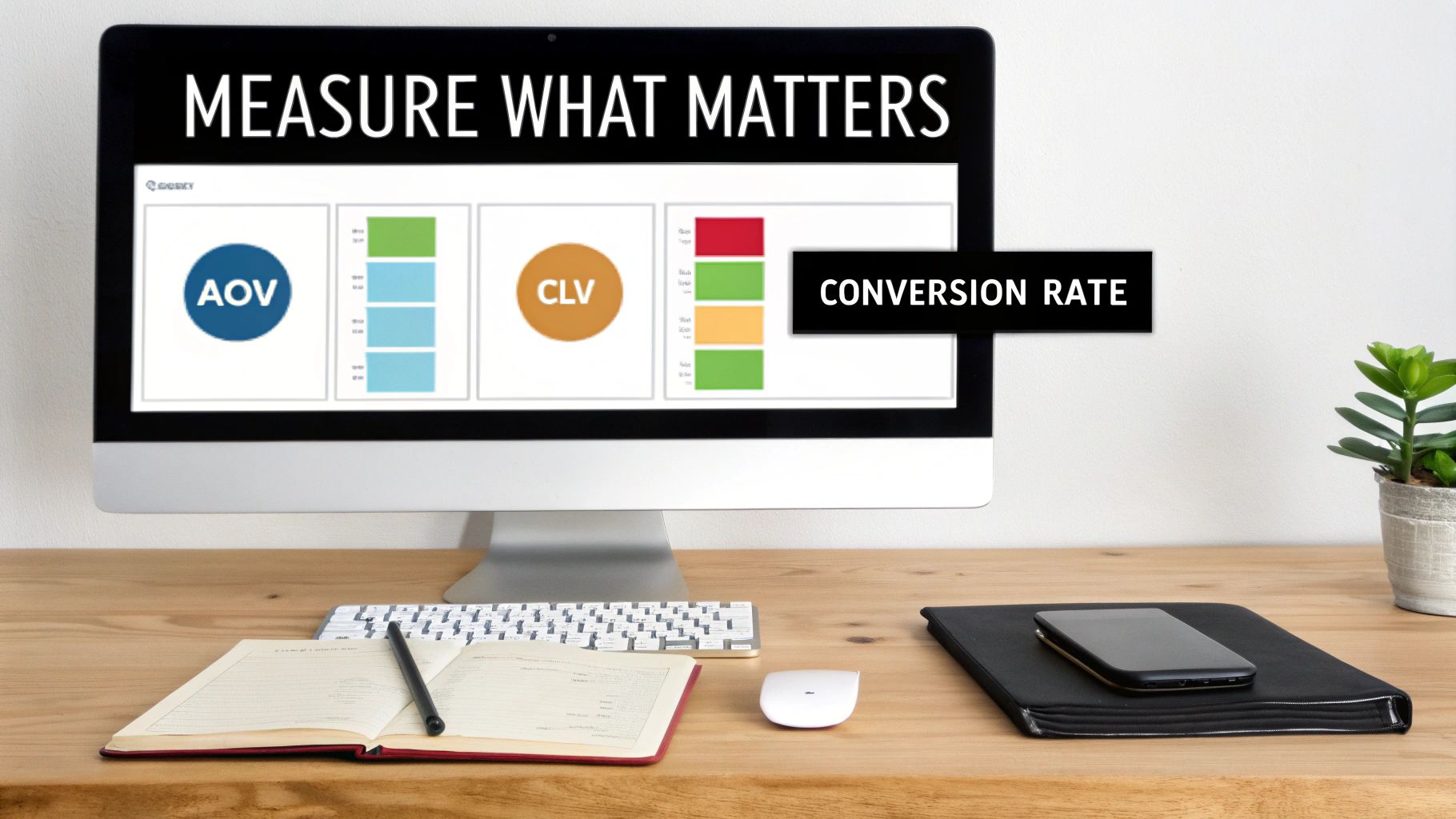
So, you've brought a conversion rate optimisation company on board. How do you actually know if the investment is paying off? In my experience, the headline conversion rate is just one small piece of a much larger puzzle. Real success is measured by the impact on your actual business goals, not just a single percentage point.
A great agency makes this crystal clear from day one. They'll work with you to establish measurable goals and deliver transparent reporting that ties every test and tweak directly back to your bottom line. The best partnerships I've ever been part of are built on this kind of clear, data-driven communication.
Looking Beyond the Headline Metric
An increase in your overall conversion rate is fantastic, but it doesn't tell the whole story. What if that lift came from selling more low-margin products? Or what if you converted more one-time buyers but failed to attract high-value, repeat customers?
This is why we need to look at a broader set of key performance indicators (KPIs). These metrics give you a much richer picture of how user behaviour is changing and, more importantly, how that's affecting your business's health.
Here are the metrics that really matter:
- Average Order Value (AOV): Are customers spending more each time they buy? A solid CRO strategy will often include tests for upselling or cross-selling that directly push this number up.
- Customer Lifetime Value (CLV): Are you attracting and keeping customers who come back again and again? This is a crucial metric for long-term, sustainable growth.
- Cart Abandonment Rate: How many people add items to their cart but bail before checking out? Chipping away at this number is often one of the quickest ways to boost revenue.
- Revenue Per Visitor (RPV): This is a powerful metric. It combines your conversion rate and AOV to show how much each visitor is worth to your business, on average.
What Great Reporting Looks Like
Your agency shouldn't just email you a spreadsheet of A/B test results. They should provide a dashboard that tells a story—explaining what was tested, why it was tested, and what the results mean for your business.
A good report doesn't just show you data; it provides insights. It should clearly explain what was learned from each experiment—win or lose—and outline the next steps in the optimisation roadmap.
A sample dashboard might track these metrics over time, showing the direct impact of the CRO program. For instance, it might show that while the overall conversion rate only nudged up by 0.5%, the AOV jumped by 15%, leading to a significant net increase in monthly revenue.
This is the kind of detail that empowers you to have productive, data-driven conversations with your partner and truly understand the value they're delivering.
Here are some of the most common questions I get asked when business owners are weighing up whether to bring a CRO agency on board. My goal is to give you the straight-up, honest answers so you know exactly what to expect.
How Much Does a Conversion Rate Optimisation Company Cost?
Honestly, it really depends. The cost can vary quite a bit, and most agencies, including many a marketing agency Melbourne has on offer, tend to use one of a few common pricing models.
You'll often see monthly retainers, which can be anywhere from a few thousand dollars up to $10,000 or more for a really comprehensive program.
Some agencies offer project-based fees for one-off things like a website audit. Others might even work on a performance-based model, where they take a slice of the extra revenue they help you generate.
From my experience, the best way to go is with a transparent approach that kicks off with a proper discovery phase. This lets an agency dig in and understand your specific needs. It’s so important to stop seeing CRO as a cost and start seeing it as an investment. A good program should deliver a return that makes the initial outlay feel like a no-brainer.
How Long Until We See Results from CRO?
This is the big one, and I’m always careful to manage expectations here. You might spot some "quick wins" from fixing obvious issues in the first month, but a proper CRO program is a long game.
The initial phase of digging into your data and auditing your site usually takes around 4-6 weeks. Only then can the first real, data-backed tests be launched.
From that point, getting statistically solid results hinges on your website's traffic. A busy e-commerce store might see meaningful data from a single A/B test in just 2-4 weeks. On the other hand, lower-traffic sites will naturally need more time to gather enough data to make a confident call.
As a rule of thumb, I tell my clients to look for consistent, measurable improvements within the first 3-6 months. This is the sweet spot where the initial research really starts to pay off and the strategic testing roadmap hits its stride.
What Is the Difference Between SEO and CRO?
I love this question because it gets right to the heart of how a successful online business actually works. I like to think of SEO and CRO as two star players on the same team—both have a critical job to do.
- SEO (Search Engine Optimisation): This is all about getting more of the right people to your website from places like Google. It’s focused on keywords, content, and the technical health of your site to bring people through the door.
- CRO (Conversion Rate Optimisation): This is what happens the second a visitor lands on your site. Its sole purpose is to make their experience better, so more of them take the action you want them to, like buying something.
Put simply: SEO brings the visitors, CRO turns them into customers. You absolutely need both working together to build a profitable, sustainable online business.
Alpha Omega Digital is a marketing agency based in Melbourne, Australia but also services clients from Sydney, Brisbane, Newcastle, Perth, Adelaide, Darwin and Hobart. Have a project in mind? Contact us.