
Building a website that actually grows your business is so much more than just picking a pretty template. It’s a deep, strategic process that turns your business goals into a hard-working digital asset. From my experience running a marketing agency in Melbourne, I've learned we have to go way beyond aesthetics. The real work is in creating a blueprint that’s laser-focused on user experience, clear conversion paths, and rock-solid technical performance. A great project always kicks off with a deep-dive discovery phase to get inside your customers' heads, and it finishes with a site that actively brings in leads or sales for your eCommerce business.
This guide is going to be massive. We're talking 10,000+ words of actionable advice, real-world examples, and the exact strategies I use for my clients every day. We'll cover everything from choosing the right platform like WordPress or Shopify to advanced marketing tactics like setting up the Meta Conversions API and mastering Google Ads.
Table of Contents
- Crafting a Website Blueprint That Actually Drives Growth
- WordPress vs Shopify: Choosing the Right Engine for Your eCommerce Business
- The Development Deep Dive: Turning Vision Into a High-Performance Website
- Integrating Your Tech Stack for Bulletproof Tracking
- Mastering Paid Advertising for eCommerce Growth
- Local SEO and Google My Business for Melbourne Retailers
- Unlocking Growth with AI: Introducing the AI Receptionist
- Common Questions About Building and Marketing a New Website
Crafting a Website Blueprint That Actually Drives Growth
Before a single line of code is written or a design mockup is even considered, we have to lay the strategic groundwork. As the founder of a digital marketing agency in Melbourne, I've seen it time and time again: a beautiful website without a solid strategy is just an expensive digital brochure. This first discovery phase is where the project is won or lost. It's what separates a site that's just 'nice to look at' from one that becomes your most effective sales tool.
We start by getting deep into your customer's world—mapping out their journey, figuring out their real pain points, and understanding what actually motivates them to click that 'buy' button. It's all about translating your big business goals into a tangible, conversion-focused plan.
Defining Your Core Objectives
First thing's first: clarity. What does success actually look like for this project? We need to ditch the vague goals and lock in specific, measurable outcomes. That means asking some tough questions:
- Are we aiming to boost eCommerce sales by 25% in the next six months?
- Is the goal to increase the average order value by 15% through strategic up-sells?
- Do we need to slash the bounce rate on key product pages by 30%?
The answers to these questions shape the entire project. For instance, a website built to maximise repeat purchases will have a completely different structure and email marketing integration compared to a site focused on acquiring new customers through paid ads.
Mapping the Customer Journey
Once we know what we're trying to achieve, we need to understand who we're building it for. This is where we create detailed user personas that feel like real people, representing your ideal customers. This isn't just about their age and location; it's about their mindset—what drives them, what frustrates them, and the specific problems they're hoping your product can solve.
A website's success is directly proportional to how well it understands and serves its user's intent. The strategy phase is where you bake that understanding into the very foundation of the project.
By mapping out their journey from the first ad they see to the post-purchase follow-up email, we can anticipate what they'll need at every single touchpoint. This ensures the site's architecture, content, and design all work in harmony to guide them smoothly towards that final conversion. As you map out your own blueprint, you'll find some great expert tips to plan, build, and scale your ecommerce website that can help maximise sales. Getting this foundational work right is absolutely critical for creating an intuitive and effective user experience that delivers real business results.
WordPress vs Shopify: Choosing the Right Engine for Your eCommerce Business
One of the biggest calls you'll make is the platform your website is built on. For most Australian eCommerce businesses we work with, this decision usually comes down to two heavyweights: WordPress (with WooCommerce) and Shopify. As both a Shopify development partner and a seasoned WordPress development company, I’ve seen the good, the bad, and the brilliant of each platform up close.
A simple way to start is by looking at your main goal. Is your primary focus on selling products directly with maximum ease, or do you need a powerful content and marketing platform with an eCommerce component? This one question can point you in the right direction.
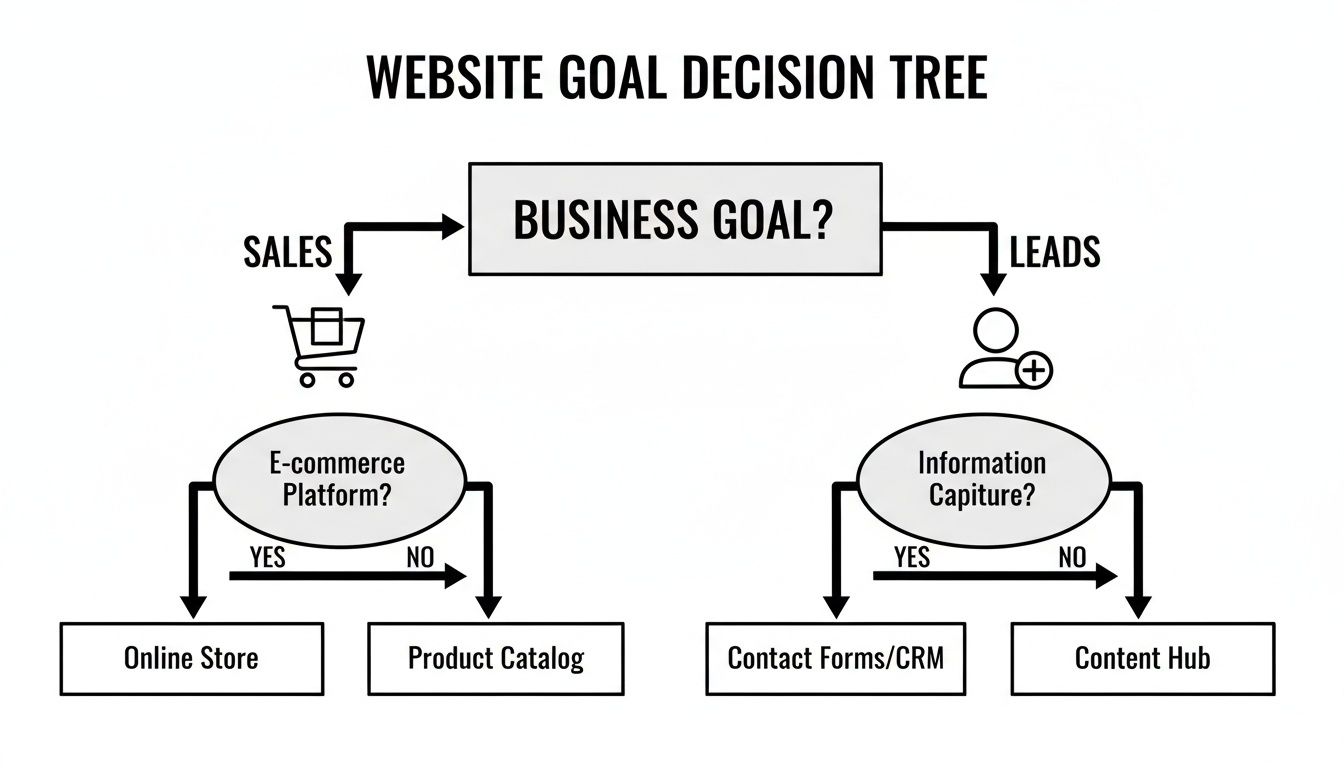
This decision tree cuts through the noise. It highlights that fundamental fork in the road, guiding you toward the platform that’s naturally built for either a sales-first eCommerce model or a more content-driven, customisable business.
When Shopify Is the Clear Winner for eCommerce
I almost always recommend Shopify to businesses that are laser-focused on selling products online. It's an absolute powerhouse for eCommerce. If your primary goal is to get a secure, scalable, and user-friendly store up and running quickly, nothing beats it.
Shopify is built for commerce from the ground up. This means crucial features like inventory management, payment processing, and abandoned cart recovery are baked right in. As an experienced Shopify developer, I can tell you that its managed hosting is a huge relief for business owners—you never have to worry about security patches or server maintenance. It just works, letting you focus on marketing and selling.
The Case for WordPress: Unmatched Flexibility and Control
On the other hand, WordPress offers a level of freedom that's hard to beat. If your business relies heavily on content—think detailed blog posts, extensive guides, or resource libraries to fuel your SEO—WordPress is typically the superior choice. Its roots as a content management system are still its greatest strength.
This is where the real customisation happens. As a dedicated WordPress developer in Melbourne, I've built some truly unique solutions for clients, from custom post types for unique content to deep integrations with third-party CRMs and inventory systems. If you have a unique business model that doesn’t fit into a standard eCommerce box, or you want to own your platform outright, the flexibility of WordPress is invaluable. A skilled team of /wordpress-developers/ can tailor the platform to your exact needs.
WordPress vs Shopify: A Quick Comparison for eCommerce
| Feature | WordPress (WooCommerce) | Shopify |
|---|---|---|
| Ease of Use | Steeper learning curve. Requires more technical know-how for setup and maintenance. | Incredibly user-friendly. Designed for non-technical users to set up and manage a store easily. |
| Customisation | Almost limitless. Thousands of themes and plugins allow for deep customisation and features. | Good customisation within its theme structure and App Store, but core functions are locked. |
| Cost Structure | Lower initial software cost (it's free), but costs add up for hosting, themes, and plugins. | Monthly subscription fee. Transaction fees apply unless using Shopify Payments. |
| Best For | Content-heavy sites, complex eCommerce models, and businesses wanting full control and ownership. | Product-first businesses, startups, and merchants who prioritise speed and simplicity. |
| SEO Capabilities | Excellent. With plugins like Yoast, you have granular control over on-page and technical SEO. | Strong built-in SEO features, but less flexibility for advanced technical configurations. |
| Maintenance | You are responsible for updates, security, and hosting. Requires ongoing management. | Fully hosted and managed. Shopify handles all security, updates, and server maintenance. |
At the end of the day, the platform you choose is a trade-off. Shopify gives you streamlined simplicity for commerce, while WordPress delivers boundless flexibility for everything else.
The platform choice often comes down to a simple trade-off: Shopify offers streamlined simplicity for commerce, while WordPress delivers boundless flexibility for content and customisation.
The costs for building on these platforms can vary widely here in Australia. A basic brochure site might start around AUD $4,000, but a proper eCommerce store often lands in the AUD $5,000 to $15,000 range. For feature-rich, custom websites—the kind that usually demand a platform like WordPress—it’s not uncommon to see costs exceed AUD $15,000 due to the complexity involved.
Ultimately, this isn’t about which platform is "better," but which one is better for your business goals. A product-first brand will thrive on Shopify’s simplicity, while a content-driven business needing unique functionality will find its home with a custom /wordpress-development/.
The Development Deep Dive: Turning Vision Into a High-Performance Website
This is where the blueprints from our strategy sessions get turned into a real, living, breathing website. The development phase is all about bringing those wireframes and designs to life, building a fully functional site that doesn’t just look good, but performs brilliantly. As a team of developers, we get obsessed with the technical details—because that foundation determines everything from user experience to your bottom line.
A huge part of my philosophy is clean, efficient code. It isn't just about making things work; it's about making them work beautifully. Clean code leads to faster loading times, fewer bugs, and a website that’s much easier to update and scale down the road. It’s the invisible engine that powers a great user experience. Whether we're working as a /wordpress-developer-sydney/ or right here in Melbourne, this principle is non-negotiable.
A Mobile-First Development Philosophy
We build every single website with a mobile-first approach. This means we design and develop for the smallest screen first—your phone—and then scale up to tablets and desktops. With a huge portion of web traffic now coming from mobile devices, if your site isn't flawless on a phone, you're actively turning away customers.
This approach isn't just a trend; it's a discipline. It forces us to prioritise what’s most important and ensures the core user journey is clear and uncluttered on any device, which ultimately leads to a much better experience for everyone.
Building for Ultimate Flexibility and Functionality
The real magic happens when we tailor the platform to your exact business needs. This isn't about just installing a pre-made theme; it's about creating custom solutions that give you a competitive edge.
Building Custom Blocks in Gutenberg for WordPress
For our clients on WordPress, this often involves building custom Gutenberg blocks. Instead of being stuck with a rigid page builder, we create unique, reusable content blocks. Your team can then build beautiful, on-brand pages without ever touching a line of code. A skilled WordPress web developer can craft these blocks to give you complete creative control while keeping everything consistent. This is a core part of our service as a /wordpress-development-company/.
A well-developed website is more than just a collection of pages. It's a customised toolkit designed to make your marketing and content management as efficient and powerful as possible.
Building Custom Shopify Apps Using Shopify CLI
On the eCommerce side, our work as Shopify developers often involves digging deep into the Shopify API. We can:
- Build custom Shopify apps using Shopify CLI to add unique features that don't exist in the App Store, like a complex product customiser or a unique wholesale portal.
- Integrate your store with third-party inventory or shipping systems for seamless operations.
- Create bespoke customer experiences, like product customisers or unique subscription models.
This level of custom Shopify development transforms your store from a standard template into a unique sales machine built specifically for your business. Leveraging the /shopify-developer-api/ is key to unlocking this potential.
Obsessing Over Site Speed
Finally, we are relentless when it comes to optimisation. Site speed is not a 'nice-to-have'—it's a critical conversion factor. Studies have consistently shown that even a one-second delay in page load time can cause a significant drop in conversions.
We implement a whole range of techniques to make sure your site is lightning-fast, including image compression, code minification, and leveraging browser caching. This technical focus ensures that the user experience is smooth and frustration-free, keeping visitors engaged and moving them closer to a purchase. From the very start of the design and development of a website, performance is at the forefront of every single decision we make.
Integrating Your Tech Stack for Bulletproof Tracking
Launching a website without proper tracking is like driving with your eyes closed. As a data-driven digital marketing agency in Melbourne, we have a simple rule we live by: if you can't measure it, you can't improve it. This stage is all about building the technical foundation that makes every marketing dollar accountable.
This isn't just about dropping a bit of code in the header. It’s about creating a solid measurement framework.
Setting Up Google Tag Manager (GTM) Containers
We start by setting up Google Tag Manager (GTM) containers. Think of GTM as a central toolbox; it lets us manage and deploy all our marketing and analytics tags—like Google Analytics or the Meta Pixel—from one spot, without needing to bug a developer every time. We create a container, install it on the site, and from then on, we can add, edit, and remove tracking scripts with ease. This gives us agility in our marketing efforts.
Once GTM is ready, we integrate Google Analytics 4 (GA4). But we go way beyond just tracking page views. We set up specific conversion events that actually line up with your business goals. For an eCommerce store, we track 'add to cart' actions, initiated checkouts, and completed purchases with dynamic revenue values. This level of detail gives us a crystal-clear view of what's working and what’s not.
Implementing the Meta Conversions API (CAPI)
For our eCommerce clients, a critical step is the Conversions API installation for Meta. This creates a direct, server-to-server connection between your Shopify or WordPress site and Meta's servers. Why is this so important? Because it neatly bypasses browser-based tracking issues (like ad blockers or iOS updates), which can cause you to lose up to 30% of your conversion data.
Setting up the Meta Conversions API isn't just a 'nice to have' anymore; it's a critical tool for maintaining accurate ad attribution in a world of increasing data privacy restrictions.
Why Server-Side Tracking is Non-Negotiable for eCommerce
CAPI is a form of server-side tracking. By sending data directly from your server to platforms like Facebook and Google, you get a much more accurate and reliable picture of your ad performance. It allows for better ad optimisation, more accurate reporting on Return On Ad Spend (ROAS), and helps Meta's algorithm find more people likely to buy from you. This bulletproof tracking foundation is what allows us to confidently run effective Google Ads and Meta Ads, measure ROAS, and make smart decisions to grow your business. It's wild how many businesses fly blind without this insight. In fact, a shocking 41% of Australian small businesses still don't have a website at all. This reliance on other channels means they're missing out on the 37.7% of Australian consumers who discover brands through search engines—a huge opportunity that proper tracking helps you tap into. You can read more about these Australian website statistics to see the whole picture.
Mastering Paid Advertising for eCommerce Growth
The moment your website goes live is the starting line, not the finish. It’s a huge milestone, absolutely, but the real work of turning that brand-new asset into a profitable engine for your business is just beginning. The focus immediately shifts to connecting your website to powerful marketing channels that drive traffic and sales from day one. Marketing your business is all about consistency.
Mastering Facebook Ads: A Crash Course
As a Facebook ads agency, we know that Meta's platform is a powerhouse for eCommerce brands. But it's not as simple as boosting a post.
The Meta Ads Creative Testing Process
Success on Meta comes down to creative. We follow a rigorous Meta ads creative testing process. This involves systematically testing different images, videos, headlines, and ad copy to find winning combinations. We start with broad audiences to gather data, then scale the winning ads to more targeted lookalike and interest-based audiences.
How to Measure Success with Facebook Ads
The key metrics we obsess over are Return On Ad Spend (ROAS), Cost Per Purchase (CPP), and Click-Through Rate (CTR). But it's crucial to look at the entire funnel. We use tools like GA4 and Triple Whale to get a blended view of attribution, understanding how Meta ads influence purchases across different channels.
Facebook Ads – Don't Quit Too Early!
One of the biggest mistakes I see is businesses quitting their ads too early. Meta's algorithm needs time and data to learn and optimise. It can take 3-7 days for an ad set to exit the "learning phase." Patience is key. We let the data guide our decisions, rather than making knee-jerk reactions based on one or two bad days.
Beginner's Guide to Google Shopping Ads
For eCommerce, Google Shopping ads are a must. These are the product listings you see at the top of Google search results. They are incredibly effective because they show the product, price, and brand to a user with high buying intent.
Google Shopping Ads for Dropshipping
If you're in dropshipping, Shopping ads can be a goldmine. The key is a well-optimised product feed. Your product titles, descriptions, and images must be high-quality and keyword-rich. You also need to ensure your pricing and shipping information is competitive and clearly stated.
Understanding Campaign Priority in Google Ads
When you have multiple Shopping campaigns targeting the same products, you need to use campaign priority settings (High, Medium, Low). A common strategy is to create a "catch-all" campaign on Low priority with low bids, and then a separate campaign on High priority with higher bids targeting your best-selling products. This gives you more control over your budget.
PMAX vs. Standard Google Shopping Ads
Performance Max (PMAX) is Google's automated campaign type that runs ads across all of Google's channels (Search, Shopping, YouTube, Display, etc.). For eCommerce, PMAX vs Google Shopping ads is a hot topic. PMAX can deliver incredible results by leveraging machine learning, but it offers less manual control. Standard Shopping gives you more granular control over bids and negatives. Often, a hybrid approach works best.
What to do when Google Shopping Ads are not spending budget
This is a common frustration. If your Google Shopping ads are not spending budget, check these things first: bids are too low, your product feed has disapprovals in the Merchant Center, your audience targeting is too narrow, or your budget is being limited by another campaign's priority setting.
What Budget Should You Spend on Google Ads?
This is the million-dollar question. How much does it cost to start Google ads? There's no magic number. I tell my clients to start with a budget they are comfortable losing for the first 30-60 days. This is the data-gathering phase. A good starting point for a small eCommerce business in Australia might be $50-$100 per day. The key is to focus on profitability. Once you have a campaign that is generating a positive ROAS, you can confidently scale the budget. The goal is to spend as much as possible, as long as it's profitable.
Local SEO and Google My Business for Melbourne Retailers
If you have a physical store in Melbourne, you can't ignore local search. As a leading SEO agency in Melbourne, we know that dominating the local map pack is critical for driving foot traffic.
Optimising Your Google Business Profile
Your Google My Business (now Google Business Profile) listing is your most important asset for local SEO. It needs to be fully optimised:
- Complete Information: Fill out every single section—services, products, attributes, Q&A.
- Accurate NAP: Your Name, Address, and Phone number must be consistent everywhere online.
- Photos & Videos: Regularly upload high-quality photos of your store, products, and team.
- Google Posts: Use Google Posts to announce promotions, new products, and events.
Building Local Citations and Reviews
Beyond your profile, we focus on building local citations—mentions of your business NAP on other local directories (like Yellow Pages, TrueLocal). Consistency is key. We also implement a strategy to actively encourage customer reviews, as they are a huge ranking factor and build trust with potential customers.
Unlocking Growth with AI: Introducing the AI Receptionist
One of the most exciting advancements we're implementing for service-based businesses (and even some eCommerce brands with high-touch customer service) is the ai-voice-agent. This technology is a complete game-changer, especially for businesses that rely on phone calls for bookings and inquiries.
What is an AI Voice Agent and How Does it Work?
An ai-voice-agent is an artificially intelligent system that can answer phone calls, understand human language, and perform specific tasks just like a human receptionist. We set this up for our clients by securing a custom number through a service like Twilio. When a customer calls that number, the AI answers instantly. It can handle conversations, answer frequently asked questions, and even take messages or book appointments.
Key Features of an AI Appointment Setter
The real power comes when the AI functions as an ai appointment setter. Here's what it can do:
- 24/7 Call Answering: It never gets sick, never takes a holiday, and never gets tired. Your phone is answered professionally every single time, day or night.
- Instant Appointment Booking: The AI can access your calendar (like Google Calendar or Calendly) and book appointments directly into available slots, sending confirmations to both you and the customer.
- Saves Thousands in Lost Business: Think of all the missed calls that happen when you're busy, after hours, or on the weekend. The AI captures every single one, turning missed opportunities into booked jobs and revenue.
AI Receptionist Australia: A Game Changer for Service Businesses
We're seeing incredible results with our ai receptionist Australia solution for tradies, hairdressers, beauty therapists, dentists, restaurants, and doctors. For a tradie, it means never missing a lucrative job inquiry while you're on the tools. For a salon, it means filling up the appointment book without having to stop working on a client. These ai appointment setters are revolutionising how small businesses operate.
Exploring AI Voice Agent Pricing
When you compare ai voice agent pricing to the cost of a full-time human receptionist (upwards of $50,000 per year plus benefits), the value is insane. It's an incredibly affordable way to ensure you have a professional, efficient front line for your business, capturing every lead and providing exceptional customer service around the clock.
Common Questions About Building and Marketing a New Website
Over the years, we've sat down with hundreds of eCommerce business owners to talk about their websites. It's a big investment, so it's only natural to have a lot of questions. Here are some of the most common ones that pop up.
How Much Does a New Website Cost in Australia?
This is usually the first question people ask, and the honest answer is: it depends on the complexity. The cost of a website in Australia really hinges on what you need it to achieve.
A simple, professional brochure-style site might start at around $4,000. But if you’re looking for a conversion-focused eCommerce website built on Shopify or WordPress—something designed from the ground up to generate sales—you're typically looking at a range of $5,000 to $15,000, and sometimes more.
What pushes the price up? Things like custom design work, complex product variations, and special functionality like integrating with an inventory management system or developing a unique feature. A /wordpress-website-developer/ can provide a detailed quote based on your specific requirements.
How Long Will It Take to Build My Website?
For a standard eCommerce project, a realistic timeline is usually between 6 to 12 weeks. This covers everything from our initial strategy session right through to launch day.
Of course, this can be quicker for more straightforward stores or a bit longer for complex projects that need a lot of custom development. One of the biggest things that keeps a project on track is having your team ready to provide feedback, content, and approvals at key stages. We map everything out in a detailed project plan, so you’ll always know exactly where we are.
Should I Choose WordPress or Shopify for My Online Store?
Great question, and it really comes down to your business model. I generally find that Shopify is the perfect choice for eCommerce businesses that are purely focused on selling products. It’s incredibly user-friendly, secure, and its built-in sales tools are fantastic for getting to market quickly.
On the other hand, WordPress (paired with WooCommerce) offers unmatched flexibility. It's a better fit for businesses that lean heavily on content marketing, need deep customisation, or have very specific features in mind that an off-the-shelf platform just can’t handle. As a leading WordPress development agency in Melbourne, we can sit down with you and properly weigh up the pros and cons based on your specific growth goals.
Do You Help with Marketing After the Website Is Launched?
Absolutely. Launching a website isn't the finish line; it’s the starting block.
We’re a full-service digital marketing agency in Melbourne, and our job is to make sure your new site actually gets seen by the right people and generates a return. We specialise in driving highly targeted traffic from day one using our expertise as a Google ads and Facebook ads agency. We partner with you for the long haul to ensure your new website delivers a strong, measurable return on your investment.
Alpha Omega Digital is a marketing agency based in Melbourne, Australia but also services clients from Sydney, Brisbane, Newcastle, Perth, Adelaide, Darwin and Hobart. Have a project in mind? Contact us.