Let’s get straight to the point. 'Ecommerce in marketing' isn’t just about sticking a ‘buy now’ button on your website and calling it a day. It’s a complete shift in thinking. It’s about building your entire marketing world around the way people actually buy things online.
I've seen it time and time again with Melbourne businesses I've worked with. The moment they stop seeing their website as a digital brochure and start treating it as their number one salesperson—one that works 24/7, mind you—is the moment everything changes. Suddenly, every single marketing touchpoint has a clear job: guide people smoothly from discovery to checkout.
How Your Store Becomes the Central Hub of Marketing
When you truly lean into ecommerce, your online store becomes the sun in your marketing solar system. Everything else—your SEO, paid ads, social media, and email campaigns—is a planet orbiting it, drawing its energy and purpose from that central point.
Without this hub, marketing activities often feel disconnected and chaotic. I often explain it to clients like this: a Google Ad might bring in traffic, but if the landing page isn't built to convert, you've just wasted your money. An Instagram post might rack up thousands of likes, but if there's no clear path to your store, it's just a vanity metric that doesn't pay the bills.
Connecting the Dots for Real Growth
Proper ecommerce marketing makes sure every action has a purpose tied directly to revenue. It’s an integrated approach where:
- Your SEO strategy isn't about generic traffic; it’s about ranking for keywords that high-intent buyers are searching for, leading them right to your product pages.
- Your paid ad campaigns, whether on Google or Meta, are measured by Return On Ad Spend (ROAS), not just clicks, because the only thing that matters is a completed transaction.
- Your content marketing—from blog posts to videos—doesn’t just inform or entertain. It builds desire and nudges visitors towards making a purchase on your site.
This visual shows how your online store acts as the central hub, with key marketing channels radiating outward to drive growth.
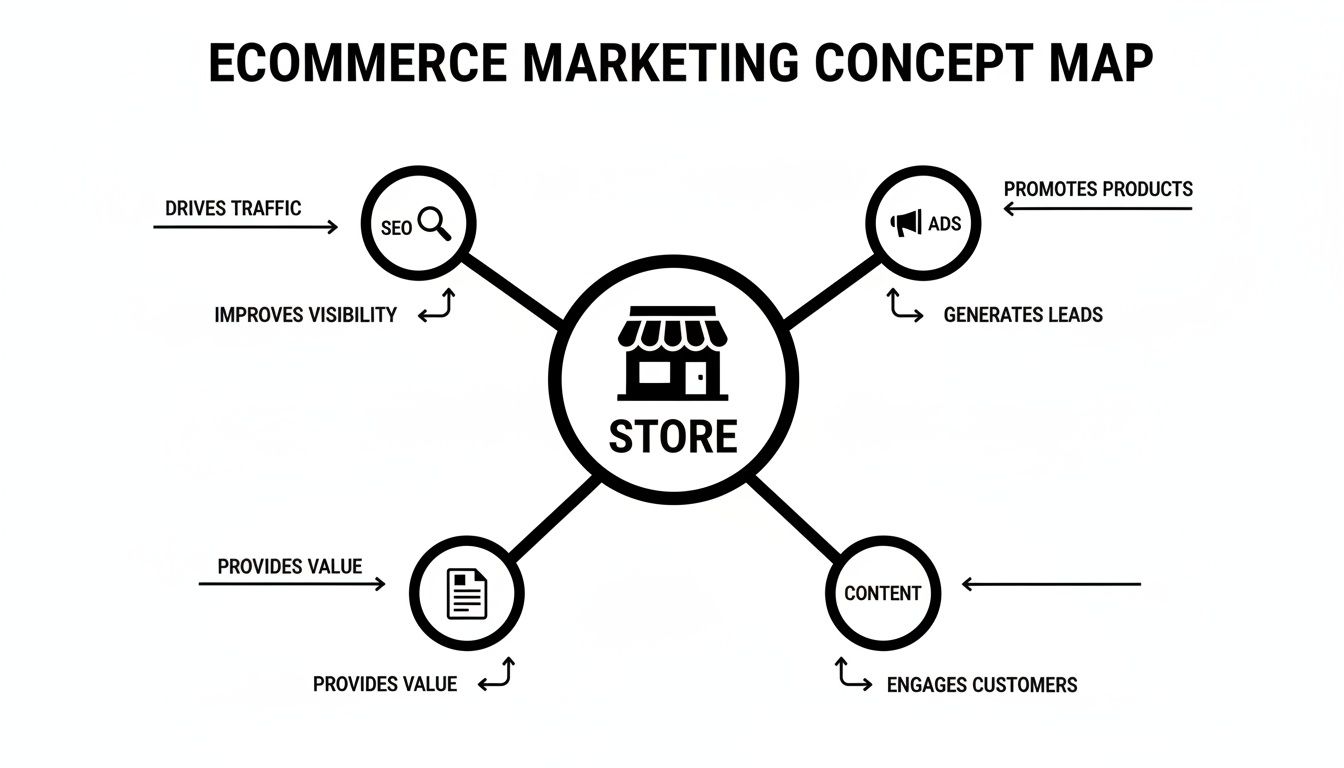
The key takeaway here is simple: all channels have to work together, funnelling interest and traffic back to the place where the sale actually happens.
To put it into perspective, here’s how these channels directly feed into your ecommerce goals.
How Key Marketing Channels Fuel Your Ecommerce Engine
This table breaks down how essential marketing channels connect directly to tangible ecommerce outcomes.
| Marketing Channel | Primary Role in Ecommerce | Key Success Metric |
|---|---|---|
| SEO | Captures organic search demand from ready-to-buy customers. | Organic Conversion Rate |
| Paid Ads | Drives immediate, targeted traffic to product or landing pages. | Return On Ad Spend (ROAS) |
| Email Marketing | Nurtures leads, recovers abandoned carts, and drives repeat sales. | Customer Lifetime Value (LTV) |
| Social Media | Builds brand awareness and funnels engaged followers to the store. | Click-Through Rate (CTR) to Site |
When each channel understands its role, the entire system becomes a well-oiled machine designed for one thing: sales.
From Cost Centre to Revenue Driver
For a lot of business owners, especially the ones I've met here in Melbourne, marketing can feel like a necessary but painful expense. But when your ecommerce store is the engine, that entire perception flips. You stop seeing marketing as a cost and start seeing it as a direct investment in sales.
By treating your website as the ultimate salesperson, every marketing dollar becomes accountable. You're not just spending on ads; you're investing in a system designed to acquire customers and generate a measurable return.
This shift is everything. It’s the difference between guessing what works and knowing what drives your business forward. Every campaign, every piece of content, and every little website tweak becomes an opportunity to sharpen your sales process and grow your bottom line.
Building Your Foundation: The Right Ecommerce Platform
Before you spend a single dollar on a Google ad or map out an Instagram campaign, we need to talk about your website. I’ve seen countless marketing campaigns fail before they even begin, and it’s almost always because the website—the very stage for the performance—wasn't up to the task.
Choosing your ecommerce platform isn’t just a technical step; it's one of the most important marketing decisions you will ever make.
Think about it. A slow, clunky, or confusing website will absolutely sabotage your return on ad spend. You can have the most compelling ads in the world, but if users land on your site and can't find what they need or the page takes forever to load, they’re gone. That's a lost sale and wasted ad budget, plain and simple.
A crucial first step is selecting from the best ecommerce platforms for small business that actually aligns with your specific needs and growth ambitions. For most businesses I work with, this decision boils down to two main contenders: Shopify and WordPress (with WooCommerce).
The Great Debate: Shopify vs. WordPress
As a digital marketing agency in Melbourne, this is a conversation I have almost weekly with clients. There's no single right answer, but there’s definitely a right answer for your business. The choice you make has huge implications for your marketing flexibility, scalability, and technical overhead down the line.
Shopify Development: An All-in-One Powerhouse
For many Melbourne retail brands, especially those just starting out or looking for a streamlined, no-fuss solution, Shopify is often the perfect match. Our team of expert Shopify developers has seen firsthand how it can accelerate growth.
- Ease of Use: Shopify is famously user-friendly. It’s a hosted platform, which means they handle all the technical heavy lifting like security, hosting, and software updates. You just focus on selling.
- App Ecosystem: Its biggest strength is the massive app store. Need a specific loyalty program, an advanced review system, or a way to set up subscriptions? There's an app for that, allowing for rapid feature deployment.
- Payment Gateways: Shopify Payments is built-in, making it incredibly simple to start accepting credit cards right out of the box.
The trade-off for all this convenience is less control over the underlying code. While you can customise themes and add apps, you don't have the same ground-up freedom you get with WordPress. That's where building a custom Shopify app using the Shopify API and Shopify CLI can be a game-changer for businesses needing unique functionality without leaving the ecosystem.
WordPress Development: Ultimate Flexibility and Control
For businesses that need unique features, complex integrations, or have a strong content marketing focus, a custom WordPress build offers total creative freedom. We’ve seen many businesses in Melbourne and Sydney achieve incredible results with this platform.
- Total Customisation: With WordPress, if you can dream it, a skilled wordpress developer in melbourne can build it. You own the code and have complete control over every single element of your site's design and functionality, right down to building custom blocks in Gutenberg for a truly unique content experience.
- SEO Potential: While Shopify's SEO is good, WordPress offers a higher ceiling for technical SEO. You have much finer control over things like URL structures, server settings, and advanced schema markup.
- Content Management: Let's not forget, WordPress started as a blogging platform. It remains the undisputed champion for content management. If your strategy involves extensive blogging, resource hubs, or detailed guides, WordPress is king.
The flip side is that with great power comes great responsibility. You’re on the hook for hosting, security, and maintenance. This is where working with an expert WordPress developer is a complete game-changer, ensuring your site is fast, secure, and ready to scale.
How Your Platform Choice Affects Your Marketing Tech
This decision directly impacts how easily you can implement critical marketing technologies. For instance, the Conversions API installation for Meta—which is essential for accurate ad tracking after Apple's iOS changes—can be done with a few clicks via an app on Shopify. On WordPress, it might require a more manual setup through setting up Google Tag Manager containers.
Your ecommerce platform isn't just a sales tool; it's the technical foundation of your entire marketing stack. The right choice simplifies tracking, enhances user experience, and maximises your SEO potential from day one.
Ultimately, whether you choose the streamlined path of Shopify development or the limitless potential of a custom WordPress build, making an informed choice is vital. It sets the stage for every marketing activity to follow, from your paid ads to your organic growth.
Driving High-Intent Traffic with Paid Advertising
Once your store is humming along and optimised for sales, it’s time to open the floodgates. SEO is a fantastic long-term play, but when you need high-intent traffic now, paid advertising is your best friend. It’s like turning on a tap of potential customers who are literally searching for what you sell at that very moment.
As a digital marketing agency in Melbourne, we’re in the trenches with paid ads every single day. I’ll walk you through the exact channels we use to generate sales for our ecommerce clients, helping you move from guesswork to genuine, data-driven results.
A Beginner's Guide to Google Shopping Ads
If you sell physical products, Google Shopping ads are non-negotiable. Seriously. These are the product listings you see right at the top of the search results, complete with images and prices. Their power comes from capturing people at the absolute peak of their buying intent.
A common trip-up for beginners is understanding the difference between standard Shopping campaigns and Performance Max (PMAX), and how campaign priority in Google Ads affects them.
- Standard Shopping Ads: These give you fine-grained control. You can set specific bids for individual products, block irrelevant searches with negative keywords, and have a much more direct say in where your ads show up. It’s the hands-on approach.
- PMAX (Performance Max): This is Google's all-in-one, automated campaign. You feed it your assets—your product list, images, videos, and text—and Google’s AI goes to work, showing your ads across all its channels (Search, Shopping, YouTube, Display) to hunt down conversions. When running both, PMAX will typically take priority over your standard shopping campaigns for the same products.
For a lot of new stores, the PMAX vs Google Shopping ads debate ends with PMAX being a great way to start. But for stores with thousands of products or tight margins, the control of a standard Shopping campaign is priceless. We often run both, letting PMAX find new customers while using standard campaigns to push our most profitable items.
The Meta Ads Creative Testing Process
While Google is great for capturing existing demand, Meta (that’s Facebook & Instagram) is where you generate it. Success on these platforms lives and dies by your creative. As a Facebook ads agency, I've seen so many businesses quit too early simply because they didn’t have a proper testing process.
Our approach is simple but incredibly effective:
- Brainstorm Creative Angles: We start with questions. Will a raw, user-generated content (UGC) video outperform a polished studio ad? Does a headline that highlights a pain point work better than one that focuses on a benefit?
- Test One Thing at a Time: We isolate variables. In one campaign, we might test three different videos against the exact same ad copy. In another, we’ll take the winning video and test three new headlines against it.
- Analyse and Iterate: After a few days, we dig into the data—not just clicks, but Add to Carts and, most importantly, Purchases. The winning creative becomes the new "control," and we start testing new ideas against it.
This process takes the emotion out of it and lets the data tell us what people actually want to see. Over time, it consistently brings down the cost to acquire a new customer. The key is consistency; marketing your business = consistency, and that's especially true with creative testing.
Demystifying Your Google Ads Budget
"How much does it cost to start Google Ads?" It's the question I get asked every single week, and the honest answer is always the same: it depends on your goals and your data. There’s no magic number.
Instead of pulling a figure out of thin air, I tell clients to start with a "data acquisition budget." Think of it as an investment in learning. This might be $500 to $1,500 for the first month. The goal isn’t to be wildly profitable from day one; it's to gather enough data to figure out your Cost Per Acquisition (CPA).
Once you know what it costs you to get a sale, then you can set a realistic budget based on how fast you want to grow.
The Australian ecommerce market is a huge opportunity for this kind of smart investment. By 2025, B2C sales will make up over 60% of the market, while the B2B ecommerce space is set to grow at a blistering 13.12% CAGR through 2031. With the total market projected to hit USD 90.57 billion by 2031, a data-led ad strategy is crucial for carving out your piece of the pie. You can learn more about the booming Australian ecommerce landscape here.
Making every dollar count is everything. That means having flawless tracking set up with Google Tag Manager and Google Analytics 4. And for businesses that rely on phone calls, using call tracking software like CallRail is essential to connect your ad spend to actual, real-world leads.
Attracting Organic Customers with Long-Term SEO
Paid ads are great for getting traffic right now—they turn on the tap. But I’ve learned from years in the trenches that true, sustainable, and profitable growth comes from building an asset that works for you 24/7. That asset is Search Engine Optimisation (SEO). As an SEO agency in Melbourne, I see its compounding value for our ecommerce clients every single day.
SEO is the long game. It’s about earning trust with both customers and search engines, creating a steady stream of high-intent organic traffic that doesn’t vanish the moment you stop paying for ads. It’s about building a foundation today that pays you back for years to come.
Starting with Local SEO and Your Google Business Profile
For any ecommerce brand with a physical footprint or a local service area—even if it's just a warehouse in Melbourne—Local SEO is non-negotiable. Your Google Business Profile (GBP) is your digital shopfront on Google Search and Maps.
Honestly, optimising it is one of the highest-impact things you can do early on. This means:
- Making sure your business name, address, and phone number are perfectly consistent everywhere online.
- Uploading high-quality photos of your products, your storefront, and your team.
- Actively encouraging and responding to every single customer review.
- Using Google Posts to announce new products, sales, and company updates.
When a potential customer nearby searches for what you sell, a well-managed GBP puts you right at the top of the map pack, driving both foot traffic and online orders.
On-Page SEO for Products and Content
Once your local presence is dialled in, the focus shifts to your website itself. This is where expert Shopify development or WordPress development becomes absolutely mission-critical. A well-structured website is the bedrock of good SEO; it helps Google understand exactly what you sell and who you sell it to.
To attract organic customers, you have to get the fundamentals of your product listings right. Think of it as merchandising your digital shelves. A great product page does more than just list features; it tells a story and answers every question a customer might have before they even think to ask it. For a deep dive, I always point people towards the anatomy of a perfect product listing, as it breaks this process down beautifully.
This involves targeting long-tail keywords—those longer, more specific search phrases that signal a customer is ready to buy. A person searching for "running shoes" is just browsing. But someone searching for "best women's trail running shoes for wide feet" is pulling out their wallet.
We weave these keywords into product descriptions, titles, and image alt-text. But just as important is creating blog content that answers the questions your customers are actually asking. A blog post on "How to Choose the Right Running Shoe" not only attracts organic traffic but also positions your brand as a helpful authority.
This strategy is particularly powerful given the huge growth in the Australian market. The country's online shopping market size rocketed to $60.8 billion in 2025, an 8.7% increase from the previous year. This growth is fuelled by 82% of households making online purchases, creating a massive pool of potential customers actively searching for products just like yours.
By investing in SEO, you're not just chasing clicks. You are building a sustainable, long-term channel that captures this growing demand, steadily reducing your reliance on paid traffic and increasing your profitability over time.
Measuring What Actually Moves the Needle
Marketing without measurement is just guesswork. You might as well be throwing money into a bonfire and hoping for the best.
In ecommerce, we’re drowning in data. The real trick is learning to ignore the vanity metrics—things like social media likes or a spike in website traffic that doesn't lead to sales. They feel good, but they don't pay the bills.
From my experience working with Melbourne-based Shopify stores, the brands that truly scale are ruthless about focusing on the key performance indicators (KPIs) that signal genuine business health. It’s all about cutting through the noise.
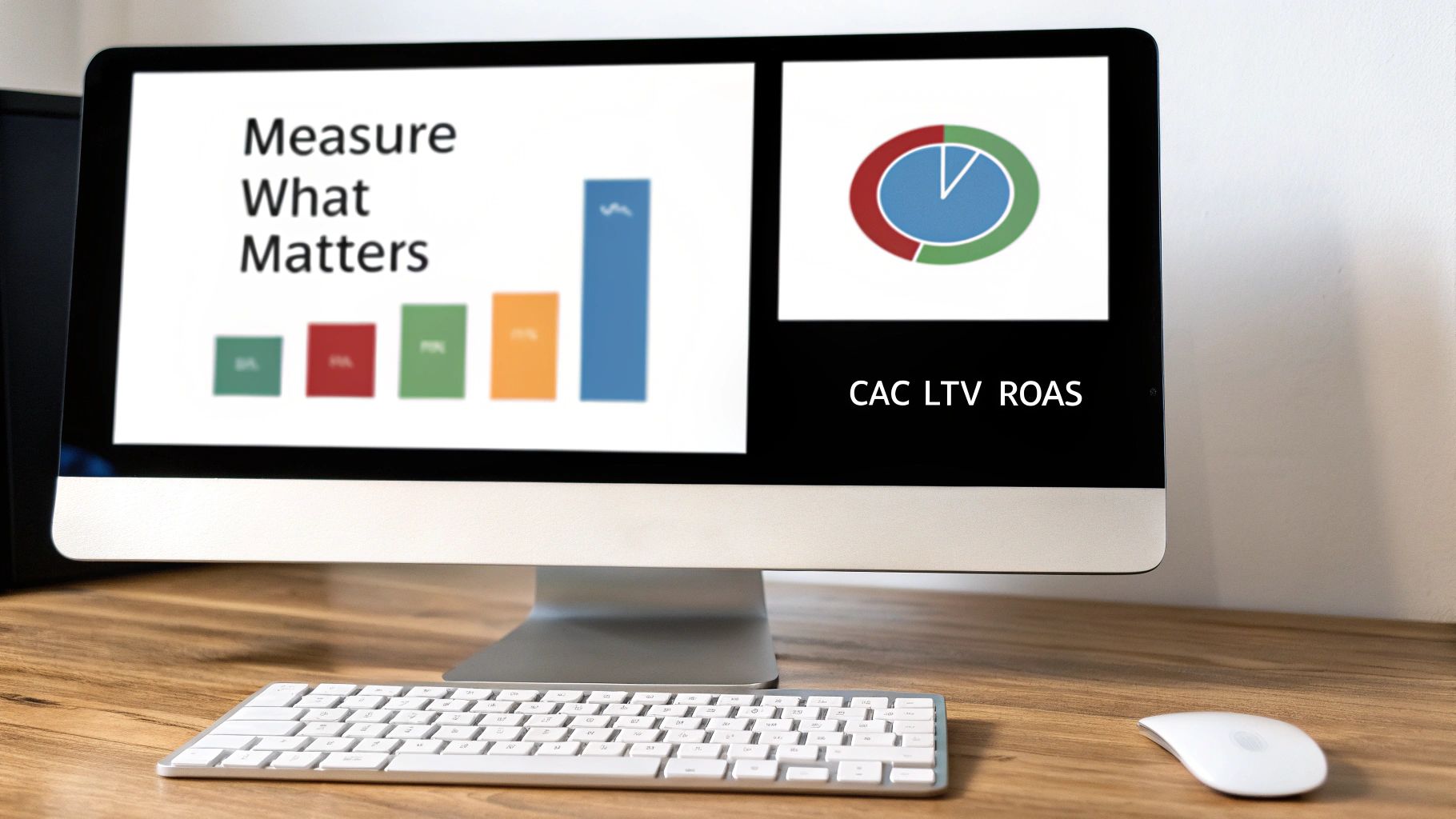
The Three Metrics That Tell the Real Story
Let's break down the only numbers you should have pinned to your wall. These aren't just figures on a spreadsheet; they're the language of ecommerce growth, telling you exactly where your business is strong and where it’s bleeding cash.
Customer Acquisition Cost (CAC): This is the total cost of your marketing and sales efforts divided by the number of new customers you brought in. It answers one simple, brutal question: "How much does it cost me to get one new customer?"
Lifetime Value (LTV): This is the total revenue you can reasonably expect from a single customer over their entire relationship with your brand. Knowing your LTV is a game-changer because it completely redefines how much you should be willing to spend to get that customer in the door.
Return on Ad Spend (ROAS): For every dollar you pump into Google Ads or Facebook, how many dollars do you get back? A ROAS of 4:1, for example, means you're generating $4 in sales for every $1 of ad spend. Simple.
The magic happens when you look at these metrics together. If your LTV is $300 and your CAC is $50, you've built a healthy, profitable business. If your CAC is higher than your LTV, you’re on a fast track to going broke.
This data-first approach is essential for surviving in Australia’s market. In 2023, the Australian eCommerce market hit a massive $63.6 billion in value, growing even during a tough cost-of-living crisis. By October 2024, online spending had already reached $40.72 billion, proving the appetite for online shopping isn't going anywhere. You can dive deeper into the latest Australian ecommerce trends and insights here.
Turning More Clicks into Customers with CRO
Having a great LTV to CAC ratio is fantastic, but you can turbocharge both by obsessing over Conversion Rate Optimisation (CRO). This is the art and science of tweaking your website to get a higher percentage of visitors to actually buy something.
I've seen tiny user experience (UX) fixes, guided by data from Google Analytics, lead to massive revenue jumps. It might be as simple as changing the colour of a "Buy Now" button, killing a few unnecessary steps in your checkout process, or adding better product photos.
Every bit of friction you remove from the buying journey makes it easier for customers to hand over their money.
Building this kind of data-driven culture is what separates the brands that fizzle out from the ones that scale profitably. It’s about making informed decisions, not just crossing your fingers and hoping.
Your Action Plan for Ecommerce Growth
Feeling a bit overwhelmed by all the possibilities? That’s normal. The key to real growth isn't about doing everything at once; it's about building momentum through consistent, focused action. This is where the theory stops and the work begins.
Think of this final section as your practical checklist to get started or to audit what you’re already doing. It’s all about prioritising the actions that will deliver the biggest impact first.
Your First 30 Days: The Foundation
Your goal for the first month is simple: build a solid foundation. If you get these fundamentals right, everything you do later will be ten times more effective.
Platform Audit: Take an honest look at your website. Is it fast? Is the checkout process actually smooth, or is it clunky? If you’re constantly fighting your platform, it might be time to consider if a different solution, like one built by professional Shopify developers, would serve you better.
Tracking Installation: Get Google Analytics 4 and the Meta Pixel installed properly using Google Tag Manager. Without clean data, you're flying blind, making decisions based on guesswork. This step is completely non-negotiable.
Google Business Profile Optimisation: If your brand has any kind of local presence in Melbourne or beyond, your Google Business Profile is the lowest-hanging fruit in local SEO. Fill out every single section and get it fully optimised.
Your Next 60 Days: Gaining Traction
Okay, your foundation is solid. Now it’s time to start driving some quality traffic and figuring out what works.
Launch a Google Shopping Campaign: Get your products right in front of people who are actively searching for them. Start with a modest "data-gathering" budget just to see what your initial cost-per-acquisition looks like. You can scale later.
Plan Your First SEO Content: Find three long-tail keywords your customers are actually searching for. Plan and write a genuinely helpful blog post for each one, making sure you link back to your relevant product pages.
Start an Email List: Add a simple signup form to your website. Don’t overthink it—just offer a small discount for an email address. Your email list will become one of your most valuable marketing assets over time.
Think of this as your roadmap to finally integrating ecommerce and marketing effectively. Every small step you take builds on the last, creating a compounding effect that drives sustainable growth.
This checklist gives you a clear starting point. Execute these steps with consistency, and you’ll be well on your way.
Of course, if you feel you need a co-pilot for the journey, we're here to help. Alpha Omega Digital is a marketing agency based in Melbourne, Australia, and we also service clients from Sydney, Brisbane, Newcastle, Perth, Adelaide, Darwin, and Hobart. Have a project in mind? Contact us and let's build something great together.
A Few Common Questions
Here are some of the most common questions I get from business owners in Melbourne and across Australia when they're trying to wrap their heads around ecommerce marketing.
How Much Should I Budget to Start Google Ads for My Store?
This is a big one, and there's no magic number. If an agency gives you one without knowing your business, they're probably not being upfront with you.
I always tell new clients to think of their initial ad spend as a 'data-gathering budget', not an instant profit machine. A realistic starting point is often somewhere in the $500-$1500 range for the first month.
The goal here isn't a massive ROAS from day one. It's about buying valuable data on what actually works. We need to see which products, keywords, and audiences convert. Once we have that crucial information, we can calculate a smart Return On Ad Spend (ROAS) and scale the budget with confidence. That first month is an investment in knowledge that lets you spend more—and more profitably—later on.
Should My Melbourne Business Choose Shopify or WordPress?
Ah, the classic showdown. Both platforms are incredibly powerful, but they're built for different jobs. I’ve seen local businesses thrive on both, and the right choice really boils down to what you need your site to do.
For most businesses selling physical products, especially if you're just starting out, Shopify is a fantastic all-in-one solution. Its security, speed, and user-friendly interface are tough to beat, making the path from idea to your first sale incredibly short. Working with skilled Shopify development partners can get you launched and selling in no time.
On the other hand, if your business model needs deep customisation, is service-based, or relies heavily on content marketing for SEO, a custom WordPress site with WooCommerce offers unmatched flexibility. It gives you total control, which is where a dedicated WordPress web developer becomes essential to really unlock its potential.
How Long Does SEO Really Take to Show Results?
I know it’s a cliché, but SEO truly is a marathon, not a sprint. Unlike paid ads that can switch on traffic the same day you launch them, SEO is about building authority and trust with search engines over time. Think of it as a long-term investment in a sustainable marketing asset for your business.
Generally, you can expect to see some early movement and ranking improvements for less competitive keywords within 3-6 months.
But for the kind of significant, business-changing results that bring in a steady, reliable flow of customers, it’s best to commit to a 6-12 month strategy. The payoff for that patience is massive: a consistent stream of highly-qualified organic traffic that delivers one of the best long-term ROIs in all of marketing.
At Alpha Omega Digital, we are a marketing agency based in Melbourne, Australia but also service clients from Sydney, Brisbane, Newcastle, Perth, Adelaide, Darwin and Hobart. Have a project in mind? Contact us.