I’ve spent years deep in the trenches with Australian businesses, helping them figure out how to actually make money online. And if there’s one thing I’ve learned, it’s that a solid foundation is everything. Ecommerce marketing isn’t just about running a few ads and hoping for the best. It’s a complete system designed to attract people, turn them into customers, and keep them coming back. Think of your website as a high-performance engine. Traffic from places like Google Ads and SEO is the fuel, and sales are the output. Without the right parts working together, that engine is just going to sputter and die. The opportunity right now is massive, but so is the competition. You need a rock-solid setup to cut through the noise.
The proof is in the numbers. Australians recently spent a staggering $69 billion online, which was a 12% jump from the year before. That’s nearly 10 million households now actively shopping online, a huge shift driven by people looking for better value as the cost of living bites. You can dig deeper into these Australian ecommerce statistics to see just how big the market has become. This means there are more customers out there than ever before, actively looking for products just like yours.
What This Guide Will Cover
In this guide, I’m going to walk you through the exact playbook we use at our marketing agency in Melbourne to build these ecommerce engines from the ground up. This isn’t theory; it’s the practical, hands-on stuff I use every single day to get real results for our clients. We’re going to skip the fluff and focus on what actually moves the needle.
We'll be diving into the essentials, including:
- Technical Setup: Getting your tracking right from day one is non-negotiable. I’m talking about a clean setup with Google Tag Manager and the Meta Conversions API.
- Creative Testing: I’ll show you the exact creative testing process we use for Meta ads to find winning campaigns without burning through your budget.
- Website Platforms: We’ll look at both WordPress and Shopify, covering everything from using the Shopify API to building custom Gutenberg blocks. As a WordPress developer myself, I know just how vital a well-built website is for turning clicks into sales.
- Paid Advertising: We'll break down Google Shopping ads, campaign priorities, and the constant debate between Performance Max and standard Shopping campaigns.
My goal here is to give you a clear, actionable roadmap. By the end, you'll see exactly how all the pieces of the ecommerce marketing puzzle fit together to create a powerful system for growth.
Alpha Omega Digital is a marketing agency based in Melbourne, Australia, but we also work with clients in Sydney, Brisbane, Newcastle, Perth, Adelaide, Darwin, and Hobart. Have a project in mind? Get in touch with us.
Your website is the heart of your entire ecommerce marketing operation. It’s the final destination. You can pour money into the most brilliant ads in the world, but if they lead to a slow, confusing, or clunky website, you're just burning cash. I've seen it happen time and time again with Australian businesses—a platform that truly converts isn't about pretty designs; it's about smart, intentional engineering.
Think of your site as your best salesperson, working 24/7. It needs to be fast, trustworthy, and make it ridiculously easy for someone to hand over their money. For most businesses I work with, the choice boils down to two heavyweights: WordPress and Shopify.
Choosing Your Ecommerce Engine
The platform you build on dictates everything that comes next. There's no single "best" option—only what's right for your specific business goals, budget, and how comfortable you are with the tech side of things.
Shopify for Streamlined Commerce: As official Shopify development partners, we see its strength every day. It’s built for one thing and one thing only: selling online. It’s clean, focused, and powerful. But when standard themes and off-the-shelf apps don't cut it, a skilled Shopify developer becomes essential. We often use the Shopify Developer API to build custom features or even entire private apps with the Shopify CLI to solve those unique business challenges that no public app can fix.
WordPress for Ultimate Flexibility: Paired with WooCommerce, WordPress offers unmatched customisation. If you need complex product options, unique content layouts, or total control over your SEO, this is where it truly shines. As a hands-on WordPress developer in Melbourne, I spend a lot of my time building custom blocks in Gutenberg. This lets us create genuinely bespoke user experiences that stand out and guide customers smoothly from browsing to buying. A great WordPress development company can engineer a site that is both beautiful and a powerful sales machine.
The Non-Negotiables for Conversion
Regardless of which platform you pick, a high-converting site absolutely must nail the fundamentals. Speed is everything; pages that take more than a couple of seconds to load will send visitors packing. The mobile experience is just as critical—a huge chunk of your traffic will come from smartphones, and if your site isn't flawless on a small screen, you're losing sales.
And then there's the checkout. It has to be frictionless. Minimal steps, clear instructions, no surprises.
Your website’s primary job is to remove friction. Every extra click, slow-loading image, or confusing navigation element is a reason for a potential customer to leave and buy from your competitor.
Ultimately, engineering a site to sell means obsessing over the entire user journey, from the first click to the thank you page. To really ensure your platform turns visitors into customers, a deep dive into how to improve ecommerce conversion rates is essential. It's the small details in design and development that add up to make a massive difference to your bottom line.
Driving Targeted Traffic with Paid Advertising
While SEO builds your long-term foundation, think of paid advertising as hitting the accelerator. It’s the fastest way to get your products in front of people who are ready to buy. But I’ve seen firsthand how it can also be the quickest way to burn through your marketing budget without a rock-solid strategy.
As a digital marketing agency in Melbourne that lives and breathes this stuff, I can tell you that success in paid ads comes down to a clear plan and relentless testing. It's about paying for placement—whether on Google's search results or a user's social media feed—to bypass the slow build of organic traffic.
Mastering Google Ads for Ecommerce
When it comes to buyer intent, nothing beats Google. People are actively searching for products, and your job is to show up at that exact moment. For ecommerce, the undisputed king is Google Shopping.
Most articles you'll find, like a beginners guide to google shopping ads, tend to oversimplify things. A successful campaign needs a meticulously set up product feed in the Google Merchant Center, logically structured campaigns, and a deep understanding of negative keywords to stop you from wasting money on irrelevant clicks.
One of the most common roadblocks I see is Google Shopping ads not spending budget. This almost always points back to a problem with the product feed, bids that are too low, or an overly restrictive audience.
The PMAX vs Standard Shopping Debate
The big question everyone asks is whether to use Performance Max (PMAX) or stick with traditional Standard Shopping campaigns. Here’s my take:
- Standard Shopping: This gives you maximum control. You can adjust bids, add negative keywords, and see precisely which search terms are driving traffic. I often start here to gather data and really understand customer search behaviour.
- Performance Max (PMAX): This is Google’s AI-driven powerhouse. It automates bidding and targeting across all of Google's channels (Search, Display, YouTube, etc.). The PMAX vs Google Shopping ads debate isn't a simple choice; PMAX can deliver amazing results, but it’s more of a "black box" and needs a lot of conversion data to work effectively. I usually introduce PMAX once a store has a steady stream of sales.
A common mistake is thinking PMAX replaces the need for strategy. It's a powerful tool, but it still needs high-quality inputs—a great product feed, compelling ad copy, and strong creative assets—to perform at its best.
Cracking the Code on Meta Ads
While Google captures intent, platforms like Facebook and Instagram create it. People are scrolling, not searching, so your ads need to grab their attention instantly. This is where a disciplined Meta ads creative testing process becomes your most valuable asset.
Don't just launch one ad and hope for the best. We test multiple images, videos, headlines, and copy variations to see what resonates. The key is to not quit too early on your Facebook ads. It takes time for the algorithm to learn, so let your campaigns run for at least 3-5 days before making a call.
The social media advertising scene in Australia is enormous, with projected spending set to hit AU$7.5 billion. Critically, 59% of shoppers aged 18-39 say social media is important for product discovery, which shows just how vital these platforms are. You can explore more fascinating marketing statistics about Australian consumer behaviour to see the full picture.
Deciding where to put your money can be tough. It really comes down to who you're trying to reach and what you're trying to achieve.
Choosing Your Paid Ad Channel
| Channel | Best For | Key Metric | Ideal Starting Budget (Monthly) |
|---|---|---|---|
| Google Search & Shopping | Capturing high-intent buyers actively looking for your products. | Return on Ad Spend (ROAS), Cost Per Acquisition (CPA) | $1,500+ |
| Meta (Facebook & Instagram) | Building brand awareness and creating demand with visually-driven ads. | Cost Per Click (CPC), Click-Through Rate (CTR) | $1,000+ |
| Reaching users in the discovery and planning phase, especially for visual products. | Pin Clicks, Saves, Outbound Clicks | $750+ | |
| TikTok | Engaging a younger demographic with creative, short-form video content. | Cost Per View (CPV), Engagement Rate | $750+ |
This table should give you a starting point, but remember that the "best" channel is the one that connects with your specific audience. The only way to know for sure is to test.
What Budget Should You Spend on Google Ads
This is the million-dollar question. I always tell clients there’s no magic number for what budget to spend on google ads.
A better question is, "How much can you invest in data?" I recommend a minimum of $50-$100 per day to start. Anything less, and you simply won't gather data fast enough to make smart decisions. Think of your initial budget not as a sales driver, but as an investment in learning what works for your specific audience.
The Technical Backbone of Your Marketing
Here’s a truth I've learned the hard way over many years: your marketing is only as good as your data. If you can't accurately track what's working and what isn't, you're just guessing. This is where a lot of businesses stumble, but it's where we, as a technical marketing agency in Melbourne, really dig in and get things right.
Getting this foundation right from the start means every dollar you spend is accounted for. It gives you the clarity to make smart, data-driven decisions instead of just hoping for the best. Let’s pull back the curtain on the technical backend of ecommerce marketing.
Your Tracking Command Centre: Google Tag Manager
Think of Google Tag Manager (GTM) as a digital toolbox for your website. Instead of asking a developer to hard-code every single tracking script for tools like Google Analytics, Meta, or Hotjar, you manage them all from one central dashboard. For any serious ecommerce business, setting up Google Tag Manager containers is the non-negotiable first step.
A GTM container is basically the package that holds all your tags, triggers, and variables.
- Tags: These are the little snippets of code from your marketing tools (like the Meta Pixel or Google Analytics tracking code).
- Triggers: These are the rules that tell your tags when to fire. A classic example is setting a trigger to "fire the 'Add to Cart' tag when a user clicks the 'Add to Cart' button."
- Variables: These are placeholders for values that change, like a product name or price. They let you pass dynamic data along with your tracking events.
Setting this up correctly gives you incredible agility. Need to add a new marketing tool or update a tracking script? You can do it in minutes, not days, without ever touching your website’s core code.
This is where all those paid advertising channels connect back to one central goal: driving sales.
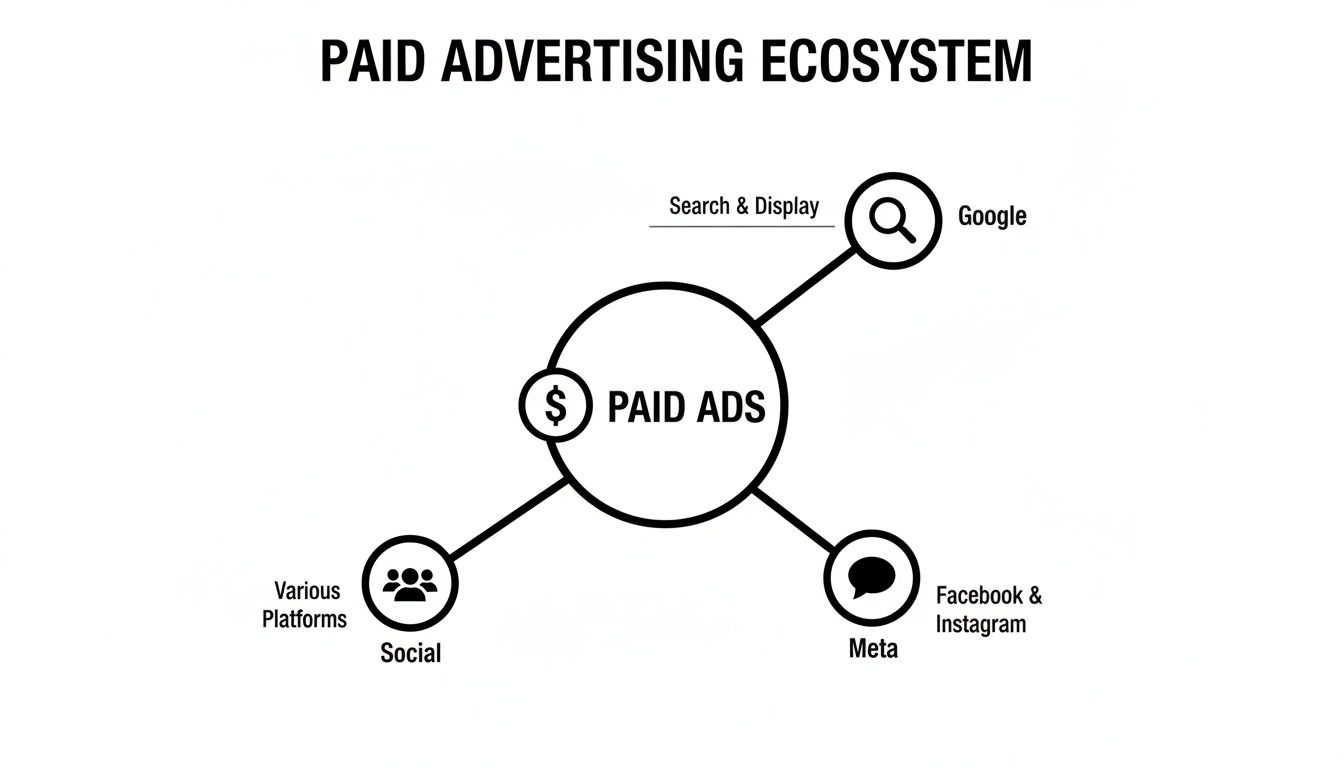
The visual shows how platforms like Google and Meta all feed into your overall paid strategy, which is exactly why a unified tracking system is so crucial.
The Essential Meta Conversions API Setup
With all the privacy changes and the slow death of third-party cookies, relying solely on the browser-based Meta Pixel just doesn't cut it anymore. The solution is the Meta Conversions API (CAPI). It creates a direct, server-to-server connection between your website and Meta's platforms.
The Conversions API installation for Meta isn't just a "nice-to-have" anymore; it's essential infrastructure for anyone serious about running effective Facebook and Instagram ads.
Why is it so critical? CAPI sends conversion data directly from your server, which means it isn’t blocked by browser ad blockers or affected by iOS privacy settings in the same way the Pixel is. This gives you far more reliable and accurate data, which in turn helps Meta’s algorithm better optimise your ads to find the right customers. The difference in your reported Return On Ad Spend (ROAS) can be absolutely dramatic.
By mastering GTM and implementing CAPI, you build a resilient tracking foundation. You stop making marketing decisions based on incomplete data and start seeing a clear, accurate picture of what truly drives growth for your ecommerce business.
Winning the Long Game with SEO and Content
Think of paid ads as the accelerator pedal for your store – you press it, you get instant traffic. It’s powerful. But Search Engine Optimisation (SEO) is something different. It’s like building the engine itself. It’s a long-term asset that, once running smoothly, drives your business forward for years without you having to pay for every single click.
As an SEO agency in Melbourne, I've seen it time and time again: a solid organic presence becomes a business’s most valuable marketing channel. This isn’t about just stuffing keywords onto a page and hoping for the best. It’s about building a genuine, long-term strategy that earns Google’s trust and puts you right in front of customers at the exact moment they’re looking for what you sell.
Beyond the Basics of Ecommerce SEO
Good ecommerce SEO is so much more than optimising your product pages. One of the biggest missed opportunities I see with Australian businesses is Local SEO. Even if you ship nationwide, getting your Google Business Profile dialled in is an absolute game-changer.
When someone in your city searches for a product you stock, a well-managed profile makes you instantly visible. It builds local credibility, and if you have a physical storefront, it can even drive real foot traffic.
Another massive part of the puzzle is building high-quality backlinks. This is essentially earning “votes of confidence” from other reputable websites on the internet. Our whole approach is built around creating genuinely valuable content—think in-depth guides, industry reports, or unique product comparisons—that other sites actually want to link to.
You can think of backlinks like real-world referrals. When a trusted industry blog links to your store, it’s like a personal recommendation telling Google that you're a legitimate, authoritative source for your products.
This kind of consistent, strategic effort is how we help our clients dominate search results, not just in their local area but right across the country.
Creating Content That Ranks and Converts
The real secret to winning with content is targeting long-tail keywords with high buyer intent. These aren't broad terms like "hiking boots." They're longer, more specific searches like "best waterproof hiking boots for wide feet Australia."
Someone searching with that level of detail isn't just browsing; they're usually very close to making a purchase.
We focus on creating long-form, genuinely helpful content that answers these specific questions. For instance, a detailed blog post comparing different types of hiking boots, complete with real-world testing and customer photos, has a far better chance of ranking and converting than a generic product page ever will.
Consistency is everything here. SEO isn't a "set and forget" task. It's an ongoing process of optimising, creating, and building your authority over time. But unlike paid ads where the traffic stops the moment you turn off the spend, the investment you make in SEO and content keeps paying dividends for years. It becomes the bedrock of your ecommerce marketing success.
Leveraging AI for Growth and Efficiency
The next big shift in ecommerce marketing is already here, and it's being driven by Artificial Intelligence. From my experience working with businesses as a digital marketing agency in Melbourne, the brands that are quick to adopt smart AI tools are gaining a serious advantage. It's less about chasing hype and more about practical, real-world results.
We've been diving deep into some interesting applications, particularly with AI voice agents. Imagine an AI receptionist that answers your business calls 24/7. It never gets sick, never takes a holiday, and can handle common queries or book appointments without you lifting a finger. This isn't science fiction; it’s a real service we’re setting up for clients right now to plug leaks in their sales funnel.
Practical AI Applications for Ecommerce
We build these systems using tools like Twilio, providing a seamless experience that’s saving our clients thousands in lost business. While an AI receptionist might sound more suited to a service business, the core idea—automation and efficiency—is universal for ecommerce. In today's market, smart operators are looking for any edge they can get, which is why so many are starting to implement AI in ecommerce brands.
AI can do so much more than just power a chatbot. Think about it:
- Personalised Product Recommendations: AI algorithms can analyse a user's browsing history and past purchases to suggest products they're almost certain to love, giving your Average Order Value a healthy boost.
- Automated Customer Service: An AI agent can instantly handle the common questions—"Where's my order?", "What's your return policy?"—freeing up your human support team to solve the trickier problems that actually require a personal touch.
- Intelligent Lead Qualification: Got a wholesale or B2B arm? An AI appointment setter can engage potential clients on your site, qualify them based on your criteria, and book a call with your sales team, all on autopilot.
Weaving AI Into Your Marketing Funnel
The real power kicks in when you integrate AI directly into your marketing funnel. For example, that AI voice agent could be the first point of contact for enquiries coming from your SEO efforts or paid ads, ensuring every single lead is captured and nurtured, even at 2 AM.
Investing in practical AI solutions isn't about chasing trends; it's about building a more efficient, responsive, and profitable business. It automates the repetitive tasks so you can focus on strategy and growth.
For businesses like hairdressers, dentists, and even restaurants, an AI receptionist in Australia is a total game-changer for managing bookings. That same technology can be adapted for an online store to manage high-volume customer service, qualify wholesale leads, and offer a level of responsiveness that used to require a massive team.
Getting on board with these tools isn't just a "nice-to-have" anymore. It's one of the smartest moves you can make to get ahead of the competition and build a more resilient operation.
Answering Your Biggest Ecommerce Marketing Questions
After years of chats in our Melbourne office and on calls with clients from Sydney to Perth, I've noticed the same questions pop up time and time again. Business owners are all trying to solve similar puzzles. So, let’s cut through the noise. Here are the straight-up, practical answers I always give.
How Much Should I Actually Spend on Google Ads to Start?
This is the big one, and there’s no magic number, but I can give you a realistic starting line based on what I’ve seen work. The cost is split into two parts: the ad spend that goes directly to Google and the management fee if you bring on a marketing agency in Melbourne like us.
For your ad spend, I always tell new stores to set aside at least $1,000 to $1,500 per month. Anything less, like trying to get by on $10 a day, just isn't enough to gather meaningful data. You end up trickling money away without learning a single thing.
Think of that initial budget as buying data, not just sales. You’re paying to learn what your customers are searching for and which products get them clicking before you decide to ramp things up.
Should I Go with a WordPress Developer or a Shopify Developer?
Ah, the classic platform debate. As an agency with dedicated WordPress developers and as official Shopify development partners, we’re in a unique position to answer this without bias. Honestly, it comes down to your business goals and how comfortable you are with the tech side of things.
My advice is usually this:
Choose Shopify for speed and simplicity. It’s an all-in-one system that’s incredibly fast to get off the ground and generally easier for beginners to manage. If you're selling straightforward products, it’s a brilliant, powerful choice. Our team of Shopify developers can get a store launched and trading very efficiently.
Choose WordPress for total customisation. When you pair it with WooCommerce, its potential is nearly limitless. If you need funky, unique functionality, complex product options, or want absolute control over your content and SEO, then hiring a skilled WordPress website developer is the smarter long-term play. A lot of our WordPress development in Melbourne involves building solutions from the ground up that just aren't possible on other platforms.
There’s no "best" platform—only the one that’s the right fit for your specific needs, budget, and where you see your business in a few years.
How Can I Tell If My Facebook Ads Are Actually Making Money?
Measuring Meta Ads success is all about ignoring the vanity metrics like likes and shares. For any ecommerce store, the only metric that truly matters is your Return On Ad Spend (ROAS). It’s a simple calculation: for every dollar you put in, how many dollars in revenue are you getting back?
To track this properly, it is absolutely non-negotiable to have the Meta Pixel and Conversions API set up correctly. Without them, you're flying blind, and your data is basically guesswork.
A quick word of advice: don't get spooked and pull the plug on your ads too early. It takes time for Meta's algorithm to learn who your ideal customer is. We almost always look at a 7 to 14-day window before making any big calls on a campaign's performance.
Beyond ROAS, keep a close eye on your Cost Per Purchase (CPP) and your overall conversion rate. Together, these numbers paint a crystal-clear picture of whether your campaigns are genuinely profitable.
Why Does Local SEO Matter for an Online Store?
It’s a massive misconception that SEO is only for businesses trying to rank nationally or globally. For so many Australian businesses, Local SEO is an untapped goldmine. Even if you ship Australia-wide, properly optimising your Google Business Profile can drive a surprising amount of traffic and build incredible local trust.
Think about it. When someone in Melbourne, Sydney, or your own suburb searches for a product you sell, a strong local signal makes you stand out. For our agency, ranking for "seo agency melbourne" is how we get in front of local clients. The same logic applies to your store.
Winning in your own backyard is often the first step to winning nationally. It creates a solid foundation of authority and trust that you can then scale from.
Alpha Omega Digital is a marketing agency based in Melbourne, Australia but also services clients from Sydney, Brisbane, Newcastle, Perth, Adelaide, Darwin and Hobart. Have a project in mind? Contact us.