As the head of a marketing agency in Melbourne, I've sat across the table from countless ecommerce store owners. They all have amazing products, but they share the same frustrating problem: nobody can find them online. Let's be real—if your store is invisible on Google, it might as well not exist. This is where a sharp ecommerce SEO marketing strategy isn't just a "nice to have"; it's the engine that turns a passion project into a profitable business.
This guide isn't theoretical. It’s a 10,000-word deep dive into the exact strategies, tools, and processes I've used to grow ecommerce businesses. I'm going to walk you through everything from the foundational setup on WordPress and Shopify to advanced advertising tactics, all based on real-world experience.
Table of Contents
- Building a Rock-Solid Foundation for Ecommerce Growth
- Mastering On-Page SEO: Product Pages That Rank and Convert
- Advanced Technical SEO for Ecommerce Stores
- Content Marketing and Link Building: Building Unshakeable Authority
- Leveraging Paid Ads to Accelerate SEO Growth
- AI Voice Agents: The New Frontier for Customer Engagement
- Platform-Specific Development: WordPress and Shopify Deep Dive
- Pulling It All Together: Your Ecommerce SEO Action Plan
Building a Rock-Solid Foundation for Ecommerce Growth
After years of running a digital marketing agency Melbourne businesses trust, I’ve seen firsthand how getting the fundamentals right can completely flip a store's fortunes. This isn't about chasing algorithms or looking for cheap tricks. It's about building a powerful, reliable online storefront that pulls in customers who are actively searching for what you sell.
This foundational work has never been more important, especially in Australia. In 2024, Australia's ecommerce market blew past USD 536.0 billion, and the growth is just getting started. Melbourne businesses are buzzing about the opportunity.
With a projected growth rate of 12.70% from 2025 to 2033, the market is set to hit a staggering USD 1,568.60 billion. That's a massive opportunity for Shopify and WordPress brands ready to own the search results. You can dig deeper into these trends over at IMARC Group.
The Three Pillars of Ecommerce SEO: My Simple Breakdown
Getting started with SEO can feel overwhelming, but it really boils down to three core pillars. I've seen these principles work for every store owner, whether you’re on Shopify or running a custom WordPress build.
Here’s a breakdown of the essential components for a winning ecommerce SEO strategy, highlighting their main purpose and key focus areas for stores on Shopify or WordPress.
| Pillar | Primary Goal | Key Focus Areas |
|---|---|---|
| Technical SEO | Make it easy for search engines to find, crawl, and understand your store. | Site speed, mobile-friendliness, sitemaps, robots.txt, canonical tags, secure HTTPS. |
| On-Page SEO | Optimise individual pages to rank for specific keywords and satisfy user intent. | Keyword research, product descriptions, title tags, meta descriptions, internal linking, image alt text. |
| Off-Page SEO | Build authority and trust signals from other websites to boost your rankings. | Link building from relevant sites, guest blogging, digital PR, brand mentions. |
These pillars don't work in isolation; they prop each other up. A technically perfect site with terrible content won't rank, just like amazing content on a slow, buggy site won't convert. It all has to work together.
Think of your site's structure as a roadmap for both Google and your customers. A logical, intuitive structure helps search engines understand your site's hierarchy, which boosts your SEO. But just as importantly, it guides real visitors from browsing to buying without any friction.
Platform Wars: Why Your Choice of Shopify vs. WordPress Matters
Whether you've built your store on Shopify or WordPress, both platforms can be SEO powerhouses—they just require different playbooks.
Shopify is fantastic for beginners because it simplifies a lot of the technical stuff straight out of the box. It handles things like SSL certificates and sitemaps automatically, which is a huge help. You can get a beautiful store up and running with great design without being a developer.
WordPress, on the other hand, offers almost limitless flexibility. With WooCommerce and plugins like Yoast SEO, a good WordPress developer has granular control over every single SEO element, from custom URL structures to advanced schema markup. A skilled WordPress development company can craft a truly bespoke and highly optimised experience. If you need a custom solution, a wordpress development expert is the way to go.
Ultimately, there's no single "best" platform. The right choice is the one that fits your technical comfort level and your business goals. Both can get you to the top of Google if you focus on building that solid foundation from day one.
Mastering On-Page SEO: Product Pages That Rank and Convert
Your product pages are the heart of your ecommerce store. They’re the digital sales floor—the exact spot where a casual browser decides to pull out their credit card. But for that to happen, they first have to find the page, and that means it has to rank in Google.
Over the years, I've seen countless businesses make the same mistake: they treat their product pages like simple data entries. They upload a generic manufacturer's description, a few basic photos, and call it a day. This is a massive missed opportunity.
Let's walk through the exact process I use to turn basic product pages into powerful revenue drivers.
Keyword Research: Finding High-Intent, Low-Competition Gold
The goal isn't to rank for broad, competitive terms like "shoes." The real money is in long-tail keywords with high buyer intent. These are longer, more specific phrases that people type when they're close to making a purchase. Think "men's waterproof trail running shoes size 11" instead of just "running shoes."
I use tools like Ahrefs and SEMrush to find these gems. I look for keywords that have a decent search volume but low keyword difficulty. These are the sweet spots where a smaller ecommerce store can easily rank #1 and capture highly qualified traffic. The key is to think like your customer. What specific problem are they trying to solve? What features are they looking for? Answering these questions will lead you directly to your most profitable keywords.
Crafting Titles and Meta Descriptions That Beg to Be Clicked
Your title tag and meta description are your sales pitch on the search results page. Their only job is to earn the click against a sea of competitors. Generic titles like "Product Name – Brand" just don't cut it anymore.
Instead, I focus on a formula that combines the primary keyword with a compelling benefit or feature that grabs attention.
- For a Shopify store selling running shoes: Instead of "Men's Trail Shoe," we'd use "Men's Waterproof Trail Running Shoes | Free AU Shipping."
- For a WordPress site with custom furniture: Instead of "Oak Dining Table," it becomes "Handcrafted Tasmanian Oak Dining Table | Seats 8."
The meta description is where you seal the deal. I always aim to answer the user's unspoken question: "What's in it for me?" Briefly highlight key benefits, unique selling points like materials, or a strong call to action like "Shop Now & Get 10% Off."
Writing Product Descriptions That Actually Sell
The single biggest mistake I see is just pasting in the manufacturer's supplied description. This creates duplicate content issues that Google dislikes, and it completely fails to capture your brand's unique voice.
I always advise clients to write unique, compelling descriptions for their most important products.
- Tell a story: How will this product actually improve the customer's life? Paint a picture for them.
- Use bullet points: Break up long text and highlight key features and specifications. This makes the information scannable and easy to digest on a phone.
- Incorporate keywords naturally: Weave in your primary and secondary keywords, but always write for a human first. If it sounds robotic, rewrite it.
Your product description isn't just for SEO. It's your 24/7 salesperson. It needs to be persuasive, answer questions, and build enough trust to overcome any purchase hesitation.
The Power of Visuals and Alt Text
Humans are visual creatures. High-quality product images are completely non-negotiable in ecommerce. I recommend using a mix of clean studio shots on a white background and lifestyle photos showing the product in actual use.
For SEO, every single image needs optimised alt text. This text describes the image to search engines and screen readers. Don't just stuff it with keywords; be descriptive and helpful. For example, instead of "shoe," use "man lacing up black waterproof trail running shoe on a muddy path."
My Secret Weapon: Using Structured Data (Schema) for Rich Snippets
This is where we get a bit more technical, but the payoff is huge. Structured data (or Schema markup) is a snippet of code you add to your product pages to give search engines incredibly detailed information. It's how you get those eye-catching rich snippets in the search results—things like star ratings, price, and stock availability.
For a client in Melbourne, implementing review and product schema resulted in a 22% increase in click-through rate from organic search. Those little orange stars build instant trust and make your listing pop right off the page.
For a more advanced look at how this applies in the biggest marketplaces, a deep dive into Amazon listing optimization can provide some powerful insights.
Advanced Technical SEO for Ecommerce Stores
The phrase 'technical SEO' sounds complex and intimidating, I get it. But it doesn't have to be a black box of code and scary jargon. Think of it this way: technical SEO is just checking the foundations of your online store. If the foundation is cracked, it doesn't matter how amazing your products or branding are—you're going to have problems that hold you back.
Let's demystify it. I'm going to break down the critical technical elements into simple, manageable checks you can start doing on your own store today, whether you're on Shopify or WordPress.
A Simple Guide to Technical SEO Audits
A technical audit is your first step. It's a health check for your website's backend, identifying issues that could be hurting your ability to rank.
Site Speed: The Silent Conversion Killer
Site speed is no longer a "nice-to-have." It's a deal-breaker, especially for mobile shoppers. A slow-loading site frustrates potential customers and sends a clear signal to Google that your user experience is poor. In fact, just a one-second delay in page load time can cause a 7% drop in conversions.
Start by running your store's URL through Google's PageSpeed Insights. It’ll give you a performance score for mobile and desktop and, more importantly, a list of specific things you can fix.
The usual suspects I find slowing down ecommerce stores are:
- Unoptimised images: Huge, uncompressed product photos are the #1 killer of site speed.
- Bloated apps or plugins: Every third-party app you install adds extra code. Too many will inevitably bog things down.
- Poorly coded themes: Not all themes are built equal. Some are lean and fast; others are a mess of inefficient code.
Finding and Squashing Broken Links (404 Errors)
Broken links, or 404 errors, are dead ends for both your customers and for search engine crawlers. They create a frustrating journey for users and waste your site's "crawl budget"—the amount of time Google's bots will spend indexing your pages. If a crawler keeps hitting dead ends, it might give up before it finds your most important product pages.
I use a tool like Screaming Frog's SEO Spider (the free version is great for up to 500 URLs) to crawl my clients' sites and hunt down all the 404 errors. Once you have a list, you can set up 301 redirects to point those broken URLs to a relevant, live page. This recovers any lost "link equity" and patches up the user's journey.
URL Structure and Sitemap Hygiene
Your site's structure is communicated to Google through two key elements: your URL structure and your XML sitemap.
Clean URLs are short, descriptive, and easy for a human to read.
- Bad URL:
yourstore.com/collections/cat1/products?id=8675309 - Good URL:
yourstore.com/products/womens-leather-handbag
This simple change helps both users and search engines understand what the page is about at a glance.
Your XML sitemap is literally a map of your website that you hand to search engines. It lists all the important pages you want Google to discover and index. Both Shopify and WordPress (with an SEO plugin like Yoast) generate these automatically, but you need to check that it’s submitted to Google Search Console and free from errors or junk pages.
A classic mistake I see all the time is allowing every single tag, filter, or variant combination to create a separate, indexable URL. This creates a mountain of low-quality, duplicate pages that can seriously dilute your SEO authority. A good developer can stop this from happening.
The DIY Technical SEO Audit Checklist
To get you started, here's a simple table you can use as a checklist. It covers the core elements, the tools you'll need, and what a "good" result actually looks like.
| Technical Element | Tool For Checking | What To Look For (Ideal State) |
|---|---|---|
| Site Speed | Google PageSpeed Insights | A "Good" Core Web Vitals assessment; green scores across the board. |
| Mobile-Friendliness | Google's Mobile-Friendly Test | A clear "Page is mobile-friendly" result. |
| Broken Links (404s) | Screaming Frog SEO Spider | Zero 404 errors found in the site crawl. |
| XML Sitemap | Google Search Console | Submitted and processed without any errors. |
| Secure Site (HTTPS) | Your Browser's URL Bar | A padlock icon, indicating a secure connection. |
Running through these basic checks once a quarter will help you spot and fix the common technical gremlins that could be secretly holding your ecommerce store back from its true potential.
Content Marketing and Link Building: Building Unshakeable Authority
Good SEO isn’t just about the technical stuff on your website; it's also about your reputation across the web. I like to think of it as a real-world referral. When a respected website links to your store, it’s like a trusted friend telling Google, "Hey, this brand knows what they're talking about."
This is where content marketing and link building become your most powerful tools.
I’m going to show you how to start thinking like a publisher, creating content that builds genuine trust and naturally attracts those valuable backlinks. It’s a long-term play, for sure, but it’s the key to sustainable, organic growth that you actually own—unlike paid ads that vanish the moment you stop paying.
Create Problem-Solving Content, Not Sales Pitches
The best way to earn links is to create genuinely useful content that answers your customers' biggest questions. Stop thinking about just selling products and start solving problems. This is the kind of content that other sites—like blogs, industry publications, and influencers—actually want to share with their audiences.
Here are a few content types I’ve seen work wonders for ecommerce brands:
- In-Depth Buying Guides: Don't just list product features. Create a comprehensive guide that helps a customer choose the right product for their specific needs, even if it means comparing your products to a competitor's. This builds enormous trust.
- Comparison Articles: Pit two of your popular products against each other. Clearly explain the specific use cases for each one, helping customers figure out the perfect option for them.
- "How-To" Blog Posts: Show customers how to use your products in creative ways or how to solve a common problem in your niche. This positions you as an expert, not just another seller. A skilled WordPress web developer can even create custom post templates to make these guides visually engaging and easy for your team to update.
The goal is to become the go-to resource in your niche. When you consistently publish content that helps people, the links will follow naturally. This is a core part of the service provided by a good SEO agency in Melbourne.
A Practical Approach to Local SEO and Google Business Profile
For any business with a physical shopfront or a strong local customer base in cities like Melbourne or Sydney, local SEO is non-negotiable. It’s all about capturing high-intent searches from people in your area who are ready to buy right now.
Your Google Business Profile (GBP), formerly Google My Business, is your single most important local SEO asset. It’s that info box that pops up in Google Maps and the local search results.
An incomplete or neglected GBP is like having a shop with no sign on the door. You're invisible to local customers actively searching for what you offer. Optimising it is one of the quickest wins in ecommerce marketing.
Make sure every single section is filled out completely:
- Accurate business name, address, and phone number (NAP).
- Correct business categories.
- High-quality photos of your products and storefront.
- Regularly encourage and respond to customer reviews.
Victoria is a prime example of why this matters. It’s expected to command a huge 24.3% of Australia's ecommerce market share in 2025, making Melbourne the absolute epicentre for online sales strategies. The national sector, valued at AUD 33.83 billion in 2025, is forecasted to grow to AUD 56.70 billion by 2035.
For ecommerce brands, this regional dominance shows why localised SEO—like targeting 'Shopify development Melbourne' or working with a Melbourne-based WordPress development team—can deliver such powerful returns. You can find more insights about Australia's online shopping market at IBISWorld.
By focusing on creating link-worthy content and dialling in your local signals, you send incredibly strong trust signals to Google. It's a two-pronged approach that builds both broad authority and captures high-converting local traffic, creating a resilient ecommerce marketing engine.
Leveraging Paid Ads to Accelerate SEO Growth
SEO is a marathon, not a sprint. It’s all about building long-term, sustainable traffic that you actually own. But let's be honest—sometimes you really need to sprint. This is where paid advertising, like Google Ads and Meta Ads, becomes an incredibly powerful ally for your ecommerce marketing.
From my experience running a marketing agency in Melbourne, I've seen that the most successful brands don't treat SEO and PPC (pay-per-click) as separate channels. They make them work together, creating a powerful feedback loop that gets results much, much faster.
Google Ads for Ecommerce: A Beginner's Guide
For ecommerce, the most powerful tool in the Google Ads arsenal is Google Shopping. These are the product listings with images and prices that appear at the top of the search results. If you're selling physical products, you absolutely need to be here.
- Google Shopping Ads for Dropshipping: This can be tricky due to margin pressures, but success comes from finding unique, high-margin products and having a highly optimised product feed. Your product titles and images are everything here.
- PMAX vs Google Shopping Ads: Performance Max (PMAX) is Google's automated campaign type that runs ads across all of Google's channels (Search, Shopping, YouTube, Display). While it can be powerful, I often start with a Standard Shopping campaign. It gives you more control over bidding and negatives, which is crucial when you're starting out and need to learn what works. Campaign priority settings also become important when you're running multiple shopping campaigns to segment products.
- What Budget to Spend on Google Ads? A common question is, "how much does it cost to start Google Ads?" I tell clients to start with a budget they are comfortable losing for 30 days. This removes the pressure and allows us to gather data. A budget of $20-$50 per day is often enough to see which products and keywords are getting traction. If you find your Google Shopping ads are not spending their budget, it's usually an issue with a low bid, a disapproved product feed, or an audience that's too narrow.
For service-based businesses or tradies, Google Ads for contact form submissions are the goal. Here, we focus on keyword intent (e.g., "emergency plumber near me") and use call tracking software like CallRail or Go High Level to measure which keywords are driving actual phone calls. PPC for tradies is incredibly effective when done right.
Meta (Facebook & Instagram) Ads: Mastering Creative and Targeting
As a Facebook ads agency, we know that success on Meta is all about the creative and the audience.
- Meta Ads Creative Testing Process: We never launch a campaign with just one ad. We test multiple images, videos, and headlines against each other to find the winning combination. This iterative process is key to scaling your ad spend profitably.
- Don't Quit Too Early: I've seen so many business owners turn off ads after two days because they didn't get a sale. You need to give the Meta algorithm time to learn. Let campaigns run for at least 3-5 days to gather enough data before making a decision.
- Instagram Shop and Facebook Shop: Setting these up is a no-brainer. It creates a seamless shopping experience directly within the apps, reducing friction and increasing conversion rates.
The key to mastering Facebook ads is to measure success beyond just sales. Look at metrics like click-through rate (CTR), cost per click (CPC), and add-to-carts to understand how your ads are performing at each stage of the funnel.
The Technical Handshake: GTM, Google Analytics, and Conversion APIs
For this synergy to actually work, your data and tracking must be flawless. This is where the technical side becomes critical. We use Google Tag Manager (GTM) as the central hub for all our tracking tags. Setting up GTM containers properly lets us deploy tracking for Google Ads, Google Analytics, and Meta Ads without having to constantly mess with the website's code.
For Meta Ads, setting up the Meta Conversion API (CAPI) is completely non-negotiable, especially after all the changes in iOS tracking. A proper Conversions API installation for Meta allows your Shopify or WordPress server to send conversion data directly to Meta, bypassing browser-based tracking limitations. This means your ad performance data is far more accurate, allowing for much better campaign optimisation.
This setup ensures that when we're running a campaign for contact form submissions on a service site or tracking purchases from a Google Shopping ad, the data is reliable across every platform. A skilled Shopify developer can help integrate these APIs seamlessly, often using the Shopify API to create a more robust and direct connection.
Ultimately, by making your SEO and paid ads work in tandem, you get invaluable data, quicker results, and a much more resilient marketing strategy that isn't leaning too heavily on a single channel.
AI Voice Agents: The New Frontier for Customer Engagement
As a forward-thinking agency, we're always looking for the next edge for our clients. Right now, that edge is in AI-powered communication. Specifically, ai-voice-agents. This technology is a game-changer for service-based businesses and ecommerce stores alike.
What is an AI Voice Agent and Why Should You Care?
An ai-voice-agent is an automated system that can answer phone calls, understand human speech, and perform tasks just like a human receptionist. Think of it as an ai receptionist that never sleeps, never gets sick, and can handle hundreds of calls at once.
We set up our clients with a custom number through Twilio, which powers the AI. This ai appointment setter can:
- Provide 24/7 call answering.
- Book appointments directly into your calendar or Calendly.
- Answer frequently asked questions about your products or services.
- Qualify leads before passing them to a human salesperson.
For tradies, hairdressers, beauty therapists, dentists, restaurants, and doctors, this is revolutionary. It means no more missed calls, which translates to thousands in saved business. The ai voice agent pricing is a fraction of the cost of a full-time receptionist, making it an incredible ROI. We've seen ai appointment setters completely transform how local businesses in Australia operate. If you're looking for an ai receptionist in Australia, this is the future.
Real-World Applications for Australian Businesses
Imagine you're a plumber in Sydney. A potential customer has a burst pipe at 2 AM. Your AI voice agent answers the call, understands the urgency, collects their details, and immediately dispatches an emergency notification to your on-call team. You just saved a high-value job that would have otherwise gone to your competitor.
Or, you run a busy beauty salon in Melbourne. The AI can handle all your appointment bookings, rescheduling, and confirmations, freeing up your human staff to focus on providing excellent service to the clients in front of them. The efficiency gains are massive. This technology integrates seamlessly and provides a level of service that was previously only available to huge corporations.
Platform-Specific Development: WordPress and Shopify Deep Dive
A great SEO strategy can be held back by a poorly built website. That's why deep expertise in the platform you're using is so crucial. As a full-service agency, we have teams of dedicated wordpress developers and shopify developers who live and breathe these systems.
WordPress Development: Beyond the Basics
Being a top-tier WordPress development company means going beyond just installing a theme and some plugins.
- WordPress Design and Development: Our process starts with design that focuses on user experience and conversion, then moves to clean, efficient development. A good wordpress website developer builds sites that are both beautiful and blazingly fast.
- Building Custom Blocks in Gutenberg: To give our clients maximum flexibility, we build custom Gutenberg blocks. This allows them to create beautiful, complex page layouts without ever having to touch a line of code, ensuring brand consistency and ease of use.
- Local Expertise: As a wordpress developer in Melbourne, we understand the local market. But our team also includes a top wordpress developer in Sydney, allowing us to service clients across Australia with tailored local insights.
Shopify Development: Custom Apps and API Magic
While Shopify is known for its simplicity, its true power lies in its expandability. As official shopify development partners, we push the platform to its limits.
- Shopify Design: We create custom Shopify themes that are not only stunning but also highly optimised for conversion and mobile performance.
- Building Custom Shopify Apps using Shopify CLI: When a client has a unique business need that can't be solved by an app on the App Store, we build a custom one from scratch. Using the Shopify CLI, we can create private apps that integrate perfectly with their workflow.
- Shopify Developer API: We leverage the Shopify developer API to create powerful integrations. This could be syncing inventory with a third-party logistics provider, connecting to a custom CRM, or building complex reporting dashboards. It allows us to make Shopify do things you wouldn't think are possible. A Shopify development crash course could only scratch the surface of what's possible with the API.
Pulling It All Together: Your Ecommerce SEO Action Plan
We've covered a lot of ground, from digging into the technical nuts and bolts to mapping out content and weaving in paid ads. Now, it's time to turn all that theory into a practical, prioritised roadmap you can actually start using.
The Power of Consistency in Marketing
If there's one thing I can tell you from experience, it's this: marketing your business = consistency. A winning ecommerce SEO strategy isn't a one-and-done project; it’s a constant cycle of optimising, creating, measuring, and refining. Don't let the sheer scope of it all paralyse you. Just start somewhere. Pick one thing—like optimising your top ten product pages—get it done, and build from there.
And remember, your game plan might need to shift based on what you’re selling. For niche businesses, it's worth checking out tailored guides like these winning SEO strategies for specific ecommerce models. The goal is to build momentum.
This process flow shows you exactly how paid ads, the data they produce, and your long-term SEO efforts should work together.
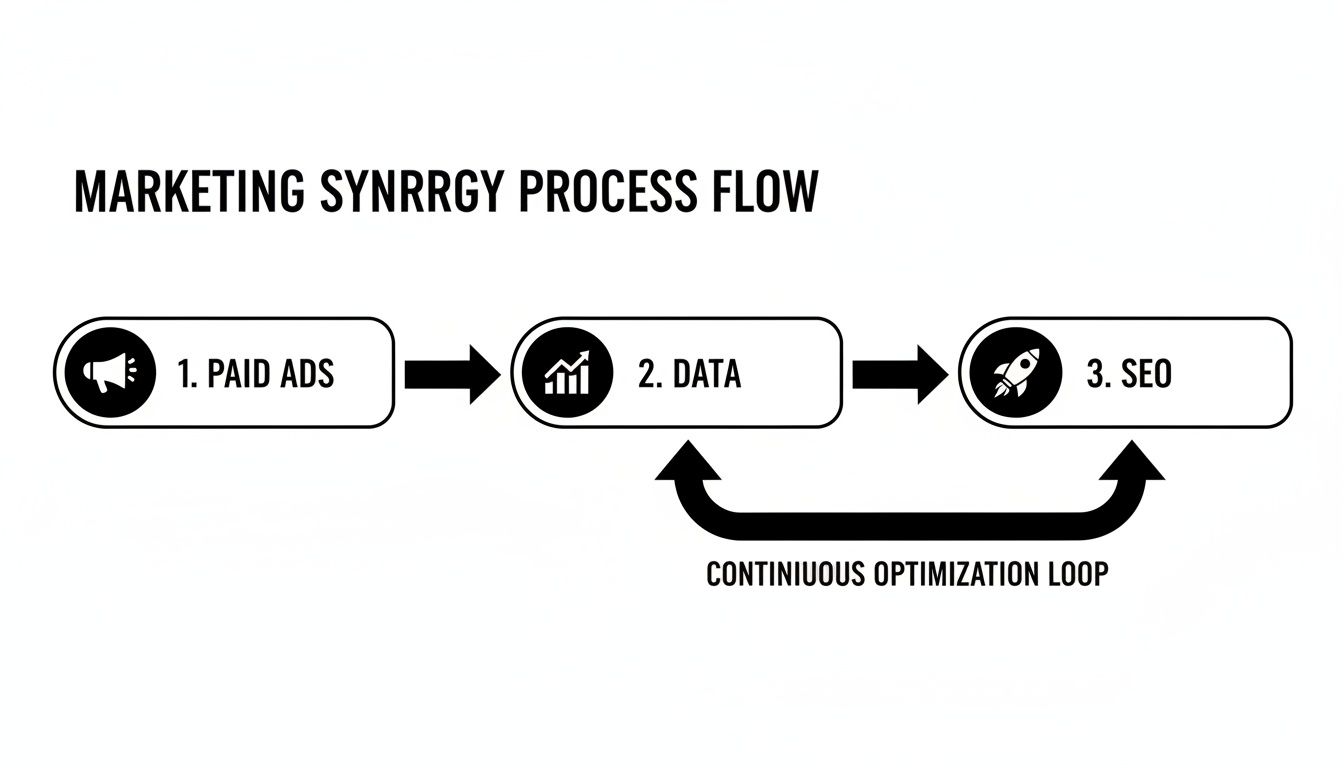
The real insight here is that each element fuels the others. Your ads generate data that sharpens your SEO, and your stronger SEO makes your ad spend more efficient. It's a continuous loop of improvement that gets you results much faster.
Building a powerful online store takes time and effort, but the payoff is a predictable, sustainable stream of customers who are actively looking for what you sell. If you want a dedicated partner to help you navigate this journey, we're here for it.
Alpha Omega Digital is a marketing agency based in Melbourne, Australia, but we also work with clients from Sydney, Brisbane, Newcastle, Perth, Adelaide, Darwin, and Hobart. Have a project in mind? Get in touch.
Frequently Asked Questions From My Clients
Clients ask me these questions all the time, and for good reason. SEO can feel a bit like a dark art, but the answers are usually pretty straightforward once you cut through the jargon. Here’s my honest take on the questions I hear most often.
How Long Does Ecommerce SEO Actually Take to Work?
This is the million-dollar question, isn't it? The honest answer is: it depends.
For a brand-new website starting from scratch, you’re probably looking at 3-6 months before you start seeing any real, meaningful traffic. If you've got an established store with some history and authority, you could see the needle move in just a few weeks after a solid round of fixes and improvements.
Think of SEO like building a house, not flicking a light switch. The work you do today lays the foundation for future growth. Unlike paid ads, which vanish the moment you stop paying, the results from SEO are cumulative. They build on each other, month after month. Consistent effort is what gets you there.
Which is Better for SEO: Shopify or WordPress?
I get this one a lot, especially from businesses here in Melbourne trying to decide on a platform. The truth is, both are fantastic for SEO… if you know how to use them.
- Shopify is brilliant right out of the box. It handles a lot of the technical heavy lifting for you and is incredibly easy for business owners to manage. It's a solid, reliable choice for most online stores.
- WordPress with WooCommerce offers almost unlimited flexibility. If you want to customise every tiny detail or implement really advanced SEO tactics, this is your playground. A good WordPress developer in Sydney or Melbourne can make it do just about anything.
The "better" platform is the one that fits your technical skills and business ambitions. We’ve ranked stores on both to the top of Google. Often, the real difference-maker is the expertise of the Shopify development partners or WordPress team you bring on board.
Can I Do My Own SEO, or Do I Need to Hire an Agency?
You can—and absolutely should—get your hands dirty with the basics. Things like writing unique, compelling product descriptions, optimising your page titles, and starting a blog are all things you can tackle yourself. Doing that groundwork will make a genuine difference.
But as your store grows, the complexity ramps up. That’s where a dedicated digital marketing agency in Melbourne comes in. We bring the specialised tools and experience for deep technical audits, sophisticated content strategies, and link-building campaigns that can seriously fast-track your growth.
Ultimately, it’s a classic business decision: do you invest your time or your budget? We step in to handle the heavy lifting so you can get back to what you do best—running your business.
If you're looking for a partner to help you navigate all this, Alpha Omega Digital is here. Got a project in mind? Let's have a chat.