If you're looking to grow your business here in Melbourne, you already know an online store is essential. But what does ‘ecommerce web development’ actually mean? From where I stand, it’s not about just building a pretty website; it's about engineering a powerful sales engine that works for you 24/7. As a digital marketing agency in Melbourne, I've spent years in the trenches, building and marketing online stores, and I've learned what truly moves the needle.
Table of Contents
- What Ecommerce Development Actually Means for Your Business
- Choosing Your Platform: Shopify vs WordPress
- Designing a Store That Actually Sells
- Connecting Your Store to Your Marketing Engine
- Building Your Digital Storefront: Deep Dive into Development
- Paid Advertising: The Beginner's Guide to Google Shopping Ads
- Local SEO for Ecommerce: Winning Your Neighbourhood
- Introducing AI Voice Agents: The Future of Customer Interaction
- Launching and Optimising for Long-Term Growth
- Where Is All This Headed? Future-Proofing Your Ecommerce Store
- A Few Common Questions I Hear All The Time
What Ecommerce Development Actually Means for Your Business
Welcome to my complete guide on how I approach ecommerce web development. My goal is to pull back the curtain on the whole process, showing you how I use platforms like Shopify and WordPress to build a storefront that’s not just visually stunning, but technically wired to fuel your marketing campaigns, from Google Ads to Facebook ads.
This journey transforms a simple idea into a high-performing digital asset. We'll walk through everything, from our first chat about your vision to launching a store that turns visitors into loyal customers.
The Core of Modern Ecommerce
At its heart, ecommerce development is the art and science of creating an online platform where you can sell products or services directly to people. It's so much more than a digital catalogue; it’s a living, breathing system that needs to handle everything from product displays and inventory to secure payments and shipping logistics.
The Australian online shopping scene is absolutely booming—it’s expected to hit AUD $33.83 billion in 2025, driven by nearly 95% internet penetration. From my experience working with local businesses, I've seen how a well-built online store can tap into this massive market. You can dig deeper into this growth in the Australian e-commerce market research.
A successful project needs a seamless fusion of two key areas:
- Front-End Development: This is everything your customer sees and interacts with—the design, the product pages, the checkout flow. My focus here is on creating an intuitive user experience (UX) that guides them effortlessly toward making a purchase.
- Back-End Development: This is the powerful engine running behind the scenes. It manages your product data, processes payments securely, and plugs into essential tools for your marketing and analytics.
This simple, three-step flow is the foundation of how I approach every single project.
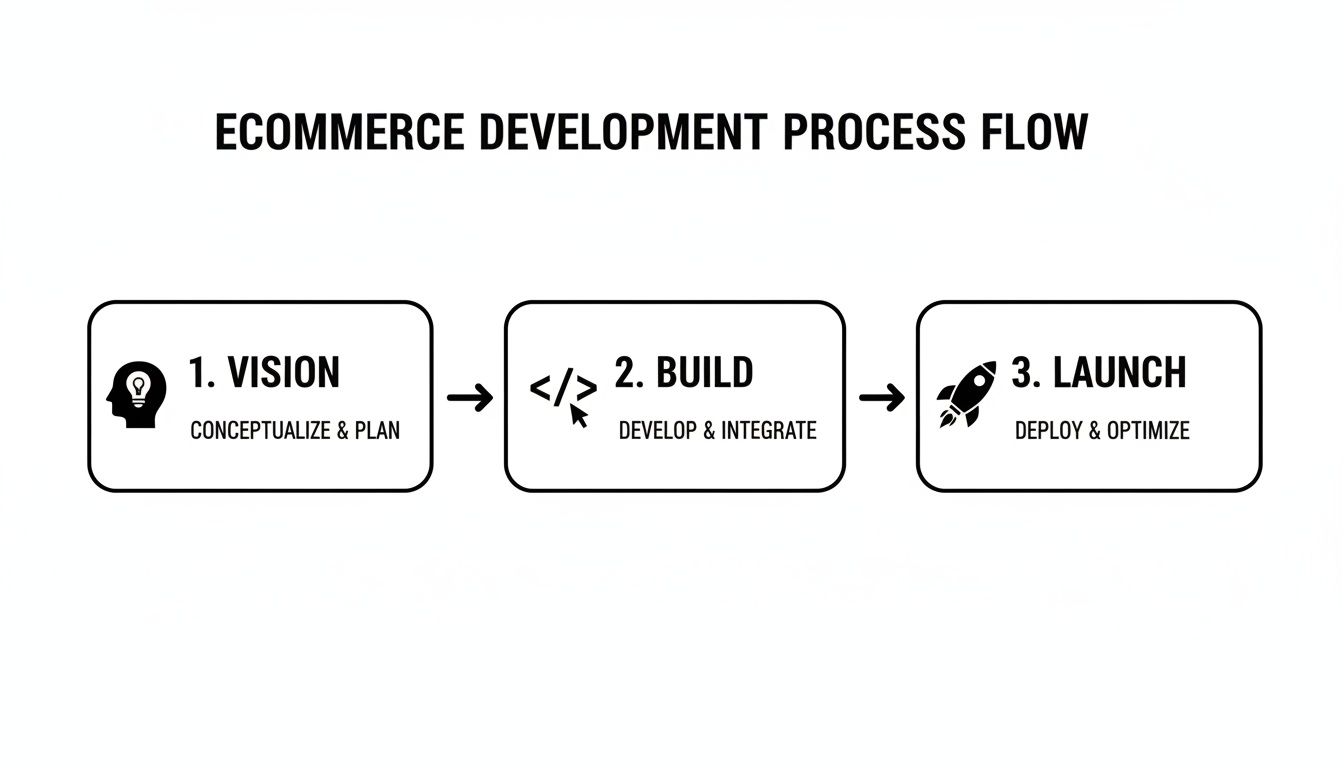
This process ensures that from the initial idea to the final launch, every decision is strategic and locked into your business goals. A strong vision informs a solid build, which leads to a successful launch and, ultimately, sustained growth for your brand.
Choosing Your Platform: Shopify vs WordPress
It’s one of the first, and biggest, decisions you’ll make for your online store. I get this question from nearly every Melbourne business owner I talk to: "Should I go with Shopify or WordPress with WooCommerce?" And honestly, there’s no single ‘best’ answer that fits everyone.
The right choice comes down to your business model, how comfortable you are with the tech side of things, and where you see your store in the next five years. As a marketing agency in Melbourne that has built countless sites on both, I’ve seen firsthand where each platform shines and where it stumbles. Let's break it down with a practical, no-fluff comparison.
Ease of Use and Day-to-Day Management
For business owners who just want to get online and start selling, fast, Shopify is almost always the winner. It's an all-in-one solution designed purely for ecommerce. You don't have to worry about finding a web host, managing security updates, or dealing with server issues—it's all handled for you. Adding products and processing orders happens in a clean, intuitive interface.
WordPress, when paired with the WooCommerce plugin, is an open-source powerhouse. This gives you incredible freedom, but it also comes with more responsibility. You'll need to sort out your own hosting, install security plugins, and stay on top of maintenance. It's not overly complex if you're a bit tech-savvy, but there's definitely a steeper learning curve compared to Shopify’s streamlined dashboard.
For us, the decision often comes down to this: Do you want to be a store owner who manages a website, or a website owner who runs a store? Shopify lets you focus almost exclusively on selling, while WordPress empowers you to build and control every aspect of your digital presence.
Flexibility and Customisation Potential
This is where WordPress and WooCommerce truly pull ahead. Because it’s open-source, the potential for customisation is virtually limitless. If you can dream it up, a skilled WordPress web developer can probably build it. From unique product layouts to integrating with obscure third-party systems, WordPress gives you complete control over your site's code. For example, as experienced WordPress developers in Sydney and Melbourne, we've built everything from custom booking systems to complex membership portals.
Shopify offers excellent flexibility through its theme editor and the massive Shopify App Store, which has thousands of apps to add new features. However, you are ultimately playing in Shopify’s sandpit. A talented Shopify developer can work wonders with custom themes and private apps using the Shopify API, but there are certain core functions you simply can't change. Our team of Shopify developers often works as Shopify development partners with businesses to push these boundaries.
Shopify vs WordPress WooCommerce at a Glance
To make things even clearer, let's put them side-by-side. This table gives a straightforward look at how the two platforms stack up on the features that matter most to an ecommerce business.
| Feature | Shopify | WordPress (WooCommerce) |
|---|---|---|
| Setup & Launch | Faster and simpler. Ideal for getting to market quickly with less technical overhead. | More involved. Requires hosting setup, plugin installation, and more initial configuration. |
| Custom Design | Great theme customisation and app support, but operates within a closed system. | Nearly infinite design and feature customisation. Perfect for unique brand experiences. |
| Ongoing Costs | Monthly subscription fee, plus transaction fees (unless using Shopify Payments) and app costs. | No monthly platform fee, but costs for hosting, premium plugins, and developer support can add up. |
| SEO Capability | Strong out-of-the-box SEO features, but less control over technical aspects like URL structure. | Unmatched SEO potential with plugins like Yoast, offering granular control over every element. |
At the end of the day, the choice is a strategic one. Shopify development is fantastic for brands that need a fast, secure, all-in-one solution and want to focus on selling. On the other hand, a WordPress website developer from a top WordPress development company offers the undisputed champion for businesses that demand deep customisation and want total ownership of their digital asset for the long haul.
Designing a Store That Actually Sells
Let's get into what really makes an online store work. A beautiful design is great, but a successful ecommerce site is built on a solid foundation of user experience (UX) and conversion rate optimisation (CRO). It’s less about artistic flair and much more about human psychology and cold, hard data.
From my experience, I can tell you that the most effective stores are the ones that make buying feel effortless. My job is to map out a customer journey that feels intuitive, removes friction at every turn, and actively encourages a purchase. It’s about building a digital environment where the path to checkout is the path of least resistance.
This is where our work as both a WordPress development company and a Shopify partner really shines. We take a standard theme and turn it into a high-performance sales machine that builds genuine customer trust and lasting loyalty.
Starting with Mobile-First Design
It’s no longer a suggestion; it’s a non-negotiable rule. The vast majority of shoppers will visit your store from their smartphone first. That's why every single project we take on starts with the mobile experience.
We design the layout, navigation, and checkout process for the smallest screen, then scale it up to tablet and desktop. This approach forces us to prioritise what’s most important, ensuring a clean, uncluttered, and fast experience for every user, no matter their device.
The Australian ecommerce landscape is growing at a blistering pace. In 2025, the online shopping market is valued at AUD $60.8 billion, showing an impressive 8.7% year-on-year increase. With so much at stake, a poor mobile experience means leaving a serious amount of money on the table. You can explore more data on this trend and discover more insights about the Australian online shopping market.
The Critical Role of Site Speed
Site speed isn’t just a technical metric; it’s a direct driver of revenue. Studies have shown that even a one-second delay in page load time can cause a massive drop in conversions. When a page is slow to load, customers lose patience and trust. They assume the site is broken or unprofessional and quickly bounce to a competitor.
As part of our development process, we focus on several key areas to ensure lightning-fast speeds:
- Image Optimisation: Compressing product images without losing quality is crucial.
- Lean Code: We make sure themes and plugins are well-coded and don't add unnecessary bloat.
- Server Response Time: Choosing the right hosting and using caching makes a huge difference.
A fast website feels professional and reliable. It tells the customer that you value their time and have invested in a quality online experience, which is the first step toward building trust.
Crafting a Frictionless Checkout Flow
Cart abandonment is the silent killer of online sales. A customer can love your products and add them to the cart, but a confusing or lengthy checkout process will make them leave in an instant.
My process for designing a high-converting checkout involves a few key principles. A crucial one for building trust and preventing fraud is implementing robust secure web payment solutions — it's simply not negotiable.
We aim to:
- Minimise Steps: We strip back the number of fields and pages required to complete a purchase.
- Offer Guest Checkout: Forcing users to create an account is a major point of friction.
- Provide Multiple Payment Options: Including options like PayPal, Apple Pay, and Afterpay caters to different preferences.
- Show Clear Progress: A progress bar lets customers know exactly where they are in the process.
By streamlining this final step, we dramatically increase the likelihood that a user who adds an item to their cart will actually follow through and become a paying customer.
Connecting Your Store to Your Marketing Engine
So, you’ve got a beautifully designed, fast-loading ecommerce store. That’s a fantastic start, but a website on its own is like a high-performance engine sitting on a workshop floor—it has incredible potential, but it’s not going anywhere until you connect it to the rest of the vehicle.
This is where our experience as a full-service digital marketing agency in Melbourne really makes a huge difference for our clients. Your website is the hub, but its true power is unlocked when it talks directly to your marketing channels.
From my experience running campaigns, I can tell you that launching an ad campaign without proper tracking is like driving blind. You're spending money but have no idea what's working, who's converting, or where to invest your next dollar. Setting up this technical groundwork correctly from day one is absolutely critical.
This is the backbone of every successful Google Ads or social media campaign we run, turning your website from a simple storefront into a data-driven sales machine. To ensure your store reaches its full potential, consulting a modern guide to e-commerce advertisement that actually converts can also provide a solid framework for your marketing strategies.

The Central Role of Google Tag Manager (GTM)
Think of Google Tag Manager (GTM) as the central nervous system for your website's marketing data. Instead of asking a developer to add dozens of individual tracking scripts to your site's code—which can slow it down and become a management nightmare—we set up a single GTM container.
From there, we can easily deploy, manage, and update all the marketing and analytics tags you need without ever touching the website’s core files. This includes tags for Google Analytics, Google Ads, the Facebook Pixel, and more. Setting up Google Tag Manager containers is one of the first things we do.
Using GTM gives us incredible agility. We can test new marketing tools or set up complex event tracking, like monitoring video plays or form submissions, in minutes rather than days. It’s an essential tool for any serious ecommerce business.
Understanding Your Customers with Google Analytics
Once GTM is in place, our next step is to configure Google Analytics 4 (GA4). This is your window into understanding exactly what your customers are doing on your site.
We go far beyond the basic pageview tracking. We set up specific ecommerce events to measure things like:
view_item: Which products are people looking at most?add_to_cart: What’s being added to carts, even if it’s not purchased?begin_checkout: How many people start the checkout process?purchase: The ultimate conversion, tracking revenue and order details.
This data is gold. It helps us identify drop-off points in your sales funnel, understand which marketing channels are driving the most valuable traffic, and make data-backed decisions to optimise the user experience for higher conversions.
For me, analytics isn't about collecting data for the sake of it. It’s about turning raw numbers into actionable insights that directly lead to more sales for your business. It's the difference between guessing and knowing.
The Essential Meta Conversion API
With recent changes in data privacy, like Apple's iOS updates, the reliability of browser-based tracking (like the standard Meta Pixel) has taken a hit. This means your Facebook and Instagram ad performance data can be incomplete, making it difficult to measure your true return on ad spend.
This is why we implement the Meta Conversion API (CAPI). Instead of sending data from the user's browser, CAPI sends conversion data directly from your website's server to Meta's servers. A proper Conversions API installation for Meta is non-negotiable now.
This server-to-server connection is more reliable and secure, giving us a much more accurate picture of ad performance. Setting up the Meta Conversion API is no longer a "nice-to-have"; it's a fundamental requirement for any business that relies on Facebook or Instagram ads for growth. It ensures our ad campaigns are optimised based on accurate data, leading to better results and less wasted spend.
Mastering Facebook Ads for Ecommerce
As a Facebook ads agency, we know that running successful campaigns is about more than just boosting a post. It's a science. We employ a rigorous Meta ads creative testing process to find out which images, videos, and copy resonate with your audience. We've learned from experience that you don't quit on Facebook ads too early; sometimes it takes time for the algorithm to find your perfect customer. The key to how to measure success on Facebook ads is looking beyond simple clicks to metrics like Return On Ad Spend (ROAS) and Cost Per Acquisition (CPA). True success in marketing your business comes down to one thing: consistency.
Building Your Digital Storefront: Deep Dive into Development
Let's get into the nuts and bolts. Having a deep technical understanding of the platforms we build on is what allows us to create truly custom and high-performing stores. Whether it's a complex WordPress development project or a sleek Shopify build, we're not just assembling pre-made themes; we're engineering solutions.
WordPress Development: Building Custom Blocks in Gutenberg
The WordPress editor, Gutenberg, has evolved into a powerful page builder. But its true potential is unlocked when we start building custom blocks in Gutenberg. Instead of relying on generic blocks from third-party plugins, we can create bespoke components tailored specifically to your content and brand. This means if you need a unique "Meet the Team" layout, a special product feature callout, or an interactive testimonial slider, we build it from the ground up. This approach gives you ultimate control over your content, keeps the site lean and fast, and ensures a unique design that stands out from the competition. Our experience in WordPress development Melbourne allows us to create these tailored experiences.
Shopify Development: Building Custom Apps with Shopify CLI
Sometimes, the Shopify App Store doesn't have the exact solution you need. That's when we roll up our sleeves and start building custom Shopify apps using Shopify CLI. This command-line interface is a powerful toolset for professional Shopify developers that lets us create private apps to handle unique business logic. Maybe you need a complex product customizer, an integration with a niche inventory system, or a custom dashboard for your sales team. By building a custom app, we can solve these specific problems seamlessly within your Shopify admin, giving you a competitive advantage that can't be bought off the shelf. If you're looking for a Shopify development crash course, this is where the real power lies.
Paid Advertising: The Beginner's Guide to Google Shopping Ads
For ecommerce businesses, Google Shopping is often the most powerful advertising channel. But it can be intimidating. Let's break down some of the most common questions I get from clients.
How Much Does It Cost to Start Google Ads?
There's no magic number. You can start with a budget as small as $10-$20 per day to gather data. The important question isn't "what's the minimum?" but what budget to spend on Google Ads to achieve your goals. We typically recommend a budget that allows for at least 50-100 clicks per day to get statistically significant data quickly. The cost depends heavily on your industry's competition. For example, PPC for tradies might have a different cost-per-click than a fashion boutique.
Troubleshooting: Google Shopping Ads Not Spending Budget
This is a frustratingly common problem. If you're seeing your Google Shopping ads not spending budget, there are a few usual suspects. First, check your product feed in Google Merchant Center for disapprovals. Second, ensure your bids aren't too low for the competition. Third, check your campaign's targeting settings—are they too narrow? We systematically go through these checks to diagnose and fix the issue.
Campaign Priority in Google Ads Explained
Understanding campaign priority in Google Ads is crucial for anyone running multiple Shopping campaigns. It's a setting (Low, Medium, High) that tells Google which campaign's bid to use if a product is eligible to show in more than one campaign. For example, you might have a general "All Products" campaign on Low priority and a specific "Best Sellers" campaign with higher bids on High priority. This gives you granular control over your bidding strategy.
PMAX vs. Standard Google Shopping Ads
The big debate right now is PMAX vs. Google Shopping ads. Performance Max (PMAX) is Google's automated, goal-based campaign type that runs across all of its channels (YouTube, Display, Search, Shopping, etc.). Standard Shopping gives you more manual control over products and bids. For many ecommerce stores, PMAX is delivering incredible results, but it requires a lot of trust in Google's AI. We often run both, or transition clients to PMAX once we have strong conversion data.
Local SEO for Ecommerce: Winning Your Neighbourhood
If you have a physical storefront in addition to your online shop, Local SEO is critical. You want to appear when someone in Melbourne searches for "shoes near me." This is where your Google My Business (GMB) profile becomes your most powerful tool. As a leading SEO agency in Melbourne, we see this as low-hanging fruit for many businesses.
Optimising Your Google My Business Profile
Your GMB profile is a mini-website within Google's search results. We ensure it's fully optimised by:
- Ensuring your business name, address, and phone number (NAP) are consistent everywhere online.
- Uploading high-quality photos of your store and products.
- Actively encouraging and responding to customer reviews.
- Using Google Posts to announce new products, sales, and events.
- Enabling messaging so customers can contact you directly from the search results.
A well-optimised GMB profile can drive significant foot traffic and local online orders.
Introducing AI Voice Agents: The Future of Customer Interaction
One of the most exciting areas we're working in is with AI voice agents. Imagine having a receptionist who works 24/7, never gets sick, and can handle hundreds of calls at once. This isn't science fiction; it's a real solution we're implementing for businesses right now. Our AI receptionist Australia service is designed for local businesses who can't afford to miss a single call.
How We Set Up Your AI Receptionist
The process is surprisingly straightforward. We start by securing a custom number through Twilio. Then, we program the AI voice agent with a script tailored to your business. It can answer common questions, provide business hours, and, most importantly, capture leads. We've seen this save thousands in lost business for tradies, hairdressers, dentists, and restaurants. The AI voice agent pricing is a fraction of the cost of a human receptionist, making it an incredibly high-ROI investment.
Benefits of an AI Appointment Setter
Taking it a step further, we can configure AI appointment setters. This system integrates directly with your calendar or a tool like Calendly. When a customer calls to book, the AI finds an available slot and books the appointment in real-time. It's a game-changer for service-based businesses, ensuring your schedule is always filling up, even when you're too busy to answer the phone.
Launching and Optimising for Long-Term Growth
Getting a new ecommerce store live is a huge moment, but in my experience, it’s just the start of the real work. The launch isn’t the finish line; it’s the starting pistol for growth. Before any site we build sees its first real customer, we put it through a seriously tough, multi-point testing process to make sure it's bulletproof.
A rushed launch is a recipe for disaster. It can kill brand trust and lose you sales from day one, and I've seen it happen way too many times. That's why we treat this pre-flight check as a non-negotiable part of our ecommerce web development process.
Our Pre-Launch Quality Assurance Checklist
We have an internal checklist that covers every possible point of failure. It's something we've built up over years, designed to catch problems before your customers ever do.
Here are a few of the key things we meticulously test:
- Payment Gateway Simulation: We run dozens of test transactions using sandbox modes for Stripe, PayPal, and other gateways. This makes sure real payments go through smoothly and securely from the second you launch.
- Cross-Browser and Device Compatibility: Your store needs to look and work perfectly, whether a customer is on Chrome on a laptop, Safari on an iPhone, or Firefox on an Android tablet. We test all the major combinations.
- Mobile Responsiveness Under Stress: We don’t just check if it 'looks okay' on mobile. We test the entire journey, from navigating the homepage to filtering products and getting through a multi-step checkout on a small touchscreen.
- Load Speed Benchmarks: Using tools like Google PageSpeed Insights and GTmetrix, we set performance targets and make final tweaks to images, code, and server settings to guarantee lightning-fast load times.
Shifting into Optimisation Mode
Once the site is live and stable, we switch gears immediately into optimisation mode. Think about it: a brand-new website is basically a collection of our best, most well-informed guesses about what will convince users to buy. Now, with real traffic, we can start swapping those guesses for hard data.
This is where the fun really begins. We start digging into user behaviour to find opportunities for improvement, including implementing call tracking softwares for PPC call campaigns like CallRail or GoHighLevel to understand which ads are driving phone calls for our clients who run Google Ads for service-based businesses.
The most successful online stores are never truly 'finished'. They are in a constant state of evolution, guided by customer data. This ongoing cycle of testing and refinement is what separates the average stores from the top performers.
The Cycle of Continuous Improvement
Our post-launch growth strategy is all about a continuous cycle: analyse, hypothesise, and test. This is how we make sure your initial investment in ecommerce web development keeps delivering a strong, and growing, return.
This process involves a few key activities:
- Analysing Heatmaps: We use tools like Hotjar or Clarity to see exactly where users are clicking, how far they scroll, and where their attention drops off. This visual data is gold for spotting friction points.
- A/B Testing Key Elements: Should the 'Add to Cart' button be green or orange? Does a different product description increase sales? We run controlled A/B tests to get definitive, data-backed answers to these kinds of questions.
- Refining the User Journey: By mixing analytics data with heatmap insights, we constantly look for ways to make the path to purchase smoother. This might mean simplifying the navigation, improving product filters, or tweaking the checkout flow.
Where Is All This Headed? Future-Proofing Your Ecommerce Store
The digital world moves at a dizzying pace. What’s considered best practice today could be old news by next year. As a digital agency owner here in Melbourne, I've seen firsthand how quickly things change. Building a great website is just the starting point; the real challenge is making sure it’s ready for what comes next.
Staying ahead isn't just about being trendy—it's about survival. So, let’s talk about how we build sites that are designed to grow with you, not hold you back. Thinking about these trends today means the store we build for you is an asset that’s ready for the opportunities of tomorrow.
AI and Hyper-Personalisation are No Longer Sci-Fi
One of the biggest shifts I’m seeing on the ground is the move towards true one-on-one personalisation, with artificial intelligence driving it all. This isn't some far-off concept; it's happening right now. We're moving way beyond basic "you might also like" product suggestions and into creating genuinely individualised shopping experiences for every single visitor.
Imagine a store that automatically rearranges its homepage based on a customer's past browsing habits. Or an AI Voice Agent that fields customer service questions 24/7, freeing up your team to handle more complex issues. These aren't just flashy gimmicks; they are becoming powerful tools for building real customer loyalty. We’re even setting up systems like an AI receptionist Australia-based businesses can use to book appointments and capture leads after hours, ensuring no opportunity ever slips through the cracks.
Headless Commerce and Why You Might Need It
For brands wanting to deliver a truly unique and lightning-fast user experience, 'headless commerce' is the answer. In simple terms, this approach separates the front-end of your store (what customers see and interact with) from the back-end (where you manage products, inventory, and orders).
This gives us incredible flexibility. We can build a custom, high-performance storefront using the latest web technologies while still plugging into the powerful, reliable back-end of a platform like Shopify. It’s the ultimate combination of creative freedom and ecommerce muscle, perfect for businesses that refuse to be constrained by templates.
On a similar note, sometimes an off-the-shelf app from the marketplace just doesn't cut it. That's where our skills as a Shopify developer come into play. By building custom Shopify apps with tools like Shopify CLI, we can create unique features tailored precisely to your business processes. It's how you get a competitive edge that your rivals simply can't copy.
The Australian e-commerce market is on an incredible trajectory. Projections suggest the market could soar to over USD $108 billion by 2030, with some forecasts predicting an aggressive growth rate of over 21% in the coming years. This just underscores the massive potential for businesses that invest in scalable, forward-thinking technology right now. You can learn more about Australia's e-commerce market projections and see exactly why future-proofing isn't just a good idea—it's essential.
Alpha Omega Digital is a marketing agency based in Melbourne, Australia but also services clients from Sydney, Brisbane, Newcastle, Perth, Adelaide, Darwin and Hobart. Have a project in mind? Contact us.
A Few Common Questions I Hear All The Time
Over the years, I've had hundreds of chats with business owners across Australia about diving into ecommerce. It’s a massive step, and it’s only natural to have questions. Here are the big ones I get asked almost every week at our Melbourne agency, along with my honest, straight-up answers.
How Much Does a Professional Ecommerce Website Actually Cost?
This is always the first question, and for good reason! The honest answer is: it really depends. The platform you choose, the complexity of the design, and any custom features you need all play a huge role.
A straightforward Shopify store using a premium theme could start in the low thousands. But a highly customised WordPress and WooCommerce site with unique integrations will naturally be a larger investment. I always tell my clients to think of it as investing in your primary business asset, not just a cost. After our initial discovery chat, we map everything out in a detailed, transparent quote so you know exactly where every dollar is going.
How Long Will It Take to Build?
Like cost, the timeline really comes down to complexity. From my experience as a WordPress developer in Melbourne, a well-planned Shopify project can often go from design to launch in about 4-8 weeks.
For more bespoke WordPress or Shopify Plus projects, you’re typically looking at somewhere between 10-16 weeks. The biggest thing that keeps a project moving smoothly is how quickly we get feedback, content, and product info from your team. We manage the whole thing with a clear project plan to keep everything on track for a timely launch, no surprises.
Can You Help Me Market the Store After It’s Built?
Absolutely. Building the website is just step one—this is where the real fun begins. We’re a full-service digital marketing agency in Melbourne, so once your store is live, we get straight to work building out marketing strategies that drive real, targeted traffic and sales.
This covers everything from setting up high-performing Google Shopping and Performance Max campaigns to running strategic ads on Facebook and Instagram. Our goal is to become your long-term growth partner, turning that brand-new website into a powerful sales engine for your business.
At Alpha Omega Digital, we're a marketing agency based in Melbourne, Australia, but we're proud to serve clients from Sydney, Brisbane, Newcastle, Perth, Adelaide, Darwin, and Hobart. Have a project in mind? Get in touch with us here.