Exceptional ecommerce website design in Melbourne is a delicate balance. I’ve found it’s part art, part science—blending beautiful visuals with a sharp understanding of how people actually shop online. From my experience, it’s all about creating a digital journey that effortlessly guides visitors from their first click all the way to checkout, turning your site from a simple product list into a sales engine that works for you 24/7.
Your Website Is More Than Just An Online Storefront
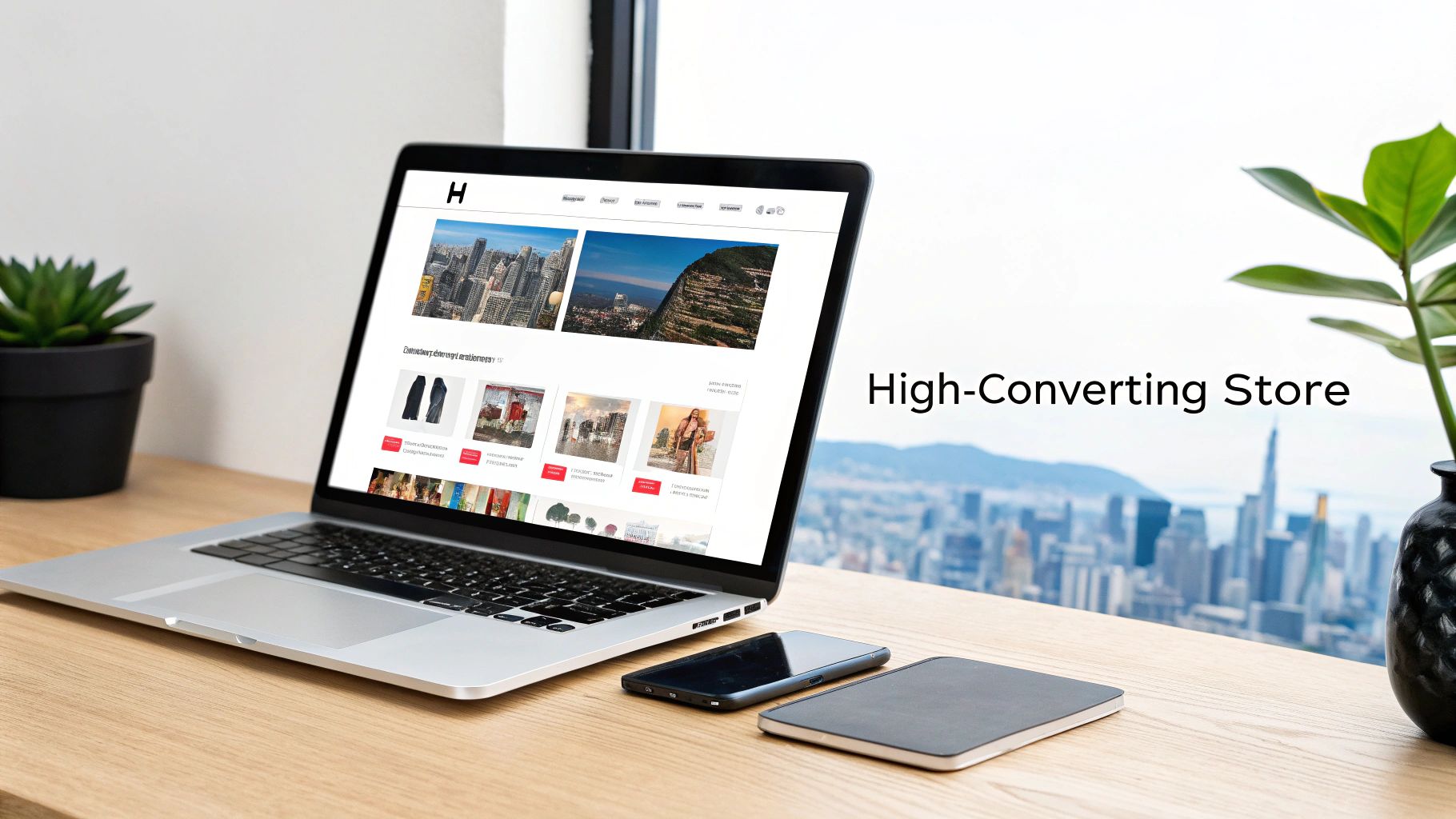
I’ve seen it happen time and time again: a Melbourne business launches a visually stunning website that looks incredible but just doesn't sell. Why? They’ve treated it like a digital brochure instead of a high-performance sales tool.
A great online store, from my real experience, is built on the twin pillars of user experience (UX) and user interface (UI). These aren’t just industry buzzwords; they're the fundamental principles that make a website work for your customers and, in turn, your bottom line.
Understanding UX And UI In A Melbourne Context
Think of UX as the logical blueprint of your store. It’s all about how easy it is for a customer to find what they need, pop it in their cart, and pay. A clunky UX is like a physical shop with messy aisles, confusing signs, and no one at the checkout counter—customers will just walk out.
UI, on the other hand, is the visual layer. It’s the colours, fonts, and images that create your brand's atmosphere and personality. Great UI builds instant trust and makes the whole experience feel polished and enjoyable. It's the digital version of a clean, well-lit, and beautifully organised boutique.
To succeed, you absolutely need both working in harmony.
To give you a clearer picture, here’s a quick breakdown of the core pillars that turn a basic website into a powerful sales tool for your Melbourne business.
Core Pillars Of High-Converting Ecommerce Design
| Pillar | What It Means For Your Business | Direct Impact On Sales |
|---|---|---|
| User Experience (UX) | A logical, intuitive, and frictionless path for customers to find and buy products. | Reduces abandoned carts and frustration, making it easier for people to give you their money. |
| User Interface (UI) | A visually appealing and professional design that builds trust and reflects your brand. | Creates a strong first impression, making customers feel confident and secure in their purchase. |
| Conversion Strategy | Strategic placement of calls-to-action, trust signals (reviews, security badges), and clear value propositions. | Directly nudges visitors towards making a purchase, increasing your overall conversion rate. |
| Mobile-First Design | A seamless experience on smartphones, where most of your customers are likely browsing. | Captures sales from customers on the go, who will leave if your site is hard to use on their phone. |
| Performance & Speed | A fast-loading website that doesn’t keep customers waiting. Every second counts. | Prevents potential customers from bouncing off your site due to slow load times. Faster sites sell more. |
Ultimately, a truly effective ecommerce site is engineered, not just decorated. It's about making smart, data-driven decisions that guide customers to the checkout.
The Unstoppable Growth Of Online Sales
The shift to online shopping isn’t just a trend; it's a fundamental change in how we buy things. The numbers tell a powerful story. Australia's total online retail spend recently hit a staggering AU$69 billion, marking a solid 12% increase year-over-year.
Ecommerce now makes up 16.8% of the nation's total retail spend—a huge jump from just 10% before the pandemic. This explosive growth is precisely why savvy Melbourne businesses are investing in properly engineered, high-converting websites.
Your website is a crucial touchpoint for customers. Building a strong online presence means prioritising user journeys and delivering value beyond just transactions, through effective customer experience design.
This means that even small, strategic tweaks can lead to huge results. Simplifying your checkout process or making your mobile navigation more intuitive can dramatically lift your revenue. We’re not just building a digital catalogue; we're building a sales machine designed to attract, engage, and convert your ideal customers, day in and day out.
Shopify vs WordPress: The Big Platform Decision
This is the first, and biggest, question every Melbourne business owner asks when they decide to sell online: “Shopify or WordPress?” Having built dozens of successful stores on both, I can tell you there’s no single right answer—but there is a right answer for your business.
Let’s cut through the noise and have a practical, real-world look at both. This isn't about which one is technically "better," but which one fits your specific goals, budget, technical comfort, and long-term vision.
The Case for Shopify: Ease of Use and Speed to Market
Shopify is an all-in-one, hosted ecommerce platform. The best way I can describe it is like renting a fully-equipped, ready-to-go retail space in a high-end shopping centre. You get top-notch security, maintenance, and all the essential features included in one monthly fee.
It's the go-to for countless startups and established brands that just need to get online quickly and efficiently. We've worked with numerous Melbourne businesses who chose Shopify because they wanted to launch in weeks, not months, and start selling immediately.
Here’s why so many ecommerce businesses love Shopify:
- It’s genuinely simple: The dashboard is incredibly intuitive. You don’t need to be a technical whiz to add products, manage orders, or pull up sales reports.
- Built-in security is a lifesaver: Shopify handles all the scary technical stuff—SSL certificates, PCI compliance for payments, and server maintenance. That peace of mind is priceless.
- A world-class checkout process: Honestly, Shopify's checkout is one of the best in the business, and it’s meticulously optimised to convert. With features like Shop Pay, it makes buying ridiculously easy for customers, especially on mobile.
- 24/7 support when you need it: When something goes wrong at 2 a.m. on a Saturday, you have a dedicated support team to call. For a small business owner, that’s a huge deal.
But this simplicity does come with a trade-off. While the Shopify App Store has thousands of integrations, deep customisation can be more limited and costly compared to WordPress. You're playing within Shopify's ecosystem. Our Shopify developers are experts at pushing these limits, often through custom app development.
The Case for WordPress: Unmatched Flexibility and True Ownership
WordPress, paired with the powerful WooCommerce plugin, is an open-source platform. This is like buying your own commercial land and building your store from the ground up. You have total freedom to build whatever you can possibly imagine, but you're also responsible for the foundation, the security, and the plumbing.
This is where our expertise as a leading WordPress developer in Melbourne really shines. We recommend WordPress for businesses with unique requirements, complex product catalogues, or ambitious content marketing strategies that go beyond a standard online store. Our team includes expert WordPress developers in Sydney and across Australia.
Here’s why WordPress + WooCommerce is so powerful:
- Infinite customisation: Your design and functionality are limited only by your imagination (and your budget). Need a custom product configurator, building custom blocks in Gutenberg, or a unique membership portal? A skilled WordPress website developer can handle it.
- You have total ownership: You own your website files and have complete control over everything. You're not tied to a single company's rules, transaction fees, or changing pricing structures. It’s your asset, period.
- Superior SEO potential: While both platforms can rank well, WordPress gives you deeper, more granular control over the technical SEO elements that can provide a serious competitive edge. It started as a blogging platform, so its content management capabilities are second to none. This is a key reason why many choose a dedicated WordPress development company for their project.
- No platform transaction fees: Unlike Shopify, which charges a transaction fee on every sale unless you use Shopify Payments, WooCommerce doesn't take a cut. You still have standard payment gateway fees from Stripe or PayPal, but the platform itself doesn't charge you extra.
The flip side is that WordPress demands more hands-on management. You're responsible for your own hosting, security plugins, and keeping everything updated. For a business owner who isn't tech-savvy, this can feel daunting without a reliable partner. As an experienced WordPress development company, we handle all of that for our clients so they can focus purely on growing their business.
Winning On Mobile Where Most Of Your Customers Are
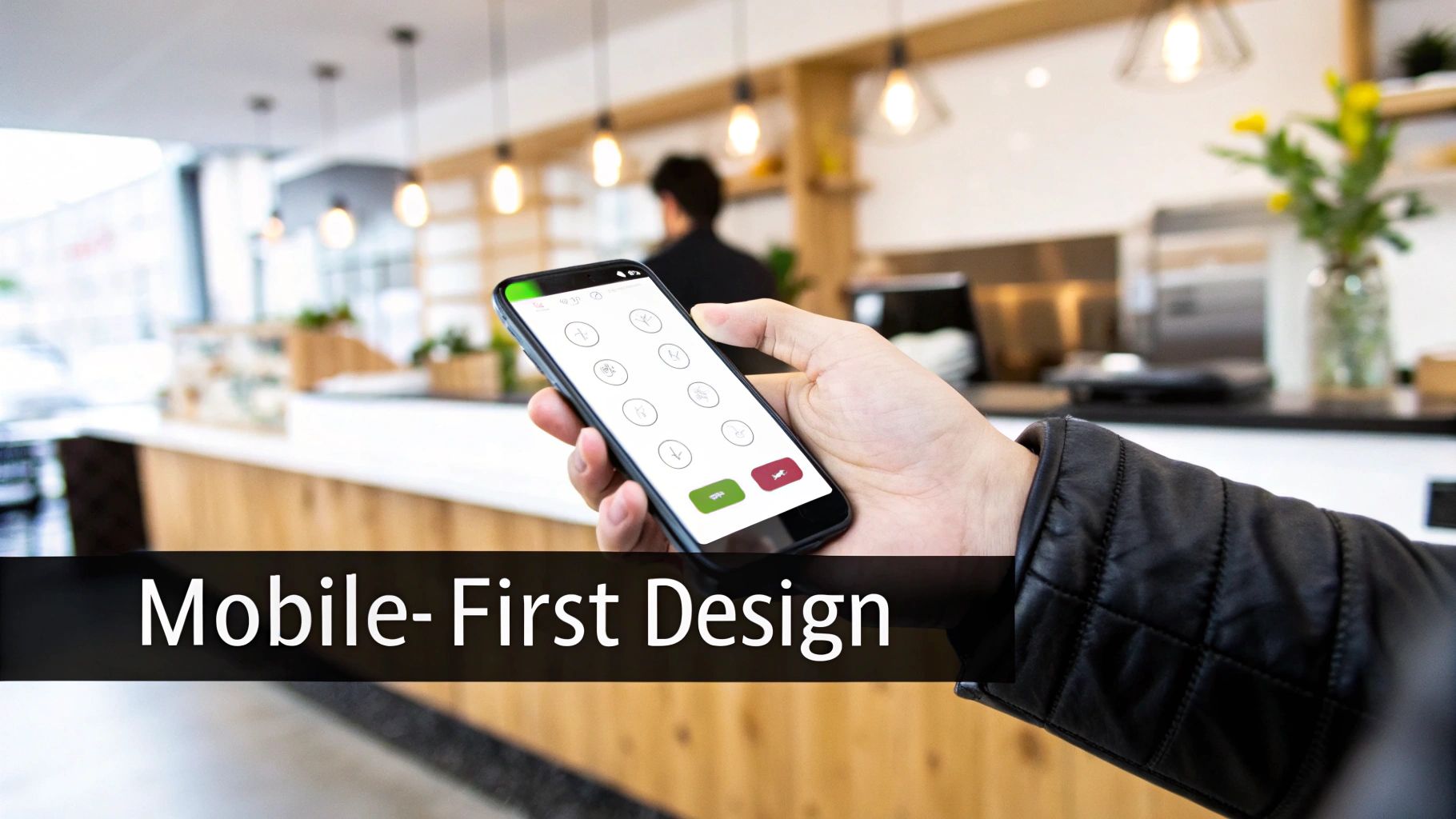
Let me be blunt: if your ecommerce site isn’t perfect on a smartphone, you’re leaving money on the table. It’s not enough to have a site that’s just ‘mobile-friendly’ anymore—from my experience, you have to think ‘mobile-first’.
What does that actually mean? It means we design the entire experience for the smallest screen right from the start, instead of just squishing a desktop design down and hoping for the best. For any Melbourne ecommerce business, this is where most of your customers will meet your brand for the first time.
The Reality Of Mobile Shopping In Australia
The numbers don't lie. In Australia, smartphones are completely running the show in online retail, driving a massive 77% of all site visits and 68% of actual orders. With an incredible 95% of Aussies shopping on their mobile devices, a fast and intuitive mobile experience isn't just a nice feature; it's the very foundation of your business. You can explore more about these Australian ecommerce trends to see what this means for local brands.
I’ve seen businesses with flatlining sales, and the culprit was almost always a clunky mobile checkout. A customer adds items to their cart on their lunch break, gets annoyed by tiny text and fiddly buttons, and just gives up. The fix is often surprisingly simple, but it demands a dedicated mobile-first approach.
Designing for mobile is about more than just making things look good on a small screen. It’s a strategic decision to meet your customers where they already are, making it ridiculously easy for them to buy from you, anytime, anywhere.
Key Elements Of A Winning Mobile Experience
When my team and I tackle ecommerce website design in Melbourne with a mobile-first mindset, we focus on a few critical things that directly boost conversions. These aren't just suggestions; they're essential.
- Thumb-Friendly Navigation: Think about how you hold your phone. Menus, buttons, and links need to be big enough and spaced out properly so someone can easily tap them with their thumb without hitting the wrong thing.
- Lightning-Fast Page Loads: Mobile users have zero patience. Every extra second your page takes to load dramatically increases the chance they’ll bounce. We obsess over optimising images and code to make load times feel instant.
- Simplified Forms and Checkout: Nobody wants to fill out their life story on a tiny screen. We strip back forms to the bare minimum and integrate one-click payment options like Apple Pay, Google Pay, and Shop Pay to make it seamless. This includes integrating with Instagram Shop and Facebook Shop for even easier purchasing.
- Legible Typography: Your text has to be readable without needing to pinch and zoom. That means picking clean fonts and setting the right sizes and spacing specifically for mobile.
Beyond The Look: Technical Performance Matters
It’s not just about what the user sees. Google also heavily prioritises mobile performance when ranking websites. It uses a set of metrics called Core Web Vitals to measure the real-world user experience of your site, looking at loading speed, interactivity, and visual stability.
Optimising for these vitals does more than just keep Google happy; it creates a genuinely better, less frustrating experience for your users. A site that loads quickly and doesn’t have elements jumping all over the screen is a site customers trust. This technical work is a core part of our process, ensuring your site doesn’t just look great but also performs at the highest level, directly boosting your search rankings and, more importantly, your sales.
Integrating The Right Tech For Ecommerce Growth
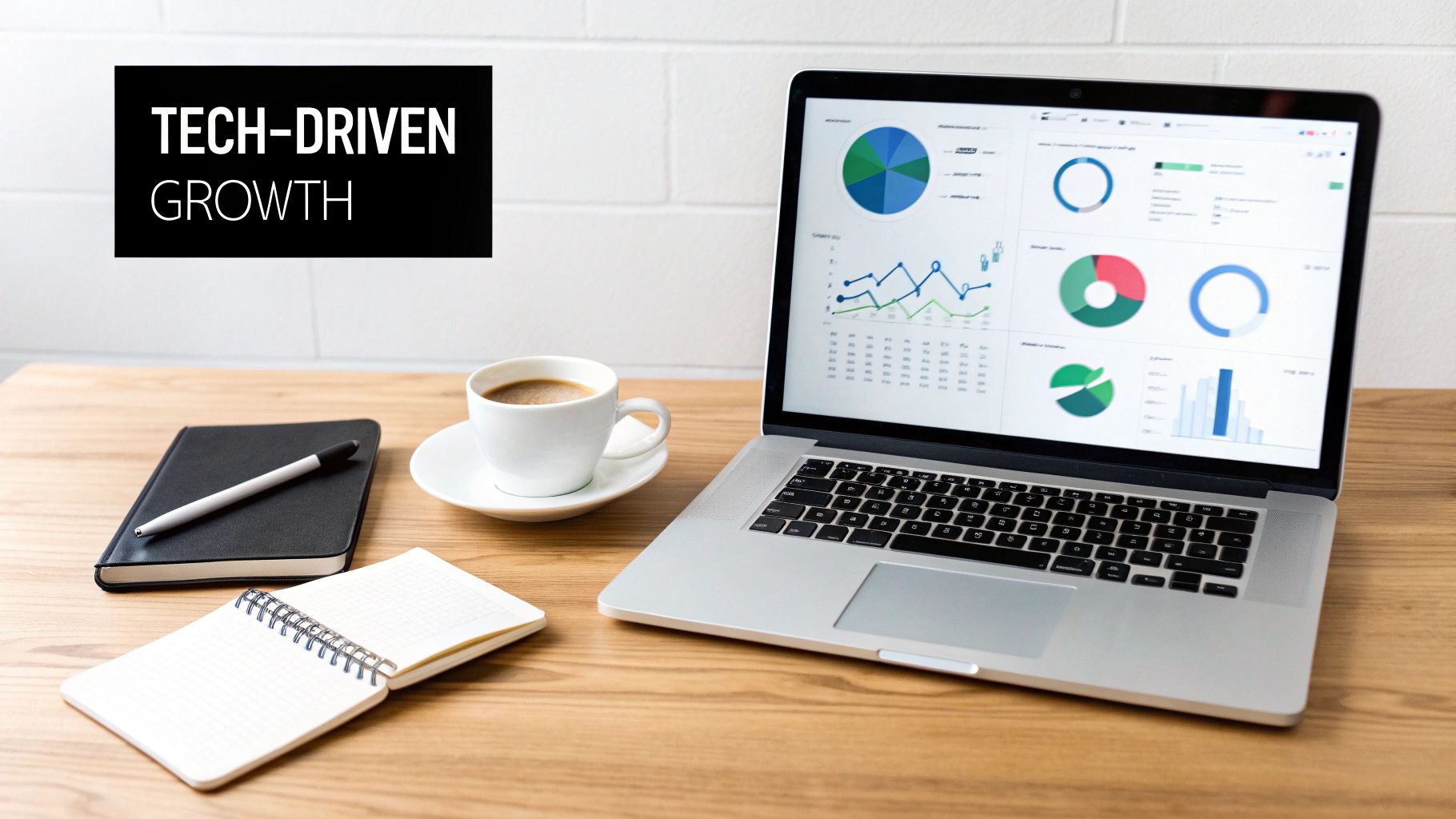
A great ecommerce website never works in a vacuum. I’ve seen firsthand that the most successful online stores are the central hub of a powerful, interconnected tech ecosystem. This is where our experience as a digital marketing agency in Melbourne really comes into play, because a beautiful site without data is just expensive guesswork.
These integrations are what turn your website from a simple storefront into a genuine growth engine. They feed you the raw data you need to understand your customers, make intelligent business decisions, and get the most out of every single dollar you spend on advertising.
The Non-Negotiables: Data And Tracking
Before you spend a single cent on ads, you absolutely need a rock-solid foundation for tracking. This starts with two essential tools from Google that I insist on for every single client project. No exceptions.
- Google Analytics: This is the dashboard for your entire online business. It tells you who is visiting your site, where they came from, which pages they looked at, and where they dropped off. Without proper GTM and Google Analytics setup, you are flying completely blind.
- Google Tag Manager (GTM): Think of GTM as a central control box for all your tracking codes. Setting up Google Tag Manager containers properly means instead of asking a developer to add new code every time you want to track something new (like a Meta Pixel), we can manage it all from one place. This saves time and headaches.
These tools work together to paint a clear picture of user behaviour, giving us the insights needed to smooth out the user journey and fix any conversion roadblocks.
Accurate Ad Tracking With The Meta Conversion API
In the past, we relied solely on the Facebook Pixel (a small piece of code on your site) to track ad performance. But with increasing privacy updates from companies like Apple, the pixel has become far less reliable.
This is where the Meta Conversion API becomes absolutely critical. It creates a direct, server-to-server connection between your website and Meta (Facebook and Instagram). My team and I have found this method is much more accurate and resilient to browser-based tracking blockers. A proper Conversions API installation for Meta ensures you get a clearer picture of how your Facebook Ads are actually performing. Mastering Facebook Ads begins with accurate data.
A website without proper tracking is like a cash register without a display. You know money is coming in, but you have no idea which products are selling, who's buying them, or how to get more customers.
Building Your Marketing And Sales Machine
Beyond tracking, the right integrations automate your marketing and unlock new ways to grow. This is where we connect powerful third-party tools to your Shopify or WordPress store to build a true sales machine. This includes a robust Meta ads creative testing process and knowing how to measure success with Facebook ads so you don't quit too early.
Here's a look at some of the essential tools we integrate to connect your website with the wider marketing world.
Must-Have Tech Integrations For Your Ecommerce Store
| Tool/Technology | Primary Function | Why It's Critical |
|---|---|---|
| Google Analytics 4 | Website Traffic & User Behaviour Tracking | The core source of truth. Tells you who your customers are, where they come from, and what they do on your site. Essential for decision-making. |
| Google Tag Manager | Tag & Script Management | Centralises all your tracking codes (Meta Pixel, Google Ads tags, etc.) in one place, making management faster and easier without needing a developer. |
| Meta Conversion API | Accurate Ad Conversion Tracking | Bypasses browser tracking restrictions for more reliable Facebook & Instagram ad data, giving you a truer picture of your campaign ROI. |
| Klaviyo or Mailchimp | Email & SMS Marketing Automation | Builds customer relationships and drives repeat sales through automated flows like abandoned cart reminders, welcome series, and targeted promotions. |
| CallRail | Call Tracking & Analytics | The best call tracking software for PPC. For businesses where phone calls are leads, this tool attributes calls back to specific ad campaigns so you know which ads are making the phone ring. |
These are just the fundamentals. A well-oiled tech stack ensures every part of your business is talking to each other, creating a seamless experience for your customers and giving you the data you need to scale.
We often use the Shopify Developer API for our clients, which lets us build completely custom solutions or connect specialised software that isn't available in the standard app store. A good Shopify developer can use the API to make the platform do almost anything you need, from a unique inventory system to a bespoke reporting dashboard. In fact, our Shopify development crash course often starts with building custom Shopify apps using the Shopify CLI.
Finally, for ecommerce businesses running Google Ads, understanding the nuances of campaigns is key. From a beginners guide to Google Shopping ads, to advanced strategies like PMAX vs Google Shopping ads and setting campaign priority in Google Ads, our team manages it all. We also solve common issues like Google Shopping ads not spending budget. We've found consistency is key when marketing your business.
How To Choose The Right Ecommerce Agency In Melbourne
Picking a partner for your ecommerce website design in Melbourne is a massive decision. How do you actually see past the slick sales pitches and glossy presentations to find a team that genuinely understands your vision and has the technical chops to pull it off?
I’ve been on both sides of this table, and I’ve seen what separates a good agency from a great one. A great agency is a strategic partner who’s as invested in your long-term growth as you are, not just a vendor ticking off a checklist. My goal here is to give you an insider's guide to making a confident, informed choice.
Look Past The Pretty Pictures In Their Portfolio
Every agency is going to show you their best-looking work. That’s a given. Your job is to dig a little deeper. Don't just look at the visuals; look for proof that their work actually performs in the wild.
When you’re scrolling through a portfolio, ask yourself these questions:
- Is there variety? Do they showcase work for different kinds of ecommerce businesses, or do all their sites have a similar cookie-cutter feel? Versatility is a huge sign of strategic thinking, not just a reliance on fancy templates.
- Are the results clear? Look for case studies that go beyond screenshots. Do they mention things like conversion rate increases, sales growth, or improved search rankings? Real results are what you’re paying for.
- Do they work with ecommerce businesses like yours? While not essential, an agency with experience in your industry will get up to speed on your specific challenges and customer base much, much faster.
The Freelancer vs Studio vs Agency Decision
The right type of partner really comes down to your project's complexity and your budget. There’s no single "best" option here, only the best fit for what you need right now.
- Freelancers: Often a fantastic choice for smaller projects, specific tasks, or if you’re on a tight budget. The main challenge is finding that rare individual who is both a skilled designer and a proficient developer.
- Small Studios (1-5 people): These teams offer a more personal touch and often have a distinct creative style. They’re a brilliant middle-ground, giving you more capacity than a freelancer but still direct access to the key people working on your project.
- Larger Agencies (10+ people): A larger marketing agency in Melbourne will typically offer a wider range of in-house services, from development and design to a dedicated SEO agency in Melbourne, Google Ads, and content marketing. They are ideal for complex projects that need a multi-disciplinary team and ongoing growth support.
Key Questions To Ask Any Potential Partner
Once you have a shortlist, it’s time to start asking the tough questions. Their answers will tell you a lot about their process, their expertise, and how they actually treat their clients.
A good agency will be able to clearly explain their strategy. They won't just talk about 'what' they will build, but 'why' they are building it a certain way, with every decision tied back to your business goals.
Here’s my non-negotiable list of questions:
- What does your discovery and strategy process look like? A detailed discovery phase is a must. If they don't start by deeply understanding your business, customers, and goals, they're just guessing.
- Who will be my main point of contact? You need to know exactly who is managing your project day-to-day and how communication is going to work.
- How do you approach ongoing support and maintenance? A website is a living, breathing asset. Ask about their post-launch support plans, security updates, and how they handle future improvements or feature requests.
- Can you explain your technical approach? Ask about their coding standards, how they handle performance optimisation, and what their process is for quality assurance testing before launch. This is especially important if you're looking for skilled WordPress developers or Shopify development partners.
Ultimately, choosing an agency is about finding a team you trust. They should feel like an extension of your own business—a partner who is just as committed to your success as you are.
Our Proven Process From Kick-off To Launch And Beyond
I believe in total transparency, so I want to pull back the curtain and show you exactly how we bring a high-converting ecommerce website to life. A successful project isn’t guesswork. It’s a structured, battle-tested process that keeps everyone on the same page, on budget, and focused on the one thing that matters: driving sales for your ecommerce business.
Over the years, my team and I have refined a six-step process that guides every project from our first chat to long after your new site goes live. Think of it less like a checklist and more like a strategic framework, with your business goals at the centre of every single decision.
Step 1: Discovery And Strategy
This is easily the most important phase. We kick things off with a deep-dive session to get inside your business. We need to understand your brand, your ideal customers, your competitors, and—most importantly—your commercial goals. We don’t just ask what you want the site to look like; we ask what you need it to do. This includes setting a realistic budget for what to spend on Google Ads.
Step 2: UX And UI Design
With a rock-solid strategy in place, we move on to the user experience (UX) and user interface (UI) design. Our designers start by creating wireframes, which are essentially the blueprints of your site. These map out the entire user journey, ensuring it’s intuitive and friction-free.
Once that structure is locked in, we bring it to life with visual design, crafting an interface that’s not only beautiful but also incredibly simple for your customers to use.
Step 3: Clean And Efficient Development
This is where the designs become a reality. Our expert team of WordPress and Shopify specialists get to work, writing clean, efficient, and scalable code.
Whether it’s a custom WordPress development project or a highly tuned Shopify store, our focus is on building a robust, high-performing foundation that’s ready to grow with you.
Step 4: Rigorous Testing And QA
Before your website ever sees the light of day, it goes through a battery of tests. We conduct rigorous quality assurance (QA) across multiple devices, browsers, and operating systems to hunt down and squash any bugs.
We test everything from the contact forms to the entire checkout process, making sure the experience is flawless for every single customer.
The visual below breaks down the key things to look for when choosing an agency, boiling it down to their past work, strategic thinking, and the real-world support they offer.
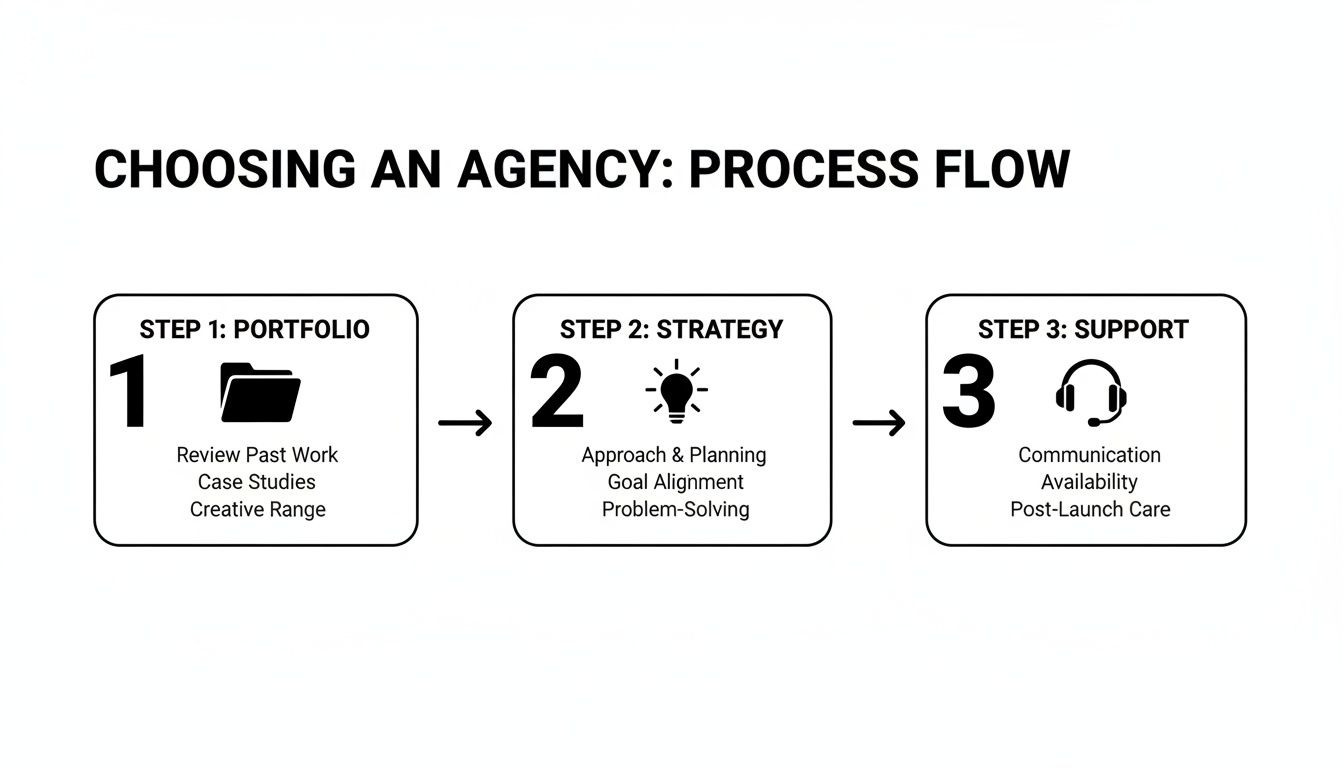
It highlights that a strong portfolio is just the ticket to the game. It's the combination of proven results, a clear strategic plan, and reliable ongoing support that actually leads to a successful partnership.
Step 5: Seamless Launch
Launching a new website is a critical moment. We manage the entire process meticulously to guarantee a seamless transition from your old site (if you have one) to the new one, with zero downtime. We handle all the technical heavy lifting so you can focus on celebrating your brand-new online store.
Step 6: Optimise And Scale
Our job isn’t done when your site goes live. In fact, that’s where our expertise as a marketing agency in Melbourne really shines. We shift into the Optimise & Scale phase, using data from Google Analytics to find opportunities for improvement. This includes ongoing Local SEO and optimising your Google My Business profile.
From there, we launch strategic marketing campaigns like Google Ads and paid social to drive targeted traffic, boost conversions, and maximise your return on investment. This ongoing partnership is designed to ensure your website evolves and grows right alongside your business.
Your Ecommerce Questions Answered
Over the years, I’ve built a lot of online stores for Melbourne ecommerce businesses, and I’ve answered hundreds of questions along the way. To give you a head start, I’ve pulled together some clear, straightforward answers to the ones that pop up the most.
This isn’t generic advice. It’s all based on my real-world experience helping brands navigate the exact same decisions you’re facing right now.
How Much Does Ecommerce Website Design In Melbourne Typically Cost?
This is always the first question, and the honest answer is: it really depends. The final cost comes down to the complexity of the build, the platform you choose (like a custom WordPress setup versus a streamlined Shopify store), and the specific features your business needs to thrive online.
To give you a ballpark, a clean, well-designed Shopify store might start from around $5,000. On the other end of the scale, a highly customised website with complex integrations, unique functionality, or a massive product catalogue could cost $30,000 or more. I always encourage clients to think about the potential return on investment, not just the upfront price tag. A great site that converts customers will pay for itself many times over.
How Long Does It Take To Build An Ecommerce Website?
Typically, a standard project takes between 8 to 12 weeks from our initial strategy session to the day we go live. This timeframe gives us enough breathing room to cover all the critical stages properly: discovery, design, development, loading up your content, and thorough testing.
Of course, more complex builds can take longer, especially if they need unique features like custom apps from a skilled Shopify API developer. We always map out a clear and realistic timeline right from the start, so you know exactly what to expect and when.
Do You Provide Ongoing Support After The Website Is Launched?
Absolutely. An ecommerce website isn’t a ‘set and forget’ project; it’s a living part of your business that needs ongoing attention to perform at its best. We offer support and maintenance plans to handle everything from security updates and performance checks to small technical tweaks you might need down the line.
But more importantly, as a digital marketing agency in Melbourne, our partnership often continues long after launch day. We work with clients on their growth strategies, using tools like Google Ads for ecommerce businesses and SEO to make sure their new site gets the traffic and sales it was built for. Your launch is just the beginning.
Have a project in mind? Alpha Omega Digital is a marketing agency based in Melbourne, Australia but also services clients from Sydney, Brisbane, Newcastle, Perth, Adelaide, Darwin and Hobart. Contact us to get started.