
I'm going to be straight with you. There's a universe of difference between a standard Shopify theme you grab off the shelf and a store that’s actually engineered to make you money. When I talk about an expert Shopify developer, I'm not talking about someone who just picks a template and fiddles with the colours. I'm talking about a partner who gets into the guts of the code, builds custom features that set you apart, and most importantly, makes your site so fast that impatient shoppers don't even think about clicking away.
It's not about just looking pretty; it’s about building a revenue engine. From my experience as the head of a marketing agency in Melbourne, I’ve seen firsthand that a solid technical foundation is what separates the stores that thrive from those that just survive.
Table of Contents
- Why an Expert Shopify Developer Is Your Best Investment
- The Technical Edge That Drives Sales
- Navigating the Competitive Australian Market
- Standard Shopify Setup vs Expert Shopify Development
- Defining Your Project: The Blueprint for Success
- Start With Your Business Goals
- List Every Single Functionality
- Define Your Audience and Brand
- Essential Skills: What Separates a Pro Shopify Developer
- Mastery of the Core Shopify Technologies
- Proficiency with the Shopify API and Headless Commerce
- More Than a Coder: A Strategic Partner
- My Proven Process for Vetting Shopify Developers
- Where to Find Genuine Shopify Talent
- Interview Questions That Cut Through the Noise
- Red Flags You Can't Ignore
- Talking Money, Contracts, and Getting Started in Melbourne
- Decoding Shopify Developer Pricing Models
- The Contract Must-Haves
- What a Smooth Onboarding Process Looks Like
- Frequently Asked Questions About Hiring Shopify Developers
- How Much Does It Really Cost To Hire A Shopify Developer In Melbourne?
- What's The Difference Between A Shopify Developer And A Shopify Expert?
- Should I Hire A Freelancer Or A Shopify Agency?
- How Long Does A Typical Shopify Development Project Take?
- Expanding Beyond Shopify: A Holistic Digital Toolkit
- WordPress Development & Design
- Paid Advertising: Google Ads & Facebook Ads Mastery
- The Technical Backbone: GTM, Analytics, and API Integrations
- Advanced eCommerce Strategies
- Local SEO & Call Tracking for Service Businesses
Why an Expert Shopify Developer Is Your Best Investment

I’ve worked with so many Melbourne business owners who started with a DIY site. They’d pour weeks into making it look perfect, only to find the sales just weren’t happening. This is exactly where the value of a real Shopify developer becomes painfully obvious. They are the bridge between a pretty but underperforming template and a genuine, high-converting eCommerce powerhouse.
Their work is so much more than skin-deep. A true pro will dig right into your store’s code to optimise it for speed—a massive factor for both your customers and your Google rankings. They can build custom solutions for you that an off-the-shelf app could never replicate, giving your brand that unique edge it needs to stand out.
The Technical Edge That Drives Sales
Think of a standard Shopify store like a reliable family sedan—it’ll get you from A to B. An expertly developed store, on the other hand, is like a finely tuned F1 car, engineered from the ground up for pure performance.
You really see this difference in a few key areas:
- Custom Functionality: Need a unique product customiser? A complex subscription model? Or maybe an integration with a niche Aussie logistics (3PL) provider? An expert uses the Shopify developer API to build these kinds of features from scratch, tailored perfectly to your business. This is where a real Shopify development company shines.
- Site Speed and Performance: They will go through your site with a fine-tooth comb, meticulously optimising images, minifying code, and deferring scripts that aren't critical. Shaving even half a second off your load time can lead to a very real and noticeable bump in your conversion rate.
- Conversion Rate Optimisation (CRO): A developer with a strategic brain understands the customer journey. They can help you implement A/B tests, smooth out friction in your checkout process, and structure your product pages in a way that naturally guides users towards that ‘Add to Cart’ button.
This kind of technical skill translates directly into higher average order values and more repeat customers. It’s an investment that pays for itself through more sales and a stronger, more scalable online store.
Navigating the Competitive Australian Market
The Aussie eCommerce scene is absolutely booming, which makes it more important than ever to have a store that truly stands out. In fact, Australia ranks as the third-largest market for Shopify globally, with over 151,042 live stores according to recent data.
This number alone explains why expert Shopify developers are in such high demand Down Under, especially in hubs like Melbourne where businesses are all racing to grab their slice of the online pie. With that much competition, a generic theme just won't cut it anymore.
The difference between a good developer and a great one becomes painfully clear once users start engaging with your store. Every misstep or error in your site’s checkout flow, theme customisation, or app integration is a potential conversion lost.
For business owners, getting the right technical talent on your team is one of the most critical decisions you'll make. For more on this, check out this fantastic startup playbook for hiring software engineers for some deeper insights.
To really spell it out, here’s a quick comparison that breaks down the real-world differences between a DIY setup and a professional build.
Standard Shopify Setup vs Expert Shopify Development
| Feature | Standard DIY Setup | Expert Developer Build |
|---|---|---|
| Performance | Often slow due to unoptimised themes and too many apps. | Lightning-fast load times, leading to lower bounce rates. |
| Customisation | Limited to theme settings and basic app integrations. | Fully custom features tailored to your unique business needs. |
| User Experience | Generic, may have confusing navigation or checkout. | A smooth, intuitive journey designed to maximise conversions. |
| Scalability | Can break or slow down as your business grows. | Built on a solid foundation that supports future growth. |
As you can see, the gap is huge. An expert build isn't just an expense; it's a foundational investment in your business's future growth and success online.
Defining Your Project: The Blueprint for Success

Before you even think about writing a job post, you need to get crystal clear on exactly what you’re asking for. I've seen too many projects go completely off the rails because the initial brief was vague. This almost always ends in scope creep, blown-out budgets, and a whole lot of frustration for everyone.
Creating a clear project scope isn’t just ticking a box; it’s the absolute foundation of your entire project. It’s what lets an expert Shopify developer give you an accurate quote and a realistic timeline. Getting this right from the start is how you set yourself up for a win.
Start With Your Business Goals
First, let’s step back from the tech for a minute. What are you actually trying to achieve here? A good developer needs to understand the ‘why’ behind the ‘what’ to deliver real value.
Are you trying to:
- Increase your average order value by 15%?
- Slash abandoned carts by making the checkout experience dead simple?
- Launch a new subscription service to build recurring revenue?
- Boost your site speed to improve SEO rankings and stop people from bouncing?
When you connect the project to a solid business objective, you give the developer crucial context. It empowers them to make smarter recommendations and sometimes even suggest a better, more efficient way to get you there.
For instance, I had a client come to us wanting a highly complex, custom-built feature. After we dug into their goal—which was really just to increase customer loyalty—we realised a simple loyalty app integration paired with a minor theme tweak would deliver the same outcome. It saved them a huge amount of time and money. That’s the kind of strategic thinking you unlock when you’re clear about your goals.
List Every Single Functionality
Once your goals are locked in, it’s time to get granular. This is where you list every single feature and function you need. Don't assume anything is obvious, because in my experience, it never is.
A solid list of functional requirements might include things like:
- Integration with a specific 3PL: Name the provider (e.g., eStore Logistics) and spell out exactly how inventory and orders need to sync.
- Custom product options: Do you need customers to be able to add custom text, upload an image, or choose from complicated variant options?
- Subscription model: Specify the billing frequency (weekly, monthly, etc.) and any special rules for managing or pausing subscriptions.
- Wholesale portal: Will B2B customers need a separate, password-protected area with its own unique pricing structure?
The more detail, the better. If you’ve seen other websites with functionality you love, include the links. This helps remove any guesswork and gives the developer a clear visual reference to work from.
A vague request like "make the site faster" is impossible to quote accurately. Instead, aim for something specific like "achieve a Google PageSpeed Insights score of 90+ on mobile" or "redesign the product page to include customer reviews and a sticky 'Add to Cart' button."
Define Your Audience and Brand
So, who are you actually selling to? A developer needs to get inside the head of your target customer to build an experience that truly connects. Are you targeting tech-savvy millennials, or an older demographic who would appreciate a simpler, more direct interface?
Your brand identity is just as important. Hand over your brand guidelines, including your logos, colour palettes, and typography. A great Shopify developer doesn't just write code; they bring your brand’s personality to life online. The work of a WordPress developer in Melbourne is much the same in this regard—they have to translate a brand’s identity into a functional and beautiful website, no matter the platform.
By clearly defining your project scope, you give them the tools to deliver a final product that is not only technically solid but also a perfect reflection of your brand.
Essential Skills: What Separates a Pro Shopify Developer
Not all developers are created equal, especially in the world of Shopify. When I talk about hiring an expert Shopify developer, I’m looking for someone who does way more than just install a theme. The real pros are a unique blend of technical masters and sharp eCommerce strategists.
So, what really separates the pros from the amateurs? It comes down to a mix of deep technical knowledge and a genuine feel for what actually makes an online store sell.
This diagram breaks down the core pillars of an expert developer's skill set, flowing from pure code right through to customer-focused strategy.
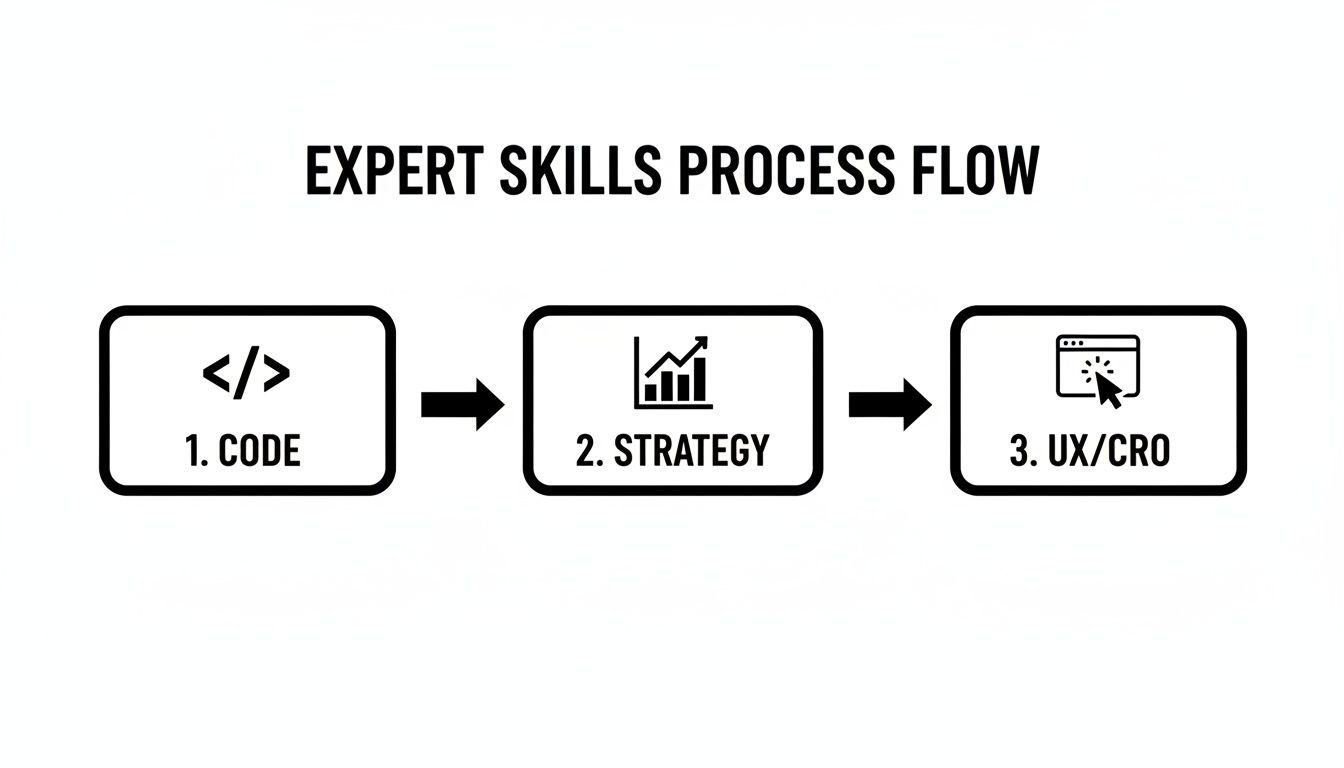
The key takeaway here is that technical skill is the foundation. But it’s the strategy and user experience that turn a functional site into a profitable one.
Mastery of the Core Shopify Technologies
The absolute non-negotiables start with the platform's native languages. This isn't up for debate.
Their technical toolbox has to include:
- Shopify Liquid: This is Shopify’s own templating language. An expert doesn't just tweak existing Liquid code; they can write it from scratch. They can build completely custom page templates, unique sections, and dynamic user experiences that just aren't possible with a standard theme editor.
- JavaScript (and its frameworks): From adding slick interactive elements on a product page to building complex front-end logic for a customiser, advanced JavaScript is essential. Experience with modern frameworks like React is also a massive plus, especially for headless builds or custom Shopify app development using Shopify CLI.
- CSS/SCSS: A developer needs to do more than just change colours. They must be able to write clean, responsive, and maintainable CSS (or SCSS) to ensure your store looks perfect on every device, without bogging it down with messy code.
A developer who is just "familiar" with these will constantly hit walls. An expert, on the other hand, uses them to solve business problems creatively.
Proficiency with the Shopify API and Headless Commerce
This is where you separate the good from the great. The Shopify API is the key that unlocks true customisation, allowing a developer to build functionality that goes far beyond what you see in the Shopify admin panel. I've been on projects where we used the API to create custom dashboards for a client and integrate their store with unique, third-party inventory systems.
A developer’s experience with the API shows they can handle complex challenges, such as:
- Building Custom Shopify Apps: Whether it's a private app for your store's specific needs or a public app for the App Store, this requires deep API knowledge. We’ve done this for clients using the Shopify CLI, and it's a game-changer for unique business models. A true shopify development partner can guide you here.
- Headless Commerce with Hydrogen: This is a more advanced approach where you decouple the Shopify backend from the front-end. A developer skilled in Shopify's Hydrogen framework and Oxygen hosting can build incredibly fast and unique storefronts that offer an unmatched user experience.
More Than a Coder: A Strategic Partner
The most valuable Shopify developers I've worked with are the ones who think like business owners. They don't just blindly follow a brief; they ask the right questions and challenge assumptions to get to a much better outcome.
A great developer's value isn't just in the code they write, but in the bad code they prevent you from paying for. Their strategic input can save you thousands by steering you away from features that won't deliver a return on investment.
They understand core eCommerce principles like Conversion Rate Optimisation (CRO) and User Experience (UX). They know that the placement of a button, the speed of a page, or the flow of a checkout process directly impacts your bottom line.
A top-tier Shopify developer should also be across effective e-commerce strategies, including how to leverage tools for revenue growth. For instance, understanding how to help you with choosing the right Shopify upsell app is crucial for maximising your conversion rates and average order value. This kind of strategic insight is what truly makes them an invaluable part of your team, not just a hired coder.
My Proven Process for Vetting Shopify Developers

Finding a developer is easy. Finding the right one? That's the hard part. Over the years, I've refined our vetting process to cut through the noise, weed out the time-wasters, and pinpoint the genuine experts who deliver real results.
It’s a system I’ve battle-tested on countless projects. The goal is to look past a flashy portfolio and dig into how a candidate actually thinks, solves problems, and understands business.
This process ensures that when we bring a Shopify developer onto a project, they aren't just a coder—they're a strategic partner ready to help our clients grow.
Where to Find Genuine Shopify Talent
Your search for a top-tier Shopify developer has to start in the right places. I’ve seen so many business owners cast a wide net on generic freelance sites, only to get buried under a mountain of low-quality applications. You end up wasting hours just filtering out people who were never a good fit.
Instead, I tell clients to focus their energy on more curated platforms:
- The Official Shopify Experts Marketplace: Honestly, this is the best place to start. Every developer and agency here, including our team at Alpha Omega Digital, has been vetted and approved by Shopify itself. It's a stamp of quality that gives you immediate confidence.
- Specialised Agencies: An agency that lives and breathes e-commerce offers a huge advantage. You’re not just hiring one person; you're getting a whole crew of strategists, designers, and project managers. If you're looking for a Shopify development partner in Melbourne, an agency provides a complete solution.
- Niche Job Boards and Communities: Platforms like Storetasker are hyper-focused on the Shopify ecosystem. They connect you with developers who are completely immersed in the platform. While they can be great for smaller, specific tasks, they're a fantastic resource to know about.
Interview Questions That Cut Through the Noise
Once you have a shortlist, the interview is where you separate the talkers from the doers. I skip the generic "tell me about yourself" stuff and get straight to questions that test their real-world technical depth and strategic mind.
Technical & Problem-Solving Questions:
- "Walk me through a complex site performance issue you solved. What was the problem, how did you diagnose it, and what specific steps did you take to fix it?"
- "Describe a time you used the Shopify API for a custom integration. What was the business need, and what challenges did you run into with the API?"
- "How do you approach mobile-first design in your CSS and Liquid code? Give me an example of a common mistake you see other developers make."
Strategic & Business-Minded Questions:
- "A client wants to add five new apps to their store. How would you advise them? What's your process for evaluating the impact of new apps?"
- "If you saw a client's checkout abandonment rate was high, what are the first three things you would investigate?"
- "How do you stay up-to-date with Shopify updates? What recent change has most impacted how you build stores?"
These questions force candidates to draw from actual experience, not just give you vague, textbook answers.
Red Flags You Can't Ignore
I've learned the hard way that some warning signs are too big to ignore. A technically brilliant developer who's a terrible communicator can sink a project just as easily as one who can't code.
Watch out for developers who say 'yes' to everything without asking questions. An expert knows when to push back, challenge an idea, and suggest a better approach. Their job is to find the best solution, not just blindly follow orders.
Here are the key red flags I always look for:
- Poor Communication: Vague, slow, or unprofessional responses are a deal-breaker. If they can’t communicate clearly during the hiring process, they definitely won’t when a problem pops up mid-project.
- No Interest in Your Business: Do they ask about your goals, your customers, or your revenue? If not, they’re just looking for a coding gig, not a partnership.
- A Portfolio of Lookalike Sites: If all their past projects look like slightly tweaked versions of the same theme, they probably lack the deep customisation skills you need for a standout store.
- Blaming Others: When you ask about a project that went wrong, do they take responsibility or blame the client? A true professional owns their mistakes and, more importantly, learns from them.
Ignoring these signs almost always leads to headaches down the road. Trust your gut—if something feels off, it probably is.
Talking Money, Contracts, and Getting Started in Melbourne
Alright, let's get into the nitty-gritty: money and logistics. Once you’ve found a Shopify developer who looks promising, the conversation always turns to cost, contracts, and how the whole thing will actually kick off. This is where a lot of business owners in Melbourne feel a bit out of their depth, but it’s much simpler than you think when you know what to look for.
Getting this part right is all about protecting your business, setting crystal-clear expectations, and starting the partnership on solid ground. Any professional developer or agency will be completely transparent here and have a structured approach for all three.
Decoding Shopify Developer Pricing Models
When it comes to paying for development work, you'll generally come across three main pricing structures. I've used all of them at different times, and each one has its place depending on the project.
- Hourly Rates: This is pretty common for freelancers and is great for ongoing support or small, unpredictable tasks. In Melbourne, you can expect to see rates anywhere from $80 to over $200 per hour for a true expert. Be very wary of rates that seem too good to be true—they almost always are.
- Fixed-Price Projects: This is my preferred model for projects with a well-defined scope, like a full theme build or developing a specific feature. You both agree on a total cost for the work outlined. It gives you budget certainty, but it relies heavily on having that super-clear project brief we talked about earlier.
- Monthly Retainers: This is the perfect setup for businesses that need continuous improvements, bug fixes, and ongoing strategic advice. You pay a set fee each month for a certain block of the developer's time. It’s ideal for a long-term partnership where you're constantly looking to optimise your store.
The Shopify partner network has absolutely exploded, which is brilliant news for you. It's part of a global 72% growth, with partners generating a staggering $12.5 billion by servicing sellers around the world. With Shopify now offering 0% commission to app developers earning under $1 million, there’s a massive incentive for Australian talent to build incredible custom solutions. For you, this means there's a vibrant market of experts ready to deliver work that drives a real return. You can find more detail on these Shopify growth statistics.
The Contract Must-Haves
Your contract isn't just a boring formality; it's the rulebook for your project. It protects both you and the developer by making sure everyone is 100% on the same page. Never, ever kick off a project without a signed agreement in place.
A professional developer will insist on a contract. If they don't, it's a massive red flag. They should see it as a tool for clarity and mutual protection, not a sign of mistrust.
Your contract should clearly lay out:
- A Detailed Scope of Work: This should reference your project brief and list every single deliverable. No ambiguity.
- Payment Terms: It must specify the pricing model, total cost, and payment schedule (e.g., 50% upfront, 50% on completion). It also needs to cover how out-of-scope work will be priced and handled.
- Project Milestones and Timeline: The project should be broken down into phases with clear deadlines.
- Intellectual Property (IP) Ownership: Crucially, the contract must state that you own all the custom code and designs once the final payment is made.
- Termination Clause: It should define how either party can end the agreement if things just aren't working out.
What a Smooth Onboarding Process Looks Like
The first week of a project really sets the tone for the entire engagement. A professional Shopify developer will have a structured onboarding process designed to get them up to speed quickly and efficiently, without wasting your time.
It typically kicks off with a formal kickoff meeting. This is where you'll meet the team, reconfirm the project goals one last time, and set up your communication channels. At our Google Ads agency, we follow a very similar process to make sure everyone is aligned from day one.
A smooth onboarding should always include:
- Discovery and Deep Dive: The developer will ask a lot of questions to fully wrap their head around your business, your brand, and your customers.
- Access and Setup: They'll have a secure process for requesting access to your Shopify store, Google Analytics, and any other tools they need.
- Communication Plan: You’ll agree on how you'll communicate (e.g., Slack, email), how often you'll have check-in meetings, and who your main point of contact is.
This initial process is critical. It’s the first real sign that the developer is organised, professional, and serious about making your project a success.
Frequently Asked Questions About Hiring Shopify Developers
As a Shopify agency owner here in Melbourne, I have countless chats with business owners who are ready to take their eCommerce store seriously. And almost every time, the same handful of questions pop up. They’re all wrestling with similar concerns about hiring an expert Shopify developer, so I wanted to lay out some straight answers for you.
How Much Does It Really Cost To Hire A Shopify Developer In Melbourne?
Honestly, the cost can be all over the place, and it really comes down to the developer’s experience and just how complex your project is. For freelance developers in Melbourne, you’ll see hourly rates anywhere from $80 to over $200. For something like a full custom theme build, you could be looking at a range of $10,000 to $30,000+.
At Alpha Omega Digital, we’ve found it’s much better to scope projects based on the actual value they’ll deliver, not just the hours they take to build. If there’s one piece of advice I can give you, it’s this: don’t just go for the cheapest quote. Poorly written code will always cost you more in the long run with lost sales, endless bug fixes, and a site that simply can’t grow with you.
What's The Difference Between A Shopify Developer And A Shopify Expert?
This is a great question, and the difference is pretty important. Essentially, anyone who knows how to tweak a Shopify store can call themselves a "Shopify developer." It's a title anyone can give themselves.
A "Shopify Expert," on the other hand, is a developer or an agency that has been officially vetted and approved by Shopify. To get that badge, you have to prove you’ve delivered high-quality work on successful projects. When you hire a verified Expert or an agency that's been through that process, you’re getting an extra layer of confidence that you're working with a true professional.
A Shopify Expert designation isn't just a badge; it's a signal that the developer has met Shopify's rigorous standards for technical skill, customer service, and project success. It's a quick way to filter out the amateurs.
Should I Hire A Freelancer Or A Shopify Agency?
The right call here really hinges on the size and complexity of what you need to get done.
- A freelancer can be perfect for smaller, clearly defined jobs. Think a specific theme tweak, setting up an app, or squashing a particular bug. They can be fast and cost-effective for those one-off tasks.
- A Shopify agency is almost always the better choice for more complex builds, a full redesign, ongoing support, or if you need a long-term strategic partner to help you grow.
When you bring on an agency like ours, you’re not just getting one developer. You’re getting a whole team—developers, designers, SEO specialists, and project managers. As a full-service eCommerce marketing agency, we’re set up to deliver a complete solution that drives sustainable growth, not just tick a task off a list. For businesses that are serious about scaling, this model just works better.
How Long Does A Typical Shopify Development Project Take?
Ah, the classic "how long is a piece of string?" question. The timeline is completely tied to the scope of work.
A few small theme customisations might only take a week or two. But a full-blown custom website build—from the initial designs right through to launch—is more likely to take anywhere from 8 to 16 weeks. For really complex sites, it can definitely take longer.
As a reputable WordPress web developer, we know that giving a client a detailed project timeline after our initial discovery phase is non-negotiable. A crystal-clear scope and constant communication are the two things that keep a web project on track, and our whole process is built around ensuring both. Any developer worth their salt should provide you with that same clarity.
Expanding Beyond Shopify: A Holistic Digital Toolkit
While a high-performing Shopify store is the heart of an eCommerce business, my experience running a digital marketing agency in Melbourne has taught me that it's just one piece of the puzzle. To truly scale, you need a full toolkit of skills that drive traffic, convert visitors, and build a brand.
WordPress Development & Design
Many of our eCommerce clients also run content hubs, blogs, or corporate sites on WordPress. It’s an incredibly powerful platform, but like Shopify, it needs expert handling. Our team of WordPress developers in Melbourne are pros at everything from custom theme design to building unique functionality with Gutenberg blocks. A skilled WordPress developer ensures your content and brand sites are just as fast and effective as your eCommerce store.
Paid Advertising: Google Ads & Facebook Ads Mastery
You can have the best store in the world, but it means nothing if no one sees it. This is where paid ads come in.
- Google Ads: We’ve helped countless eCommerce brands master Google Shopping Ads. We understand the nuances of campaign priority in Google Ads, the PMAX vs Google Shopping debate, and how to create campaigns for dropshipping that are actually profitable. We get into the weeds of troubleshooting why your Google Shopping ads are not spending budget and figuring out what budget to spend on Google Ads to see a return.
- Facebook & Instagram Ads: As a leading Facebook ads agency, we know that success here is about more than just boosting a post. It's about a rigorous creative testing process, mastering Facebook Ads even when you want to quit too early, and understanding how to measure success beyond simple vanity metrics. We help businesses set up their Instagram and Facebook Shops and drive targeted traffic.
The Technical Backbone: GTM, Analytics, and API Integrations
Modern marketing runs on data. Our expertise includes:
- Google Tag Manager (GTM) & Analytics: Setting up GTM containers properly is the first step. We ensure all your tracking is flawless, so you can make decisions based on real data, not guesswork.
- Meta Conversion API (CAPI): With iOS changes, server-side tracking is non-negotiable. We handle the complete Conversions API installation for Meta, ensuring your ad data is as accurate as possible. This is a complex but crucial task for any serious advertiser.
Advanced eCommerce Strategies
For businesses looking to really push the boundaries, we dive deep into advanced development and strategy. This can involve a Shopify development crash course for your in-house team or building custom Shopify apps using the Shopify CLI to solve unique business challenges that off-the-shelf apps can't handle.
Local SEO & Call Tracking for Service Businesses
While our core focus is eCommerce, many of the principles apply to service businesses, especially those in the trades. We’re experts in Local SEO and optimising your Google My Business profile. For PPC campaigns for tradies, one of the most powerful tools we've implemented is custom call tracking.
We can set up a custom number through services like Twilio that includes a 24-hour AI-powered call answering service. It never gets sick or tired, can book appointments directly into your Calendly, and saves thousands in lost business for tradies, hairdressers, and dentists. Integrating this with the best call tracking software for PPC, like CallRail or Go High Level, provides a closed-loop system that proves ROI.
Alpha Omega Digital is a marketing agency based in Melbourne, Australia, but we also service clients from Sydney, Brisbane, Newcastle, Perth, Adelaide, Darwin and Hobart.
If you're an eCommerce business with a paid ads budget of at least $3k a month, I'd love to offer you a low-risk deal: get a month of paid ads management FREE.
Have a project in mind? Apply now through our contact page.