Think of a dedicated Facebook advertising agency as a team of specialists who take your ad campaigns from hopeful guesswork to a data-backed system for growth. It’s the difference between just ‘boosting posts’ and building a predictable engine that delivers a much better return on your ad spend.
Why Melbourne Businesses Partner with a Facebook Advertising Agency
As a marketing agency in Melbourne, I see it all the time: eCommerce business owners trying to do everything themselves. Juggling inventory, customer service, and designing new products is already a full-time job. Adding Facebook and Instagram advertising to the mix? It’s a complex machine that demands constant attention, and trying to master it while running a business is a recipe for wasted money and burnout.
That’s where partnering with a specialist Facebook advertising agency becomes a game-changer. It’s not about offloading a task you don’t like; it's a strategic move to bring in experts who live and breathe inside Meta's constantly changing platform. We handle everything, from deep audience research and creating ads that actually convert, to the nitty-gritty of tracking pixels and relentless campaign optimisation.
Reclaim Your Time, Maximise Your Budget
The real value is simple: we help you get your most valuable asset back—your time—while making sure every dollar in your ad budget works harder. Instead of you spending hours trying to figure out Ads Manager, we’re in there testing new audiences, analysing performance data, and refining your creative. This hands-on management stops you from making costly mistakes and gets you on the path to profitability much faster.
This shift isn't just a hunch; the numbers back it up. Social media ad spend in Australia is booming, grabbing a bigger and bigger slice of digital marketing budgets. Recent analysis shows that social media ad spend alone was around AUD $4.26 billion, a huge chunk of the total digital ad spend and a massive jump year-on-year. This surge creates intense competition and a real need for agencies that can deliver measurable results. You can dig into these Australian social media statistics to see just how much businesses are investing here.
The table below breaks down the real-world difference between going it alone and working with a team that does this day in, day out.
DIY Facebook Ads vs Agency Management
| Aspect | DIY Approach | Agency Partnership |
|---|---|---|
| Time Investment | 10-15+ hours/week learning, testing, and managing. | 1-2 hours/week for check-ins and approvals. We handle the rest. |
| Expertise | Learning curve is steep. Mistakes can be costly. | Deep knowledge of platform updates, strategies, and creative best practices. |
| Strategy | Often reactive, based on boosting posts or basic targeting. | Proactive and data-driven, built around your business goals and KPIs. |
| Tools & Tech | Limited to native platform tools. | Access to advanced analytics, creative, and automation software. |
| Cost | "Cheaper" upfront, but high risk of wasted ad spend on poor campaigns. | Agency fee + ad spend, but optimised for higher ROAS and lower CPA. |
| Results | Hit-or-miss. Success is often inconsistent and hard to replicate. | Predictable, scalable growth with clear reporting on what matters. |
As you can see, partnering with an agency isn't just about saving time—it's about investing in a more efficient and effective growth system from the get-go.
From Guesswork to a Growth System
When you work with an agency, your advertising stops being a frustrating expense and becomes a predictable system for bringing in new customers. We build a structured process based on solid data, not just hunches.
Here’s what that actually looks like in practice:
- A Solid Foundation: We start by getting to know your business inside and out—your goals, ideal customer, and profit margins—to build a campaign strategy that actually helps your bottom line.
- Expert Execution: Our team handles all the technical headaches, from setting up the Meta Conversion API for accurate tracking to designing and split-testing ad creative to find what truly clicks with your audience.
- Constant Optimisation: The work doesn’t end once the ads are live. We’re constantly watching performance, shifting budget to the winning ads, and tweaking your targeting to improve your Return On Ad Spend (ROAS).
- Reporting That Makes Sense: You get straightforward reports that focus on the numbers that matter—sales, leads, and cost per acquisition—not confusing vanity metrics that don't pay the bills.
How We Tackle Shopify and WordPress Ads
When we partner with an eCommerce business, our job as a Facebook advertising agency goes way beyond just clicking "boost post". We build a complete system where your ads and your website are perfectly in sync. Think about it: incredible ads are completely wasted if they send eager customers to a slow, confusing website that leaks sales.
This is especially true for businesses running on platforms like Shopify or WordPress. They're both incredibly powerful, but getting them to communicate flawlessly with Meta's ad platform requires a very specific technical skillset. Our services are designed to bridge that gap and make sure every dollar you spend has the best possible chance of turning into revenue.
Bulletproof Tracking Setup Is Non-Negotiable
Before a single dollar of your ad budget gets touched, we have to get the tracking right. In a world of increasing privacy updates from Apple and other browsers, relying on the old-school Meta Pixel alone is a recipe for disaster. Your data will be patchy, your results will look worse than they are, and you'll be making decisions completely in the dark.
Our first job is always a full technical audit and setup. This includes:
- Google Tag Manager (GTM): We use GTM as the central nervous system for all your tracking scripts. This keeps your website code clean and lightweight, which helps with loading speed, and it lets us add or change tracking without bothering your developers to edit theme files.
- Meta Conversions API (CAPI): This is the real game-changer. CAPI lets your website's server send sales data directly to Meta, completely bypassing the browser and its ad-blocking tech. This gives us a much more accurate picture of what’s actually working, leading to smarter ad optimisation and a healthier ROAS. For any serious eCommerce brand, setting up the Meta Conversion API is an absolute must.
I can't stress this enough: without a proper CAPI and server-side tracking setup, you are flying blind with your ad spend. It's the difference between guessing which ads are making sales and knowing with confidence.
The Foundation: A High-Performing Website
All the traffic in the world won't save a website that can't convert visitors into customers. Your Shopify or WordPress store is the final, most critical step in the sales journey. This is exactly why our ad services are so closely tied to our expertise as a WordPress development company and our deep experience with Shopify.
We make sure your site is primed and ready for paid traffic by focusing on:
- Speed and Performance: Slow-loading pages are conversion killers. We obsess over site speed to make sure users don't get frustrated and leave before they even see what you're selling.
- Mobile-First Design: The vast majority of social media traffic comes from smartphones. Your store absolutely must provide a seamless, intuitive experience on a small screen.
- Clear Conversion Pathways: We look at your user journey with a critical eye, removing any friction or confusing steps that might stop someone from hitting "add to cart" and checking out.
A fast, secure, and conversion-focused platform is the perfect launchpad for any ad campaign. Whether you're a Melbourne local or a nationwide brand, a solid site built by a skilled WordPress developer is essential.
Systematic Creative Testing for Meta Ads
Once the technical foundation is solid, we get to the fun part: the ads themselves. Our process isn't about trying to create one single "perfect" ad. It's about building a rigorous testing system to let the data tell us what your customers actually want to see.
We methodically test different creative elements to find the winning combination that resonates with your audience. This means testing:
- Ad Formats: Single Images vs. Carousels vs. Videos vs. Reels.
- Creative Angles: Should we highlight product features? Show off glowing customer testimonials? Or use authentic user-generated content?
- Ad Copy: We test different headlines, body text, and calls-to-action (CTAs) to see what language drives the most clicks and sales.
This structured approach takes all the guesswork out of the equation. We quickly find the top-performing ads, scale the budget behind them, and make sure your ad spend is always working as hard as it possibly can to grow your business.
Understanding Facebook Ads Budgets and Costs in Australia
Alright, let's talk about the part everyone asks about first: the money. Figuring out budgets and costs is often the biggest hurdle for business owners, but it doesn't have to be a confusing black box. I believe in being completely upfront about how the finances work when you partner with a Facebook advertising agency.
There are two main costs you need to plan for: the agency management fee and your actual ad spend that goes straight to Meta.
How Agencies Typically Structure Their Fees
When you engage a digital marketing agency in Melbourne, you'll usually come across one of two common pricing models. There’s no single "best" way; it's all about what fits your business stage and goals.
- Monthly Retainer: This is a fixed fee you pay each month for the agency to manage your campaigns. It's predictable, which is great for budgeting, and it's common for businesses that need consistent, ongoing management and optimisation.
- Percentage of Ad Spend: In this model, the agency's fee is a percentage (often 10-20%) of your monthly ad budget. This model aligns the agency's success with yours—the more you can profitably spend, the more they earn. It's a popular choice for brands that are ready to scale their advertising aggressively.
We'll always discuss which model makes the most sense for you. The goal is to find a structure that feels fair and focuses our efforts squarely on getting you the best possible results for your investment.
What Should Your Actual Ad Budget Be?
This is the million-dollar question, and the honest answer is: it depends. A realistic starting budget comes down to your industry, your product's price point, and what you’re trying to achieve. However, I can give you a clear framework based on real Australian market data.
To make informed decisions, we look at key metrics like Cost Per Click (CPC) and Cost Per Mille (CPM), which is the cost per 1,000 impressions. These numbers tell us how much it costs just to get your ads in front of people and to get them to click.
Market summaries from 2025 show that the average Facebook CPC in Australia is around AUD $2.10, and the average CPM is near AUD $11.04. For eCommerce, the cost per sale often lands between AUD $20–$50. These are the baseline figures we use to set realistic expectations and build a starting budget that can actually gather enough data to succeed. For more details on these Australian ad cost benchmarks, you can explore the latest Facebook ads cost data.
A common mistake is starting with a budget that's too small. You need to spend enough to allow Meta's algorithm to exit its "learning phase" and find your ideal customers. A budget of at least $50-$100 per day is a solid starting point for a single campaign to gather meaningful data quickly.
Balancing Spend Between Google and Facebook
Many of our clients also run Google Ads, and a frequent question is how to split the budget. Here’s my simple rule of thumb:
- Google Ads (especially Shopping and Search): This is fantastic for capturing intent. People are actively searching for what you sell. This is your low-hanging fruit.
- Facebook & Instagram Ads: This is where you create demand. You're showing your products to people who are a perfect fit but might not be looking for you right now. This is crucial for building your brand and scaling beyond existing demand.
A healthy strategy often involves a balanced approach. We typically start by making sure you're capturing all existing demand on Google and then use Facebook to find new audiences and drive scalable growth. The exact split will evolve as we analyse performance data and see where your marketing dollars are working hardest.
Our Proven Process for Launching Your Campaign
I’m a big believer in transparency, so I want to pull back the curtain and show you exactly how we operate. Great results don't just happen by accident. They’re the product of a methodical, proven framework that makes sure nothing gets missed along the way.
This is our six-step roadmap for taking a client from our first chat to a high-performing campaign that actually drives growth. It’s a system we’ve refined by working with countless eCommerce businesses, from local Melbourne startups to established brands across Australia, moving beyond guesswork and into a repeatable process for success.
Step 1: Discovery and Strategy
It all starts with a deep dive into your business. We jump on a call to get a real feel for your most important goals, your profit margins, and exactly who your ideal customer is. This isn't just a casual chat; it's a strategic session where we lock in the key metrics that truly matter to your bottom line, setting the foundation for everything to come.
Step 2: Technical Audit and Setup
Once we have a clear strategy, we shift focus to the technical stuff. This is a non-negotiable step. We run a full audit of your existing tracking setup and then implement a bulletproof system using Google Tag Manager (GTM) for clean code and the Meta Conversions API (CAPI) for rock-solid, server-side data. This is how we make sure we can trust every number we see.
Step 3: Audience Research and Persona Building
Next up, we become experts on your customer. We use audience insight tools and dig into your existing data to build out detailed customer personas. We’re looking for their pain points, their motivations, and where they hang out online. This research is what lets us craft messaging and targeting that speaks directly to the people most likely to buy from you.
The flowchart below shows how we connect our agency model to your budget and the metrics we'll be tracking together.
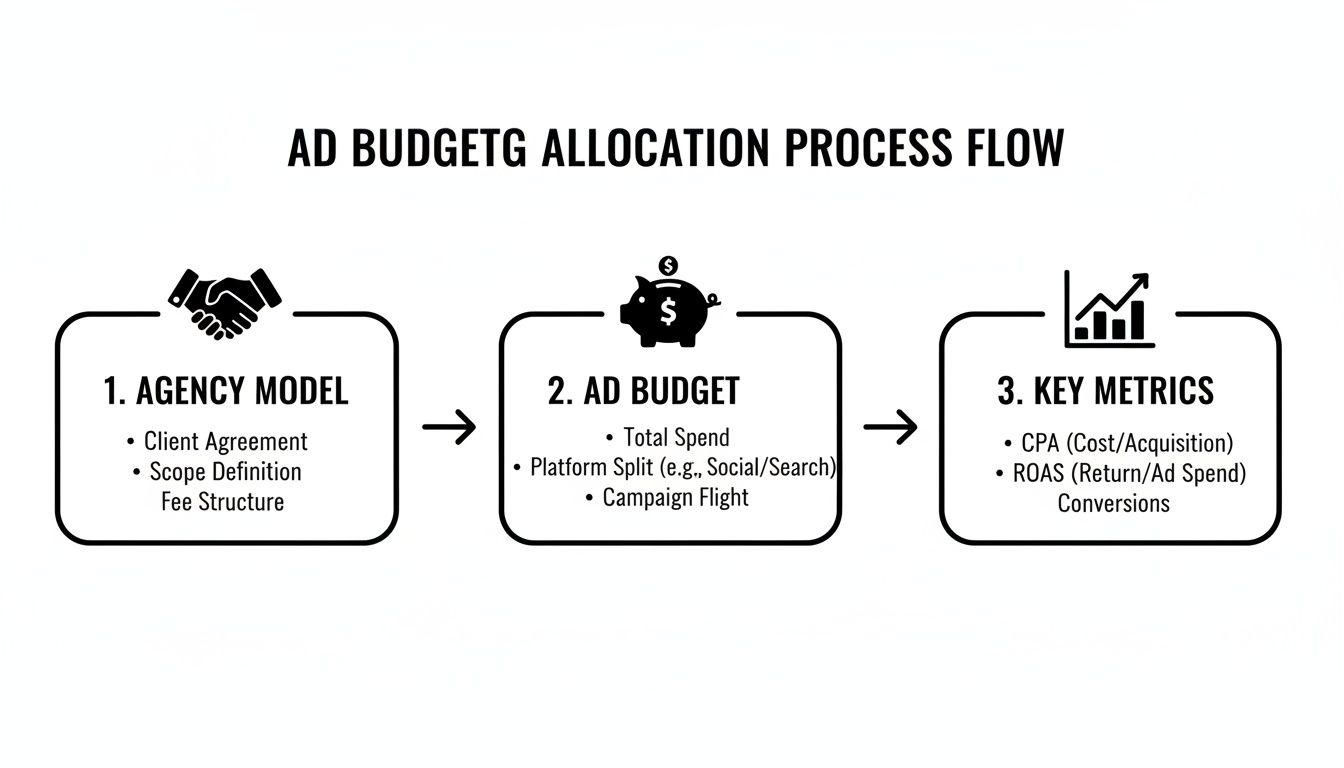
This gives you a clear picture of how we translate your investment directly into measurable outcomes that we can both see and act on.
Step 4: Creative Strategy and Development
This is where we turn all that audience research into compelling ad creative. We brainstorm different angles, write persuasive copy, and produce high-quality images and videos designed to stop the scroll. Our goal here is to build a library of assets we can systematically test to find the winning combinations.
Step 5: Campaign Build and Launch
With all the pieces in place, we get into Meta Ads Manager and meticulously build out the campaigns. We structure everything for optimal performance, set up targeting based on our research, and hit the launch button. Those first 72 hours are critical, and our team monitors performance like a hawk to make any necessary tweaks right out of the gate.
Step 6: Ongoing Optimisation and Reporting
The launch is really just the beginning. From here, we enter a continuous cycle of testing, learning, and optimising. Budget gets shifted to top-performing ads, underperformers are switched off, and fresh creative is constantly introduced to keep things from going stale. You’ll get clear, concise reports that cut the fluff and focus on what actually matters: sales, leads, and your return on ad spend.
How We Measure Success Beyond Clicks and Likes
It’s easy to get distracted by flashy numbers like likes, comments, and clicks. And while a bit of social buzz is nice, those metrics don’t pay the bills. As a performance-focused Facebook advertising agency, my team and I look straight past the vanity stuff to focus on the numbers that have a real, measurable impact on your eCommerce store's bottom line.
Success isn't about popularity; it's about profit. To truly understand if a campaign is working, it's essential to know how to effectively measure social media engagement in a way that connects directly to business goals. We translate ad performance into a clear story about your revenue.
Our North Star: Return On Ad Spend (ROAS)
For us, Return On Ad Spend (ROAS) is the ultimate measure of success. It’s a simple, brutally honest calculation: for every dollar you put into ads, how many dollars in revenue did you get back?
If you spend $100 on Facebook ads and generate $500 in sales directly from those ads, your ROAS is 5x. Simple.
This single metric cuts through all the noise. A high ROAS means your advertising is a profitable investment, plain and simple. It’s the primary KPI we use to decide whether to scale a campaign, shift budgets, or pull the plug.
The Other Critical eCommerce KPIs
While ROAS is our North Star, a few other key metrics give us the full picture of your campaign's health and profitability. Understanding how they all work together is what separates a good campaign from a great one.
Here’s a straightforward breakdown of the most important metrics we track for Facebook campaigns and why each one is critical for your profitability.
| KPI | What It Measures | Why It's Important |
|---|---|---|
| Cost Per Acquisition (CPA) | The average cost to acquire one new paying customer from your ads. | We monitor CPA closely to ensure we’re bringing in customers at a price that leaves you with a healthy profit margin. |
| Customer Lifetime Value (LTV) | An estimate of the total revenue a single customer will generate over their entire relationship with your brand. | A high LTV allows for a higher CPA. It justifies spending more to acquire a customer who will buy from you again and again. |
| Average Order Value (AOV) | The average dollar amount a customer spends each time they complete a purchase. | Increasing your AOV is one of the fastest ways to improve ROAS without needing to find more new customers. |
These metrics don’t live in isolation; they tell a story together.
Here's a real-world example: We might choose to run a campaign with a higher CPA if the data shows it attracts customers with a 50% higher LTV. It costs more upfront, but the long-term profit is significantly better. That’s thinking like a performance marketer.
By focusing on these core financial metrics, we move your advertising from the expense column and turn it into an investment in predictable, sustainable growth for your business.
Choosing the Right Agency (and the Red Flags to Run From)
Finding the right Facebook advertising agency can genuinely change the trajectory of your business. But let’s be honest, picking the wrong one is a costly, frustrating disaster. I want to give you a practical checklist you can use to vet any agency, so you feel confident you’re choosing a real partner, not just another vendor.
The whole selection process can feel complex. While there are great general strategies for finding the right design agency that apply here too, my goal is to arm you with the specific questions and red flags that are most relevant when you’re about to hand over your ad spend.
Key Questions to Ask Any Potential Agency
Don't be shy here. A great agency—whether they're a marketing agency in Melbourne or a team of Shopify development partners—will welcome your diligence and have clear, confident answers.
What’s your specific experience with eCommerce stores on Shopify/WordPress? Ask for case studies or examples of clients who look a lot like you. Generic experience isn't enough; you need a team that intimately understands the quirks and opportunities of your platform.
Can you walk me through your creative testing process? Vague answers like "oh, we test everything" are a massive red flag. Look for a methodical process. A good answer sounds like, "First, we test three core audiences against two creative angles, then we take the winning combo and test three different headlines…" You get the idea. They should have a system.
What does communication and reporting actually look like? Who is my point of contact? How often do we meet? Ask to see a sample report. You want to make sure it’s focused on the KPIs that matter to your bottom line (like ROAS and CPA), not vanity metrics like clicks and impressions.
How do you handle tracking and attribution? Their answer should immediately involve the Meta Conversions API (CAPI) and server-side tracking. If they only mention the basic Meta Pixel, they're not equipped for modern advertising. Full stop.
You're looking for signs of deep, specialised expertise. For example, an agency that clearly understands the nuts and bolts of a platform like Shopify is a good sign.
This shows they’re not just generalists; they understand the technical side of driving sales on that specific system.
Red Flags to Watch Out For
Just as important as knowing what to look for is knowing what to run from. If you spot any of these during your conversations, it’s a good reason to be very cautious.
- Guaranteed Results: This is the biggest red flag of them all. No honest agency can guarantee a specific ROAS or number of sales, especially right at the start. Advertising involves testing, and anyone who promises a certain outcome isn't being straight with you.
- Vague Processes: If they can't clearly explain their onboarding, strategy, and optimisation process step-by-step, it’s likely because they don't really have one. You want to see a structured framework, not just vague promises of "getting you results."
- Long, Inflexible Contracts: Be very wary of any agency that tries to lock you into a 12-month contract from day one. A confident agency will often offer a shorter initial term (like 3 months) to prove their value before you both commit to a longer agreement.
- Lack of Transparency: They should be completely open about their fees, what's included, and who will be working on your account. If you feel like you're not getting straight answers about anything, trust your gut and walk away.
A Few Common Questions
Here are some of the most common questions business owners ask me before we start working together. My goal is to give you clear, direct answers so you know exactly what to expect when you partner with a Facebook advertising agency.
How Long Until I See Results From Facebook Ads?
This is always the first question, and the honest answer is: it takes a little time. Think of the first 1-3 months as the data and testing phase. We’re gathering crucial information, teaching Meta’s algorithm who your best customers are, and figuring out which ad creatives and audiences hit the mark.
You'll see activity like clicks and traffic almost immediately. But the consistent, profitable results—the kind you can build a business on—usually start showing up after this initial learning period. By the end of month three, our goal is to have a clear picture of your winning campaigns and be well on our way to a positive and scalable Return On Ad Spend (ROAS).
Who Is Responsible For Creating The Ads?
This is a team effort. The best results come when we combine your deep brand knowledge with our advertising expertise. You know your products, customers, and brand voice better than anyone. We know what kind of images, videos, and copy actually get people to stop scrolling and click on Facebook and Instagram.
Here’s how we usually break it down:
- You Provide: Your brand guidelines, existing high-quality photos or videos, and any insights on what’s worked well with your customers before.
- We Create: The campaign strategy, write the ad copy, edit your assets for different placements (like Reels and Stories), and design new graphics if needed. We then show you everything for approval before a single dollar is spent.
How Much of My Time Will This Require?
My job is to free you up, not give you more homework. After the initial onboarding and strategy sessions—which do need a bit more of your time—your weekly commitment becomes very manageable.
You can expect to spend about 1-2 hours per week reviewing ad creative, giving the green light to new campaign ideas, and jumping on our regular performance check-in calls. We handle all the day-to-day management, monitoring, and tweaking so you can get back to running your business.
Can You Work With Businesses Outside of Melbourne?
Absolutely. While I’m proud to be a marketing agency based in Melbourne, we successfully manage campaigns for eCommerce clients all across Australia. Our entire process is built for smooth remote communication.
We use video calls for strategy sessions, shared documents for collaboration, and have a transparent reporting system that keeps you in the loop no matter where you're located. Whether you're in Sydney, Brisbane, or Perth, you'll get the same dedicated level of service and expertise. We’re focused on driving results, not on your postcode.
Alpha Omega Digital is a marketing agency based in Melbourne, Australia but also services clients from Sydney, Brisbane, Newcastle, Perth, Adelaide, Darwin and Hobart. Have a project in mind? Contact us