Let's be honest, relying on word-of-mouth is a slow, unpredictable way to fill your job board. When a homeowner's lights flicker out or a local cafe's switchboard fails, they don't ring a neighbour for a recommendation. They grab their phone and Google it.
That's the moment of truth. And Google Ads is the most direct way to put your business front and centre when it happens.
Why Google Ads Is Your Most Powerful Lead Generator
If your website is just sitting there hoping someone stumbles across it, you're missing out on the best kind of customer—the one with a burning, urgent problem that you are the perfect person to solve. I've spent years running pay-per-click campaigns for tradies, and the difference between a passive online presence and an active one is night and day.
It’s all about showing up for searches like 'emergency electrician Melbourne' or '24-hour sparky near me' at the exact second a potential customer needs you most.
This isn't just about being seen; it's about connecting with people who are ready to book a job right now. Unlike other marketing, Google Ads finds people who are actively looking for a fix. They aren't just browsing—they have a real problem and need a professional to solve it.
The Real-World Impact on Your Business
So, what does this actually look like for your business? It means your phone rings with genuine jobs, not just tyre-kickers hunting for the cheapest quote.
A well-oiled Google Ads campaign delivers:
- Immediate Visibility: No more waiting months for SEO to maybe kick in. Your ads can be at the top of Google search results within hours of going live.
- Targeted Local Reach: You get to pinpoint the exact suburbs and postcodes you want to work in. This ensures you only get calls for jobs that are actually profitable and convenient for you to get to.
- Measurable Results: Every single dollar is trackable. You'll know exactly which keywords are making the phone ring and which ads are turning clicks into paying customers.
The goal isn’t just to get clicks; it's to get qualified leads that turn into profitable work. By targeting customers with urgent needs, you position yourself as the go-to expert in your local area.
While Google Ads is an absolute powerhouse, the Australian home services market is definitely competitive. But the numbers tell a compelling story.
Electrician Google Ads Performance Snapshot
Here's a quick look at the key performance indicators for electricians using Google Ads in Australia, showing why the investment pays off despite the higher costs.
| Metric | Average for Electricians | What This Means for You |
|---|---|---|
| Average Cost Per Click (CPC) | $12.18 | It's a premium to play, but you're paying for high-intent traffic. |
| Average Click-Through Rate (CTR) | 5.15% | Your ads will get noticed if they're relevant and well-written. |
| Average Conversion Rate | 9.08% | Nearly 1 in 10 clicks becomes a genuine lead—a fantastic return. |
| Average Cost Per Lead (CPL) | $93.69 | This is your real acquisition cost, a solid figure for a qualified job lead. |
Even with a CPC of over $12, the strong click-through and conversion rates prove that when people search, they're ready to act. A cost per lead under $100 for a qualified electrical job is a number most business owners would happily pay all day long.
Ultimately, using Google Ads is about taking control of your lead flow. It transforms your marketing from a passive hope into an active, predictable engine for growth. And while this platform is incredibly effective on its own, exploring broader general marketing tips for tradies can help build an even more robust strategy for your electrical business.
Setting Up Your Campaign For High-Quality Leads
Jumping straight into the Google Ads platform without a plan is like starting a major rewiring job without a schematic. You might get power, but it's going to be inefficient and probably dangerous for your budget. Before we even touch keywords or ad copy, there are a few critical groundwork steps I always take with my clients.
Getting this pre-launch phase right is what separates the campaigns that generate genuine, high-quality leads from those that just burn cash. It all starts with defining exactly who you're trying to reach and where.
Defining Your Ideal Customer and Service Area
First up, you need to get crystal clear on your ideal customer and the specific postcodes you want to own. Are you chasing high-value commercial fit-outs, or are you the go-to for urgent residential repair jobs? The customer looking for a switchboard upgrade is worlds apart from the one with a sparking powerpoint at 10 PM on a Friday.
Knowing this helps you tailor every single part of your campaign later on. More importantly, you need to be ruthless about your service area. If a job is too far away to be profitable after you factor in travel time and fuel, you must exclude that area from your targeting. Don't be tempted to target an entire city if you only really service the northern suburbs—it’s the fastest way to get calls you can't actually service.
Building a High-Converting Landing Page
So, a potential customer clicks your ad. Where do they end up? If your answer is "my homepage," we need to fix that—fast. Your homepage is built for browsing; it’s packed with information and distractions. A dedicated landing page has one job and one job only: to get that visitor to call you or fill out your form.
To really squeeze the most value out of your Google Ads, the destination for your ad clicks—your landing page—is crucial. You should check out best practices for creating a simple landing page that’s laser-focused on conversion.
Here are the non-negotiable elements your landing page absolutely must have:
- A Punchy, Problem-Solving Headline: Something direct like, "Reliable Emergency Electrician Servicing Melbourne's Eastern Suburbs."
- An Unmissable Phone Number: Put it right at the top, make it click-to-call on mobile, and pepper it throughout the page.
- A Simple Contact Form: Ask for the bare minimum. Name, Phone, Suburb, and a brief message is plenty. Anything more just creates friction.
- Clear Trust Signals: Prominently display your licence number, insurance details, and any industry association logos.
- Social Proof: A few of your best Google reviews or customer testimonials build instant credibility and show you’re the real deal.
This flowchart shows the simple, direct path a customer takes when they desperately need your help.
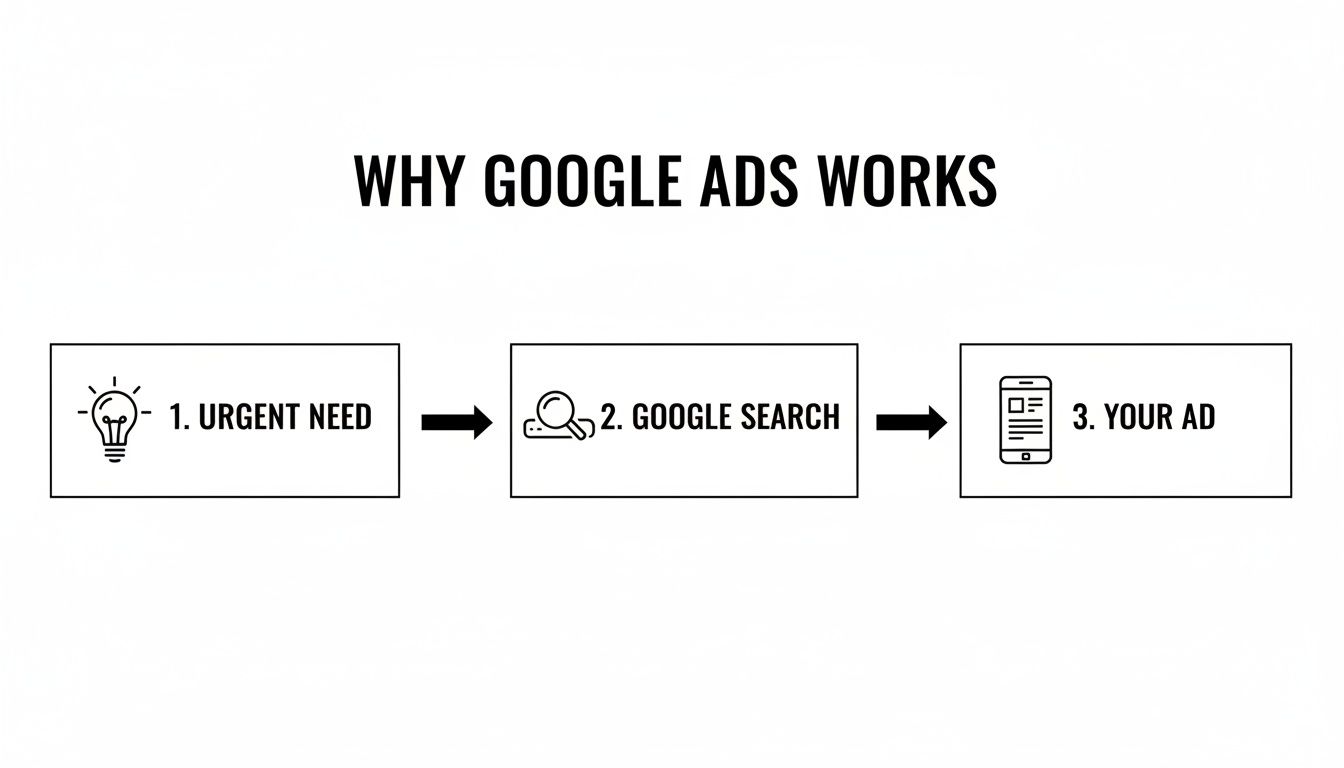
It really highlights that your ad is the critical link between a customer's urgent problem and the solution they're actively hunting for on Google.
Setting Up Conversion and Call Tracking
This final step is easily the most important. If you don't track what's working, you're just flying blind and guessing with your money. You absolutely need to know which ads and keywords are making your phone ring.
Without conversion tracking, you can't calculate your cost per lead or your return on investment. It's the difference between running a professional marketing campaign and just gambling.
I always set up two main types of conversion tracking for my clients:
- Form Submission Tracking: This is a small piece of code that tells us every time someone successfully submits the contact form on your landing page.
- Call Tracking: We use a dynamic phone number on your landing page that links directly to your Google Ads account. This allows us to see exactly which ad click led to which phone call.
Getting this tracking infrastructure set up is non-negotiable. It makes every dollar you spend accountable and gives us the hard data needed to optimise the campaign for better results over time.
This is where we separate the campaigns that make money from the ones that just burn through it.
Picking the right keywords is the absolute foundation of a solid Google Ads campaign, especially for an electrician. Get this wrong, and you'll waste your budget on DIY-ers and students. Get it right, and your phone will start ringing with the kind of urgent, high-value jobs you actually want.
Over the years, I've learned that the most profitable keywords aren't just about the service you offer, but the intent behind the search. You need to get inside the head of someone whose power just went out, not someone writing a paper on electrical engineering.
Finding High-Intent "Money" Keywords
High-intent keywords are the phrases people type into Google when they have a genuine, urgent problem and are ready to hire someone now. They often include specific problems, locations, and time-sensitive language.
Here are the types of keywords that have consistently driven the best jobs for the electricians I've worked with:
- Emergency & Urgent Keywords: These are pure gold. Think
24/7 emergency electrician Sydneyorafter hours electrician Melbourne. The person typing this isn't casually browsing; they need help immediately. - Problem-Specific Keywords: These searches get straight to the point. Examples like
switchboard upgrade cost,safety switch keeps tripping, orno power to houseshow a real, tangible issue that needs a professional. - Location-Based Service Keywords: Combining a service with a suburb is crucial for attracting local customers. Simple phrases like
electrician Prestonorcommercial electrician Richmondpull in people right in your service area.
The real magic happens when you combine these elements. A keyword like ‘emergency switchboard repair Carlton’ is incredibly valuable. It’s urgent, it's specific, and it's local. This is exactly the kind of traffic you want to be paying for.
Understanding Keyword Match Types
Google gives you a few levers to pull that control how closely a search needs to match your keyword for your ad to appear. Using the right mix is non-negotiable if you want to protect your budget and filter out irrelevant clicks.
- Broad Match: This is the default setting and, frankly, the riskiest. If your keyword is
electrician, your ad could pop up for searches likeelectrician apprenticeshiporhow to become an electrician. I almost never recommend this for tradies. - Phrase Match: You signal this with quotation marks, like
"emergency electrician". Your ad shows up when the search includes that phrase in that order, but it can have words before or after it. It’s a great starting point for most campaigns. - Exact Match: Indicated with square brackets, like
[electrician near me], this is the most restrictive. Your ad only shows for that exact search or incredibly close variations. This is perfect for your absolute best-performing, most profitable keywords.
I usually start new campaigns with a healthy mix of Phrase and Exact match keywords. This gives us enough reach to see what's working while keeping a tight rein on who sees the ads.
The Power of a Strong Negative Keyword List
A negative keyword list is just as important as the keywords you're targeting. This is where you tell Google what searches you don't want your ads to show up for. Building this list from day one will save you a ridiculous amount of money.
Every irrelevant click you prevent is pure savings.
Here are some of the first negative keywords I add to every single electrician's campaign without fail:
- DIY & Informational:
how to,DIY,fix,repair guide,wiring diagram - Career & Training:
jobs,apprenticeship,course,salary,training,school - Brand Names (not yours):
Bunnings,Clipsal,HPM(unless you're a specific supplier, of course) - Cheap & Free:
free,cheap,cheapest,quote only
Think of it as building a fence around your ad budget. You’re letting the good traffic in while keeping the time-wasters and tyre-kickers out. This is an ongoing job, too. You should be checking your "Search Terms" report in Google Ads regularly to find new negative keywords to add. It’s one of the single most effective ways to make your campaigns more profitable over time.
Structuring Your Campaign for Maximum Local Impact
A well-structured campaign is what separates the sparkies who get consistent, profitable jobs from Google Ads from the ones who just burn through their budget. Your goal is to spend every dollar where it counts—on local customers in your service area who need you right now.
Let’s walk through setting up a campaign from scratch, focusing on what I’ve seen work time and time again for electricians.
For most electricians, the standard Search campaign is the absolute workhorse. It's reliable, highly customisable, and puts you right in front of people actively typing their problems into Google. Honestly, this is my starting point for nearly every tradie I work with because it gives us the most control over keywords, ad copy, and targeting.
But it's not the only game in town. There are other powerful options you should definitely know about.
Understanding Your Campaign Options
While Search is king, two other campaign types are particularly useful for service businesses like yours.
- Call Campaigns: These are built with one single goal in mind: to make your phone ring. The ads only show up on mobile devices, and the headline is your phone number. When someone clicks it, it doesn't take them to a website; it opens their phone's dialler with your number already punched in. It's incredibly direct and perfect for capturing those urgent, high-value emergency jobs.
- Local Services Ads (LSAs): You've definitely seen these at the very top of Google—the ones with the little green "Google Guaranteed" badge. These are pay-per-lead, not pay-per-click. You only get charged when a customer actually calls or messages you through the ad. While you have less control over keywords, the trust signal from the Google Guarantee is massive and can bring in some of the highest-quality leads you'll ever get.
My advice? Start with a robust Search campaign. Get that humming along profitably. Once it's bringing in consistent leads, consider layering on a Call Campaign to specifically target mobile users or go through the verification process for Local Services Ads to completely dominate the top of the search results.
Hyper-Local Targeting That Actually Works
This is the single most important setting for any electrician. There is zero point paying for a click from a customer in a suburb you won't travel to. You need to be ruthless with your location targeting.
Google gives you a few powerful ways to nail this:
- Postcode Targeting: This is my preferred method, hands down. You can create a specific list of every single postcode you service and tell Google to only show your ads to people physically located in those areas. It’s precise and leaves no room for error.
- Radius Targeting: You can also drop a pin on your business address (or the centre of your service area) and set a radius, say, 20 kilometres. This is a quick way to get started, but it can sometimes include bits of suburbs you don't actually want to service.
Whichever method you pick, make sure you dig into the advanced settings and select "Presence: People in or regularly in your targeted locations." This is crucial. It stops your ad from showing to someone in another city who just happens to add "Melbourne" to their search.
Scheduling Your Ads For The Best Jobs
The final piece of the structural puzzle is ad scheduling. Do you want your phone ringing at 2 AM for an emergency call-out, or do you only want leads during standard business hours? Your answer here determines your entire schedule.
If you’re a 24/7 emergency service, you can run your ads around the clock. But I’ve found great success for many clients by being more strategic. We can use bid adjustments to tell Google we’re willing to pay more for clicks during certain hours.
For instance, we could bump up our bids by 25% from 6 PM to 6 AM to more aggressively chase those high-value, after-hours emergency jobs when competition might be a bit lower. On the flip side, if you only work Monday to Friday, 9-to-5, you can schedule your ads to turn off completely outside those times. This protects your budget from being wasted when you can't even answer the phone. This level of control is fundamental to getting a good return.
Google Ads delivers exceptional, trackable results for Australian electricians, with built-in analytics giving you real-time insights into clicks, impressions, conversion rates, and crucially, call tracking. Benchmarks specific to Australia show home services like electrical work can achieve a 9.08% conversion rate, outpacing the industry average of 7.52%. For a Melbourne-based business, this transparency is invaluable, allowing for data-driven tweaks to keywords like 'electrical contractor Melbourne' for optimal local targeting. You can dive deeper into the latest benchmarks for electricians in Australia to see how your results could stack up.
Managing Your Budget And Bids To Get The Best ROI
Launching your ads is just the first step. The real magic, where you turn a decent campaign into a lead-generating machine, happens in the ongoing tweaks and smart management of your ad spend. This is where you start getting a consistent flow of profitable jobs.
Let's dive into the practical side of managing your budget.
First, we need to tackle the biggest question on every tradie's mind: "how much should I actually spend on Google Ads?" While there's no single magic number, I've seen enough campaigns to know what works for electricians at different stages of their business.
What Budget Should You Start With?
Honestly, the right budget depends entirely on your goals and where your business is at right now. A solo operator just getting started will have a very different budget from an established business with a few vans on the road looking to expand. It's a common question, and understanding how much it costs to start Google Ads helps set realistic expectations from day one.
I always tell my clients to think of their ad spend as an investment, not a cost. You're buying data and, more importantly, leads that will directly grow your business. For most tradies, a well-run campaign can deliver a return of 200% or more. That means for every $1 you put in, you’re getting $2 back in revenue. It just makes sense.
So, how do you pick a starting point?
Choosing Your Starting Budget And Bidding Strategy
I've put together a simple table that I use to guide electricians on where to start. It breaks things down based on your business stage, giving you a clear path forward.
| Business Stage | Recommended Starting Monthly Budget | Best Initial Bidding Strategy | Primary Goal |
|---|---|---|---|
| Just Starting Out | $750 – $1,500 | Maximise Clicks | Gather data and get traffic to your landing page. |
| Steady Workload | $1,500 – $3,000 | Maximise Conversions | Drive a consistent flow of qualified job leads. |
| Scaling & Growth | $3,000+ | Target CPA (Cost Per Acquisition) | Acquire leads at a specific, profitable cost. |
When you're brand new, Maximise Clicks is your best friend. Your immediate goal isn't profit; it's data. You need to feed the Google machine enough traffic to figure out which keywords and ads actually resonate with potential customers.
Once you’ve got a few weeks of data and a decent number of conversions under your belt (I usually aim for at least 20-30), it’s time to switch to Maximise Conversions. This is where you tell Google's algorithm to stop just looking for any old click and start hunting for people who are actually likely to call you or fill out your form.
My Simple Routine For Reviewing Campaign Performance
Google Ads is definitely not a "set and forget" platform. True profitability comes from regular check-ins and making smart, small adjustments over time. I follow a simple routine to keep campaigns on track without it becoming a full-time job.
- Daily Check-in (5 minutes): This is just a quick health check. I scan the account for any major red flags. Is the budget spending correctly? Any disapproved ads? It's a fast way to catch problems before they cost you money.
- Weekly Review (30 minutes): This is where the real work gets done. I dive straight into the Search Terms report to find new negative keywords. This is your single best tool for cutting out wasted spend on irrelevant searches. I also check the Cost Per Lead to make sure we're hitting our targets.
- Monthly Analysis (1 hour): Here, I take a step back and look at the bigger picture. Which ad groups are the top performers? Which ad copy has the best click-through rate? This is where I make strategic calls, like pausing underperforming keywords or testing a completely new headline.
The single most important metric I track is Cost Per Lead (CPL). Clicks and impressions look nice on a report, but they don’t pay the bills. Knowing exactly how much you're paying for each phone call or form submission is the only way to know if your campaign is truly profitable.
By making intelligent, data-backed decisions, you can constantly refine your campaigns. This process—pausing weak keywords, testing new ad copy, and adjusting bids—is exactly how you get the best possible results without lighting your money on fire.
Going Beyond The Basics: Advanced Tips And Tools
Once your campaign is up and running and the leads are trickling in, it's tempting to think the job is done. But honestly, this is where the real work—and the real competitive advantage—begins. Now we get to fine-tune the engine and squeeze even more value out of every dollar you spend.
I'm going to walk you through a few of the more advanced tactics and tools I use to take a good campaign and make it a great one. These are the pro-level adjustments that can seriously lower your cost per lead over time.
Unlocking The Power Of Remarketing
Have you ever looked at a product online, left the site, and then suddenly started seeing ads for that exact product everywhere you go? That's remarketing, and it's an absolute game-changer for electricians.
Think about it: a potential customer lands on your page, gets distracted by a phone call, and leaves. Without remarketing, they're probably gone for good. With it, you get a second, third, and even fourth chance to win their business.
We can show simple, targeted display ads to these past visitors as they browse other websites or watch YouTube, keeping your business top-of-mind. It’s a powerful way to bring back people who showed interest but just weren't quite ready to pull the trigger.
Maximising Your Real Estate With Ad Extensions
Ad extensions are one of the simplest yet most effective ways to make your ads stand out. They're extra snippets of information that "extend" your ad, making it bigger and more informative without any extra cost per click.
Taking up more space on the search results page naturally pushes your competitors further down. It’s a no-brainer.
Here are the essential ad extensions I set up for every single electrician:
- Sitelink Extensions: These are extra links that point to specific pages on your site, like ‘Emergency Services’ or ‘Switchboard Upgrades’.
- Call Extensions: This one is non-negotiable. It adds your phone number directly to the ad, making it a simple, one-tap process for mobile users to call you.
- Location Extensions: This links to your Google Business Profile and shows your address, which really helps to build trust with local customers.
- Callout Extensions: These are short, punchy text snippets to highlight key selling points, like ‘Fully Licensed & Insured’ or ‘24/7 Emergency Service’.
Using a combination of these extensions not only gives potential customers more information at a glance but also significantly improves your ad's visibility and click-through rate. It's a free way to make your ad work much harder for you.
Investing In The Right Tools For The Job
Just like you wouldn't tackle a major rewiring job without the right tools, you shouldn't run a serious ad campaign without the right software. The most crucial tool in your digital toolbox is a dedicated call tracking platform.
While Google's built-in call tracking is a good start, professional software gives you a much, much deeper level of insight.
The Best Call Tracking Software For PPC Call Campaigns
I've used several platforms over the years, but a couple stand out as particularly effective for sparkies running PPC for tradies. Tools like CallRail or the phone system built into a platform like GoHighLevel are fantastic.
They do more than just count calls; they can record them (with the proper disclaimers, of course) and provide detailed analytics on call duration, the caller's location, and even which specific keyword triggered the call in the first place.
This level of data is pure gold. It allows you to definitively prove which parts of your campaign are driving actual, high-quality phone calls, not just clicks. When you can listen back to calls and identify which ones turned into booked jobs, you can double down on what’s working and cut everything else. It’s how you truly optimise for profit, not just leads.
Got Questions? I’ve Got Answers
Here are some of the most common questions I get from electricians diving into Google Ads. Let's clear up any last-minute uncertainties so you can launch with confidence.
Can I Run Google Ads Without A Website?
Technically, you can. Google has options like Smart campaigns or Call-only ads that don't need a website. But honestly, I'd strongly advise against it.
Think of it this way: sending traffic somewhere you don't control is like renting instead of owning. A proper, high-converting landing page gives you total control over your message. It's where you build trust with customer reviews, showcase your licence, and give people a way to book you online.
In my experience, campaigns that point to a dedicated landing page almost always deliver a much better return. Don't skip this step.
How Long Does It Take To See Results?
This is the best part about Google Ads—the results can feel almost instant. Unlike SEO, which is a slow burn that can take months to gain traction, your ads can be sitting at the top of Google within hours of going live.
You can literally start getting phone calls on day one.
But here’s the important distinction: getting profitable and consistent results takes a little more time. The first few weeks are all about data gathering. It usually takes a solid 30 to 90 days of tweaking and optimising to get a campaign running like a well-oiled, lead-generating machine.
Your initial goal isn't immediate profit; it's to learn what works, fast. You're buying data that will pay you back for months and years, turning your ad spend from an expense into a reliable growth engine.
Is Google Ads Better Than SEO?
I get this one all the time. The honest answer? They’re not competitors; they’re teammates. When you use them together, they create a powerful one-two punch that can dominate your local market.
Here’s how I break it down for my clients:
- Google Ads is for right now. It brings in immediate traffic and leads, which is perfect for filling up your job board this week.
- Local SEO is for the future. It's a long-game strategy that builds your organic presence and authority, eventually bringing in "free" leads from Google Maps and search results.
I always recommend starting with Google Ads to get the phone ringing immediately. While that campaign is bringing in work, you can build your SEO foundations in the background, like optimising your Google Business Profile. If you need help with that side of things, finding a specialised SEO agency in Melbourne can make a massive difference.
What If I Get Bad Leads?
It’s going to happen, especially when you’re just starting out. Not every click will be from your ideal customer. This is exactly why building a rock-solid negative keyword list is one of the most critical, ongoing tasks you'll have.
Whenever a junk lead comes through from a totally irrelevant search, your first move should be to add that search term to your negative keyword list. This tells Google, "Never show my ad for this search again."
Consistently doing this is like slowly closing a leaky tap. It stops wasted spend in its tracks and steadily improves the quality of every lead that comes through.
Alpha Omega Digital is a marketing agency based in Melbourne, Australia but also services clients from Sydney, Brisbane, Newcastle, Perth, Adelaide, Darwin and Hobart. Have a project in mind? Get in touch