Let me be direct: just ‘running’ Google Shopping ads isn't a strategy that wins anymore. I’ve been in the trenches managing campaigns for countless eCommerce stores, and I’ve seen firsthand how things have shifted. What used to be a simple product listing game is now a complex battleground.
Winning today comes down to obsessive product feed optimisation, clever campaign structures, and data-backed bidding strategies. Honestly, these are things that are almost impossible to master when you're also trying to run a business. This is exactly where a specialist Google Shopping ads agency changes everything.
The Shift From DIY Ads to Strategic Partnerships
Think of it less as a cost and more as an investment in deep expertise—the kind of expertise that separates a wasted budget from a profitable Return On Ad Spend (ROAS). For businesses selling to Australian customers, understanding the local market is non-negotiable, a perspective we live and breathe as a leading digital marketing agency Melbourne is known for. My goal here isn't to sell you, but to show you why a dedicated partner is crucial for cutting through the noise and finding real growth.
The sheer dominance of this channel in Australia really tells the story. Google Shopping Ads pull in a massive 76% of all retail search ad spending and are responsible for an incredible 85% of clicks from Google Ads and Shopping campaigns combined. As a marketing agency Melbourne locals trust, working daily with Shopify and WordPress stores, we know this concentration of high-intent traffic is where the biggest opportunities are hiding.
When you're trying to figure out if it's better to keep things in-house or partner up, it helps to see a direct comparison.
In-House Management vs Specialist Agency
| Aspect | In-House Management | Specialist Agency |
|---|---|---|
| Expertise | General marketing knowledge, learning on the job. | Deep, specialised expertise in Shopping Ads nuances. |
| Time Investment | A significant time drain on you or your staff. | Frees up your team to focus on core business tasks. |
| Tools & Tech | Limited to basic tools or expensive subscriptions. | Access to premium, industry-standard tools. |
| Strategy | Often reactive, based on trial and error. | Proactive, data-driven strategies from day one. |
| Cost | "Cheaper" on paper, but high risk of wasted ad spend. | Higher fee, but maximises ROAS and profitability. |
| Tracking | Basic conversion tracking, often with gaps. | Advanced, granular tracking (e.g., Meta CAPI, GTM). |
Trying to juggle it all yourself can feel like you're saving money, but the hidden cost of missed opportunities and wasted ad spend can be huge. An agency brings focus, experience, and a proven process to the table.
Beyond Clicks: The Real Value of an Agency
A specialist agency doesn’t just chase clicks; we chase the right clicks that turn into profitable sales. This takes a layered approach that most business owners simply don't have the time to execute properly.
Let’s break down what that actually looks like:
- Deep Technical Expertise: We get our hands dirty with the complex stuff, like setting up the Meta Conversion API and ensuring your tracking is flawless with GTM and Google Analytics. This isn't just about dropping a pixel on a page; it's about building a data foundation you can actually trust.
- Platform Mastery: It doesn't matter if you're on Shopify or WordPress, the technical setup is critical. As both a WordPress developer in Melbourne and a Shopify partner, we close the gap between marketing and development. We make sure your site is actually ready to convert the traffic we send it.
- Strategic Campaign Management: We get right into the detail, weighing up the pros and cons of PMAX vs standard Shopping campaigns and structuring everything to squeeze the most out of your budget—whether you're dropshipping or selling high-end custom products.
The Foundation of Success
At the end of the day, your ad performance is only as good as the website it sends people to. I've seen perfectly targeted campaigns fall flat because the landing page was slow, clunky, or confusing.
A genuine specialist agency looks beyond the ads. We’ll stress the importance of a solid online foundation, often recommending a comprehensive website optimisation service to get your site firing on all cylinders. This bigger-picture view is what separates a simple service provider from a real growth partner. The right agency gets it: your success is a mix of sharp advertising and a seamless user experience. That’s a philosophy we live by.
So, you’re thinking about hiring a Google Shopping ads agency. What do you actually get for your money? It’s a fair question. I’ve found that a lot of business owners think it’s just about setting a budget and letting the ads run themselves. The reality? It’s far more hands-on and strategic than that. I want to pull back the curtain and show you exactly what happens behind the scenes to turn your ad spend into actual, measurable revenue.
It’s not just about clicking a few buttons; it’s a constant cycle of optimisation, analysis, and deep technical work. A good agency transforms a basic ad account from a money pit into a powerful, predictable sales engine. This visual shows that journey perfectly, moving from a DIY approach to leveraging an agency for serious growth.
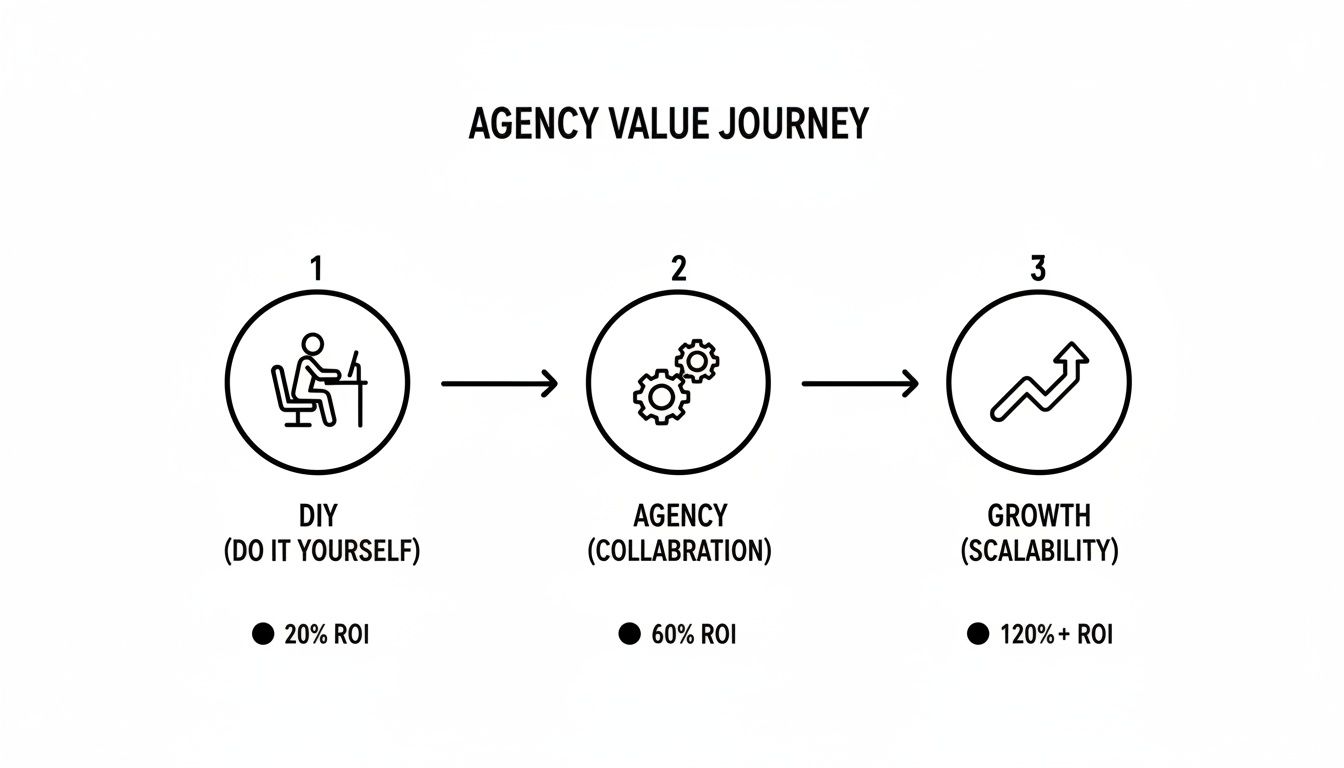
As you can see, bringing an expert on board isn't just a small bump. It introduces strategic processes that properly amplify your return over time.
The Foundation: Product Feed Optimisation
Everything in Google Shopping lives and dies by the product feed. Honestly, this is the single most important part of the puzzle, and it’s always where we start. Think of your product feed as the DNA Google uses to build your ads. If that DNA is weak or incomplete, you get poor ad placements, low click-through rates, and a whole lot of wasted cash.
Our first job is to get forensic with this data. This means:
- Rewriting Product Titles: We don’t just accept the default titles from your website. We craft keyword-rich, descriptive titles that match how real people search. That means putting the brand, product type, colour, and size right at the front where it matters.
- Enhancing Descriptions: We flesh out basic descriptions, packing them with relevant keywords that help Google’s algorithm understand exactly what your product is and who it’s for.
- Optimising Images: We test everything. Clean, product-on-white shots versus lifestyle images—whatever grabs attention and earns the click wins. High-quality, appealing visuals are completely non-negotiable here.
A well-optimised product feed is the difference between showing up for a generic, low-intent search and capturing a highly specific, ready-to-buy customer. It’s the foundation all campaign success is built on.
Strategic Campaign Structure and Bidding
Once the feed is dialled in, we build the campaign architecture. This isn't a one-size-fits-all setup. The right structure depends entirely on your business goals, your product catalogue, and—most importantly—your profit margins.
We strategically choose between different campaign types. For some clients, a Standard Shopping campaign gives us the granular control we need to set specific bids on individual products. For others, a Performance Max (PMax) campaign is the smarter move, using Google’s AI to hunt for customers across all its channels, like YouTube, Display, and Gmail. Often, the best strategy is a hybrid, running both in tandem.
Our bidding is just as nuanced. We move beyond simple cost-per-click (CPC) bids to more advanced models like Target ROAS (Return On Ad Spend). This lets us tell Google the exact return we need to be profitable, ensuring your budget flows to the products and campaigns most likely to hit your financial targets.
Bulletproof Tracking and Technical Integration
Here’s where our unique advantage as both marketers and developers really comes into play. As a marketing agency Melbourne businesses trust, we know that driving traffic is only half the job. If you can’t accurately track what happens after the click, you’re just guessing.
We implement rock-solid conversion tracking using Google Tag Manager (GTM) and Google Analytics 4 (GA4). This setup lets us track every single valuable action, from a simple enquiry to a complex multi-step purchase.
Our deep expertise with eCommerce platforms is crucial here. Whether you're on Shopify or need a specialised WordPress developer, we make sure the technical integration is flawless. This could mean setting up server-side tagging with the Meta Conversion API or building custom data layers to pass rich eCommerce data back to the ad platforms.
This level of technical skill ensures our data is 99.9% accurate, allowing us to make smarter optimisation decisions that directly grow your bottom line. It’s a level of detail many agencies skip, but for us, it’s just how we work.
Why Mobile Optimisation is Non-Negotiable
I've seen too many businesses burn through their ad budget by making one critical mistake: neglecting the mobile user's journey. It's a painful thing to watch because the fix is usually straightforward, but the damage from ignoring it is huge. You pay good money for a click, get a customer excited about your product, and then they land on a website that’s a nightmare to use on their phone.
The data from the Australian market tells a compelling story. Mobile devices are where the action starts, contributing to over 70% of clicks on paid Google search results. In fact, about 65% of all paid search clicks on Google come from mobile phones. But here's the kicker: while mobile traffic brings in the volume, it often converts at half the rate of desktop traffic. You can discover more insights about these mobile-first consumer patterns on bind.media and you'll see the strategic challenge it creates.
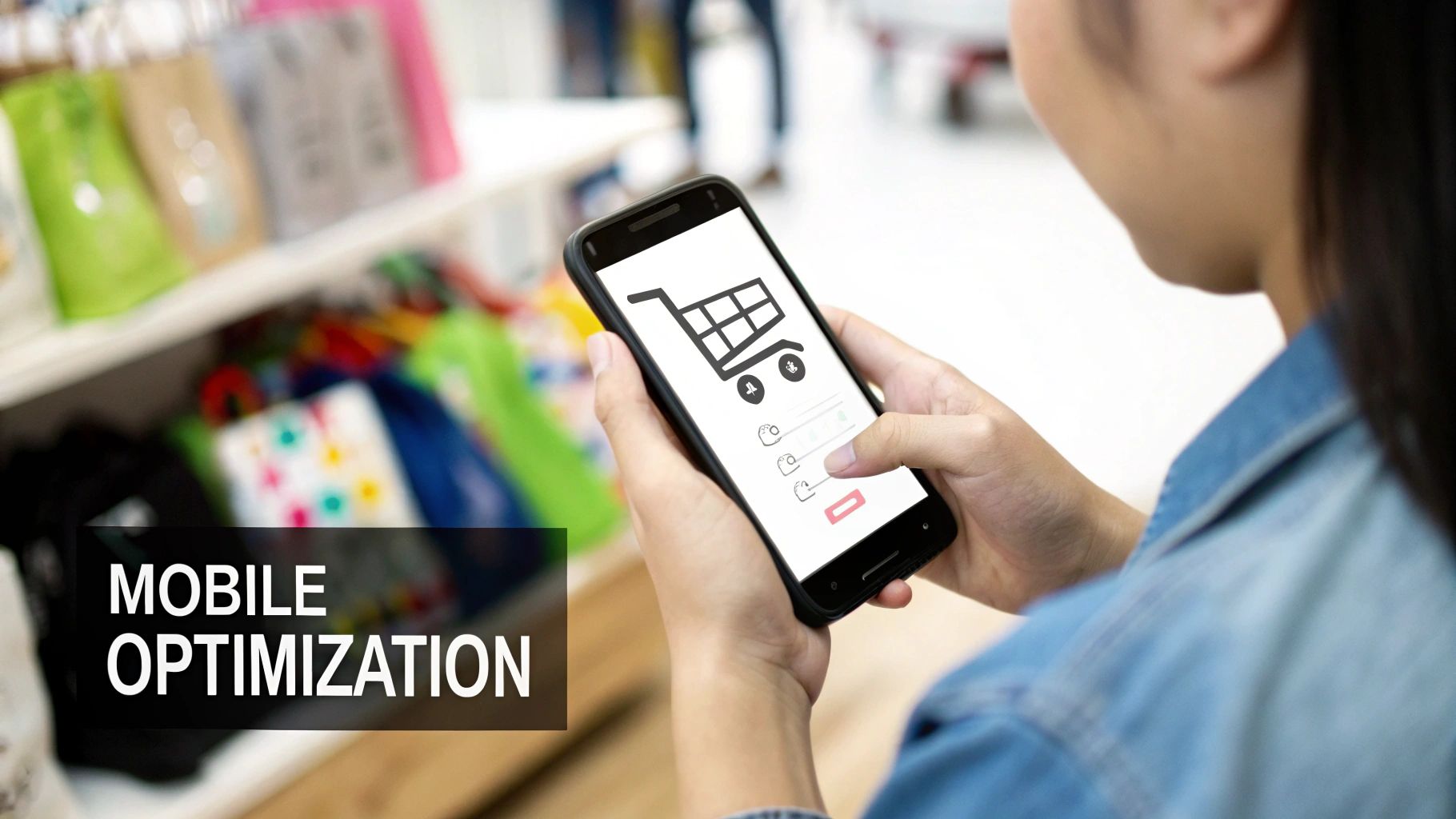
This gap between mobile clicks and mobile sales is where your profit disappears. It's a clear signal that something is breaking down between the ad and the checkout.
Why Mobile Conversions Fail
From my experience, the problem usually isn't the ad itself; it's the post-click experience. When we onboard a new client, we almost always find one or more of these conversion killers on their mobile site.
- Painfully Slow Load Times: If your product page takes more than three seconds to load, you've likely lost the sale. Mobile users are impatient, and a slow site feels unprofessional and untrustworthy.
- A Clunky Checkout Process: Forms that are hard to fill out, tiny buttons that are impossible to tap, or asking for too much information are common culprits. The goal should be a frictionless path to purchase.
- Poorly Optimised Product Images: Images that don't load correctly, are too small to see details, or can't be easily zoomed in on are frustrating for shoppers. They want to see what they're buying.
- Confusing Navigation: If a user can't easily find what they're looking for, like shipping information or a return policy, they'll just leave.
Fixing these issues is not just a 'nice-to-have'—it's essential for getting a return on your ad spend.
Bridging the Gap Between Marketing and Development
This is where our dual expertise as a development and marketing agency becomes invaluable. We're not just a team that drives traffic; we analyse and refine the entire path from the initial ad click right through to the final purchase confirmation. As a top-tier marketing agency Melbourne businesses rely on, we understand that a successful ad campaign requires a technically flawless website.
Our deep skills in both Shopify and WordPress development allow us to go beyond surface-level recommendations. We don't just point out that your site is slow; we dive into the code to fix it.
A technically sound, mobile-optimised website isn’t an added bonus; it's the key to converting the high-value traffic you're already paying for. It turns wasted clicks into profitable customers.
As experienced WordPress developers, we can build custom blocks in Gutenberg to create beautiful, fast-loading landing pages. For our Shopify clients, our experience as Shopify development partners means we can optimise themes for speed and even build custom solutions when needed.
We bridge the all-too-common gap between the marketing team and the web developers because, for us, they are one and the same. This integrated approach ensures the entire user journey is seamless, converting the mobile traffic that other agencies might write off as low-quality.
How to Budget for Google Ads Success
"So, how much should I spend on Google Ads?" It’s the first question nearly every business owner asks, and the most honest answer is always the same: there's no magic number. I know that’s not what you want to hear, but setting a budget isn't about pulling a figure out of thin air. It's about building an intelligent financial plan for growth.
Let's walk through how we actually figure this out, so you can see it’s a process based on data, not guesswork.
The right budget comes down to a few key things: your industry, your product's price, and your profit margins. Selling $30 t-shirts in a crowded market needs a completely different approach to selling $3,000 custom furniture. The more competitive your industry, the higher your cost-per-click (CPC) will be, which means your budget has to be bigger just to get a meaningful amount of traffic through the door.
The Testing Phase vs. The Scaling Phase
When you're just starting, your budget has one primary job: to buy data. This is what I call the 'testing phase'. During this period, we're not necessarily aiming for a huge profit. Instead, we’re learning what works. We’re discovering which products resonate, which search terms actually convert, and which audiences are the most valuable to your business.
This is exactly why we recommend a minimum starting budget of $3,000 per month. Anything less, and you're just not gathering data fast enough to make smart decisions. You'll get stuck in that frustrating cycle of spending a little, seeing no clear results, and concluding that "Google Ads doesn't work." In reality, you just didn't feed the machine enough information to let it learn.
Once we have that data—usually after about 60-90 days—we move into the 'scaling phase'. This is where the fun really begins. We take all the winning elements from the testing phase—the best-performing products, the killer ad copy, the most profitable audiences—and start to strategically increase the budget behind them. The goal shifts from data collection to maximising your Return On Ad Spend (ROAS).
Building a Practical Framework
So, how do you work out a starting number for your own business? We can use a simple formula based on what you want to achieve.
- Define Your Target: How many sales do you want to generate per month? Let's say your goal is 20.
- Estimate Your Conversion Rate: A typical eCommerce conversion rate is around 2%. This means for every 100 visitors, two will buy something.
- Calculate Required Clicks: To get 20 sales at a 2% conversion rate, you'll need 1,000 clicks (20 sales / 0.02 = 1,000 clicks).
- Estimate Your CPC: Check the average cost-per-click for your industry. Let’s assume it's $1.50.
- Calculate Your Budget: Multiply the clicks you need by the average CPC. In this case, it’s $1,500 per month (1,000 clicks x $1.50).
This calculation gives you a baseline. If the result is below our recommended $3,000 starting point, it's a sign that we need to be realistic about the initial volume of sales while we gather enough data to optimise and improve that conversion rate.
This isn't about guesswork. It’s about setting a realistic budget that’s tied to real business objectives. As a transparent marketing agency Melbourne businesses partner with, our goal is to empower you with a clear financial plan. We’re here to make sure your investment is a calculated step towards predictable growth, not just a shot in the dark.
Key Questions to Ask Before Hiring an Agency
I want you to walk into any conversation with a potential agency feeling confident and in control. Hiring a partner is a huge decision, and asking the right questions is the fastest way to slice through the sales pitch and find out if they really know their stuff.
Think of this as your vetting checklist. It’s designed to help you find a genuine growth partner, not just another service provider. I’ve put together the essential questions you should be asking any Google Shopping ads agency you talk to—including us. I'll also break down what a great answer should sound like, setting a high standard that we hold ourselves to.
How Do You Approach Product Feed Optimisation?
This should be the very first question you ask. Seriously. If an agency gives you a vague answer or tries to downplay its importance, that's a massive red flag. The product feed is the absolute foundation of any successful Google Shopping campaign. End of story.
A great answer will be detailed and specific. They should be talking about things like:
- Title Optimisation: A good agency will explain their process for rebuilding product titles. They should be adding critical keywords like brand, product type, colour, and size right at the beginning—moving way beyond your website's default titles to match what people are actually searching for.
- Image Testing: They should mention A/B testing different image types. Think clean product shots versus lifestyle images, to see what actually drives a higher click-through rate.
- Custom Labels: This is a big one. A top-tier agency will talk about using custom labels to segment products by profit margin, sale items, or seasonality. This is what allows for much smarter, more profitable bidding strategies.
A weak answer sounds like, "We make sure your feed is connected correctly." A strong answer sounds like, "We use a tool like DataFeedWatch to apply custom rules that automatically optimise your titles and use custom labels to segment your best-sellers into a high-priority campaign."
What Is Your Strategy for Campaign Structure?
There's no single "best" campaign structure; it depends entirely on your business, your products, and your goals. A good agency will tell you this straight up and then explain how they would decide on a structure for your specific situation.
Look for an agency that can intelligently discuss the pros and cons of different approaches. They should be able to explain when they'd use:
- Standard Shopping Campaigns: These are ideal for granular control over individual product bids and for using negative keywords to filter out irrelevant, money-wasting traffic.
- Performance Max (PMax) Campaigns: The right choice for maximising reach across all of Google's channels, powered by AI. A savvy agency will also talk about how they provide strong creative assets and audience signals to properly guide the PMax algorithm.
- A Hybrid Approach: Often, the most effective strategy involves using both campaign types together. A classic example is running a Standard Shopping campaign for brand-specific searches while using PMax to go out and find new customers.
How Do You Handle Reporting and Communication?
Transparency is non-negotiable. You need to know exactly how your money is being spent and what results it's generating. Ask them what their communication rhythm looks like and what you can actually expect to see in a report.
A good agency will offer:
- A Customised Dashboard: A real-time dashboard that tracks the key metrics that matter to your business (like ROAS, CPA, and total revenue), not just vanity metrics like clicks and impressions.
- Regular, Scheduled Meetings: A clear commitment to weekly or bi-weekly calls to discuss performance, strategy, and what’s next.
- Proactive Insights: Their reports shouldn't just be a data dump. They need to provide analysis and explain why performance changed and what they're doing about it.
What's Your Experience with Both Shopify and WordPress?
This question is more important than most people think because ad performance is directly tied to your website's technical health. An agency that only understands the ad platform but can't help you fix a slow landing page or a broken tracking tag is only doing half the job.
As both a marketing agency Melbourne businesses trust and experienced WordPress developers, we know this connection is critical. A strong agency should be able to confidently discuss their experience with your specific eCommerce platform, whether it's Shopify or WordPress.
They should be able to give you concrete examples of how they've solved technical challenges in the past—like setting up server-side tagging with the Meta CAPI or building custom solutions to improve site speed. This proves they have the well-rounded expertise needed to manage your entire customer journey, not just the ad click.
Ready to Grow Your eCommerce Sales?
So, we've walked through the whole process, from the nitty-gritty of product feed optimisation to the technical side of setting up bulletproof tracking on platforms like Shopify and WordPress. My goal was to show you that real success with Google Shopping isn't just about 'running ads'. It’s about building a complete system where powerful advertising meets a flawless user experience.
This is exactly where we fit in. As a specialist Google Shopping ads agency, we’re a rare mix of both marketers and developers. It means we don't just send traffic your way; we make sure your website is perfectly tuned to turn that traffic into actual sales. We manage the whole picture.
Your Next Step Towards Measurable Growth
As a marketing agency Melbourne businesses trust, we've seen firsthand what works. It’s the seamless blend of technical skill and marketing know-how. We understand that a campaign is only ever as good as the website it sends people to. This dual expertise is what lets us deliver consistent, profitable results for our eCommerce clients.
And while you're focused on using Google Shopping Ads to bring in new customers, don't forget that long-term growth is built on happy customers. Knowing how to improve ecommerce customer experience and drive growth is what turns first-time buyers into loyal fans who come back again and again.
We’re so confident in our process that we want to make the decision to work with us an absolute no-brainer.
If you're a business with a paid ads budget of at least $3k a month, I'd love to offer you a low risk deal- get a month of paid ads management FREE. Apply now through the contact page.
This is your chance to see what a dedicated, expert team can really do, without the usual upfront risk.
Partner with a True Australian eCommerce Expert
Alpha Omega Digital is a marketing agency based in Melbourne, Australia, but we work with ambitious clients right across the country, from Sydney and Brisbane to Perth and Adelaide. We live and breathe eCommerce, and we're ready to put all that expertise to work for you.
Ready to stop guessing and start growing? Have a project in mind? Contact us and let's build something great together.
Common Questions I Get About Google Shopping Ads
I get it. Putting money into a new marketing channel or trusting a Google Shopping ads agency for the first time always brings up questions. I've heard just about all of them over the years, so my goal here is to tackle the big ones head-on and give you the honest, no-fluff answers you need.
How Long Until I See Real Results?
This is always the first question, and it's a fair one. You'll probably see clicks and impressions pop up within the first couple of weeks, but that’s not the real story.
From my experience, it takes a solid 60-90 days to see consistent, profitable momentum. Think of the first month as pure data gathering. We’re basically feeding Google's algorithm information, learning what works, what doesn't, and finding our footing. The next 30-60 days are all about aggressive optimisation based on what we've learned. This isn't about hitting a home run on day one; it's about building a foundation for predictable, long-term growth.
What Kind of ROAS Can I Expect?
Everyone wants to know the magic number for a "good" Return On Ad Spend (ROAS). The honest answer? It completely depends on your business. A brand with 80% profit margins can be incredibly profitable with a 3:1 ROAS ($3 back for every $1 spent). On the other hand, a business with 25% margins might need a 6:1 ROAS just to stay in the black.
As a general benchmark, a 4:1 ROAS is often a healthy target for many eCommerce businesses. But the first thing we'll do is sit down with you, look at your specific profit margins, and work backwards to define a target ROAS that actually means real profit for your business.
Do You Work with Both Shopify and WordPress?
Yep, absolutely. This is one of the things that really sets us apart. We aren't just marketers who know their way around an ads platform; we’re developers, too. As a marketing agency Melbourne businesses have come to rely on, we have deep, hands-on experience in both Shopify and WordPress. We’ve been building sites as WordPress developers for years and are also official Shopify development partners.
This developer-first mindset is a huge advantage. It means we can:
- Nail the tracking: We can implement tricky setups like the Meta Conversion API or build custom Google Tag Manager containers from scratch.
- Fix what's broken: If slow page speed is tanking your conversion rate, we don't just point it out—we dive in and fix it ourselves.
- Own the entire journey: We don’t stop at the ad click. We manage the entire customer experience, making sure there are no technical glitches or roadblocks preventing a sale. This integrated approach is what truly maximises your return.
At Alpha Omega Digital, we’re focused on turning your ad spend into growth you can actually measure. We're a marketing agency based in Melbourne, Australia but also service clients from Sydney, Brisbane, Newcastle, Perth, Adelaide, Darwin and Hobart.
If you're a business with a paid ads budget of at least 3k a month, I'd love to offer you a low risk deal- get a month of paid ads management FREE. Have a project in mind? Contact us and let's get started.