As the founder of a marketing agency in Melbourne, I've seen countless ecommerce brands get completely fixated on one thing: the first sale. Their whole world revolves around driving down the cost per acquisition (CPA). But I'm here to tell you that true, sustainable growth doesn't come from just acquiring cheap customers. It comes from understanding what a customer is really worth over their entire relationship with your business.
Calculating customer lifetime value (CLV) is more than just a metric; it's a mindset shift that can reframe your entire approach to marketing. It moves your focus away from the cost of a single transaction to the total potential revenue you can expect from a long-term customer relationship.
Why CLV Is Your Most Important Ecommerce Metric
Before we get into the formulas, let's talk about why you should actually care about Customer Lifetime Value (CLV). From my experience working with ecommerce businesses, I've seen that obsessing only over the initial cost per sale is a recipe for short-term thinking.
Knowing your CLV fundamentally changes how you look at your marketing budgets, especially for platforms like Google Ads and Facebook Ads. It’s the difference between fear and confidence.
Shifting from Short-Term Costs to Long-Term Value
When you only focus on CPA, your decision-making becomes incredibly short-sighted. I've seen businesses kill a promising Facebook ads campaign way too early because the initial cost per purchase seemed high. They didn't realize those ads were bringing in customers who would buy from them again and again.
But once you know your CLV, you have a totally new benchmark for success.
Let's say your average CLV is $250. Suddenly, paying $50 to acquire that customer doesn't seem so expensive anymore. You gain the confidence to invest more heavily in your campaigns because you know—based on actual data—that you'll earn that money back and then some over time.
This strategic shift is crucial. It moves you from a mindset of "How much did this sale cost?" to "How much is this new customer relationship worth?" This perspective influences every part of your business.
How CLV Informs Your Entire Strategy
Understanding CLV is about more than just setting ad budgets. It gives you critical insights that should guide your entire ecommerce strategy.
From my experience, it impacts everything:
- Website Development: A high CLV easily justifies investing in a better user experience on your Shopify or WordPress site. You can allocate resources to things like building custom blocks in Gutenberg for a richer content experience, or even building custom Shopify apps using the Shopify CLI, because you know it will pay dividends in customer retention.
- Customer Service: When you know a happy customer is worth hundreds of dollars, you’re far more likely to go the extra mile to resolve an issue. This creates the kind of brand loyalty that fuels repeat purchases.
- Marketing & Retention: It shapes everything from your email marketing flows to your Meta ads creative testing process. You start focusing on campaigns designed to re-engage past buyers, not just attract new ones.
At its core, calculating and tracking CLV is about building a more resilient, profitable business. It forces you to think beyond the next sale and build a brand that people genuinely want to come back to.
As a digital marketing agency in Melbourne that works with businesses across Australia—from Sydney to Perth—we consistently see that the brands who obsess over their CLV are the ones that achieve lasting success.
Alpha Omega Digital is a marketing agency based in Melbourne, Australia but also services clients from Sydney, Brisbane, Newcastle, Perth, Adelaide, Darwin and Hobart. Have a project in mind? Contact us.
The Simple Formulas for Calculating CLV
Alright, let's get into the numbers. The good news is that calculating customer lifetime value isn't some dark art. If you're running a Shopify or WordPress store, you already have all the data you need; it's just a matter of piecing it together.
I'll start with the most foundational formula you can use today. I’ll walk you through each component, explaining what it means and where you can find this info inside your own store's analytics. This first calculation will give you a seriously powerful baseline.
This is all about shifting your mindset from short-term wins to long-term, sustainable growth.
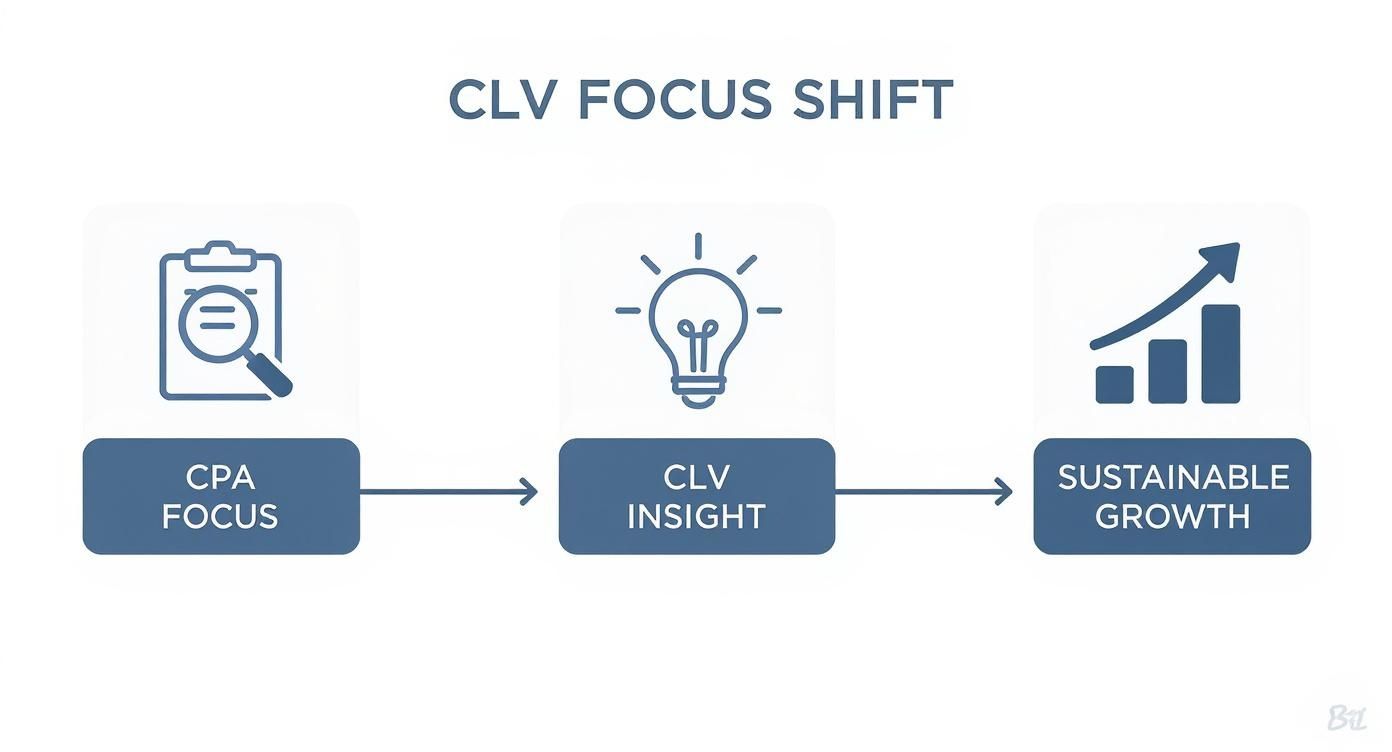
As you can see, understanding CLV is the bridge between simply acquiring customers and building a genuinely profitable business.
The Basic CLV Formula Explained
The simplest way to get a handle on CLV is with the standard predictive formula. It looks like this:
(Average Purchase Value) x (Purchase Frequency Rate) x (Average Customer Lifespan) = CLV
This calculation gives you the total revenue you can reasonably expect from an average customer over their entire relationship with your brand. It’s a fantastic starting point for understanding the real value your marketing is generating.
Let's break down each part.
CLV Calculation Components Breakdown
To get started, you'll need to pull three key metrics from your store's data. Most ecommerce platforms like Shopify or WooCommerce make this relatively straightforward to find in your analytics or sales reports. Here’s what you're looking for and what it all means.
| Metric | What It Means | How to Calculate It |
|---|---|---|
| Average Purchase Value (APV) | The average amount a customer spends in a single order. | Total Revenue (over a period) / Total Number of Orders (same period) |
| Purchase Frequency Rate (PFR) | How often the average customer buys from you within that period. | Total Number of Orders / Number of Unique Customers |
| Average Customer Lifespan | The average length of time a customer continues buying from you. | This is an estimate, often starting at 1-3 years for newer stores. |
For a deeper dive into these foundational metrics, Shopify's official blog has some great insights. Once you have these three numbers, you're ready to plug them into the formula and see what your customers are really worth.
A Worked Example From a Melbourne Store
Let's make this real. Imagine I'm working with a Shopify store based in Melbourne that sells high-quality coffee beans. We pull the data from the last 12 months and find:
- Total Revenue: $150,000
- Total Orders: 2,500
- Unique Customers: 1,000
First, we need to calculate the Average Purchase Value (APV).
$150,000 (Revenue) / 2,500 (Orders) = $60 APV
Next up is the Purchase Frequency Rate (PFR).
2,500 (Orders) / 1,000 (Customers) = 2.5 purchases per year
Finally, let's estimate the Average Customer Lifespan at 3 years, which is a pretty reasonable starting point for a subscription-style product.
Now, we just plug it all into the formula:
$60 (APV) x 2.5 (PFR) x 3 (Lifespan) = $450 CLV
This simple calculation tells us that, on average, each new customer we bring in is worth $450 in revenue over their lifetime. This single number completely changes our perspective on what we can afford to spend on Google Ads or Facebook Ads to acquire them.
Levelling Up to Gross Margin CLV
The basic formula is great, but it has one flaw: it’s based on revenue, not profit.
To get a much more accurate picture of what a customer is actually worth to your bottom line, you need to factor in your cost of goods sold (COGS). This gives you the Gross Margin CLV, a far more useful metric for making budget decisions.
The formula is almost identical, we just tweak the first part:
(Average Gross Margin per Purchase) x (Purchase Frequency Rate) x (Average Customer Lifespan)
Let's revisit our Melbourne coffee store. We know the average order is $60. After accounting for the cost of the beans, packaging, and shipping, we calculate their gross margin is 40%.
Their Average Gross Margin per Purchase is now:
$60 x 0.40 = $24
Now, let's recalculate with this more realistic figure:
$24 (Margin) x 2.5 (PFR) x 3 (Lifespan) = $180 CLV
See the difference? This number is much lower, but it’s also much more real. It tells you that each customer generates $180 in actual profit. This is the number you should be using to decide how much you can really afford to spend on marketing.
As a marketing agency in Melbourne, this is the figure I always push my clients to find. It’s the key to building truly profitable campaigns that scale.
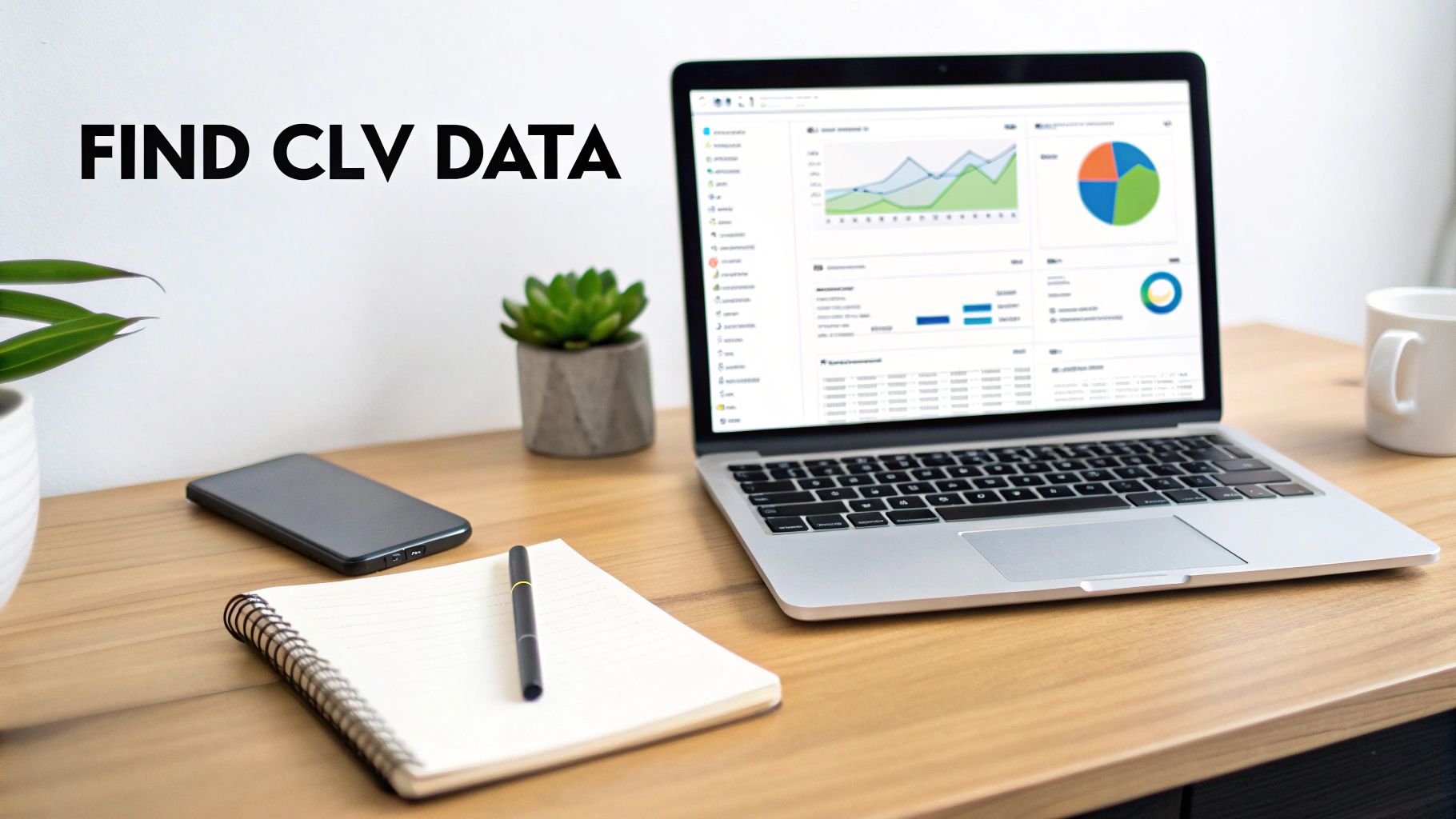
Finding Your CLV Data in Shopify and GA4
Knowing the formulas is one thing, but from my experience, the real challenge is often digging up the right numbers to plug into them. As an agency that spends its days deep inside platforms like Shopify, WordPress, and Google Analytics 4, I know it can feel overwhelming trying to find the exact data points you need.
So, let's walk through exactly where I look.
The good news is, these platforms are designed to track the core metrics you need for customer lifetime value. It’s just a matter of navigating to the right reports and understanding what you’re looking at. Accurate data is the foundation of an accurate CLV, so getting this part right is non-negotiable.
Uncovering the Numbers in Your Shopify Dashboard
If you’re running a Shopify store, you’re in luck. Shopify’s built-in analytics are surprisingly powerful and make finding your CLV components pretty straightforward.
Here’s where I typically start when working with a new Shopify client:
- Navigate to Analytics > Reports: This is your home base for all sales data.
- Set Your Date Range: Choose a meaningful period, like the last 12 months, to get a solid average. Consistency here is key for future comparisons.
- Find Total Sales and Orders: The 'Sales over time' report will give you your total sales (revenue) and the total number of orders for your selected period. These are the first two numbers you need.
- Identify Unique Customers: Go to the 'Customers over time' report. This shows the number of new and returning customers. Add these together to get your total number of unique customers for the period.
With these three pieces of data—total sales, total orders, and unique customers—you have everything you need to calculate your Average Purchase Value and Purchase Frequency Rate.
One pro tip I always share with our clients: Make sure you're looking at net sales if possible. This figure excludes discounts and returns, giving you a much cleaner and more accurate starting point for your revenue calculation.
Digging into Google Analytics 4 for Deeper Insights
For businesses on WordPress with WooCommerce, or even Shopify stores looking for more granular data, Google Analytics 4 (GA4) is essential. As a digital marketing agency in Melbourne, we live inside GA4 and Google Tag Manager, setting up robust tracking for our clients. Clean data starts with proper setup, which is why we handle everything from setting up GTM containers to Conversions API installation for Meta.
Assuming your tracking is configured properly, here’s how I find the data in GA4:
- Go to Reports > Monetization > Ecommerce purchases.
- Like with Shopify, set your date range to a full year for the best results.
Inside this report, you'll find key metrics like:
- Item revenue: This is your total revenue figure.
- Number of purchases: This is your total order count.
- Total users: This gives you a close approximation of your unique customers.
Using GA4 gives you the massive advantage of being able to segment your audience. You can analyse the CLV of customers who came from Google Ads versus those from Facebook ads, or compare the value of mobile versus desktop users.
This level of detail is where you can start making seriously smart marketing decisions. For example, I've seen clients discover their PMAX campaigns drive a lower initial AOV but a much higher CLV over time compared to standard Google Shopping ads. This is an insight you just can't get without proper tracking.
Ensuring Your Data is Accurate
The old saying "garbage in, garbage out" has never been more true than when calculating CLV. If your tracking is off, your CLV will be meaningless.
Here are a few things we always check for our clients:
- Consistent UTM Tagging: Are all your marketing campaigns properly tagged? Inconsistent tagging can muddy the waters, making it impossible to attribute sales to the correct channel.
- Google Tag Manager (GTM) Health: Is your GTM container set up correctly? Are your ecommerce event triggers firing on the right actions? A poorly managed GTM setup is a common source of data headaches.
- Cross-Domain Tracking: If your customer journey spans multiple domains (like a separate checkout portal), is cross-domain tracking enabled? Without it, GA4 will see a single user as multiple different users, completely skewing your numbers.
Getting your data collection right is foundational. It’s what allows you to accurately measure the success of your campaigns and make informed decisions.
Alpha Omega Digital is a marketing agency based in Melbourne, Australia but also services clients from Sydney, Brisbane, Newcastle, Perth, Adelaide, Darwin and Hobart. Have a project in mind? Contact us.
Alright, you've done the work, crunched the numbers, and now you have your Customer Lifetime Value. So, what's next? This is where the real magic happens. Calculating CLV is just the first step; the true power comes from using that number to make smarter, more profitable marketing decisions every single day.
As a digital marketing agency in Melbourne, this is the metric I use to ground our entire strategy. It transforms our clients' advertising from a cost centre into a predictable growth engine. Without CLV, you're essentially flying blind, making budget decisions based on gut feelings rather than cold, hard data.
Setting Ad Budgets with the CLV to CPA Ratio
One of the most immediate ways I put CLV to work is by defining budgets and performance targets for paid advertising, particularly for Google Ads and Facebook Ads campaigns. The key here is understanding the relationship between what a customer is worth (CLV) and what it costs to acquire them (Cost Per Acquisition, or CPA).
This relationship is known as the CLV to CPA ratio.
A healthy benchmark that I aim for with most of our ecommerce clients is a 3:1 ratio. This means for every dollar you spend to acquire a new customer, you should be making at least three dollars back in lifetime profit.
A ratio of 1:1 means you're just breaking even on a customer, which is a dangerous place to be once you factor in overheads and other costs. Anything above 3:1 is fantastic and signals you have a very profitable model with room to scale your ad spend aggressively.
Let's run through a quick example. Say your profit-based CLV is $180. With that 3:1 ratio in mind, you can confidently set your target CPA at $60. This completely reframes how you manage your campaigns. Suddenly, a campaign with a $55 CPA isn't "expensive"—it's hitting your profitability target perfectly. This insight is what helps you decide what budget to spend on Google Ads without just guessing.
Identifying and Rewarding Your Best Customers
Here’s a truth I've seen reflected in every client's data: not all customers are created equal. Your CLV numbers will prove it. By segmenting your customer base, you'll quickly identify the top 10-20% of customers who are likely driving a huge portion of your total lifetime value. These are your VIPs.
Once you know who they are, you can build specific strategies just for them:
- Exclusive Offers: Create special discounts or give them early access to new products.
- Loyalty Programs: Invite them into a tiered loyalty program that offers escalating rewards the more they spend.
- Personalised Communication: Use their purchase history to send highly relevant email and SMS campaigns that make them feel seen and valued.
This isn't just about being nice; it's smart business. These high-value customers are your most likely repeat buyers and your most powerful brand advocates. Nurturing this group is one of the highest-leverage activities you can undertake to boost your overall CLV.
Justifying Investment in Your Website Experience
Ever hesitated to spend money on improving your Shopify or WordPress site? Maybe you've been putting off a Shopify design refresh, some custom Shopify development, or a deep dive into conversion rate optimisation (CRO). A high CLV gives you the business case you need to make these investments with confidence.
If you know a customer is worth $450+ over their lifetime, spending $5,000 on Shopify development to improve the user experience and boost your conversion rate suddenly becomes an obvious decision. A smoother checkout, faster page speeds, or better mobile design directly impacts customer satisfaction and encourages repeat purchases, which in turn increases your CLV.
For businesses aiming to make truly agile and impactful decisions based on CLV, exploring the principles of mastering real-time data analytics can provide the immediate insights needed to dynamically adjust these strategies.
Recent research really underscores this connection. Studies from PwC Australia show that businesses investing in seamless digital experiences have seen a 44% increase in revenues over two years, directly tied to better customer retention. In fact, a staggering 88% of Australian customers are more likely to make repeat purchases after a positive service experience, which is a direct driver of their lifetime value. You can find more details in the full PwC report on Australian service industry trends.
Alpha Omega Digital is a marketing agency based in Melbourne, Australia but also services clients from Sydney, Brisbane, Newcastle, Perth, Adelaide, Darwin and Hobart. Have a project in mind? Contact us.
Proven Strategies to Increase Your Customer Lifetime Value
Figuring out your Customer Lifetime Value is a bit like a doctor diagnosing a patient. It gives you a clear picture of the health of your customer relationships. But the diagnosis is just the starting point. The real work is in the treatment—the strategies you put in place to actively boost that value over time.
As a Melbourne-based marketing agency, we've moved beyond just calculating CLV for our clients. We actively work to improve it. Here are some of the most effective, real-world strategies I use to turn one-time buyers into lifelong fans for our e-commerce clients.

Master Your Automated Email and SMS Flows
Your job isn't done when a customer clicks "buy." Honestly, that's just the beginning. Your post-purchase communication is the single biggest opportunity you have to encourage a second sale and lift your purchase frequency rate.
We build out automated email and SMS sequences that feel personal and add genuine value, not just the generic "thanks for your order" messages everyone else sends.
Think about flows like these:
- Post-Purchase Welcome Series: This is your chance to introduce new customers to your brand story. Show them how to get the most out of their new product and maybe offer a small incentive for their next purchase to get the ball rolling.
- Abandoned Cart Recovery: A classic for a reason. A well-timed series of reminders can recover a huge percentage of lost sales, directly bumping up your average customer value.
- Win-Back Campaigns: Got customers who haven't purchased in a while (say, 90 days)? Target them with a compelling offer to bring them back into the fold. It works.
Implement a Loyalty Program That Actually Works
A well-designed loyalty program is an absolute powerhouse for increasing customer lifespan. It gamifies the shopping experience and gives customers a real reason to stick with you over a competitor. The trick is to make the rewards feel both attainable and genuinely valuable.
Don't just offer boring old points. I've seen clients get creative with what they give back:
- Early access to new product launches.
- Exclusive entry into a VIP community or Facebook group.
- Free shipping for life after they hit a certain spending threshold.
The goal here is to build a sense of community and exclusivity. When customers feel like they're part of an inner circle, their loyalty—and their lifetime value—skyrockets.
Create Compelling Upsells, Cross-Sells, and Bundles
Want to lift your CLV fast? Focus on increasing your Average Purchase Value (APV). Instead of just hoping customers add more to their cart, you need to strategically guide them toward higher-value purchases.
- Upselling: On a product page, offer a slightly better, more premium version of the item they're looking at.
- Cross-selling: In the cart or at checkout, suggest complementary products. Think "Don't forget the batteries!" or other items people frequently buy together.
- Bundling: Create product bundles that offer a slight discount compared to buying each item separately. This not only increases the immediate order value but also introduces customers to more of your product range.
We often build these features directly into our clients' Shopify or WordPress sites, making them a seamless part of the shopping experience.
Key Takeaway: Every one of these strategies—email flows, loyalty programs, and bundling—is designed to improve one of the core parts of the CLV formula. They are direct, measurable actions that lead to a higher final number.
Prioritise Exceptional Customer Service
Finally, never, ever underestimate the power of simply being great to your customers. In my experience, all the clever marketing in the world can be undone by a single poor customer service interaction.
A fast, empathetic, and helpful support team turns problems into opportunities. A customer who has an issue resolved brilliantly is often more loyal than one who never had an issue at all. This builds the kind of long-term trust that is the absolute bedrock of a high CLV. To dig deeper into this, check out this great infographic on Top 4 Tips to Improve E-commerce Personalization—it’s full of actionable ideas.
Even after we've crunched the numbers and mapped out the strategies, I find clients still have a few questions buzzing in their heads. As a marketing agency in Melbourne, we hear the same ones pop up all the time.
Let's run through some of the most common ones. Getting these sorted will give you the confidence to start using this metric to make smarter decisions.
How Often Should I Calculate CLV?
For most e-commerce businesses, my go-to recommendation is quarterly or semi-annually. This hits the sweet spot. It's frequent enough to spot meaningful trends and see if your efforts are paying off, but not so often that you get lost in the weeds of constant analysis.
The exception? If you've just launched a massive marketing campaign—say, a big push with a Facebook ads agency—or rolled out a brand-new loyalty program, you might want to check it monthly. This gives you a much faster feedback loop on its immediate impact.
The most important thing is just to be consistent. That's what lets you make valuable comparisons over time.
What Is a Good CLV to CPA Ratio?
A healthy benchmark we always aim for is a CLV to Customer Acquisition Cost (CPA) ratio of 3:1. Think of it as a solid rule of thumb for profitable growth.
Put simply, it means for every dollar you spend to get a new customer through channels like Google Ads, you make three dollars back over their lifetime with your business.
A ratio of 1:1 means you're just breaking even on your ad spend, which isn't a recipe for long-term success. Anything higher than 3:1 is fantastic and signals that you probably have room to invest more aggressively in your marketing. Just remember, this is a guideline; your ideal ratio will hinge on your own profit margins.
How Do I Calculate CLV for a Brand New Business?
This is a great question. For a new store with no sales history, you can't calculate CLV in the traditional sense—you have to project it. It’s all about making educated guesses to get started.
You’ll need to lean on industry benchmarks for things like purchase frequency and average customer lifespan. A bit of digging into case studies or market research for your specific niche will give you a decent starting point. Your average order value, of course, will just be based on your own product pricing.
It won’t be perfect at first, but it gives you a vital baseline to work from. The key is to swap out those projections with your own real data as soon as you have a few months of sales history under your belt.
Is CLV Different for Subscription Businesses?
Yes, it is—and in many ways, it’s much simpler to figure out. For subscription models, the purchase frequency is fixed (e.g., monthly), and the purchase value is just your subscription price.
The main variable you need to solve for is the average customer lifespan. You can get this from your churn rate (the percentage of subscribers who cancel in a given period).
The formula usually looks like this:
(Average Monthly Revenue per Customer) / (Monthly Churn Rate)
Because of this predictable, recurring revenue, CLV is an absolutely essential metric for any subscription business to have on its dashboard.
At Alpha Omega Digital, we don't just help you calculate CLV—we help you improve it. As a marketing agency based in Melbourne, Australia, we also service clients from Sydney, Brisbane, Newcastle, Perth, Adelaide, Darwin and Hobart.
Have a project in mind? Contact us.