You're packing orders, checking stock and answering customer emails, but you still find yourself opening Ads Manager before bed. Instagram says the campaign is performing. Your bank balance makes you less certain. You've tried boosting posts, changed the audience and approved another batch of creative, yet you can't explain which activity is bringing in profitable orders.
When I'm evaluating an ecommerce account, that uncertainty is where I start. A Melbourne founder doesn't need more advertising terminology. You need someone who can connect the ads, the website and the numbers, then explain what they'd change and why.
Why Melbourne Businesses Hire an Instagram Ads Agency
Hiring an Instagram ads agency in Melbourne should mean handing over a defined commercial responsibility, not simply finding someone to press publish.
For an ecommerce business, I'd expect that responsibility to include choosing products worth promoting, developing creative, managing campaigns and checking whether purchases make financial sense. Your agency also needs to notice when advertising isn't the main problem. Sending more visitors to a confusing product page isn't a growth strategy.
What you're actually buying
A useful agency relationship gives you a repeatable decision-making process:
- Commercial judgement: Which products have enough margin, stock and customer appeal to justify paid acquisition?
- Creative direction: What should a prospective customer see, understand and believe before buying?
- Technical oversight: Can the team explain how website behaviour becomes a reported conversion?
- Accountability: What changed, what happened afterwards and what's the next decision?
I prefer ecommerce specialists when the work involves product feeds, merchandising, repeat purchases and inventory constraints. A generalist can still be a good fit, but I'd ask them to demonstrate that knowledge rather than assume it.
An in-house marketer brings different strengths. They're closer to your customers, product launches and daily operations. An agency should complement that knowledge with execution capacity and an outside perspective, not compete with your employee for control.
Check whether you're ready
If you can't supply product information, approve creative or explain your margins, hiring an agency won't remove those gaps. The founder still owns the offer and the business economics.
For another perspective on evaluating an agency relationship, Gym Membership Tips on hiring agencies is a useful supplementary resource. I'd use it to prompt questions, not as evidence of ecommerce performance.
My hiring rule: Ask an agency to explain a decision it would make differently if your margin changed. That tells you more than a polished dashboard.
Whether I'm discussing an account with a founder in Melbourne, Sydney, Brisbane or Adelaide, I want the same starting point: a clear brief, realistic expectations and permission to challenge an offer that isn't ready.
How Big Instagram Actually Is in Australia in 2026
Instagram has substantial Australian advertising reach, but reach isn't a sales forecast.
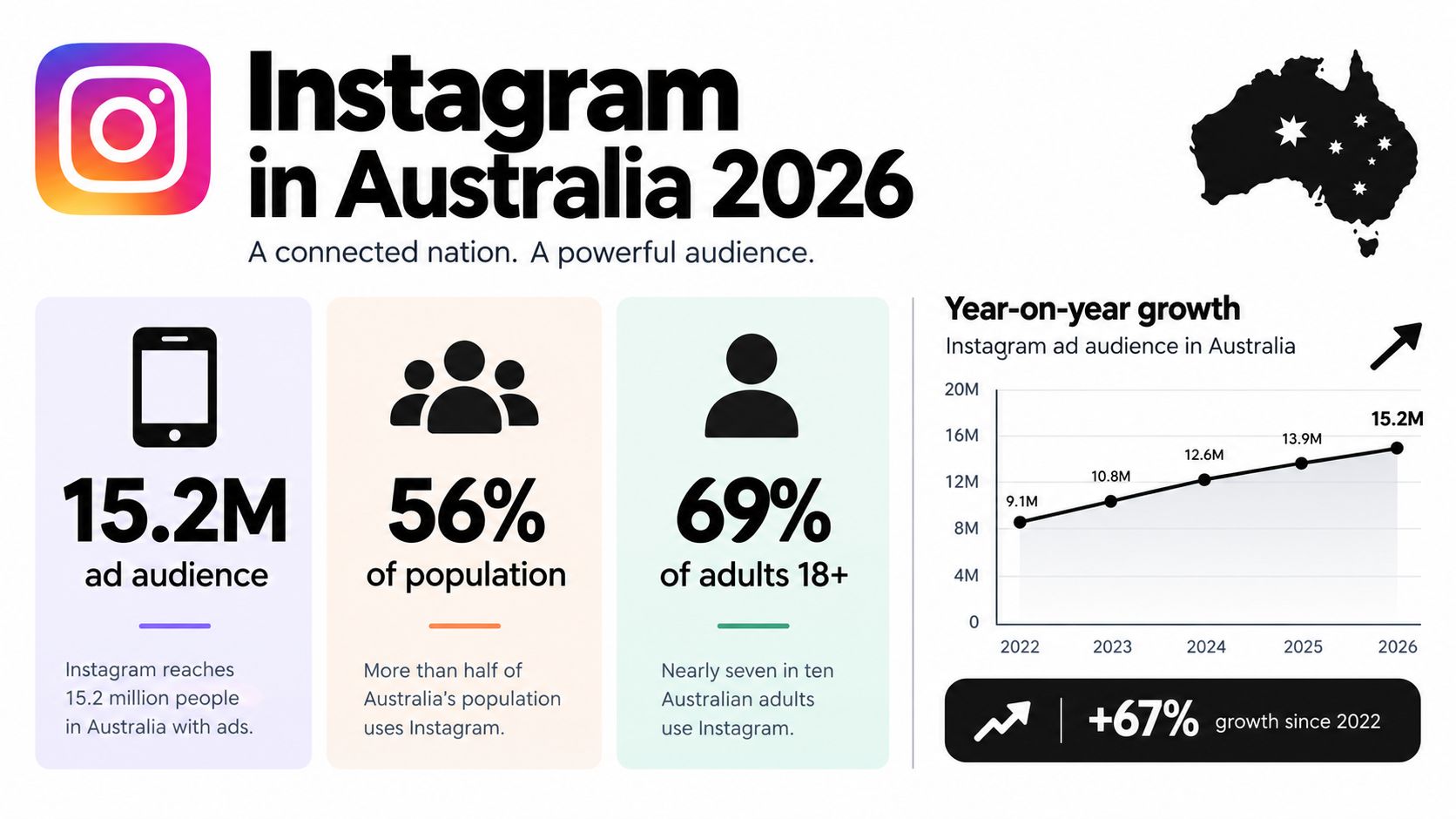
Meta's planning estimates put Instagram's Australian advertising audience at approximately 15.2 million in late 2025, equivalent to 56.0% of the population and 69.2% of adults aged 18 and over. The estimated audience increased by 1.2 million, or 8.6%, between October 2024 and October 2025, according to DataReportal's Digital 2026 Australia report.
The visual below summarises the headline audience estimates. Treat the reported late-2025 figures as advertising-planning estimates, not a verified count of unique customers.
National scale doesn't require national targeting
For comparison, the early-2025 Australian adult advertising audience was 55.2% women and 44.8% men, according to DataReportal's Digital 2025 Australia report. That describes the platform's estimated audience, not necessarily your buyers.
I wouldn't exclude a customer group because it's smaller in a national demographic breakdown. Your product, purchase history and creative response are more useful starting points.
Geography needs the same judgement. A Melbourne skincare brand that ships nationally shouldn't automatically restrict acquisition to Melbourne suburbs. A bulky furniture business with limited delivery coverage has a different constraint.
- Use delivery coverage first: Don't pay to attract customers you can't serve economically.
- Separate customer relationships: Assess new-customer acquisition separately from activity aimed at existing buyers.
- Test segmentation deliberately: Compare audience approaches without creating so many small groups that results become difficult to interpret.
The budget context matters too
Australia's digital advertising market reached $16.4 billion in 2024, while video advertising reached $4.5 billion, according to IAB Australia's Internet Advertising Revenue Report. Those are national market figures, not Instagram-specific or Melbourne-specific spending.
My takeaway isn't that every store needs more video spend. It's that founders should evaluate Instagram within their broader acquisition mix, rather than assume a large platform audience guarantees demand for their products.
What a Good Agency Process Looks Like From Brief to Scale
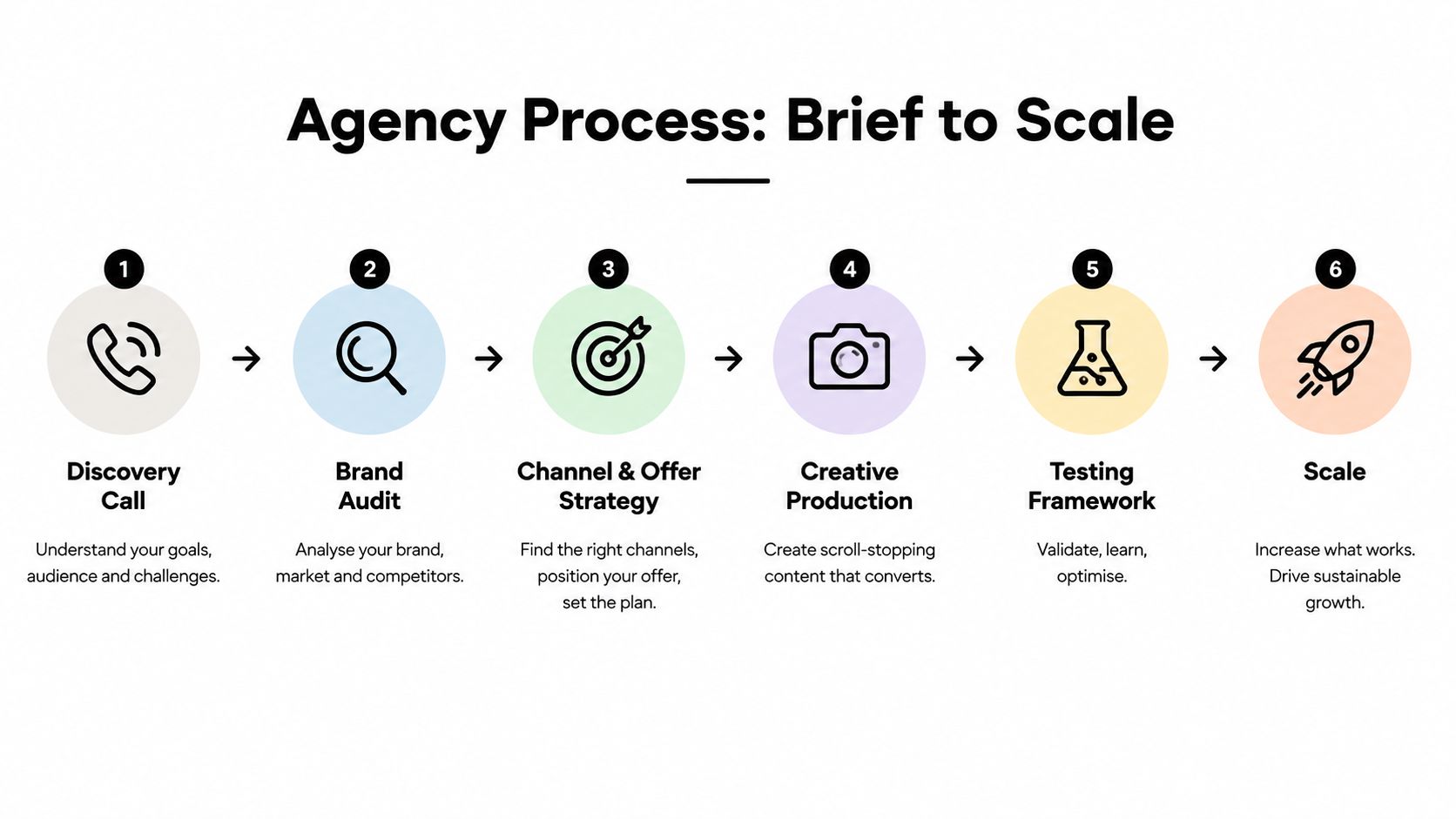
I want an agency process to produce useful work at every stage. A discovery meeting should create a better brief. An audit should identify decisions. A report should change what happens next.
This diagram gives a useful overview, although measurement checks should happen before launch, not after a campaign appears ready to scale.
Discovery, strategy and creative preparation
Discovery and brand audit should establish your margins, bestsellers, stock position, existing channels and previous advertising decisions. I'd ask you for store access, historical reports and honest feedback about products that generate complaints or returns.
Channel and offer strategy should turn that information into a written recommendation. That might mean promoting a dependable bestseller rather than a discounted product with little margin left.
Creative production and testing should produce briefs, assets and a record of what each concept is intended to test. You provide product expertise, samples and approvals. The agency translates those inputs into advertising.
Launch timing should depend on access, assets and technical readiness. I wouldn't promise a fixed turnaround before checking them.
Tracking, optimisation and reporting
Before spending, I'd expect the team to document the event setup. That includes Meta Pixel and Conversions API installation, plus Google Tag Manager and Google Analytics where they're part of the measurement plan.
Setting up Google Tag Manager containers isn't the same as proving that purchase events are reliable. Ask who tests transaction values, duplicate events and the connection between a completed order and the advertising report.
Then the operating rhythm needs substance:
- Weekly optimisation: Review spend, purchases, creative response, stock changes and landing-page problems. Make changes for an identified reason.
- Monthly reporting: Explain commercial outcomes, unresolved questions and the next testing priorities.
- Scaling decisions: Increase investment only when the business can support additional orders and the evidence justifies the risk.
Website work belongs in this process when it removes a buying obstacle. That could mean WordPress development for clearer product information or Shopify development support for a better merchandising experience.
Custom Gutenberg blocks, Shopify API integrations and custom apps built using Shopify CLI should have a specific purpose. I wouldn't commission development just to make an advertising proposal look more technical.
A founder should be able to ask what an implementation fixes, how it will be tested and who maintains it afterwards.
Creative Testing That Actually Moves Cost Per Purchase
My first creative question isn't whether an ad looks professional. It's whether a potential customer can quickly understand the product and find a convincing reason to buy it.
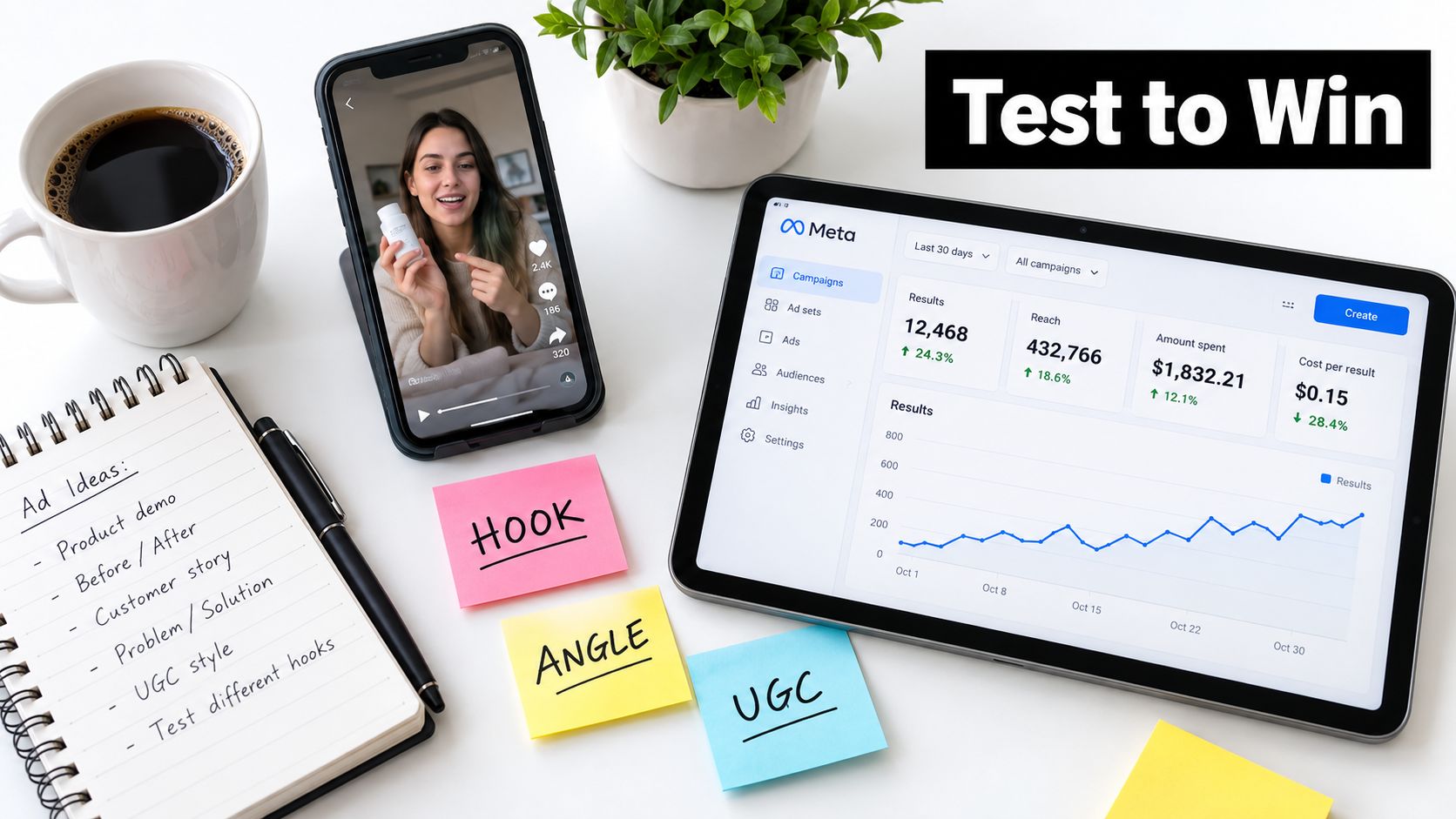
A useful creative review puts the advertisement beside the commercial results, rather than judging the design in isolation.
Test a reason to buy, not just a new colour
Consider a hypothetical store selling travel bags. A product demonstration could show how the compartments work. A founder video could explain the design choices. Customer-created footage could show the bag being packed for an actual trip.
Those are different arguments. Changing the background colour behind the same product photograph usually isn't.
I'd organise a Meta ads creative testing process around clear hypotheses:
- Hook: Does the opening make the product and its relevance obvious?
- Proof: Does the demonstration answer a real buying objection?
- Offer: Are price, inclusions and any conditions understandable?
- Destination: Does the landing page continue the promise made in the ad?
User-generated content, founder-on-camera footage, product demonstrations and static carousels are options, not a ranking of formats. I wouldn't assume informal footage will beat a well-made product image without testing the proposition.
This video can sit alongside your creative review as a discussion resource, rather than a substitute for account evidence.
Know why you're stopping or continuing
I don't use engagement alone to declare a winner. Video viewing and click behaviour can help diagnose attention, but purchases and acquisition economics decide whether an ad deserves more investment.
An ad that attracts clicks without purchases needs investigation. The problem might be the audience, the offer, unexpected delivery costs or a mismatch between the creative and product page.
Practical rule: Don't kill an idea because you're bored with it. Don't keep funding it because you're emotionally attached to it.
“Don't quit too early” is useful advice only when there's a test plan. Decide what evidence you need, what loss you're prepared to accept and what would justify another iteration before launching.
Marketing consistency means maintaining that production and review process. It doesn't mean repeating an unproductive campaign indefinitely. When evaluating a Facebook and Instagram ads agency, ask to see how it records creative hypotheses and carries learning into the next brief.
Reporting, Privacy and Trust-Aware Measurement
A precise-looking dashboard can still leave important questions unanswered. I'd rather explain the limits of attribution than pretend every purchase has an observable, exclusive advertising cause.
Australian social-media research reports that 43% of users are concerned about how companies handle their data, while 75% worry about distinguishing real from fake information online, as reported by Marketing-Interactive's coverage of Australian social-media research. That's a reason to take data handling and advertising claims seriously, not a reason to abandon measurement.
Combine evidence without counting it twice
I want a reporting plan that assigns a purpose to each information source:
- Meta reporting: Assess delivery, creative response and platform-attributed outcomes.
- Google Analytics: Review website journeys and channel patterns within its own measurement limits.
- Store and CRM records: Reconcile completed orders, refunds, customer status and qualified enquiries.
- Post-purchase surveys: Add customer-reported discovery information without treating memory as perfect attribution.
- Controlled tests: Investigate whether advertising contributes additional business where a practical test is possible.
The checklist below is a useful starting point for those conversations.
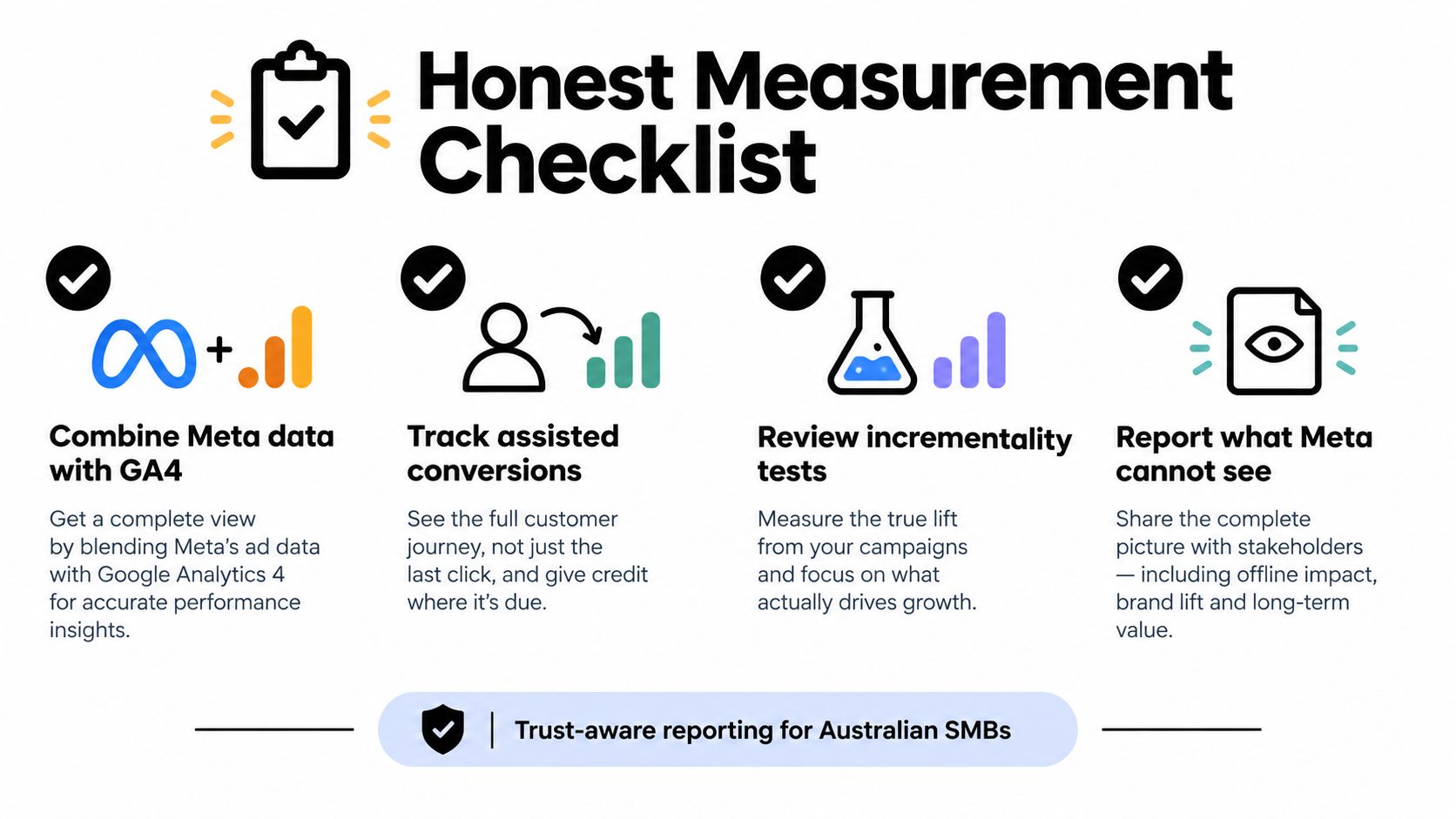
Don't add every platform's attributed revenue together and call it total sales. I'd reconcile reporting against the store, while keeping the distinction between attributed revenue and incremental revenue explicit.
Server-side tracking isn't a consent workaround
Setting up Meta Conversions API should include a documented decision about which events and customer information are sent. I'd check browser and server event reconciliation, access permissions and the privacy notices customers encounter.
Use consent-based email or SMS capture, limit customer-list uploads to an appropriate purpose and prefer aggregated reporting when individual-level attribution isn't dependable. Get qualified privacy advice where the implementation or business circumstances require it.
The same standard belongs in creative. Show the product accurately, explain pricing, use genuine reviews with permission and avoid implying that you know something sensitive about the viewer.
For a founder, the practical reporting question is simple: What do we know, what are we estimating and what decision follows? An agency should answer all parts without using tracking limitations as an excuse for either certainty or helplessness.
Pricing, Budgets and the $3k-a-Month Threshold
I separate media spend, management, creative production and development before discussing affordability. Otherwise, a seemingly inexpensive proposal can become difficult to compare with a more complete scope.
There isn't a verified Melbourne fee schedule I can responsibly present as a market rate. For businesses considering monthly advertising budgets from $3k to $15k, I'd use the following as a buying framework, not a quoted price list or performance forecast.
Typical Melbourne Instagram ads agency pricing tiers
| Monthly ad spend | Common management fee | What's usually included | Best fit for |
|---|---|---|---|
| Lower end of the proposed budget | Request a fixed-fee quote with exclusions stated | Confirm campaign scope, asset requirements and reporting | A focused product range with usable creative |
| Middle of the proposed budget | Compare fixed and hybrid proposals | Confirm testing capacity, strategy time and production responsibilities | A store developing a repeatable acquisition process |
| Upper end of the proposed budget | Compare percentage-based and hybrid quotes | Confirm account complexity, creative throughput and scaling oversight | A business with broader products or campaign requirements |
A flat fee makes the management cost easier to plan. A percentage-based fee changes with spend, so I'd ask what additional work accompanies an increase. A hybrid proposal needs particularly clear boundaries to avoid paying twice for overlapping responsibilities.
Calculate a return the business can live with
A business generally must register for GST once its GST turnover connected with Australia reaches A$75,000, and the calculation can include imported services, digital products and low-value imported goods sold to Australian consumers, according to the Australian Taxation Office's GST guidance.
That matters when discussing GST-aware ROAS. I'd agree with your accountant on the revenue basis used for decision-making, then separate product costs, fulfilment, payment costs, refunds and advertising expenses.
- Platform ROAS: Useful for campaign comparison, provided its revenue basis is understood.
- Contribution after acquisition: Useful for deciding whether additional orders support the business.
- Cash requirements: Essential when stock must be purchased before advertising revenue arrives.
Retention costs belong in the calculation too. If you're considering a rewards system, review loyalty program pricing alongside implementation and reward costs rather than assuming repeat revenue comes without expense.
For eligible businesses with at least $3k a month in paid ads budget, my offer is a month of paid ads management free. Media spend remains separate, and the scope should be agreed before work begins.
Working With Alpha Omega Digital and Next Steps
I'm based in Melbourne and work with businesses across Sydney, Brisbane, Newcastle, Perth, Adelaide, Darwin and Hobart. The strongest fit is an ecommerce founder who wants advertising and the shopping experience managed as connected responsibilities.
That includes Shopify design and development, WordPress design, paid social, Google Ads and conversion measurement. Service-based businesses can also be a fit, but an ecommerce store needs an operating plan built around products and orders, not borrowed lead-generation targets.
Bring the business context
Before an initial conversation, prepare a practical snapshot:
- Your products: Bestsellers, margins, stock constraints and common objections.
- Your store: Shopify or WordPress access, current development issues and checkout concerns.
- Your advertising: Recent reports, existing creative and the decisions you're unsure about.
- Your capacity: Who can approve work, supply footage and manage increased demand?
If Google Shopping is part of your mix, I'd also ask why it's being used alongside Instagram. Performance Max and Standard Shopping aren't interchangeable: Google describes broader inventory for Performance Max, while Standard Shopping provides explicit campaign-priority control for overlapping products, as explained in Google's retail campaign guidance.
That's the kind of trade-off worth discussing with a marketing agency in Melbourne. Not how many channels can be added to a proposal, but which responsibilities each channel should carry.
Start with a decision, not a sales presentation
You don't need a perfect account before asking for help. You do need to be open about what isn't working and what the business can afford to test.
Have a project in mind? Use the contact page to share your store, current advertising setup and main commercial challenge.
If your business has a paid ads budget of at least $3k a month, I'd love to offer you a low-risk starting point: get a month of paid ads management FREE, with media spend separate. Visit Alpha Omega Digital and apply through the contact page so we can assess your Instagram campaigns, store experience and measurement before agreeing on the work.
[email protected]
Read more insights from our team on web design, paid ads, and growth strategy.