A charity's board asks why donations haven't risen after a burst of Facebook activity. The team can show reach, clicks and a busy calendar, but can't say which campaign led to completed gifts, whether mobile visitors abandoned the form, or who owns the donor data. That's not a social media problem. It's a measurement and operating-model problem.
I've seen organisations treat an agency as a supplier for the next appeal, then discover their website, donation platform, email list and reporting don't work together. A capable nonprofit digital marketing agency should help fix that system, with a plan that respects limited budgets, staff capacity and the trust donors place in the organisation.
What a Nonprofit Digital Marketing Agency Actually Does
A small charity may have one staff member managing communications, a volunteer handling the website and a board asking whether digital spending is protecting public trust. In that setting, an agency's job is not to bring in more donors. It is to make limited time and money work harder, while keeping data, approvals and reporting under proper control.
In 2024–25, more than 52,000 charities employed approximately 1.54 million people, 10.7% of the workforce, and engaged about 3.77 million volunteers. Sector revenue reached $222 billion, exceeding reported expenses of $212 billion, according to the ACNC's 2024–25 annual report. Digital systems support that work: websites, donation journeys, search visibility, email databases and analytics help charities raise funds, recruit volunteers, reach program participants and maintain public trust.
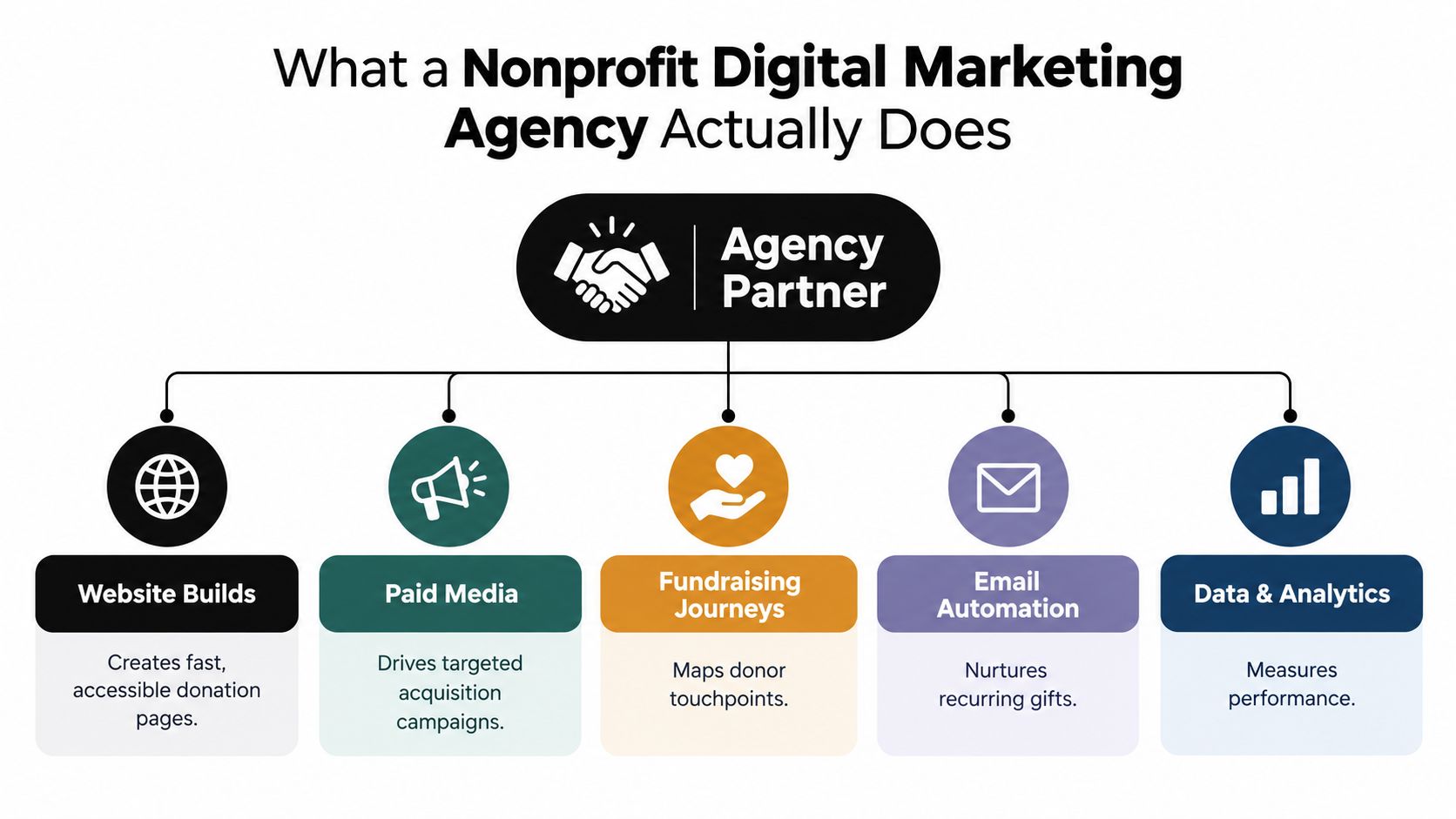
A partner works across the whole supporter journey
An agency should connect the website, paid campaigns, fundraising journeys, email automation and analytics around clear outcomes. Buying media is only one part of the work. A Google Ad may attract a prospective donor, but the landing page, payment form and follow-up determine whether that interest becomes a gift and a continuing relationship.
That coordination matters for charities with lean teams. Around 60% of registered Australian charities are micro or small organisations with annual revenue below $500,000, and about half are run entirely by volunteers, according to the Australian Government address to the ACNC. Many cannot employ specialists in web development, paid media, donor journeys, CRM administration and analytics. An agency can supply those skills, but the charity still needs clear ownership of access, approvals and supporter data.
| Service | Operational problem it solves | Typical owner inside the agency |
|---|---|---|
| Website builds | Slow, inaccessible or confusing pages make it harder to donate, volunteer or find services. | UX designer or web developer |
| Paid media | Campaigns need planned audience targeting, creative and budget control. | Paid media specialist |
| Fundraising journeys | Supporters need relevant next steps, not a generic appeal at every touchpoint. | Fundraising strategist |
| Email automation | New supporters can be welcomed and existing donors kept informed without relying on manual follow-up. | Email and automation specialist |
| Data and analytics | Teams need to connect channel activity with completed actions. | Analytics specialist |
Practical rule: Don't pay to generate attention until your organisation can capture it, measure what happens and follow up responsibly.
A provider focused only on Facebook ads may send visitors to a broken donation journey or gather leads nobody has time to contact. Choose a partner that can identify where each part of the system fails, explain who will fix it and show how the charity retains control. More activity is useful only when the organisation can manage its consequences.
Setting Goals, Budgets and a Realistic Timeline
A small Australian charity can commit money to an agency and still lack the staff time to approve creative, check results or follow up with supporters. Set the limits before requesting proposals: agree on the outcome, available budget, internal owner and decisions the team can make. “Grow digital fundraising” is too vague to guide the work. Name a specific action and audience, such as improving completed donations from an appeal page or increasing qualified volunteer enquiries.
Start with current performance, then set a target after the agency has reviewed analytics, donation-platform records, campaign history and landing pages. Don't ask the board to approve a promised lift before anyone has checked whether the existing setup can support it.

Build a budget the board can defend
A large retainer can put pressure on program funding and staff capacity. Ask agencies to phase their work, with a clear decision point before the charity commits to further spending. Ambition is not measured by the size of the monthly fee.
Separate the budget into three parts:
- Foundation work: Review the website, donation platform, consent notices, analytics and account access. Fix issues that prevent reliable measurement.
- Campaign delivery: Pay for the creative, media and landing-page work required for a defined appeal or acquisition objective.
- Learning and optimisation: Set aside time and budget to review results, test changes, and decide what to continue or stop.
Keep agency fees separate from media spend and third-party costs. If the board cannot see what each amount pays for, the proposal needs more detail.
Set a timeline around decisions, not promises
A realistic schedule allows time for discovery, access, setup, launch and review. Website changes, donation-platform permissions, creative approval and internal sign-off can all affect delivery. Require the agency to identify what it needs from the charity, who will approve decisions and what could delay launch. A date without those answers is a guess.
Put the objective, budget limits, responsibilities and approval process in a short written brief. The Fundl guide to sustainable fundraising can help teams align campaign activity with broader fundraising priorities, rather than treating an agency campaign as a standalone fix.
Services You Actually Need Versus Services That Sound Good
A pitch deck can make every service look urgent. For a small charity, the right question is simpler: which work removes the biggest obstacle between a supporter's intent and a useful action? Start with a dependable website, a working donation journey, trustworthy measurement and a channel the team can sustain. Add complexity only when the basics are doing their job.
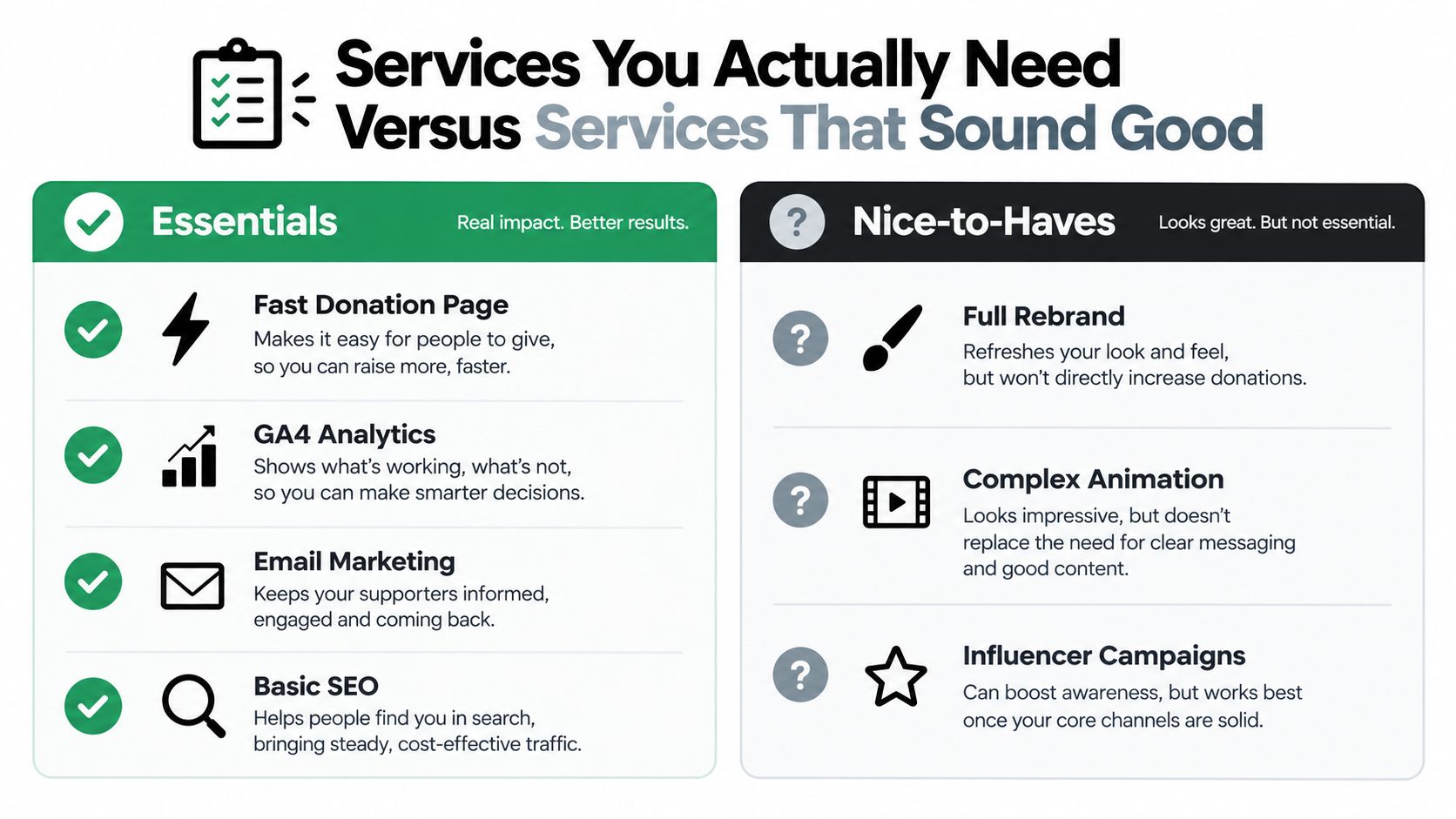
Prioritise the infrastructure that supports action
A useful donation page should be fast, accessible and clear about what happens after a donor submits the form. Analytics should record meaningful events, not just page views. Email should welcome new supporters and give existing donors relevant updates. Basic search optimisation helps people find the organisation's services and cause-related information.
| Service | Usually essential when… | Usually defer when… |
|---|---|---|
| Donation-page improvements | Visitors struggle to understand or complete the donation process. | The existing journey hasn't been reviewed or tested. |
| GA4 and tracking setup | The charity can't connect campaigns to completed actions. | No one has agreed which actions matter. |
| Email marketing | Donors and volunteers receive little or no follow-up. | The team can't maintain basic list hygiene and approvals. |
| Basic SEO | People need to find programs, services or local support. | The organisation is considering SEO without a clear audience or content owner. |
| Rebrand or complex animation | The current brand or site prevents people from understanding the organisation. | The proposal is driven by aesthetics rather than a defined problem. |
| Influencer campaign | The charity has a credible fit, clear safeguarding processes and a way to assess results. | The team lacks capacity to manage relationships and approvals. |
Match the specialist to the actual problem
A generalist agency can be useful when the charity needs coordination across website, media and reporting. A specialist can make sense when one channel is the clear bottleneck, such as a donation-page rebuild or search campaign. Neither model is automatically better. What matters is whether the people doing the work can explain the process, demonstrate relevant experience and work within the organisation's approval and safeguarding requirements.
Be cautious of an SEO retainer that promises visibility without explaining which pages, audiences and actions it will serve. Likewise, don't buy more Meta advertising if the donation journey is difficult to use on a phone. Traffic can't compensate for a form that confuses people.
Ask every provider to rank its proposed services by urgency. If everything is marked essential, ask what they would remove first if the budget tightened. The answer will tell you whether the agency understands the trade-offs charities face.
Measuring Results the Right Way
Reporting is where an agency relationship can lose the board's confidence. A dashboard full of impressions and click-through rates doesn't answer the question that matters: did the campaign produce completed gifts, qualified enquiries or another agreed outcome, and what should the charity do next?
A 2025 benchmark covering 13,000 digital fundraising campaigns and more than AUD 400 million processed found that typical campaigns generated 75% of revenue by week four. It also reported median digital income increased 6%, while 49% of organisations increased revenue, 24% stayed flat and 26% declined, according to the 2025 digital fundraising benchmark. Treat that as a reason to review performance during an appeal, not as a promise that any individual campaign will follow the same pattern.
Instrument before you buy traffic
Define one primary conversion event, such as a completed donation or qualified volunteer enquiry. Then check that GA4 and the donation platform record it consistently. Use UTMs to distinguish source, medium, campaign and creative, and make sure the landing page and device can be identified in reporting.
Review the donation journey on mobile as well as desktop. Australian benchmark research reported average conversion of 31% for appeal donation pages and 26% for general donation pages, with stronger examples reaching 80% and 41%, respectively. The same research reported 51% of nonprofit website visitors used mobile devices; it also found surveyed donors were more likely to abandon lengthy processes or difficult navigation, according to the donation-page research. Those results make mobile testing and accessible forms part of measurement, not a cosmetic extra.
Use the weekly review to make decisions
| Metric | What it measures | Target band | Action if off track |
|---|---|---|---|
| Cost per completed donation | Media cost associated with a completed gift. | Set from the charity's fundraising economics and baseline. | Check attribution, audience, page friction and gift value before shifting spend. |
| Conversion rate | Share of relevant visits that complete the chosen action. | Establish a baseline by page and device. | Review the form, page speed, message match and payment options. |
| Average gift | Typical donation value in the campaign. | Compare with the organisation's own appeal history. | Review suggested amounts, impact explanation and donor segments. |
| Recurring-gift rate | Share of donors selecting an ongoing gift. | Set only when recurring giving fits the appeal. | Check how the option is presented and whether the campaign audience suits it. |
| Abandonment by device | Where visitors leave the donation process on mobile or desktop. | Compare devices separately; investigate unexpected gaps. | Test the form, keyboard navigation, labels, errors and payment flow. |
Review the dashboard weekly and make budget changes only when there's enough conversion evidence to support a decision. Click-through rate can help diagnose an ad, but it isn't a substitute for completed actions. The benchmark also found peer-to-peer campaign volume rose 18% while dollars raised per participant fell 20%; agencies should therefore report value per activated participant and the next action taken, not registrations alone.
Why Recurring Giving Is Not Always the Right Answer
Monthly giving can support predictable income, but treating every donor as a recurring-gift prospect is lazy segmentation. Some supporters respond to an urgent appeal, a local event, a specific program or a clear opportunity to help at a particular moment. The charity should offer a next step that fits the reason someone gave, not force every relationship into the same payment pattern.
Australian giving data points to seasonal behaviour. GiveNow activity analysis found one-off donations increased 4–5% in early June 2025 compared with the same period in 2024, the average June donation was about $300, and more than one-third of one-off GiveNow donations over the previous decade occurred in June. Separately, Equity Trustees research reported that 20% cited tax benefits as a key giving motivator, with personal alignment, community outcomes and trust ranking more strongly, as described in this Australian analysis of what motivates donations.
Give different supporters different routes
Build a portfolio of journeys rather than a single recurring-gift funnel. An urgent appeal can lead with the immediate need and a clear one-off option. A tax-time campaign can explain impact and make the donation process straightforward. Event and peer-to-peer supporters may need a follow-up that recognises their participation before asking for another action. Advocacy audiences may be more ready to share, volunteer or learn before they donate.
That doesn't require a large technology project. Start with distinct landing pages or message variants for the audiences the charity already understands. Keep the number of segments manageable, and make sure the team can maintain each follow-up.
A second gift, a useful volunteer enquiry or a supporter who shares a campaign can matter more than an immediate monthly sign-up.
Measure donor quality, not just the first transaction
Track whether a new donor gives again, how long it takes for a second gift, and whether the supporter engages with the charity's work. Use those signals to decide when recurring giving belongs in the journey. If the charity is explaining a sponsorship model, a clear description of what the supporter is funding helps; this guide to horse sponsorship programmes offers a useful example of explaining a specific form of support.
The trade-off is straightforward. Recurring gifts can support planning, but a poorly timed ask can weaken trust. A one-off donation isn't a failed recurring conversion. It may be the right expression of that donor's intent.
Evaluating Agencies, Asking Sharper Questions and Onboarding Well
Choose an agency by testing how it thinks, not by admiring its presentation. Ask for examples that resemble your organisation's size, capacity and goals. When a provider shares results, ask what it measured, what work it controlled and what conditions affected the outcome. A case study without context is marketing copy, not evidence.
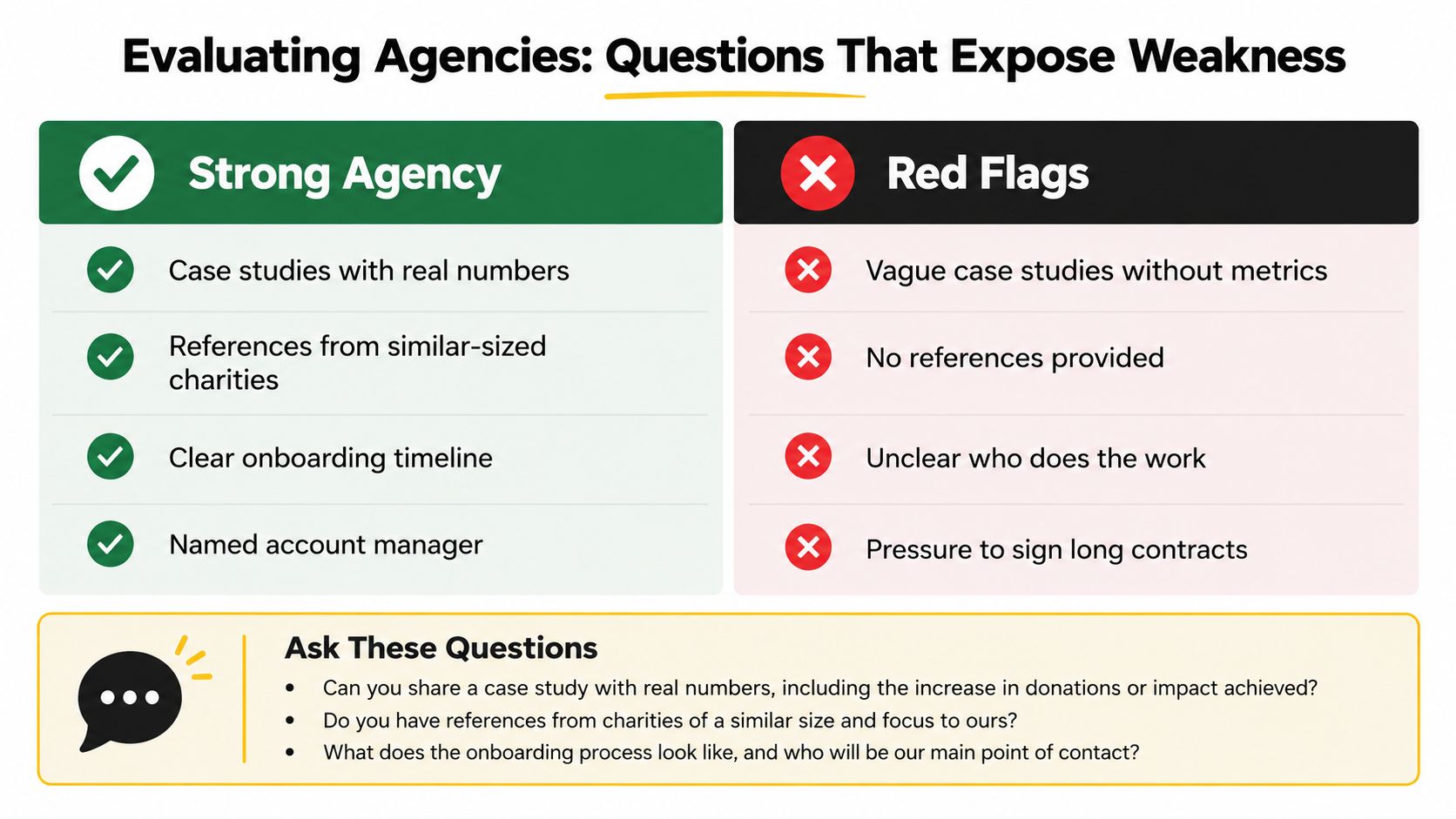
Ask questions that expose the working relationship
Use the first conversation to establish who will do the work and what the charity retains control of. Ask:
- Relevant experience: Can you show work for organisations with similar constraints and explain what changed?
- People and ownership: Who will manage the account, and who owns the ad accounts, website, analytics and creative files?
- Measurement: How will you distinguish a completed donation from a click or form start?
- Privacy and governance: How do you minimise personal information sent to advertising platforms, and who approves tracking changes?
- Exit terms: What happens to access, documentation and campaign assets if the contract ends?
Reject pressure to sign a long commitment before the agency has understood the organisation's needs. Ask for references from comparable charities and speak directly with them about communication, reporting and handover.
Make onboarding a governance task
Before launch, confirm account access, consent notices, data permissions and the organisation's process for approving creative. The OAIC says valid consent must be informed, voluntary, current and specific. Its privacy guidance on consent is relevant when a charity collects personal information or uses tracking technologies.
Connect GA4 and the donation platform, then test the conversion event before spending. If the agency proposes Meta Conversions API or another server-side integration, require a plain-language explanation of what data it sends, why it needs that data and how consent is handled. The charity should also agree on named KPIs and a practical review rhythm, rather than receiving a dashboard nobody reads.
This video can support a discussion about what digital marketing work involves:
Compare pricing by incentives and risk
| Pricing model | Best fit | Risk to watch | Typical range AUD |
|---|---|---|---|
| Retainer | Ongoing work across channels with a defined scope. | Paying for capacity that isn't being used or measured. | Request a written proposal; no reliable range is provided here. |
| Percentage of ad spend | Campaigns where media management scales with spend. | The agency may benefit when spend rises, even if outcomes don't. | Request a written proposal; no reliable range is provided here. |
| Project fee | A defined website, tracking or strategy deliverable. | Unclear support after handover or launch. | Request a written proposal; no reliable range is provided here. |
| Hybrid | A fixed base with scoped campaign or project work. | Responsibilities and extra fees can become difficult to track. | Request a written proposal; no reliable range is provided here. |
Your Next Move and the Questions Worth Answering First
This week, write a one-page brief, choose two agencies to interview and agree on the outcomes the board wants to see. Keep the brief practical: the audience, the action, current barriers, available staff time, budget limits and who has authority to approve work.
Then address the risks that often sit outside the marketing conversation. The 2025 Digital Technology in the Not-for-Profit Sector report surveyed 824 organisations across Australia and New Zealand and found 67% used generative AI, while only 14% had an official AI policy or guidelines. About 23% had a documented cybersecurity plan, and just 20% of volunteer-led organisations used multifactor authentication, according to the sector's digital technology report coverage.
Ask who can access donor data, which AI tools staff may use, who checks generated fundraising copy, and what the agency will do if an account or dataset is exposed. Agree on data minimisation before connecting tracking tools. These aren't IT details to postpone. They shape whether the charity can use digital marketing responsibly.
A strong agency relationship gives your organisation clearer decisions, better measurement and a workable system, not just more campaign activity. Alpha Omega Digital works with organisations on website development, analytics setup and paid advertising; for charities ready to discuss a practical plan, contact the team.
If your organisation needs a more reliable website, clearer campaign measurement or paid advertising connected to meaningful actions, speak with Alpha Omega Digital. The team is based in Melbourne and works with organisations across Australia to plan, build and measure digital campaigns.
[email protected]
Read more insights from our team on web design, paid ads, and growth strategy.