A nonprofit executive in Melbourne can spend a week weighing the same difficult trade-off: ask an already stretched team to run another campaign, or bring in outside help and explain the cost to the board. The right decision isn't automatically to hire an agency. It's to identify what's preventing the organisation from reaching its goals, then find the kind of support that addresses that specific gap.
A capable nonprofit marketing agency should connect mission, audience, fundraising, and measurement. It shouldn't sell activity for its own sake. Use four tests to judge whether a potential partner fits: strategic fit, capability fit, commercial fit, and trust fit.
Why the Right Agency Choice Matters for Nonprofits
Start with the outcome, not the agency's service menu. Does the organisation need more first-time donors, better retention, stronger volunteer recruitment, clearer communication about its impact, or a website that makes it easier to act? Those are different problems. A partner who can run ads may not be equipped to improve donor journeys, and a strong brand strategist may not be the right person to fix a broken donation process.
An outside agency can bring specialist skills, a fresh perspective, and time to execute. It can help an internal team turn scattered ideas into a practical plan, build campaigns across channels, and make results easier to review. But an agency can't supply a clear mission, approve sensitive stories on the organisation's behalf, or repair internal decision-making. Your team still needs to set priorities, provide context, and make timely decisions.
Four tests before you hire
Strategic fit means the agency understands the organisation's priorities and the audiences it serves. Ask how it would distinguish messaging for donors, volunteers, service users, funders, and corporate partners without diluting the mission.
Capability fit is about the actual work. Ask who will handle strategy, creative, fundraising, technology, and reporting. A polished pitch is no substitute for knowing who'll do the day-to-day work and whether they've handled the relevant platforms and processes.
Commercial fit means the scope and fee match the problem. If your main issue is donor retention, paying for a broad awareness campaign may be a poor use of limited funds. If the website can't accept donations smoothly, buying more traffic may only send more people into a leaky funnel.
Trust fit matters because nonprofit marketing often deals with vulnerable communities, personal stories, and sensitive data. The agency should respect privacy, protect dignity, check claims, and be candid about what it can and can't prove.
My advice: Don't hire an agency to make the marketing look busier. Hire one when you can name the problem, the people who need to solve it, and the evidence that would show whether the work is helping.
The point isn't to outsource responsibility. It's to decide whether outside expertise can help your organisation make better choices and deliver work your internal team can't reasonably take on alone.
The Australian Nonprofit Market in Real Numbers
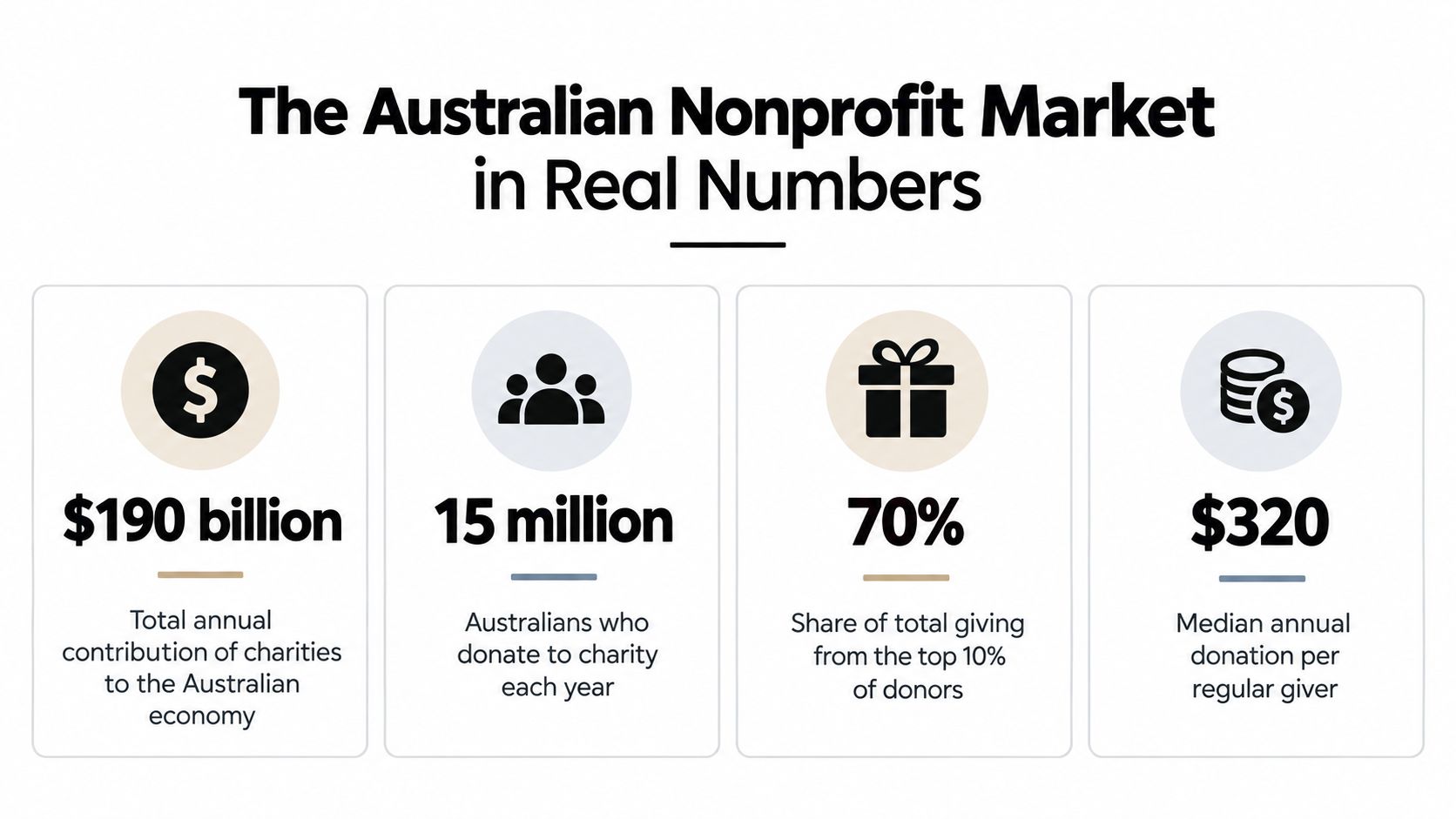
Australia's charity sector has significant scale, but headline figures need context. Registered charities generated more than $222 billion in total revenue in 2023, a 10.7% increase of over $21 billion from the previous year, according to the Australian Charities Report. The same report recorded $18.9 billion in donations and bequests, the highest amount since the Australian Charities and Not-for-profits Commission was established.
That donation total doesn't mean the average charity suddenly found fundraising easier. Around $4.9 billion, roughly a quarter of reported donations, came from a single gift to the Minderoo Foundation group. Excluding that exceptional donation, the underlying increase was only about 0.4%, or $54 million. A growth target built around the headline donation figure would therefore give a misleading picture of what most organisations can expect.
What scale means for your marketing decision
Australian Government information puts charities' and not-for-profits' contribution to the economy at approximately $156 billion, or about 4.8% of gross value added. ACNC reporting for 2024 found that charities employed approximately 1.6 million people, equivalent to 11% of the Australian workforce, and involved about 3.9 million volunteers. The register contained 60,572 charities as of 1 February 2024, a sign of how varied and crowded the sector is. Those figures are outlined in the Australian Government's information on charities and not-for-profit support.
For a marketing agency, the practical point isn't that every charity should spend more. It's that each organisation must earn attention and trust among donors, volunteers, beneficiaries, funders, policymakers, and partners. Ask an agency to explain how its proposed targets relate to your starting point, donor mix, capacity, and campaign history. If it promises effortless growth without asking about those factors, treat the promise with caution.
The donor-retention picture also deserves attention. The Australian Benchmarking Project found that single-gift donor recruitment declined about 5% annually, or 27% over five years, while retention challenges added to acquisition pressure. The same Australian sector analysis reported a 10.45% year-on-year increase in recurring giving, and smaller organisations investing in retention recorded a 58% increase in recurring revenue. These are benchmarks, not a forecast for any individual charity. Ask how an agency would test retention work against your own data and costs before treating a sector result as a target. The findings are summarised in Community Directors' coverage of the donor-pool squeeze.
Services a Nonprofit Marketing Agency Should Actually Offer
A useful agency connects the whole supporter journey. A donation page, an email sequence, a paid campaign, and a donor database shouldn't operate as separate projects with no shared measurement. Ask each prospective partner to show how the work moves someone from awareness to action, and how the organisation will learn from the result.
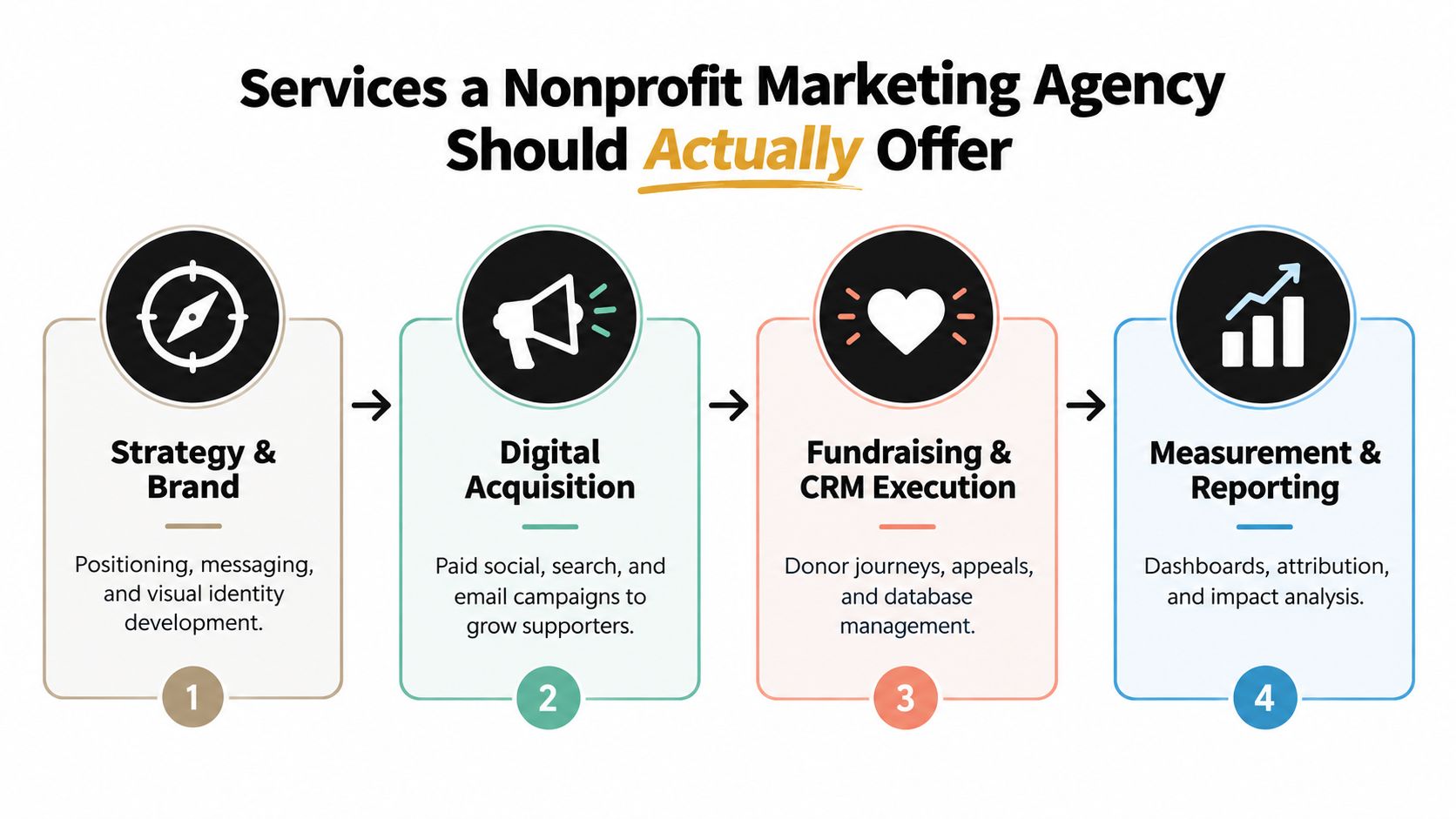
Four connected areas of work
Strategy and brand. Expect audience priorities, positioning, message guidance, and a clear campaign brief. Ask how the agency will keep the organisation's voice consistent while adapting it for donors, volunteers, and community partners. Competence shows up in thoughtful questions and useful working documents, not just a visual refresh.
Digital acquisition. This can include paid social, search, landing pages, and email campaigns. Ask what each channel is supposed to accomplish and how the team will decide whether to change the audience, creative, or destination page. A capable partner can explain the conversion path, not just present impressions and clicks.
Fundraising and CRM execution. Look for practical donor journeys, campaign appeals, forms, and database workflows. The agency should understand how a first gift differs from a recurring contribution and how consent, donor preferences, and data quality affect communications. Ask which tasks your staff will own and which the agency will deliver.
Measurement and reporting. Request a reporting view that ties marketing activity to outcomes the organisation values. That might mean completed donations, second gifts, recurring conversions, volunteer registrations, or service enquiries. Ask how the agency will check whether tracking reflects real records in the CRM or payment system.
A good proposal makes these pieces work together. If the agency recommends more traffic, it should also check that the website makes the next step clear. If it proposes a donor email series, it should explain how the messages fit the broader relationship and how the organisation will judge their contribution. If it can't describe the hand-off between its own channels and your team's database, you may be buying disconnected deliverables rather than a working system.
Generalist, Digital, or Fundraising Specialist How to Read the Difference
There isn't one ideal agency model. A generalist can be useful when the organisation needs coordinated brand, content, and campaign support. A digital marketing agency may suit a team with a clear offer that needs stronger websites, paid media, or analytics. A fundraising specialist can be the better choice when donor strategy and CRM execution are the central challenge.
| Criteria | Generalist Agency | Digital Marketing Agency | Fundraising Specialist |
|---|---|---|---|
| Strategy depth | Broad brand and communications planning | Digital channel and conversion planning | Donor and fundraising strategy |
| Fundraising fluency | Varies by team | Varies, may be limited | Usually central to the offer |
| Technical capability | Depends on internal team and partners | Often strong across websites, tracking, and paid channels | Strongest where CRM and donor journeys are concerned |
| Price structure | Often scope-based or retainer-led | Often project fees, retainers, or media-management fees | Often tied to fundraising and database scope |
| Accountability | Campaign and communications outcomes | Channel and conversion outcomes | Donor, giving, and retention outcomes |
Match the model to the gap
A smaller charity with a capable communications lead might need a specialist to implement tracking or improve its donation journey, not a full-service agency. A team with limited in-house marketing capacity may value a broader partner, but should still identify a staff member who can make decisions and provide approvals. A fundraising-led organisation with a complex donor programme should test whether a digital agency has enough fundraising fluency to support that work.
For practical ideas on event formats and supporter engagement, a useful resource is fundraising event ideas to help homeless children and families. Use it as inspiration, then assess whether an agency can connect an event to your own audience, mission, and follow-up plan.
Don't choose on category labels alone. Ask for examples of relevant work, the specific people who'd deliver it, and the measurement approach. The best fit is the partner whose strengths align with your current constraint, not the one with the longest service list.
Running a Two-Week Shortlist Without Losing Your Mind
A shortlist doesn't need to become a drawn-out procurement exercise. A small team can keep it focused by writing down the problem, asking each agency the same core questions, and judging proposals against agreed criteria rather than presentation style.

Build a brief you can actually use
Write a short discovery brief that states the organisation's mission, current marketing challenge, audiences, available internal capacity, existing tools, and the outcome you want to improve. Include the work you already know is out of scope. This keeps agencies from filling gaps with assumptions and makes proposals easier to compare.
In the first call, ask who will do the work, what they need from your team, what they'd want to inspect before recommending a solution, and how they'd define progress. Ask them to explain a project that didn't go to plan and what they changed. Their answer often reveals more about accountability than a polished success story.
A practical test: Give each agency the same brief and ask for a short explanation of its approach. Compare the questions they ask before they propose a solution.
Use references to check the working relationship, not just the outcome. Ask the former client whether the agency communicated clearly, respected approvals, surfaced problems early, and transferred usable knowledge to the organisation. A reference who can speak to those details is more helpful than a list of impressive deliverables.
End an evaluation early if an agency guarantees results without reviewing your data, can't identify the person responsible for delivery, or treats sensitive stories casually. Also be wary of proposals that make your team responsible for approvals and implementation without accounting for the time that work takes.
The selection process works best when you keep a shared scorecard. Rate strategic fit, capability, commercial fit, and trust, then record the reason behind each rating. That gives executives and board members a defensible decision instead of a collection of impressions.
Before signing, ask the agency to make its assumptions explicit: what access it needs, what assets your team must supply, what happens if approvals are delayed, and how either party can raise a concern. Clear expectations protect the relationship as much as they protect the budget.
To see how an agency approaches audience, messaging, and delivery, ask it to talk through this short overview before the next conversation.
Pricing Models Contract Terms and What a Fair Deal Looks Like
There's no responsible universal price for nonprofit marketing support. The fee depends on the work, the number of channels, the agency's role, the complexity of the organisation's data and approvals, and how much execution your own team can take on. A fair proposal explains those inputs clearly rather than presenting a headline fee with an unclear list of exclusions.
Compare the model, not just the monthly figure
A project fee makes sense for a defined task such as a website refresh, messaging work, or campaign setup. A retainer can suit ongoing optimisation, reporting, and creative delivery when the workload is predictable. A performance-based or hybrid arrangement needs especially careful definitions: agree on what counts as a result, how attribution works, and which costs sit outside the fee.
Ask whether media spend is paid directly by your organisation or routed through the agency. Keep the ad account, analytics, CRM, and creative files accessible to your team. If the agency owns the only login or stores key records in a system you can't access, you're taking an avoidable operational risk.
Don't accept invented benchmarks as a pricing shortcut. Ask for a scope that shows who is doing what, how often, and what decisions the fee includes. If the proposed work includes strategy, design, campaign management, and reporting, the proposal should explain how those activities connect and what your team must supply.
Contract terms to read line by line
Check the reporting cadence and the decisions each report should support. Confirm who owns creative and website work, what access you retain, how the agency handles donor data, and what happens to active campaigns and files when the relationship ends. Put the exit process in writing, including notice, handover, and any remaining project costs.
The contract should also identify approval responsibilities, points of contact, and how the parties will handle scope changes. Ask for a plain-language breakdown of excluded work, such as new landing pages, extra creative, or CRM changes. A clear agreement gives both sides room to do good work without arguing over what the fee was meant to cover.
Onboarding Measurement and the First 90 Days
Good onboarding begins with access, context, and a shared definition of success. The agency should review the website, donation flow, campaign history, analytics, CRM, consent practices, and existing reporting before recommending a major change. Your team should provide the mission context, audience knowledge, constraints, and the people responsible for approvals.
Set a baseline before launch. For fundraising, useful measures include first-time and repeat donors, donor retention, average gift, recurring-giving conversion, and acquisition cost. For other goals, track the action that matters, such as volunteer registrations or service enquiries. Reach and clicks can help explain performance, but they don't replace evidence of the action the campaign was meant to generate.
A practical early working rhythm
Agree on the first experiments and record what each one is intended to test. If the team changes the message, audience, and donation page at the same time, it becomes harder to tell which change mattered. Ask the agency to document decisions and use the organisation's own records to validate reported outcomes.
Set a regular review with the people who can approve changes and act on findings. Keep the agenda focused: what happened, what the data can support, what remains uncertain, and what the team will change next. The purpose isn't to defend a report. It's to make the next decision better.
Before the engagement starts, agree on what would lead you to continue, adjust the scope, or stop. A nonprofit marketing agency should be willing to discuss weak results and recommend changes based on evidence, not activity. That's how an organisation protects donor trust while deciding whether its marketing investment is earning its place.
If your team is weighing outside support, Alpha Omega Digital works on nonprofit website design, WordPress development, analytics setup, and paid advertising. Visit Alpha Omega Digital to discuss whether that kind of support fits your organisation's priorities.
[email protected]
Read more insights from our team on web design, paid ads, and growth strategy.