Think of a PPC marketing agency as your business’s investment manager, but for the digital world. Instead of stocks and shares, we take your advertising budget and put it to work on platforms like Google and Facebook to generate the best possible return. My entire mission is to get your brand in front of the right people at the exact moment they’re looking for what you offer.
What I Actually Do as a PPC Marketing Agency
When I chat with business owners, I often find they see paid ads as just another line item on the expense sheet. My first job is usually to shift that mindset.
A well-managed PPC campaign isn’t an expense; it’s a calculated investment designed to produce measurable growth. It’s about moving past simply spending money on ads and into making strategic decisions that drive real, tangible results.
Anyone can boost a post on Facebook or throw some money behind a Google Ad. The real value a specialist agency like mine brings is in the how and the why. It’s about deep research, continuous testing, and a rock-solid technical setup that makes sure every dollar is accounted for. This is often the difference between a campaign that costs you money and one that makes you money.
Beyond Just “Running Ads”
A huge part of what I do happens behind the scenes. It’s a blend of technical skill, creative thinking, and sharp analytical work that goes far beyond just launching a campaign and hoping for the best.
Here’s a quick look at what we’re actually managing:
Core Responsibilities of a PPC Agency
This table breaks down some of the key tasks I handle to turn your ad spend into actual revenue.
| Responsibility | What It Means For You |
|---|---|
| Deep Platform Mastery | We live and breathe platforms like Google Ads and Meta Ads. I know the algorithms, ad formats, and targeting options inside out, ensuring your message actually reaches the right audience. |
| Technical Tracking Setup | Using tools like Google Tag Manager and Google Analytics, I track every click, conversion, and user interaction. This data is the lifeblood of a successful campaign. |
| Advanced Data Integration | With privacy rules constantly changing, setting up the Meta Conversion API is crucial. This helps us track performance accurately and reliably, even when cookies aren’t available. |
| Constant Optimisation | We don’t “set and forget.” I’m constantly analysing data, tweaking bids, testing new ad copy, and refining targeting to improve your ROAS and lower your cost per lead. |
This isn’t just about managing ads; it’s about building a predictable growth engine for your business.
For an eCommerce business, this precise tracking is non-negotiable. It’s how I connect ad spend directly to sales, proving the value of your marketing investment down to the last cent.
Ultimately, we’re not just ad managers; we’re growth partners. I handle all the technical complexities so you can get back to what you do best—running your business. My expertise in everything from Shopify development to configuring complex tracking through the Shopify API ensures your entire digital ecosystem works together seamlessly to turn clicks into loyal customers.
The Core Services That Power Your Growth
When you team up with a PPC agency, you’re not just buying ads. You’re tapping into a whole suite of specialised services that are designed to work together. I like to think of it as a high-performance engine; every part has a job, but they all have to fire in sync to actually create momentum.
From my experience, the moment clients understand these core services, it becomes much clearer where their investment is going and what they can realistically expect back.
Google Ads and Paid Social Campaigns
Let’s start with the big one: Google Ads. This is what most people picture when they think of PPC. My main job here is to get your business front-and-centre at the top of Google, right when people are actively searching for what you sell. It’s all about capturing that high-intent traffic the second someone needs a solution.
But winning at Google Ads isn’t just about outbidding everyone. It’s a craft. It involves deep keyword research, writing ad copy that speaks directly to a searcher’s problem, and structuring campaigns to squeeze every bit of value out of your budget. For e-commerce brands, it also means running those slick, visual Shopping ads that show off products right in the search results.
Then you’ve got paid social media, which is a completely different ball game. As a Facebook ads agency, I use platforms like Facebook and Instagram to create demand, not just capture it. We build brand awareness and connect with audiences based on their interests, demographics, and what they do online. It’s a different approach, but it’s incredibly powerful when done right.
The demand for PPC marketing agencies in Australia has absolutely skyrocketed, which shows just how critical this stuff has become. A 2025 analysis found that the best local agencies have become masters of search, shopping, and social ads by being disciplined with budgets and delivering predictable ROI. Many of them built their reputations on a data-first approach, especially for e-commerce brands where every dollar has to be accounted for. You can get more details on Australian digital agency benchmarks in the full report.
The Technical Foundation for Success
Now, let’s get into the stuff that I believe truly separates a great agency from a good one: the technical setup. This is where the real magic happens because it’s the foundation for accurate measurement and smart decisions. Without a solid technical backbone, even the most creative ads are just flying blind.
I always start by setting up GTM and Google Analytics. Think of Google Tag Manager (GTM) as the control panel for all the tracking codes on your website. It lets us add and manage tracking pixels without constantly bugging your developer to edit the site’s code. This then feeds clean, organised data into Google Analytics, where we can see how users are behaving and how campaigns are performing.
This technical precision is what allows us to attribute a sale on your Shopify store directly back to a specific Facebook ad or Google keyword. It’s how I prove your return on investment and find opportunities to scale what’s working.
Another critical piece of the puzzle is the Meta Conversion API. With all the browser privacy changes impacting old-school cookie tracking, the Conversion API creates a more reliable, server-to-server link between your website and Facebook. Setting up Meta Conversion API properly ensures our data stays accurate, allowing us to optimise campaigns effectively and keep performance up despite all the industry shifts.
For my e-commerce clients, I often go even deeper. My experience in both Shopify development and the Shopify API means I can build custom tracking solutions and integrations. This could be anything from setting up advanced e-commerce event tracking to connecting your store’s data to other marketing platforms for a complete picture of the customer journey.
- WordPress Development and Design: I make sure your landing pages aren’t just pretty, but are actually optimised to convert, with fast load times and unmissable calls-to-action.
- Shopify Development and Design: For online stores, I build and fine-tune user experiences that guide visitors smoothly from that first click all the way to checkout.
Ultimately, these core services are all connected. A top-tier PPC marketing agency doesn’t just manage ads; we build and maintain the entire system that turns your ad spend into predictable, sustainable growth.
Decoding Agency Pricing and Your Expected ROAS
Let’s get straight to the point everyone cares about: the money. I know that investing in a PPC agency is a big decision, and you need to understand exactly how the financials work. The goal isn’t to see this as a cost, but as a direct path to generating more revenue for your business.
When you start talking to different PPC marketing agencies, you’ll quickly find there are a few common ways we structure our fees. There’s no single “best” model; it really comes down to the scale of your campaigns and what you’re trying to achieve.
Common Pricing Models Explained
One of the most common structures you’ll see is a percentage of ad spend. Here, the agency’s management fee is a set percentage—often between 10-20%—of your total monthly ad budget. This model is pretty straightforward and scales with your marketing efforts. As you spend more, the fee increases, but so should your results.
Another popular option is a flat monthly retainer. This is a fixed fee you pay each month, no matter how much you’re spending on ads. I find this works really well for businesses that need predictable monthly expenses. It allows us to focus purely on driving performance without being tied to your ad budget.
Finally, some agencies offer performance-based pricing. This model ties our fee directly to specific results, like the number of leads generated or total sales revenue. While it sounds great on paper, it can be tricky to set up and often comes with a higher base retainer to cover the initial work.
What Is a Good Return on Ad Spend?
Now for the metric that truly matters: Return on Ad Spend (ROAS). This is the ultimate measure of whether your campaigns are actually making you money. It’s a simple calculation: for every dollar you put into advertising, how many dollars in revenue do you get back?
A common benchmark is a 4:1 ROAS, meaning you generate $4 in revenue for every $1 spent. But a “good” ROAS can vary massively depending on your industry, profit margins, and business goals. For a high-margin business, a 3:1 ROAS might be fantastic, while a low-margin e-commerce store might need a 10:1 ROAS just to be profitable.
The effectiveness of PPC marketing agencies in Australia is often judged by their ability to hit these targets. An industry report highlighted that businesses working with top-tier agencies typically see a ROAS between 5x to 8x, which is a huge leap compared to trying to manage it all yourself. This usually comes down to deep platform expertise and transparent, proven processes.
To get a real handle on profitability, it’s essential to learn how to calculate ROAS correctly. This empowers you to have informed conversations with your agency and truly understand the financial impact of your marketing spend.
My approach is to work with you to set realistic ROAS targets from day one. I dig into your margins and business objectives to define what success actually looks like for you. From there, I build a data-backed strategy designed to meet and exceed those goals, turning your PPC campaigns into a powerful and predictable revenue generator.
Why Your Website Is Crucial for PPC Success
I’ve seen it happen more times than I can count. A business pours money into a brilliantly crafted ad campaign. The targeting is spot-on, the copy is compelling, and the clicks start rolling in. But then… crickets. The leads don’t convert, and the sales just don’t materialise. Nine times out of ten, the culprit isn’t the ad; it’s the website it leads to.
A successful ad campaign never works in a vacuum. Think of your Google Ad as a brilliant movie trailer—it can get someone excited enough to buy a ticket, but if the movie itself is slow, confusing, or keeps buffering, they’re going to walk out disappointed. Your website is the main feature, and it has to deliver on the promise your ad makes.
That’s precisely why my agency doesn’t just stop at running ads. We get our hands dirty with WordPress development and Shopify development because I know the user’s journey after the click is where your money is actually made or lost.
The Critical Link Between Ads and Landing Pages
The moment a user clicks your ad, a stopwatch starts. You have mere seconds to prove their click was a good decision and guide them toward the next step. A slow-loading, poorly designed, or confusing landing page is the digital equivalent of a slammed door in their face.
For e-commerce businesses, a slow site can be fatal. Studies show that even a one-second delay in page load time can cause a 7% drop in conversions. This is where our expertise in Shopify design and WordPress design becomes a non-negotiable part of my PPC service. I build landing pages and websites that don’t just look good—they’re engineered for speed and conversion from the ground up.
Here are the non-negotiables for any website hooked up to a PPC campaign:
- Lightning-Fast Load Times: Your page has to load almost instantly on both desktop and mobile. Anything less, and you’re losing people.
- A Clear Conversion Path: The user should know exactly what to do next, whether it’s “Add to Cart,” “Request a Quote,” or “Download Now.” No ambiguity.
- Seamless User Experience (UX): Navigation needs to be intuitive. Information should be easy to find. Frustration is the number one conversion killer.
- Mobile-First Design: With most ad traffic coming from phones, your site absolutely must look and function perfectly on a smaller screen.
Beyond Design: Advanced Technical Capabilities
Building a high-performance digital ecosystem goes much deeper than just what you see on the front end. For my clients on Shopify, this often means diving into the backend to build custom solutions. Using the Shopify API, I can create unique features, streamline data flows between your store and other platforms, and solve complex business challenges that an off-the-shelf app just can’t touch.
This technical skill is also why I insist on a rock-solid tracking setup using GTM and Google Analytics. It’s like having a CCTV camera on your website, letting us see exactly how people are interacting with your landing pages. I can pinpoint where they’re dropping off, which buttons they’re clicking, and what’s stopping them from converting.
This granular data is gold. It allows us to move beyond guesswork and make data-driven improvements to your website, directly increasing your campaign’s ROAS. It’s the difference between hoping your website works and knowing precisely how to make it better.
As an agency that handles the whole picture, I also manage the paid social side of things. My work as a Facebook ads agency is far more effective when I can trust the data flowing from your website. By properly setting up the Meta Conversion API, I build a reliable data bridge that feeds Facebook the information it needs to find you more customers, not just more clicks.
Ultimately, the top PPC marketing agencies get this. They know that managing Google Ads is only half the battle. The other half is won on your website, by creating a complete, high-performance environment where every single element works together to turn curious clicks into valuable customers.
How to Choose the Right PPC Agency for Your Business
Picking a marketing partner is a big deal, and I want you to feel completely confident in your choice. It’s not just about hiring someone to run your Google Ads; it’s about finding a team that becomes an extension of your own, someone who’s just as committed to your growth as you are.
To help you look past the slick sales pitch, I’ve put together a practical guide. This is all about judging a PPC marketing agency on its process, its technical chops, and the real results it has delivered for businesses just like yours.
This infographic shows a simplified but critical path to PPC success, highlighting how a fast website is what actually turns an ad click into a real conversion.
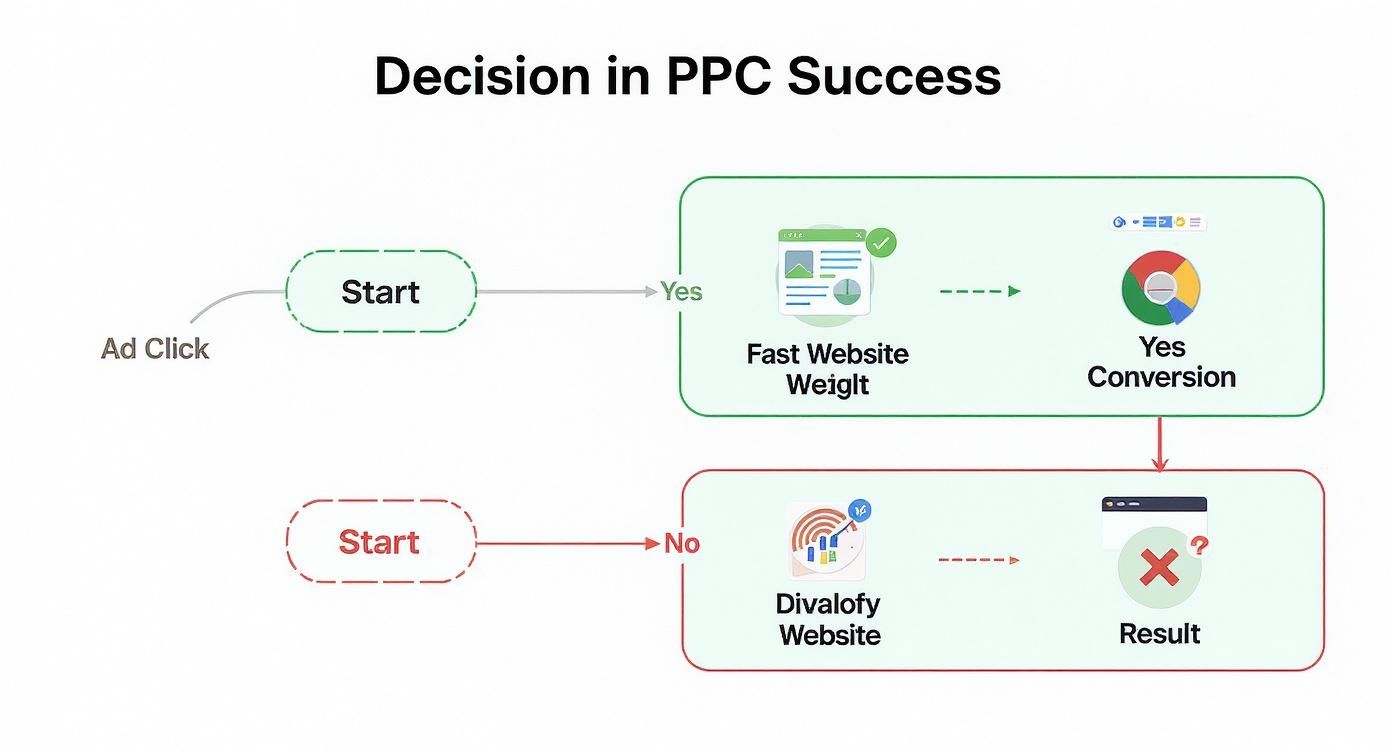
As you can see, a great ad is only the first step. What happens next—the user’s experience on your website—is what truly seals the deal.
Questions to Ask Any Potential Agency
When you’re interviewing agencies, you need to dig deeper than surface-level questions. The quality of their answers will tell you everything you need to know about their capabilities, especially when it comes to the technical foundations we’ve talked about.
To help you get straight to the point, I’ve put together a checklist of key questions to ask when you’re interviewing a potential PPC agency. Think of this as your cheat sheet for separating the talkers from the doers.
Agency Evaluation Checklist
| Area to Evaluate | Key Question to Ask | What a Good Answer Looks Like |
|---|---|---|
| Technical Tracking | “How do you approach tracking and attribution setup?” | They should immediately mention tools like Google Tag Manager and Google Analytics 4. They’ll also explain their process for setting up the Meta Conversion API to get accurate data from social campaigns, especially post-iOS updates. |
| Platform Expertise | “What’s your experience with our platform (e.g., Shopify, WordPress)?” | A solid agency will provide specific examples. They’ll talk about building high-converting landing pages with WordPress design or optimising product feeds and checkout flows using their Shopify development skills. |
| Proven Results | “Can you show us case studies from clients similar to our business?” | Vague promises won’t cut it. They need to show you real data from past clients—think screenshots, reports, and clear examples of how they solved a problem and drove measurable growth. |
| Communication & Team | “Who will be my day-to-day contact and what does your communication look like?” | You’re looking for clarity. A good answer involves a dedicated account manager, scheduled check-in calls (weekly or fortnightly), and transparent reporting that you can actually understand. |
Getting clear, confident answers to these questions is the first step in finding a partner who can truly move the needle for your business.
A truly capable agency won’t just talk about running ads. They will connect their PPC strategy directly to your website’s performance, explaining how their expertise in Shopify design or WordPress development will improve your conversion rates and overall ROAS.
Red Flags to Watch Out For
Just as important as knowing what to look for is knowing what to avoid. I’ve seen far too many businesses get locked into contracts that deliver nothing but frustration and wasted ad spend.
Here are some critical red flags to keep an eye on:
- Guaranteed Results: This is the oldest trick in the book. No one can guarantee a #1 ranking or a specific ROAS. PPC is a dynamic process of constant testing and optimisation, not a magic button.
- Vague or “Secret” Strategies: If an agency isn’t completely transparent about what they’re doing, that’s a huge problem. You should have full ownership and visibility of your ad accounts, always.
- Lack of Technical Depth: If they can’t confidently discuss things like the Shopify API for custom e-commerce solutions or the critical importance of the Meta Conversion API, they probably lack the skills to deliver top-tier results.
- Their Own Website Sucks: An agency’s own online presence is a massive tell. While many great firms use effective digital marketing website templates for agencies as a foundation, if their own site is slow, clunky, or poorly designed, how can you possibly trust them with yours?
The best agencies in Australia have built their reputations on delivering tangible outcomes. In fact, a 2025 industry review found that leading PPC agencies consistently helped clients achieve impressive growth, with some seeing a 53% increase in monthly visitors and generating up to $30,000 in monthly sales from PPC alone. The most successful firms earned perfect client feedback by consistently exceeding ROAS targets.
Our Transparent Process for Driving Results
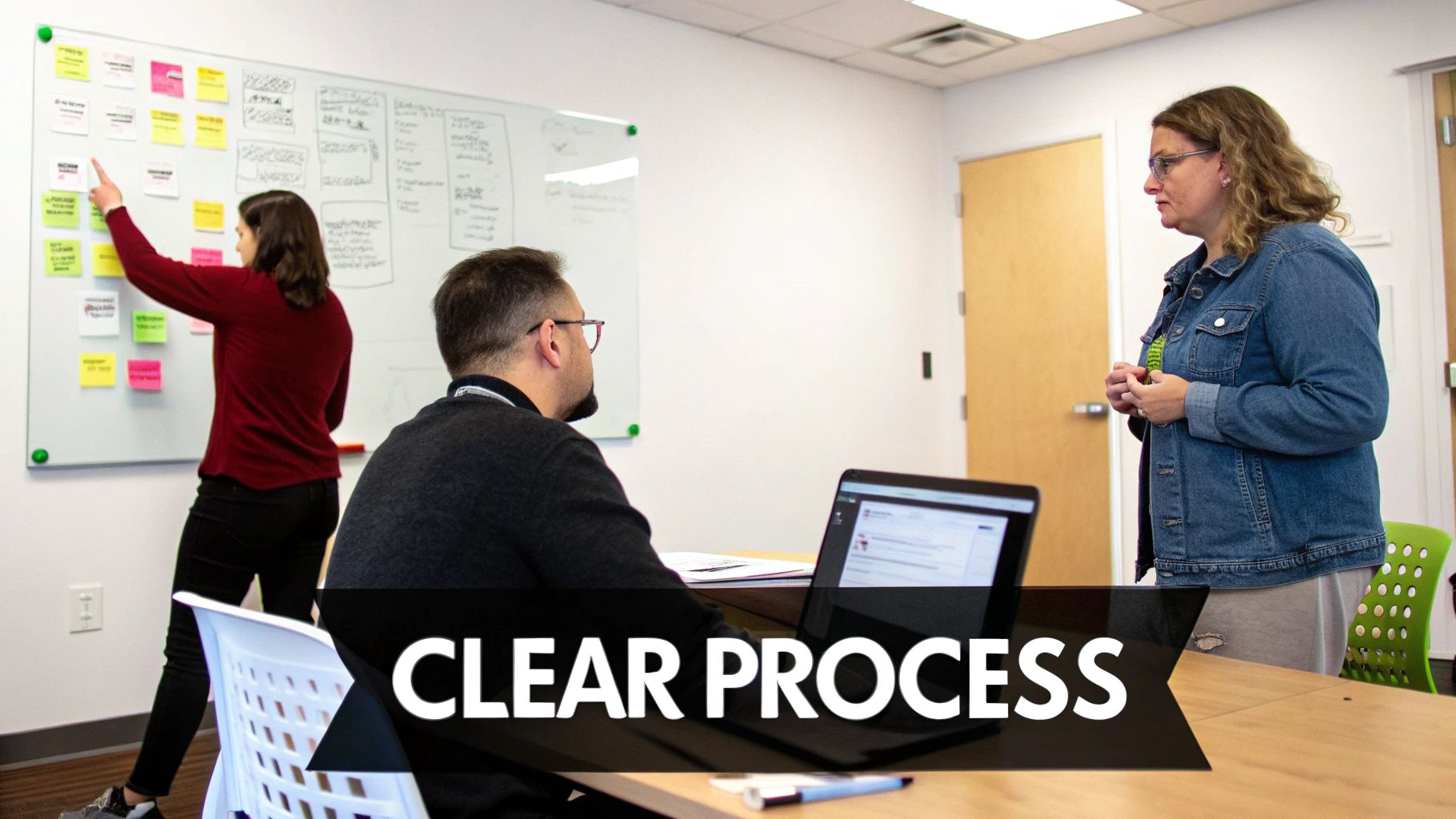
I believe the best partnerships are built on clarity and trust. That’s why I want to pull back the curtain and show you exactly what it’s like to work with us, from the very first conversation to scaling your campaigns.
We follow a structured, transparent process that keeps you in the loop and makes sure every decision is focused on getting you results. No smoke and mirrors here.
It all starts with our discovery and strategy phase. This isn’t just a quick chat; it’s a deep dive into the heart of your business. We need to understand your goals, who your ideal customers are, your unique value, and what the competitive landscape looks like. This initial work is the foundation for everything that follows.
This stage is all about aligning our strategy with your business objectives. I don’t just launch ads for the sake of it; I build a complete plan designed to achieve specific outcomes, whether that’s generating high-quality leads, driving online sales, or increasing brand visibility.
Campaign Build and Technical Setup
Once we have a solid strategy, my team gets to work. This is where our technical expertise really comes into play. We conduct meticulous keyword research to find the precise terms your customers are typing into Google Ads, then we craft compelling ad copy that speaks directly to their needs and drives them to act.
A huge part of this phase is the technical setup – something many other PPC marketing agencies gloss over. I make sure your tracking is flawless by implementing GTM and Google Analytics. For my e-commerce clients, I get granular with Shopify development to ensure every click and purchase is recorded accurately.
This meticulous technical work, including setting up the Meta Conversion API for our Facebook ads agency services, is non-negotiable. It’s what allows us to attribute every dollar of your ad spend to a real result, giving us the clean data we need to make smart optimisation decisions down the line.
I also focus heavily on the destination. Whether you’re on WordPress or Shopify, my team applies best practices in WordPress design and Shopify design to make sure your landing pages are optimised for conversion from day one.
Ongoing Optimisation and Reporting
Launching the campaign is just the beginning. The real work happens in the ongoing optimisation. We are constantly in your ad accounts, analysing performance data, testing new ad variations, refining audience targeting, and adjusting bids to maximise your return.
Our reporting is built on transparency. You’ll get regular, easy-to-understand reports that show you exactly what’s working, what isn’t, and what we’re doing about it. I cut through the jargon and focus on the metrics that matter most to your bottom line.
Here’s a quick, anonymous example of how this plays out:
- The Challenge: A local service business was getting plenty of clicks but very few qualified leads from their Google Ads. Their phone wasn’t ringing.
- Our Process: I rebuilt their landing pages using our WordPress development expertise, improving the user experience and clarifying the call-to-action.
- The Result: Within two months, their conversion rate tripled, and their cost-per-lead dropped by 40%. They started getting a steady stream of qualified inquiries without increasing their ad spend.
This commitment to a transparent, collaborative, and results-focused partnership is at the core of everything I do.
Got Questions About PPC Agencies? You’re Not Alone.
When business owners are thinking about hiring a PPC agency, the same questions tend to pop up. I’ve heard them all over the years, so I’ve put together some straight-talking answers to help you get a clearer picture.
How Quickly Can I Expect to See Results?
This is the big one, and the honest answer is: it depends. You’ll see data like clicks and impressions flowing in almost the second we launch your Google Ads campaigns. That part is instant.
But real business results—the kind you can take to the bank, like consistent leads and sales—take a little longer to dial in.
Think of the first 1-3 months as the “learning phase.” We’re gathering data, running tests, and figuring out what works for your audience. I’m looking for positive signals like a rising click-through rate (CTR) or a falling cost-per-acquisition (CPA). Once we have that data, usually from month three onwards, we can start delivering that predictable, solid ROI you’re looking for.
What Level of Involvement Will I Need to Have?
Your involvement can be as much or as little as you like, but I’ve found the best results always come from a partnership. Initially, we’ll need your brainpower to understand your business goals, who your ideal customers are, and what makes you different from the competition.
Day-to-day, I handle all the heavy lifting—the bidding, the ad writing, the technical stuff like working with the Shopify API or setting up the Meta Conversion API. Your ongoing role is simply to check in on the performance reports, give us feedback on the strategy, and keep us in the loop about big-picture business changes, like a new product launch or a seasonal promotion. Your industry knowledge is the secret sauce that makes a good campaign great.
Do I Still Need SEO If I’m Doing PPC?
Yes, a thousand times, yes. Seeing PPC and SEO as an “either/or” choice is one of the most common mistakes I see businesses make. The truth is, they’re two different tools that work brilliantly together.
PPC gets you immediate visibility at the top of Google. It’s perfect for testing new offers, targeting specific keywords, and getting leads in the door right now. SEO is the long game—it builds organic trust, credibility, and a sustainable source of traffic over time.
A smart digital strategy uses both to completely dominate the search results. I often find high-converting keywords in my Google Ads campaigns and feed that data directly into the SEO strategy. It creates a powerful feedback loop where each channel makes the other stronger.
Plus, a strong organic presence can actually improve your ads’ Quality Score, which often leads to lower advertising costs. It’s a genuine win-win.
At Alpha Omega Digital, we don’t just manage PPC campaigns in a silo. I connect them to your website and overall business goals to create a complete growth system. My skills in WordPress development, Shopify design, Google Ads, and as a Facebook ads agency all come together to build a cohesive strategy. If you’re ready to see how that can transform your business, let’s have a chat. Visit us at https://alphaomegadigital.com.au/get-in-touch/ to book your free consultation.