As the founder of a digital marketing agency in Melbourne, I've spent years in the trenches with e-commerce businesses. I've seen firsthand what works, what doesn't, and what it really takes to turn an online store into a thriving brand. This isn't about abstract theories or chasing fleeting trends. This is a practical guide built from real-world experience, designed to help you navigate the complexities of digital marketing and achieve sustainable growth.
Whether you're just starting out on Shopify, looking to scale up your WordPress site, or trying to make sense of your ad spend, my goal here is to give you a clear, actionable roadmap. We'll cover everything from building a rock-solid website foundation to mastering paid advertising and leveraging the power of local SEO. Let's get into it.
Table of Contents
- Website Development: The Foundation of Your E-commerce Empire
- Mastering Paid Advertising: Your Guide to Google & Meta Ads
- The Technical Backbone: Analytics, Tracking, and APIs
- Local SEO: Winning Your Neighbourhood
- AI Voice Agents: The Future of Customer Interaction
- The Mindset for Marketing Success
Website Development: The Foundation of Your E-commerce Empire
Before you spend a single dollar on ads, your website has to be flawless. I've seen too many businesses pour money into marketing only to send traffic to a slow, confusing, or broken site. It's like inviting guests to a party at a house that's still under construction. Your website is your digital storefront, your sales engine, and your brand's home. Getting it right is non-negotiable.
As a marketing agency in Melbourne, we specialise in building high-performance e-commerce sites on two main platforms: WordPress (with WooCommerce) and Shopify. Each has its strengths, and the right choice depends entirely on your specific needs, goals, and technical comfort level.
WordPress Development: Power and Flexibility
WordPress is the king of versatility. It powers a massive chunk of the internet for a reason: it's open-source, endlessly customisable, and gives you complete control over every aspect of your site. When a client needs a highly unique user experience, complex integrations, or a powerful content marketing platform alongside their store, I often lean towards WordPress.
Our team of WordPress developers has spent years mastering this platform. We don't just use pre-made themes; we build from the ground up. A huge part of our work involves creating custom blocks in Gutenberg, the native WordPress editor. This allows us to give clients a unique, branded design that is still incredibly easy for them to update without ever needing to touch a line of code. It’s the perfect blend of bespoke design and user-friendly content management.
Whether you're looking for a WordPress developer in Melbourne or a WordPress developer in Sydney, the principles of quality WordPress development remain the same. A skilled WordPress web developer will focus on:
- Performance: A fast-loading site is crucial for both user experience and SEO.
- Security: Implementing best practices to protect your store and customer data.
- Scalability: Building a site that can grow with your business.
We operate as a full-service WordPress development company that handles everything from initial design concepts to final launch and ongoing maintenance. For us, a successful project is one where the WordPress website developer creates a tool that empowers the business owner.
Shopify Development: The E-commerce Powerhouse
When a client's primary focus is selling products online with minimal fuss, Shopify is often the answer. It's a platform built from the ground up for e-commerce, and it excels at it. The backend is intuitive, the payment processing is seamless, and the ecosystem of apps is vast.
But "simple" doesn't mean "basic." As experienced Shopify developers, we push the platform to its limits. We're official Shopify development partners, which gives us access to tools and resources to build highly customised experiences.
One of our key skills is leveraging the Shopify developer API and Shopify CLI to build custom Shopify apps. This is a game-changer. Have you ever needed a feature that no public app could quite deliver? That's where we come in. By building a custom app, we can create tailored solutions for unique shipping rules, complex product options, or integrations with third-party systems.
A great Shopify developer can transform a standard theme into a unique brand experience. This involves deep customisation of the theme's code, creating custom sections, and ensuring the design is not only beautiful but also optimised for conversions. We even offer a Shopify development crash course for clients who want to be more hands-on with their stores.

Mastering Paid Advertising: Your Guide to Google & Meta Ads
A great website is just the starting point. To grow, you need traffic—and not just any traffic. You need the right traffic. This is where paid advertising on platforms like Google and Meta (Facebook & Instagram) comes in. It's the fastest way to get your products in front of people who are actively looking to buy.
Google Ads for E-commerce & Service Businesses
Google Ads is my go-to for capturing high-buyer-intent traffic. When someone searches "buy running shoes online" or "emergency plumber near me," they have a problem and they're looking for an immediate solution. Being at the top of that search result is incredibly powerful.
For service-based businesses, the goal is often simple: generate leads. We build campaigns specifically optimised for contact form submissions or phone calls. A key part of this is call tracking. Using software like CallRail or the tools within Go High Level, we can attribute every single phone call back to the specific keyword and ad that generated it. This is crucial for optimising campaigns for PPC for tradies, consultants, and other service providers.
For e-commerce, Google Shopping is the star of the show.
A Beginner's Guide to Google Shopping Ads
Google Shopping ads are the product listings with images and prices you see at the top of the search results. They are an absolute must for any e-commerce store. Here’s a quick rundown:
- Product Feed: It all starts with your product feed, which is a file containing all your product data (titles, descriptions, prices, images). You create this in your Google Merchant Center account.
- Campaign Setup: In Google Ads, you link your Merchant Center account and create a Shopping campaign. Unlike search ads, you don't bid on keywords. Instead, Google matches your products to relevant search queries.
- Bidding and Optimisation: You can set bids at the product group level (e.g., bid higher for your best-selling items). Optimisation involves refining product titles, improving images, and using negative keywords to exclude irrelevant searches.
A common issue I see is Google Shopping ads not spending budget. This can happen for several reasons: low bids, disapproved products in Merchant Center, or a niche that's too small. It requires a systematic check of every part of the campaign, from the feed to the bidding strategy.
We also get a lot of questions about Google Shopping ads for dropshipping. It's absolutely possible, but you need to be very careful about shipping times and product data accuracy to avoid getting your Merchant Center account suspended.
One advanced topic is understanding campaign priority in Google Ads. If you have multiple Shopping campaigns, you can set a priority (low, medium, high) to determine which campaign's bid is used for an auction. This is useful for segmenting traffic, for example, by creating a campaign with high bids for your best-selling products.
Many businesses also wonder about PMax vs. Google Shopping ads. Performance Max (PMax) is a newer, automated campaign type that can run ads across all of Google's channels, including Shopping. It can be incredibly powerful, but it offers less granular control. Often, I'll run a Standard Shopping campaign alongside a PMax campaign to ensure full coverage and control.
Facebook Ads: From Creative Testing to Conversion
While Google captures intent, Meta (Facebook and Instagram) is where you create it. It’s a platform for discovery, where you can introduce your brand to new audiences who didn't even know they needed your product yet. As a dedicated Facebook ads agency, we have a refined process for this.
Mastering Facebook ads is all about a robust creative testing process. You can't just run one ad and hope for the best. We test multiple variables:
- Images/Videos: Different angles, lifestyle shots vs. product shots, user-generated content.
- Ad Copy: Different headlines, hooks, and calls to action.
- Audiences: Lookalike audiences, interest-based targeting, broad targeting.
The key to how to measure success on Facebook ads isn't just looking at clicks. We focus on Cost Per Acquisition (CPA), Return On Ad Spend (ROAS), and Lifetime Value (LTV).
A huge mistake I see is business owners giving up too soon. My advice on Facebook ads: don't quit too early. It takes time for the algorithm to learn and for you to gather enough data to know what's working. You need to let campaigns run long enough to exit the "learning phase."
Setting up an Instagram Shop and Facebook Shop is also a fantastic way to create a seamless shopping experience, allowing users to browse and purchase products without ever leaving the app.
The Technical Backbone: Analytics, Tracking, and APIs
Running ads without proper tracking is like flying a plane blind. You're spending money but have no idea where you're going or what's working. Getting your technical setup right is the most critical and often overlooked part of digital marketing.
Setting Up Google Tag Manager and Analytics
Everything starts with GTM and Google Analytics. Google Tag Manager (GTM) is a container that holds all your tracking scripts (tags). Instead of asking a developer to add new code to your site every time you want to add a new marketing tool, you can do it yourself through GTM's interface.
Our process involves setting up Google Tag Manager containers for every client. We install the GTM code on their website, and then all other tags—Google Analytics, the Meta Pixel, Google Ads conversion tracking—are deployed through GTM. This keeps the website code clean and makes tracking management much easier.
The Meta Conversions API: A Non-Negotiable Setup
With the rise of iOS 14 and increasing browser privacy restrictions, the effectiveness of the Meta Pixel (which relies on browser cookies) has been significantly reduced. The solution is the Meta Conversions API (CAPI).
CAPI allows your website's server to send conversion data directly to Meta's server. It's a more reliable and durable way to track events because it doesn't rely on browser cookies. A proper Conversions API installation for Meta is no longer optional; it's essential for accurate tracking and ad optimisation. We handle this setup for all our clients to ensure their ad campaigns have the best possible data to work with.
Local SEO: Winning Your Neighbourhood
Even for a global e-commerce brand, local matters. For businesses with a physical presence or a defined service area, it's absolutely critical. As an SEO agency in Melbourne, we know how to help businesses dominate their local market.
Why Local SEO Matters for Every Business
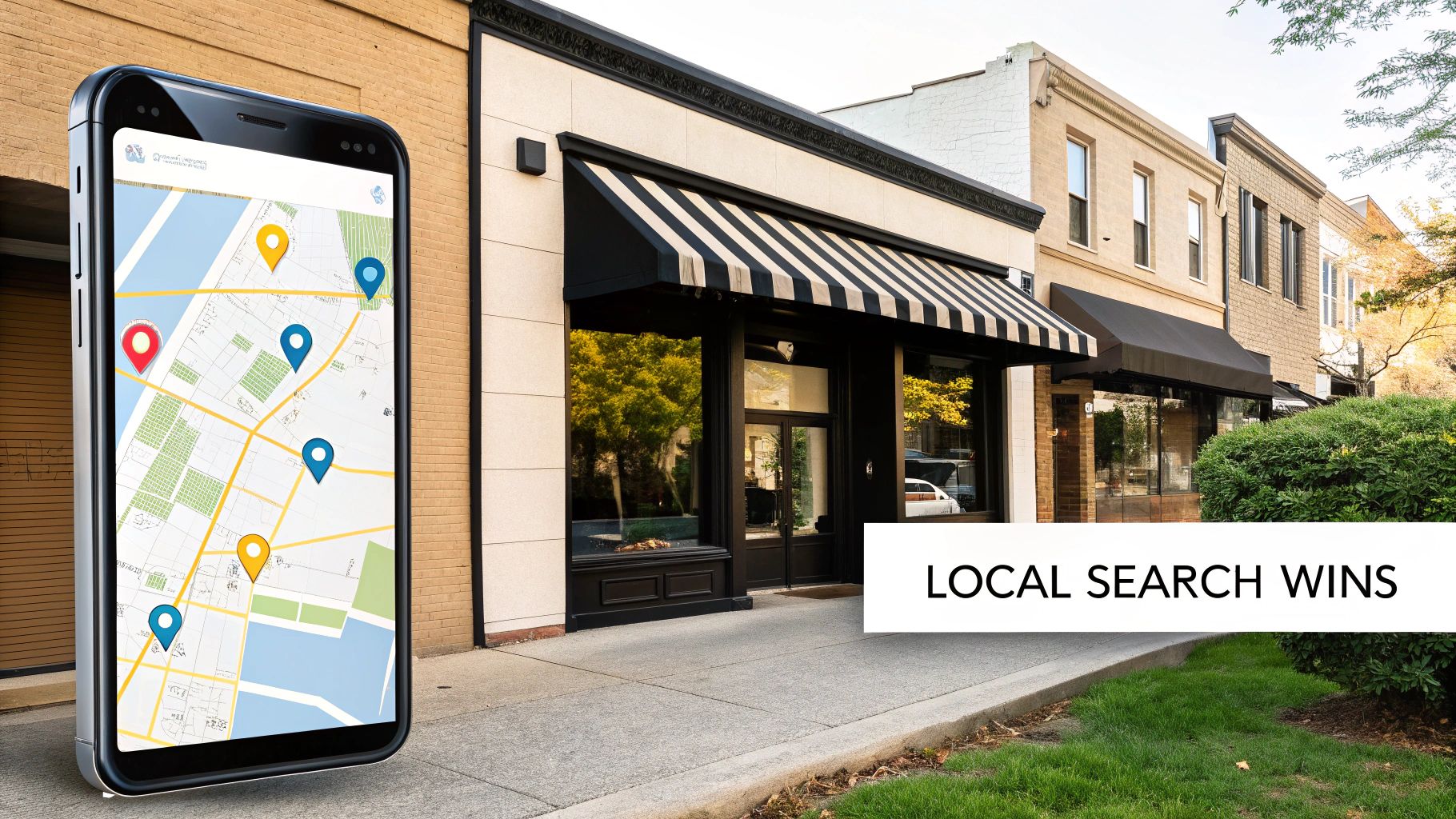
Local SEO is the practice of optimising your online presence to attract more business from relevant local searches. These are the "near me" searches that have become so common. When someone in your area needs what you offer, you want to be the first name they see.
Mastering Your Google Business Profile
The cornerstone of Local SEO is your Google Business Profile (formerly Google My Business). This is the information panel that appears on the right side of Google search results and in Google Maps. Optimising it is one of the highest-impact marketing activities you can do. This includes:
- Complete and Accurate Information: Ensure your name, address, phone number, hours, and website are correct.
- Categories: Choose the most accurate primary and secondary categories for your business.
- Photos: Regularly upload high-quality photos of your products, services, and team.
- Reviews: Actively encourage customers to leave reviews and respond to every single one, good or bad.
- Google Posts: Use this feature to share updates, offers, and news.
A well-managed Google Business Profile can drive a significant amount of website traffic, phone calls, and foot traffic.
AI Voice Agents: The Future of Customer Interaction
One of the most exciting areas we've expanded into is building custom AI Voice Agents. Think of it as a super-powered receptionist that works 24/7, never gets tired, and can handle hundreds of calls simultaneously. This technology is a game-changer for service-based businesses that rely on phone calls and appointment bookings.
What is an AI Voice Agent?
An AI Voice Agent, also known as an AI receptionist, is a conversational AI that can answer phone calls, respond to customer queries, book appointments, and even qualify leads. It uses advanced natural language processing to understand what the caller is saying and provide intelligent, human-like responses.
We've seen huge demand for our AI receptionist Australia service because it solves a massive pain point for small businesses: missed calls. Every missed call is a potential lost customer.
How We Build Custom AI Receptionists with Twilio
Our process involves using Twilio, a powerful communications platform, to create a custom phone number for your business. We then build and train an AI model specifically for your business. This AI can:
- Provide 24-hour call answering.
- Answer frequently asked questions (e.g., "What are your hours?", "Where are you located?").
- Take messages and send transcriptions via email or SMS.
- Book appointments directly into your calendar or Calendly.
- Qualify leads by asking a series of questions before transferring the call to a human.
This technology can save thousands in lost business for tradies, hairdressers, beauty therapists, dentists, restaurants, and doctors. It ensures that every single lead is captured and handled professionally, even after hours. When you consider AI voice agent pricing, the return on investment from just a few captured leads can be immense.
AI Appointment Setters: Never Miss a Booking Again
For businesses that live and die by their calendar, an AI appointment setter is revolutionary. Instead of a potential customer getting your voicemail and calling a competitor, our AI appointment setters can check your real-time availability and book them in on the spot, 24/7. This seamless experience not only captures more business but also delights customers. The world of AI voice agents is here, and it's giving smart businesses a serious competitive edge.
The Mindset for Marketing Success
Technology and tactics are important, but the right mindset is what truly separates successful businesses from the ones that struggle.
Marketing Your Business = Consistency
I can't stress this enough. Marketing is not a one-time task you can check off a list. It's a continuous process. You need to consistently post on social media, update your website, run ads, and analyze your results. Sporadic efforts yield sporadic results. Consistency builds momentum and trust over time.
Don't Quit Your Facebook Ads Too Early
I mentioned this before, but it's worth repeating. I've seen so many business owners turn off their ads after just a few days because they weren't seeing immediate sales. Paid advertising platforms like Facebook and Google have a "learning phase" where their algorithms are figuring out who to show your ads to. Cutting them off too early is a waste of money and prevents you from ever gathering the data you need to find a winning formula. You have to be patient and trust the process.
The Budget Question: How Much Does It Cost to Start Google Ads?
This is a common question with a "it depends" answer. The budget to spend on Google Ads varies wildly based on your industry, location, and goals. For a local service business, you might start seeing results with $500-$1000 a month. For a competitive national e-commerce store, you might need several thousand.
My advice is to start with a budget you're comfortable testing with for at least 3 months. The goal in the beginning isn't necessarily profit; it's data. You're spending money to learn what works, which you can then scale up.
At Alpha Omega Digital, we're more than just a service provider; we're a growth partner. As a digital marketing agency Melbourne, we live and breathe this stuff every day. We service clients not just here at home but also from Sydney, Brisbane, Newcastle, Perth, Adelaide, Darwin and Hobart.
Whether you need a high-performance website, a data-driven ad strategy, or an innovative AI solution to handle your calls, we have the experience to make it happen. Have a project in mind? Contact us.