As a digital marketing agency in Melbourne, I've spent years in the trenches with e-commerce businesses, and I can tell you one thing for sure: SEO isn't just a marketing buzzword; it's the engine that drives sustainable, long-term growth. It's the art and science of making your online store appear right when a potential customer searches on Google for a product you sell. Done right, it transforms your website from a simple online catalogue into a powerful, consistent source of sales.
Why SEO is Your E-commerce Store's Most Valuable Asset
I've worked with countless online stores, from startups to established brands, and I've seen firsthand how a strong SEO strategy can completely change the game. A few years ago, you might have been able to get by with just social media ads. Today, the prime real estate for any e-commerce business is the first page of Google.
When someone needs a new product, their first instinct isn’t to scroll through their social feed hoping for an ad. They pull out their phone and type in "best running shoes for flat feet" or "organic cotton baby clothes Australia". If your store doesn’t appear in those first few results, you're practically invisible to the majority of your potential customers.
This isn’t just about getting more website traffic. It’s about connecting with people who have high buyer intent—they are actively looking to make a purchase. For most people, the customer journey begins with a search.
The modern e-commerce sales funnel is clear: a person searches for a product online, they find your website, and that click leads to a sale.
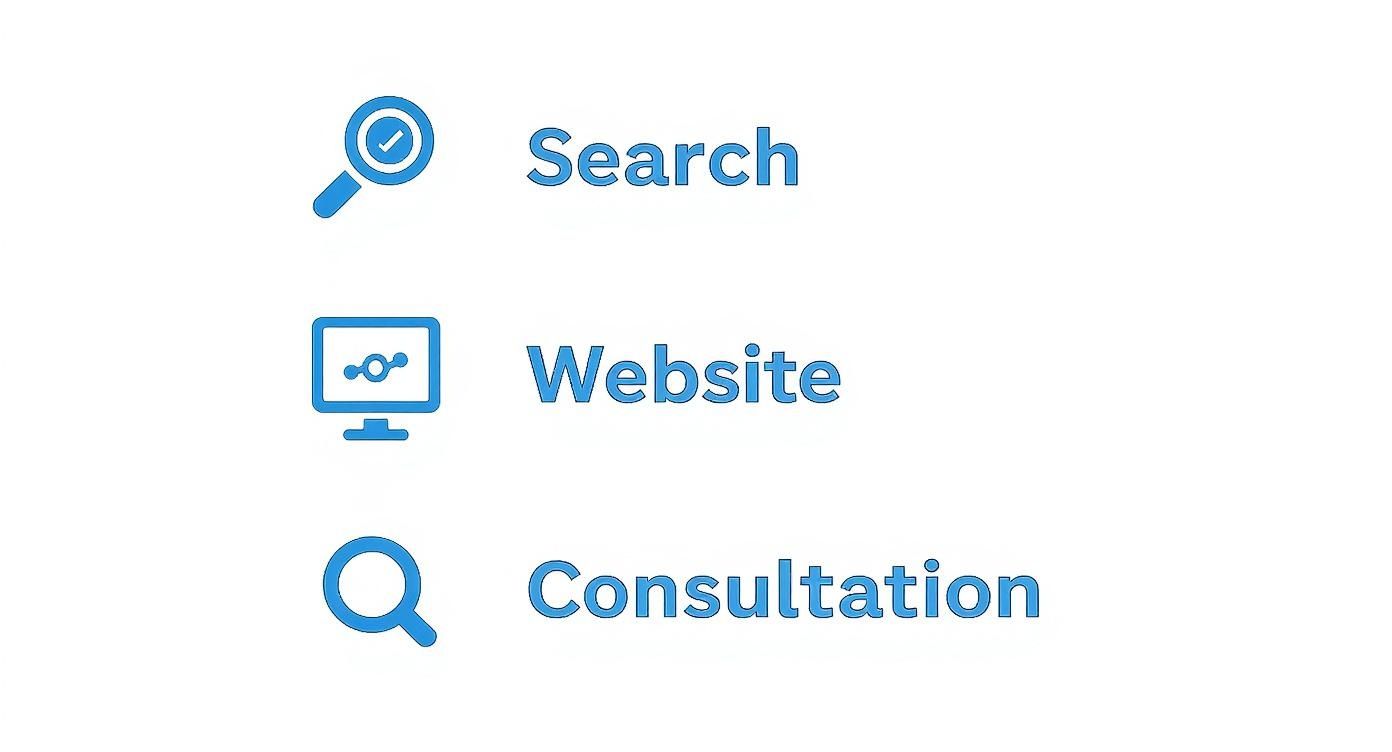
As you can see, without that initial search visibility, the rest of the funnel collapses. You lose the chance for that crucial website visit and, ultimately, the sale.
The Australian E-commerce Market Opportunity
The shift to online search is massive in the Australian retail market. In fact, projected spending on SEO for e-commerce brands in Australia is expected to hit $1.5 billion in 2025. That figure tells a clear story: Australian businesses are investing heavily in their online presence to attract customers.
The data backs this up. Nearly half (47%) of the websites ranking in the top 10 on Google belong to local businesses, including online stores. This is critical because Aussie consumers trust organic results far more than paid ads—so much so that the number one organic spot captures almost 29.5% of all clicks. You can dig deeper into these trends and what they mean for local businesses.
For an e-commerce store, ignoring SEO is like having a shop with no sign on the door. You might have the best products in the world, but if customers can't find you, that quality goes unnoticed.
More Than Just Rankings
At the end of the day, a successful SEO strategy does more than just boost your rankings; it builds your brand's most valuable asset: its reputation.
By creating helpful, authoritative content that helps customers make informed decisions, you establish trust long before they ever add a product to their cart. This positions you not just as another online retailer, but as the go-to authority in your niche. That foundation of trust is what converts a searcher into a loyal customer, and it’s why I believe SEO is the most sustainable and powerful engine for long-term growth for any e-commerce business.
Mastering Local SEO to Dominate Your Service Area
For many Australian e-commerce brands, especially those with a physical presence or a defined service area, local customers are the lifeblood of the business. This is where local SEO becomes your most powerful tool. It’s not just about popping up on a map; it’s about cementing your business as the undeniable authority in your specific city or neighbourhood.
When someone searches for "boutique clothing Melbourne" or "fresh coffee beans near me," Google’s main job is to give them the most relevant, local answer it can find. Landing in the "Map Pack"—that coveted box of three local businesses at the top of the search results—can drive a flood of high-intent calls, website visits, and foot traffic. It's prime digital real estate.

This kind of visibility isn't accidental. It’s earned through a focused effort on local ranking signals, and it all starts with the cornerstone of your local online presence.
Your Google Business Profile Is Your Digital Front Door
Your Google Business Profile (GBP) is, without a doubt, the single most important piece of the local SEO puzzle. Think of it as your store’s digital business card, displayed prominently to anyone looking for your products or services in your area. Nailing the optimisation here is non-negotiable.
Simply having a profile isn't enough. From my experience, a fully fleshed-out and active profile consistently blows a neglected one out of the water. This means going way beyond the basics and treating it like a dynamic, living part of your marketing.
Here are the critical components you have to get right:
- Accurate Business Information: Your business's name, address, and phone number (what we call NAP) must be perfectly consistent across your GBP, your website, and every other online directory. Any little discrepancy can confuse Google and hurt your rankings.
- Precise Categories: Choose the most specific primary category for your business (e.g., "Women's Clothing Store" instead of just "Retail"). Then, add secondary categories for every other product type you offer.
- Compelling Business Description: Write a clear, customer-focused description that speaks directly to your ideal shopper. Highlight your unique selling points and what makes your store the right choice.
- High-Quality Photos: Get professional photos of your storefront (if you have one), your products, your team, and your logo. This builds immediate trust and gives potential customers a real sense of your brand's quality before they even click through to your site.
Building Local Trust Through Citations and Reviews
Beyond your GBP, Google is constantly looking for other signals to verify that your business is a legitimate and prominent player in the local community. This is where citations and reviews come into play.
A local citation is simply any online mention of your business's name, address, and phone number on another website. You’ll typically find these in online directories like Yelp, Yellow Pages, and niche-specific directories relevant to your industry.
The more consistent, high-quality citations you have, the more confident Google becomes that your business is a real, established local entity. Each one acts as a powerful vote of confidence for your location and services.
Just as important are your customer reviews. A steady stream of positive reviews on your GBP sends a massive signal of trust to both Google and potential customers. In fact, 88% of consumers trust online reviews as much as they trust a personal recommendation from a friend. To truly own your service area, a comprehensive approach to local SEO strategies is essential for building that strong community presence.
Make a habit of encouraging satisfied customers to leave feedback, and always respond professionally to every single review—good or bad. This engagement shows you value your customers' opinions and are an active, reputable business. By mastering these local essentials, you ensure your brand is the first one customers see when they need your products the most.
Building a High-Performance E-commerce Website
Think of your e-commerce website as its digital storefront. If that door is slow to open, hard to navigate, or looks untrustworthy, potential customers will just walk away. I’ve seen it time and time again: brands spend a fortune on a beautiful design but completely overlook the technical engine running underneath—and that engine is what Google really cares about. As a WordPress developer, I know this is especially true for platforms that require hands-on management.
A fast, secure, and mobile-friendly website isn't a "nice-to-have" anymore; it’s a baseline requirement for getting found online. If your site takes too long to load, potential customers will hit the back button before they even see your products.
This isn’t just about keeping visitors happy. It’s about sending the right signals to Google. The search engine’s performance standards are strict because they’re designed to reward sites that deliver a brilliant user experience.
Understanding Google's Core Web Vitals
Google uses a set of metrics called Core Web Vitals to measure the real-world user experience of a webpage. You can think of them as a technical report card for your site’s health. Nailing these tells Google your site is high-quality and deserves to rank well.
The three main pillars of Core Web Vitals are:
- Largest Contentful Paint (LCP): How quickly does the main content (like a big product image or banner) load? The goal is under 2.5 seconds.
- First Input Delay (FID): How fast does your site respond when someone clicks a button or adds an item to their cart? A good score here is under 100 milliseconds.
- Cumulative Layout Shift (CLS): This measures visual stability. It checks for annoying layout shifts where elements jump around as the page loads—a killer for user experience.
These metrics might sound technical, but their impact is dead simple: a poor score means a poor user experience, which directly tells Google your site might not be the best answer for someone's search.
For Australian e-commerce stores, this is a massive opportunity. A recent audit of 54 prominent Australian retail websites found that a staggering 28% failed Google’s Core Web Vitals tests. That high failure rate means many brands are being held back by technical gremlins that hurt their rankings and turn potential customers away. You can read the full analysis on technical SEO for law firms to see just how common this problem is across different industries.
The Blueprint for a Strong Site Structure
Beyond raw speed, the way your website is organised—its site structure—is critical for both people and search engines. A logical, intuitive structure makes it effortless for potential customers to find what they're looking for, whether it’s a specific product or your shipping policy.
Imagine your website is a department store. If products are just piled up randomly, nobody can find anything. But if they're organised by category and sub-category, navigation is a breeze. Your website needs that same logic.
A well-structured e-commerce site usually follows a clear hierarchy:
- Homepage: Your digital storefront, pointing visitors to the most important categories.
- Category Pages: These are your money pages. You need a dedicated, well-optimised page for each product category (e.g., /womens-dresses/, /mens-shirts/).
- Product Pages: These individual pages must be detailed, persuasive, and optimised for specific product names and long-tail keywords.
- Supporting Content: This includes your blog, buying guides, and brand story. All of this content should link back to your main category and product pages to build authority.
This kind of clean structure doesn't just help users. It helps Google’s crawlers understand which pages on your site are the most important, what products you sell, and how all your content fits together. Get the technical foundation and structure right, and you’ll have a high-performance website that both customers and Google will love.
If your website is the foundation, then your content is the engine that actually brings in new customers. I’ve seen it time and time again: the e-commerce brands that win at SEO are the ones that build trust and showcase their product expertise long before a potential customer is ready to buy.
Content is your chance to answer their most urgent questions and prove you’re the right brand to purchase from.
This isn’t about stuffing pages with keywords. Forget that old-school approach. Effective e-commerce content is about creating genuinely helpful, customer-focused resources that solve real-world problems. When you do that, you naturally attract the right kind of traffic—people actively looking for the solutions your products provide.
This whole strategy really comes down to two core types of content: powerhouse category pages and authoritative blog posts or guides. Each one plays a different but equally important role in getting your checkout to sing.
Developing Compelling Category & Product Pages
Think of your category and product pages as the most important real estate on your website. When someone lands on your "Women's Winter Coats" page, they're not just browsing. They're sizing you up, comparing products, and trying to figure out if you have what they need.
These pages have to be comprehensive, persuasive, and laser-focused on ranking for those high-intent keywords that signal someone is ready to buy.
A great category page does more than just list products. It needs to:
- Clearly explain the product range and help users filter and find what they need.
- Answer the questions they already have and speak directly to their pain points (e.g., "looking for a waterproof coat").
- Showcase your brand’s authority with helpful copy, user-generated content like reviews, and clear calls-to-action.
- Be optimised for search with a strong H1, meta description, and introductory text.
Simply put, these pages are your digital sales floor. They need to be detailed enough to build authority but clear enough to turn a curious visitor into a paying customer.
Establishing Thought Leadership with Blog Content
While your category pages target customers ready to buy now, your blog content is for everyone else—the people who are still in the research phase. By creating articles that answer common questions or solve problems related to your products, you position your brand as a helpful, knowledgeable guide.
This builds incredible trust and keeps your brand top-of-mind for when they’re finally ready to make a purchase. To do this well, you have to get inside a potential customer's head. For example, understanding how clients select a personal injury attorney is about understanding intent and pain points, which is the same process as figuring out why someone would choose one skincare product over another. It gives you a goldmine of insights you can use to shape content that actually connects with their needs and worries.
Here are a few examples of blog topics that work really well for e-commerce:
- Fashion: "How to Style a Maxi Dress for Winter" or "5 Must-Have Accessories for the Summer Season."
- Home Goods: "A Beginner's Guide to Choosing the Right Bed Linen" or "How to Declutter Your Kitchen in One Weekend."
- Electronics: "What to Look for When Buying a New Laptop" or "How to Set Up the Perfect Home Office."
The goal here is simple: become the go-to source for information in your niche. When someone Googles a question and your brand’s article gives them the best, clearest answer, you’ve already started building a relationship.
This dual approach—strong category/product pages and an authoritative blog—is a seriously powerful combination. It lets you attract potential customers at every stage of their journey, from their first curious search to the final decision to buy, making sure your brand is the one they see and trust when it matters most.
If your website is your digital store and your content is your expert sales team, then backlinks are the customer referrals and public endorsements that prove you’re the real deal. In my experience, getting other reputable websites to link back to yours is one of the most powerful ways to signal trust and authority to Google.
It’s a process called link building, and the principle is pretty straightforward. When a well-respected website links to one of your pages, it’s like they're vouching for you. They’re essentially telling Google, "Hey, this e-commerce store really knows their stuff." The more of these high-quality 'votes' you collect, the higher your website is likely to rank.
But let's be clear: not all links are created equal. A single link from a major industry blog or a local news outlet is worth more than a hundred links from spammy, low-quality directories. When it comes to backlinks, quality always, always trumps quantity.
Building Links Through Community and Expertise
The best link-building strategies have nothing to do with trying to trick Google. They're about genuinely earning recognition for your brand’s expertise and local involvement. It’s about building relationships and creating value that other people naturally want to share.
Here are a few of the most effective and ethical ways I’ve seen e-commerce brands earn powerful backlinks:
- Sponsor Local Events: Getting behind a local charity run, a community festival, or a school sports team is a fantastic way to get your brand a link from the event's website. These are powerful local signals that show Google you're an active, trusted part of the community.
- Join Industry Associations: Becoming a member of business or retail organisations usually comes with a listing in their online directory, complete with a valuable link back to your site.
- Create Scholarship Programs: Offering a small annual scholarship for local students in a relevant field (like design or business) is a brilliant move. It’s a great way to earn a high-authority link from a university's ".edu" website—a domain that Google trusts immensely.
Leveraging Digital PR for High-Value Links
Digital public relations (PR) is another fantastic way to earn some of the most authoritative links out there. This involves positioning your brand and its founders as the go-to experts for commentary on trends in your industry.
When a journalist needs an expert opinion on a new retail trend or a product story, they're always on a tight deadline. By making your experts available for comment, you can land mentions and links in major news publications you could never get otherwise.
Setting up alerts for topics relevant to your niche can help you spot these opportunities the moment they pop up. It’s also smart to reach out to local journalists and introduce your brand as a reliable source, planting the seeds for future media coverage. This strategy doesn't just build powerful links; it massively boosts your brand's public profile and credibility.
Creating Link-Worthy Resources
Finally, one of the most sustainable ways to earn links is to create content so valuable that other people link to it without you even having to ask. Some people call this "link bait," but I prefer to think of it as creating a "link-worthy asset."
Instead of just another standard blog post, think about developing a comprehensive resource like:
- An in-depth guide to choosing the perfect engagement ring.
- An interactive tool for calculating your ideal running shoe size.
- A data-driven report on sustainable fashion trends in Australia.
These kinds of resources answer complex questions so thoroughly that they become the definitive source on a topic. Industry blogs, community resource sites, and even other retailers will start to reference and link to them, building your site's authority organically for years to come.
Measuring SEO Success to Prove Your ROI
Pouring time and money into SEO without tracking what’s coming back is like running a business without looking at your sales figures. How do you actually know if any of it is working? From my experience, the biggest mistake e-commerce brands make is getting distracted by the wrong numbers. It’s not about how many people land on your website; it’s about how many of those visitors turn into real, paying customers.
Success isn't measured in clicks alone. It’s measured in tangible growth for your business. That means you need to stop obsessing over "vanity metrics" like total website traffic and start zeroing in on the numbers that actually matter. These are the key performance indicators (KPIs) that show you're getting a clear return on your investment.
Key Performance Indicators for E-commerce Brands
Forget about generic reports. Your brand needs to track the specific metrics that draw a straight line from your SEO activity to your bottom line. These are the KPIs I always prioritise with my e-commerce clients because they paint a crystal-clear picture of what’s working.
- Organic Traffic to Category Pages: Don’t just look at total traffic. Where are people actually going? A surge in visitors to your key product category pages tells you you’re attracting people with real, immediate buying intent.
- Keyword Rankings for High-Value Terms: Are you on page one for searches like "women's linen dresses Australia" or "buy coffee beans Melbourne"? Tracking your position for these money-making keywords is a direct measure of your visibility when potential customers are ready to buy.
- Organic Revenue and Conversion Rate: This is where the rubber meets the road. Using Google Analytics e-commerce tracking, you can see exactly how much revenue is generated from organic search. This is the ultimate measure of your ROI.
A Real-World Example of SEO ROI
Let’s break down how this works in practice. Case studies from Australian e-commerce stores repeatedly show just how powerful targeted SEO can be for bringing in new customers.
Take a high-intent keyword like 'organic cotton baby clothes'. It gets searched around 1,600 times every single month in Australia. If your store secures the number one spot for that term, you can expect to pull in about 30% of those clicks. That’s roughly 480 potential customers landing on your website, every month, from just one phrase.
If you convert a conservative 2% of those visitors into sales (a typical e-commerce conversion rate), you've just generated almost 10 new sales. If your average order value is $100, that's $1,000 in revenue every month. All from a single, well-targeted keyword. Find out more about how Australian firms are using SEO to drive leads, as the principles of attracting high-intent traffic are universal.
This simple calculation shows a direct and powerful return. It proves that a strategic SEO campaign isn't just an expense; it's a predictable and scalable engine for growing your business. By tracking these core KPIs, you can confidently justify your SEO spend and watch your store grow.
Common Questions About E-commerce SEO
Over the years, I've had hundreds of conversations with e-commerce brands just starting to explore SEO. It's natural to have questions before you commit your brand's time and money. I get asked a lot of the same things, so let's tackle the most common ones head-on.
How Long Does SEO Take to Show Results?
This is always the first question, and it's the big one. Unlike paid ads that can bring you traffic overnight, SEO is a long-term strategy. Think of it like planting a tree, not flipping a light switch.
You can expect to see the first signs of progress in about 3-6 months, with real, compounding growth happening over the following 12-24 months. In those early months, you might notice some keywords moving up the rankings or small upticks in organic traffic. But the meaningful increase in organic sales? That usually starts to materialise around the six-month mark.
Of course, this timeline depends heavily on how competitive your market is and the current state of your website.
How Much Does E-commerce SEO Cost?
The cost of SEO for e-commerce varies wildly, but most brands should budget somewhere between $2,500 and $25,000 per month. If you're in a hyper-competitive space like fashion or electronics, that figure can easily climb to $30,000 or more just to make a real dent.
A good rule of thumb is to set aside around 10-12% of your gross revenue for your entire marketing budget. If sustainable, long-term growth is your goal, a significant slice of that should be dedicated to SEO. Be very wary of cheap services; with SEO, you almost always get what you pay for.
Should I Do SEO Myself or Hire an Agency?
While handling SEO in-house seems like a good way to save money, it comes at a steep price: your time. And let's be honest, there's a massive learning curve. SEO is a full-time job that demands deep technical know-how (from Shopify development to WordPress development), sharp content strategy skills, and constant adaptation to Google’s never-ending algorithm changes.
For most business owners, your time is far more valuable when it's spent on product development, customer service, and actually running your business.
Hiring a specialised SEO agency in Melbourne gives you immediate access to a team of experts, advanced tools, and proven strategies. It's an investment in getting results faster and more effectively than you likely ever could on your own.
Alpha Omega Digital is a marketing agency based in Melbourne, Australia but also services clients from Sydney, Brisbane, Newcastle, Perth, Adelaide, Darwin and Hobart. Have a project in mind? Contact us