Investing in SEO is single-handedly the most powerful move I've seen for the long-term health of an e-commerce business. Forget the confusing technical jargon for a second. At its core, SEO is a direct line to customers who are already looking for what you sell. It’s about generating high-quality leads without having to constantly feed the paid ads machine, something I help businesses in Melbourne with every day.
This guide is designed to reframe SEO from a complex, intimidating chore into your hardest-working business asset—one that brings in customers 24/7.
Why SEO Is Your Best Investment as a Small Business
I get it. As a small business owner, your budget is stretched thin and your to-do list is a mile long. It’s easy to look at Search Engine Optimisation (SEO) as just another expense or a tech-heavy task to shove to the bottom of the list.
But having worked with countless e-commerce businesses just like yours, I can tell you it's a total game-changer.
Think of it this way: paid ads, like the Facebook Ads and Google Ads campaigns I manage for clients, are like renting a billboard on a busy highway. The second you stop paying, your billboard comes down and you disappear. SEO, on the other hand, is like buying the land and building your own permanent storefront right on that highway. The effort you put in today—whether it's through expert WordPress development or a deep dive into your Shopify setup—builds a valuable asset that keeps attracting customers long into the future.
From Expense to Asset
The real magic of SEO is that it connects you with customers at the exact moment they need you. This isn't about interrupting their social media scroll with a flashy ad. It's about being the first and best solution when they type their problem into Google.
This simple visual breaks down how it works: you invest in building a solid SEO foundation, which then attracts the right kind of customers and, ultimately, converts them into sales.
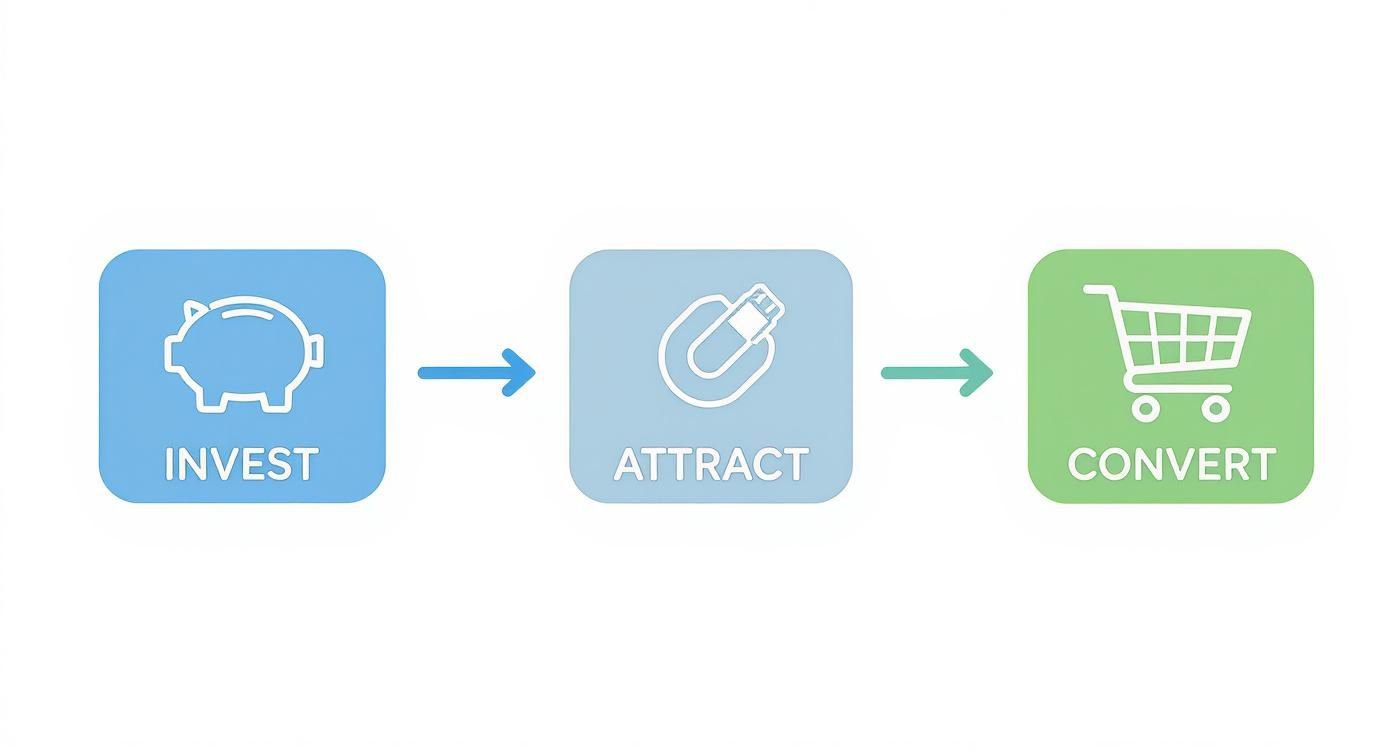
It’s a straightforward process. Your initial investment in good SEO builds momentum that consistently draws in high-intent visitors, creating sustainable, long-term growth. Before we dive into the nitty-gritty, it's worth understanding the bigger picture of building an online presence for your small business.
Capturing Local Search Intent
For Aussie businesses, especially those with a physical presence or defined service area, local search is a goldmine. Seriously. Research shows that a massive 46% of all Google searches are for local information. Think "coffee shop near me" or "emergency plumber in Sydney."
If you’re not optimised for local search, you’re basically invisible to almost half of your potential customers. This is where a targeted SEO strategy, handled by a knowledgeable seo agency melbourne, becomes non-negotiable for attracting people in your area.
For an e-commerce business with a Melbourne storefront, showing up in local search results isn't just a marketing tactic—it's a survival strategy. It puts you directly in front of motivated buyers in your community who are ready to make a decision. This is where you can truly compete and win against larger, faceless online retailers.
Mastering Your Google Business Profile for Immediate Wins
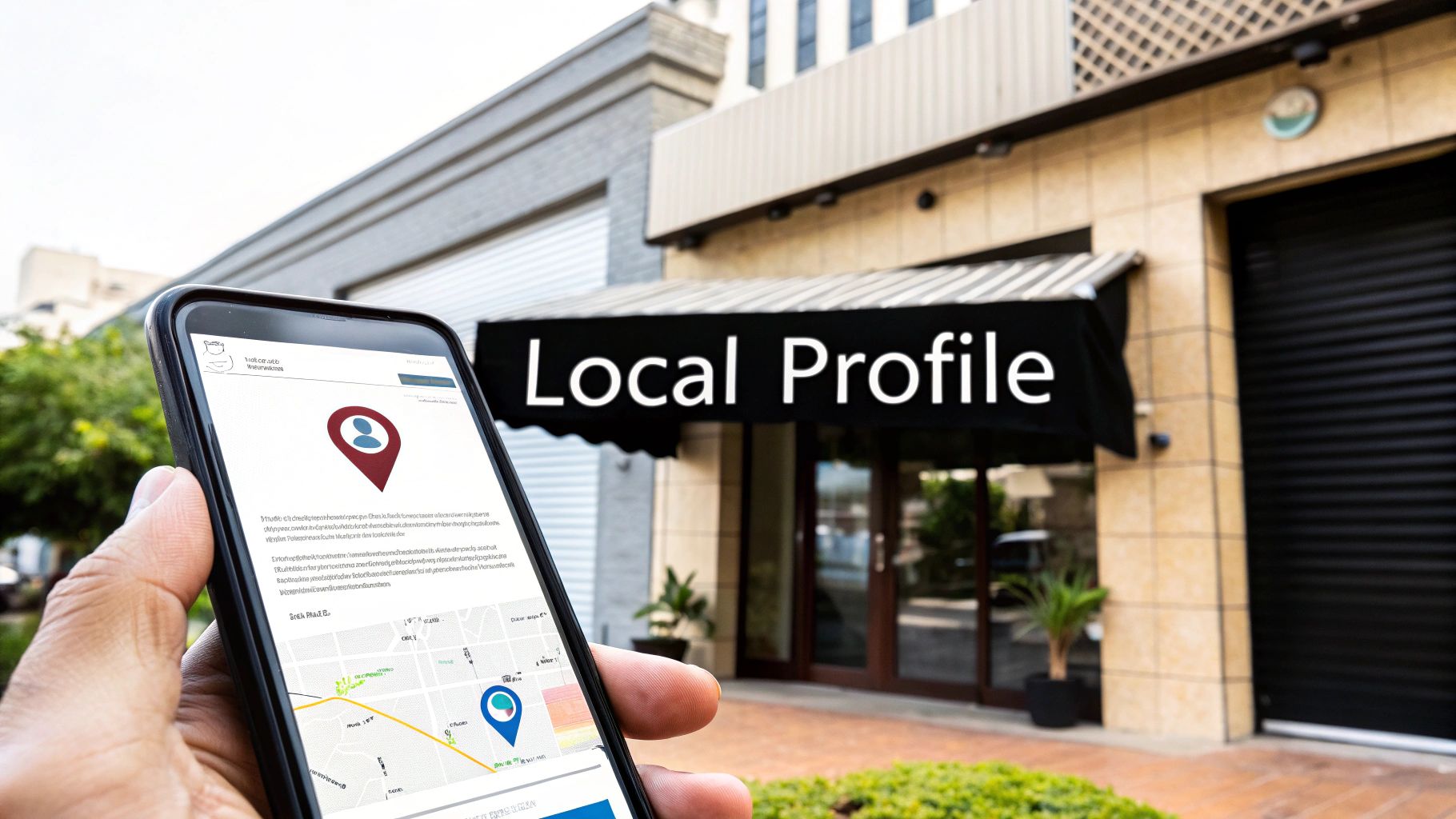
If there’s one thing you take away from this entire guide, make it this. Your Google Business Profile (or GBP) is your digital front door. For a local business, it’s often more powerful than your actual website. I’ve seen clients boost their phone calls and foot traffic literally overnight, just by getting their GBP right.
This isn’t about just listing your address and phone number. Think of your profile as a live, interactive storefront that builds trust and gets people to take action immediately. Honestly, it’s the lowest-hanging fruit in local SEO, and we're going to pick it.
It’s shocking how many businesses just let this slide. An estimated 56% of local businesses in Australia haven’t even claimed their Google Business listing, let alone optimised it. That's a huge chunk of your competition missing out on what is basically free, high-intent advertising. Even the ones who have claimed it often leave critical info incomplete—a massive mistake when you realise local SEO traffic converts at roughly three times the rate of general organic search. You can discover more key insights about Australian businesses to see just how big that gap really is.
Choosing the Right Business Categories
This is where I see the most common—and most costly—mistakes. When you set up your profile, Google makes you pick a primary category. This single choice has the biggest impact on the kinds of searches you'll show up for.
You have to think like your customer. Are they searching for a "Shopify Developer" or a "Web Designer"? A WordPress developer in Sydney or a local marketing agency? Pick the category that gets to the absolute core of what you do.
But don't stop there. Once you've locked in your primary category, add as many relevant secondary categories as you can.
- Primary Category: The main thing you do (e.g., "Clothing Store").
- Secondary Categories: All the other related services you offer (e.g., "Shoe Store," "Handbag Shop," "Fashion Accessories Store").
Getting this right tells Google exactly what you're about, widening the net so more potential customers can find you.
Writing a Business Description That Sells
Your business description is your elevator pitch. You get 750 characters to convince a potential customer to choose you over the competitor down the road. Don't just list what you do; tell a story and solve their problem.
Instead of this: "We are a marketing agency in Melbourne. We do websites and ads."
Try something like this: "As a Melbourne-based digital marketing agency, we partner with e-commerce businesses to build stunning Shopify stores and run targeted Google Ads campaigns that actually generate sales. We specialise in helping fashion and beauty brands grow their online presence."
See the difference? The second one speaks directly to a target audience and spells out the value you provide. It’s not just about what you do, but who you do it for and why it matters to them.
Leveraging Photos and Google Posts
A picture is truly worth a thousand words on GBP. Profiles with photos get 42% more requests for directions and 35% more clicks through to their websites. That’s not a small number.
Upload high-quality images that showcase:
- Your Products: High-resolution shots of your best-sellers, new arrivals, and lifestyle photos of products in use.
- Your Team: Humanise your business. Show the faces behind the brand.
- Your Location: Give people a feel for your storefront, office, or workshop.
Pro Tip: Use Google Posts regularly. Think of them like mini-ads or social media updates that live directly on your Google profile. Share special offers, announce new products, or link to your latest blog post. It signals to Google that you're an active, engaged business, and that can give your rankings a nice little nudge.
To help you nail this, I've put together a checklist of all the essential (and some advanced) optimisations you should tackle for your Google Business Profile. Work your way through this, and you'll be miles ahead of the competition.
Google Business Profile Optimisation Checklist
| Optimisation Task | Why It Matters | Pro Tip |
|---|---|---|
| Claim & Verify Your Listing | This is the first, non-negotiable step. Without verification, you can't manage your profile information. | Use the mail verification option if you're a service-area business without a physical storefront. |
| Complete All Profile Sections | 100% completion builds trust with Google and customers. Don't leave any field blank. | Even if a section seems minor (like accessibility options), fill it out. Every detail helps paint a complete picture. |
| Use a Local Phone Number | A local area code appears more trustworthy to local searchers than a mobile or 1300 number. | Set up call tracking with software like CallRail to see exactly how many calls your GBP is generating. This is crucial for measuring ROI. |
| Upload High-Quality Photos | Visuals increase engagement, clicks, and direction requests. | Add new photos weekly. Showcase your team, your work (before/after), and your premises. Geotag them first for extra local juice. |
| Get Consistent Customer Reviews | Reviews are a huge local ranking factor and build social proof. More positive reviews = more trust. | Reply to every single review, both positive and negative. It shows you're engaged and value customer feedback. |
| Utilise Google Posts | Signals to Google that your business is active. Keeps your profile fresh and engaging for users. | Create 'Offer' posts with a start/end date for promotions. They stand out more and create urgency. |
| Enable Messaging Feature | Allows customers to contact you directly from your profile, reducing friction. | Download the Google Maps app to your phone to ensure you can respond to messages quickly. Fast responses matter. |
| Answer Questions (Q&A) | Proactively address common customer queries. It saves time and positions you as an expert. | Seed your own Q&A section. Ask common questions you get all the time and answer them yourself. |
| Add Products/Services | Clearly lists what you offer with descriptions and prices, helping customers make faster decisions. | For e-commerce, highlight your best-selling product categories directly on your GBP. |
By systematically working through this checklist, you’re not just ticking boxes. You're building a powerful, free tool for customer acquisition that works for you around the clock. Get these fundamentals right, and you'll see the impact almost immediately.
Finding Keywords Your Customers Actually Use
Keyword research sounds like one of those really technical, intimidating jobs, but I promise it’s more about listening than it is about complex software. Before you even think about paying for fancy tools, let’s start with what you already know: your customers and the problems you solve for them every single day.
The goal here isn’t to find a massive list of generic terms. It’s to uncover the exact phrases people type into Google when they’re actually ready to pull out their wallet. These are the long-tail keywords with high buyer intent that can easily rank number 1.
I’ve seen so many business owners chase keywords with huge search volumes, like "Shopify developer," only to get absolutely nowhere. Why? Because the competition is fierce, and the intent behind that search is often incredibly broad. Someone searching for that might just be a student looking for a course or someone wanting a free theme.
But a keyword like "best Shopify development partners for custom apps"? That has a much lower search volume, but the person searching for it is almost certainly a serious buyer. This is the difference between casting a giant, empty net and using a targeted fishing spear.
Uncovering High-Intent Keywords for Free
Let's put the credit card away for a minute and start with some simple, powerful discovery methods. My favourite place to begin is with Google itself.
Go to the search bar, start typing one of your core services, and just… pause. Look at the list of autocomplete suggestions that pops up. This isn't a random list; it's a real-time collection of the most frequent related searches people are performing.
For example, if you start typing "wordpress developer," you might see things like:
- wordpress developer melbourne
- wordpress developer for small business
- wordpress developer hourly rate australia
- wordpress developer for custom theme
Each of these is a long-tail keyword that tells you a story about what a potential customer needs. They aren’t just looking for any wordpress website developer; they need one in a specific location, for a specific business size, with a specific pricing model, or for a specific task. These are your golden nuggets.
Another free goldmine is the "People also ask" section that appears in the search results. Answering these questions directly in your website content is one of the quickest ways I've seen to start gaining traction for relevant terms. I often advise clients on creating content around topics like "PMAX vs Google Shopping ads" or a "beginner's guide to Google Shopping ads," as these directly address user pain points.
My Experience: One of the most effective keyword strategies I've used for e-commerce clients is to look at their competitors' customer reviews. I scan for the specific language customers use when describing their problems. Phrases like "needed an integration for my Shopify API" or "couldn't find a developer to build custom Gutenberg blocks" are pure keyword gold that go straight into our content plan. It's also how I discover opportunities for technical content, like a "Shopify development crash course" or how to build "custom Shopify apps using Shopify CLI."
From Broad Terms to Buyer Keywords
The key is to move from broad, informational keywords to specific, transactional ones. It helps to think about the customer's journey.
| Keyword Type | Example | Customer Intent |
|---|---|---|
| Informational | "what is wordpress" | Just learning, not ready to buy. Low value for an e-commerce store. |
| Navigational | "wordpress login" | Trying to find a specific site. Not a potential customer. |
| Commercial | "wordpress vs shopify" | Comparing options, getting closer to a decision. Good for a blog post. |
| Transactional | "hire wordpress developers sydney" | Ready to spend money. This is the keyword you want on your service page. |
As a WordPress web developer, my focus is always on capturing that transactional intent. Your service pages should be built around these "I'm ready to buy" keywords. A general blog post might target a commercial keyword, but your money pages need to be laser-focused on the terms that lead directly to a sale or a filled-out contact form.
By focusing on long-tail, high-intent keywords, you sidestep the impossible competition for broad terms and connect directly with the customers who are actively looking to hire someone like you. This simple shift in mindset is the foundation of a successful SEO for small business strategy.
Making Your Website a Magnet for Google
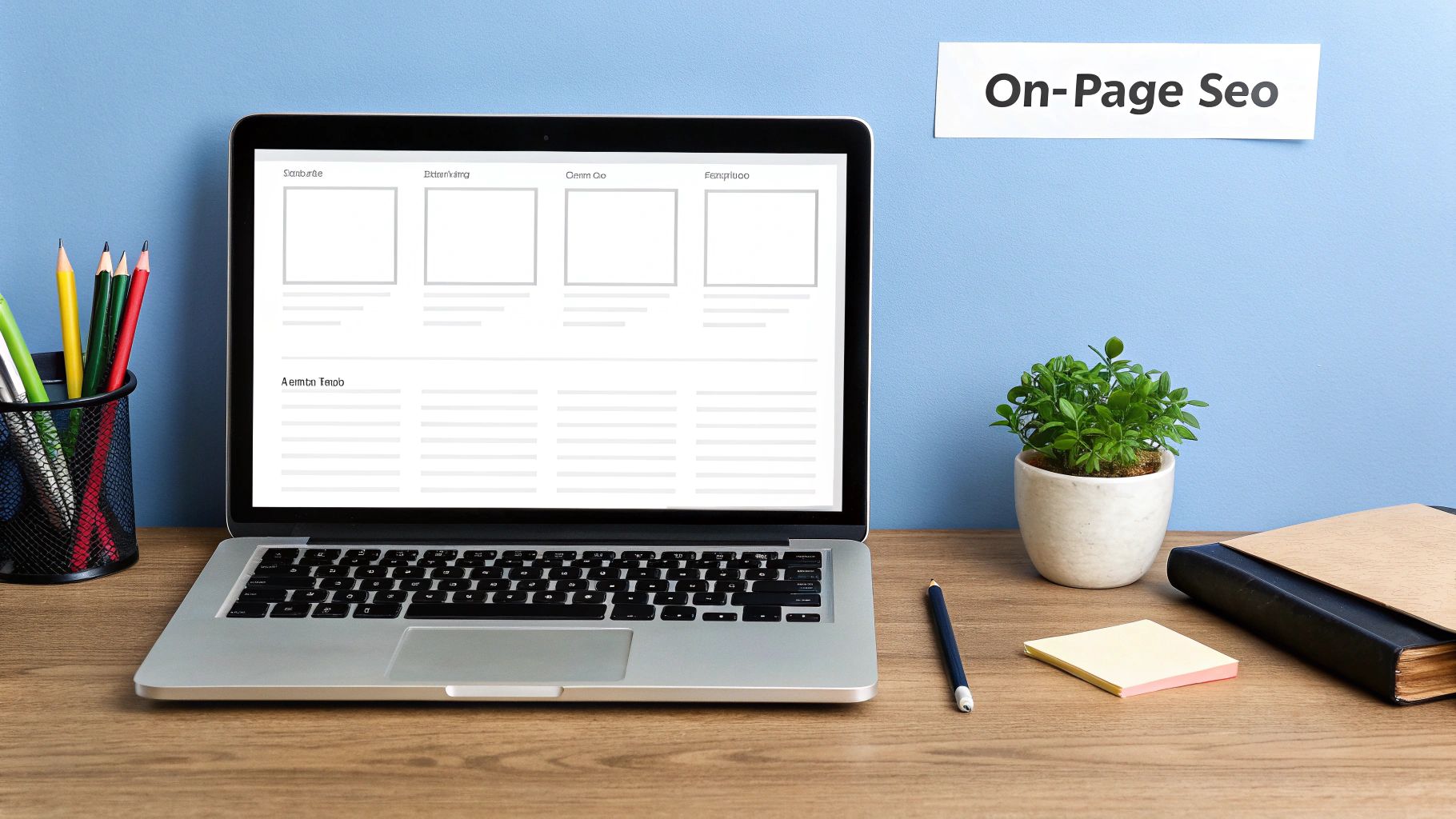
Once you’ve nailed down the keywords your customers are actually searching for, it's time to weave them into the very fabric of your website. This is what we call ‘on-page SEO’, and it’s nowhere near as technical as it sounds. As a hands-on agency, this is something we live and breathe, from setting up Google Tag Manager containers to mastering the Meta Conversions API installation.
Really, it’s just about structuring your pages so both Google and your potential customers can instantly figure out what you’re all about.
Think of Google's crawler bots as incredibly fast but very literal librarians. They scan your site looking for clear signals to help them categorise your pages correctly. If your signals are messy or confusing, they'll have a hard time recommending your page to people who need your services.
Our goal is to make their job dead simple. We’ll do this by optimising the most critical on-page elements: your title tags, meta descriptions, headings, and image alt text.
Title Tags: The Clickable Headline
Your title tag is that blue, clickable headline that shows up in Google search results. It’s your first impression and, without a doubt, the most important piece of on-page SEO real estate you own.
A good title tag has two jobs:
- Include your main keyword: This is a non-negotiable signal to Google.
- Entice a human to click: It has to be compelling enough to grab their attention.
For example, a generic title like "Services" is a waste of space. A much better title for a WordPress development company would be: "Expert WordPress Development Melbourne | Custom Websites & Themes". It hits the keyword, adds a location, and tells the user exactly what they'll get.
Meta Descriptions: Your 155-Character Sales Pitch
Right below your title tag in the search results is the meta description. While it doesn’t directly influence your rankings, it has a massive impact on whether someone clicks on your result or the one above or below it.
This is your chance to sell the click.
Think of it as the short blurb on the back of a book. It should expand on the promise of the title tag and ideally include a call to action. For a Shopify developer, it might be something like: "Need a custom Shopify solution? Our expert Shopify developers in Melbourne build high-converting e-commerce stores. Get a free, no-obligation quote today!"
A well-written meta description can be the tiebreaker that convinces a searcher to choose you over a competitor, even if you’re ranked one spot lower. It’s your ad copy for organic search.
Headings and Content Structure
Once someone clicks through to your page, headings (H1, H2, H3, etc.) are crucial. They guide the reader through your content and help them find what they're looking for fast. They also provide a clear, logical structure for search engines to follow.
Here’s the simple hierarchy I stick to:
- H1 Tag: This is your main page title. You should only have one H1 per page, and it should closely match your title tag. For a service page, it would be something direct like "Professional Shopify Development."
- H2 Tags: Use these for your main subheadings. They’re perfect for including variations of your primary keyword or related secondary keywords. Think "Our Shopify Development Services" or "Why Choose Our Shopify Developers."
- H3 Tags: These are for breaking down points within your H2 sections, like listing out specific services or features.
This structure makes your content easy for people to scan and even easier for Google to understand.
Image Alt Text: Helping Google See Your Images
Search engines can't 'see' images the way we do. They rely on alt text (alternative text) to understand what an image is about. It’s just a simple description you add to an image's code.
So, instead of a useless file name like IMG_0458.jpg, your alt text should be descriptive: "Custom WordPress theme development on a laptop screen."
It’s a small detail, but it improves accessibility for visually impaired users and gives Google another important clue about your page's topic. While optimising your site is key, effectively monitoring its performance with tools, such as free ChatGPT rank tracker tools, helps confirm it remains a strong magnet for Google.
Building Trust with Local Content and Links
A well-optimised website is your foundation, but to really pull ahead in local search, you need to build authority and trust. In the world of SEO, this boils down to two key things: creating genuinely helpful content and earning backlinks from other reputable websites.
Forget the idea that you need to write a novel or get tangled up in risky, complicated link-building tactics. I'm going to show you some realistic strategies I've used that are a perfect fit for busy small business owners.
Create Content That Actually Helps Your Customers
The best content strategy for a small business isn't about churning out post after post; it's about delivering real value. Your goal is to become the go-to resource for your specific niche in your local area. Stop thinking like a salesperson and start thinking like a problem-solver.
What are the top five questions you get on the phone every single week? Answer them in a blog post. This type of content is pure gold because you know people are already searching for these answers.
Here are a few content ideas that work wonders:
- Detailed FAQ Pages: Go beyond the basics. Build a comprehensive FAQ page that tackles every single question a customer might have before buying from you. Answer questions like, "What budget should I spend on Google Ads?" or "How much does it cost to start Google Ads?"
- Comparison Guides: If you're a Shopify developer, a post comparing two popular apps or a guide on "Google Shopping ads for dropshipping" can attract highly targeted traffic from people who are ready to make a decision.
- Project Case Studies: Show, don't just tell. Walk people through a recent project, detailing the client's problem, your solution, and the fantastic result you achieved for them. It’s authentic and builds instant credibility.
The most effective SEO content feels less like marketing and more like a helpful conversation. When you genuinely answer your customers' biggest questions, you build trust and authority that Google rewards with higher rankings. Marketing your business is all about consistency.
Earning Local Links The Right Way
Backlinks are basically votes of confidence from other websites. When a reputable local site links to yours, it signals to Google that you're a legitimate and trusted player in the community. It's an incredibly powerful ranking factor.
Forget about buying dodgy links or spamming forums. We're going to focus on authentic, local link-building that actually works.
One of the simplest strategies I recommend is local sponsorship. Sponsoring a local kids' sports team, a community event, or a charity fun run often gets you a link back to your website from their sponsors' page. These are high-quality, relevant local links that are fantastic for your SEO.
Another great approach is to partner with a neighbouring, non-competing business for a joint promotion. A local cafe and a bookstore, for instance, could co-host an event and link to each other’s websites when promoting it. It's a natural way to build relationships and earn valuable links at the same time.
The rising importance of SEO isn't going unnoticed. Australian small businesses are increasingly allocating serious budgets to it, reflecting a strategic shift toward sustainable digital growth. Projections show Australian brands are set to spend a total of $1.5 billion on SEO services, a 12% increase from the previous year. This spending is driven by the fact that organic search delivers long-term value, driving 53% of all website traffic for the small and medium businesses that make up 97% of Australia’s economy. You can discover more about local SEO spending habits to see how your competitors are investing.
By creating useful local content and earning genuine local links, you're building a reputation that both Google and your future customers will reward. This is how you win at SEO for small business.
Your Small Business SEO Questions Answered

Whenever I chat with small business owners about SEO, the same handful of questions always pop up. They’re great questions, too — the kind that get right to the heart of what matters.
So, let's tackle them head-on. No fluff, just direct answers to give you the clarity you need to move forward.
How Long Does SEO Take to Work for a Small Business?
This is the big one, and the only honest answer is: it depends. SEO isn't a light switch you can flick on for instant results; it's more like building an asset for your business, brick by brick.
For local SEO stuff, like getting your Google Business Profile completely dialled in, you can see a real jump in calls and map views within just a few weeks. I've had clients get a noticeable bump in leads almost immediately just by getting their GBP sorted.
But when it comes to ranking your website for competitive terms, that’s more of a long game. As a general rule, you should expect to see meaningful progress in traffic and rankings within three to six months of consistent effort.
Think of SEO like planting a tree. The work you do today—writing content, optimising your pages, getting local links—is building the foundation. It creates strong, sustainable growth that will pay off for years. It’s the polar opposite of ads, which disappear the second you stop paying. This is why when I work on Facebook Ads campaigns, I always tell clients: don't quit too early. The same applies to SEO.
How Much Should a Small Business Budget for SEO in Australia?
SEO budgets can be all over the place, depending on your industry, how competitive your local area is, and what you’re trying to achieve.
For a solid, comprehensive local SEO campaign with a reputable Australian agency, like an seo agency melbourne, you’re typically looking at an investment of $1,000 to $3,000+ per month.
Be really wary of anyone promising page-one rankings for a few hundred bucks. In my experience, those cheap services often use risky, outdated tactics that can get your site penalised by Google. It can do a lot more harm than good in the long run.
The best way to think about it is as an investment in your lead generation. A well-run strategy should deliver a strong return by bringing in more customers and sales over time, making it a profitable part of your marketing spend.
Can I Do SEO Myself or Should I Hire an Agency?
You can absolutely make a huge difference doing SEO yourself. I actually encourage business owners to start there.
By following the steps in this guide—like perfecting your Google Business Profile and sorting out your on-page basics—you’ll already be miles ahead of many competitors. Getting your hands dirty is the best way to learn the ropes.
But as your business grows, the time it takes and the technical side of things (like link building and site audits) can become a real headache. A lot of the owners I work with start out with DIY SEO, get a feel for it, and then partner with a marketing agency melbourne like ours to really scale things up.
Here’s a simple way to look at it:
DIY SEO is great for:
- Nailing your Google Business Profile.
- Basic keyword research for your main services.
- Writing title tags and meta descriptions.
- Starting a blog based on common customer questions.
Hiring an agency is ideal for:
- Deep technical SEO audits and fixes.
- Strategic link building campaigns that get real results.
- Advanced keyword strategies to capture more of the market.
- Freeing you up to focus on what you do best: running your business.
Is SEO or Google Ads Better for My Business?
Ah, the classic question. But it's not really an "either/or" situation. The truth is, SEO and Google Ads work best when they work together, playing different but complementary roles. As a Facebook ads agency and Google Ads expert, I see this synergy every day.
Google Ads gives you immediate visibility. You can be at the top of the search results tomorrow. It’s brilliant for promoting a sale, testing a new service, or just getting the phone ringing when you need leads right now. A well-structured "Google ads for service based businesses" campaign can be a game-changer for getting contact form submissions.
SEO, on the other hand, builds sustainable, long-term organic traffic. It builds trust. A top organic ranking is like Google giving your business a massive thumbs-up, which customers really respond to.
A smart strategy often uses Google Ads for quick wins and to gather valuable keyword data—for example, by testing campaign priority settings—while the long-term SEO engine is warming up. As your organic rankings climb, your SEO will start generating a steady stream of leads, allowing you to pull back on ad spend and lower your overall cost to get a customer.
Alpha Omega Digital is a marketing agency based in Melbourne, Australia but also services clients from Sydney, Brisbane, Newcastle, Perth, Adelaide, Darwin and Hobart. We've seen firsthand how a powerful website, built by an expert wordpress developer, combined with a smart SEO and paid ads strategy, can create an unstoppable growth engine for e-commerce businesses.
Have a project in mind? Contact us to discuss how we can help you achieve your goals.