Let's be honest. As a small business owner, you pour everything into your work, but when it comes to your online presence, it often feels like you're shouting into a void. I've seen this firsthand with countless business owners here in Melbourne—it's not a personal failing; it's an incredibly common struggle. Having a great website is just the first step.
The Real Reason Your Small Business Is Invisible Online
Just having a slick-looking WordPress or Shopify website isn't enough to get customers through the door. The online world is unbelievably crowded. Without a clear strategy to guide people to your online storefront, your site might as well be hidden. This is the core challenge so many small businesses we partner with face every day.
Think of it like this: you've built a brilliant retail shop. The design is perfect, the shelves are stocked with amazing products, and you're ready to go. But if that shop is located down a hidden alley with no signs, no listing on Google Maps, and no one talking about it, how will anyone find you? That's exactly what happens when you have a website without investing in proper SEO services for small business.
The Gap Between Having a Website and Being Found
This disconnect—between having an online presence and actually being visible—is where most businesses get stuck. It's a gap filled with common hurdles and myths I hear all the time:
- The "Build It and They Will Come" Myth: So many owners think launching a website is the finish line. In my experience, it’s the starting line. Without ongoing work to make it visible to search engines, your site simply won’t show up when people are looking for what you offer.
- Analysis Paralysis: The world of SEO can feel overwhelming. Keywords, backlinks, technical jargon… it’s easy to get so bogged down by it all that you do nothing. In the meantime, your competitors are happily soaking up all that traffic.
- The Cost Misconception: There’s this idea that effective SEO is ridiculously expensive. While big budgets can definitely speed things up, a smart, focused strategy can deliver a massive return on investment, even for small businesses.
This gap is a huge problem right across Australia. A 2023 study of 700 Australian SMEs found that only 36% were using SEO effectively. That means a staggering 64% of business owners either didn't see its importance or just couldn't figure out how it delivers real results. That's a massive opportunity for anyone willing to get it right.
Building the Bridge to Your Customers
A smart SEO service acts as the bridge connecting your expertise with the customers who are actively searching for it. It's the process of putting up all those digital signposts, getting your business listed on the map, and paving the roads that lead people straight to your website.
For many small businesses, online invisibility also comes from a lack of effective online reputation management for small businesses, which is a crucial part of building trust and authority online. It’s about making your business not just exist online, but truly thrive there.
Deconstructing a Modern SEO Service Strategy
When you hear “SEO services,” it’s easy to picture some sort of mysterious, one-off task. But from my experience working with all sorts of Aussie businesses, it helps to think of it less like a magic trick and more like a well-oiled engine with four critical parts working together. It’s never about one single fix; it’s about building a synchronised strategy that creates real, lasting momentum.
Let's pull back the curtain and break down the four pillars that hold up any modern, effective SEO strategy. Getting your head around these is the first step to knowing exactly what you're paying for when you partner with an agency.
This diagram perfectly illustrates the journey we take clients on—from feeling invisible online to finally connecting with the right customers through a clear, structured plan.
The problem of being invisible online feels huge, but it's completely solvable once you have a roadmap that bridges the gap between where your business is and where your customers are searching.
The Four Pillars of Small Business SEO
To get this right, a successful SEO campaign needs to balance four key areas. If you neglect one, it’ll undermine all the hard work you’re putting into the others. It’s like trying to drive a car with a flat tyre—you might move a little, but you won’t get far, and the ride will be painful.
Here's a quick breakdown of what those four pillars actually are and what they mean for different types of businesses.
| Pillar | What It Is | Example for an Ecommerce Store | Example for a Service Business |
|---|---|---|---|
| On-Page SEO | Everything on your actual website that tells Google what your pages are about. Think keywords, headings, and meta descriptions. | Crafting unique product descriptions on Shopify with the right keywords, instead of using the manufacturer's default text. | Creating a "Plumbing Services Richmond" page with headings and content that specifically target that suburb. |
| Technical SEO | The "under the hood" work that makes sure your site is fast, secure, and easy for search engines to crawl and understand. | Ensuring product images are compressed to load quickly and that the site works perfectly on a mobile phone during checkout. | Fixing broken links and making sure the "Contact Us" page loads in under 2 seconds on a mobile device. |
| Local SEO | The secret weapon for businesses with a physical location or service area. It’s all about showing up on Google Maps and in "near me" searches. | Making sure the retail store's Google Business Profile has the correct opening hours, photos of the shop, and plenty of positive reviews. | Getting the plumbing business listed in local directories and encouraging customers to leave reviews on their Google profile. |
| Content & Link Building | Creating genuinely useful content and earning "votes of confidence" (links) from other reputable websites to build your authority. | Writing a blog post titled "How to Choose the Right Running Shoes for Beginners" that links to relevant shoe categories in the store. | Publishing a guide on "5 Signs Your Hot Water System Needs Replacing" and sharing it with local building and real estate blogs. |
By tackling all four of these areas, you create a powerful, holistic strategy that actually gets results, rather than just tinkering with one piece of the puzzle and hoping for the best.
On-Page SEO: Optimising What You Own
On-page SEO is all about optimising the individual pages on your website so they can rank higher and pull in the right kind of traffic. For an eCommerce store on a platform like Shopify, this means writing compelling product descriptions that use the keywords people are actually searching for, optimising image alt-text, and structuring product pages with clear headings.
It also includes creating unique meta titles and descriptions for every single page. Think of these like your digital shopfront sign and window display—they have to be enticing enough to make someone click through from a crowded search results page.
Technical SEO: The Engine Under the Hood
Technical SEO is the stuff that makes sure search engines can find, crawl, and index your website without running into any roadblocks. It’s the foundation that supports everything else. A huge piece of this involves optimizing website performance because a slow website doesn’t just frustrate users, it gets penalised by Google.
Common tasks here include boosting site speed, making sure your site is mobile-friendly (this is absolutely non-negotiable now), fixing broken links, and mapping out a logical site structure. For a WordPress developer, this might mean optimising plugins or ensuring the code is clean and doesn't slow things down.
A fast, secure, and easily crawlable website is the price of admission for ranking in today's search results. Without a solid technical foundation, even the best content can go completely unnoticed.
Local SEO: Winning Your Neighbourhood
If you serve customers in a specific local area, mastering your Google Business Profile is a total game-changer. This is the absolute cornerstone of local SEO. It means keeping your business info razor-sharp accurate, actively gathering positive reviews, and posting regular updates or photos.
For a service business, like a plumber in Sydney, creating location-specific pages (e.g., "Emergency Plumbing Services Sydney CBD") is a brilliant tactic. It helps you capture those high-intent, "I need help now" local searches.
Content & Link Building: Earning Authority and Trust
Finally, creating genuinely helpful content that answers your customers' questions is how you establish yourself as an authority. This could be a detailed "Beginner's guide to Google Shopping ads" for a dropshipping store or a blog post comparing "PMAX vs Google Shopping ads" for an eCommerce audience.
Link building is the other side of this coin. It’s the process of earning links from other websites, which Google interprets as votes of confidence. A good agency will focus on earning high-quality, relevant links that make sense for your business, not just spammy, low-value ones that can do more harm than good.
How Local SEO Dominates the Australian Market
For any Aussie small business with a physical shop or a defined service area, Local SEO isn’t just a part of the marketing plan—it's the entire playbook. I’ve personally seen Melbourne clients completely transform their lead flow by getting this one thing right. It’s the difference between waiting for the phone to ring and managing a constant stream of local enquiries.
This is all about connecting your real-world business to the people searching for it online, right in your neighbourhood. It’s the most direct and powerful way to drive foot traffic, phone calls, and quote requests.
The Power of the Google Map Pack
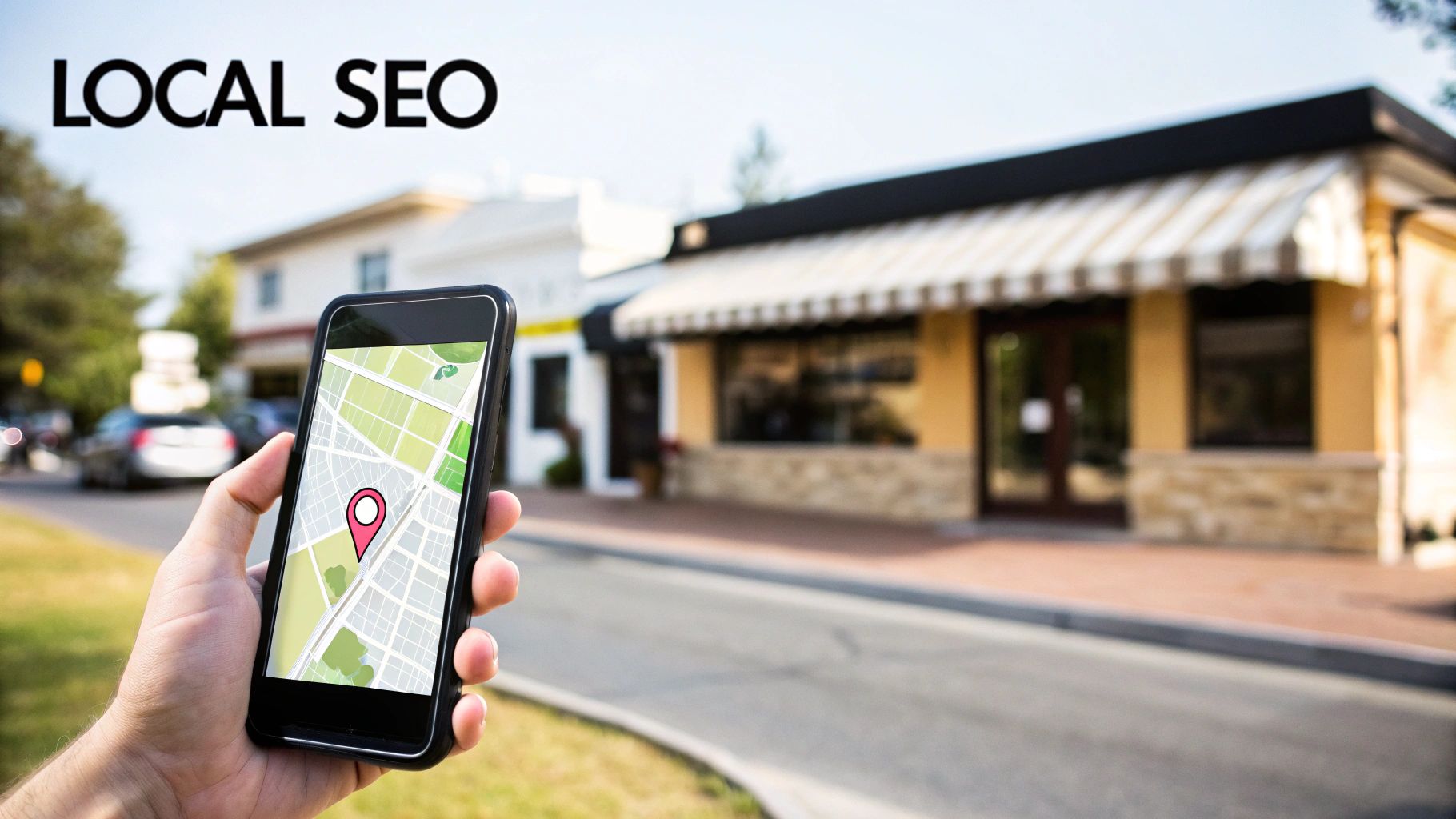
When someone in your suburb searches for "cafe near me" or "emergency plumber," Google's first response is usually the 'Map Pack'—that box at the top showing three local businesses with their location, reviews, and contact info. Earning a spot here is like having a billboard on the busiest digital highway in your city.
Getting into this coveted space isn't luck; it's the result of a deliberate and consistent Local SEO strategy. And the foundation of this strategy? Your Google Business Profile (GBP), which you might remember as Google My Business.
For a local business, your Google Business Profile is arguably more important than your website's homepage. It’s your digital front door, and most potential customers will see it before they ever click through to your site.
Mastering your GBP is non-negotiable. It involves a series of ongoing actions that signal to Google that your business is active, reputable, and relevant to local searchers.
Your Step-by-Step Guide to GBP Optimisation
A well-managed Google Business Profile is a lead-generation machine. Here’s a breakdown of the key areas we focus on to get our clients ranking:
- Complete and Accurate Information: Every single field must be filled out perfectly. This includes your business name, address, and phone number (NAP), plus your opening hours and service categories. Consistency is key here; this data must match what's on your website and other online directories.
- A Constant Stream of Reviews: Reviews are a massive ranking factor. We help clients set up simple systems to consistently request reviews from happy customers. Equally important is responding to every single review, positive or negative, to show you’re engaged.
- Leveraging Posts and Q&As: Think of GBP Posts as mini-ads or social media updates directly on your Google listing. We use them to announce offers, showcase new products, or share helpful tips. The Q&A section is another goldmine; by proactively asking and answering common questions, you control the narrative and provide instant value.
- High-Quality Photos and Videos: A picture is worth a thousand words, especially for local businesses. Regularly uploading high-quality photos of your storefront, team, and work in action helps build trust and makes your profile much more engaging.
Creating Location-Specific Service Pages
Beyond your GBP, a seriously powerful tactic is creating dedicated pages on your website for each service in each key location you serve. For instance, instead of just a generic "Shopify Development" page, a smart marketing agency in Melbourne would create pages like /shopify-developer-melbourne/ or /shopify-development-melbourne/.
These pages are hyper-targeted to capture high-intent searches. They tell Google and potential customers that you are the go-to expert for that specific service in that specific area. This is how you move from being a generalist to a local specialist, dominating the search results for valuable, location-based keywords. The impact of a well-executed local strategy cannot be overstated.
In fact, the data shows that Australian small businesses that target multiple locations with Local SEO drive an incredible 557% more organic traffic on average than their single-location peers. In a market where 46% of all Google searches have local intent, the opportunity is immense—especially since over half of local businesses haven't even claimed their Google Business Profile. To get more insights into these Australian local SEO statistics, you can discover the full findings on WebsitesThatSell.com.au.
Alright, let's tackle the question I get from every single small business owner I sit down with: "So, how much is this going to cost me?" It’s a perfectly fair question, and I'm a big believer in being upfront about it. When you start searching for a marketing agency in Melbourne, you’ll pretty quickly run into a few common ways we price our services.
Getting your head around these models is the first step. But the real shift I want you to make is from seeing SEO as a 'cost' to seeing it as an 'investment'. SEO isn't just another bill you pay, like electricity. It's you putting money into a business asset that will keep generating returns for years to come.
Common Pricing Models Explained
Most good agencies, us included, stick to one of three main pricing structures. Each has its place, especially for a growing business.
- Monthly Retainer: This is the go-to for ongoing SEO. You pay a set fee each month for a clearly defined amount of work. It’s brilliant for building long-term momentum because it means we’re constantly strategising, implementing, and reporting on what’s working.
- Project-Based Fees: This is perfect for a specific, one-off job. Maybe you need a deep-dive technical SEO audit on your Shopify store, or you want to build out a new set of local service pages. You pay a single price for a very clear outcome.
- Hourly Rates: Some freelancers or consultants charge by the hour. This can be handy for tiny, ad-hoc tasks or a bit of advice, but it gets tricky to budget for and doesn't always line up with your bigger business goals.
Shifting from Cost to Investment
Here’s the most important part of budgeting for SEO services for small business: figuring out the potential return on that investment. You have to connect the SEO work directly to what matters in your business. How much is a new lead actually worth to you? What's the average lifetime value of a customer who buys from your Shopify store?
Once you have those numbers, you can start working backwards. If a new customer is worth $1,000 on average and a solid SEO campaign brings you just five new customers a month, that’s $5,000 in fresh revenue. All of a sudden, a $2,000 monthly retainer doesn’t feel like a cost anymore—it feels like a seriously high-performing investment.
This is especially true for local SEO, which delivers an incredible return for Aussie businesses. The reality is, organic results get 85-90% of all clicks, with the top three spots grabbing most of that. While 2023 data shows only 36% of SMEs are really investing properly, those who do—like spending over $1,200 a month—can genuinely compete with the big players. You can read more about these Australian local SEO statistics to see the full breakdown.
Why Cheap SEO Is an Expensive Mistake
Look, I get it. It’s tempting to go for the cheapest option you find. I’ve seen those "$99 a month SEO" offers, and let me tell you from my own experience, they almost always end in tears. Cheap SEO means cutting corners, using dodgy tactics that can get your site penalised by Google, and ultimately, just throwing your money away without any real results to show for it.
When you partner with a proper agency, you're not just paying for someone to tick off a list of tasks. You're paying for strategic expertise, access to professional tools that cost thousands a year on their own, and the dedicated time of a team that’s focused on your growth. It’s about having a real partner in your corner who’s as invested in your success as you are.
Finding the Right SEO Agency: An Insider's Checklist
Choosing an SEO partner is one of the most critical decisions you’ll make for your business. I've seen the aftermath of bad partnerships firsthand—wasted budgets, stagnant traffic, and a whole lot of frustration. My goal here is to give you a practical, no-nonsense checklist to help you vet any digital marketing agency in Melbourne or anywhere else in Australia.
This isn't about finding the cheapest provider; it's about finding a true partner. The best agency relationships are built on clear communication, shared goals, and a relentless focus on business results, not just vanity metrics like rankings.

Crucial Questions You Must Ask
When you’re on that first discovery call, remember you’re interviewing them just as much as they’re learning about you. It's time to cut through the sales pitch and get straight to what matters.
Here are the questions that will help you find a genuine partner:
- "Can you show me a case study from a business similar to mine?" General success stories are nice, but you need proof they understand your world, whether you’re an eCommerce store needing a shopify developer or a local service business with a custom WordPress site.
- "How do you measure and report on success?" Their answer should go way beyond "more traffic." Look for a focus on conversions, leads, sales, and return on investment. They should be talking about setting up tools like Google Tag Manager and Google Analytics to track tangible business outcomes.
- "What will the first 90 days look like?" A good agency will have a clear, structured plan. It should start with a deep-dive audit, technical fixes, and identifying low-hanging fruit—not vague promises of "doing SEO."
- "Who will be my day-to-day contact, and what's their experience level?" Make sure you aren't handed off to a junior account manager right after the sales call. Direct access to the strategist actually working on your account is a huge plus.
- "What's your approach to link building?" This is a big one. You want to hear about earning high-quality, relevant links through great content, not buying cheap, spammy links that could get your site penalised by Google.
Major Red Flags to Watch Out For
Knowing what to look for is important, but knowing what to run from is just as critical. If you hear any of these during your initial chats, it's a massive red flag.
If an agency's promises sound too good to be true, they almost certainly are. In my experience, SEO is a long-term investment in building a sustainable business asset, not a get-rich-quick scheme.
Be on high alert for these warning signs:
- Guarantees of "#1 Rankings": This is the oldest trick in the book. No one can guarantee a specific ranking on Google. A reputable seo agency in Melbourne will focus on driving qualified traffic and leads, not on chasing vanity positions.
- A "Secret Sauce" or Proprietary Method: Transparency is everything. If an agency isn't willing to explain their process because it's a "secret," they are likely using outdated or shady tactics they don't want you to see.
- Vague, Evasive Answers: If they can't clearly explain their strategy or how they'll measure success in a way you can actually understand, walk away. A true expert can make complex topics simple.
- One-Size-Fits-All Packages: Your business is unique. An agency that tries to shoehorn you into a pre-set "gold package" without first understanding your specific goals isn't a strategic partner.
- No Focus on Technical SEO: Any agency worth its salt knows that a solid technical foundation is non-negotiable. If they only talk about keywords and content without mentioning site speed, crawlability, or schema, they're missing half the picture.
Finding the right agency really comes down to doing your homework. Use this checklist to screen potential partners and build the confidence to select a team that is genuinely invested in helping your business grow.
Your Action Plan for Driving Growth with SEO
All this information is only powerful if you actually use it. I've worked with hundreds of Aussie businesses, and I can tell you the biggest hurdle is usually just getting started. So, let’s cut through the noise and map out some clear, practical steps to get the ball rolling.
This isn’t about trying to do everything at once. The goal is to take smart, sequential steps that build real momentum, making the whole process feel manageable and, most importantly, empowering.
Your Immediate High-Impact Tasks
Before you even think about talking to an agency, there are a few high-impact things you can tackle right now. Think of these as the non-negotiable foundations for any business that’s serious about being found online.
- Claim and Fully Optimise Your Google Business Profile: This is your number one priority, hands down. Fill out every single section—services, photos, business hours, description. It's the most powerful free tool you have for pulling in local customers.
- Start a Simple Review Generation System: Just ask every happy customer for a review. A simple follow-up email or even a text message can work wonders. A steady stream of positive reviews is pure gold for your local rankings.
- Run a Basic Website Health Check: Use a free tool to check your site’s mobile-friendliness and page speed. You don’t need to fix everything overnight, but just knowing where the big issues are is a massive first step.
Preparing to Engage an Agency
Once you've handled the basics, it’s time to prepare for a partnership. Walking into that first call prepared will ensure you find the right agency and get the most value from your investment. This is where you shift from doing to strategising.
A great agency relationship isn't a transaction; it's a partnership. My experience shows that the more clarity you bring to the table about your business goals, the faster and more effectively a good partner can deliver results.
Before you start contacting any marketing agency in Melbourne or Sydney, get these ducks in a row:
- Define Your Business Objectives: What does success actually look like for you? Is it 20 new contact form submissions a month? A 30% increase in online sales for your Shopify store? Get specific.
- Set a Realistic Budget: Based on our earlier discussion, figure out what you can comfortably invest in your growth each month. Remember to see this as an investment in a long-term asset, not just another business cost.
- Identify Your Ideal Customer: Who are you actually trying to reach? Knowing your audience helps an agency craft a much more targeted and effective strategy from day one.
Armed with this plan, you're no longer just hoping for online growth—you're actively building it.
Alpha Omega Digital is a marketing agency based in Melbourne, Australia but we also service clients from Sydney, Brisbane, Newcastle, Perth, Adelaide, Darwin and Hobart. We're not just another service provider; we see ourselves as a growth partner for businesses across the country. Have a project in mind? Contact us to explore your options and see how we can help you succeed.
Your Questions, Answered
I get asked these questions all the time by small business owners trying to get their heads around SEO. My goal here is to give you the straight-up, no-fluff answers to help you figure out what’s right for your business.
How Long Does It Take to See Results from SEO?
This is the big one, and the honest answer is: it depends.
For some quick wins, like optimising a Google Business Profile for local searches, you can genuinely start seeing more calls and website visits within one to three months. It’s often one of the fastest ways to get a tangible return.
But real, comprehensive SEO is a long-term game. For bigger goals like ranking for competitive keywords across Australia, you should realistically expect to see significant, sustainable growth in traffic and leads within six to twelve months. Think of it like building a house—it takes time to lay a solid foundation, but once it's built, it’s a valuable asset that works for you around the clock. It's a marathon, not a sprint.
Can I Do SEO Myself for My Small Business?
Absolutely! You can definitely get started on your own, and I honestly encourage it. Tackling the basics is a fantastic way to build a solid foundation and understand what's involved.
Here are a few things you can start with right now:
- Optimise your Google Business Profile: Seriously, fill out every single section. Upload high-quality photos and start asking your happy customers for reviews.
- Create genuinely helpful content: Write blog posts that answer the common questions your customers are already asking you.
- Make sure your site is mobile-friendly: Just pull out your smartphone and check how your website looks and feels. Can you easily tap the buttons?
But as your business grows, you'll find the competition gets tougher. Partnering with a marketing agency in Melbourne like ours lets you tap into specialised expertise, advanced tools, and the dedicated time needed to really accelerate your growth and compete at a higher level.
What Is the Difference Between SEO and Google Ads?
It's a great question. Think of it this way: SEO is about earning "free" or organic traffic. It’s the long-term process of optimising your website so Google trusts you enough to rank you as high as possible in the main, unpaid search results. You're building lasting authority.
Google Ads, on the other hand, is a pay-per-click (PPC) platform. You're essentially paying to rent a spot at the very top of the search results for immediate visibility. As soon as you stop paying, you disappear.
A really strong digital strategy often uses both. SEO builds that sustainable, long-term growth, while Google Ads can be switched on for targeted, immediate campaigns when you need leads now.
How Do You Measure the ROI of SEO Services?
We measure the return on investment (ROI) of our SEO services for small business by focusing on metrics that actually impact your bottom line. We move beyond vanity numbers like "impressions" and track the stuff that grows your business.
This means we’re tracking:
- Increases in qualified organic traffic (people who are actually looking to buy).
- Keyword rankings for high-intent, "money-making" terms.
- Conversion rates—things like contact form submissions, online sales, and phone calls.
- And ultimately, the revenue generated from organic search compared to what you've invested.
Alpha Omega Digital is a marketing agency based in Melbourne, Australia but also services clients from Sydney, Brisbane, Newcastle, Perth, Adelaide, Darwin and Hobart. Have a project in mind? Contact us