
Think of a Shopify Developer Partner as your technical co-pilot. They’re a professional or an agency that Shopify has officially given the nod to, recognising their skill in building and growing ecommerce stores on the platform. From my experience as a marketing agency in Melbourne, I can tell you this isn't just about hiring someone to code; it's about bringing on a strategic technical ally who can help you design, build, and fine-tune your online business for real growth.
What a Shopify Developer Partner Actually Does
I've seen firsthand how the right technical partner can completely change the game for an ecommerce business. A genuine Shopify Developer Partner isn’t just a coder for hire. They’re a strategic guide who lives and breathes the platform, understanding all its little quirks and powerful features. It’s their job to cut through the jargon and deliver actual results.

You can think of them as the architect for your digital storefront. They lay a solid, scalable foundation so you can get on with the important stuff—running your business. This goes way beyond just picking a theme and uploading a few products.
Crafting Your Brand's Digital Home
A huge part of their role is creating an online experience that feels authentically you. This usually kicks off with custom theme development or some serious customisation of an existing one. A good partner makes sure your store doesn't just look pretty; they optimise it for conversions, creating a user journey that guides customers smoothly from the homepage all the way to checkout. They’ll obsess over things like mobile responsiveness, site speed, and intuitive navigation, because they know these are the details that actually make sales happen. For any Shopify design project, this is the absolute minimum.
And if you want something truly unique, a skilled partner can build a custom theme from the ground up. This gives you a one-of-a-kind storefront that leaves the competition behind and perfectly captures your brand's identity.
Solving Problems with Custom Solutions
Sometimes, an off-the-shelf app just won't cut it. You have a unique business problem, and a generic solution feels clunky or incomplete. This is exactly where a Shopify Developer Partner proves their worth. Using the Shopify API, they can build bespoke Shopify apps to add unique functionality, automate tedious workflows, or integrate with other crucial systems your business depends on. I've personally seen this make a huge difference for ecommerce clients who needed solutions like custom product bundlers or advanced inventory syncs.
A true partner doesn't just build what you ask for. They dig into your business needs and recommend solutions—like a custom app or integration—that you might not have even known were possible.
This could be anything from a product customiser that lets customers build their dream item to a complex inventory system that syncs perfectly with your warehouse operations. We've even gone as far as building custom Shopify apps using Shopify CLI for clients with very specific operational needs.
Ensuring a Seamless Migration
Moving your store from another platform like Magento or WooCommerce can be a total nightmare if it’s not handled properly. A Shopify Developer Partner takes control of this entire process. They manage a seamless transition, making sure you don't lose precious SEO rankings, customer data, or sales history in the move. They do all the technical heavy lifting, so you can avoid costly downtime and lost revenue.
At its core, a Shopify Developer Partner provides specialised website development services designed to build and optimise your online store for success. Here in Australia, Shopify's growth has been massive, with 154,625 live stores making it the third-largest market in the world. For a marketing agency in Melbourne like us, this means having deep Shopify expertise is non-negotiable for turning a standard store into a powerful sales machine.
So, What Are These Shopify Partner Tiers All About?
Not all Shopify partners are built the same, and Shopify has a pretty clear system to prove it. When you're on the hunt for a genuine expert, the whole "Shopify Partner" landscape can feel a bit murky, so let me clear it up. Getting your head around the different levels is crucial because they're a direct signal of a partner's experience, skill, and track record.
The journey for most agencies and freelancers kicks off in the general Shopify Partner program. This is the starting line, open to anyone who wants to build stores, apps, or themes for Shopify merchants. Partners here get the keys to the kingdom: development tools, training resources, and a commission structure. While plenty of talented developers get their start here, the badge itself doesn't guarantee a deep well of experience.
The Standard Shopify Partner
Think of the standard partner program as the foundation. To get in, a developer or agency simply signs up and gains access to unlimited development stores. This is a brilliant system because it lets them build and test sites for clients—like we do here at Alpha Omega Digital—without any cost until the store is ready to launch. It’s the perfect sandbox for perfecting a client's site before the big reveal.
But just having a Shopify Partner badge is only the first step. The real difference comes down to what a partner does with that access. They build their reputation one project at a time, proving their skills by delivering high-quality Shopify development and design that actually helps their clients grow.
The Elite: Shopify Plus Partners
This is where things get serious. A Shopify Plus Partner badge isn’t something you can just sign up for; you have to earn it. It’s an exclusive, invitation-only club reserved for the absolute best in the business. To even get a look-in, an agency has to show a rock-solid history of building and managing complex, high-volume stores for enterprise-level brands.
Shopify puts these partners through the wringer, looking for:
- Proven Technical Chops: They need to show off advanced skills in custom development, tricky integrations, and large-scale data migrations.
- High-Volume Success Stories: They must have a portfolio stacked with successful projects for merchants doing serious sales volume on the Shopify Plus platform.
- A Full-Service Crew: Shopify wants agencies that can handle everything from strategy and design to development and ongoing support.
Choosing a Shopify Plus Partner is like hiring a specialist surgeon for a complex operation. You're bringing in a team that has successfully handled similar high-stakes projects many times before, giving you the confidence they know exactly what they're doing.
To give you a better idea of the differences, here’s a quick breakdown.
Shopify Partner Tiers at a Glance
This table helps spell out the key distinctions between a standard Shopify Partner and the more seasoned Shopify Plus Partner.
| Feature | Shopify Partner | Shopify Plus Partner |
|---|---|---|
| Entry Requirement | Open sign-up for freelancers and agencies. | Invitation-only, based on proven expertise. |
| Focus | Primarily SMBs and new ecommerce stores. | Enterprise-level, high-volume, and complex businesses. |
| Vetting Process | Basic program registration. | Rigorous review of technical skill, portfolio, and team. |
| Typical Projects | Store setups, theme customisations, app installations. | Custom apps, large-scale migrations, complex integrations. |
| Shopify Relationship | Access to standard partner resources and support. | Direct access to Shopify Plus teams, early API access, strategic partnership. |
| Indication of Experience | A great starting point, but experience levels vary widely. | A clear signal of elite, verified, and extensive experience. |
Ultimately, both tiers play a vital role. Standard Partners are perfect for getting new businesses off the ground, while Plus Partners are the go-to for scaling established brands into major players.
The Shopify partner ecosystem in Australia is absolutely thriving, with top-tier agencies delivering incredible results for local businesses. The agencies that earn the Shopify Plus Partner title have proven their mettle on hundreds, if not thousands, of projects. This is especially important when you consider that Shopify Plus merchants globally have seen 126% year-over-year growth—a massive testament to what’s possible with the right platform and the right technical partner. You can find out more about how the program supports these premier partners with exclusive API access and strategic guidance.
As a digital marketing agency in Melbourne, we get how important this distinction is. While we love tackling complex Shopify development challenges, we have immense respect for the high bar set by the Plus partners. It’s that same level of strategic thinking and technical excellence we bring to every one of our ecommerce clients.
Essential Questions to Ask Before Hiring
Hiring a Shopify developer is a big deal. It’s a serious investment of both your time and money, and from my experience helping Melbourne clients through this, I know the right choice can make all the difference. To get it right, you need to ask questions that go deeper than just "how much will it cost?".
You're looking for a partner who can think strategically, not just a pair of hands to write code. The goal is to uncover their real-world experience, their process, and how they approach problem-solving. This is how you separate the true experts from the talkers.
Digging into Their Experience and Portfolio
The first thing I always tell clients is to look for proof. Don't just take their word for it; you need to see what they've actually built. Generic portfolios are a red flag for me.
Here are the questions you should lead with:
- Can you show me a portfolio of Shopify stores you've built, specifically for businesses in my industry or with similar challenges? This shows they understand your niche and won't be learning on your dime.
- What was the most complex Shopify project you've worked on, and what made it so challenging? Listen for how they describe the problem and, more importantly, the solution they engineered.
- Do you have experience with custom Shopify app development or complex API integrations? Even if you don't need this now, it's a great indicator of their technical depth.
A great answer will involve them walking you through specific examples, explaining the business goals behind the project, and showing you the live results. A weak answer is vague and focuses only on aesthetics.
Understanding Their Process and Communication
A brilliant developer with a chaotic process is a recipe for disaster. You need to know how they'll manage your project from start to finish to ensure there are no nasty surprises.
The best partners are obsessive about communication. They understand that keeping you in the loop isn’t a chore; it’s a critical part of building a successful project and a lasting relationship.
Ask them directly about their workflow:
- What does your project management process look like? Look for clear phases like discovery, design, development, testing, and launch. Ask what tools they use (like Asana, Trello, or Jira) to keep things organised.
- How often will we communicate, and who will be my main point of contact? You want regular, scheduled updates (daily or weekly) and a dedicated person you can always reach.
- How do you handle scope creep or changes to the project once we've started? A professional agency will have a clear change-order process. This protects both of you from misunderstandings down the line.
A confident Shopify developer partner will have clear, well-defined answers for all of these. They’ve done this before and have refined their process. For broader insights into building out a technical team, it can be really useful to consult a guide on how to hire developers, as it often covers essential sourcing and interviewing strategies that apply here, too.
Gauging Their Strategic Thinking
Finally, you want a partner, not just a developer. A true expert will care about your business goals and your bottom line. Their job isn't just to build a website; it's to build a sales machine.
Here's how you test for strategic thinking:
- How do you approach conversion rate optimisation (CRO) and user experience (UX)? They should talk about user journeys, clear calls-to-action, and data-driven design, not just pretty layouts.
- What's your process for ensuring the site is fast and mobile-friendly? They should mention things like image compression, clean code, and Core Web Vitals. These are non-negotiables for SEO and sales.
- What kind of post-launch support or ongoing retainers do you offer? A good partner knows the work isn't over at launch. They'll have plans for maintenance, updates, and continuous improvement.
Asking these questions will arm you with the confidence to properly evaluate any potential Shopify developer partner. You’ll be able to spot the difference between someone who just builds websites and a strategic partner who builds businesses.
Why an Agency Partner Is a Strategic Advantage
You might be tossing up between hiring a freelance developer and partnering with a full-service agency. It's a common crossroads. While a great freelancer is perfect for smaller, one-off tasks, a dedicated agency partner offers a much broader strategic advantage, especially when you're serious about growing your e-commerce business.
Let’s get into the real, tangible benefits of having an agency in your corner.
Think of it this way: you instantly gain an entire team of specialists. You get developers, designers, SEO experts, and paid ads managers all under one roof, all working together on your brand. This integrated approach is the secret sauce.
A Holistic Growth Engine
When you work with an agency like Alpha Omega Digital, the different parts of your marketing machine are finally in sync. A freelancer might build you a beautiful new landing page, but who’s going to drive traffic to it? Who’s going to make sure it’s optimised for Google?
An agency connects those dots.
For instance, when our Shopify developers build a new "product bundle" feature for a client, our Google Ads team is already strategising. They're crafting a specific Google Shopping campaign to promote those bundles, ensuring the new feature actually generates revenue from day one. It's a proactive, coordinated effort you just don't get when hiring isolated specialists.
Breadth and Depth of Expertise
An agency brings a diverse skill set to the table that a single person simply can't match. Your business might need a custom Shopify app built one month, a technical SEO audit the next, and a Meta CAPI setup the month after that.
An agency has specialists for each of these needs:
- Shopify Development & Design: We have experts focused solely on building and beautifying Shopify stores.
- Paid Advertising: Our team includes specialists in Google Ads, Facebook Ads, and PMAX campaigns who know how to drive profitable traffic. Our Facebook ads agency team dives deep into creative testing and knows not to quit on campaigns too early.
- SEO & Analytics: We have an SEO agency team in Melbourne that handles everything from local SEO and Google My Business to setting up Google Tag Manager containers and GA4.
This collective knowledge means we can tackle complex challenges from multiple angles. We recently helped a client whose Google Shopping ads were not spending their budget. Our ads team diagnosed the campaign setup, while our development team identified and fixed feed issues in their Shopify backend. It was a two-pronged solution that got them back on track, fast.
Partnering with an agency means you're not just hiring for a single task. You're investing in a team that can adapt and scale with your business, providing the right expertise at the right time.
Reliability and Scalability
Let’s be honest: what happens if your freelance developer gets sick, goes on holiday, or takes on another big project? Your progress can grind to a halt.
Agencies are built for continuity. We have processes, project managers, and multiple team members who understand your business. If one person is away, another can step in seamlessly. This reliability is crucial for ambitious brands that can't afford delays.
On top of that, as your business grows, an agency can scale its services to match. What starts as a simple website build can evolve into a comprehensive growth strategy involving paid ads, CRO, and email marketing. We have the resources ready to go when you are.
At Alpha Omega Digital, we’re a marketing agency in Melbourne, but we work with clients all across Australia, from Sydney to Perth. We see this all the time. A client comes to us for a new Shopify build, and six months later, we're managing their entire digital growth strategy. It’s a partnership that evolves.
If you're a business with a paid ads budget of at least $3k a month, I'd love to offer you a low-risk deal—get a month of paid ads management FREE. Apply now through our contact page. It's the perfect way to experience the agency advantage firsthand.
Alright, you've picked your Shopify developer partner. So, what actually happens next?
A great agency doesn’t just take your order and disappear. They guide you through a clear, collaborative process. I want to pull back the curtain on how we typically run our projects, because knowing the roadmap from the start is the best way to manage expectations and make sure the final website is exactly what your business needs.
Think of it as a collaboration, not just a transaction. We start by getting under the hood of your business, then move to visual concepts, build out the technical side of things, and finally, test everything obsessively before the big launch.
Let's walk through what each of those stages actually looks like.
Phase 1: Discovery and Strategy
Honestly, this is the most critical part of the entire project, and it's where we do more listening than talking. We kick things off with a Discovery and Strategy Session to get to the absolute heart of your business. We need to properly understand your goals, who you're selling to, what makes you different, and what your biggest headaches are right now.
We'll dig in with questions like:
- What are your revenue targets for the next 12 months?
- Who is your dream customer, and what makes them click 'buy'?
- What are the most frustrating things about your current website?
- Which competitors do you secretly admire, and why?
From there, we build out a strategic plan. This isn't just a simple to-do list; it's a genuine blueprint for growth that maps out the project scope, key features, and a realistic timeline. We'll also define the specific metrics that matter to you—whether that’s conversion rate, average order value, or something else entirely—so we know exactly what success looks like.
Phase 2: Wireframing and Design
Once we’ve locked in the strategy, our design team gets to work. But we don't just jump straight into making things look pretty. First, we start with wireframes—super basic, black-and-white layouts that focus purely on structure, user flow, and how things work. This step makes sure the user experience is intuitive before we even think about adding a single colour or font.
After you’ve given the thumbs-up on the wireframes, we move into the visual design. This is where we bring your brand to life. We create high-fidelity mockups that show you exactly what your new Shopify store will look like on both desktop and mobile. The goal here is to create a design that not only looks fantastic but is engineered to guide visitors towards making a purchase.
Phase 3: Development and Testing
With the design signed off, our Shopify developers step in to do the heavy lifting. This is where we turn those static designs into a fully functional, dynamic ecommerce store. We'll either build a custom theme from the ground up or heavily customise an existing one, making sure the code is clean, efficient, and built according to Shopify’s best practices.
We build everything on a private development server. This means your current site stays live and completely untouched throughout the whole process. You get a private link so you can watch the new site come to life and give us feedback along the way.
Once the build is complete, we shift into a rigorous testing phase. We test every single part of the site across different browsers, devices, and screen sizes. We hammer the checkout process, test contact forms, check app integrations, and analyse site speed to iron out any bugs before we even think about going live.
Finally, it's time to launch. We handle the entire migration, point your domain to the new site, and monitor everything closely to ensure a smooth, seamless transition. Your new store is live, but our partnership is really just getting started.
Growing Your Store Beyond the Initial Launch
Launching your shiny new Shopify store is a massive milestone, but I always tell my clients it’s the starting line, not the finish line. The e-commerce world moves fast. What worked yesterday might not work tomorrow, and your store needs to keep evolving just to stay in the game.
This is where an ongoing relationship with a Shopify developer partner becomes so valuable. A true partner doesn't just build your site, hand over the keys, and disappear. They stick around for the long haul, shifting from a builder into a genuine growth strategist who helps you figure out what comes next.
What Good Post-Launch Support Looks Like
An ongoing support or retainer agreement isn’t just about fixing things when they break. It’s about proactive care and continuous improvement to keep your store running at peak performance. For me, a solid retainer always covers the essentials.
This includes the non-negotiables:
- Regular Theme and App Updates: Keeping everything current is critical for security and performance. Outdated code is an open invitation for problems.
- Security Monitoring: We’re always scanning for vulnerabilities to keep your customer data safe and your reputation intact.
- Performance Checks: Regularly running speed tests and optimising code is the only way to ensure your site stays lightning-fast, which is a massive factor for conversions.
Think of these tasks as the technical bedrock of your store. Without them, you're trying to build your business on shaky ground.
From Maintenance to Strategic Growth
Beyond just keeping the lights on, the real magic of an ongoing partnership is in strategic growth. This is where we stop just maintaining the store and start actively scaling it.
It's an active process of testing, learning, and iterating to squeeze more revenue out of the traffic you already have.
This next phase is all about data-driven improvements. We move into activities like running A/B tests on new features to see what actually moves the needle on conversions. We might integrate new marketing tools, like handling the Conversions API installation for Meta to improve your Facebook ad tracking, or using the Shopify API to build custom solutions that solve a unique business challenge no off-the-shelf app can handle.
The diagram below shows the simplified, core process that gets a project from an idea to a live store.
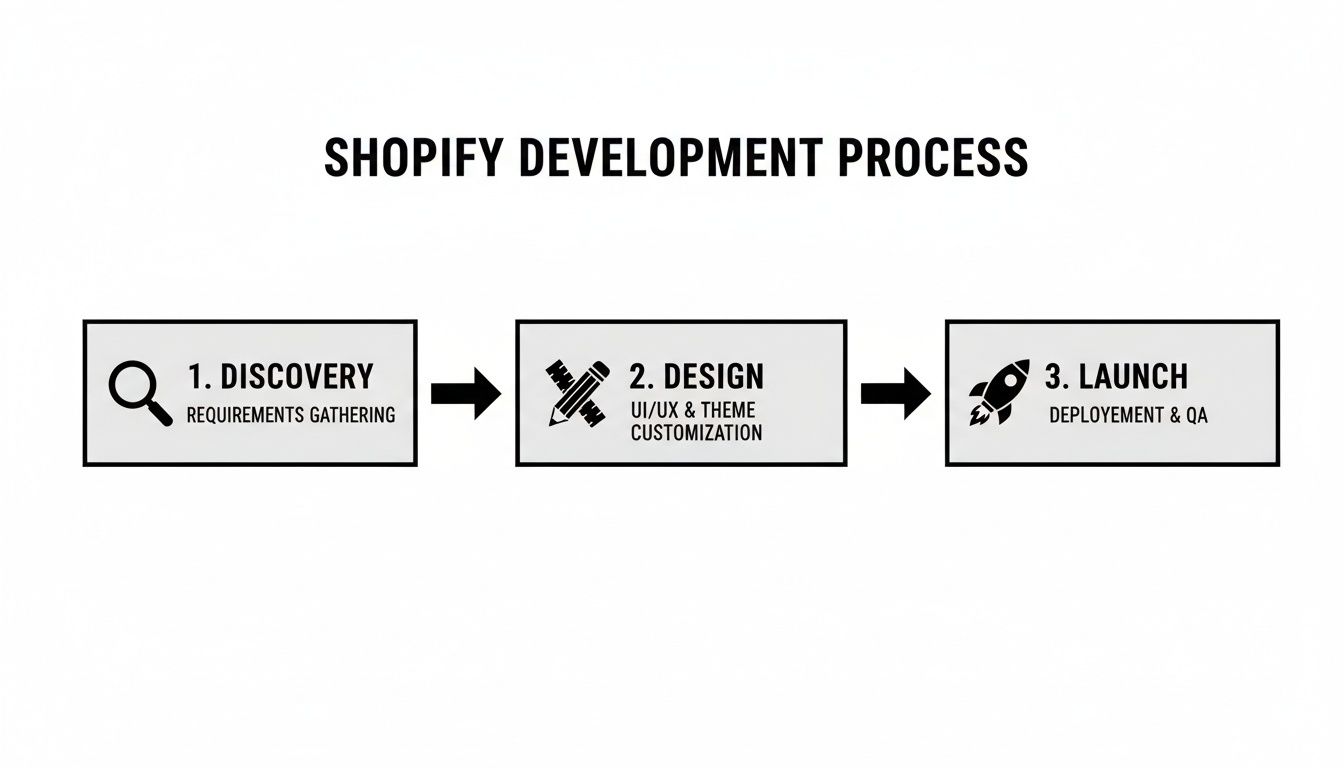
This visualises the journey from initial discovery to design and finally, launch—the foundation for all future growth. It’s this structured approach that allows a partner like Alpha Omega Digital to help our clients in Melbourne, Sydney, and across Australia stay one step ahead of the competition.
Have a project in mind? Contact us to see how we can help.
We Get These Questions a Lot
Over the years, I've had countless chats with business owners trying to figure out if a Shopify Developer Partner is the right move for them. A few questions always come up, so I wanted to lay them all out here to give you a clearer picture and help you start on the right foot.
What's the Real Difference Between a Shopify Developer and a Partner?
This is a great question. Honestly, any developer can learn their way around Shopify, but a Shopify Partner has officially joined the Shopify program. This isn't just a title; it gives them access to development tools, insider educational resources, and a direct line to Shopify support. That last one is a massive advantage when you're troubleshooting a really tricky issue.
Basically, a partner is invested in the Shopify ecosystem for the long haul. A freelance developer might just be working on a one-off project.
How Much Does It Cost to Hire a Shopify Partner?
The honest answer? It varies wildly depending on what you need and the partner's experience. A simple theme customisation might be a few thousand dollars, whereas a full custom build with unique app integrations could easily run into the tens of thousands.
Here in Australia, you can generally expect:
- Small Projects: Minor tweaks or app setups are often charged by the hour, typically from $100 to $200+ per hour.
- Medium Projects: A full theme customisation or a new store built on a premium theme usually lands somewhere between $5,000 and $15,000.
- Large Projects: If you're talking completely custom builds, complex data migrations, or bespoke app development, you're usually looking at a starting point of $20,000, and it can go much higher from there.
My advice is to always ask for a detailed proposal that breaks down every single cost. No one likes surprises.
Do I Really Need a Partner for a Small Shopify Store?
You don't need one, but it can be a huge strategic advantage. You can absolutely set up a basic store yourself using a standard theme, and many people do. But a partner brings a level of expertise that helps you dodge the common pitfalls that trip up new store owners. They make sure your site is built correctly from day one—optimised for speed, mobile, and conversions.
Think of it like this: you can build a flat-pack wardrobe yourself, and it’ll probably work. But an experienced carpenter will make sure it’s perfectly level, sturdy, and built to last. A good partner does the same for your online store, setting a solid foundation for you to grow on.
Can a Shopify Partner Actually Help with Marketing?
Absolutely, and the best ones do. While some partners stick purely to the code, a full-service agency like Alpha Omega Digital understands that development and marketing are two sides of the same coin. A beautiful, fast website is useless if no one sees it.
That’s why we offer services like Google Ads management and SEO—to drive qualified customers to the amazing store we just built. A great Shopify developer builds the engine, and a great marketer provides the fuel. Alpha Omega Digital is a marketing agency based in Melbourne, Australia but also services clients from Sydney, Brisbane, Newcastle, Perth, Adelaide, Darwin and Hobart.
At Alpha Omega Digital, we combine expert Shopify development with results-driven digital marketing. If you're a business with a paid ads budget of at least 3k a month, I'd love to offer you a low-risk deal—get a month of paid ads management FREE. Apply now through our contact page.