
When I first started building e-commerce stores, the term "Shopify Developer Partner" felt like corporate jargon. But after years in the trenches, running a digital marketing agency Melbourne and seeing hundreds of stores succeed and fail, I can tell you this: that "jargon" is one of the most important quality signals you can look for.
A Shopify Developer Partner isn't just a freelancer who knows how to code. It's an agency or individual officially recognised by Shopify. Think of it as a pre-vetted expert who has proven their skills and commitment to the platform. This partnership gives us access to special resources, beta features, and priority support from Shopify itself. For you, the business owner, it means you're not hiring a random person from the internet; you're bringing on a professional with a direct line to the ecosystem your entire business is built on.
What a Shopify Developer Partner Actually Does (From Real Experience)
Let's cut through the noise. Beyond the official title, what does working with a partner mean for your Australian e-commerce business on a day-to-day basis? It's about tangible advantages that directly impact your bottom line.
From my experience as a Shopify developer, it boils down to three core areas: insider access, deep technical expertise, and a strategic growth mindset.
The Insider Advantage: Why Partnership Matters
The biggest, and most underrated, benefit is the access. As partners, we get to see what’s coming next from Shopify. We can experiment with new features before they’re released to the public, which can give our clients a serious competitive edge. More importantly, it means we have a priority support channel.
I remember one frantic afternoon when a client's third-party app update completely broke their checkout on a major sale day. Instead of being stuck in a generic support queue for hours, losing thousands in sales, we used our partner line. We had an expert Shopify technician on a call within minutes who helped us diagnose and roll back the issue. That single moment of fast-tracking saved the client's entire weekend of revenue. A non-partner would have been dead in the water.
This direct line isn't just for emergencies. It's for getting definitive answers on complex issues related to the Shopify API, which is the backbone for any custom functionality.
More Than Just Code: The Art of Integration
A huge part of a Shopify developer partner's work is managing the critical Shopify integrations that make your store a functional business, not just a pretty website. This is where a lot of DIY stores and inexperienced developers fall over. It's about making sure your inventory, shipping, accounting, and marketing systems all communicate flawlessly.
For an Australian business, this means seamlessly integrating with:
- Payment Gateways: Afterpay, Zip, and local bank gateways.
- Shipping & Logistics: Australia Post, Sendle, and complex courier matrixes.
- Marketing & Analytics: Setting up Google Tag Manager containers correctly, implementing the Meta Conversions API for accurate ad tracking, and ensuring your Google Ads agency has the data it needs.
This isn't just about clicking "install" on an app. It's about understanding how these systems work together and troubleshooting when they don't. As an agency that manages both development and paid ads, I’ve seen firsthand how a broken Meta Pixel or a misconfigured GTM container can completely derail a six-figure marketing campaign. A true partner prevents that.
Strategic Growth: From Developer to Business Partner
The best Shopify developers don't just take orders. We ask why. We want to understand your business goals, your profit margins, and your customer acquisition strategy. A project shouldn't start with "build me this feature." It should start with "we need to increase our average order value by 15%."
From there, we can recommend the right technical solution—maybe it's a custom upsell feature, a product bundling app, or a tiered discount system for VIP customers. The code is the how, but understanding the business goal is the why. This mindset is what separates a technician from a genuine growth partner.
Why the Australian Shopify Ecosystem Is a Goldmine for E-commerce Brands
If you're an Australian business on Shopify, you’re sitting on a massive home-ground advantage. The local scene isn’t just ticking along; it’s a fully-fledged, buzzing ecosystem that gives you a serious leg up. When I talk with my e-commerce clients, I don’t just see stats—I see real, tangible opportunities right on our doorstep.

Let’s just look at the raw numbers for a second. Australia is home to over 154,625 Shopify stores. That’s a massive community, and it's created an incredible pool of talent, especially in hubs like Melbourne. It means finding a skilled Shopify developer in Melbourne who just gets the local market is more straightforward than ever. That local knowledge is priceless.
Localisation Is Your Superpower
The real magic here is how deeply localised everything has become. A good Australian partner doesn't need to be told why these things are important; they're baked into our process:
- Payment Gateways: Getting set up with Afterpay, Zip, and local bank gateways isn't an afterthought; it’s step one. We know Aussie customers expect these options at checkout.
- Shipping Solutions: Connecting your store to Australia Post, Sendle, or other local couriers is a must-have. A local partner understands the nuances of our shipping landscape, from rural deliveries to calculating GST correctly. It’s how you get accurate shipping rates and logistics that don’t give you or your customers a headache.
- Aussie Consumer Behaviour: A local developer partner instinctively understands Australian buying habits, our opposite seasons, and what we expect from an online store. This knowledge shapes everything, from the site's UX design to the marketing strategy. For instance, we know how to structure a Boxing Day sale or an End of Financial Year promotion for maximum impact.
This built-in familiarity means you spend less time explaining the basics and more time focused on actually growing. It’s exactly why teaming up with a local ecommerce marketing agency is so powerful; they already know how to navigate the Australian market and which levers to pull.
The Rise of Shopify Plus and a Deeper Talent Pool
It’s not just small startups fuelling this growth. Australia has the third-highest number of Shopify Plus stores in the world, with over 3,056 businesses running on the platform’s enterprise plan.
This surge in Shopify Plus is a huge deal. It tells you that big, successful Australian brands like JB Hi-Fi and Koala trust the platform for high-volume sales. In turn, this demand forces developers and agencies to up their game. We're not just installing themes; we're doing complex Shopify API work, building custom Shopify apps using Shopify CLI, and handling large-scale migrations. This enterprise-level demand creates a ripple effect, fostering a more skilled and experienced developer community.
These are the experts who can tackle complex challenges that come with scaling a business. For you, the merchant, this thriving environment creates more competition, drives up quality, and gives you more choice. Whether you’re a new brand just starting out or a growing enterprise, the Australian Shopify ecosystem has the perfect foundation to help you find a developer partner who can help you win.
The Essential Skills of a Top-Tier Shopify Developer Partner
When you're looking to hire a Shopify developer, it’s so easy to get bogged down in a sea of technical jargon. But from my experience, the difference between a good developer and a truly great one isn’t just how well they can code—it’s a specific blend of technical mastery, an eye for marketing, and genuine business sense.
Let’s be clear: this isn’t about finding someone who can just “build a website.” It’s about finding a partner who can build you a high-performing sales machine. As a WordPress developer who also specialises in Shopify, I see the overlap and the key differences clearly.
Core Technical Skills: The Non-Negotiables
First things first, they absolutely have to know the Shopify platform inside and out. This goes way beyond just installing a pre-made theme.
Mastery of Liquid: This is Shopify's own templating language. A top developer uses Liquid to customise every single pixel of your store, creating unique user experiences and features that you simply can't get from an off-the-shelf theme. Ask them for specific examples of custom Liquid logic they’ve written.
Shopify API Experience: This one is crucial and a key part of our work as shopify development partners. The Shopify API is what allows for custom apps and complex integrations with other software (like your inventory system or CRM). If you need a special feature that doesn't exist in the app store, a developer with deep API knowledge is your only real option. This is a non-negotiable for any serious Shopify development project.
Site Speed Optimisation: In e-commerce, speed equals revenue. A skilled developer knows exactly how to optimise images, minify code (CSS and JavaScript), and cut down server requests to make sure your site loads lightning-fast. They should be obsessed with Core Web Vitals and tools like Google’s PageSpeed Insights.
I’ve personally seen stores double their conversion rates just by cutting their page load time in half. A developer who dismisses the importance of site speed is a massive red flag. This isn't a "nice-to-have"; it's a fundamental requirement for success.
Business and Marketing Savvy: Connecting Code to Cashflow
A developer who only speaks in code is operating with one hand tied behind their back. The best partners I've worked with are the ones who understand why they’re building something, not just how to build it.
They should have a solid grasp of e-commerce marketing principles. This includes knowing the basics of SEO to ensure your site is built on a strong foundation. More importantly, they need to be comfortable with the marketing tech stack. At our agency, a developer must understand how to implement tracking for Google Ads and Meta Ads. This includes:
- Setting up Google Tag Manager containers correctly.
- Mastering the Facebook (Meta) Ads pixel implementation.
- Conversions API installation for Meta, which is critical for accurate tracking post-iOS14.
I often find the best developers are those who work hand-in-glove with a Google Ads agency or a Facebook ads agency to ensure every dollar spent is tracked and attributed correctly.
Shopify Developer Partner Skill Checklist
| Skill Category | What to Look For | Why It's Critical for Your Business |
|---|---|---|
| Technical Proficiency | Deep knowledge of Liquid, Shopify APIs, and headless commerce. | They can build custom features and create a unique, high-performing store that isn't limited by templates. |
| Performance Optimisation | A proven track record of improving site speed and Core Web Vitals. | Faster sites directly lead to higher conversion rates, better SEO rankings, and a superior customer experience. |
| UX/UI Design Sense | An understanding of user experience principles and mobile-first Shopify design. | They'll build a store that is intuitive and easy to navigate, guiding customers smoothly toward a purchase. |
| Marketing Integration | Experience with GTM, Meta CAPI, Google Ads tracking, and SEO best practices. | Ensures your marketing efforts are measurable and your store is visible to search engines from day one. |
| Business Acumen | They ask questions about your revenue goals, profit margins, and target audience. | They connect their technical work to your bottom line, suggesting solutions that drive real business growth, not just "cool features." |
| Communication & Process | Clear communication, a defined project plan, and a collaborative approach. | A structured process prevents misunderstandings, keeps the project on track, and ensures the final product meets your expectations. |
Ultimately, you're not just hiring a coder. You’re investing in a partner who can connect the dots between technical execution and tangible business growth. Beyond Shopify-specific knowledge, the best developer partners also keep an eye on broader industry trends and make use of available general resources for developers. This wider perspective helps them bring fresh ideas and more robust solutions to your project.
How to Properly Vet and Hire Your Shopify Partner (My Personal Playbook)
Alright, you know what skills to look for, but how do you actually find the right person or agency and feel confident in your decision? This is where so many business owners I’ve spoken to get completely stuck. I’m going to walk you through my personal playbook for vetting a potential Shopify developer partner without wasting your time or money.
It all boils down to moving beyond their sales pitch and digging into the actual work they’ve done.
Look Past the Pretty Pictures in Their Portfolio
Anyone can show you a screenshot of a stunning homepage. Your job is to look deeper. When I’m assessing a potential partner, the first thing I do is ask for a list of 3-5 live sites they’ve built.
Then, I put on my detective hat.
Run the Speed Test: I run every single one of those sites through Google’s PageSpeed Insights. This gives me a real, unbiased look at how their work performs on both mobile and desktop. Trust me, if a developer's past projects are slow, yours will be too. It’s a non-negotiable.
Do the Mobile-First Walkthrough: I open my browser's developer tools (just right-click and hit "Inspect") to properly check out the mobile experience. I’ll resize the window, click through the navigation, add items to the cart, and even try to go through the checkout process as if I were a real customer on my phone. Is it clunky? Are the buttons hard to click? These are massive red flags that show a lack of attention to detail where it matters most.
Ask Questions That Reveal True Expertise
During the interview, you have to ask questions that can’t be answered with a simple 'yes' or 'no'. You’re trying to see their problem-solving brain in action.
Here are a few of my personal go-to questions:
- "Describe a time you solved a complex integration issue using the Shopify API. What was the business problem, and what was your technical solution?"
- "Walk me through your process for theme customisation. How do you balance adding custom features with keeping the site fast and easy to upgrade later?" (This is a huge one. Over-customised themes can become a maintenance nightmare).
- "How would you approach setting up tracking for a new e-commerce store? Talk me through the Google Tag Manager, Google Analytics, and Meta Pixel/CAPI setup."
Their answers will tell you everything. A great partner will get excited by these questions and walk you through their process with clarity and confidence. A less experienced one might give vague answers or just rattle off buzzwords. This is how you separate the Shopify developers who talk the talk from those who walk the walk.
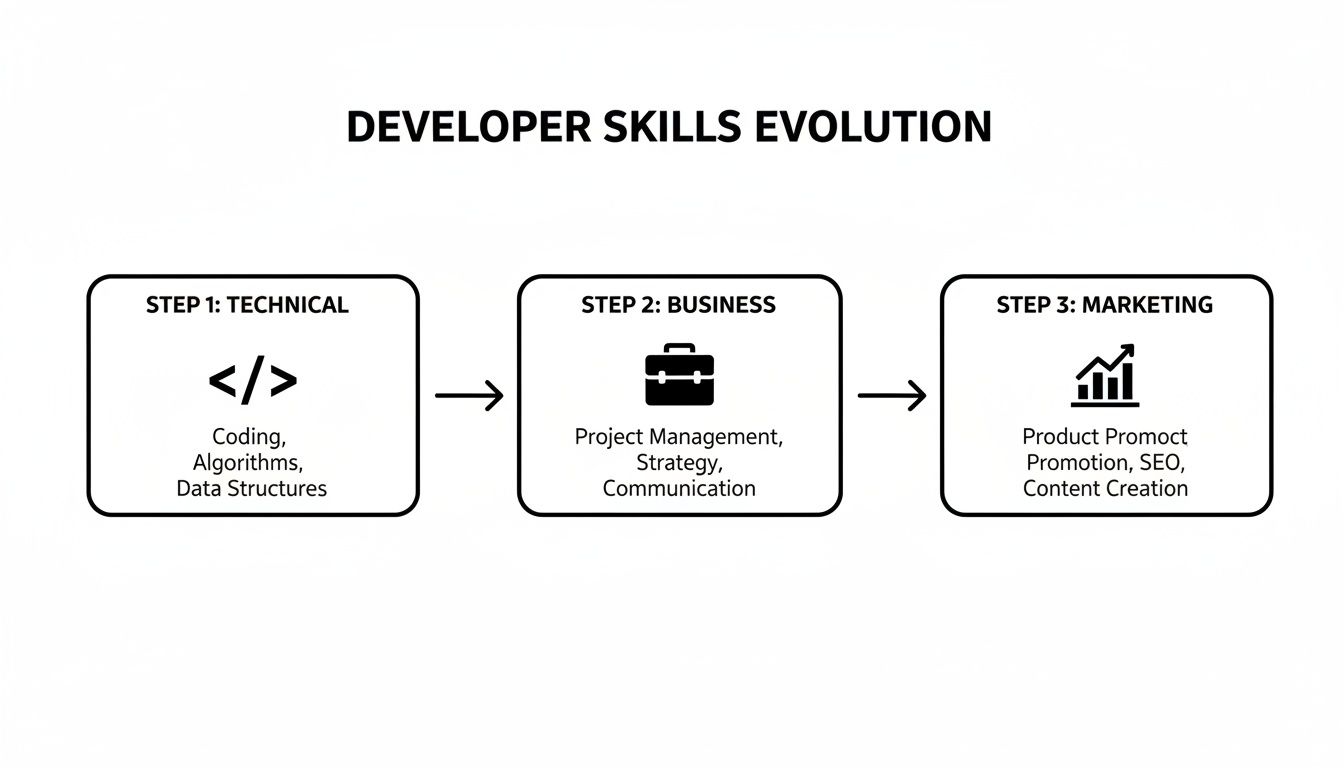
It’s this evolution—from just being a coder to understanding business strategy and marketing—that separates the good from the great. A partner who only talks about code is missing half the picture. The real value comes from a developer who understands your business goals and can translate them into a technical strategy that drives revenue.
Finally, make sure you talk about their pricing models openly. Whether it’s a fixed project fee, a day rate, or an ongoing monthly retainer, you need to understand exactly what you're paying for. A transparent partner will have zero issues breaking down their costs and explaining the value you’ll get in return.
When Do You Need a Shopify Plus Partner? The Big League
If your e-commerce business is hitting that exciting but chaotic stage—we're talking high sales volume, thousands of orders, and operational hurdles that are starting to feel overwhelming—it’s probably time to think about Shopify Plus. And when you do, you’ll need a specific type of Shopify developer partner: a certified Shopify Plus Partner.
This isn't just a fancy title. Plus Partners are the special forces of the Shopify world. They have proven, hands-on experience with large-scale migrations, complex ERP/CRM integrations, and custom checkout development—things that are completely outside the scope of a standard Shopify setup.
From my experience working with scaling brands, this is where the real magic happens. It’s one thing to build a standard store; it’s another to architect a system that can handle thousands of transactions an hour without breaking a sweat.
The Shopify Plus Advantage: What You're Paying For
A certified Plus Partner has access to an exclusive toolkit that can completely transform your store's capabilities. These aren't just minor tweaks; they are genuinely powerful tools for automation and deep customisation.
Shopify Scripts & Functions: These allow for serious customisation of the checkout process. We've used scripts to create complex tiered pricing for wholesale customers, automatically apply shipping discounts based on cart contents, and even hide specific payment options for certain products. Shopify Functions are the newer, more powerful evolution, letting us build custom backend logic (like unique discount rules) that runs incredibly quickly.
Custom Checkout: With Shopify Plus, you can heavily customise the look, feel, and functionality of your checkout pages. A Plus Partner can design a checkout experience that matches your brand perfectly, helping to build trust and seriously reduce cart abandonment. This is a game-changer for conversion rates.
Launchpad & Flow: Shopify Flow is an automation engine that handles repetitive tasks (like tagging high-value customers or getting notified of low inventory). Launchpad allows you to schedule and automate major events like flash sales or product drops. A Plus Partner knows how to leverage these tools to save you hundreds of hours of manual work.
Australia's own Shopify Plus adoption speaks volumes about our maturing e-commerce market. With over 3,056 live Shopify Plus stores, Australia is the third-largest hub for the platform on the planet. This growth is powered by Certified Technology Partners who use their exclusive access to serve the advanced needs of Plus merchants.
With global Plus sites having nearly doubled since 2022, the demand for reliable partners who can deliver and optimise is only going to grow. You can find out more about the exclusive benefits available to Plus merchants and their partners.
Put simply, a Plus Partner can turn your store from a simple sales channel into a highly efficient, scalable, enterprise-level machine. For a high-volume business, this isn't a luxury; it’s a competitive necessity.
Building a Partnership That Drives Growth After Launch
The relationship with your Shopify developer partner shouldn't just stop the moment your site goes live. From my perspective, that’s when the real work of growing your business actually begins. The launch is just the foundation; the ongoing partnership is what builds the rest of the house.

This is all about shifting from a one-off project to a cycle of continuous improvement. A proper ongoing partnership, often managed through a retainer, is your ticket to staying agile and ahead of the competition.
What a Valuable Retainer Looks Like (It's Not Just "Support")
A good retainer is so much more than an insurance policy for when things break. It’s a proactive growth engine. We structure our partnerships around real, measurable outcomes, not just ticking off billable hours. This is about marketing your business with consistency.
This includes:
- Performance and Security Monitoring: We keep a constant eye on site speed and security. This makes sure your store is always fast, safe, and reliable for your customers. No excuses.
- Conversion Rate Optimisation (CRO): We don’t guess what works; we test it. Using data from heatmaps, user recordings, and A/B tests, we make small, iterative changes to your site designed to bump up your conversion rate over time.
- Feature Enhancements & A/B Testing: As your business evolves, your website has to keep up. We help you plan and roll out new features that support your growth, whether that’s a new loyalty program, a custom product builder, or a new landing page for a campaign. We rigorously test these changes to ensure they have a positive impact.
The most successful partnerships I've had are with clients who see us as an extension of their team. We’re in their Google Analytics, we see their paid ad campaign data from their Facebook ads agency, and we use all that information to make smart, data-driven decisions together.
Connecting Development to Marketing ROI
Your website doesn’t exist in a bubble. It's the central hub for all your marketing efforts. When we work with a client on an ongoing basis, our development choices are directly shaped by their marketing performance.
If a Google Ads campaign is driving a ton of traffic to a landing page with a high bounce rate, our first move is to analyse that page and figure out why it's not converting. This might lead to a design tweak, a change in the call-to-action, or an improvement in page speed. This is especially true for our e-commerce marketing agency clients.
By closing this loop between marketing data from platforms like Google Ads and web development, we ensure your entire strategy is working together to drive revenue, not working in silos.
We Get These Questions a Lot
Over the years, I've had countless chats with Australian business owners trying to figure out if hiring a Shopify Developer Partner is the right move. A few questions always seem to pop up, so I wanted to answer them here to give you a clear picture right from the get-go.
How Much Does It Cost to Hire a Shopify Developer in Australia?
The honest answer? It varies wildly depending on the experience of the developer and exactly what you need done.
Here in Australia, you can find freelance developers charging anywhere from $80 to over $200 per hour. For a full, custom-built store from a reputable agency in a city like Melbourne or Sydney, you should be budgeting for a project fee somewhere between $8,000 and $30,000+. A complex Shopify Plus build can easily exceed this.
At Alpha Omega Digital, we always kick off with a detailed discovery process. This lets us give you a precise quote that’s tied to real business value and a clear return on investment. Remember, you're investing in a core business asset, so always prioritise the value you're getting, not just the lowest price tag.
What Is the Difference Between a Shopify Developer and a Shopify Expert?
While people often use these terms interchangeably, there’s a crucial difference. 'Shopify Expert' is an official badge of honour that Shopify awards to partners with a proven, high-level track record of success. It’s a title you have to earn through volume and quality of work.
'Shopify Developer' is more of a general term for anyone who builds on the platform, including us at our wordpress development company. A 'Shopify Developer Partner' is the perfect middle ground—an agency or freelancer formally registered with Shopify's partner program. This gives them access to special resources and signals a serious professional commitment to the ecosystem.
Can a Shopify Developer Partner Help with Marketing and SEO?
A great one absolutely should. I’ve said it before and I’ll say it again: a beautiful store is completely useless if it doesn't attract customers. You have to look for a partner who brings more than just technical skills to the table. As a seo agency melbourne, we see this gap all the time.
A top-tier Shopify partner understands that the code they write is directly connected to your marketing success. They don't just build pages; they build assets that are primed for visibility and conversion.
At our Melbourne agency, for instance, we integrate our Shopify development work with deep expertise in Google Ads, Meta Ads, and SEO. This holistic approach ensures your store is built for performance from the ground up—optimised for search, ready for paid ad campaigns, and designed to convert visitors into loyal customers. Always ask a potential partner how they plan to handle your site speed, on-page SEO, and essential marketing integrations.
Alpha Omega Digital is a marketing agency based in Melbourne, Australia but also services clients from Sydney, Brisbane, Newcastle, Perth, Adelaide, Darwin and Hobart.
If you're a business with a paid ads budget of at least 3k a month, I'd love to offer you a low risk deal- get a month of paid ads management FREE. Apply now through the contact page.
Have a project in mind? Contact us.