
From my experience, I think of a Shopify development partner as your store's technical co-pilot. They're a specialised agency or company that I see helping businesses build, customise, and actually grow their online store on the Shopify platform. This isn't about hiring a freelance coder for a one-off task. A true partner brings ongoing strategic advice, deep technical skill, and the support you need to make sure your store doesn't just work, but smashes its commercial goals.
Why a True Partner Is More Than Just a Developer

I've seen so many eCommerce businesses treat development like a simple to-do list. They find a freelancer to tweak a theme or install an app, then get frustrated when sales are flat and the site feels clunky. The problem? They're treating a strategic asset like a commodity. A real Shopify development partner is so much more than a coder for hire; I see them as a growth engine for your business.
The crucial difference comes down to perspective. A developer finishes a task and moves on. A partner, on the other hand, is invested in your success. They become an extension of your team, getting a deep understanding of your business goals, your customers, and your operational headaches. Every single technical decision they make is filtered through the lens of your bottom line.
Moving Beyond Basic Code Fixes
When I sit down with clients, the conversation quickly moves past simple theme adjustments. We start asking bigger, more impactful questions. It's not just about making the site look good; it's about making it work harder for you.
This partnership approach means we focus on things like:
- Strategic App Integration: Instead of just installing any popular app, we figure out which tools will genuinely streamline your operations or improve the customer journey. This might mean setting up the Meta Conversion API for spot-on ad tracking or integrating a complex inventory management system.
- Conversion Rate Optimisation (CRO): A partner dives into user behaviour, identifies friction points in the buying process, and rolls out data-driven changes to turn more of your visitors into paying customers.
- Performance Marketing Synergy: As a digital marketing agency in Melbourne, we know that development and marketing are two sides of the same coin. A well-built Shopify store needs to be optimised for Google Ads and Facebook Ads right from the start, making sure your ad spend delivers the best possible return.
- Future-Proofing Your Store: A partner thinks ahead. They build a scalable foundation that can handle growth, new product lines, and shifts in the market without needing a complete and costly overhaul down the track.
The Real-World Impact of a Partnership
Let me give you a concrete example from my own experience. A client came to us with a beautiful but painfully slow website. They'd hired a designer who did fantastic visual work but lacked deep Shopify expertise. Their ad campaigns were bleeding money because the poor user experience was killing conversions on the spot.
Instead of just applying a band-aid to the speed issues, we dug deeper. We found bloated apps, messy code, and a checkout process with far too many steps. By rebuilding key elements and integrating their systems correctly, we not only fixed the speed but boosted their conversion rate by over 30%. That’s the kind of result that comes from a strategic partnership, not a quick fix.
I always say a task-based developer asks, "What do you want me to build?" A strategic partner asks, "What business problem are we trying to solve?" This shift in focus is what separates stagnant stores from high-growth brands.
Ultimately, investing in a Shopify development partner is about minimising risk and maximising opportunity. It prevents expensive mistakes born from short-term thinking and unlocks hidden revenue by aligning every technical piece of your store with your ultimate business goals. It's the difference between having a website and having a powerful, scalable eCommerce machine.
What A Shopify Development Partner Actually Does For You
When you first start looking for help with your Shopify store, the technical terms can feel like you’re learning a whole new language. I’ve seen countless business owners get bogged down in jargon, making it almost impossible to figure out what they actually need.
Let's cut through all that noise. I want to talk about what really makes a difference for eCommerce brands here in Australia. I’ll break down the core services a proper Shopify development partner provides, explaining what they are and, more importantly, what they mean for your sales and growth.
Custom Theme Development and Design
This is so much more than just picking a pre-made theme and tweaking the colours. My experience has shown me that custom theme development is about building a unique shopping experience from the ground up that’s perfectly aligned with your brand. It’s about taking your brand’s story and values and translating them into a visual design that truly connects with your specific audience.
For one of my Melbourne-based clients in the hyper-competitive fashion space, we built a custom theme with a unique lookbook feature and a highly visual navigation system. This wasn't just for show; it was designed to solve a specific problem—helping customers discover products in a way that felt more like flicking through a high-end magazine.
The result? A 22% increase in average order value because customers were more engaged and inspired to buy.
API Integrations and Custom Apps
This is where the real magic happens behind the scenes. Your Shopify store doesn’t exist in a bubble; it needs to talk to all the other systems you use, like your inventory management software, your customer relationship manager (CRM), or your third-party logistics (3PL) provider.
A skilled Shopify developer uses the Shopify API to build these connections, creating a seamless flow of data between your platforms. This automates painfully tedious manual tasks, slashes human error, and ensures your operations run like a well-oiled machine. Think about syncing your inventory in real-time to avoid overselling or connecting to a custom shipping calculator to get accurate rates every time.
Sometimes, an off-the-shelf app from the App Store just won't cut it. That's when we get into building custom Shopify apps. This could be anything from a unique product customiser for your customers to an internal tool that streamlines your order fulfilment process. It’s all about creating bespoke solutions that give your business a genuine competitive edge. To really get a feel for these possibilities, it helps to understand the broader the e-commerce industry landscape, as it dictates the tools needed to succeed.
I explain an API like this: it's a universal translator that allows different software programs to communicate with each other. A good partner ensures these conversations are flawless, preventing costly data mix-ups that can damage customer trust and your bottom line.
Platform Migrations and Technical Support
Moving your entire store from another platform like WordPress/WooCommerce or Magento over to Shopify can be a seriously nerve-wracking process. A key service offered by an experienced Shopify partner is managing this migration from start to finish.
This isn't a simple copy-paste job. It involves meticulously moving all your products, customers, and order data while preserving your hard-earned SEO rankings with proper URL redirects.
Finally, ongoing technical support is your safety net. The internet never sleeps, and issues can pop up at the worst possible times—like right in the middle of a major sales event. A partner provides retainer-based support to handle bug fixes, security updates, and performance optimisations, making sure your store is always fast, secure, and ready to make sales. It's the peace of mind I find you need to actually focus on growing your business.
How To Evaluate A Potential Shopify Partner
Choosing the right Shopify agency is one of the most important decisions you'll make for your online store. I’ve sat on both sides of this table, hiring partners for my own projects and pitching our services at Alpha Omega Digital, so I know exactly what separates a great agency from a mediocre one. Getting this right means finding a partner who will grow your business, not just complete a task.
Let's walk through a practical checklist I use to vet potential agencies. This isn't just about looking at pretty websites; it's about digging into their process, their technical skills, and their strategic thinking.
Portfolio and Relevant Case Studies
The first thing I always look at is their past work. A strong portfolio is non-negotiable, but don't just skim the surface. Look for case studies that are relevant to your business, especially within the competitive Australian eCommerce market. If you sell fashion, an agency that has only ever worked with B2B industrial clients might not be the best fit.
Specifically, I look for evidence of:
- Industry Experience: Have they worked with businesses like yours? They'll understand your unique challenges and customer base.
- Measurable Results: Case studies should show real numbers. Look for metrics like conversion rate increases, average order value growth, or improved site speed. Vague claims are a red flag.
- Problem-Solving Skills: The best case studies don't just show the final product. They explain the business problem, the agency's strategy to solve it, and the tangible outcome.
Technical Expertise and Platform Knowledge
This is where I find you can separate the theme-tweakers from the true Shopify development experts. You need a partner who has a deep understanding of the entire Shopify ecosystem. Their team should be fluent in Shopify’s templating language, Liquid, and be comfortable building custom solutions using the Shopify API.
A key area to probe is their experience with Shopify Plus, the platform's enterprise-level solution. The Shopify Plus ecosystem has grown massively in Australia, representing a huge opportunity for ambitious brands. Globally, merchants on Shopify Plus see an average year-over-year growth rate of 126%, which is a massive leap above the industry average. A partner familiar with Plus is a partner prepared for your growth. You can discover more insights about these Shopify statistics and what they mean for your business.
This decision tree visualises how a partner might approach different Shopify needs, whether you're starting a new store or enhancing an existing one.
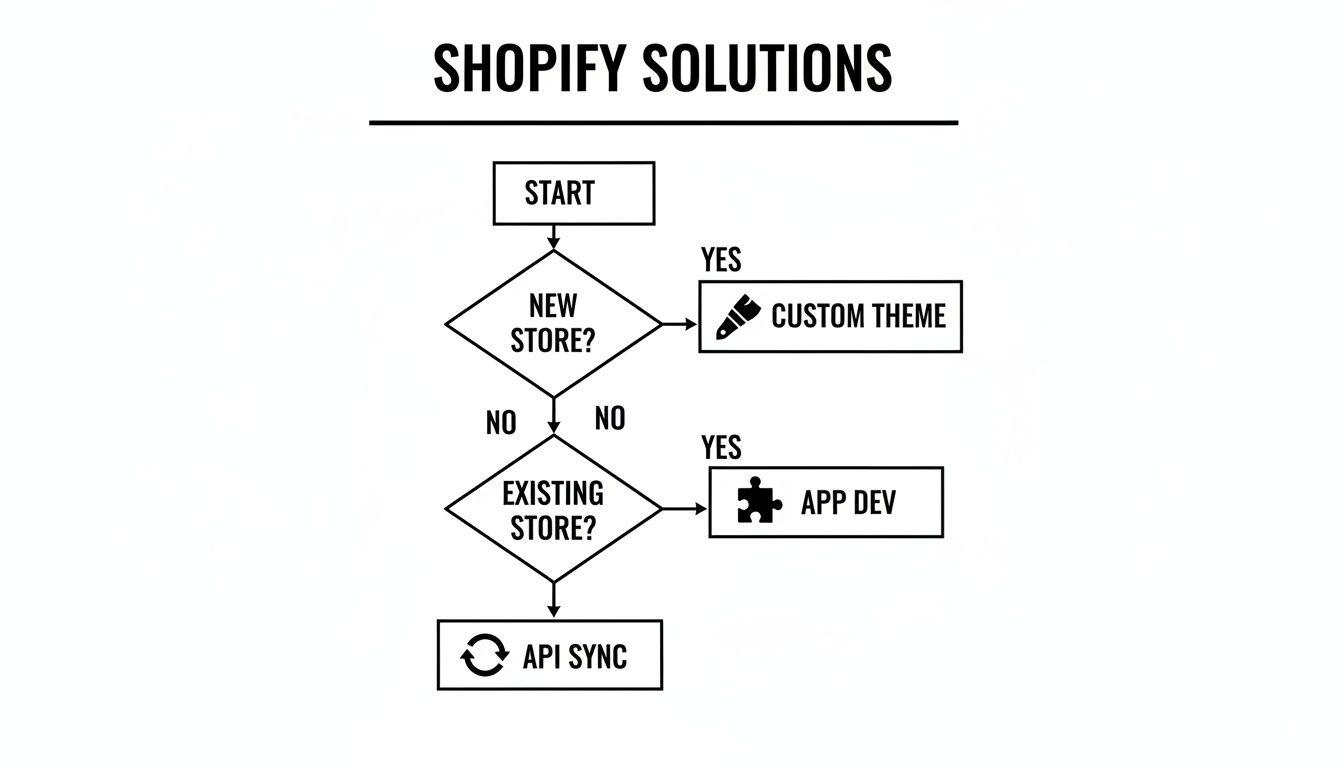
The visualisation shows that a partner's first step is to diagnose your core need to recommend the right solution, from a custom theme to app development.
Project Management and Communication Style
A brilliant developer who you can never get a hold of is useless. A clear, structured project management process and transparent communication are vital. During your initial conversations, ask them how they manage projects. Do they use a specific software? How often will you get updates? Who will be your main point of contact?
In my experience, a great Shopify partner over-communicates. They set clear expectations, provide regular progress reports, and are proactive about flagging potential roadblocks before they become serious problems.
Marketing and Conversion Acumen
Finally, and this is something I'm passionate about as a marketing agency in Melbourne, a great Shopify development partner understands that a website is a marketing tool. They should be building your site with conversions in mind from day one.
Ask them about their experience with Google Ads, Meta Ads, and setting up tracking with Google Tag Manager. A partner who understands performance marketing will build a site that's not just beautiful but also technically sound for advertising campaigns. This integrated approach ensures your ad spend isn't wasted on a site that can't convert, giving you a much higher chance of success right out of the gate.
Using AI In Modern Shopify Development
Artificial intelligence has shot past being a futuristic buzzword and landed squarely into the toolkit of any top-tier Shopify development partner worth their salt. From my own experience, weaving AI into an eCommerce store is a complete game-changer, especially when it comes to running things smarter and creating shopping experiences that feel like they were made for each individual customer.
This isn’t about sci-fi robots taking over. It’s about using smart algorithms to make sharper business decisions and to craft customer journeys that feel personal and intuitive. Getting your head around how these tools work is vital when you're picking a partner, because you need someone who can build a business for the future, not just a static website for today.
The shift is already happening, big time. For Australian small and medium eCommerce businesses, AI adoption has hit a tipping point. Recent data shows a staggering 75% of SMBs were already dabbling with AI tools in 2024. Of those, a massive 78% said they believe AI will be a 'game-changer' for how they operate. These numbers aren't just noise; they show how quickly this technology is becoming a core part of business.
Driving Sales With AI-Powered Personalisation
One of the most powerful things I’ve rolled out for clients is AI-driven product recommendations. Think of it as having a digital personal shopper for every single person who lands on your site. The AI gets to work analysing a user's browsing history, what they've bought before, and even what similar customers are buying, all to show them products they're genuinely likely to want.
This is worlds away from those basic "customers who bought this also bought…" widgets we're all used to. Modern AI can tweak the entire homepage, shuffle search results, and even personalise marketing emails to match an individual's taste. This level of personalisation makes customers feel seen and understood, which translates directly into higher conversion rates and bigger average order values.
Streamlining Operations With Intelligent Automation
Beyond what the customer sees, AI is an absolute powerhouse for your back-end operations. I've used AI tools to help clients with:
- Intelligent Chatbots: These aren't the clunky, frustrating bots from a few years ago. I've seen modern AI receptionists, like our AI voice agent, handle complex customer service questions 24/7, answer product queries, and book appointments. This frees up your human support crew to focus on the interactions where they can add the most value.
- Inventory Management: AI can chew through sales data and market trends to predict future demand with incredible accuracy. This is huge for preventing stockouts on your bestsellers while avoiding over-ordering products that just sit on the shelf.
- Fraud Detection: AI algorithms are brilliant at sniffing out dodgy transactions. They spot unusual patterns in real-time, protecting your business from the headache and financial loss of chargebacks.
I’ve found AI's true strength in Shopify development isn't just about adding flashy features. It's about using data to make smarter, faster, and more profitable decisions across your entire business, from marketing to fulfilment.
To really get a feel for how artificial intelligence is being used in e-commerce, especially in the fashion world, it pays to look at specific examples. For instance, a detailed guide on AI tools for fashion brands can give you a heap of practical ideas and inspiration. Choosing a Shopify development partner who is fluent in these AI applications means you're not just keeping up with the competition—you’re setting yourself up to stay several steps ahead.
What The Engagement Process Actually Looks Like

So, what actually happens after you decide to team up with a Shopify development partner? From my experience, the biggest sign of a professional agency is a clear, predictable process. It gets rid of all the guesswork and ensures we're all pulling in the same direction, every single step of the way.
I'll walk you through the engagement model we've fine-tuned over years of successful projects here at Alpha Omega Digital. We've designed it to be transparent, collaborative, and completely focused on getting you results.
Phase 1: Discovery and Strategy
Honestly, this is the most critical stage. Before we even think about writing a single line of code, we kick things off with a deep-dive discovery session. I want to understand everything: your vision, your business goals, your operational headaches, and exactly who your ideal customer is.
We’ll have a frank chat about what’s working, what’s not, and where you want to see your business in the next 12-24 months. This isn't just a casual conversation; it's a strategic meeting to make sure the technical solutions we build are perfectly aligned with your business objectives. Based on this, we'll put together a detailed strategy and a clear proposal that lays out the scope, timeline, and investment.
Phase 2: Onboarding and Kickoff
Once we're all on the same page with the strategy, we move into the official onboarding. This is where we get everything we need to hit the ground running.
The onboarding process usually involves a few key things:
- Gathering Assets: We’ll collect your brand guidelines, logos, product photos, and any other creative assets needed for the project.
- Access and Credentials: We'll securely get the necessary access to your Shopify store, Google Analytics, and any other relevant platforms.
- Project Kickoff Meeting: The entire project team gets together to review the goals and timeline, making sure everyone is aligned from day one.
Phase 3: Build and Launch
This is where the vision starts turning into a reality. Our team gets to work on the design and development, building out all the custom features and functionality we agreed upon. We believe in total transparency, so you’ll get regular updates and plenty of chances to review our progress.
Before anything goes live, we put the site through a tough testing process. We check everything from mobile responsiveness and page speed to the checkout flow and app integrations. Our goal is a flawless launch that goes off without a hitch.
I always say a successful launch isn't the finish line; it's the starting line for growth. The real value of a partnership shows up in what happens after your new site is live.
Phase 4: Optimisation and Scaling
This is the phase that truly separates a task-based developer from a genuine growth partner. Our partnership doesn't just stop when the site launches. In fact, this is where the most exciting work really begins.
We dive deep into the data from your store, Google Analytics, and ad campaigns. We track user behaviour, pinpoint opportunities for improvement, and run A/B tests to boost your conversion rates. This ongoing optimisation is a continuous cycle of learning and refinement, ensuring your store is always evolving to meet customer needs and drive more revenue.
This is how we fuel sustainable growth, turning your Shopify store from a simple website into a powerful, ever-improving sales machine.
Partnering With Alpha Omega Digital For Growth
Throughout this guide, I've walked you through what makes a great Shopify development partner and how to find one. Now, I want to talk about how we put all those principles into practice here at Alpha Omega Digital.
As a digital marketing agency in Melbourne, we live and breathe the Australian eCommerce landscape. We’re not just a team you hire to build a website; we’re a dedicated growth partner invested in your success.
Our whole approach is built on a simple but powerful idea: a Shopify store and its marketing strategy are two halves of the same whole. A stunning website is useless if no one sees it, and a brilliant ad campaign will fail if it sends traffic to a clunky, low-converting site.
We bridge that gap by blending expert Shopify development with data-driven performance marketing.
An Integrated Approach To eCommerce Growth
This means that when we build or optimise your Shopify store, we’re doing it with a marketer's eye.
We make sure every page is structured for SEO success, the user experience is designed to maximise conversions, and all the critical tracking—like Google Tag Manager and the Meta Conversions API—is set up flawlessly from day one.
This synergy creates a powerful feedback loop:
- Development informs marketing: We build fast, mobile-first sites with clear calls-to-action that give your Google and Facebook Ads the best possible chance to succeed.
- Marketing informs development: The data from your ad campaigns tells us exactly what’s working and what’s not. We use these insights to make continuous, data-backed improvements to your website, further boosting conversion rates.
We don't just build websites; we build scalable, high-performance sales engines. Our goal is to be the Shopify development partner that helps you not only launch but dominate your market.
We’ve seen this integrated strategy deliver incredible results for eCommerce businesses all across Australia, from Sydney to Perth and right here in Melbourne. By aligning technical excellence with sharp marketing, we help brands scale their revenue and achieve a sustainable competitive advantage.
A Special Offer To Prove Our Value
I’m confident that our unique blend of development and marketing expertise can make a real difference to your business. To prove it, I want to make you a low-risk offer.
If you're a business with a paid ads budget of at least $3k a month, I'd love to give you a month of paid ads management FREE.
It's our way of showing you firsthand the impact our strategic approach can have on your growth.
Ready to see how a true Shopify development partner can transform your business? Apply now through our contact page, and let's start a conversation about your goals.
We Get These Questions a Lot
Over the years, I've had countless chats with business owners trying to figure out if hiring a Shopify development partner is the right move for them. A few questions always come up, so I wanted to lay them all out here to give you a clearer picture and help you make the right call.
How Much Do Shopify Development Partners Charge?
This is always the big question, and the honest answer is: it really depends. A simple theme setup might only cost a few thousand dollars, but a complex custom build for a Shopify Plus store with multiple API integrations could easily run well into the tens of thousands.
Most agencies, including us, work with a few different pricing models:
- Fixed Project Price: This is perfect for projects with a crystal-clear scope, like a full website build or a platform migration. You get one single price for the entire job, no surprises.
- Monthly Retainer: This model is ideal for ongoing work. Think technical support, regular feature updates, and conversion rate optimisation. You pay a set fee each month for a dedicated block of our time.
- Hourly Rate: We usually reserve this for smaller, one-off tasks or consultancy where the scope isn't easy to lock down from the get-go.
As a marketing agency in Melbourne, we often find a hybrid approach works best, combining a project fee for the initial build with an ongoing retainer to focus on growth and support.
Is A Partner Better Than A Freelancer?
For a small, one-off task, a good freelancer can be a fantastic option. No doubt about it. But for anything more substantial, a Shopify development partner brings some serious advantages to the table.
With a partner, you’re not just hiring one person; you’re getting a full team of experts—developers, designers, project managers, and strategists. This means you’re not left hanging if one person gets sick or goes on holiday.
That team structure delivers more reliability, a much broader skillset, and a strategic sounding board that can offer insights that go way beyond just code. A freelancer might fix a problem for you; a partner helps you build a long-term growth strategy.
How Long Does A Shopify Build Take?
Just like the pricing, the timeline is completely tied to the project's complexity. A straightforward store build using a premium theme might take us somewhere between 4 to 6 weeks. On the other hand, a fully custom design with unique features and third-party integrations is more likely to take 10 to 16 weeks, sometimes even longer.
A good partner will never be vague about timelines. They should give you a detailed project plan with clear milestones and deliverables so you know exactly what’s happening and when.
The discovery and strategy phase at the beginning is absolutely crucial here. A thorough upfront process stops scope creep and delays from derailing the project later on, making sure everything stays on schedule.
We've put together a quick table to answer a few more common questions we hear from businesses looking for the right Shopify partner.
Common Questions About Shopify Partners
| Question | Answer |
|---|---|
| What's the difference between a developer and a partner? | Any developer can learn Shopify, but a "Partner" has officially joined Shopify's program. This gives them access to exclusive development tools, training, and a direct line to Shopify support, which is a huge help for tricky issues. |
| Can a partner help with marketing too? | The best ones absolutely do. A full-service agency understands that development and marketing are two sides of the same coin. A great developer builds the engine, and a great marketer provides the fuel to drive traffic and sales. |
| Do I really need a partner for a small store? | You don't need one to get started, but it’s a massive strategic advantage. A partner ensures your site is built correctly from day one—optimised for speed, mobile, and conversions—setting a solid foundation for you to grow on. |
| How do I know if they understand my industry? | Ask to see their portfolio! A good partner should be able to show you examples of stores they've built for businesses with similar challenges or in the same niche. This proves they won't be learning on your dime. |
Hopefully, these answers clear things up a bit and give you the confidence to start looking for a partner that feels like the right fit for your brand.
At Alpha Omega Digital, we blend expert Shopify development with performance marketing to create a seamless growth engine for your brand. As a marketing agency based in Melbourne, Australia, we service clients from Sydney, Brisbane, Newcastle, Perth, Adelaide, Darwin and Hobart. Have a project in mind? Contact us.
If you're a business with a paid ads budget of at least 3k a month, I'd love to offer you a low risk deal- get a month of paid ads management FREE. Apply now through the contact page.