
A Shopify development partner is much more than just a coder. Think of them as a strategic asset, the technical mind who translates your business vision into a high-performing e-commerce store that actually sells. Finding the right one is about securing an expert in design, custom functionality, and marketing integration—a decision that will genuinely shape your brand's growth and profitability.
Why Your Choice Of Shopify Development Partner Matters

I’ve seen it happen too many times: a promising e-commerce business with a fantastic product gets completely stalled by the wrong technical team. On the flip side, I've watched brands achieve explosive growth because they chose the right Shopify development partner from day one. This decision is one of the most critical you'll make for your online store, no question.
This isn't just about hiring someone to install a theme and pop your logo on it. A true partner acts as a strategic extension of your team, a role that goes far beyond just writing code.
Moving Beyond a Simple Storefront
A great partner doesn't just build a website; they architect an experience designed for one primary purpose: conversions. They dig deep to understand your business inside and out.
They’ll want to know:
- Your Business Goals: Are you aiming for rapid scaling, entering a new market, or improving profitability? Their technical recommendations should be a direct line to these objectives.
- Your Target Audience: Who are you selling to? A developer who understands your customer's behaviour will build a user journey that feels intuitive and compelling to them.
- Your Brand DNA: The look, feel, and voice of your site must be a perfect reflection of your brand. A partner ensures this consistency, which is vital for building trust and loyalty.
For anyone looking to build a thriving e-commerce presence, figuring out how to start an online clothing store successfully often comes down to this crucial early decision. The right partner guides you through the technical maze, letting you focus on product and marketing.
I remember a client who came to us after their initial developer simply installed a generic theme. Sales were flat. We spent time analysing their customer data and realised their audience was primarily mobile shoppers who abandoned carts at checkout. A few strategic changes—a redesigned mobile checkout and a custom integration with a one-click payment option—doubled their conversion rate in 60 days. That’s the difference a strategic partner makes.
The Impact on Revenue and Scalability
Your partner's expertise has a direct line to your bottom line and your ability to grow. A cheap, quick-fix solution might get you online, but it will almost certainly cost you more in the long run through lost sales and expensive re-platforming projects down the track.
A skilled Shopify development partner ensures your store is built on a solid foundation that can handle growth. They think about the big picture:
- App Ecosystem: They know which apps are reliable and which will slow your site to a crawl. Their guidance can save you from "app bloat" that kills performance and frustrates users.
- API Integrations: Need to connect your store to a warehouse management system, a custom CRM, or accounting software? A developer with deep experience in the Shopify API makes this seamless.
- Marketing Funnel Integration: They understand how to properly set up tracking like the Meta Conversion API and Google Analytics 4. Without this, your marketing efforts are flying blind. We are a Facebook ads agency and we absolutely insist on a proper technical setup before a single dollar is spent on ads.
Ultimately, choosing a Shopify development partner is an investment in your business's future. It's about finding someone who is as committed to your success as you are.
Right, before you even think about typing “Shopify developer Melbourne” into Google, let’s get a few things straight. Taking a moment to get your own house in order first will save you a world of headaches later. From my experience, the clients who walk in with a clear plan are the ones who get the most accurate proposals and see the smoothest projects.
When you approach a potential Shopify development partner with a well-thought-out brief, it shows you’re serious. But more importantly, it forces you to get crystal clear on what you actually need, which is the foundation of any successful web project.
Define Your Project Scope
First things first: what are we actually building here? "I need a new website" is a start, but we need to dig a lot deeper than that. Getting specific now is what stops scope creep and budget blowouts from killing your project down the line.
Your project will most likely fit into one of these buckets:
- New Store Build: You’re starting from scratch. A brand-new Shopify store, built from the ground up.
- Platform Migration: You’re moving house, shifting from a platform like WooCommerce, Magento, or BigCommerce over to Shopify. This is a delicate operation that needs careful planning.
- Store Redesign: Your current Shopify store is looking a bit tired, isn't performing, or just doesn't feel like your brand anymore. You need a total visual and functional overhaul.
- Custom Feature Development: You need something special that an off-the-shelf app can't do. Maybe it's a product customiser, a unique booking system, or a custom Shopify API integration with your warehouse software.
Just knowing which category you fall into is the first step to getting a realistic quote. A migration project, for example, is a completely different beast to a new build—you’ve got to think about things like preserving SEO rankings and carefully migrating customer data.
Distinguish Must-Haves from Nice-to-Haves
Pay attention, because this is probably the most important part of your homework. It’s easy to get carried away and list every cool feature you’ve ever seen on another website. But if you want to keep your budget in check, you need to be ruthless about what really matters right now.
I always tell my clients to make two lists:
- Must-Haves (The Non-Negotiables): These are the core features your store simply cannot function without. Think things like Afterpay integration, a specific shipping calculator, or the ability for customers to create accounts.
- Nice-to-Haves (Phase 2): These are the features you’d love to have, but you could launch without them if you had to. This is where you put your loyalty programs, advanced product filters, or a "shop the look" feature. These can always be added later as your business grows and proves the need.
Being honest with yourself here is key. A good development partner will respect your budget. They’ll work with you to plan a phased approach, tackling the 'must-haves' first and building a smart roadmap for the 'nice-to-haves'.
Set a Realistic Budget
Speaking of budget, you need to have a number. "As cheap as possible" isn't a budget; it's a recipe for a bad time. Do some research into the typical costs for Shopify development in Australia to get a feel for the market. A simple theme tweak might be a few thousand dollars, while a complex custom build for an established brand can easily climb into the tens of thousands.
This isn't about showing all your cards on day one. It's about giving an agency a realistic range so they can propose a solution that actually fits your financial reality. A partner who knows your approximate budget can help you get the most bang for your buck.
Gather Your Assets and Inspiration
Finally, do some of the legwork before you even make the first call. The more you can pull together upfront, the better the entire process will be.
- Brand Assets: Get your logo files (in high-res vector formats, please!), brand style guide (colours, fonts), and any decent product photography you have.
- Competitor & Inspiration Sites: Pull together a list of 3-5 websites you admire. But don't just send links; be specific about why you like them. Is it their clean design? The slick checkout process? The way they display their products? Do the same for a few competitors—what do they do well, and where are they dropping the ball?
Having all this ready makes that first chat with a potential Shopify development partner incredibly productive. It shifts the conversation from a vague "What can you do for me?" to a strategic "Here's what I need, how can we make it happen?". That level of clarity is vital, especially in a market like this. Australia is a massive player in the Shopify world, with over 154,000 active stores. For partners like us at Alpha Omega Digital, this local focus is our bread and butter—it lets us build deep expertise that directly helps Aussie businesses stand out. You can get more insights into these Shopify growth trends on The Frank Agency.
A portfolio is so much more than a gallery of pretty websites. When I'm sizing up a potential partner, I treat their portfolio as a collection of evidence. It’s proof of their problem-solving skills, their technical chops, and their ability to deliver real business results.
Let’s move past the surface-level visuals and get into how you can analyse a portfolio like a true expert.
The first step is to look beyond the homepage. Anyone can make a homepage look good. The real test of a developer’s skill lies in the details that impact the user experience and, ultimately, your sales.
Look Past The Pretty Pictures
When you're clicking through a potential partner's past projects, put on your most critical customer hat. Pay close attention to these three areas:
- Site Speed and Performance: How fast do their sites load? Use Google's PageSpeed Insights to run a quick, free test. If the sites in their portfolio are slow and sluggish, yours will be too. A good developer obsesses over performance.
- Mobile Experience: Don't just look at the site on your desktop. Pull it up on your phone. Is it truly mobile-responsive, or just a shrunken-down version of the desktop site? Is the navigation easy to use with your thumb? Is the checkout process seamless on a small screen?
- Checkout Flow: This is where the money is made. Go through the process of adding a product to the cart and starting the checkout. Does it feel clunky? Are there unnecessary steps or confusing fields? When reviewing a potential partner's portfolio and expertise, pay close attention to their work on crucial platform elements like optimising your Shopify checkout page customization. A partner who has mastered this shows a deep understanding of conversion.
Scrutinise Their Case Studies For Real Results
Screenshots are nice, but they don't tell the full story. A top-tier Shopify development partner will present their work in the form of a case study that outlines the actual business impact of their efforts.
A weak case study just shows before-and-after pictures. A strong case study tells a story:
- The Business Challenge: What problem was the client facing? Were their sales flat? Was their old site constantly crashing?
- The Solution: What did the developer actually do? Did they build a custom app, integrate a complex API, or completely overhaul the user journey?
- The Measurable Results: This is the most important part. Did their work lead to a 25% increase in conversion rates? A 40% reduction in page load time? A 50% lift in average order value? Numbers don't lie.
If a portfolio is full of pretty designs but lacks any data on performance or ROI, that's a major red flag for me. It suggests they are more of a design shop than a results-driven development partner. You need someone who understands that the goal isn't just a beautiful site, but a profitable one.
Before you begin this deep dive, it's helpful to have your own project details organised. This simple checklist visualises the core elements you should have ready: a clear scope, a defined budget, and your brand assets.
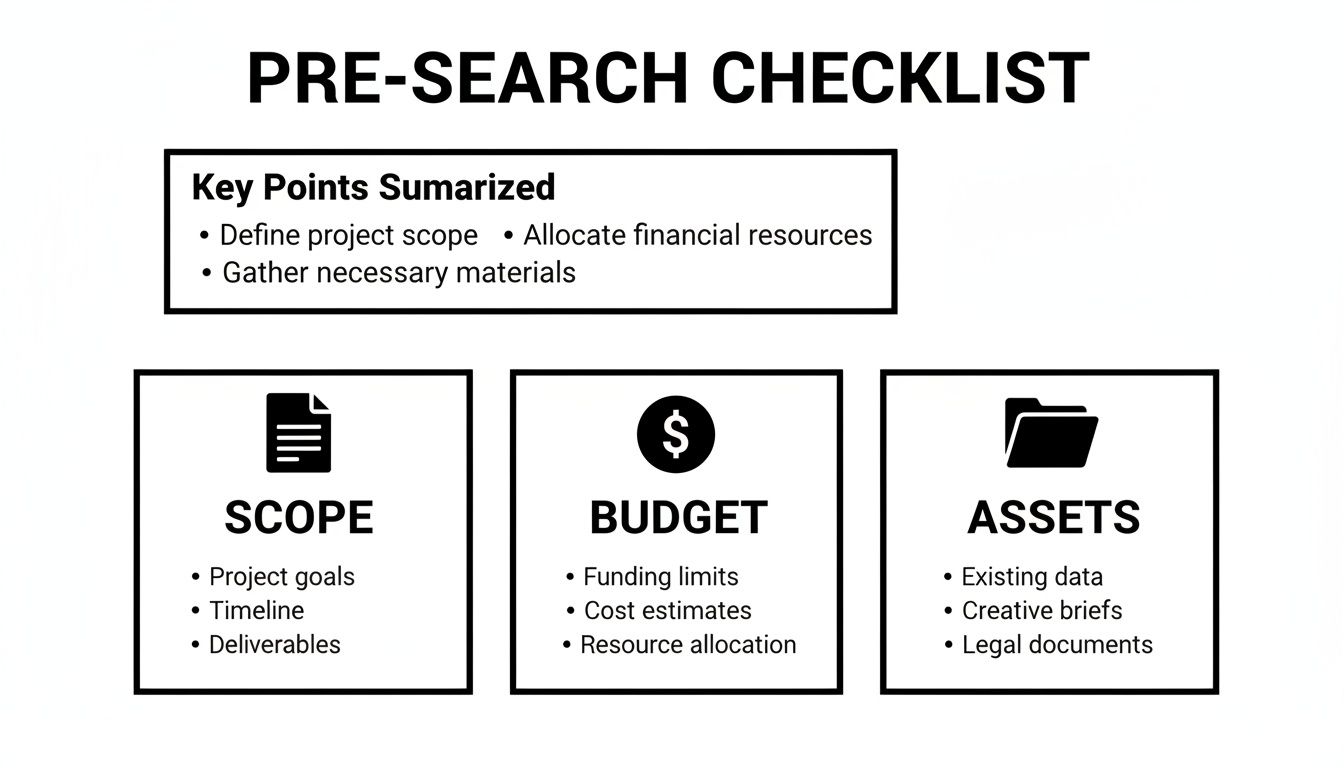
Having these three components defined makes your evaluation of a partner's portfolio more focused, as you can compare their past work directly against your specific needs.
To help you systematically compare potential partners, we've put together an evaluation checklist. Use it to keep your notes organised and make a data-driven decision, not just a gut-feel one.
Shopify Partner Evaluation Checklist
| Evaluation Criteria | What to Look For | Red Flags to Watch For |
|---|---|---|
| Portfolio & Case Studies | Live sites, industry relevance, clear UX/UI. | Broken links, outdated designs, no live examples. |
| Measurable Results | Case studies with hard numbers (e.g., +% conversion, +% AOV). | Vague claims like "improved sales" without data. |
| Technical Skills | Mention of custom apps, API integrations, Headless. | Only basic theme customisations are showcased. |
| Communication Style | Clear project process, regular updates, dedicated contact. | Vague answers, slow response times, no project plan. |
| Shopify Partnership | Official Shopify Partner or Plus Partner badge. | No mention of official Shopify partnership. |
| Client Testimonials | Specific, detailed reviews on their site, Clutch, or Google. | Generic, anonymous praise or no reviews at all. |
This checklist isn't just a tick-the-box exercise. It's a framework to ensure you're comparing apples with apples and finding a partner who genuinely aligns with your business goals.
Verify Their Credentials And Technical Depth
Finally, you need to verify their official status and assess their technical expertise. This is how you separate a true Shopify developer from someone who just knows their way around a pre-built theme.
First, check if they are an official Shopify Partner. You can usually find a badge on their website, but it's worth confirming. This certification means they have been vetted by Shopify itself. The growth in this space has been massive; the Shopify partner ecosystem has swelled to around 100,000 partners across 50 countries, reflecting a huge increase in recent years as demand for specialised skills has accelerated.
Next, look for evidence of advanced technical skills. Does their portfolio or services page mention things like:
- Shopify API Experience: This is crucial for building custom integrations with third-party software like an ERP or a complex CRM.
- Custom Shopify App Development: Have they built private apps using technologies like the Shopify CLI to solve unique client problems?
- Headless Commerce: Do they have experience with more advanced setups using Shopify's Hydrogen framework for ultra-fast, custom front-ends?
Finding a partner with this level of technical depth ensures they can build a store that not only meets your needs today but can also scale with your business tomorrow.
Alright, you've done the hard yards, shortlisted a few promising agencies, and now it's time for that first proper chat. This call is your single most important vetting opportunity. The questions you ask here will tell you everything you need to know, but you have to go way beyond just, "So, how much will this cost?"
I've refined these questions over years of consultations, both asking them and answering them. They’re designed to peel back the layers and get a real feel for a potential partner's process, their strategic brain, and how they actually work. This isn't just about building a website; it's about finding a partner who gets the entire e-commerce machine.
Probing Their Process and Communication
How an agency works is just as critical as what they build. I’ve seen it time and again: a chaotic process always leads to a chaotic, over-budget, and stressful project. Your goal here is to get a sense of their project management rhythm and how they’ll keep you in the loop.
Start with these fundamentals:
- Who will be my day-to-day point of contact? If the answer is vague, like "our team," or they can't name a specific project manager, that’s a red flag for me. You need a single, accountable person to avoid communication nightmares.
- What project management tools do you use? Whether it's Asana, Trello, or something else, a professional agency will have a system. It shows they have a structured workflow for tracking tasks, deadlines, and all communication.
- What does your standard development process look like? They should be able to walk you through their key phases without hesitation—from discovery and design to development, QA testing, and launch. It shows they have a repeatable blueprint for success, not just making it up as they go.
Assessing Their Strategic and Technical Acumen
This is where you separate a simple theme installer from a true Shopify developer. You need to test their ability to think strategically and handle genuine technical challenges. A great partner doesn’t just take your order; they bring their expertise to the table and guide you.
These questions are designed to see how they think on their feet:
- Based on my business goals, what custom functionality would you recommend? This forces them to connect their technical skills to your business objectives. Their answer will reveal if they've actually been listening.
- How do you approach GA4 and Meta Conversion API setups for accurate tracking? This is a non-negotiable question. If they stumble here, they don't understand the full e-commerce stack. We are a Facebook ads agency and know from painful experience that improper tracking makes every dollar of ad spend worthless.
- Can you provide an example of a complex integration you've built using the Shopify API? This gets right to their deep technical skills. You want to hear a story about a time they connected Shopify to a custom ERP, a warehouse management system, or built a unique feature that an off-the-shelf app couldn't handle.
- What is your process for quality assurance (QA) and testing before launch? A professional partner will have a rigorous multi-device and multi-browser testing process. An answer like, "Oh, we click around a bit" is simply not good enough.
A good partner understands the massive landscape they’re operating in. Shopify supports over 5.6 million active online stores globally and commands a huge 26% of the global market share. That dominance reflects a staggering growth of 278% from 2019 to 2026. A great developer knows this and understands how to make your store stand out in that crowded space. You can discover more insights about Shopify's massive growth on brentonway.com.
A few years back, a client hit me with a brilliant question: "What would you do if you had our marketing budget?" It completely changed the conversation. It forced me to think beyond just the website build and consider the entire customer journey, from Google Ads to email marketing. That's the kind of strategic thinking you want in a partner.
Understanding Post-Launch and Ongoing Partnership
The project doesn't end when the site goes live. In many ways, that’s when the real work begins. You need to be crystal clear on what to expect after launch day.
- What does your post-launch support and warranty period look like? A standard warranty to fix any bugs that pop up after launch (usually 30-60 days) is the absolute minimum you should expect.
- Do you offer ongoing retainers for maintenance, updates, and improvements? A great partner wants a long-term relationship, not a one-and-done project. They should have clear packages for ongoing work to keep your site secure, fast, and continuously improving.
- How do you handle urgent issues or site-down emergencies? You need to know they have a solid process for critical support and what their response times look like. Peace of mind is priceless here.
Asking these questions will give you a complete picture of who you’re about to partner with. Remember, you’re not just buying a product; you’re investing in a service and a relationship that could define your business's success for years to come.
Decoding Pricing Models And Post-Launch Support
Alright, let's get into the money conversation. Figuring out how a Shopify development partner actually charges for their work is where a lot of people get stuck, but it’s crucial for keeping your budget in check. The truth is, pricing models aren't as scary as they seem.
Most agencies use one of three main approaches, and the right one for you really just depends on your project's scope and how much flexibility you need. Building a custom Shopify app from scratch is a totally different beast to a few simple theme tweaks, and the pricing will reflect that.
Understanding the Common Pricing Structures
When that first proposal lands in your inbox, the price will almost always be built around one of these models. Knowing the pros and cons of each is your best defence against nasty surprises down the track.
- Fixed-Price Projects: This is exactly what it sounds like. You agree on a single, set price for a very specific list of deliverables. It's brilliant for budget certainty, but it leaves very little room to move if you decide you want to add or change things halfway through.
- Hourly Rates (Pay-As-You-Go): You simply pay an agreed-upon hourly rate for the time a developer works on your project. I find this works perfectly for smaller tasks, troubleshooting, or projects where the scope isn’t set in stone and is likely to evolve.
- Ongoing Retainers: You pay a fixed fee each month, which gives you a set block of development hours or dedicated access to the team. This is the go-to model for businesses that need continuous support, ongoing optimisation, and the ability to roll out new features.
For a brand new store build, a fixed-price project is usually the clearest path forward. But once you're live, an hourly or retainer model makes more sense for all the tweaks and improvements. The key is to match the model to the job.
From my experience, the best client partnerships often end up using a hybrid model. We might start with a fixed-price project for the main store build, then shift to a monthly retainer for ongoing growth and support. It gives both of us clarity and security.
What A Healthy Project Workflow Looks Like
Signing on the dotted line is just the warm-up. Now the real work begins, and any professional Shopify developer will walk you through a clear, structured roadmap. If a potential partner gets vague about their process, consider it a major red flag.
This workflow isn't just about ticking boxes; it’s the blueprint for turning your vision into a real, money-making asset. It ensures the final product actually delivers on your business goals.
Here’s what you should expect to see:
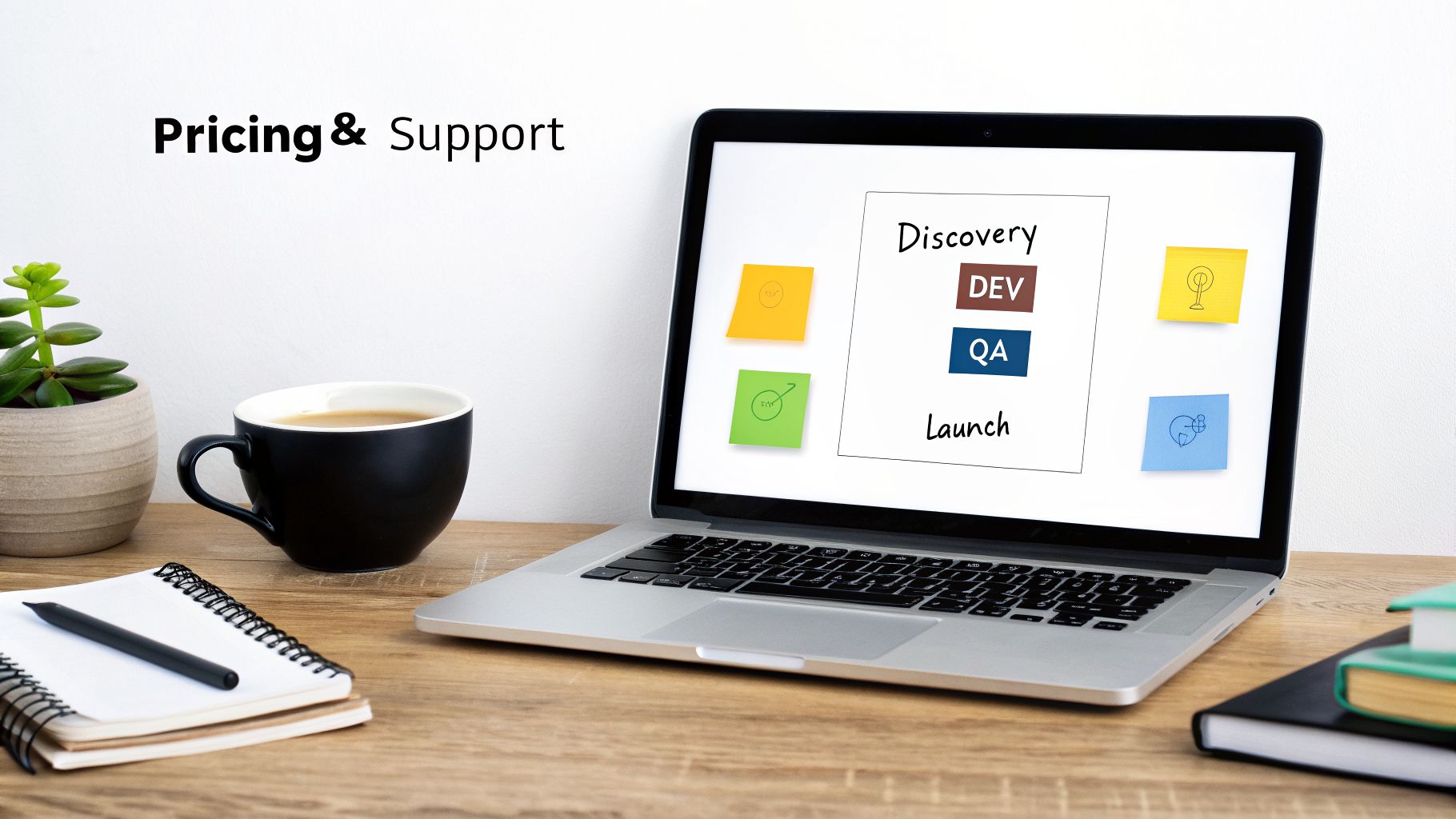
- Discovery & Strategy: The project always kicks off with a deep dive into your business. Your partner should run workshops to finalise the technical requirements, map out the customer journey, and nail down the strategy. This is where we lock in the "must-haves" and separate them from the "nice-to-haves."
- Design & Wireframing: Before anyone writes a single line of code, you should be looking at wireframes (the basic blueprints of your site) and then full-colour mockups. This is your chance to approve the look, feel, and user flow of the store.
- Development: Once the designs are signed off, the developers roll up their sleeves. They’ll set up a staging or development environment—a private clone of your site where you can see progress in real-time without touching your live store.
- Quality Assurance (QA) & Testing: This is a non-negotiable, critical step. The team must rigorously test the entire site across different browsers, mobile devices, and screen sizes to hunt down and squash any bugs or glitches.
- Go-Live & Launch Plan: Launching a website is way more than just flipping a switch. Your partner needs a detailed launch-day checklist, including pre-launch audits, a scheduled deployment (usually during low-traffic hours), and post-launch monitoring to make sure everything is running smoothly.
After the Launch What’s Next
Launch day is the start line, not the finish line. Any agency worth its salt will include a warranty period—usually 30-90 days—to fix any bugs that might have slipped through the cracks.
After that, the conversation should immediately turn to ongoing support and growth. A real partner won't just vanish. They’ll talk to you about a support retainer to handle security updates, performance monitoring, and strategic improvements to help you scale your business. This long-term relationship is where the true value of a great Shopify development partner really shines through.
We Get These Questions a Lot
Over the years, I've had countless chats with business owners trying to figure out the best way to hire a Shopify partner. A few questions always seem to pop up, so I wanted to tackle them head-on here to give you a clearer picture. These are the practical, nitty-gritty concerns that come up time and time again, straight from our experience on the front lines.
What’s the Real Difference Between a Shopify Developer and a Shopify Expert?
This is a great question, and it’s an important one because people throw these terms around interchangeably. While there's overlap, in practice, I’ve seen a clear distinction.
A 'Shopify Expert' is often your go-to for strategy and setup. They're brilliant at configuring themes, know the App Store inside and out, and can get a beautiful, standard store up and running. Think of them as masters of the Shopify admin panel.
A 'Shopify Developer', on the other hand, brings the heavy-duty coding skills. We’re talking about someone fluent in Liquid (Shopify’s own language), JavaScript for those unique front-end experiences, and a deep knowledge of the Shopify API for complex, custom integrations.
For any business needing to stand out with unique features, connect to a custom inventory system, or build a private app, you absolutely need a true Shopify development partner. An expert configures; a developer builds.
How Much Should I Budget for a Custom Shopify Project in Australia?
Ah, the "how long is a piece of string" question. I get it. While every project is different, I can give you some realistic ballpark figures based on what we’re seeing in the Melbourne and Sydney markets.
Costs really do scale with complexity. Here’s a rough breakdown:
- Significant Theme Customisation: Taking a premium theme and needing heavy modifications to match your brand and features? You're likely starting around $5,000 – $10,000.
- Full Custom Build: For a completely bespoke store, designed and built from the ground up with unique features, you’re often looking at a range of $15,000 to $50,000+.
- Private Shopify App: If you need a custom application built to solve a very specific business problem, that’s a similar investment, often starting in the $10,000 – $25,000 range and climbing from there.
A good partner will always insist on a detailed discovery phase before locking in a quote. Be very wary of rock-bottom prices—they almost always mean you're getting a cookie-cutter site that won't grow with you.
Should I Hire a Local Melbourne Partner or an Overseas Freelancer?
I get this question all the time, especially from businesses trying to be smart with their budget. Hiring an overseas freelancer might seem cheaper on paper, but the hidden costs can bite you, hard.
Just think about the practical side of things:
- Time Zone Delays: A simple question turns into a 24-hour wait for an answer. That kind of delay absolutely kills a project's momentum.
- Communication Gaps: Nuances get lost in translation, leading to frustrating rework and a final product that just isn't quite right.
- Local Market Knowledge: A Melbourne-based partner like us at Alpha Omega Digital just gets the Australian ecommerce scene. We know the local payment gateways like Afterpay and understand the quirks of shipping with Australia Post.
For something as critical as your online store, having a local partner in your time zone, who you can collaborate with in real-time and who is accountable under local laws, provides peace of mind you just can’t put a price on.
What Happens After My Shopify Store Is Launched?
Launch day is the starting line, not the finish. Any Shopify development partner who hands over the login details and then vanishes isn’t a partner; they're just a vendor.
Post-launch support is non-negotiable. At the absolute minimum, this should include a warranty period (we offer 30-60 days) to iron out any bugs that might pop up once the site is live. From there, a great partner offers ongoing retainers for security updates, performance optimisation, and strategic enhancements.
The goal should always be a long-term partnership focused on growth. Your business will change, and your website needs to evolve with it.
If you're a business with a paid ads budget of at least $3k a month, I'd love to offer you a low-risk deal—get a month of paid ads management FREE. Alpha Omega Digital is a marketing agency based in Melbourne, Australia but also services clients from Sydney, Brisbane, Newcastle, Perth, Adelaide, Darwin and Hobart.
Have a project in mind? Apply now through our contact page.