
When you’re building an eCommerce business, hiring Shopify expert developers isn't just about getting a website live. From my experience, it's about building a high-performance sales engine designed for real, sustainable growth.
A good expert transforms your store from a basic template into a customised, conversion-focused platform that gives you a proper competitive edge. The difference they make has a direct impact on your bottom line.
Why the Right Shopify Expert Is a Game Changer for Growth

From my experience running a digital marketing agency in Melbourne, I’ve seen the massive gap between an average coder and a true Shopify expert firsthand. It’s the difference between a store that just exists and one that actively works to sell for you, 24/7.
A genuine expert doesn't just install a theme and call it a day. They dig deep into your business goals to build features that solve real problems and, most importantly, drive sales. As a Shopify development company, we’ve seen the direct impact this has on revenue for our clients.
Beyond a Pretty Theme
Thinking a Shopify developer just picks a nice design is one of the most common mistakes I see. Their real value is in the technical execution that powers your eCommerce business’s growth.
This is where the magic really happens:
- Deep Customisations: They can implement unique features your competitors can't just copy, like advanced product bundlers or custom checkout flows that slash friction for your customers.
- Performance Optimisation: They ensure your site is lightning-fast. We take this seriously, because even a one-second delay in page load time can tank conversions by 7%.
- Flawless Integrations: A pro will correctly set up critical tools like the Meta Conversion API via Google Tag Manager. This makes sure your ad spend is accurately tracked, giving you the clean data you need to make smart decisions in your campaigns.
The demand for this level of skill is growing like crazy. Australia's Shopify Partner ecosystem has seen a massive 72% increase in partner agencies and developers recently, servicing over 154,000 live stores.
For an eCommerce business in Melbourne, this is great news. It means access to world-class talent is better than ever, but it also means you need to know how to be selective. You can discover more about these market trends and what they mean for the platform's future.
A great Shopify developer doesn't just build what you ask for; they build what your business needs to succeed. They understand that every line of code should ultimately contribute to a better customer experience and a higher conversion rate.
Working with an expert means you have a partner who can build custom Shopify apps using tools like Shopify CLI, giving you proprietary functionality you won't find anywhere else. Our experience as a WordPress developer also informs our approach, as we often help clients migrate or integrate systems, highlighting the value of versatile development skills.
At our eCommerce marketing agency, we’ve seen clients completely transform their operations and revenue by investing in this level of expertise. It's not an expense; it's a strategic investment in your long-term success.
Alright, so you're sold on getting an expert. But where do you actually find one? The internet is a crowded place, and it’s surprisingly easy to make a wrong turn that ends up costing you a lot of time and money. I’m going to walk you through the main places I’ve sourced talent and share my honest experience with each.
Finding the right person is all about knowing where to look and understanding the pros and cons of each channel. Let's start with the most obvious one.
The Official Shopify Experts Marketplace
Shopify has its own hand-picked marketplace, which is a sensible place to start your search. The developers and agencies you find here have already been vetted by Shopify, so you can count on a certain baseline level of quality. They usually have solid track records and a deep understanding of the platform.
The catch? This is generally the premium option. Because they’re officially recognised, their rates are often on the higher side. It’s a solid, reliable choice if you’ve got the budget for it, but it might not be the most cost-effective path for smaller projects or startups just getting off the ground.
Freelance Platforms like Upwork and Toptal
Platforms like Upwork, Fiverr, and Toptal are absolutely flooded with Shopify expert developers. The big advantage here is the sheer volume of talent and the competitive pricing. You can find someone for just about any budget or project size.
The downside is that it’s a real mixed bag. You have to do a lot more of the heavy lifting to vet candidates yourself. While you might stumble upon a hidden gem, you could just as easily hire someone who overpromises and underdelivers. These platforms are often best for smaller, well-defined tasks rather than a full custom store build where you need a deeper partnership.
Many platforms also specialise in connecting businesses with skilled developers. For instance, you can easily find and actively choose to hire Shopify expert developers through dedicated services that really simplify the search process.
Partnering with a Local Melbourne Agency
This is where I believe the real value is, especially for Australian eCommerce businesses. When you partner with a Shopify developers Melbourne agency like ours, you’re getting so much more than just a coder.
You get a team that gets the local market, understands Australian consumer behaviour, and knows the specific challenges of selling in this country.
A local agency isn't just a vendor; they're a growth partner. We don't just build your site and disappear. We integrate development with the services that actually grow your business.
For example, as the best Facebook Ads agency for many of our eCommerce clients, we build a site with conversion in mind from day one and can immediately tie it into a high-performing Google Ads agency campaign or a targeted Meta Ads strategy. This cohesive approach ensures your investment in development translates directly into sales and a strong return. It’s about building a sales engine, not just a website.
My Vetting Checklist for Spotting a True Expert
This is where you separate the real Shopify professionals from the pretenders. A bad hire can cost you thousands in wasted budget and set your business back months—I've seen it happen. Over the years, I've refined a process that helps me filter out the noise and identify genuine talent. I’m going to share that exact checklist with you.
First, let's be clear: a portfolio isn't just a gallery of pretty designs. I look for proof of results. I want to see case studies showing how their work directly improved a store's conversion rate, average order value, or site speed. A beautiful store that doesn't sell is just an expensive digital brochure.
To help guide your hiring journey, this visual decision tree can map out the process, from defining what you actually need to finding the right place to look.
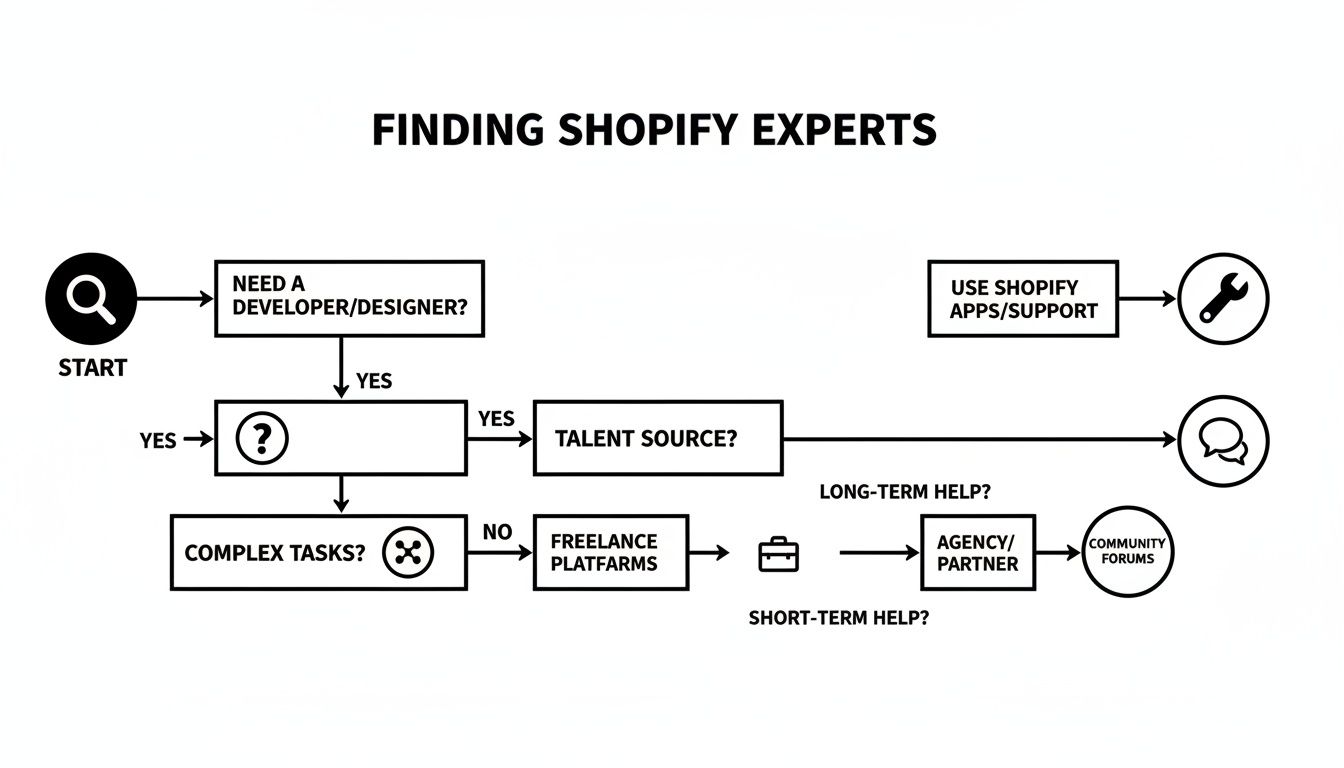
The flowchart shows that the path to a top-tier Shopify developer starts by getting crystal clear on your project's scope before you even think about looking at marketplaces, agencies, or freelance platforms.
Digging Deeper with Technical Questions
When I'm interviewing a candidate or an agency, I ask specific questions to gauge their technical depth. You can tell pretty quickly if they truly know their stuff or are just repeating buzzwords they found online.
Here are a few of my go-to questions:
- Shopify API: "Describe a project where you used the Shopify API for a complex integration. What was the challenge, and how did you solve it?" Their answer reveals their problem-solving chops and experience with custom work.
- Custom App Development: "Walk me through your process for building a custom Shopify app using Shopify CLI. What are the key considerations?" This tests their knowledge of modern Shopify workflows beyond simple theme edits.
- Tracking & Analytics: "How would you approach setting up the Meta Conversion API and GA4 eCommerce tracking through Google Tag Manager for a new store?" A true expert will talk about data layers, server-side tracking, and ensuring data accuracy for ad campaigns. This is a core part of what our Facebook Meta Ads agency does to ensure ROI.
The eCommerce scene in Australia is absolutely booming. In fact, Shopify has a massive footprint with 154,625 active stores, making it one of the platform's strongest markets globally. This huge reliance on Shopify highlights the soaring demand for expert developers who can build high-converting stores. Top agencies are leading the charge by blending advanced tech with a deep understanding of local market needs, which is why so many Melbourne businesses seek out local Shopify experts for fast, effective sites. You can get more details on these Shopify store statistics from recent analyses.
A developer's ability to clearly explain complex technical concepts in simple terms is a massive green flag. It shows they not only understand the 'how' but also the 'why,' which is critical for a successful partnership.
For a more complete vetting process, looking into essential candidate assessment methods is a smart move to make sure you find an expert who delivers real business results. Verifying their skills with a small, paid test project or checking references is a final, non-negotiable step before you sign any contracts.
Navigating Pricing Models and Project Contracts
Let's talk about the money. This is often the part where eCommerce businesses get stuck or, worse, make a costly mistake when hiring a Shopify expert developer. How much should it cost? The honest answer is "it depends," but I'll give you some realistic benchmarks based on my years of experience running projects as a marketing agency in Melbourne.
The price tag will swing wildly based on the developer's location, their experience, and how complex your project actually is. A simple theme tweak is a world away from building a custom app using the Shopify developer API, and the price will reflect that. Our experience as WordPress developers in Melbourne shows similar pricing structures, confirming this is an industry-wide model.
Decoding Common Pricing Models
Once you start getting quotes, you’ll run into three main ways developers structure their pricing. Getting your head around these is key to finding a deal that works for you and avoiding any nasty surprises down the track.
Hourly Rates: This is a classic for freelancers and some agencies. You simply pay for the time they spend on your project. It's great for ongoing work, small fixes, or projects where the scope isn't perfectly defined yet. The risk? Costs can spiral if the project isn’t managed with an iron fist.
Fixed-Price Projects: For projects with a rock-solid scope—like a full site build or adding a specific feature—a fixed price is perfect. You know the total cost upfront, which makes budgeting a breeze. The crucial part here is to have an incredibly detailed project brief to avoid "scope creep."
Monthly Retainers: This is my favourite model for long-term partnerships. A retainer secures a set number of hours from a developer or agency each month. It’s ideal for ongoing support, performance optimisation, and gradually rolling out new features. It turns your developer into a proactive partner, not just a one-off contractor.
The best pricing model really comes down to your needs. For a quick bug fix, hourly is a no-brainer. For building a new store from scratch, a fixed price gives you certainty. For continuous growth and optimisation, a retainer is unbeatable.
Your Contract Is Your Best Friend
No matter which pricing model you land on, a solid contract or Statement of Work (SOW) is completely non-negotiable. This document is your best defence against budget blowouts, missed deadlines, and painful misunderstandings. I've seen handshake deals go sour, and trust me, it’s a lesson you don’t want to learn the hard way.
Your contract needs to clearly outline every single aspect of the project. Don't be afraid to get overly detailed; clarity is everything here.
A strong SOW should always include:
Clear Deliverables: What exactly is being built? Get specific. Instead of "build a new product page," it should read, "Design and develop a new product page template including a sticky 'Add to Cart' button, a custom image gallery, and an accordion for product details."
Payment Milestones: Break the total cost into smaller payments tied to project milestones (e.g., 25% on signing, 25% after design approval, 50% on final launch). This protects both you and the developer.
Revision Process: How many rounds of revisions are included at each stage? What’s the process for asking for changes? Defining this upfront stops the endless back-and-forth later.
Ownership of Code: This is critical. The contract must state that you own 100% of the final code and assets once the final payment is made. This is your business's future, so make sure you own it.
A well-defined contract sets the foundation for a successful relationship. It ensures everyone is on the same page and gives you a clear path forward if disagreements ever pop up.
Managing the Project for a Successful Launch

So you’ve found and hired your Shopify expert developer—congratulations! But the real work is just beginning. This is where your vision finally starts taking shape, and how you manage this phase is just as critical as who you hired in the first place.
A brilliant developer can’t read your mind. I've seen countless projects go off the rails because of assumptions and miscommunication. Clear, structured project management is the secret to a smooth launch.
At our agency, we’ve learned that a strong start prevents most headaches down the track. It all begins with a detailed project brief. This is more than a list of features; it’s a document that explains your business goals, your target audience, and the why behind every single requirement. When a developer gets your commercial objectives, they stop being just a coder and start becoming a strategic partner. We apply these same principles to our web design Melbourne projects.
Setting Up for a Smooth Workflow
Once the brief is locked in, we get organised. Immediately. We set up shared spaces for communication and all your brand assets. This is non-negotiable. It stops vital information from getting buried in endless, messy email threads.
Here’s a quick look at our typical setup, which you can easily adopt:
- A Dedicated Comms Channel: We almost always use a dedicated Slack channel for each project. It keeps all project-related chat in one place, lets us ask quick questions, and makes it easy to loop in different team members when needed.
- Centralised Asset Management: A shared Google Drive or Dropbox folder is essential. We ask clients to upload all brand assets—logos, fonts, high-res images, and copy—before any development starts. This simple step prevents so many delays.
- A Transparent Project Board: Tools like Asana or Trello are our source of truth. We map out the entire project, breaking it down into phases, tasks, and deadlines. Everyone can see what’s being worked on, what’s next, and who’s responsible for what.
This level of organisation keeps everyone on the same page and is especially vital for complex builds. We see this a lot with projects on Shopify Plus, which often involve multiple apps and custom integrations.
The scale of these projects is only getting bigger. Shopify Plus adoption in Australia is expected to hit 3,056 stores soon, joining over 47,000 live Plus sites globally. With 87% of merchants using an average of six apps, you need an expert developer who can manage that complexity for a successful launch. You can read more about Shopify development trends in Australia to get a sense of the landscape.
My biggest tip for giving feedback is to be specific and visual. Instead of saying "I don't like this," say "Can we change the button colour to our brand's primary blue and increase the font size by 2px?" A screenshot with annotations is even better.
This kind of constructive, actionable feedback is gold. It removes all the guesswork for the developer and ensures the final result is exactly what you had in mind, perfectly aligned with your business goals.
Common Questions About Hiring Shopify Developers
Over the years, I've had hundreds of chats with eCommerce owners about hiring Shopify expert developers. A few key questions always pop up, so I wanted to tackle them head-on with some straight-to-the-point answers based on what I’ve seen work (and what hasn’t) while running projects.
How Much Does It Cost to Hire a Shopify Expert Developer?
The honest answer? It varies wildly. Here in Australia, you’ll see experienced freelancers charging anywhere from $70 to $200+ per hour. If you're looking at a full custom store build from a Melbourne agency like ours, you’re typically looking at a starting point of $10,000 to $50,000+, depending on how complex things get.
For smaller, more contained jobs like tweaking a theme or getting a specific app integrated, you might find a fixed fee starting around $1,500-$3,000.
My best advice is to stop focusing on the hourly rate. A cheap developer often ends up costing you more in the long run through bugs, delays, and a site that just doesn't convert. Always weigh the cost against the potential value and ROI.
What Is the Difference Between a Shopify Developer and a Designer?
Getting this distinction right is crucial. A Shopify designer is all about the user experience (UX) and user interface (UI)—how your store looks, feels, and guides a customer through their journey. They’re the architect of the customer’s experience.
A Shopify expert developer, on the other hand, is the builder who takes that architectural blueprint and brings it to life with code. They handle the heavy lifting: the technical build, custom app development, and complex Shopify developer API integrations—like hooking up Meta's Conversion API. They’re the ones making sure your site is lightning-fast and secure.
At our agency, the best projects always happen when our designers and developers are working in lockstep from day one.
The most successful Shopify stores are a perfect blend of brilliant design and flawless development. One without the other will always fall short of its true potential.
Do I Need a Local Developer in Melbourne or Can I Hire Remotely?
You can definitely hire remotely, and many people do. But partnering with a local Shopify developers Melbourne agency brings some real, tangible benefits to the table. For starters, you’re in the same time zone, which makes communication a whole lot easier. They also have a gut-level understanding of the Australian consumer market.
More importantly, a full-service agency can offer you a whole lot more than just a website. We can build your Shopify store and then immediately roll into running a targeted Google Ads campaign for you. It’s all managed by one cohesive team that already gets your business goals inside and out.
What Ongoing Support Will I Need After My Store Is Built?
Launching your store is just the beginning. I always tell clients to think of a monthly support retainer not as an upsell, but as insurance for their investment.
Your store is a living asset, and it needs ongoing care to perform. A retainer usually covers the essentials:
- Security Updates: Protecting your store and your customers' data from new threats.
- Bug Fixes: Having an expert on call to quickly squash any technical issues that pop up.
- Performance Monitoring: Making sure your site stays fast and responsive as you add more products and apps.
- Small Enhancements: Gradually adding new features or making small tweaks based on customer feedback.
It's also vital for keeping your marketing running smoothly. For instance, if your Google Shopping ads suddenly stop spending, you need a developer who can jump in and troubleshoot a product feed issue. Having that expert on call gives you peace of mind and ensures your store can continue to adapt and grow.
If you're a business with a paid ads budget of at least $3k a month, Alpha Omega Digital would love to offer you a low-risk deal—get a month of paid ads management FREE. Apply now through our contact page.