
As the founder of a digital marketing agency in Melbourne, I've had this exact conversation countless times with rapidly growing eCommerce clients. It usually starts with them asking, "Is it time for Shopify Plus?" This isn't just a casual question; it's a sign that they're starting to feel the walls closing in on their current setup. They've hit a ceiling, and it's costing them money.
From my real-world experience, the answer isn't a simple "yes" or "no" based on revenue. It’s about recognising the specific growing pains that are throttling your potential and knowing when to make the leap. It's about seeing the platform not as an expense, but as a high-performance engine for growth.
In this guide, I'm going to walk you through everything I've learned from helping dozens of Australian eCommerce brands make this transition. We'll cover when to upgrade, the features that actually make you money, how to calculate the real ROI, and how to partner with an agency to get the most out of your investment.
Table of Contents
- When to Make the Leap to Shopify Plus
- Recognising the Tipping Point
- Shopify Standard vs Shopify Plus At a Glance
- A Platform Built for Australian Growth
- Core Features That Actually Drive Growth
- Unlocking a Smarter Checkout
- Automate Your Operations with Shopify Flow
- Launchpad and B2B on Plus
- Calculating the True Cost and ROI
- The Transaction Fee Advantage
- Estimating Your Break-Even Point
- The Opportunity Cost of Staying Put
- How to Migrate Without the Headaches
- The Migration Playbook, Step-by-Step
- The Most Overlooked Step: SEO Preservation
- Final Checks and a Flawless Launch
- Shopify Plus vs Other Enterprise Platforms
- Total Cost of Ownership: A Reality Check
- Speed to Market and Agility
- Ease of Use for Your Team
- Enterprise Platform Feature Showdown
- Why Partner with a Shopify Plus Agency
- Beyond the Launch: A Strategic Growth Partnership
- Hyper-Targeted Ads That Leverage Plus Data
- Solving Unique Problems with Custom Solutions
- Common Questions We Get About Shopify Plus
- What's the Revenue Tipping Point for Shopify Plus?
- Can I Just Keep My Current Shopify Theme?
- How Does Shopify Plus Actually Handle International Sales?
- What Kind of Support Do You Actually Get?
- My Final Thoughts and Your Next Step
- Bonus Section: Expanding Your Digital Toolkit
- WordPress Development and Design
- Mastering Paid Advertising: From Google to Meta
- The Power of SEO and Local Presence
- Advanced Technical Setups and Custom Development
When to Make the Leap to Shopify Plus

From my experience guiding dozens of brands through this exact transition, the decision to upgrade is rarely a single lightning-bolt moment. It’s more like a slow burn—a collection of frustrations that finally reach a tipping point.
It’s that sinking feeling when your site slows to a crawl during a Black Friday sale, costing you thousands in lost revenue and customer trust. It’s the realisation that your team is burning hours on manual tasks that should have been automated months ago, pulling them away from work that actually moves the needle.
I've seen it all the time with ambitious eCommerce businesses. A brand does everything right—their marketing is firing on all cylinders, products are flying off the digital shelves—but the platform itself becomes the bottleneck.
Recognising the Tipping Point
The signs that you’ve outgrown your standard plan are usually crystal clear, if you know what to look for. Are you hitting a wall with checkout customisation? This is a huge one. The standard Shopify checkout is solid, but it’s not your brand.
With Shopify Plus, you get total control. You can add trust badges, custom upsells, and a design that feels like a seamless extension of your site. This isn't just a cosmetic tweak; it directly lifts your conversion rate. I've personally seen it happen again and again.
Here are the key triggers I've seen that scream, "It's time":
- Traffic Surges: Your site groans under the pressure of product launches, holiday sales, or a viral marketing moment. Shopify Plus is engineered to handle over 10,000 transactions per minute, so you never have to worry about the site going down when it matters most.
- Automation Gaps: You're still manually segmenting customers, juggling inventory across multiple warehouses, or handling complex order rules. A tool like Shopify Flow (a Plus exclusive) automates these workflows, saving a staggering amount of time and cutting out human error.
- Global Ambitions: You want to sell overseas, but managing different currencies, languages, and regional storefronts is a logistical nightmare. Plus makes this easy with dedicated expansion stores that simplify global commerce.
- Wholesale Headaches: Your B2B or wholesale operation is clunky, relying on spreadsheets and manual orders. The Plus-exclusive wholesale channel gives your B2B customers a slick, self-service portal that streamlines the entire process.
Shopify Standard vs Shopify Plus At a Glance
Here’s a straightforward breakdown of what you get when you level up, comparing the core limitations of standard plans with the capabilities of Plus. I often share this with clients to make the choice clear.
| Feature | Shopify Standard | Shopify Plus |
|---|---|---|
| Checkout | Standard, non-editable checkout page. | Fully customisable checkout.liquid file for a branded experience. |
| Automation | Limited; relies on third-party apps. | Shopify Flow for powerful, custom workflow automation. |
| Storefronts | One store per subscription. | Up to 9 expansion stores for international markets. |
| Wholesale | Requires apps or workarounds. | Dedicated, password-protected wholesale channel. |
| Staff Accounts | Up to 15 staff accounts. | Unlimited staff accounts with advanced permissions. |
| Server Capacity | Standard capacity. | Enterprise-grade infrastructure built for high-volume sales. |
| Support | Standard support channels. | Dedicated Launch Engineer and Merchant Success Manager. |
| Custom Development | Limited API access. | Enhanced API limits and access to exclusive APIs for custom apps and integrations. |
| Event Scheduling | Manual execution for sales events. | Launchpad for scheduling product releases, theme changes, and sales. |
This table really just scratches the surface, but it highlights the fundamental shift from a platform that supports your business to one that actively scales it.
A Platform Built for Australian Growth
It's no accident that so many of Australia's top brands make the switch. In fact, Australia is a powerhouse market for the platform. Recent data shows there are 3,056 live websites powered by Shopify Plus in Australia, making us the third-largest market globally, right behind the US and the UK. When I'm looking for inspiration, I prioritise checking out great Australian websites first, as they're often leading the charge.
This rapid adoption, especially within Melbourne's vibrant eCommerce scene where our agency is based, speaks volumes. Globally, merchants on the platform report an incredible 126% year-over-year revenue growth, a trend we consistently see reflected right here at home. You can dig into more Shopify Plus statistics and see how it’s reshaping the market.
Moving to Shopify Plus isn't just an upgrade. It’s a strategic decision to equip your business with the enterprise-level tools needed to compete and win. It's about finally having the power to create a truly seamless, branded customer journey from the first click all the way to the final purchase.
Core Features That Actually Drive Growth

Alright, let's cut through the marketing fluff and talk about the tools inside Shopify Plus that we, as a Melbourne-based agency, actually use to get results for our eCommerce clients. It’s easy to get lost in a long feature list, but a few key ones consistently deliver a massive return through smart customisation and automation.
The ability to completely customise the checkout is probably the biggest and most immediate win. On standard Shopify plans, the checkout is a locked box. With Plus, we get the keys. Using Shopify Scripts, we can build dynamic, intelligent checkout experiences that directly pump up your average order value (AOV).
As a hands-on shopify development partner, I've found that what you do in the checkout is just as important as getting someone there. Simple, script-driven offers can easily lift AOV by 15% or more, paying for the platform upgrade on its own.
Unlocking a Smarter Checkout
This isn't about changing a few colours and fonts. This is about injecting powerful business logic right at the final step of the purchase journey, when the customer has their wallet out.
Here’s how my team and I have used Shopify Scripts to make our clients more money:
- Tiered Shipping Offers: We can set up rules like, "Spend $100, get standard shipping for $5. Spend $150, get it free." This updates in real-time as customers add to their cart, nudging them towards that higher spend.
- Automatic 'Buy One, Get One' (BOGO) Deals: Instead of making customers fiddle with discount codes, we can automatically add a free or discounted product to the cart when a specific item is added. It's a brilliant way to clear old stock or promote new products.
- VIP Customer Discounts: We can write scripts that automatically apply a 10% discount for customers tagged as 'VIP', rewarding loyalty without them having to remember a code.
- Hiding Payment Options: For some high-risk products, we can write a script that hides certain payment gateways, giving the business more control and reducing fraud risk.
These aren’t just minor tweaks; they're powerful conversion tools that used to be reserved for brands with huge, custom-built platforms. This level of customisation is a core part of effective Shopify design and development.
Automate Your Operations with Shopify Flow
The next game-changer is Shopify Flow. Honestly, think of it as your own tireless, 24/7 operations manager who never needs a coffee break. It's a visual workflow builder that lets you automate hundreds of repetitive tasks across your store and apps, freeing up your team for work that actually requires a brain.
The interface uses simple blocks, letting you connect triggers, conditions, and actions to create automations. The best part? It's designed to be used by anyone on your team, not just a Shopify developer.
I set up flows for everything, from marketing segmentation to fraud prevention. A common workflow we build is one that segments customers who spend over $500 in one go. The flow automatically adds a 'High-Value Customer' tag and sends their details to a special email list for exclusive offers. Simple, automated, and effective.
Launchpad and B2B on Plus
For brands that live and die by big, scheduled events like flash sales or product drops, Launchpad is an absolute lifesaver. It lets you schedule a whole bunch of actions to happen at a specific time, including:
- Publishing a new theme for the sale.
- Making products available to buy.
- Applying event-specific discounts.
- Running scripts to lock the site beforehand with a "coming soon" page.
This means you can set up your entire Black Friday campaign weeks in advance and know it will execute perfectly, even if your whole team is asleep.
Finally, the dedicated wholesale channel gives you a separate, password-protected storefront just for your B2B clients. It lets you set custom pricing, net payment terms, and minimum order quantities, turning what was once a manual, email-driven process into a slick, self-service portal.
Of course, none of this matters without rock-solid security. Ensuring your payment processing meets industry standards is non-negotiable, and understanding topics like PCI DSS compliance is crucial. All these Shopify Plus features are built on an enterprise-level foundation, giving both you and your customers peace of mind as you scale.
Calculating the True Cost and ROI
That Shopify Plus price tag—starting at $2,300 USD per month—can make anyone pause. As a results-focused digital agency in Melbourne, I’ve walked countless clients through this exact calculation, and I always tell them the same thing: don't just look at the subscription fee. You have to look at the entire picture to see the real maths.
When you’re processing a serious volume of sales, the platform cost isn't just the monthly bill. It’s also the slice you give away on every single transaction. This is where, for many growing eCommerce businesses, Shopify Plus suddenly starts to make a whole lot of financial sense.
The Transaction Fee Advantage
For any business not using Shopify Payments, the fee structure is a critical part of the equation. On the Advanced Shopify plan, you’re paying a 0.5% transaction fee. Once you step up to Shopify Plus, that fee gets cut in half, dropping to just 0.25% if you're using a third-party payment gateway.
It might not sound like much, but that tiny percentage adds up incredibly fast. If your store is pulling in $100,000 AUD in monthly revenue, that 0.25% reduction instantly saves you $250 a month. Push that to $500,000 AUD a month, and you're saving $1,250 every single month, just on fees. At the $1 million AUD per month mark, you’re pocketing an extra $2,500—which covers a huge chunk of the platform cost right there.
It's a simple calculation I run with my clients: at what point do your transaction fee savings start to eat into, or even exceed, the platform's monthly cost? For many high-volume Australian stores, this break-even point arrives much sooner than they expect.
Estimating Your Break-Even Point
You can get a rough idea of your own financial break-even point with some back-of-the-napkin maths. It helps you reframe the monthly fee not as a cost, but as an investment that those lower fees help pay for.
Here’s a basic way to think about it:
- Figure out the fee difference: What’s the price gap between your current plan and the Shopify Plus plan?
- Calculate your fee savings: Take your monthly revenue and multiply it by the percentage you'd save (e.g., 0.25%).
- Compare the two: How much of the platform upgrade is covered by what you save on transaction fees?
This calculation is a great starting point, but it only tells half the story. The real return on investment (ROI) comes from what you gain by making the switch, not just what you save.
The Opportunity Cost of Staying Put
Often, the biggest cost isn't the one on your invoice. It’s the "opportunity cost"—all the money you’re leaving on the table by sticking with a platform that’s holding your growth back. I see this play out constantly with clients who wait just a little too long to upgrade.
Think about these real-world scenarios I've seen:
- Lost Revenue from Downtime: What would it cost you if your site crashed for just one hour during a Black Friday sale? For many brands, that’s tens of thousands of dollars in lost orders and, even worse, a serious blow to customer trust. Shopify Plus is built on enterprise-grade infrastructure designed to handle those massive traffic spikes without breaking a sweat.
- The Salary Cost of Manual Work: How many hours does your team burn on tasks that Shopify Flow could automate in seconds? Manually segmenting customers, dealing with inventory tags, or flagging high-risk orders costs real money in salaries. Automating that work frees up your team to focus on strategy and growth.
- Inability to Customise and Convert: What's a 1% lift in your conversion rate worth to you? Features like checkout customisation and Shopify Scripts, which let you create targeted upsells and unique promotions, directly lead to higher conversion rates and bigger average order values. If you can't implement these, you're just letting competitors with better tools win over your customers.
Once you start factoring in these opportunity costs, the platform fee stops looking like an expense and starts looking like a strategic investment. These features aren't just bells and whistles; they are commercial tools designed to make your site faster, boost your conversion rates, and ultimately drive a much higher customer lifetime value. This is how I help clients turn a platform fee into a profitable engine for their eCommerce business.
How to Migrate Without the Headaches
Moving your entire eCommerce operation over to a new platform like Shopify Plus sounds terrifying. I get it. The thought of losing data, breaking links, or watching your sales flatline during the switch is enough to keep any business owner up at night.
But after managing dozens of these migrations, I promise you, it doesn’t have to be a headache.
My Shopify development team here in Melbourne has this down to a science. We’ve built a battle-tested process that’s all about preparation, precision, and relentless testing. It’s a playbook we’ve designed to protect your revenue, preserve your hard-earned SEO authority, and make the transition so smooth your customers won’t even notice anything changed.
The Migration Playbook, Step-by-Step
A successful migration isn't a rushed job; it’s a carefully planned project with very distinct phases. From what I’ve seen, skipping any of these steps is where things usually go wrong. For a project of this scale, many businesses find that working with an agency or deciding to hire skilled Shopify developers is the safest path forward to avoid costly mistakes.
Here’s the step-by-step process I follow:
- Step 1: The Discovery Phase: Honestly, this is the most crucial stage. I dig deep into your current setup, identifying every single app, customisation, and third-party integration you rely on. I create a full inventory and map out how each function will be replicated or, more often, improved on Shopify Plus.
- Step 2: Secure Data Migration: We use specialised tools to securely export and then import all your critical data. This means your customers (with their passwords and order history), your products (with every variant and image), and all your historical order information. Accuracy here is completely non-negotiable.
- Step 3: Custom Theme Development: Sure, you can use an existing theme, but this is the perfect opportunity to build a custom storefront that truly harnesses the power of Plus. Our Shopify developers get to work creating a fast, beautiful, and conversion-focused theme in a private sandbox environment.
- Step 4: App Integration and Testing: We install and configure all the necessary apps, from your email marketing platform to your inventory management system. This is also where my team can build any custom solutions needed to bridge functionality gaps, making sure your new setup works exactly how your business operates.
The Most Overlooked Step: SEO Preservation
The single biggest mistake I see people make is failing to map their old URLs to their new ones. It’s a disaster waiting to happen. If Google comes back to crawl your site and finds thousands of "404 Not Found" errors, your search rankings will plummet overnight.
It can take months, even years, to recover from that kind of SEO damage.
I treat your URL structure like gold. A comprehensive 301 redirect map is non-negotiable in our migration process. Every old product page, category page, and blog post must point perfectly to its new home on Shopify Plus. This is a core service for any good seo agency in Melbourne.
This process is meticulous, but it's absolutely essential. We crawl your entire existing site to capture every single URL and then systematically map each one to its new counterpart. This tells search engines exactly where the content has moved, ensuring a seamless transfer of your SEO authority and preventing any loss of organic traffic.
The diagram below gives a simplified look at how we approach a project's value. It’s not just about managing the upfront cost, but about unlocking new savings and profit through the platform's advanced capabilities.
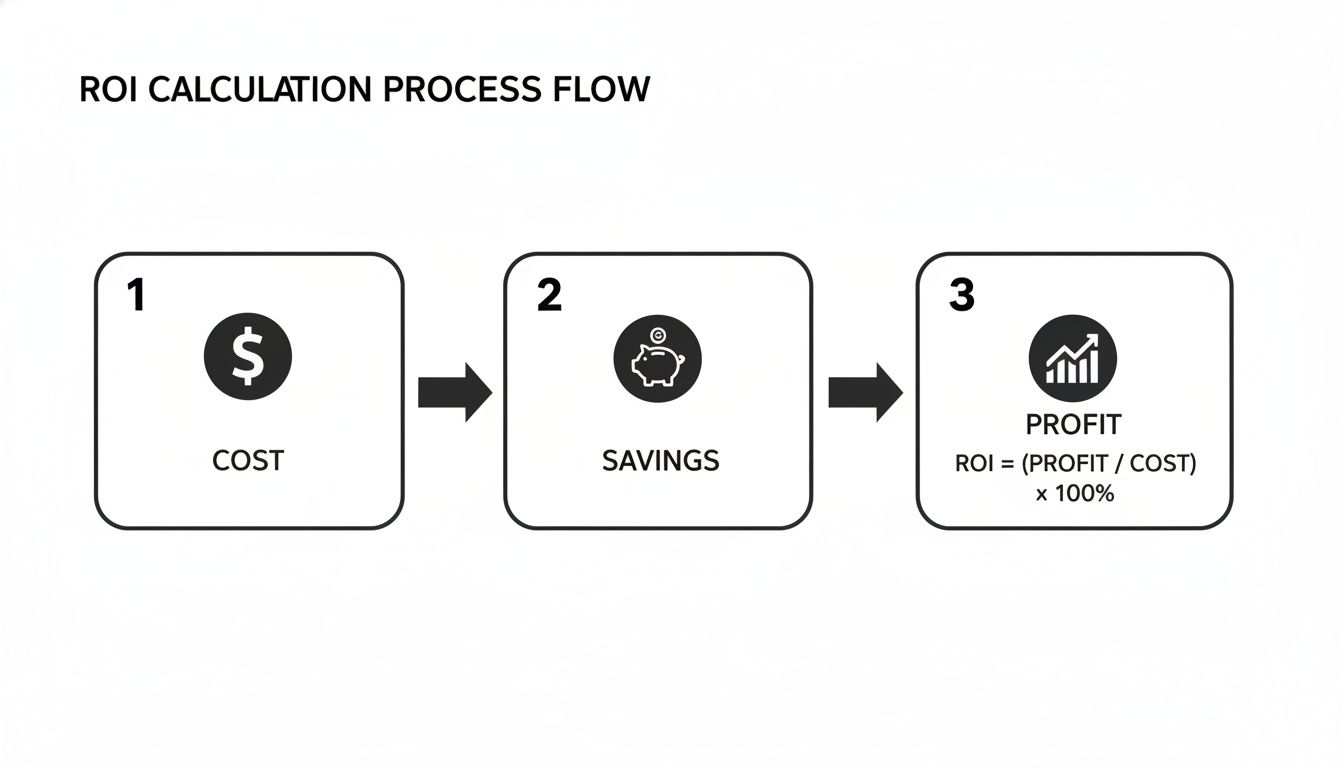
A successful migration isn't an expense; it's an investment that pays for itself by boosting your bottom line.
Final Checks and a Flawless Launch
Before I even think about going live, everything is built and tested in a private "sandbox" environment. Think of it as a complete, fully functional clone of your new Shopify Plus store that only my team and you can see.
We test every link, every automation, and every single step of the checkout process. We run test orders, check app functionality, and make sure the customer experience is absolutely perfect from start to finish.
Only when I am 100% confident that the new site is flawless do we schedule the launch. By following this detailed blueprint, we turn what could be a stressful event into a smooth, controlled, and exciting step forward for your business.
Shopify Plus vs Other Enterprise Platforms
When you start scaling up, Shopify Plus isn’t the only name that gets thrown around. The enterprise eCommerce space has some big players, and you’ll definitely hear about BigCommerce Enterprise, Magento (now Adobe Commerce), and even Salesforce Commerce Cloud. Having been in the trenches with these platforms, I can give you a practical, no-fluff comparison from an agency perspective.
Deciding on the right platform isn't about picking the one with the longest feature list. It’s about looking at what actually matters to a business owner: total cost of ownership, how fast you can get to market, how easy it is for your team to use, and whether it can genuinely scale with you.
Total Cost of Ownership: A Reality Check
The sticker price of a platform is just the tip of the iceberg. What you really need to get your head around is the total cost of ownership (TCO). This includes all the sneaky, hidden fees for development, maintenance, hosting, and security that some platforms almost demand.
- Shopify Plus: This is all about predictable, transparent pricing. The monthly fee covers your hosting, security, and a powerhouse set of core features, so you’re hit with far fewer surprise costs down the track.
- Magento (Adobe Commerce): It can be incredibly powerful, but it often comes with a much, much higher TCO. You're on the hook for your own hosting, security patches, and a mountain of custom development work. This can easily run into tens or even hundreds of thousands of dollars every year.
- Salesforce Commerce Cloud: This is typically aimed at the biggest global brands, and its price tag reflects that. Licensing fees are often a percentage of your revenue, and getting it implemented is a complex, long, and expensive project.
For most high-growth businesses, Shopify Plus hits that perfect sweet spot, delivering serious power without the outrageous and unpredictable overheads of its rivals. As a Shopify development partner, I’ve seen so many clients migrate from Magento just to escape the constant financial drain of maintenance.
Speed to Market and Agility
In eCommerce, speed is your competitive edge. How fast can you test a new idea or launch a new product? This is where the difference between platforms becomes crystal clear.
I’ve seen businesses burn over a year and six figures just trying to get a basic Magento site off the ground. With Shopify Plus, we can have a sophisticated, custom store launched in a matter of months, sometimes even weeks.
This agility isn’t just about the initial launch, either. On Shopify Plus, your marketing team can run promotions, update landing pages, and even build simple automations with Shopify Flow, all by themselves. On a platform like Magento, even a tiny change like adding a new banner often means logging a developer ticket and waiting. It’s a bottleneck that just kills momentum.
Ease of Use for Your Team
The best platform in the world is useless if your team can’t stand using it. Shopify’s admin dashboard is famous for being intuitive, which means less training and more empowerment for your marketing, sales, and customer service staff. They can manage products, pull reports, and handle orders without needing a degree in computer science.
This empowerment is a huge reason why I, as the head of an eCommerce marketing agency, recommend Shopify Plus so often. It frees your team up to be proactive and respond to market trends, instead of being held hostage by development cycles. The platform's user-friendly design isn't an accident; it's a deliberate choice that puts business agility first.
Enterprise Platform Feature Showdown
Alright, let's get into a direct head-to-head. I've put together a simple table to show how these platforms really stack up on the features that matter most when you're growing.
| Feature | Shopify Plus | Magento (Adobe Commerce) | BigCommerce Enterprise |
|---|---|---|---|
| Ease of Use | Excellent; intuitive for non-technical users. | Poor; requires significant technical expertise. | Good; user-friendly but more complex than Shopify. |
| Total Cost | Predictable monthly fee plus transaction fees. | High & unpredictable; includes licensing, hosting, and hefty developer costs. | Moderate; similar to Shopify Plus, with pricing based on order volume. |
| Launch Speed | Fast; can launch in weeks to a few months. | Slow; often takes 6-12+ months for complex builds. | Moderate; faster than Magento, often similar to Shopify. |
| Maintenance | Included; hosting and security are managed by Shopify. | Self-managed; requires constant security patches and developer oversight. | Included; a fully hosted solution, similar to Shopify. |
| Scalability | Excellent; proven for high-volume sales and huge traffic spikes. | Highly scalable, but demands expert (and expensive) management. | Good scalability for most growing brands. |
| Customisation | Extensive via a massive app ecosystem, themes, and APIs. | Nearly limitless, but extremely complex and costly to implement. | Strong API access for "headless" and custom builds. |
For the vast majority of high-growth eCommerce brands, Shopify Plus simply offers an incredible balance of power, agility, and predictable cost. It empowers your team to move fast, gives you rock-solid reliability, and scales with you—all without the technical headaches and runaway expenses that can absolutely plague other enterprise solutions.
Why Partner with a Shopify Plus Agency
Getting your business onto Shopify Plus is a fantastic first step. But honestly, that’s just getting to the starting line. Unlocking its full potential to actually drive revenue is another game entirely, and this is where partnering with a specialist digital marketing agency in Melbourne like mine becomes your biggest competitive advantage.
As an eCommerce marketing agency, we don't just build websites; we build growth engines. A Shopify Plus licence gives you a high-performance engine, but you still need an expert team to tune it, fuel it, and drive it to win the race. My job is to make sure your investment in the platform pays for itself many times over.
Beyond the Launch: A Strategic Growth Partnership
Handing over the keys to a new Shopify Plus store isn’t the end of our relationship—it’s the beginning. A beautiful website is useless if it’s not constantly being optimised for more conversions and more revenue. That’s where my real work starts.
I become your strategic growth partner. This means creating a powerful, post-launch conversion rate optimisation (CRO) strategy. My team and I dive deep into user behaviour, identify drop-off points in your sales funnel, and then systematically use A/B testing to improve every element, from product page layouts to checkout button colours.
I don't believe in guesswork. I believe in data. A dedicated agency partner moves you from a 'set and forget' mentality to a cycle of continuous, data-driven improvement that relentlessly pushes your revenue upward.
Hyper-Targeted Ads That Leverage Plus Data
One of the most powerful aspects of Shopify Plus is the rich, first-party customer data it collects. As a Google Ads agency and Facebook ads agency, this data is gold. We don’t just run generic ad campaigns; we build hyper-targeted campaigns that speak directly to your most valuable customer segments.
Our process includes:
- Advanced Analytics: I personally oversee the setup of a robust tracking foundation using Google Tag Manager (GTM) and the Meta Conversions API. This ensures we’re capturing every critical user action with pinpoint accuracy.
- High-Value Audience Building: We sync your Shopify Plus customer data to create powerful lookalike audiences and retargeting lists on platforms like Facebook and Google. This allows us to target ads to people who look and act just like your best customers.
- Profit-Focused Optimisation: We go beyond just tracking leads. Our campaigns are optimised for real business goals, like Return On Ad Spend (ROAS) and Customer Lifetime Value (LTV), ensuring your ad budget works as hard as possible.
Solving Unique Problems with Custom Solutions
Sometimes, an off-the-shelf app just won’t cut it. Your eCommerce business might have a unique shipping rule, a complex product bundling need, or a specific B2B ordering requirement. This is where my expertise as a Shopify developer comes in.
We build custom Shopify apps and functions using the Shopify API to solve your specific business problems. By understanding both the technical capabilities and your commercial goals, we create tailored solutions that streamline operations and open up new revenue streams. We are your partner in making the platform work for your business, not the other way around.
If you're a business with a paid ads budget of at least $3k a month, I'd love to offer you a low-risk deal—get a month of paid ads management FREE. Apply now through my contact page.
Common Questions We Get About Shopify Plus
Over the years, I've had countless chats with Australian business owners wondering if it's time to make the leap to Shopify Plus. A few questions always come up, so I wanted to tackle them head-on, using my direct, real-world experience to cut through the noise.
As the head of a marketing agency in Melbourne, I spend a lot of my time demystifying this platform. Let's get straight to the questions I hear most.
What's the Revenue Tipping Point for Shopify Plus?
There's no magic number written in stone, but from what I've seen on the ground, the math starts to make undeniable sense when a business hits or surpasses $1 million AUD in annual sales. At that point, the money you save on transaction fees alone, combined with the power of the new automation tools, usually more than covers the monthly platform cost.
But revenue isn't the whole story. I've seen ambitious, high-growth eCommerce brands with investor backing or complex needs—like B2B and multi-region sales—jump on board much sooner. The real question you should be asking is: are the limitations of your current plan costing you more in lost opportunities than the upgrade would?
Can I Just Keep My Current Shopify Theme?
Yes, you absolutely can. Every theme in the Shopify Theme Store works perfectly with Shopify Plus, so you aren't forced to change a thing.
However, I see the upgrade as the perfect excuse to seriously level up your site's experience. Most of my clients work with our Shopify development team to either build a custom theme from scratch or give their existing one a major overhaul. This is how you actually unlock the full value of Plus-exclusive features like checkout customisation and performance boosts that directly pump up your conversion rates.
How Does Shopify Plus Actually Handle International Sales?
Shopify Plus is built from the ground up for global ambition. It gives you up to nine 'expansion stores' that you can manage from a single dashboard, which is an absolute beast of a feature for any Australian brand looking to go global.
This means you can spin up localised storefronts with different languages, currencies, and even unique product catalogues for each country you're targeting. For Aussie businesses trying to crack the US, UK, or Asian markets, this feature is a total game-changer. It takes what used to be a logistical and technical nightmare and makes it manageable, letting you serve up a tailored experience for every market.
From Experience: I've had clients use these expansion stores to test out market-specific pricing and product bundles, gathering priceless data before committing to a full-blown regional launch. It’s a powerful, low-risk way to test the waters and grow strategically.
What Kind of Support Do You Actually Get?
The support model is one of the biggest step-ups from the standard Shopify plans. Forget just having access to a 24/7 helpdesk; with Plus, you get dedicated experts who become an extension of your own team.
Here’s how the specialised support breaks down:
- Dedicated Launch Engineer: Think of this person as your technical project manager during the entire setup and migration. They are an invaluable guide for making sure the whole transition goes off without a hitch.
- Merchant Success Manager: After you're live, you're assigned a Merchant Success Manager. This person is your strategic partner inside Shopify. They give you ongoing advice, get you into beta programs, and help you squeeze every last drop of value out of the platform to hit your specific business goals.
This level of hands-on support means you don’t just get launched on the platform; you’re actively coached on how to use it to its full potential to drive real, measurable growth.
My Final Thoughts and Your Next Step
Making the decision to upgrade to Shopify Plus is a major milestone for any eCommerce business. It’s a sign that you've outgrown the basics and are ready for enterprise-level tools. But the platform itself is only half the equation.
From my personal experience running a digital marketing agency in Melbourne, the brands that see the biggest success are the ones who combine the power of Shopify Plus with a strategic partner who knows how to use it. It’s about leveraging the automation, customisation, and data to build a smarter, more profitable business.
The real value isn't in the features list; it's in what you do with them. It’s in using Shopify Flow to automate your operations so your team can focus on growth. It’s in using Shopify Scripts to customise your checkout and boost your average order value. And it’s in using your rich customer data to run hyper-targeted ad campaigns that deliver an incredible return on ad spend.
If you’re feeling the limitations of your current platform and know you’re ready to scale, then Shopify Plus is almost certainly worth it. But don't just upgrade your platform—upgrade your strategy.
Bonus Section: Expanding Your Digital Toolkit
While this article focuses on Shopify Plus for eCommerce businesses, I know that a successful digital presence often involves a much wider toolkit. As a full-service marketing agency, here are some other key areas I help clients with that can supercharge their growth.
WordPress Development and Design
For content-heavy sites, blogs, or corporate websites, WordPress is still king. I've been a WordPress developer for years and my team has extensive experience in both WordPress design and WordPress development. We often build hybrid solutions, where a stunning WordPress site for content and branding links to a powerful Shopify store for commerce. My team of WordPress developers in Melbourne are experts at building custom blocks in Gutenberg, creating bespoke themes, and ensuring your site is fast, secure, and SEO-friendly.
Mastering Paid Advertising: From Google to Meta
Driving traffic is non-negotiable. As a Facebook Meta ads agency and Google Ads specialist, I live and breathe paid media. My process involves:
- Mastering Facebook Ads: I don’t believe in quitting too early. Success comes from a rigorous Meta ads creative testing process and understanding how to measure success beyond just clicks.
- Google Ads for eCommerce: I've written the beginners guide to Google Shopping Ads and have deep expertise in everything from PMAX vs Google Shopping Ads to fixing campaigns that are not spending their budget. I also have specific strategies for Google Shopping ads for dropshipping.
- PPC for Tradies & Service Businesses: Beyond eCommerce, I run campaigns for service businesses like plumbers and electricians, focusing on call campaigns and contact form submissions. I always recommend using the best call tracking softwares for PPC call campaigns (like CallRail or Go High Level) to prove ROI.
- Budgeting: A common question I get is "What budget to spend on Google Ads?" or "How much does it cost to start Google Ads?". The answer depends on your goals, but consistency is key to marketing your business.
The Power of SEO and Local Presence
Organic traffic is the gift that keeps on giving. My approach to Local SEO starts with optimising your Google My Business profile. As an seo agency in Melbourne, I focus on building high-quality backlinks from Australian websites to boost your authority and rankings for critical keywords.
Advanced Technical Setups and Custom Development
This is where my team really shines. We offer:
- Conversions API installation for Meta: Essential for accurate tracking in a post-cookie world.
- Setting up Google Tag Manager containers: We ensure your analytics foundation is rock-solid.
- Building custom Shopify apps using Shopify CLI: For when an off-the-shelf solution just won't do. I've even created a Shopify development crash course for teams who want to build their skills in-house.
Alpha Omega Digital is a marketing agency based in Melbourne, Australia, but we also service clients from Sydney, Brisbane, Newcastle, Perth, Adelaide, Darwin and Hobart. Have a project in mind? Contact us.
If you're a business with a paid ads budget of at least $3k a month, I'd love to offer you a low-risk deal—get a month of paid ads management FREE. Apply now through the contact page.