As the owner of a marketing agency in Melbourne, I've seen countless eCommerce businesses grapple with social media. It's often seen as this mysterious beast, a place for nice photos and maybe, just maybe, a few sales. But from my real-world experience, effective social media marketing services are about something much more powerful: building a predictable, scalable system that turns casual scrollers into loyal customers. It's not magic; it's a methodical process combining smart tech, creative strategy, and consistent effort.
For an eCommerce brand, whether you're on Shopify or WordPress, social media isn't just a branding tool—it's a direct sales channel. Think of it as the engine of your online store. You need all the parts working in perfect harmony, from the creative that grabs someone's attention to the technical backend that tracks every single click and conversion. This guide is my attempt to pull back the curtain and show you how we, as a digital marketing agency in Melbourne, build these engines for our clients.
Table of Contents
- What Social Media Marketing Services Actually Involve
- The Technical Engine Driving Your Ad Campaigns
- How We Build Ad Campaigns That Actually Convert
- Budgeting For Ads and Measuring Real Success
- Leveraging AI for Customer Service and Lead Generation
- Choosing the Right Marketing Agency in Melbourne
- Your Social Media Marketing Questions Answered
What Social Media Marketing Services Actually Involve
For an eCommerce brand, social media marketing isn't just about getting your name out there; it's a direct line to revenue. Think of it as a well-oiled machine combining creative storytelling with sharp, data-driven execution to turn followers into loyal customers. As a marketing agency in Melbourne, we've seen firsthand how this can transform a local Shopify or WordPress store into a national success story.
It’s like building a high-performance engine for your business. You need all the right parts working together, from the content that grabs attention to the technical setup that ensures every click is tracked and optimised.
The Core Components of an eCommerce Strategy
A comprehensive social media service is built on several key pillars. Each one plays a distinct role in attracting, engaging, and converting your target audience. We don't just focus on one area; we integrate them all to create a seamless journey for your customers.
- Strategic Content Planning: This is the foundation. It involves pinning down your brand's voice, figuring out what content formats your audience loves (like video, carousels, or user-generated content), and creating a calendar that guarantees consistent, high-quality posts.
- Community Management: This is where you build real relationships. It means actively engaging with comments, messages, and mentions to foster a loyal following that feels genuinely connected to your brand.
- Paid Advertising Campaigns: This is your growth accelerator. We design and manage targeted ad campaigns on platforms like Facebook and Instagram to reach brand new customers, bring back interested shoppers, and drive sales.
- Technical Integration & Tracking: This is the non-negotiable backend work. It includes setting up essential tools like the Meta Conversions API and Google Tag Manager to accurately measure results and squeeze the maximum return from your ad spend.
To give you a clearer picture, here’s a breakdown of how these pieces fit together to support an online store.
Key Components of eCommerce Social Media Services
This table outlines the essential services a marketing agency provides to help eCommerce businesses grow on social media.
| Service Component | What It Achieves For Your Business | Key Platforms |
|---|---|---|
| Strategy & Content | Builds brand identity and engages your ideal audience consistently. | Instagram, Facebook, TikTok, Pinterest |
| Community Management | Creates a loyal following and turns customers into brand advocates. | Instagram, Facebook, X (Twitter) |
| Paid Advertising | Drives targeted traffic, retargets warm leads, and generates sales. | Facebook Ads, Instagram Ads, TikTok Ads |
| Analytics & Tracking | Measures what's working and ensures every dollar is spent effectively. | Meta Business Suite, Google Analytics |
Each of these components is crucial. Without a solid content strategy, your ads won't resonate. Without proper tracking, you're just guessing where your sales are coming from.
From Content Creation to Conversion
The real magic happens when these components work in harmony. For instance, a great organic post can be amplified through a targeted ad campaign. The data from that campaign, captured perfectly via the Conversions API, then tells us what to do next with our content strategy. It's a continuous loop: create, measure, refine.
For an eCommerce business, every social media action must have a purpose. Whether it's a beautifully designed Instagram post or a meticulously targeted Facebook ad, the end goal is always to move a potential customer closer to making a purchase. It's about turning engagement into a measurable commercial outcome.
Ultimately, professional social media marketing services create a predictable system for growth. It moves you from randomly posting and hoping for sales to strategically investing in activities that deliver a clear return. To really get a handle on what’s possible, exploring modern social media advertising strategies can open your eyes to the opportunities. This is how we take the guesswork out of social media and turn it into one of your most powerful sales channels.
The Technical Engine Driving Your Ad Campaigns
Let's pull back the curtain on the technical side, because this is where a professional agency really proves its worth. When you see a successful social media ad campaign, you’re only seeing the final product. Behind that slick creative is a complex technical engine making sure every dollar is tracked, every action is measured, and every decision is backed by solid data.
From my experience, this technical foundation is the single biggest difference between running ads that feel like they're working and running ads that you know are profitable. It's the plumbing that makes the entire system work, and getting it right is non-negotiable for any serious eCommerce brand.
Mastering Data with Google Tag Manager
One of the first things we set up for any new client is a Google Tag Manager (GTM) container. Think of GTM as a digital toolbox for your website. Instead of asking a developer to add little snippets of code (or "tags") for things like the Meta Pixel or Google Analytics every time, we can manage everything from one central dashboard.
This is a complete game-changer. It means we can quickly add, edit, or remove tracking tags without ever touching your website’s core code, which saves a huge amount of time and lowers the risk of breaking something. For a fast-moving eCommerce business, this agility is essential for launching and testing campaigns on the fly. We've mastered setting up GTM containers to ensure every piece of data is captured accurately.
The map below shows how we approach this, moving from initial strategy to ad deployment and, critically, the tracking systems that power it all.
As you can see, tracking isn't an afterthought; it’s a core component that informs and refines both your strategy and your ad creative.
Why the Meta Conversions API is a Must-Have
For years, the Meta Pixel (formerly Facebook Pixel) was the gold standard for tracking ad performance. But with increased privacy measures like Apple's iOS 14 update, its accuracy has taken a serious hit. This is where the Meta Conversions API (CAPI) comes in.
The Conversions API creates a direct, server-to-server connection between your website and Meta. This bypasses browser-based tracking limitations, giving Facebook and Instagram a much more reliable and complete picture of who is converting from your ads.
Setting up CAPI is a technical process, but our team specializes in Conversions API installation for Meta. This ensures your ad campaigns receive the high-quality data they need to optimise properly. Without it, you’re basically flying blind, and the ad platform can’t accurately find more people who are likely to buy your products.
Custom Solutions for WordPress and Shopify
For the eCommerce businesses we partner with, a standard setup is often just the starting point. We frequently build custom solutions to give our clients a competitive edge. This is where having a team of expert developers makes all the difference.
- For Shopify Stores: We often use the Shopify API to build custom integrations. This could be anything from syncing inventory with a third-party warehouse to creating a unique customer loyalty program. Our expertise as Shopify development partners allows us to push the platform way beyond its native capabilities. We've even built custom Shopify apps from the ground up using the Shopify CLI for clients with unique needs. A skilled shopify developer is an invaluable asset.
- For WordPress Sites: Many of our clients use WooCommerce on WordPress. As a top-tier wordpress development company, we specialize in WordPress development, which includes creating custom Gutenberg blocks. This lets us design completely unique, on-brand content layouts for product pages or blog posts that simply aren't possible with standard themes and page builders. A dedicated wordpress web developer can unlock this next level of customisation. Whether you need a WordPress developer in Melbourne or Sydney, our team of wordpress developers has you covered.
This deep technical work—from setting up bulletproof tracking with CAPI and GTM to building bespoke features for Shopify and WordPress—is what elevates a social media marketing service from just "running ads" to building a true, data-driven growth machine for your business.
How We Build Ad Campaigns That Actually Convert
Running a successful ad campaign is both an art and a science. It's not enough to have a great product; you need a methodical process to get that product in front of the right people at the right time. From my experience as a marketing agency in Melbourne, I can tell you that guesswork is the fastest way to burn through your budget. Instead, we rely on a battle-tested process that blends creative exploration with cold, hard data.
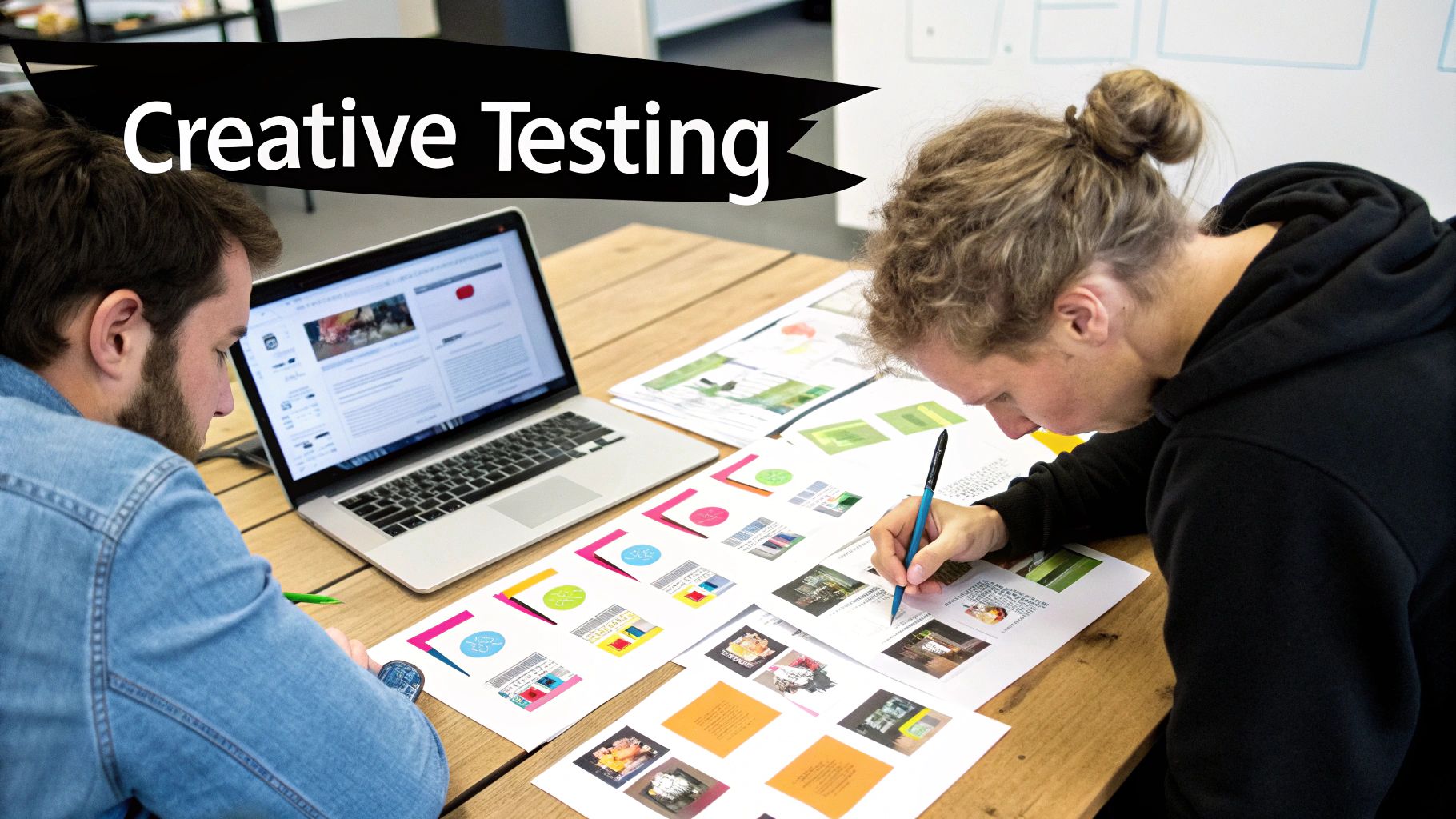
This all starts with a robust testing framework, especially for platforms like Meta (Facebook and Instagram). We don't just create one ad and cross our fingers. We develop multiple concepts—each with different visuals, headlines, and copy—to find out what truly connects with your audience. This is how we uncover the winning combinations that actually drive sales.
Our Meta Ads Creative Testing Process
Our approach to creative testing is systematic, not random. We isolate variables to understand exactly what’s driving performance. Is it the image? That specific turn of phrase? The call-to-action button? We find out. Our guide to mastering Facebook ads is built on this very principle.
Here’s a look at how it typically plays out:
- Concept Development: We start by brainstorming several unique angles. One ad might focus on the product's features, another on a glowing customer testimonial, and a third on a lifestyle benefit.
- Asset Creation: For each concept, we create a variety of assets. This could mean static images, short video clips, carousel ads, and several versions of ad copy.
- Audience Segmentation: We then test these creative variations across different audience segments—like a cold audience of new prospects versus a warm audience of past website visitors. They won't respond to the same message.
- Launch and Learn: We launch the tests with a controlled budget and watch early performance indicators like click-through rate (CTR) and cost per click (CPC) like a hawk.
- Iterate and Scale: Once we identify a winning ad, we pour more budget into it and pause the underperformers. The insights from that test then become the foundation for our next round of creative ideas.
This methodical testing is crucial because what works today might be stale tomorrow. Continuous testing keeps your campaigns fresh and effective, making sure your ad spend is always working for you.
Mastering Google Shopping Ads for eCommerce
For any eCommerce store, Google Shopping Ads are an absolute powerhouse. These visual ads pop up right at the top of the search results, catching high-intent buyers at the exact moment they’re looking to make a purchase. They are simply non-negotiable for online retail success.
Setting them up correctly, especially for models like dropshipping, requires a specific, careful approach. We have a beginner's guide to Google Shopping ads that we use to train our team, ensuring product feeds are perfectly optimised, with high-quality images, keyword-rich titles, and accurate pricing. It's this attention to detail that separates a profitable Google Shopping campaign from a money pit.
I've seen firsthand that a well-optimised Google Shopping feed can dramatically lower your customer acquisition cost. It ensures your products show up for the most relevant searches, connecting you with shoppers who are ready to buy now.
The importance of this channel is clear when you look at the Australian market. With 95% of retail and e-commerce businesses using social platforms for sales, standing out requires a multi-channel approach where search and social work hand-in-hand. This massive adoption is fuelled by the 20.9 million social media users in Australia, making a strong presence across all key touchpoints essential for growth. You can uncover more insights into Australian social media usage and see why this integrated approach is so vital.
PMax vs Google Shopping: Which Is Better?
A common question we get is about campaign types, specifically comparing traditional Shopping campaigns against the newer Performance Max (PMax) campaigns. The PMax vs Google Shopping ads debate is a hot one.
- Standard Google Shopping: This campaign type gives you granular control. You can set specific bids for individual products or product groups and have more direct say over where your ads appear. Understanding campaign priority in Google Ads is key here. It's excellent for businesses that want to manage their campaigns with a fine-toothed comb.
- Performance Max (PMax): This is Google’s automated, goal-based campaign type. It uses machine learning to run ads across Google's entire inventory—including Search, Display, YouTube, and Shopping. PMax requires you to trust the algorithm, but it can often uncover conversion opportunities you might have missed on your own.
For many eCommerce businesses, a combination of both works best. We might use a standard Shopping campaign for core, high-margin products where we want tight control, while deploying a PMax campaign to drive broader reach and find new customers. As a digital marketing agency in Melbourne, we tailor the strategy to your specific business goals, making sure your ad spend is always working as hard as possible to generate profitable revenue.
Budgeting For Ads and Measuring Real Success
Two of the biggest questions I get are, "How much should I spend?" and "How do I know if any of this is actually working?" These are the right questions to ask, and getting the answers right is what separates a profitable marketing effort from a costly one. Let's tackle them head-on.
This is a serious investment for businesses these days. In 2024, Australian brands poured a staggering $4.26 billion into social media advertising alone—a huge 12.1% jump from the previous year. This tells you just how vital paid ads are, but it also means making every dollar count is more important than ever.
What Budget Should You Start With on Google Ads
Let's clear up the mystery around how much it costs to start Google Ads. For a new eCommerce business, I almost always recommend a minimum daily budget of around $30 to $50. This works out to be about $900 to $1,500 a month.
Why that specific number? It’s enough to buy meaningful data. With that budget, Google's algorithm has enough runway to test different keywords and audiences, helping us figure out what drives clicks and, more importantly, actual sales. If you start with too little, say $5 a day, your campaigns often get stuck in the "learning phase" and never get enough traction to give you clear answers.
Realistic Facebook and Instagram Ad Budgets
The logic is pretty similar for Meta Ads (Facebook and Instagram). A starting budget of $30 per day is a solid baseline for an eCommerce store. It gives us enough breathing room to test different ad creatives and audience segments without spreading the budget too thin.
One of the biggest mistakes I see businesses make is pulling the plug on their Facebook ads way too early. The first week or two is all about collecting data. Your initial results might not look amazing, but that data is gold. It tells us what doesn't work so we can quickly pivot and double down on what does. My advice is: don't quit too early. Marketing your business is all about consistency.
Patience is your biggest asset in paid advertising. The goal of the first month isn't necessarily massive profit; it's to find a profitable formula that you can then scale with confidence in the following months. Don't quit before you find it.
The KPIs That Actually Matter For eCommerce
Likes and comments are nice for the ego, but they don't pay the bills. When we run campaigns, we’re obsessed with the metrics that directly reflect business health. Knowing how to measure success with Facebook ads is crucial.
- Return On Ad Spend (ROAS): This is the holy grail. For every dollar you put into ads, how many dollars in revenue do you get back? A 4:1 ROAS means for every $1 spent, you generated $4 in sales. Simple.
- Customer Acquisition Cost (CAC): How much does it cost, on average, to get a new customer through your ads? Knowing your CAC is critical for understanding your real profitability.
- Conversion Rate (CVR): What percentage of people who click your ad end up buying something? This helps us judge how well our ads and landing pages are working together.
Ultimately, any ad spend is just a guess until you can confidently calculate marketing ROI. That's when it stops being an expense and becomes a strategic investment.
Troubleshooting Common Ad Spend Issues
Sometimes, things don't go to plan. Here are two of the most frequent frustrations we help clients solve:
- Google Shopping Ads Not Spending Budget: This is a classic headache. It's almost always an issue with the product feed, bidding strategy, or audience targeting. We start by auditing the Merchant Center for errors, making sure product titles are optimised, and checking that the bid strategy isn't too restrictive.
- Facebook Ads Losing Momentum: Ever had a campaign start strong and then just… fizzle out? That’s usually ad fatigue. Your audience has seen the same creative too many times and started ignoring it. This is exactly why our creative process is continuous; we're always feeding fresh ads into the machine to keep performance high.
By setting realistic budgets, tracking the right numbers, and knowing how to troubleshoot, you can turn social media marketing services from a line item into a powerful engine for growth.
Leveraging AI for Customer Service and Lead Generation
In the last few years, one of the biggest game-changers for our clients—especially service-based businesses like tradies, hairdressers, and dentists—has been the rise of AI. While this article focuses on eCommerce, many of our clients are tradies or run service businesses, and the principles of digital marketing are universal. A powerful tool we've implemented is the ai-voice-agent. This isn't just a chatbot; it's a fully integrated part of your customer service and sales process.
Introducing the AI Voice Agent: Your 24/7 Receptionist
Imagine never missing a customer call again. That's the power of an ai receptionist. We set up a custom phone number for your business through Twilio, which is then managed by an AI. This AI is trained on your business's information—your services, pricing, and availability.
Here's what it can do:
- 24/7 Call Answering: The ai-voice-agents we deploy never get sick, never take a holiday, and are always ready to answer a customer's call, day or night.
- Appointment Booking: The AI can directly access your calendar or Calendly and book appointments for new clients, confirming the time and sending them a notification. For a busy hairdresser or dentist, this is revolutionary.
- Saves Thousands in Lost Business: Every missed call is a potential lost customer. For tradies on a job site or beauty therapists with a client, the AI ensures every lead is captured and every query is answered.
The ai receptionist australia market is growing rapidly because business owners are realising how much time and money this technology can save them. You can learn more about ai voice agent pricing and see how affordable it is to have a perfect employee on your team.
How an AI Appointment Setter Transforms Your Business
Beyond just answering calls, these systems act as powerful ai appointment setters. Think about the time your team spends on the phone just scheduling and rescheduling appointments. An ai appointment setter handles all of that, freeing up your human staff to focus on delivering high-quality service to the customers in front of them.
This technology is a perfect complement to Google Ads for service-based businesses. We run PPC campaigns for tradies that drive calls, and instead of those calls going to a voicemail, they're handled instantly by the AI. We can even use call tracking software like CallRail to see which keywords are driving the most valuable appointments. It creates a seamless, highly efficient system from the initial ad click to the final booked job.
The Technology Behind AI Receptionists
Setting this up involves a few key components. First, we secure a custom phone number through a service like Twilio. Then, we build the AI's "brain," feeding it information about your business and scripting its responses to common questions. We integrate it with your booking calendar (like Google Calendar or Calendly) so it has real-time access to your availability. The result is a smooth, human-like conversational experience for your customers. They get their questions answered and their appointment booked without ever having to wait on hold. For businesses like restaurants, dentists, or doctors, this level of instant service is a massive competitive advantage.
Choosing the Right Marketing Agency in Melbourne
Finding the right partner to manage your social media is easily one of the biggest decisions you’ll make for your eCommerce brand. With so many agencies out there, it can feel pretty overwhelming trying to pick the best digital marketing team in Melbourne. From my experience, the right choice goes way beyond a slick sales pitch; it's about finding a team with proven, platform-specific expertise and a genuine feel for the local market. As a top seo agency melbourne, we know what it takes.
Look for Platform-Specific Expertise
The first thing I always tell business owners is to hunt for an agency that lives and breathes your platform. If you're running a Shopify store, you absolutely need a partner with deep Shopify design and development experience. If you’re on WordPress, you need a team that understands advanced WordPress design and development inside and out.
Why is this so critical? A generalist agency might know how to run ads, but they won't get the specific technical quirks of your setup. They won't know how to use the Shopify API for a clever custom solution or how to fix a complex integration that’s gone wrong. A specialised team, like a dedicated WordPress developer in Melbourne or Sydney, brings a level of technical skill that has a direct impact on your campaign performance and website functionality.
Insist on Seeing Real Results
Any agency can put together a fancy presentation. The real test? Whether they can show you real, verifiable results. Don't be shy about asking for case studies and specific examples of their work with businesses similar to yours.
Here’s a quick checklist of what to ask for:
- Case Studies: Ask for detailed breakdowns of past campaigns. What was the challenge, what was their strategy, and what were the measurable outcomes?
- Client References: A great agency will be happy to connect you with current or past clients. Don't be afraid to actually call them.
- Performance Dashboards: Ask to see examples of their reporting. It should be clear, transparent, and focused on the KPIs that actually matter, like ROAS and CAC.
Vague promises are a massive red flag. If an agency can't provide concrete proof of their past successes, it's a good sign they probably can't deliver them for you. Always prioritise evidence over eloquence.
The Value of Local Melbourne Knowledge
Partnering with a local marketing agency in Melbourne offers more than just the convenience of being in the same time zone. A local team understands the Australian market—the consumer behaviour, the seasonal trends, and the competitive landscape. That kind of insight is invaluable for crafting campaigns that actually connect with people, especially when it comes to local SEO and optimising your Google My Business profile.
This local understanding is more important than ever. Social media has become a primary channel for brand discovery in Australia, with over 58% of Aussies now using these platforms for product research before they buy. This shift puts social media right up there with traditional search engines, showing just how vital a targeted, culturally aware strategy is. Australians spend an average of 1 hour and 51 minutes on social platforms daily, making it a critical touchpoint. You can read more about this trend in Australian digital behaviour to see why local expertise matters so much.
Choosing the right partner means finding a team that blends technical skill, a proven track record, and a deep understanding of your market. Taking the time to properly vet agencies is an investment that will pay off big time for your business's growth.
Alpha Omega Digital is a marketing agency based in Melbourne, Australia but also services clients from Sydney, Brisbane, Newcastle, Perth, Adelaide, Darwin and Hobart. Have a project in mind? Contact us.
Your Social Media Marketing Questions Answered
Over the years, I've had countless chats with eCommerce owners about social media marketing. It’s a big investment, so it’s only natural that the same questions come up time and again. You’re putting your hard-earned money on the line and you deserve to know what you’re getting into.
Here are some of the most common questions I get, with straight-up, honest answers based on my experience helping Aussie businesses grow.
How Long Until I See Real Results?
This is the big one, and the honest-to-God answer is: it takes a bit of time. While you’ll see initial activity like traffic and clicks almost straight away, real business results—like consistent, profitable sales—don't happen overnight.
Think about it: a brand-new ad account on Meta or Google starts with a blank slate. It has to go through a "learning phase" that can last a few days or even a couple of weeks. This is where the algorithm is busy figuring out who your best customers actually are.
I always tell clients to budget for at least a three-month initial period. The first month is all about setup, gathering data, and running tests. In the second month, we take what we've learned and start optimising. By the third month, we should have a clear picture of what's working and be ready to scale it up. Patience is everything.
Which Social Media Platform Is Best for eCommerce?
For the vast majority of eCommerce businesses I’ve worked with, the Meta ecosystem (Facebook and Instagram) is the undisputed champ. It’s just built for selling visual products. The targeting capabilities are incredibly powerful, and the shopping integrations like Instagram Shop and Facebook Shop make the buying process seamless.
But that doesn't mean it's the only game in town. The right platform always comes back to where your specific audience hangs out.
- If you sell unique, visually-driven products like custom jewellery or boutique home decor, Pinterest can be an absolute goldmine of high-intent buyers.
- If your customers are mainly Gen Z, building brand awareness on TikTok is pretty much non-negotiable these days.
A smart strategy often means putting most of your focus on Meta while carving out a smaller test budget for a secondary platform that perfectly matches your customer demographic.
Can I Do Social Media Marketing Myself?
You absolutely can. But the real question you should be asking is whether you should. Managing social media marketing effectively is a full-time job that demands a surprisingly diverse set of skills: copywriting, graphic design, video editing, data analysis, and the technical know-how to set up things like the Conversions API.
As a business owner, your time is your most valuable asset. Sure, you might save on agency fees by DIY-ing it, but you could easily lose far more in wasted ad spend from unoptimised campaigns or lost hours you could have spent on product development or customer service.
An agency brings a team of specialists, access to expensive analytics tools, and years of hands-on experience to the table. That combination just accelerates your growth and—crucially—lets you get back to focusing on what you do best: running your business.
Are Paid Ads or Organic Content More Important?
This is a classic question, and the answer is that they're two sides of the same coin. They work best when they work together. Relying on just one will seriously stunt your growth.
Think of it like this:
- Organic Content is your long-term relationship builder. It’s how you build your brand’s personality, create a community around your products, and establish trust with your followers.
- Paid Ads are your growth accelerator. They get your products in front of thousands of new, highly targeted customers almost instantly, driving immediate traffic and sales.
Relying only on organic content leads to painfully slow, unpredictable growth. On the flip side, relying only on paid ads can feel purely transactional and might weaken your brand's connection with its audience. The sweet spot is using compelling organic content to engage your audience, while a strong paid ad strategy scales your reach and brings in the sales. They amplify each other for the best possible results.
At Alpha Omega Digital, we build integrated social media strategies that combine powerful organic content with data-driven paid advertising. As a marketing agency based in Melbourne, Australia, we also service clients from Sydney, Brisbane, Newcastle, Perth, Adelaide, Darwin and Hobart. Have a project in mind? Contact us.